
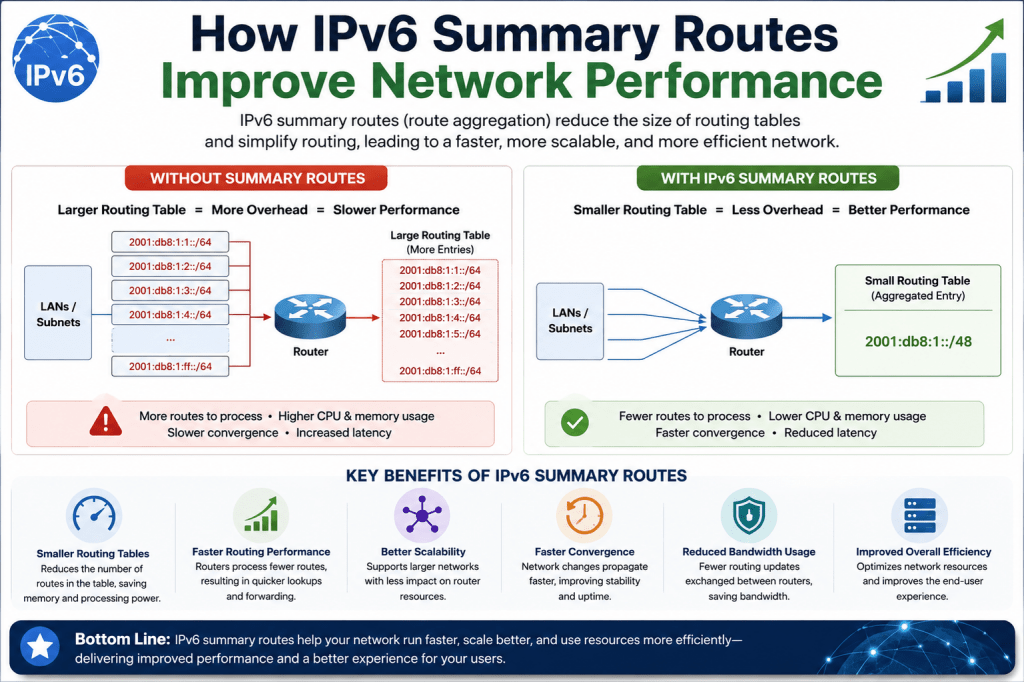
IPv6 summary routes are a method used in networking to combine multiple IPv6 network addresses into a single route advertisement. Instead of routers storing and sharing every individual network path separately, summary routes allow several related networks to be grouped together under one broader address. This process reduces the size of routing tables, improves router performance, and makes large networks easier to manage. IPv6 networks can contain an enormous number of devices and subnets, so summarization plays a major role in keeping routing efficient and scalable.
To understand IPv6 summary routes more easily, imagine searching for a specific ingredient in a very large grocery store. You ask a store employee where to find miso paste. The employee may not know the exact shelf location, but they can direct you toward the international foods aisle. Once you arrive there, signs and sections guide you further until you finally locate the item. IPv6 summary routes work in a similar way. Routers may not always know the exact path to every device on every network, but they can direct traffic toward the correct general area until more specific routers take over and guide packets to their final destination.
In modern networking environments, routers constantly exchange routing information. Every route learned by a router takes memory, processing power, and bandwidth. In small networks, storing every route individually may not create a problem. However, in enterprise environments, service provider infrastructures, and internet-scale networks, the number of routes can become massive. Without route summarization, routers would struggle to handle the growing size of routing tables efficiently. IPv6 summary routes solve this issue by reducing the number of entries routers must maintain.
Understanding the Purpose of Route Summarization
Route summarization is the process of combining multiple contiguous network addresses into a single summarized route. This summarized route represents several smaller networks at once. Instead of advertising multiple individual routes, a router advertises one larger route that covers all the included subnets.
The main goal of summarization is efficiency. Routing tables become smaller, routers spend less time processing routes, and network updates consume fewer resources. As routing tables shrink, routers can forward packets more quickly because they have fewer entries to search through during route lookups.
Another major advantage is network stability. In large networks, individual subnet failures can create frequent routing updates. If routers advertise every subnet separately, a single network change may trigger updates across many devices. Summary routes help contain these updates because the summarized route can remain stable even if one subnet inside the range changes.
IPv6 was designed with enormous address space capabilities. Because IPv6 supports a huge number of networks, summarization becomes even more important than it was in IPv4 environments. Without summarization, IPv6 routing tables could become excessively large.
How Routers Use IPv6 Summary Routes
Routers forward traffic based on routing table information. When a packet arrives, the router checks the destination address and compares it to entries in its routing table. If the router finds a matching route, it forwards the packet toward the destination.
When summary routes are used, routers rely on broader route information instead of specific subnet details. The packet is forwarded toward the summarized network, and routers deeper within the network handle more detailed routing decisions.
For example, a backbone router may not know every subnet within a remote branch office. Instead, it only knows a summarized route that represents all networks in that branch. Once the packet reaches the branch router, that router has more detailed routing information and can deliver the packet correctly.
This layered approach allows routing information to remain manageable. Core routers avoid storing unnecessary details, while local routers maintain precise knowledge of their own networks.
Why IPv6 Networks Need Summary Routes
IPv6 networks are capable of supporting extremely large infrastructures. Businesses, internet service providers, cloud environments, and data centers often deploy thousands of subnets. If every subnet were advertised individually, routing tables would grow rapidly.
Large routing tables create several problems. Routers require more memory to store routes. CPU utilization increases because route calculations become more complex. Network convergence times also increase because routers must process more routing updates after topology changes.
Summary routes reduce these issues by consolidating multiple entries into one. A summarized route can represent many subnets simultaneously, allowing routers to operate more efficiently.
Consider a large organization with multiple departments, buildings, and campuses. Each department may have its own subnet. Without summarization, core routers would need individual routes for every department network. With summarization, all departmental subnets within a campus can be represented by a single summarized route.
This approach simplifies network administration and improves scalability.
The Importance of Contiguous Networks
Route summarization only works with contiguous addresses. Contiguous networks are subnets that share common binary patterns in their addresses. The summarized route represents the shared portion of those addresses.
If networks are not contiguous, they cannot be summarized cleanly. Attempting to summarize unrelated networks may create routing problems because the summary route could unintentionally include addresses that do not exist or belong elsewhere.
IPv6 addresses are written in hexadecimal format, and summarization depends heavily on binary analysis. Routers examine shared bits among addresses to determine the appropriate summary.
For example, if two IPv6 networks differ by only one bit, they may be summarized into a single route with a shorter prefix length. The summarized prefix covers both networks because the majority of their address bits are identical.
This binary relationship is the foundation of IPv6 route summarization.
Understanding IPv6 Address Structure
IPv6 addresses contain 128 bits and are typically written as eight groups of hexadecimal numbers separated by colons. Each hexadecimal digit represents four binary bits.
An example IPv6 subnet might look like this:
2001:0DB8:6783:045A::/64
Another related subnet could be:
2001:0DB8:6783:045B::/64
These two networks are nearly identical. The only difference exists in the final hexadecimal character. Since hexadecimal values represent binary data, the last digit determines the final bits that differ between the addresses.
The hexadecimal value A equals binary 1010, while B equals binary 1011. Since only one bit differs, these two networks can be summarized together.
The summarized route becomes:
2001:0DB8:6783:045A::/63
The /63 prefix means the first 63 bits are identical across both networks. This single summarized route represents both /64 networks simultaneously.
How Summary Routes Reduce Routing Table Size
Every route stored in a routing table consumes system resources. Even modern routers with powerful hardware benefit from smaller routing tables because fewer entries improve lookup performance.
Suppose a network contains hundreds of branch offices. Each branch office may contain multiple subnets for users, servers, wireless devices, printers, and management systems. Advertising every subnet individually could create thousands of routing entries.
By using summarization, branch routers advertise only broader summary routes to the core network. Instead of storing thousands of entries, core routers may only need a few hundred.
This reduction improves router efficiency in several ways:
- Less memory usage
- Faster route lookup operations
- Reduced CPU utilization
- Smaller routing updates
- Faster convergence during failures
- Simpler network troubleshooting
These benefits become extremely important in large enterprise and service provider networks.
How OSPF Uses IPv6 Summary Routes
OSPF is a link-state routing protocol commonly used in enterprise networks. OSPF for IPv6 supports route summarization to improve scalability.
OSPF organizes networks into areas. Area 0 serves as the backbone area, while additional areas connect through Area Border Routers, also called ABRs.
ABRs play a critical role in summarization because they exchange routing information between OSPF areas. An ABR can suppress detailed subnet routes and advertise summarized routes instead.
This keeps routing information between areas more efficient.
Suppose Area 45 contains two subnetworks:
2001:0DB8:6783:045A::/64
2001:0DB8:6783:045B::/64
Without summarization, routers in other areas would learn both routes individually. However, the ABR can summarize them into a single /63 route before advertising them to the backbone.
As a result, backbone routers maintain fewer entries while still reaching all destinations correctly.
Visualizing an IPv6 OSPF Environment
Imagine a network containing several OSPF areas connected together. Area 0 acts as the central backbone, while Area 45 connects through an ABR called R2.
Inside Area 45, routers R4 and R5 connect to separate subnetworks. Each subnet serves different groups of devices.
The backbone router R1 initially learns both subnet routes individually. Its routing table includes detailed entries for both /64 networks.
Although this may not seem significant with only two routes, real-world environments may contain thousands of subnets. The routing table could grow extremely large if every route were advertised separately.
When summarization is enabled on R2, the ABR advertises only the summarized /63 route toward Area 0. Router R1 then stores only one summarized route instead of two detailed entries.
This simple change demonstrates the efficiency gained through route summarization.
Viewing Routing Tables Before Summarization
Network administrators often examine routing tables before implementing summarization. This helps confirm how routes are currently being advertised.
A routing table contains information about learned networks, routing protocols, next-hop addresses, and outgoing interfaces.
Before summarization, routers display detailed subnet entries. Each subnet appears separately because no aggregation has been configured.
Administrators may filter routing output to focus on specific routes. This makes it easier to identify the networks involved in summarization.
Detailed routes consume space individually, even when they follow identical paths through the network. Summarization reduces this redundancy by replacing multiple entries with one broader route.
Binary Logic Behind IPv6 Summarization
IPv6 summarization relies heavily on binary mathematics. Routers compare binary bits across addresses to determine shared prefixes.
Each hexadecimal character equals four binary bits. When comparing networks, routers identify how many leading bits remain identical.
For example:
A = 1010
B = 1011
Only the final bit differs between these values. Therefore, the networks can share a summarized prefix covering the first 63 bits.
This binary approach allows routers to aggregate routes efficiently while maintaining accurate forwarding decisions.
Understanding binary relationships is important for designing proper summary routes. Incorrect summarization can accidentally include unintended networks or create routing black holes.
Careful planning ensures summarized routes remain accurate and efficient.
Benefits of IPv6 Route Summarization in Enterprise Networks
Enterprise networks often span multiple offices, campuses, and regions. Each location may contain numerous subnets for different departments and services.
Without summarization, routing tables can become difficult to manage. Core routers may store thousands of detailed entries from remote sites.
Summarization improves enterprise networking by simplifying route management. Regional routers advertise summarized prefixes instead of individual subnet routes.
This creates several operational advantages:
- Easier troubleshooting
- Reduced routing complexity
- Better scalability
- Improved router performance
- Lower bandwidth usage for routing updates
Large organizations depend heavily on summarization to maintain stable and efficient routing infrastructures.
How Summarization Improves Network Stability
Frequent routing changes can affect network performance. When links fail or networks become unavailable, routers exchange updates to reflect the changes.
If every subnet is advertised individually, even small topology changes can generate large amounts of routing traffic.
Summary routes reduce the impact of these changes. As long as the summarized network remains reachable overall, individual subnet failures may not require updates beyond the local area.
This containment improves network stability and prevents excessive routing recalculations across the infrastructure.
Stable routing environments are especially important in mission-critical networks where downtime and convergence delays must be minimized.
Planning IPv6 Addressing for Summarization
Effective summarization depends on structured address planning. Randomly assigned subnets make summarization difficult or impossible.
Network designers often allocate IPv6 prefixes hierarchically. Similar locations, departments, or services receive contiguous address blocks that can later be summarized easily.
For example, an organization may assign:
- One prefix per region
- One subnet range per building
- One block per department
This structured approach supports clean summarization throughout the network.
Poor address planning can lead to fragmented routing tables and inefficient network operation. Therefore, summarization should be considered during the initial network design phase rather than added later as an afterthought.
IPv6 Summary Routes and Routing Efficiency
Routing efficiency is one of the most important reasons IPv6 summary routes are used in modern networks. Routers are responsible for examining destination addresses and deciding where packets should travel next. Every routing decision depends on the information stored in routing tables. When routing tables become too large, routers must spend more time and resources processing network traffic. IPv6 summary routes reduce this burden by allowing routers to work with grouped network information instead of thousands of individual entries.
As networks grow larger, routing efficiency becomes increasingly important. A small office network may only contain a few routers and subnets, making individual route advertisements manageable. However, enterprise networks, internet service providers, and cloud infrastructures often contain thousands or even millions of network segments. Without summarization, routing tables would become excessively large and difficult to manage.
Summary routes improve routing performance because routers can make forwarding decisions more quickly. Instead of checking many detailed routes one by one, routers evaluate a smaller number of summarized prefixes. This reduces processing overhead and helps maintain fast packet forwarding speeds even during periods of heavy network activity.
The Relationship Between Routing Tables and Performance
A routing table is essentially a database of network destinations. Every entry inside the table contains information about where traffic should be sent in order to reach a particular subnet.
When a router receives a packet, it compares the destination IPv6 address against its routing table entries. The router selects the most appropriate match and forwards the packet toward its destination.
The larger the routing table becomes, the more work the router must perform. Even though modern routers are powerful, maintaining unnecessary routing information still consumes memory and CPU resources. This can affect overall network performance, especially in very large infrastructures.
IPv6 summary routes reduce the number of routing entries stored inside routing tables. Fewer routes mean faster route lookups, lower memory consumption, and improved routing efficiency.
Smaller routing tables also simplify network troubleshooting. Administrators can identify network paths more easily when summarized routes reduce clutter within routing information.
How Hierarchical Network Design Supports Summarization
IPv6 networks are often designed using hierarchical structures. Hierarchical design divides networks into layers or sections that can be managed more efficiently.
A common hierarchy includes:
- Core layer
- Distribution layer
- Access layer
The core layer handles high-speed traffic movement across the network. Distribution routers connect different sections of the network together. Access routers connect end devices such as computers, servers, and printers.
Summary routes work best in hierarchical networks because address assignments can be organized logically. Each section of the network receives a structured range of IPv6 addresses that can later be summarized.
For example, a company with multiple campuses may assign a different IPv6 block to each location. Within each campus, separate departments receive smaller subnet ranges from that larger block. Because the addresses follow a structured pattern, routers can summarize them efficiently.
Hierarchical design and summarization work together to create scalable and manageable networks.
The Role of Area Border Routers in Summarization
Area Border Routers play a central role in IPv6 route summarization within OSPF environments. These routers connect different OSPF areas and exchange routing information between them.
Without summarization, ABRs advertise every subnet individually from one area into another. This can quickly increase routing table sizes throughout the network.
When summarization is configured, the ABR advertises a summarized route instead of all detailed routes. The detailed subnet information remains inside the local area, while the rest of the network only sees the broader summary.
This creates a cleaner and more scalable routing environment.
ABRs also help isolate routing instability. If a subnet inside an area experiences changes, those updates may remain hidden from the rest of the network because only the summarized route is advertised externally.
This isolation reduces unnecessary routing updates and improves overall network stability.
Understanding Prefix Lengths in IPv6 Summarization
IPv6 uses prefix lengths to identify network portions of addresses. Prefix lengths indicate how many leading bits belong to the network portion.
For example:
2001:db8:6783:45a::/642001:db8:6783:45a::/642001:db8:6783:45a::/64
A /64 prefix means the first 64 bits identify the network, while the remaining bits identify host addresses.
When summarization occurs, the prefix length becomes shorter because multiple networks are grouped together.
For example:
2001:db8:6783:45a::/632001:db8:6783:45a::/632001:db8:6783:45a::/63
The /63 summary includes two adjacent /64 networks because they share the first 63 bits.
Shorter prefixes represent larger address ranges. This allows one summarized route to cover multiple subnets simultaneously.
Network administrators must calculate summaries carefully to ensure only intended networks are included.
Why Binary Knowledge Matters in IPv6 Routing
IPv6 summarization relies heavily on binary mathematics. Although IPv6 addresses are written in hexadecimal format, routers process them as binary numbers.
Every hexadecimal character represents four binary bits. Understanding this relationship helps administrators calculate summary routes accurately.
Consider two hexadecimal values:
A = 1010
B = 1011
These values differ by only one bit. Because the majority of their bits match, the related networks can be summarized together.
Administrators often convert portions of IPv6 addresses into binary form when determining summary routes manually. This process reveals shared bit patterns that identify valid summarization opportunities.
Without understanding binary relationships, summarization errors can occur. Incorrect summaries may include unintended networks or cause traffic forwarding problems.
Binary analysis remains one of the most important technical skills for advanced IPv6 routing design.
The Difference Between Specific Routes and Summary Routes
Specific routes identify exact network destinations. Summary routes identify broader address ranges containing multiple subnets.
Specific routes provide more detailed routing information, while summary routes provide simplified guidance.
Routers generally prefer more specific routes because they represent precise destinations. This behavior is known as longest prefix matching.
For example, if a router knows both:
2001:db8:6783:45a::/642001:db8:6783:45a::/642001:db8:6783:45a::/64
and
2001:db8:6783:45a::/632001:db8:6783:45a::/632001:db8:6783:45a::/63
the router prefers the /64 route because it is more specific.
This behavior allows summarized routes and detailed routes to coexist safely in many situations.
Specific routes are useful for local routing decisions, while summary routes improve scalability across larger sections of the network.
How Summarization Reduces Routing Updates
Routing protocols constantly exchange updates to maintain accurate network information. Every time a network changes state, routers may send updated routing information throughout the infrastructure.
In very large networks, excessive updates can create instability and consume bandwidth.
Summary routes help reduce update traffic because routers advertise broader prefixes instead of detailed subnet information.
Suppose a summarized route represents twenty subnetworks. If one subnet temporarily fails, routers outside the area may not need to learn about the failure because the summarized route remains valid overall.
This containment prevents unnecessary routing recalculations across the network.
Reducing routing updates improves convergence speed and helps maintain stable network operation during failures or topology changes.
Network Convergence and IPv6 Summary Routes
Convergence refers to the process routers use to agree on current network topology information.
When a change occurs, routers exchange updates and recalculate routes until every device has consistent routing information.
Large routing tables slow convergence because routers must process more entries during recalculations.
Summary routes improve convergence by reducing the number of routes involved in routing updates.
Smaller routing tables allow routers to complete calculations more quickly. Faster convergence reduces downtime and improves application performance during network disruptions.
In environments supporting critical applications such as voice services, video conferencing, financial systems, and cloud computing, fast convergence is extremely important.
Summary routes help networks recover from failures more efficiently.
IPv6 Summarization in Service Provider Networks
Internet service providers manage extremely large routing environments. Their networks connect businesses, residential customers, cloud providers, and international internet exchanges.
Without summarization, provider routing tables would become unmanageable.
Service providers allocate IPv6 address space carefully to support hierarchical summarization. Regional networks receive large address blocks that can later be summarized toward the provider backbone.
This structure allows provider core routers to maintain manageable routing tables despite serving massive numbers of customers.
Summarization is especially important at internet scale because global routing tables already contain hundreds of thousands of routes.
Efficient summarization helps maintain stable internet routing infrastructure.
How IPv6 Address Allocation Supports Summarization
IPv6 address allocation is often designed specifically to support summarization.
Organizations receive large address blocks that can be subdivided logically. These allocations are typically assigned according to geographic regions, departments, or network functions.
For example:
- One block for headquarters
- One block for branch offices
- One block for data centers
- One block for wireless networks
This structure allows routers to summarize traffic paths effectively.
Proper allocation planning makes summarization easier throughout the network lifecycle. Poorly organized addressing schemes often create fragmented routing structures that are difficult to summarize.
Good address planning is one of the most important foundations of scalable IPv6 networking.
How Summarization Improves Security and Stability
Summary routes can indirectly improve network security and operational stability.
Because summarized routes hide detailed subnet information, external areas may know less about internal network structures. While summarization is not a security mechanism itself, reducing unnecessary routing visibility can simplify network exposure.
Summarization also helps stabilize routing environments by limiting the spread of route changes.
If individual subnet failures remain hidden behind summarized advertisements, the rest of the network avoids unnecessary updates and recalculations.
This containment reduces the likelihood of widespread routing instability during outages.
Stable routing behavior is critical in large organizations where downtime can impact business operations significantly.
Troubleshooting IPv6 Summary Routes
Troubleshooting summarized networks requires understanding how routes are being advertised and interpreted.
Administrators often begin by examining routing tables to confirm summarized routes appear correctly.
Important troubleshooting steps include:
- Verifying summary prefixes
- Checking OSPF area configuration
- Confirming contiguous subnet design
- Testing reachability with ping
- Using traceroute to examine packet paths
- Reviewing routing advertisements
If traffic cannot reach a destination correctly, administrators may need to determine whether the summary route includes the proper address range.
Incorrect summaries may accidentally cover unintended addresses or exclude valid subnets.
Careful verification helps prevent routing black holes and connectivity failures.
Routing Black Holes and Improper Summarization
One risk associated with summarization is the possibility of creating routing black holes.
A routing black hole occurs when traffic is forwarded toward a summarized route, but no router actually knows how to deliver the packet to the final destination.
This problem usually happens when summaries are configured incorrectly or when summarized networks become unavailable without proper backup routes.
For example, if a summary route advertises networks that do not actually exist, routers may continue forwarding traffic into an area where delivery is impossible.
Administrators reduce this risk by designing summaries carefully and ensuring valid routing information exists behind summarized prefixes.
Proper testing and monitoring are essential after implementing summarization.
How IPv6 Summarization Supports Scalability
Scalability refers to a network’s ability to grow without suffering major performance problems.
IPv6 was designed to support enormous scalability because modern networks continue expanding rapidly. Devices such as smartphones, cloud systems, virtual machines, sensors, and Internet of Things technologies all contribute to increasing network sizes.
Summary routes allow routing infrastructures to scale efficiently.
Without summarization, every new subnet would increase routing table size throughout the network. Over time, routers would struggle to maintain performance.
Summarization prevents this growth from becoming unmanageable by reducing route advertisement complexity.
Large organizations rely heavily on summarization to support expansion while maintaining stable and efficient routing operations.
Operational Advantages of IPv6 Summary Routes
IPv6 summary routes provide many operational benefits for network administrators and engineers.
They simplify routing table management, reduce hardware resource usage, improve network stability, and support scalable infrastructure design.
Operational teams also benefit because summarized routing structures are easier to understand and document.
When troubleshooting large environments, simplified routing information reduces confusion and accelerates problem resolution.
Summary routes also help improve redundancy strategies because routing advertisements remain cleaner and more predictable.
As IPv6 adoption continues expanding globally, route summarization remains one of the most important techniques for building scalable, high-performance networks capable of supporting modern internet demands.
Configuring IPv6 Summary Routes in OSPF Networks
Configuring IPv6 summary routes in an OSPF environment is a straightforward process, but understanding the logic behind the configuration is extremely important. The actual commands used on routers may only take a few moments to apply, yet those commands can dramatically improve routing efficiency across large network infrastructures.
Before configuring summarization, administrators must first understand the network topology and addressing structure. Summary routes only work correctly when networks are contiguous and share common address bits. Proper planning ensures summarized prefixes accurately represent the intended subnetworks without including unnecessary address ranges.
In an OSPF environment, summarization commonly occurs on Area Border Routers. These routers connect one OSPF area to another and control how routing information is exchanged between areas.
Imagine a network where Area 0 acts as the backbone and Area 45 connects through an Area Border Router called R2. Inside Area 45 are multiple routers and subnetworks using IPv6 addressing.
Two example subnetworks may look like this:
2001:0DB8:6783:045A::/642001:0DB8:6783:045A::/642001:0DB8:6783:045A::/64
2001:0DB8:6783:045B::/642001:0DB8:6783:045B::/642001:0DB8:6783:045B::/64
These subnetworks are sequential and differ by only one binary bit. Because of this similarity, they can be summarized into a single route advertisement.
The summarized prefix becomes:
2001:0DB8:6783:045A::/632001:0DB8:6783:045A::/632001:0DB8:6783:045A::/63
This summary route represents both subnetworks simultaneously.
Preparing for IPv6 Route Summarization
Before configuring summarization, administrators typically review the current routing environment. This helps confirm how routes are being advertised and ensures the network is operating correctly before changes are introduced.
Preparation often includes:
- Reviewing OSPF topology
- Identifying contiguous networks
- Confirming Area Border Router placement
- Examining existing routing tables
- Verifying IPv6 addressing structure
- Testing current connectivity
Careful preparation reduces the risk of configuration mistakes.
Network virtualization environments are commonly used for testing summarization before deployment into production networks. Virtual labs allow administrators to simulate large routing infrastructures and validate routing behavior safely.
Testing configurations in controlled environments helps identify problems early and improves deployment reliability.
Viewing Existing IPv6 OSPF Routes
One of the first steps before implementing summarization is examining the current routing table.
Routers store learned routes from OSPF and other routing protocols. Before summarization, detailed subnet routes typically appear individually.
Administrators often filter routing output to focus only on the routes relevant to the summarization process.
Viewing existing routes helps verify:
- The routes currently being advertised
- The prefix lengths in use
- Which routers are learning the routes
- Whether summarization opportunities exist
Detailed route visibility is essential before implementing changes.
In many cases, administrators notice multiple similar routes consuming routing table space unnecessarily. Summarization reduces these entries into broader prefixes that simplify routing information.
How Area Border Routers Handle Summarization
Area Border Routers perform the actual summarization work inside OSPF environments.
These routers receive detailed subnet information from one area and advertise summarized information into another area.
The ABR suppresses individual route advertisements and replaces them with broader summary routes.
This behavior creates cleaner routing tables across the backbone network while preserving detailed routing knowledge within the local area.
For example, routers inside Area 45 may still maintain individual subnet entries for precise forwarding decisions. However, routers in Area 0 only see the summarized route advertisement.
This separation improves scalability and reduces unnecessary routing complexity.
ABRs therefore serve as critical control points for routing optimization.
Entering Router Configuration Mode
To configure summarization, administrators access the router console and enter configuration mode.
Configuration mode allows routing protocol settings and interface parameters to be modified.
Before making changes, administrators often verify they are connected to the correct router. In large environments containing many devices, accidentally modifying the wrong router can create significant network problems.
Verification steps may include:
- Checking interface assignments
- Confirming OSPF area participation
- Reviewing neighbor relationships
- Examining IPv6 addresses
Once the correct router is confirmed, administrators enter the OSPF IPv6 routing configuration section.
Within OSPF configuration mode, summary routes can be applied to specific areas.
The Area Border Router then begins advertising the summarized route while suppressing more detailed prefixes.
How OSPF Summary Configuration Works
The summarization process itself is relatively simple because OSPF handles much of the complexity automatically.
Administrators specify:
- The area being summarized
- The summary prefix
- The desired prefix length
Once configured, the ABR calculates how the summarized route should be advertised.
The summarized route replaces multiple detailed advertisements when updates are sent into other OSPF areas.
OSPF continues maintaining detailed routing knowledge internally, ensuring accurate packet forwarding remains possible.
This balance between detailed local knowledge and summarized external advertisements is one of the key strengths of hierarchical OSPF design.
Verifying IPv6 Summary Routes
After configuring summarization, administrators must verify that routing behavior matches expectations.
Verification helps confirm:
- The summary route is being advertised
- Detailed routes are suppressed properly
- Connectivity remains functional
- Traffic reaches intended destinations
The routing table should now display the summarized prefix instead of multiple detailed subnet entries.
For example, routers that previously displayed two separate /64 routes should now display one summarized /63 route.
This reduction confirms summarization is working correctly.
Verification also includes testing end-to-end communication.
Administrators may send test traffic toward devices located within summarized networks to ensure connectivity remains operational.
Successful connectivity tests confirm the summarized route correctly directs traffic toward the destination networks.
Testing Connectivity After Summarization
Connectivity testing is an essential part of deployment verification.
Even when summarized routes appear correctly in routing tables, administrators must ensure packets still reach their final destinations successfully.
Common testing methods include:
- Ping tests
- Traceroute analysis
- Neighbor verification
- Routing table examination
- Interface status checks
Ping tests confirm devices remain reachable across the summarized network.
Traceroute tools provide additional insight by showing the exact path packets follow through the network.
These tests help identify routing loops, black holes, or forwarding issues introduced during summarization.
Successful testing confirms the summarized route functions correctly throughout the infrastructure.
How Traceroute Helps Verify Routing Paths
Traceroute utilities reveal how packets travel from source to destination across multiple routers.
Each router along the path responds, allowing administrators to observe packet forwarding behavior step by step.
After implementing summarization, traceroute output helps confirm traffic still follows expected routing paths.
For example, traffic originating from the backbone router may travel through:
- The Area Border Router
- Internal area routers
- Final destination subnet
This path confirms summarized routing information is successfully directing packets into the correct area.
Traceroute analysis is especially useful when troubleshooting connectivity issues after routing changes.
Summarization and Large-Scale IPv6 Networks
The true value of summarization becomes most visible in large-scale environments.
Saving one or two routing entries may not seem important in a small lab environment. However, internet-scale networks contain enormous numbers of routes.
Large organizations may operate:
- Multiple campuses
- Global branch offices
- Data centers
- Cloud environments
- Remote access infrastructures
Each environment may contain hundreds or thousands of subnetworks.
Without summarization, routing tables could become excessively large and difficult to manage.
Summary routes dramatically reduce routing complexity by consolidating many routes into broader prefixes.
This scalability is one of the primary reasons summarization remains a fundamental networking technique.
The Relationship Between IPv4 and IPv6 Summarization
Although IPv6 uses larger addresses than IPv4, the principles of route summarization remain similar.
Both protocols rely on hierarchical addressing and shared network prefixes.
Both IPv4 and IPv6 summarization aim to:
- Reduce routing table size
- Improve scalability
- Lower resource consumption
- Minimize routing updates
- Simplify network management
However, IPv6 makes summarization even more important because of the massive address space available.
IPv6 supports significantly more subnet allocations than IPv4, increasing the need for structured address planning and aggregation.
Administrators transitioning from IPv4 to IPv6 often apply similar summarization concepts while adapting to IPv6 address structures.
Challenges Associated with IPv6 Summarization
Although summarization offers many advantages, improper implementation can create problems.
One common challenge involves inaccurate summary calculations.
If a summary route includes unintended addresses, traffic may be forwarded incorrectly. This can create routing black holes or inefficient traffic patterns.
Another challenge involves address planning. Poorly designed addressing schemes reduce summarization opportunities.
For example, randomly assigning IPv6 subnets throughout an organization may prevent clean summarization because addresses no longer share contiguous binary patterns.
Effective summarization therefore depends heavily on disciplined address management.
Administrators must also consider redundancy and failover behavior when designing summary routes.
Improperly summarized networks can sometimes hide failures that administrators need visibility into.
Careful planning helps balance scalability with operational awareness.
Best Practices for IPv6 Summary Routes
Experienced network engineers follow several best practices when implementing summarization.
These practices help ensure efficient and reliable routing operation.
Important best practices include:
- Design hierarchical IPv6 addressing plans
- Allocate contiguous subnet ranges
- Summarize at network boundaries
- Test configurations in lab environments
- Verify routing tables after deployment
- Monitor traffic flow continuously
- Avoid overly broad summaries
- Document summarized prefixes clearly
Proper documentation is especially important in large organizations where multiple administrators manage routing infrastructure.
Clear documentation helps teams understand summarized address allocations and troubleshoot issues efficiently.
Why Structured Addressing Is Critical
Structured addressing is the foundation of successful summarization.
IPv6 provides enormous flexibility, but without proper planning, address allocations can become disorganized.
Hierarchical addressing structures support:
- Easier summarization
- Simpler troubleshooting
- Better scalability
- Improved operational consistency
Organizations often assign IPv6 blocks according to:
- Geographic regions
- Departments
- Building locations
- Network services
- Device categories
This structure creates predictable addressing patterns that simplify route aggregation.
Structured planning also improves long-term network growth because additional subnet allocations can follow the same hierarchy.
How IPv6 Summary Routes Improve Network Administration
Summary routes simplify administrative tasks across large infrastructures.
Administrators working with summarized routing tables encounter fewer entries, making routing analysis easier.
Simplified routing information helps teams:
- Identify routing problems faster
- Understand network topology more clearly
- Reduce operational complexity
- Improve troubleshooting efficiency
Summary routes also reduce configuration overhead because fewer routing entries require management.
This operational simplicity becomes increasingly valuable as networks expand over time.
Large organizations depend on scalable routing structures to support business growth and evolving technology demands.
The Future Importance of IPv6 Summarization
IPv6 adoption continues growing worldwide as internet-connected devices increase rapidly.
Cloud computing, mobile technologies, smart devices, virtualization, and Internet of Things deployments all contribute to expanding IPv6 infrastructures.
As networks become larger and more complex, summarization remains essential for maintaining scalable routing systems.
Routers must continue handling increasing amounts of traffic efficiently while supporting stable and reliable communication.
IPv6 summary routes help achieve these goals by reducing routing complexity and improving operational efficiency.
Modern networking depends heavily on intelligent route aggregation techniques to support future growth.
Conclusion
IPv6 summary routes are one of the most important tools for building scalable and efficient modern networks. By combining multiple subnetworks into broader route advertisements, summarization reduces routing table size, lowers processing overhead, improves convergence speed, and simplifies network management.
Summary routes allow routers to focus on general traffic direction instead of maintaining unnecessary details about every subnet in the network. This approach improves performance while supporting massive infrastructure growth.
Successful IPv6 summarization depends on structured address planning, binary understanding, hierarchical network design, and careful implementation. Area Border Routers play a major role in OSPF summarization by controlling how routing information moves between areas.
As IPv6 adoption continues expanding across enterprises, service providers, and cloud environments, summary routes remain essential for maintaining stable, scalable, and high-performance routing infrastructures capable of supporting the growing demands of modern networking.