
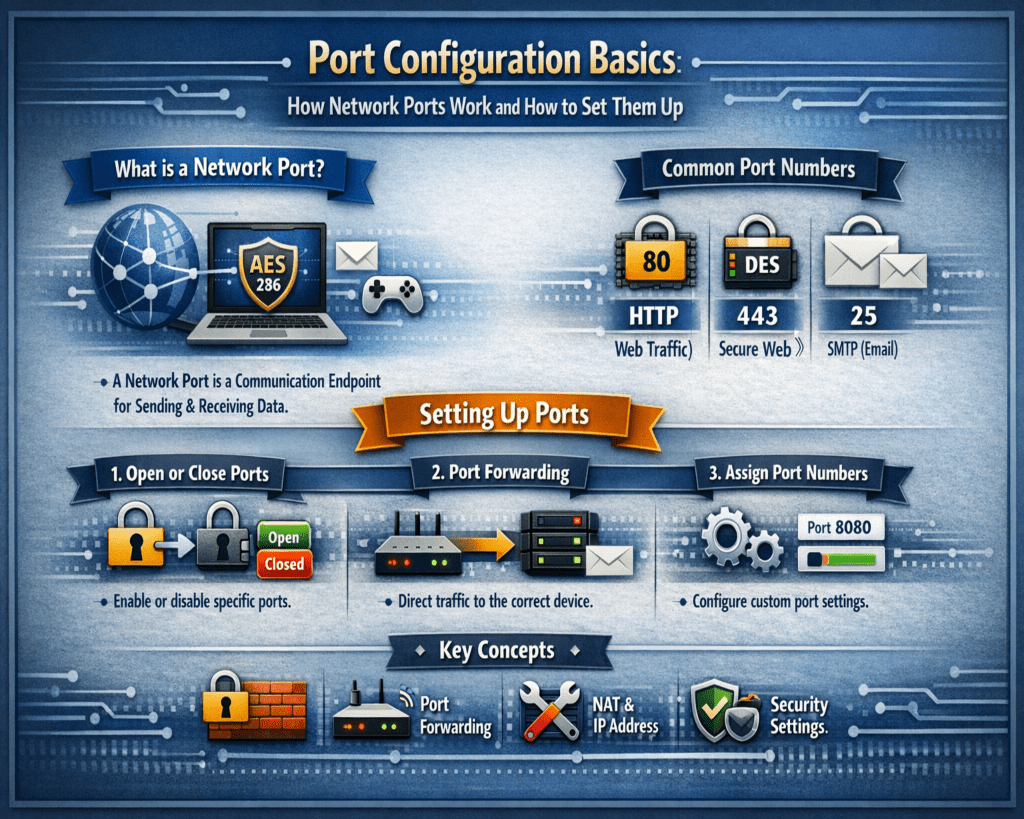
Port configuration is a core process in networking that defines how devices communicate through network ports. A port is a logical or physical endpoint that allows data to enter or leave a system in a controlled way. Every network, whether small or enterprise-level, depends on properly configured ports to manage communication between devices, applications, and services.
In simple terms, port configuration ensures that data travels through the correct pathways without disruption. It defines how traffic is handled, what type of communication is allowed, and how security rules are enforced at the connection level. Without proper configuration, networks may experience unstable connections, unauthorized access, or performance degradation.
Ports exist on devices such as routers, switches, servers, firewalls, and wireless access points. Each port must be assigned specific rules so that it understands how to handle incoming and outgoing traffic. These rules help maintain order in complex digital environments where multiple services run simultaneously.
Port configuration is not limited to large infrastructures. Even basic home networks rely on port settings to support internet browsing, streaming, gaming, and device connectivity. Every online interaction depends on properly configured ports working behind the scenes.
Role Of Ports In Network Communication Structure
Ports serve as communication endpoints that allow devices to exchange data efficiently. While IP addresses identify devices on a network, ports identify specific services running on those devices. This combination allows precise delivery of data packets to the correct destination.
For example, a single server may host multiple services such as web hosting, email processing, and file sharing. Each of these services uses a different port number to separate its traffic. This prevents confusion and ensures that incoming data reaches the correct application.
Ports also enable multitasking within a network environment. Without ports, a device would only be able to handle one type of communication at a time. Instead, ports allow multiple connections to operate simultaneously without interference.
When ports are properly configured, communication becomes smooth and predictable. Data flows efficiently between systems, reducing delays and improving performance. When misconfigured, however, communication failures can occur, leading to packet loss, slow response times, or complete service interruptions.
Core Purpose Of Port Configuration In Network Management
Port configuration plays a central role in managing how networks operate. It ensures that communication pathways are clearly defined and that traffic follows specific rules.
One major purpose of port configuration is traffic control. Networks often handle large volumes of data, and without proper control mechanisms, congestion can occur. Port settings help regulate how data is transmitted, ensuring balanced usage of network resources.
Another purpose is access control. Port configuration determines which devices or services are allowed to communicate through specific ports. This helps prevent unauthorized access and reduces exposure to potential threats.
Port configuration also improves network organization. By assigning specific functions to different ports, administrators can create structured communication systems that are easier to manage and scale. This becomes especially important in large environments with multiple departments or service layers.
In addition, port configuration supports network efficiency. Properly configured ports ensure that data is processed quickly and routed correctly, reducing delays and improving overall system responsiveness.
Physical And Virtual Port Structures In Networking
Network ports exist in two main forms: physical and virtual. Both serve the same fundamental purpose but operate in different environments.
Physical ports are hardware-based connection points found on devices such as switches, routers, and servers. These ports allow cables to be physically connected, enabling wired communication between devices. Each physical port is assigned a specific function based on network design requirements.
Virtual ports, on the other hand, exist within software environments. They are used in operating systems, virtual machines, and cloud-based systems. These ports do not require physical hardware but function as logical endpoints for communication.
Virtual ports are especially important in modern computing environments where virtualization is widely used. Multiple virtual systems can run on a single physical machine, each requiring its own communication pathways. Virtual ports make this possible by separating traffic within software-defined environments.
Despite their differences, both physical and virtual ports follow similar configuration principles. They are assigned rules that control traffic flow, security settings, and communication behavior.
Key Parameters Involved In Port Configuration
Port configuration is based on several important parameters that define how a port operates within a network.
One of the most basic parameters is port status. A port can be enabled or disabled depending on network requirements. Disabled ports are often used as a security measure to reduce unnecessary access points.
IP addressing is another essential parameter. It determines how data is routed between devices and ensures that communication reaches the correct destination. Without proper addressing, network traffic can become misdirected or lost.
Traffic prioritization is also an important factor. It determines which types of data are given priority when multiple services compete for bandwidth. This ensures that critical applications receive the necessary resources for smooth operation.
Security parameters define access restrictions and protect against unauthorized communication. These rules may include device authentication, protocol filtering, or access limitations based on network policies.
Bandwidth allocation controls how much data can pass through a port at any given time. Proper allocation ensures that no single service consumes excessive network resources, which helps maintain balanced performance.
Importance Of Port Security In Network Environments
Port security is a critical component of network protection. It ensures that only authorized devices are allowed to communicate through specific ports.
Without port security, networks become vulnerable to unauthorized access and malicious activity. Attackers could potentially connect to open ports and gain entry into sensitive systems.
Port security typically involves restricting access based on device identity or predefined rules. This ensures that only trusted devices are allowed to use network resources.
It also helps prevent unauthorized configuration changes. By limiting access to administrative functions, port security protects network integrity and stability.
Monitoring is another important aspect of port security. By observing traffic patterns, administrators can detect unusual activity and respond to potential threats before they cause damage.
Traffic Management Through Port Configuration
Traffic management is an essential function of port configuration that ensures efficient data flow across a network.
Networks often carry multiple types of traffic simultaneously, including voice, video, and data services. Without proper management, these traffic types can interfere with each other.
Port configuration allows administrators to prioritize certain types of traffic over others. This ensures that time-sensitive applications, such as communication services, receive sufficient bandwidth and low latency.
Traffic control mechanisms also help prevent congestion by regulating how much data is allowed to pass through each port. This improves network stability and reduces delays.
In addition, traffic shaping techniques help smooth out data transmission patterns. Instead of allowing sudden bursts of traffic, the system regulates flow over time to maintain consistent performance.
Role Of Segmentation In Port Configuration
Segmentation involves dividing a network into smaller, isolated sections to improve performance and security.
Each segment operates independently and communicates through controlled pathways defined by port settings. This reduces unnecessary traffic between unrelated systems.
Segmentation also enhances security by limiting the spread of potential threats. If one segment is compromised, others remain unaffected due to isolation.
Port configuration plays a key role in implementing segmentation by assigning specific ports to different network groups. This ensures that communication remains organized and controlled.
Segmentation also improves efficiency by reducing congestion. Devices only communicate with relevant systems, which reduces unnecessary network load.
Basic Principles Of Port Operation And Control
Port operation is guided by several fundamental principles that ensure reliable communication.
Controlled access ensures that only authorized devices can use specific ports. This prevents unauthorized communication and strengthens network security.
Structured data flow ensures that information moves through the network in an organized manner. This reduces the risk of congestion and improves performance.
Defined communication rules determine how ports interact with other network components. These rules control how data is transmitted, received, and processed across the system.
Error handling mechanisms ensure that communication failures are managed properly. This prevents system instability and helps maintain continuous operation even when issues occur.
Together, these principles form the foundation of effective port configuration and ensure stable network performance across all connected devices.
Understanding Port Behavior In Real Network Environments
Port behavior in real network environments is shaped by a combination of configuration rules, device roles, and traffic demands. While basic port setup defines whether a port is active and how it communicates, real-world environments introduce complexity through simultaneous services, multiple users, and varying traffic types.
In enterprise networks, ports are rarely used for a single purpose. Instead, they support multiple applications that require different levels of performance and security. For example, a single switch may handle internal communication, guest access, VoIP traffic, and cloud synchronization simultaneously. Each of these services depends on port-level configuration to function correctly without interfering with others.
Port behavior is also influenced by network topology. In a star topology, for instance, all devices connect through a central switch, meaning port configuration at that switch becomes critical. In mesh or hybrid designs, port interactions become more dynamic, requiring careful planning to ensure consistent performance across all paths.
Another factor affecting port behavior is traffic volume. As the number of connected devices increases, ports must handle higher data loads. Without proper configuration, congestion can occur, leading to latency and packet loss. This makes scalable port configuration essential in growing network environments.
Port Configuration In Switching Devices
Switching devices rely heavily on port configuration to manage internal network traffic. Each port on a switch acts as a dedicated communication channel that connects end devices or other network equipment.
One of the primary roles of switch port configuration is to control how devices communicate within a local network. By assigning rules to each port, switches determine whether traffic is forwarded, filtered, or blocked. This ensures that only authorized communication occurs between connected devices.
Switch ports are often configured based on their intended function. Some ports may be assigned to user devices, while others are dedicated to servers, printers, or uplink connections to other switches. This segmentation helps maintain a structured traffic flow.
Another important aspect is port mode configuration. Ports can operate in different modes depending on network requirements, such as access mode or trunk mode. Access mode typically connects end devices and carries traffic for a single network segment, while trunk mode carries traffic for multiple segments simultaneously.
Switch port configuration also plays a key role in preventing broadcast storms. Without proper configuration, excessive broadcast traffic can overwhelm a network, causing performance degradation. By controlling how ports handle broadcast traffic, switches maintain network stability.
Role Of Port Configuration In Routing Devices
Routers use port configuration to manage traffic between different networks. Unlike switches, which operate within a single network, routers connect multiple networks and direct traffic between them.
Each router interface functions as a port that must be configured with specific parameters such as IP addressing, routing rules, and security policies. These configurations determine how data is forwarded between networks.
Routing port configuration also involves defining pathways for incoming and outgoing traffic. This ensures that data packets reach their intended destination efficiently without unnecessary delays or rerouting.
In more advanced environments, routers may use dynamic routing protocols that adjust port behavior based on network conditions. This allows ports to respond to changes in traffic load or network topology automatically.
Security is also a major consideration in router port configuration. Since routers often serve as gateways between internal and external networks, ports must be carefully secured to prevent unauthorized access or external threats.
VLAN Implementation Through Port Configuration
Virtual Local Area Networks rely heavily on port configuration to segment network traffic logically. VLANs allow multiple isolated networks to exist within a single physical infrastructure.
Port-based VLAN configuration assigns specific ports to particular VLAN groups. Devices connected to those ports become part of the assigned logical network, regardless of their physical location.
This segmentation improves both security and performance. Devices within one VLAN cannot directly communicate with devices in another VLAN unless explicitly allowed through routing rules. This reduces the risk of unauthorized access and limits the spread of potential network issues.
VLAN tagging is another important concept associated with port configuration. Tagged ports can carry traffic for multiple VLANs simultaneously, which is commonly used in trunk links between switches.
Proper VLAN port configuration requires careful planning to ensure that traffic is correctly segmented and routed. Misconfiguration can result in communication failures or unintended access between network segments.
Advanced Port Security Mechanisms
Advanced port security mechanisms go beyond basic access control and introduce deeper levels of protection for network environments.
One such mechanism is MAC address filtering, which restricts port access based on device hardware identifiers. Only devices with approved MAC addresses are allowed to communicate through the port.
Another mechanism is sticky MAC learning, where a switch dynamically learns and stores authorized MAC addresses based on initial connections. This reduces manual configuration effort while maintaining security.
Port shutdown features are also used in advanced security configurations. If a violation is detected, such as an unauthorized device connection, the port can automatically disable itself to prevent further access.
Intrusion detection at the port level helps identify suspicious behavior, such as repeated unauthorized access attempts or abnormal traffic patterns. These mechanisms enhance network protection by providing early warnings of potential threats.
Quality Of Service And Traffic Prioritization At Port Level
Quality of Service configuration allows network administrators to prioritize specific types of traffic based on application requirements. This is especially important in environments where multiple services compete for bandwidth.
At the port level, QoS rules determine how traffic is classified and prioritized. For example, voice communication traffic may be given higher priority than file downloads to ensure clear and uninterrupted calls.
Port-based QoS configuration ensures that critical applications maintain performance even during periods of heavy network usage. This prevents latency-sensitive services from being affected by background traffic.
Traffic marking and queuing mechanisms are often used to implement QoS policies. These mechanisms assign priority levels to packets and determine the order in which they are transmitted.
By managing traffic at the port level, QoS ensures consistent performance across the network and improves user experience for essential applications.
Port Forwarding And Network Address Translation Role
Port forwarding is a technique used to direct external traffic to specific internal devices within a private network. This is commonly used for services such as web hosting, remote access, and gaming servers.
When external requests arrive at a network’s public interface, port forwarding rules determine which internal device should receive the traffic. This ensures that communication reaches the correct destination inside the network.
Network Address Translation works alongside port forwarding to map public IP addresses to private internal addresses. This allows multiple devices within a private network to share a single public IP address.
Port configuration plays a critical role in defining these translation rules. Incorrect configuration can result in inaccessible services or security vulnerabilities.
Properly configured port forwarding ensures controlled exposure of internal services to external networks while maintaining security boundaries.
Link Aggregation And Port Bundling Techniques
Link aggregation is a method of combining multiple physical ports into a single logical connection. This increases bandwidth and provides redundancy in case one link fails.
Port configuration in link aggregation involves grouping ports and defining how traffic is distributed across them. This allows networks to handle higher data loads more efficiently.
Load balancing is a key benefit of link aggregation. Traffic is distributed across multiple ports, preventing congestion and improving overall performance.
Redundancy is another important advantage. If one physical link fails, traffic can continue flowing through other active links without interruption.
Proper configuration ensures that all ports in the aggregation group operate consistently and maintain synchronization with each other.
Spanning Tree Protocol And Loop Prevention Through Ports
Spanning Tree Protocol is used to prevent network loops that can occur when multiple switches are interconnected. Loops can cause broadcast storms and severely impact network performance.
Port configuration plays a critical role in STP operation. Ports are assigned roles such as root, designated, or blocked based on network topology.
Blocked ports are temporarily disabled to prevent loops while maintaining backup paths in case of failure. This ensures network stability while preserving redundancy.
STP continuously monitors network changes and adjusts port states automatically when topology changes occur.
Without proper STP configuration, networks can experience severe disruptions due to uncontrolled looping traffic.
Dynamic Discovery Protocols And Port Awareness
Dynamic discovery protocols allow network devices to automatically identify and share information about connected neighbors.
These protocols operate through port-level communication, enabling devices to exchange details such as device type, capabilities, and connection status.
This information is useful for network mapping and troubleshooting. Administrators can quickly identify how devices are connected without manual inspection.
Port configuration ensures that discovery protocols function correctly by allowing or restricting protocol traffic as needed.
While useful, these protocols must be properly secured to prevent unauthorized information exposure within the network.
Troubleshooting Port Configuration Issues In Networks
Troubleshooting port configuration involves identifying and resolving issues related to connectivity, performance, and security.
Common problems include disabled ports, incorrect VLAN assignments, misconfigured IP addresses, and faulty security settings.
Diagnostic tools help analyze port behavior and identify where communication failures occur. By testing connectivity step by step, administrators can isolate the source of the issue.
Configuration mismatches between connected devices are a frequent cause of network problems. Ensuring consistency across port settings is essential for stable communication.
Monitoring port activity also helps detect performance issues such as congestion or packet loss, allowing proactive adjustments to improve network efficiency.
Advanced Port Optimization in High-Performance Networks
Port optimization in modern networks focuses on improving speed, stability, and efficient resource usage across all connected devices. As network environments grow in complexity, simply configuring ports for basic communication is no longer enough. Optimization ensures that ports are fine-tuned to handle high traffic loads, diverse applications, and strict performance requirements without degradation.
In high-performance environments such as enterprise data centers or cloud-connected infrastructures, ports must be configured to support consistent throughput. This involves balancing traffic loads, minimizing latency, and ensuring that no single port becomes a bottleneck. Optimization techniques are applied at both hardware and software levels, depending on the network architecture.
One of the key elements of port optimization is traffic distribution. When multiple services operate simultaneously, data must be evenly distributed across available ports. Uneven distribution can result in congestion on certain interfaces while others remain underutilized. Proper configuration ensures balanced utilization of network resources.
Another important aspect is latency reduction. Ports can be configured to prioritize low-latency communication paths for time-sensitive applications. This is especially important in environments where real-time data transmission is required, such as communication systems or financial networks.
Buffer management also plays a significant role in optimization. Network devices use buffers to temporarily store data before processing. If buffers are not configured properly, they can overflow or underutilize capacity, leading to performance issues. Proper tuning ensures smooth data flow even under heavy traffic conditions.
Bandwidth Management And Port-Level Control
Bandwidth management is a critical component of port configuration that ensures fair and efficient distribution of network resources. Each port must be configured to handle a specific portion of available bandwidth based on its role within the network.
Without bandwidth control, certain applications or devices may consume excessive resources, leading to network congestion. This negatively impacts overall performance and user experience. Proper configuration ensures that bandwidth is allocated according to priority and necessity.
Port-level bandwidth control allows administrators to define limits on how much data a port can transmit or receive. These limits help maintain balance across the network and prevent any single port from overwhelming the system.
In addition to limiting usage, bandwidth management also supports prioritization. High-priority applications such as voice communication or critical system processes can be allocated guaranteed bandwidth to ensure uninterrupted performance.
Dynamic bandwidth adjustment is another advanced feature used in modern networks. This allows port configurations to adapt in real time based on traffic conditions, ensuring optimal performance even during peak usage periods.
Advanced Security Hardening At Port Level
Security hardening at the port level involves strengthening configuration settings to prevent unauthorized access, data breaches, and malicious activity. Since every port represents a potential entry point into a network, securing them is essential for overall system protection.
One of the primary methods of security hardening is strict access control. This ensures that only authorized devices are allowed to communicate through specific ports. Access rules can be based on device identity, protocol type, or predefined security policies.
Another important technique is port isolation. This prevents communication between selected ports unless explicitly permitted. Isolation reduces the risk of lateral movement within a network in case of a security breach.
Port security also includes limiting the number of devices that can connect through a single interface. This helps prevent unauthorized device injection attacks where multiple unknown devices attempt to gain access through one port.
Monitoring and logging are also key components of security hardening. By tracking port activity, administrators can identify unusual behavior patterns that may indicate a security threat. These logs are essential for both real-time detection and post-incident analysis.
Encryption support at the port level ensures that data transmitted through network interfaces remains protected from interception. This is especially important for sensitive communications across public or untrusted networks.
Port Configuration In Virtualized And Cloud Environments
Virtualized and cloud-based environments rely heavily on software-defined port configuration. Unlike traditional physical networks, these environments use virtual switches, virtual machines, and containerized systems that require flexible port management.
In virtualization platforms, ports are created logically within software layers. These ports behave like physical interfaces but operate entirely in a virtual space. They allow virtual machines to communicate with each other and with external networks.
Port configuration in these environments must account for dynamic scaling. Virtual machines can be created, modified, or deleted rapidly, requiring ports to adapt automatically to changing workloads.
Cloud environments also rely on distributed networking, where resources are spread across multiple physical locations. Port configuration ensures that communication remains consistent across these distributed systems.
Security is particularly important in virtualized environments. Since multiple systems share the same physical infrastructure, port-level isolation is used to separate workloads and prevent unauthorized cross-communication.
Automation plays a major role in managing ports in these environments. Configuration templates and policy-based controls help maintain consistency across large-scale deployments.
Fault Detection And Recovery In Port Systems
Fault detection in port configuration involves identifying issues that affect communication, performance, or security. These faults can occur due to misconfiguration, hardware failure, or network congestion.
One common type of fault is port inactivity, where a port fails to transmit or receive data. This may be caused by incorrect settings or physical disconnection. Detection mechanisms continuously monitor port status to identify such issues quickly.
Another type of fault is misalignment in configuration between connected devices. If two connected ports have mismatched settings, a communication failure can occur. Detecting these mismatches is essential for maintaining network stability.
Recovery mechanisms help restore normal operation after a fault is detected. This may involve restarting ports, reapplying configuration settings, or rerouting traffic through alternative paths.
Redundancy also plays an important role in recovery. Backup ports or alternate communication paths ensure that network services remain operational even if a primary port fails.
Automatic failover systems are commonly used in advanced networks to switch traffic seamlessly in case of a port failure. This minimizes downtime and ensures the continuous availability of services.
Load Balancing Strategies Using Port Configuration
Load balancing is a technique used to distribute network traffic evenly across multiple ports to prevent congestion and improve performance.
Port-based load balancing ensures that no single interface becomes overloaded. Traffic is distributed based on predefined rules such as round-robin distribution, weight-based allocation, or dynamic traffic analysis.
In environments with high data volume, load balancing improves responsiveness and reduces delays. It ensures that all available network resources are utilized efficiently.
Load balancing also enhances reliability. If one port experiences failure or high congestion, traffic can be redirected to other available ports without disruption.
Proper configuration is essential for effective load balancing. Incorrect settings can lead to uneven distribution or inefficient use of resources, negatively affecting network performance.
Spanning Tree Enhancements And Loop Protection Techniques
Loop prevention is a critical function in network port configuration, especially in environments with multiple interconnected switches. Network loops can cause broadcast storms, leading to severe performance degradation.
Spanning Tree mechanisms help prevent loops by selectively blocking redundant paths while maintaining backup connections. Port configuration determines how these decisions are made.
Advanced enhancements allow faster detection and recovery from topology changes. Ports can quickly transition between states to maintain network stability.
Loop protection features also include automatic shutdown of ports when abnormal traffic patterns are detected. This prevents loops from spreading across the network.
Proper configuration ensures that redundancy is maintained without introducing instability or communication failures.
Dynamic Port Monitoring And Real-Time Analytics
Dynamic monitoring of ports provides real-time visibility into network performance and behavior. This includes tracking traffic volume, error rates, and connection status.
Real-time analytics allow administrators to identify performance bottlenecks and security threats as they occur. This enables faster response times and proactive network management.
Port monitoring tools analyze traffic patterns to detect anomalies such as sudden spikes in usage or unusual communication behavior.
These insights help optimize configuration settings by identifying underperforming or overutilized ports.
Continuous monitoring also supports predictive maintenance by identifying potential failures before they occur.
Troubleshooting Complex Port Configuration Failures
Troubleshooting complex port issues requires a structured approach that examines configuration, connectivity, and performance layers.
One common issue is inconsistent configuration between connected devices. Even minor mismatches can cause communication breakdowns.
Another issue is incorrect traffic assignment, where data is sent through the wrong port due to misconfigured rules. This can result in service disruption or data loss.
Performance-related issues may include congestion, latency, or packet loss. These are often caused by improper bandwidth allocation or overload conditions.
Security misconfigurations can also lead to restricted access or unintended exposure. Identifying these issues requires careful review of access control rules.
Systematic troubleshooting involves isolating each layer of the network to determine where the failure originates. This helps ensure accurate diagnosis and efficient resolution.
Future Trends In Port Configuration And Network Evolution
Port configuration continues to evolve alongside advancements in networking technology. Modern networks are becoming increasingly automated, intelligent, and adaptive.
Artificial intelligence is being integrated into network management systems to optimize port behavior dynamically. This allows systems to adjust configurations automatically based on traffic conditions.
Software-defined networking is also transforming how ports are managed. Instead of manual configuration, centralized controllers manage port behavior across entire networks.
Cloud-native architectures require highly flexible port systems that can scale automatically with demand. This shifts the configuration from static setups to dynamic, policy-driven models.
Security continues to evolve as well, with advanced threat detection systems integrated directly into port-level configurations.
These advancements are shaping the future of networking, where port configuration becomes more intelligent, automated, and responsive to real-time conditions.
Conclusion
Port configuration sits at the core of how modern networks operate, even though it often remains invisible to end users. Every digital action, whether it is loading a webpage, transferring files, joining a video call, or accessing cloud applications, depends on properly configured ports working behind the scenes. Without structured port configuration, network systems lose their ability to communicate reliably, securely, and efficiently.
At its foundation, port configuration is about control. It defines how data enters and exits devices, how traffic is organized, and how communication pathways are maintained. This control is essential because networks are no longer simple, isolated systems. Instead, they are complex environments where thousands of devices and services interact simultaneously. Ports provide the structure that keeps this interaction stable and predictable.
One of the most important outcomes of proper port configuration is reliability. When ports are correctly configured, communication flows smoothly between devices without interruption. Data reaches its destination without unnecessary delays, and services remain accessible even under high traffic conditions. Reliability is not accidental in networking; it is built through careful configuration of every port within the system.
Security is another critical outcome of port configuration. Every open port represents a potential entry point into a network, which means every port must be carefully managed. Through configuration rules, networks define which devices are allowed to communicate, what types of traffic are permitted, and how unauthorized access is prevented. This layered control reduces exposure to external threats and internal misconfigurations.
In modern environments, security is no longer limited to perimeter defense. Instead, it extends deep into the network through port-level controls. Features such as access restrictions, traffic filtering, segmentation, and monitoring ensure that even if one part of the system is compromised, the damage remains contained. Port configuration plays a direct role in enforcing this internal security structure.
Performance optimization is another major benefit of well-managed port configuration. Networks must handle large volumes of data, often from multiple applications competing for the same resources. Without proper configuration, congestion can occur, leading to slow response times and poor user experience. By controlling bandwidth allocation, prioritizing traffic, and balancing loads, port configuration ensures that performance remains consistent even under heavy demand.
Scalability is also closely tied to port configuration. As networks grow, new devices and services must be integrated without disrupting existing communication. Properly designed port configurations allow networks to expand smoothly by providing structured rules for new connections. This flexibility is essential in modern environments where growth is continuous and unpredictable.
Another important aspect is segmentation, which helps divide networks into smaller, manageable sections. Port configuration enables this by assigning specific roles and boundaries to different ports. Segmentation improves both performance and security by limiting unnecessary communication between unrelated systems. It also helps contain issues when failures or security incidents occur, preventing them from spreading across the entire network.
Virtualization and cloud computing have further increased the importance of port configuration. In these environments, physical limitations are replaced by software-defined systems where ports are created, managed, and adjusted dynamically. This shift requires more flexible and intelligent configuration approaches. Ports are no longer static connection points; they are adaptable resources that respond to changing workloads and system demands.
Automation is becoming a key factor in how port configuration is managed today. Instead of manually adjusting each setting, modern networks rely on automated systems that apply configuration rules consistently across large infrastructures. This reduces human error, improves efficiency, and ensures uniform policy enforcement. Automation also allows real-time adjustments based on traffic conditions, improving overall network responsiveness.
Despite technological advancements, the core principles of port configuration remain unchanged. Every network still depends on clear communication rules, structured data flow, and controlled access. These principles ensure that even as systems become more complex, they remain understandable and manageable.
Troubleshooting is another area where port configuration plays a vital role. When network issues occur, such as connectivity failures or performance drops, ports are often one of the first areas to inspect. Misconfigured ports, incorrect assignments, or conflicting rules can quickly disrupt communication. Understanding port behavior makes it easier to isolate problems and restore normal operation efficiently.
Monitoring and visibility also depend heavily on port configuration. By tracking how ports behave under different conditions, network administrators gain insight into system health and performance. This visibility helps detect unusual activity, identify bottlenecks, and optimize configurations over time. Without proper monitoring at the port level, networks would become difficult to manage and diagnose.
As networks continue to evolve, the importance of port configuration will only increase. Emerging technologies such as artificial intelligence, edge computing, and software-defined networking are changing how systems operate, but they still rely on ports as fundamental communication points. Even in highly automated environments, port configuration remains the foundation that supports all higher-level network functions.
The future of networking is moving toward greater intelligence and adaptability, where systems can adjust themselves based on real-time conditions. In this future, port configuration will become more dynamic, with automated systems continuously optimizing performance, security, and resource allocation. However, the underlying purpose will remain the same: ensuring that communication between devices is efficient, secure, and reliable.
Ultimately, port configuration is not just a technical task but a structural necessity in networking. It defines how systems connect, how data moves, and how networks maintain order in complex digital environments. Whether in small setups or global infrastructures, properly configured ports are what make modern communication possible.