
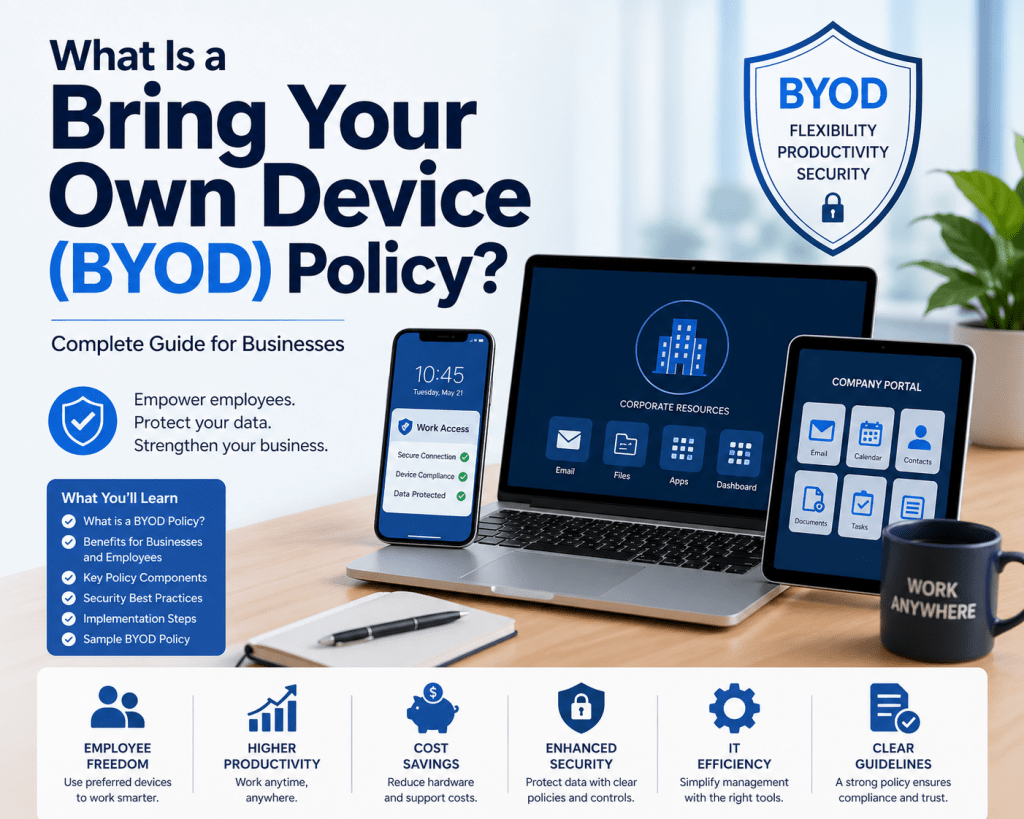
The modern workplace has undergone a significant transformation over the past decade, driven by rapid advancements in mobile technology, cloud computing, and remote work culture. One of the most influential shifts has been the widespread adoption of Bring Your Own Device, commonly known as BYOD. This concept revolves around allowing employees to use their personal devices, such as smartphones, laptops, and tablets, to perform work-related tasks. What once seemed like a convenience has now become a strategic operational model for many organizations.
At its core, a BYOD policy is a structured agreement between an organization and its workforce that defines how personal devices can be used within the corporate environment. It establishes boundaries, responsibilities, and security expectations to ensure that while employees benefit from flexibility, organizational data remains protected. The appeal of BYOD lies in its simplicity, but the implications extend far beyond convenience, touching productivity, security, compliance, and infrastructure design.
The increasing reliance on personal devices in professional settings did not happen overnight. It emerged as employees began to prefer their own familiar devices over company-issued hardware. Personal devices often offer better usability, customization, and comfort, enabling individuals to work more efficiently. Organizations quickly recognized this behavioral shift and started formalizing policies to accommodate it rather than resist it.
However, the integration of personal devices into corporate ecosystems introduces a dual-edged scenario. On one hand, it enhances operational agility and employee satisfaction. On the other hand, it expands the attack surface for potential cyber threats. This makes the BYOD policy not just a convenience framework but a critical component of organizational security architecture.
A well-defined BYOD policy typically outlines acceptable device types, operating system requirements, access controls, and security protocols. It also clarifies ownership of data, responsibilities in case of device loss, and compliance expectations. Without such clarity, organizations risk exposing sensitive information to unauthorized access, either through negligence or malicious intent.
The significance of BYOD becomes even more evident in hybrid and remote work models. As employees operate from various locations, often outside traditional network perimeters, personal devices become primary endpoints for accessing corporate resources. This decentralization of access demands a more robust and adaptive security approach, where policies must evolve continuously to address emerging risks.
Another key aspect of BYOD is its impact on IT management. Traditional models relied heavily on centralized control, where all devices were owned, configured, and maintained by the organization. BYOD disrupts this model by introducing a diverse range of devices with varying configurations, operating systems, and security postures. This diversity requires IT teams to shift from device-centric control to policy-driven governance.
Moreover, BYOD policies must strike a balance between security enforcement and user privacy. Employees may be hesitant to allow organizations full control over their personal devices, especially if it involves monitoring or data access. Therefore, policies must be transparent, clearly communicating what data is accessed, how it is used, and what measures are in place to protect personal information.
The concept also intersects with legal and regulatory frameworks. Industries that handle sensitive data, such as healthcare, finance, and legal services, must ensure that BYOD practices comply with strict data protection regulations. This adds another layer of complexity, as organizations must ensure that personal devices meet the same compliance standards as corporate systems.
In essence, BYOD represents a shift from rigid, organization-controlled environments to more flexible, user-driven ecosystems. It reflects the broader trend of consumerization of IT, where personal technology influences enterprise practices. While this shift brings numerous advantages, it also demands a higher level of strategic planning and risk management.
Understanding BYOD is not just about recognizing its definition but appreciating its role in shaping modern work dynamics. It requires a holistic approach that considers technology, human behavior, security, and business objectives. Organizations that successfully implement BYOD policies are those that view it not as a shortcut to convenience but as a structured framework requiring continuous refinement.
Origins and Growth of BYOD Adoption Across Industries
The emergence of BYOD can be traced back to the early proliferation of smartphones and portable computing devices. As mobile technology advanced, individuals began to rely heavily on their personal devices for both communication and productivity. These devices were often more advanced and user-friendly than the equipment provided by organizations, leading employees to naturally integrate them into their work routines.
Initially, organizations resisted this trend due to security concerns and lack of control. However, as the demand for flexibility increased and remote work began gaining traction, companies started to reconsider their stance. The turning point came when businesses realized that restricting personal device usage could hinder productivity and employee satisfaction.
The adoption of BYOD accelerated with the rise of high-speed internet, cloud-based applications, and collaboration tools. Employees were no longer tied to physical office spaces or specific devices. Work could be performed from virtually anywhere, provided there was connectivity. This shift fundamentally changed how organizations approached device management and access control.
Different industries adopted BYOD at varying rates depending on their operational requirements and regulatory constraints. Technology companies were among the earliest adopters, leveraging BYOD to foster innovation and agility. Creative industries followed suit, benefiting from the flexibility and personalization that BYOD offered.
In contrast, sectors such as healthcare and finance approached BYOD more cautiously. These industries deal with highly sensitive data and are subject to stringent compliance requirements. As a result, their BYOD policies tend to be more restrictive, incorporating advanced security measures and strict access controls.
The growth of BYOD also coincided with the expansion of remote and hybrid work models. As organizations transitioned away from traditional office setups, the need for flexible device usage became more pronounced. Employees working from home or on the move required seamless access to corporate resources, making BYOD an attractive solution.
Another factor contributing to BYOD adoption is cost optimization. Providing devices for every employee can be a significant financial burden, especially for large organizations. BYOD shifts some of this cost to employees while allowing companies to invest more in security infrastructure and software solutions.
Despite its advantages, the rapid adoption of BYOD exposed several challenges. Organizations struggled with managing diverse device ecosystems, ensuring consistent security standards, and addressing privacy concerns. These challenges highlighted the need for comprehensive policies and advanced management tools.
Over time, BYOD policies evolved from informal guidelines to structured frameworks supported by technology solutions such as mobile device management and endpoint security systems. These tools enable organizations to enforce policies, monitor device compliance, and respond to security incidents more effectively.
The evolution of BYOD reflects a broader transformation in workplace culture. Employees now expect greater autonomy and flexibility in how they work, and organizations must adapt to meet these expectations. BYOD is no longer just a trend but a standard practice in many workplaces.
Understanding the origins and growth of BYOD provides valuable insights into its current significance. It highlights the factors that drove its adoption and the challenges that shaped its development. This context is essential for organizations looking to implement or refine their BYOD strategies.
Core Components That Define an Effective BYOD Policy
A successful BYOD policy is built on a foundation of clearly defined components that address both operational needs and security requirements. These components serve as guidelines for employees while providing IT teams with the framework needed to manage and secure personal devices within the corporate environment.
One of the fundamental elements of a BYOD policy is device eligibility. Organizations must specify which types of devices are permitted, including supported operating systems and minimum hardware requirements. This ensures compatibility with corporate applications and reduces the risk of vulnerabilities associated with outdated technology.
Access control is another critical component. Not all employees require the same level of access to corporate resources, and the policy must define permissions based on roles and responsibilities. Implementing role-based access control helps limit exposure of sensitive data and reduces the potential impact of security breaches.
Authentication mechanisms play a vital role in securing BYOD environments. Strong authentication methods, such as multi-factor authentication, are essential to verify user identity and prevent unauthorized access. These measures add an additional layer of security beyond traditional passwords.
Data protection is at the heart of any BYOD policy. Organizations must establish guidelines for data encryption, both in transit and at rest, to safeguard sensitive information. This ensures that even if a device is compromised, the data remains inaccessible to unauthorized parties.
Another important aspect is the separation of personal and corporate data. Techniques such as containerization allow organizations to isolate work-related information from personal content on the same device. This not only enhances security but also addresses privacy concerns by ensuring that personal data remains untouched.
Device management is a key consideration in BYOD policies. Organizations need mechanisms to monitor device compliance, enforce security settings, and respond to incidents. This often involves the use of management tools that provide visibility and control over connected devices.
Incident response procedures must also be clearly defined. The policy should outline steps to be taken in case of device loss, theft, or security breaches. This includes the ability to remotely lock or wipe devices to prevent unauthorized access to corporate data.
User responsibilities are equally important. Employees must understand their role in maintaining security, including adhering to policy guidelines, reporting incidents, and avoiding risky behaviors. Clear communication and training are essential to ensure compliance.
Compliance with legal and regulatory requirements is another critical component. Organizations must ensure that their BYOD policies align with relevant laws and industry standards. This includes data protection regulations and privacy requirements that govern how information is handled.
Finally, continuous evaluation and improvement are necessary to keep the policy effective. As technology evolves and new threats emerge, BYOD policies must be updated regularly to address changing risks and requirements.
An effective BYOD policy is not a static document but a dynamic framework that adapts to the evolving landscape of technology and work practices. By incorporating these core components, organizations can create a balanced approach that maximizes benefits while minimizing risks.
Security Challenges and Risk Landscape in BYOD Environments
As organizations increasingly adopt Bring Your Own Device (BYOD) frameworks, the security perimeter of traditional IT environments becomes significantly more complex. Instead of managing a controlled set of standardized corporate devices, IT teams must now account for a diverse ecosystem of personal smartphones, laptops, and tablets that operate outside direct administrative ownership. This shift introduces a broad spectrum of security challenges that must be addressed through layered defenses and adaptive policies.
One of the most critical concerns in BYOD environments is data exposure. When employees access corporate systems from personal devices, sensitive information may be stored, cached, or synchronized outside controlled infrastructure. Unlike corporate-owned endpoints, personal devices may not always adhere to strict encryption standards, increasing the likelihood of unauthorized data exposure in case of compromise.
Another major risk is device compromise due to inconsistent security hygiene. Personal devices often host a mix of personal applications, third-party downloads, and unsecured browsing activities. These behaviors can introduce vulnerabilities such as spyware, keyloggers, and trojans, which may operate silently in the background while intercepting sensitive business communications.
The diversity of operating systems and device configurations further complicates security enforcement. Unlike standardized corporate devices, BYOD ecosystems include multiple versions of operating systems with varying patch levels. This fragmentation makes it difficult to ensure consistent security updates across all endpoints, leaving potential gaps that attackers can exploit.
Phishing attacks also become more effective in BYOD scenarios. Employees frequently use personal devices for both professional and private communication, increasing the likelihood of interacting with malicious links or fraudulent messages. Since personal devices often lack enterprise-grade email filtering and endpoint protection, the risk of credential theft and unauthorized access increases significantly.
Physical security is another often-overlooked concern. Personal devices are more likely to be used in public spaces such as cafes, transport systems, or shared environments. This increases the probability of theft or accidental loss, both of which can lead to unauthorized access to corporate data if proper safeguards are not in place.
The absence of centralized control is one of the defining security challenges in BYOD ecosystems. In traditional IT environments, administrators maintain full oversight over device configurations, software installations, and security policies. In BYOD models, however, this control is partially relinquished, requiring organizations to rely on policy enforcement tools rather than direct intervention.
Network security risks also escalate in BYOD environments. Employees may connect their personal devices to unsecured Wi-Fi networks, which can expose corporate data transmissions to interception or man-in-the-middle attacks. Without proper encryption and secure tunneling mechanisms, sensitive data can be captured during transmission.
Another significant concern is shadow IT behavior. Employees may install unauthorized applications or use unapproved cloud services on personal devices to enhance productivity. While well-intentioned, these actions bypass corporate security controls and create blind spots in data governance frameworks.
Compliance violations represent a serious risk in regulated industries. When personal devices handle sensitive data, ensuring adherence to legal frameworks becomes more complex. Failure to enforce proper controls can result in regulatory penalties, reputational damage, and legal consequences.
The challenge is not only external threats but also internal misuse. Employees may unintentionally mishandle data by sharing files through unsecured channels or storing sensitive documents on personal storage services. These actions, although not malicious, can still lead to significant security breaches.
Endpoint visibility is another weak point in BYOD environments. Without proper monitoring tools, IT teams may lack insight into device health, installed applications, and security posture. This lack of visibility reduces the ability to detect anomalies or respond to threats in real time.
In addition, malware propagation becomes more likely in mixed-use devices. When personal and corporate environments coexist on the same device, malware targeting personal applications can potentially escalate privileges or access corporate data containers if isolation mechanisms are weak or misconfigured.
The cumulative effect of these risks is an expanded attack surface that requires proactive management. Unlike traditional environments where perimeter defenses were sufficient, BYOD ecosystems demand a shift toward endpoint-centric and identity-driven security models.
Advanced Threat Scenarios and Attack Vectors in BYOD Systems
The complexity of BYOD environments creates opportunities for sophisticated attack strategies that exploit gaps in device management, user behavior, and network security. Understanding these attack vectors is essential for designing resilient defense mechanisms.
One prominent threat scenario involves credential harvesting through compromised personal applications. Attackers often target widely used apps on personal devices to inject malicious code or phishing interfaces. Once credentials are captured, they can be used to access corporate systems without triggering immediate detection.
Another advanced attack vector is session hijacking. When employees access corporate resources over unsecured networks using personal devices, attackers can intercept active sessions and gain unauthorized access. This is particularly dangerous in environments where multi-factor authentication is not consistently enforced.
Rogue Wi-Fi networks also pose a significant threat. Attackers can set up malicious access points that mimic legitimate networks, tricking users into connecting their personal devices. Once connected, all transmitted data becomes vulnerable to interception and manipulation.
Man-in-the-middle attacks are especially effective in BYOD scenarios where encryption standards are inconsistently applied. Attackers position themselves between the user and the corporate server, capturing or altering data without detection.
Device jailbreaking or rooting introduces another layer of vulnerability. Users who modify their devices to gain administrative control often disable built-in security features. This creates an environment where malware can operate with elevated privileges, bypassing standard security controls.
Application-based attacks are also increasingly common. Malicious applications disguised as legitimate tools can be installed on personal devices. Once installed, these applications may request excessive permissions, enabling unauthorized access to contacts, files, and corporate data.
Data leakage through synchronization services is another subtle but dangerous risk. Many personal devices automatically sync data with cloud storage platforms. If corporate data is stored on these devices without proper segregation, it may inadvertently be uploaded to unsecured or unauthorized cloud services.
Insider threats take on a new dimension in BYOD environments. Employees with legitimate access to corporate systems may misuse their privileges either intentionally or unintentionally. The blurred boundary between personal and professional usage increases the difficulty of detecting malicious behavior.
Another sophisticated threat involves lateral movement within corporate networks. Once a compromised BYOD device gains access to the internal network, attackers can move laterally to other systems, escalating privileges and accessing sensitive resources across the infrastructure.
Supply chain vulnerabilities can also manifest in BYOD ecosystems. Third-party applications installed on personal devices may contain hidden vulnerabilities that serve as entry points for attackers targeting corporate environments indirectly.
Evil twin attacks further amplify risk in wireless environments. Attackers replicate legitimate corporate Wi-Fi networks, deceiving employees into connecting their devices and exposing sensitive traffic to interception.
Inadequate patch management on personal devices creates long-term vulnerabilities. Unlike managed corporate systems, personal devices may not receive timely updates, leaving known security flaws unpatched and exploitable.
These attack scenarios highlight the evolving sophistication of threats targeting BYOD environments. Security strategies must therefore extend beyond traditional perimeter defenses and incorporate continuous monitoring, behavioral analysis, and adaptive access controls.
Mitigation Strategies and Security Hardening Approaches for BYOD
Addressing the risks associated with BYOD requires a multi-layered security strategy that integrates technology, policy, and user behavior management. The objective is not to eliminate risk entirely but to reduce exposure while maintaining operational flexibility.
One of the foundational approaches is endpoint protection enforcement. Ensuring that all personal devices accessing corporate resources meet minimum security standards is essential. This includes antivirus protection, firewall activation, and system integrity checks before granting access.
Identity-centric security models play a crucial role in BYOD environments. Rather than relying solely on device trust, organizations must verify user identity continuously through adaptive authentication mechanisms. This reduces dependency on device integrity alone.
Application control mechanisms help restrict unauthorized software execution. By defining approved application lists and restricting unknown software installations, organizations can significantly reduce malware exposure.
Encryption remains a core defense strategy. Encrypting both stored data and transmitted information ensures that even if a device or network is compromised, the data remains unreadable to unauthorized parties.
Secure containerization techniques provide logical separation between personal and corporate environments on the same device. This ensures that corporate data remains isolated and can be managed independently without interfering with personal content.
Network access control systems enhance security by evaluating device compliance before granting access to internal resources. Devices that fail to meet security requirements can be restricted or redirected to limited-access environments.
Behavioral monitoring adds another layer of defense by analyzing user activity patterns. Unusual behavior, such as access from unfamiliar locations or abnormal data transfers, can trigger alerts and preventive actions.
Regular security updates and patch management are essential to minimize vulnerabilities. While personal devices are outside direct corporate control, policies can enforce compliance requirements before allowing network access.
Data loss prevention mechanisms help monitor and control the movement of sensitive information. These systems can detect unauthorized transfers and block risky actions such as uploading corporate data to external platforms.
Zero trust architecture principles are increasingly applied in BYOD environments. This approach assumes no implicit trust, requiring continuous verification of users, devices, and access requests.
Incident response frameworks must also be adapted for BYOD scenarios. Rapid containment strategies, including remote wipe capabilities and access revocation, are critical when devices are lost or compromised.
User awareness and behavioral training remain essential components of mitigation. Employees must understand the risks associated with personal device usage and adopt secure practices when accessing corporate systems.
By combining technical controls with policy enforcement and continuous monitoring, organizations can significantly reduce the risks associated with BYOD while maintaining its operational advantages.
Enterprise BYOD Implementation Models and Organizational Adoption Frameworks
The implementation of a Bring Your Own Device (BYOD) strategy at the enterprise level requires far more than enabling access to corporate resources from personal devices. It demands a structured operational framework that integrates governance, security architecture, user management, and long-term scalability planning. Organizations that approach BYOD without a defined model often encounter fragmented security controls, inconsistent user experiences, and elevated operational risk.
One common implementation model is the permissive BYOD approach, where employees are allowed broad flexibility in device usage with minimal restrictions. While this model supports high productivity and user satisfaction, it often introduces significant security exposure. It is typically suitable for small teams or less sensitive operational environments where data risk is relatively low.
A more controlled model is the policy-driven BYOD framework. In this structure, organizations define strict usage rules, including approved device types, mandatory security configurations, and restricted access zones. Employees are granted access based on compliance with these predefined conditions. This model strikes a balance between flexibility and governance, making it widely adopted across mid-sized and large enterprises.
Another increasingly popular approach is the hybrid device model, where employees are provided with a choice between corporate-managed devices and BYOD participation. In this structure, BYOD users must enroll their devices into centralized management systems, allowing IT teams to enforce security policies without taking full ownership of the hardware. This hybrid approach supports scalability while maintaining a baseline level of control.
Enterprise BYOD implementation also relies heavily on identity-centric access frameworks. Instead of focusing solely on the device as a trust boundary, organizations increasingly prioritize user identity, behavior patterns, and contextual access conditions. This shift enables more dynamic security enforcement that adapts to risk levels in real time.
A critical component of BYOD adoption is onboarding and enrollment processes. Devices must be registered within enterprise systems before gaining access to corporate applications. This process typically includes device verification, security posture assessment, and policy acceptance confirmation. Without structured onboarding, unmanaged devices can become entry points for security vulnerabilities.
Another essential aspect is segmentation of access environments. Organizations often separate network zones based on sensitivity levels, ensuring that personal devices are restricted to specific areas of the infrastructure. This prevents unrestricted access to critical systems and reduces the impact of potential breaches.
Scalability considerations are also central to BYOD implementation. As organizations grow, the number of personal devices connecting to corporate systems increases exponentially. Without scalable management frameworks, IT teams may struggle to maintain consistent security enforcement across all endpoints.
Cloud integration plays a significant role in modern BYOD strategies. Cloud-based applications reduce dependency on local infrastructure and enable secure access from distributed devices. This aligns well with BYOD models, as it allows centralized policy enforcement while supporting decentralized usage.
Another key consideration is interoperability between personal devices and enterprise applications. Organizations must ensure that applications function consistently across different operating systems and hardware configurations. This requires thorough compatibility testing and adaptive application design.
Change management is equally important during BYOD rollout. Employees must transition from traditional device usage models to more flexible frameworks. This transition requires clear communication, structured onboarding, and continuous support to ensure smooth adoption.
Organizations also need to establish clear ownership boundaries. While employees own the devices, organizations retain ownership of corporate data accessed or stored on those devices. This distinction must be clearly defined to avoid legal and operational ambiguity.
Governance Structures and Policy Enforcement in BYOD Ecosystems
Effective governance is the backbone of any successful BYOD strategy. Without clearly defined governance structures, organizations risk inconsistent enforcement, fragmented security controls, and unclear accountability. Governance frameworks ensure that BYOD policies are applied uniformly across all users and devices.
At the core of governance is policy definition. Organizations must establish comprehensive BYOD policies that outline acceptable usage, security requirements, access limitations, and compliance obligations. These policies serve as the foundation for all operational decisions related to personal device usage.
Policy enforcement mechanisms are equally critical. Technical controls such as mobile device management systems, endpoint protection platforms, and identity access management tools are used to enforce governance rules in real time. These systems ensure that devices continuously comply with organizational standards.
Role-based governance models help distribute responsibility across different organizational layers. IT teams manage technical enforcement, security teams oversee risk management, and compliance teams ensure regulatory alignment. This distributed responsibility model enhances operational efficiency and accountability.
Audit and monitoring frameworks are essential for maintaining governance integrity. Regular audits help identify non-compliant devices, unauthorized access patterns, and policy violations. Continuous monitoring ensures that deviations are detected early and addressed proactively.
Governance structures must also incorporate lifecycle management. This includes device onboarding, active usage monitoring, and secure offboarding processes when employees leave the organization. Proper lifecycle management prevents residual access risks from former employees or outdated devices.
Change control processes are another important governance component. Any modifications to BYOD policies must go through structured approval workflows to ensure alignment with security and operational objectives. Uncontrolled policy changes can introduce vulnerabilities or inconsistencies.
Data classification frameworks support governance by categorizing information based on sensitivity levels. This enables organizations to apply differentiated security controls depending on the type of data accessed from personal devices.
Risk management integration is also essential. BYOD governance must align with broader enterprise risk management strategies, ensuring that device-related risks are identified, assessed, and mitigated in a structured manner.
Accountability mechanisms ensure that both users and administrators adhere to defined responsibilities. Employees must comply with usage policies, while IT teams must ensure proper enforcement and system integrity.
Documentation and transparency play a key role in governance effectiveness. Clear documentation of policies, procedures, and enforcement mechanisms helps reduce ambiguity and improves organizational compliance.
Compliance Alignment and Regulatory Considerations in BYOD Systems
Compliance is one of the most challenging aspects of BYOD implementation, particularly for organizations operating in regulated industries. The use of personal devices to access corporate data introduces complexities in ensuring adherence to legal and regulatory standards.
Data protection regulations require organizations to maintain strict control over how sensitive information is accessed, stored, and transmitted. In BYOD environments, this becomes more difficult due to the decentralized nature of device ownership and usage.
One major compliance concern is data residency. Organizations must ensure that data accessed from personal devices does not violate geographic restrictions or cross-border data transfer regulations. This requires careful control of synchronization and storage mechanisms.
Another key requirement is auditability. Regulatory frameworks often mandate that organizations maintain detailed logs of data access and usage. BYOD systems must therefore incorporate logging mechanisms that track user activity across personal devices without compromising privacy.
Encryption standards are also a critical compliance requirement. Many regulations mandate that sensitive data must be encrypted both in transit and at rest. BYOD policies must enforce encryption across all participating devices to ensure compliance.
Access control regulations require organizations to implement strict authentication and authorization mechanisms. This ensures that only authorized users can access specific data sets based on their roles and responsibilities.
Privacy regulations add another layer of complexity. Organizations must balance the need for monitoring and control with employee privacy rights. This requires transparent communication about what data is collected and how it is used.
Retention policies must also be carefully managed. Regulatory frameworks often define how long data can be stored and under what conditions it must be deleted. BYOD systems must ensure that data stored on personal devices complies with these retention requirements.
Incident reporting obligations require organizations to report security breaches within defined timeframes. BYOD environments must therefore include rapid detection and response mechanisms to meet these obligations.
Third-party risk management becomes relevant when personal devices interact with external applications or services. Organizations must ensure that these integrations do not introduce compliance gaps.
Regular compliance audits are necessary to verify that BYOD systems adhere to regulatory requirements. These audits help identify gaps and ensure continuous alignment with evolving legal standards.
Long-Term Evolution and Strategic Direction of BYOD in Digital Ecosystems
The evolution of BYOD is closely tied to broader trends in digital transformation, remote work adoption, and cloud-first strategies. As organizations continue to decentralize their operations, BYOD is expected to evolve into more sophisticated and integrated frameworks.
One major trend shaping the future of BYOD is the shift toward zero trust architectures. In this model, trust is never assumed based on device ownership or network location. Instead, continuous verification of identity, device health, and contextual factors is required for access.
Artificial intelligence and machine learning are also expected to play a significant role in BYOD evolution. These technologies can analyze behavioral patterns to detect anomalies, predict security risks, and automate response mechanisms.
Another emerging direction is the integration of unified endpoint management systems. These systems aim to consolidate the management of all device types, including personal and corporate endpoints, under a single governance framework.
The rise of edge computing also influences BYOD strategies. As processing moves closer to the user, personal devices become more integrated into distributed computing environments, increasing their role in enterprise workflows.
Privacy-enhancing technologies are likely to become more prominent in BYOD systems. These technologies enable organizations to enforce security policies without intruding on personal data, improving user trust and compliance alignment.
Automation will increasingly define BYOD management. Routine tasks such as compliance checks, patch enforcement, and access provisioning will be handled by automated systems, reducing manual intervention and operational overhead.
The concept of digital identity will become central to BYOD ecosystems. Instead of focusing on devices, organizations will prioritize persistent user identities that follow individuals across multiple devices and environments.
Regulatory evolution will continue to shape BYOD frameworks. As governments introduce new data protection laws, organizations will need to adapt their BYOD policies to remain compliant while maintaining operational flexibility.
The convergence of personal and professional digital environments will further blur traditional boundaries. BYOD will likely evolve into broader models where device ownership becomes less relevant than secure identity-based access.
Ultimately, the long-term direction of BYOD points toward highly adaptive, intelligence-driven ecosystems where security, usability, and compliance are dynamically balanced in real time.
Conclusion
Bring Your Own Device (BYOD) has evolved from a convenience-driven workplace trend into a foundational component of modern enterprise mobility strategy. Its influence extends across productivity, workforce flexibility, cost optimization, and digital transformation initiatives. However, its true significance lies in how it reshapes the relationship between users, devices, and organizational data in an increasingly decentralized computing landscape.
At its core, BYOD represents a structural shift in how organizations approach endpoint computing. Traditional IT models relied heavily on centralized ownership and strict perimeter-based security. Devices were issued, configured, and controlled entirely by the organization, ensuring uniformity and predictability. BYOD disrupts this model by introducing heterogeneity, where employees use personally owned devices that exist outside direct administrative control. This shift forces enterprises to rethink security architecture, governance frameworks, and operational processes from the ground up.
One of the most important outcomes of BYOD adoption is the redefinition of workplace flexibility. Employees are no longer bound to specific hardware or physical locations. They can seamlessly transition between work environments using devices they already understand and prefer. This familiarity reduces friction in daily tasks and contributes to higher efficiency. In many cases, productivity gains are directly linked to reduced learning curves and improved user experience on personal devices compared to standardized corporate equipment.
From a financial perspective, BYOD can significantly reduce hardware procurement and lifecycle management costs. Organizations no longer need to purchase, maintain, and replace large fleets of employee devices at regular intervals. Instead, investment shifts toward security infrastructure, access management systems, and policy enforcement tools. This redistribution of cost often results in more efficient allocation of IT budgets, particularly in large-scale enterprises with distributed workforces.
Despite these advantages, BYOD introduces a persistent and evolving security challenge. The expansion of the attack surface is perhaps the most critical concern. Each personal device becomes a potential entry point into corporate systems, and the variability in security hygiene across devices increases overall risk exposure. Unlike managed environments where uniform policies can be enforced consistently, BYOD ecosystems require adaptive and context-aware security models that can evaluate trust dynamically.
This necessity has accelerated the adoption of advanced security paradigms such as zero trust architecture. In this model, trust is never assumed based on device ownership or network location. Instead, every access request is continuously verified based on identity, device posture, behavior, and contextual signals. BYOD environments align naturally with this approach, as they inherently lack a fixed trust boundary. As a result, BYOD is not just compatible with zero trust frameworks but often acts as a catalyst for their implementation.
Another key takeaway from BYOD adoption is the increasing importance of identity as the primary security perimeter. Since devices are no longer fully controlled by the organization, identity verification becomes the most reliable anchor for access decisions. Multi-factor authentication, behavioral analytics, and adaptive access controls are now essential components of BYOD security strategies. This shift reduces reliance on device integrity alone and strengthens overall resilience against compromise.
Governance also plays a central role in determining the success of BYOD strategies. Without clearly defined policies, enforcement mechanisms, and accountability structures, organizations risk creating fragmented environments where security and compliance are inconsistent. Effective governance ensures that all stakeholders understand their responsibilities, from employees using personal devices to IT teams managing access controls and monitoring systems. It also ensures that policies evolve in response to emerging threats and technological changes.
Compliance considerations add another layer of complexity. Organizations operating in regulated industries must ensure that BYOD implementations adhere to strict legal and data protection requirements. This includes encryption standards, auditability, data residency rules, and breach reporting obligations. Achieving compliance in BYOD environments requires a combination of technical controls and procedural discipline, as well as continuous monitoring and auditing to ensure ongoing alignment with regulatory expectations.
Looking ahead, BYOD is expected to continue evolving in parallel with broader technological trends. The increasing adoption of cloud-native applications reduces dependency on local device storage, making secure remote access more practical and scalable. At the same time, advancements in endpoint management and identity-driven security will further enhance the ability of organizations to manage diverse device ecosystems without sacrificing control or visibility.
Artificial intelligence is also likely to play a transformative role in BYOD ecosystems. AI-driven security systems can analyze user behavior, detect anomalies, and respond to threats in real time. This level of automation is particularly valuable in BYOD environments, where manual monitoring of every device is not feasible. Predictive security models will help organizations anticipate risks before they materialize, further strengthening defense mechanisms.
The long-term trajectory of BYOD suggests a gradual shift toward device-agnostic computing environments. In such environments, the focus moves away from the physical device itself and toward secure access to digital identity and resources. Employees may use multiple devices interchangeably, with security and access controls following the user rather than being tied to specific hardware. This represents a fundamental change in how enterprise IT is conceptualized.
However, despite technological advancements, the human factor remains central to BYOD success. User behavior, awareness, and adherence to security policies continue to play a decisive role in maintaining system integrity. Even the most advanced security frameworks can be undermined by careless actions such as weak password practices, unauthorized application installations, or insecure network usage. Continuous education and awareness programs remain essential to reinforcing secure behavior patterns.
Ultimately, BYOD should not be viewed as a standalone policy but as part of a broader digital strategy that integrates mobility, security, and operational efficiency. Its effectiveness depends on how well it is embedded within organizational culture, supported by technology, and governed by clear policies. When implemented correctly, BYOD enables organizations to achieve a balance between flexibility and control, empowering employees while safeguarding critical assets.
As digital ecosystems continue to expand and evolve, BYOD will remain a key enabler of modern work environments. Its continued relevance will depend on the ability of organizations to adapt their security models, governance structures, and technological capabilities to meet emerging challenges. In this context, BYOD is not just a policy choice but a strategic capability that reflects how organizations adapt to the realities of an increasingly mobile and interconnected world.