
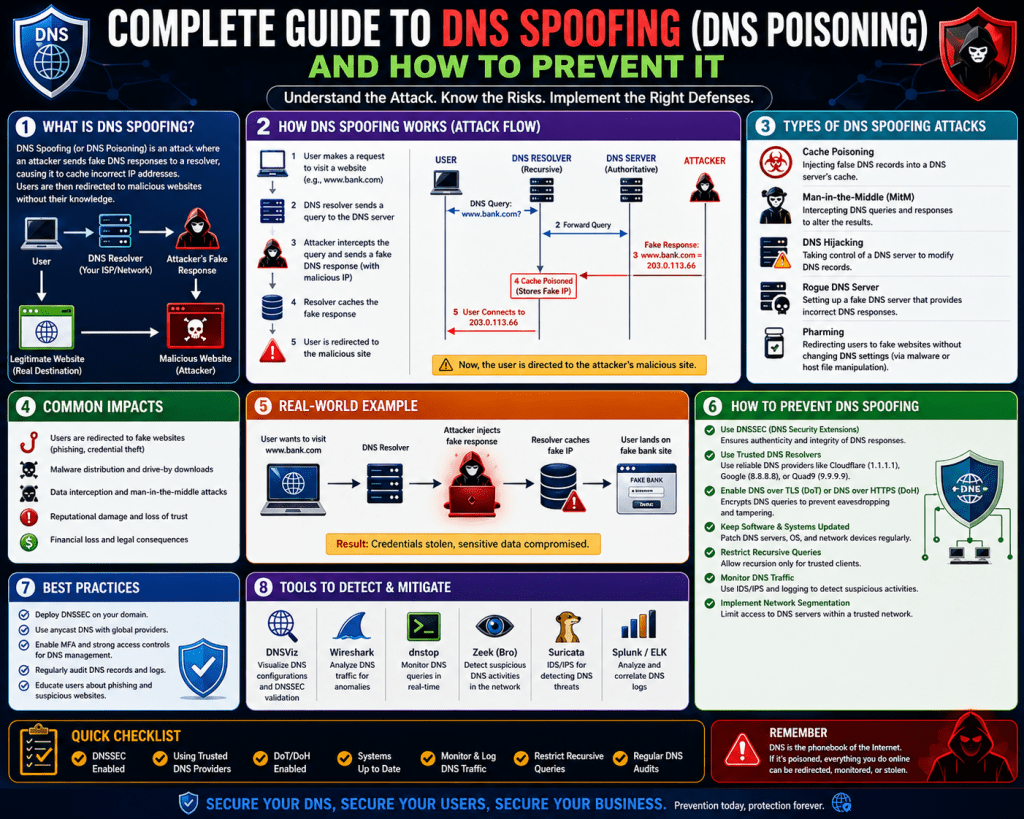
DNS spoofing is a network-layer exploitation technique where adversaries interfere with the normal translation process between human-readable identifiers and machine-resolvable network addresses. Under normal conditions, this translation process operates through a structured query-response mechanism that relies on distributed resolution nodes. These nodes collaborate to ensure that a requested identifier is mapped to the correct destination address. When this process is manipulated, the integrity of network communication is compromised at a foundational level, allowing attackers to silently redirect traffic without user awareness.
The significance of this attack lies in its position within the communication stack. Instead of targeting applications or endpoints directly, DNS spoofing intervenes at the resolution layer, which is one of the earliest stages of network interaction. This positioning allows attackers to influence a large volume of traffic before higher-level security mechanisms even become aware that a connection has been initiated. As a result, the attack has both broad reach and subtle execution characteristics, making it difficult to detect in real time.
Structural Role of the Domain Name System in Digital Communication
The domain name system functions as a distributed hierarchical naming architecture designed to convert readable identifiers into numerical network addresses required for routing traffic. Every time a user initiates a request to access a digital service, a resolution process begins, traversing multiple layers of lookup systems until a final mapping is retrieved. This process is essential for usability because it eliminates the need for users to memorize numerical addresses for every service they access.
At a technical level, this system is composed of recursive resolvers, authoritative sources, and caching intermediaries. Recursive resolvers handle initial queries, authoritative sources provide verified mappings, and caching systems store previously resolved data to improve efficiency. While this architecture is highly optimized for performance and scalability, it introduces multiple points where data integrity can be influenced if proper validation controls are not enforced.
The reliance on distributed trust within this structure means that each layer assumes the accuracy of responses received from other layers. This assumption is a critical design principle that enables efficiency but also creates opportunities for malicious interference when trust boundaries are violated.
Core Operational Mechanism Behind DNS Spoofing Attacks
DNS spoofing operates by disrupting the normal flow of resolution data and inserting falsified mapping information into the communication process. This can occur through multiple interception or injection methods, depending on the attacker’s position relative to the communication flow. Once incorrect mapping data is introduced and accepted by a resolving system, it may be stored temporarily in cache memory, allowing repeated redirection of future requests.
A key element in this process is response timing. In many resolution environments, the first valid response received is considered authoritative for that query session. Attackers exploit this behavior by sending forged responses that reach the target system faster than legitimate ones. If the forged response is accepted first, it overrides the correct mapping and becomes the active resolution reference.
This mechanism does not require continuous interaction once successful injection has occurred. Instead, the compromised mapping persists within cached records, allowing long-term redirection effects even after the initial attack phase has ended. This persistence significantly increases the efficiency and impact of the attack.
Trust Dependency and Vulnerability in Resolution Architecture
The effectiveness of DNS spoofing is closely tied to the inherent trust model embedded within network resolution systems. These systems prioritize speed and scalability, often assuming that incoming responses are legitimate unless proven otherwise. This design choice reduces computational overhead but introduces a structural weakness when adversaries are able to insert false data into the communication flow.
In environments where verification mechanisms are weak or absent, this trust assumption becomes a critical vulnerability. Attackers exploit this by crafting responses that mimic legitimate resolution data structures, making it difficult for systems to distinguish between authentic and manipulated entries. Once trust is violated at this level, all dependent communication layers are indirectly affected.
This dependency chain means that even secure applications can be compromised if the underlying resolution process is manipulated. The attack does not need to break application-level security directly; instead, it undermines the foundation upon which those applications rely.
Caching Behavior and Persistence of Malicious Mapping Data
Caching is a performance optimization mechanism that stores previously resolved address mappings for a defined period. This reduces the need for repeated resolution queries and improves overall system efficiency. However, this same mechanism becomes a persistence vector when malicious data is introduced.
Once falsified mapping data is stored in a cache, all subsequent requests referencing that entry will follow the compromised route until the cache entry expires or is manually cleared. This creates a sustained period of vulnerability where users continue to be redirected without any active attack being present.
The persistence effect is particularly dangerous in large-scale environments where caching systems serve multiple users simultaneously. A single corrupted entry can influence a wide range of traffic, amplifying the impact of the initial compromise.
Communication Interception and Response Manipulation Techniques
In some scenarios, attackers position themselves between the requesting system and resolution infrastructure, allowing them to intercept and modify queries or responses in transit. This intermediary position enables real-time manipulation of resolution data without requiring direct access to the original authoritative source.
By injecting modified responses into this communication flow, attackers can redirect traffic dynamically based on observed queries. This approach allows for highly targeted manipulation, where specific requests are redirected while others remain unaffected, reducing the likelihood of immediate detection.
This form of interception relies heavily on exploiting weaknesses in transport security or leveraging compromised network segments. When communication channels lack proper integrity verification, intercepted data can be altered without triggering visible errors at the application level.
Systemic Exploitation Through Configuration Weaknesses
DNS infrastructures often rely on configuration settings that balance performance with compatibility. In many cases, these settings may prioritize faster resolution over strict validation of response authenticity. Attackers exploit these design decisions by targeting environments where validation checks are minimal or inconsistently applied.
Misconfigured resolution forwarding rules, outdated software components, and weak authentication mechanisms for administrative access all contribute to increased vulnerability. When these weaknesses are combined, they create multiple entry points for attackers to inject falsified resolution data.
In such environments, attackers do not necessarily need advanced exploitation techniques. Instead, they take advantage of operational oversights that reduce the security posture of the resolution infrastructure.
Impact on Data Integrity and Communication Reliability
Once DNS spoofing successfully alters resolution pathways, the integrity of data communication becomes compromised. Users may unknowingly interact with systems that are visually identical to legitimate services but are controlled by malicious actors. This enables unauthorized data collection, credential interception, and potential distribution of malicious content.
The broader impact extends beyond individual user sessions. In enterprise environments, compromised resolution data can affect internal communication flows, service dependencies, and authentication processes. This can lead to widespread operational disruption, particularly in systems that rely heavily on centralized resolution services.
The indirect nature of this attack makes it especially dangerous because the visible symptoms often appear unrelated to the root cause. Users may experience service inconsistencies without realizing that the resolution layer has been compromised.
Propagation Dynamics and Scale of Influence in Network Systems
One of the defining characteristics of DNS spoofing is its ability to propagate through shared resolution infrastructure. When a centralized or widely used resolver is compromised, the effects can extend across multiple users and systems simultaneously. This creates a multiplier effect where a single point of compromise influences a large network segment.
The scale of influence depends on the structure of the resolution environment and the extent of caching propagation. In highly distributed systems, the impact may be localized, while in centralized systems, the impact can be widespread and persistent.
This propagation dynamic makes DNS spoofing particularly valuable to attackers seeking broad disruption or large-scale data interception without needing to compromise multiple endpoints individually.
Advanced DNS Spoofing Techniques in Modern Attack Architectures
DNS spoofing techniques have evolved alongside network infrastructure, becoming more adaptive, stealth-oriented, and layered in execution. Modern attackers rarely rely on a single method; instead, they combine multiple manipulation strategies to increase success rates and reduce detection probability. These techniques operate by targeting weaknesses in resolution timing, caching behavior, and trust validation processes.
At a structural level, DNS spoofing attacks are designed to exploit the deterministic nature of resolution systems. Because queries follow predictable patterns, attackers can anticipate when and how responses will be generated. This predictability enables them to inject falsified data at precise moments in the communication cycle, maximizing the likelihood that their response is accepted as legitimate.
Response Forgery and Packet Manipulation Strategies
One of the most widely used techniques involves forging resolution responses that mimic legitimate server replies. These forged responses are constructed to match expected query identifiers, transaction parameters, and timing windows. When executed correctly, they appear indistinguishable from authentic responses at the protocol level.
Attackers often flood a target resolver with multiple crafted responses in rapid succession. This increases the probability that at least one forged packet will arrive before the legitimate response. Once the incorrect response is accepted, it becomes part of the system’s resolution state, allowing further traffic redirection.
This method relies heavily on speed advantage and prediction accuracy. The attacker must anticipate the query and respond faster than legitimate infrastructure, which often requires proximity to the network path or optimized attack infrastructure positioned strategically within routing proximity.
Cache Injection and Persistent Resolution Corruption
Caching systems play a critical role in reducing query latency by storing previously resolved mappings. However, this optimization creates a persistent attack surface when incorrect data is introduced. Cache injection techniques focus on inserting falsified mappings directly into these temporary storage systems.
Once injected, the corrupted entry remains active until it expires or is overwritten by a legitimate update. During this period, all subsequent queries referencing the affected identifier will be resolved using the malicious mapping. This creates a sustained redirection state that does not require continuous attacker involvement.
The persistence of cache-based manipulation makes it particularly effective in large-scale environments where resolution data is reused across multiple sessions and users. Even a single compromised cache entry can influence repeated interactions over extended periods.
Exploitation of Weak Resolution Validation Mechanisms
Many resolution systems still operate with minimal response verification, relying on implicit trust rather than cryptographic validation. Attackers exploit this gap by crafting responses that conform to expected structural formats while containing falsified mapping data.
In such environments, the absence of strict verification allows malicious responses to be accepted as legitimate without additional scrutiny. This structural weakness is especially prevalent in systems that prioritize backward compatibility or performance efficiency over security enforcement.
When validation mechanisms are incomplete or inconsistently applied, attackers can systematically introduce falsified entries without triggering defensive alerts. This creates a silent compromise condition that can persist undetected for long periods.
Interception-Based Traffic Manipulation Models
Beyond direct injection, attackers may position themselves within the communication pathway between resolution clients and servers. This intermediary position allows them to observe, alter, or replace responses in transit. This method is often associated with network-level compromise scenarios where attackers gain access to routing paths or shared infrastructure.
Once positioned within this pathway, attackers can selectively modify resolution responses based on query content or target identity. This allows for highly granular control over redirection behavior, enabling targeted attacks rather than broad systemic compromise.
This interception model is particularly effective in environments where encryption or integrity validation is not consistently enforced across all communication segments.
Timing Manipulation and Race Condition Exploitation
DNS resolution systems often accept the first valid response received for a given query. Attackers exploit this behavior through timing manipulation techniques designed to outpace legitimate responses. This creates a race condition where multiple responses compete for acceptance.
By sending forged responses at precisely calculated intervals, attackers increase the probability of winning this race condition. Once the malicious response is accepted, it overrides legitimate data and becomes part of the active resolution state.
This technique is highly dependent on network latency analysis and response prediction modeling. Attackers may simulate or measure response times to optimize their injection timing for maximum effectiveness.
Distributed Attack Coordination and Amplification
In more advanced scenarios, DNS spoofing may be executed using distributed systems where multiple attacker nodes coordinate response injection. This distributed approach increases the likelihood of successful manipulation by introducing multiple simultaneous forged responses into the resolution environment.
This coordination reduces dependency on a single attack point and increases resilience against detection or blocking mechanisms. Even if some injected responses are filtered or delayed, others may still succeed in being accepted by the resolver.
Distributed coordination also allows attackers to simulate legitimate traffic patterns, making malicious activity harder to distinguish from normal resolution behavior.
Hybrid Exploitation Using Behavioral and Technical Layers
Modern DNS spoofing campaigns often combine technical manipulation with behavioral exploitation techniques. While technical methods focus on altering resolution data, behavioral methods influence user interaction patterns to increase exposure to compromised routes.
For example, users may be guided toward initiating resolution requests that are already known to be manipulated. Once interaction begins, technical spoofing mechanisms ensure that the resolution process is redirected without visible disruption.
This hybrid approach increases success rates by addressing both system-level vulnerabilities and human decision-making patterns simultaneously.
Exploitation of Forwarding and Recursive Resolution Chains
Resolution systems often rely on forwarding mechanisms where queries are passed between multiple recursive nodes before reaching authoritative sources. Each hop in this chain represents a potential interception or manipulation point.
Attackers exploit this layered structure by targeting weaker nodes within the chain. Once a single intermediate resolver is compromised, it can influence all upstream and downstream resolution behavior connected to it.
This chain-based exploitation is particularly dangerous because it allows attackers to propagate falsified data across multiple resolution layers without directly compromising the final authoritative source.
Manipulation of Temporary Resolution States
Resolution systems maintain temporary states that store partial or intermediate query results during processing. These states can be manipulated to influence final resolution outcomes.
Attackers may inject falsified data into these temporary states, causing incorrect resolution decisions to be finalized and stored. Because these states are transient by design, they are often less strictly monitored than permanent records, making them attractive targets for exploitation.
Once incorrect data is promoted from temporary state to cached or active state, it becomes significantly more persistent and impactful.
Stealth Techniques for Avoiding Detection
Advanced DNS spoofing operations prioritize stealth to prolong attack duration. Techniques used to avoid detection include mimicking legitimate traffic patterns, randomizing injection timing, and limiting the scope of affected queries.
By blending malicious responses into normal traffic behavior, attackers reduce the likelihood of triggering anomaly detection systems. This allows compromised resolution states to persist without immediate remediation.
Stealth strategies are often combined with selective targeting, where only specific queries are manipulated while others remain unaffected to maintain operational camouflage.
Long-Term Persistence Through Controlled Update Suppression
In some cases, attackers attempt to suppress or delay legitimate updates to resolution data. By interfering with update propagation mechanisms, they ensure that falsified mappings remain active for longer durations.
This suppression may involve blocking update propagation paths or injecting conflicting data that prevents overwriting of malicious entries. The goal is to maintain control over resolution outcomes for extended periods without repeated intervention.
This technique is particularly effective in environments where update cycles are infrequent or rely on hierarchical propagation systems.
Cross-System Influence Through Shared Resolution Dependencies
Many systems rely on shared resolution infrastructure, meaning a single compromised resolver can influence multiple dependent systems simultaneously. Attackers leverage this dependency to extend the impact of a single successful spoofing event across multiple environments.
When shared infrastructure is compromised, the resulting effect is not isolated but distributed across all systems relying on that resolver. This amplifies the severity of the attack and increases recovery complexity.
The interconnected nature of modern networks makes this form of influence especially impactful in large-scale environments where centralized resolution services are heavily utilized.
Detection Mechanisms for DNS Spoofing in Modern Network Environments
Detecting DNS spoofing requires a structured approach centered on behavioral analysis, anomaly identification, and validation consistency across resolution pathways. Because these attacks operate at the resolution layer, traditional endpoint-focused security tools are often insufficient on their own. Detection must therefore occur within the communication flow itself, focusing on how responses are generated, delivered, and interpreted.
One of the primary detection indicators is inconsistency in resolution outputs for identical queries over short time intervals. When the same identifier resolves to different network addresses without legitimate configuration changes, it suggests possible interference in the resolution process. These inconsistencies may appear sporadically or in patterns depending on the attacker’s method of injection.
Another critical indicator is unexpected latency variation in response delivery. Spoofed responses often arrive either significantly earlier or slightly delayed compared to baseline resolution timing. By analyzing response time distributions, it becomes possible to identify irregular patterns that deviate from normal operational behavior.
Anomaly-Based Behavioral Analysis in Resolution Traffic
Behavioral analysis plays a central role in identifying DNS spoofing activities. This approach involves establishing a baseline of normal resolution behavior and then continuously comparing live traffic against that baseline. Deviations from expected patterns are flagged for further investigation.
Such deviations may include sudden spikes in resolution failure rates, irregular routing changes, or unexpected shifts in resolved address clusters. When multiple anomalies occur simultaneously, the likelihood of resolution manipulation increases significantly.
Behavioral analysis is particularly effective because DNS spoofing often introduces subtle inconsistencies rather than overt failures. These subtle changes may not trigger traditional alerts but become visible when examined within a broader behavioral context.
Cryptographic Validation and Integrity Enforcement Models
One of the most effective defensive mechanisms against DNS spoofing is cryptographic validation of resolution data. This approach ensures that responses received from resolution systems are digitally signed and verifiable before being accepted.
When cryptographic validation is enforced, any modification of resolution data during transit invalidates the signature, preventing acceptance of falsified responses. This significantly reduces the feasibility of successful spoofing attempts.
Integrity enforcement also extends to ensuring that resolution chains maintain trust continuity across all intermediary nodes. If any link in the chain fails validation, the response is rejected, preventing propagation of corrupted data.
Secure Resolution Pathway Architecture
Secure resolution architecture involves designing systems in which every stage of the resolution process is protected by verification controls. This includes recursive validation, authenticated forwarding, and strict separation between trusted and untrusted resolution zones.
By segmenting resolution infrastructure, the impact of potential compromise is limited to isolated sections rather than entire systems. This reduces the ability of attackers to propagate falsified data across multiple layers.
Secure pathways also incorporate redundancy mechanisms, allowing resolution data to be cross-verified across multiple independent sources before final acceptance. This reduces reliance on a single point of trust.
Traffic Inspection and Pattern Recognition Systems
Advanced monitoring systems analyze resolution traffic at a granular level, inspecting packet structure, origin consistency, and response timing. These systems are capable of identifying subtle deviations that may indicate spoofing activity.
Pattern recognition algorithms are used to detect irregular clustering of resolution changes or repeated redirection behavior for specific identifiers. When such patterns emerge, they are flagged for deeper forensic analysis.
Traffic inspection also includes validation of response origin consistency. If responses claiming to originate from authoritative sources exhibit inconsistent network behavior, they may be classified as suspicious.
Role of Controlled Update Mechanisms in Prevention
Controlled update mechanisms ensure that resolution data modifications occur only through authenticated and verified channels. This prevents unauthorized injection of falsified mappings into active systems.
By restricting update pathways, systems reduce the likelihood of external manipulation. Updates are validated before being applied, ensuring that only legitimate changes affect resolution behavior.
Controlled updates also include rollback capabilities, allowing systems to revert to previously verified states if anomalies are detected. This helps restore integrity after suspected compromise.
Monitoring Recursive Resolution Dependencies
Recursive resolution systems operate through a chain of interconnected queries, where each step depends on the accuracy and integrity of the previous one. This multi-layered structure increases efficiency but simultaneously expands the attack surface. Every intermediary resolver, forwarder, or cache node becomes a potential interception or manipulation point. Monitoring these dependencies is not just beneficial but essential for maintaining resolution integrity across distributed environments.
Effective monitoring requires visibility into the full resolution path rather than isolated checkpoints. Security systems must trace how a query propagates from the initiating client through recursive layers to the final authoritative source. This includes analyzing response timing, consistency of returned data, and the behavior of intermediate nodes. Even slight deviations in expected behavior, such as inconsistent response origins or unexpected routing paths, can indicate interference within the chain.
Each recursive step introduces latency, transformation, and dependency, which can be exploited by attackers. For instance, if a single intermediary node is compromised, it can inject falsified data that propagates downstream, affecting multiple systems relying on that node. Continuous tracking of these dependencies helps identify weak points where trust boundaries are insufficiently enforced.
Dependency monitoring also plays a critical role in tracing the origin of manipulated data. By mapping how resolution responses travel across systems, security teams can identify propagation patterns and isolate the exact node responsible for the anomaly. This level of traceability enables faster containment and reduces the risk of widespread impact.
Infrastructure Hardening Through Access Control Segmentation
Access control segmentation is a foundational security strategy that limits exposure by restricting who can interact with critical resolution infrastructure. In DNS environments, configuration changes can directly influence traffic routing, making administrative access a high-risk vector if not properly controlled.
Segmentation begins with defining clear boundaries between operational roles. Not all users or systems require full administrative privileges. By implementing role-based access control, organizations ensure that permissions are granted strictly based on necessity. This minimizes the number of entities capable of modifying resolution records or system configurations.
In addition to role segmentation, layered authentication mechanisms provide an added level of protection. Multi-step verification processes ensure that even if credentials are compromised, unauthorized changes cannot be easily executed. This significantly reduces the likelihood of internal misuse or external exploitation through stolen access credentials.
Infrastructure hardening also includes isolating management interfaces from general network traffic. Administrative operations should occur within secured environments that are not directly exposed to external communication channels. This separation reduces the risk of unauthorized access through network-based attacks.
Regular auditing of access logs further strengthens this approach. By continuously reviewing who accessed the system, when, and what changes were made, organizations can quickly detect suspicious behavior and respond before significant damage occurs.
Real-Time Response Validation Techniques
Real-time validation introduces an immediate verification layer that evaluates resolution responses before they influence routing decisions. This proactive approach ensures that falsified data is identified at the earliest possible stage, reducing the risk of traffic misdirection.
Validation processes typically involve comparing incoming responses against trusted references or previously established resolution patterns. If a response deviates significantly from expected values, it is flagged for further inspection or rejected outright. This prevents malicious entries from being integrated into active system states.
Another important aspect of real-time validation is consistency checking. Systems analyze whether repeated queries produce stable and predictable results. Inconsistent outputs for identical queries may indicate manipulation attempts, triggering defensive actions such as response rejection or alternative resolution pathways.
Real-time validation also benefits from redundancy. By querying multiple independent sources and comparing their responses, systems can determine which data is most reliable. This cross-verification reduces reliance on a single point of trust and enhances overall accuracy.
The effectiveness of real-time validation depends on its ability to operate without introducing significant latency. Optimized validation algorithms ensure that security checks are performed efficiently, maintaining performance while enhancing protection.
Long-Term Integrity Monitoring and Historical Analysis
While real-time validation addresses immediate threats, long-term monitoring focuses on identifying patterns that develop over extended periods. Some spoofing attempts are designed to be subtle and gradual, making them difficult to detect through short-term observation alone.
Historical analysis involves collecting and analyzing resolution data over time to establish baseline behavior patterns. These baselines include normal response distributions, typical routing paths, and expected frequency of resolution changes. Once established, they serve as reference points for identifying anomalies.
Persistent anomalies, even if minor, can indicate ongoing manipulation. For example, repeated slight variations in resolution results for specific identifiers may suggest targeted spoofing efforts. By correlating these variations across time, security systems can detect patterns that would otherwise remain hidden.
Maintaining historical records also aids in forensic analysis after an incident. By reviewing past resolution behavior, investigators can trace when the manipulation began, how it evolved, and which systems were affected. This information is crucial for both remediation and future prevention.
Long-term monitoring also supports predictive analysis. By identifying recurring trends and patterns, systems can anticipate potential attack vectors and implement preventive measures before exploitation occurs.
Propagation Containment and Isolation Strategies
Once DNS spoofing is detected, rapid containment is essential to prevent further spread. Because resolution systems are interconnected, a single compromised node can influence multiple downstream systems. Isolation strategies aim to break this chain of influence.
Isolation typically involves removing or restricting access to affected nodes within the resolution infrastructure. This prevents them from continuing to distribute falsified data. Traffic may be rerouted through secure fallback systems that are verified to be uncompromised, ensuring continuity of service while remediation takes place.
Another containment approach involves disabling or clearing compromised caching mechanisms. Since cached data can persist beyond the initial attack, removing these entries eliminates the source of continued redirection. This step is critical in stopping the spread of manipulated mappings.
Containment strategies must balance security with operational continuity. Abruptly shutting down resolution services can disrupt legitimate communication, so controlled isolation methods are preferred. These methods allow systems to remain functional while limiting exposure to compromised data.
Effective containment also requires coordination across all affected systems. Without synchronized action, isolated remediation efforts may fail to fully eliminate the threat, allowing compromised nodes to reinfect cleaned systems.
Recovery and Restoration of Resolution Integrity
After containment, the next step is restoring the integrity of the resolution environment. This involves removing all traces of falsified data and re-establishing trust across the system.
The first stage of recovery typically includes clearing all cached resolution entries to eliminate any remaining manipulated data. This ensures that future queries are resolved using fresh and verified information rather than previously compromised records.
Revalidation of resolution data is another critical step. Systems must re-query authoritative sources and confirm that all mappings are accurate. This process may involve cross-verification with multiple trusted sources to ensure consistency.
In more severe cases, complete reconstruction of resolution infrastructure may be necessary. This includes rebuilding caches, reconfiguring resolution pathways, and re-establishing secure communication channels. While resource-intensive, this approach guarantees that no residual compromise remains.
Recovery also involves reviewing and strengthening security controls to prevent recurrence. Identifying how the spoofing occurred allows organizations to address underlying vulnerabilities and improve defensive measures.
Adaptive Defense Systems and Predictive Modeling
Modern security environments increasingly rely on adaptive defense systems that evolve based on observed threats. These systems use machine learning and behavioral analytics to identify patterns associated with DNS spoofing and adjust detection mechanisms accordingly.
Adaptive systems continuously refine their understanding of normal resolution behavior. When deviations occur, they analyze the context and determine whether the anomaly represents a potential threat. Over time, this learning process improves detection accuracy and reduces false positives.
Predictive modeling enhances this capability by forecasting potential attack scenarios based on historical data. By analyzing trends and recurring patterns, systems can anticipate where and how spoofing attempts may occur. This allows for proactive adjustments to security policies and monitoring thresholds.
These adaptive approaches are particularly valuable in defending against advanced spoofing techniques that evolve over time. Static defenses may become ineffective as attackers develop new methods, but adaptive systems remain responsive and resilient.
Systemic Importance of Continuous Validation Cycles
Continuous validation represents a shift from static trust models to dynamic verification processes. Instead of assuming that once-validated data remains trustworthy, systems repeatedly verify resolution accuracy throughout the communication lifecycle.
This approach ensures that any delayed or persistent manipulation attempts are detected even after initial validation. For example, if cached data is altered after being verified, continuous validation processes will identify the discrepancy and trigger corrective actions.
Continuous validation also reduces reliance on singular points of verification. By performing checks at multiple stages, systems create a layered defense model where failures in one layer can be detected and corrected by another.
Another advantage of continuous validation is its ability to adapt to changing network conditions. As infrastructure evolves, validation processes adjust accordingly, maintaining effectiveness without requiring constant manual reconfiguration.
Ultimately, continuous validation strengthens overall system resilience by ensuring that trust is not assumed but continuously earned. This dynamic approach is essential in environments where threats are constantly evolving and static defenses are no longer sufficient.
Conclusion
DNS spoofing represents one of the most structurally significant threats in modern network communication because it does not target applications directly, but instead undermines the foundational resolution layer that every connected service depends on. By interfering with how identifiers are translated into routing destinations, attackers gain the ability to silently redirect traffic without requiring user interaction beyond normal browsing behavior. This makes the attack especially dangerous because it operates beneath the visibility threshold of most conventional security controls, often leaving users unaware that any manipulation has occurred.
The core danger of DNS spoofing lies in its ability to exploit trust assumptions embedded within network architecture. Most resolution systems are designed to prioritize speed, scalability, and availability. These priorities mean that responses are frequently accepted based on structural conformity rather than cryptographic certainty. When this trust model is compromised, the entire communication chain becomes vulnerable to misdirection. Even highly secure applications cannot fully protect users if the underlying resolution process has been altered before the connection is established.
Another critical factor is the persistence mechanism created through caching behavior. Once falsified resolution data is stored within intermediate systems, it can continue to influence traffic long after the initial attack has ended. This persistence allows attackers to achieve long-term impact with minimal ongoing effort. In practical terms, a single successful injection can affect multiple sessions, users, or even entire organizational environments depending on how widely cached data is shared and reused. This amplifies the scale of damage significantly compared to attacks that require continuous active presence.
The indirect nature of DNS spoofing also makes detection particularly challenging. Because the attack does not necessarily break communication but instead subtly alters routing paths, users may still receive functional responses from malicious destinations. These destinations often replicate legitimate services closely enough to avoid immediate suspicion. As a result, users may unknowingly interact with compromised systems while believing they are operating within a trusted environment. This subtle deception increases the likelihood of credential theft, data exposure, and secondary exploitation.
From an infrastructure perspective, DNS spoofing exposes the importance of validation and verification mechanisms within distributed systems. Environments that lack strict integrity checks are significantly more vulnerable because they accept responses without confirming authenticity at a deeper structural level. Introducing cryptographic validation methods and integrity enforcement layers reduces this risk by ensuring that any alteration of data during transmission invalidates the response. However, inconsistent adoption of such protections across global systems continues to leave gaps that attackers can exploit.
Another important dimension is the role of network configuration and operational hygiene. Many successful spoofing incidents are not the result of highly sophisticated exploitation but rather weaknesses in configuration, outdated systems, or insufficient access controls. Misconfigured resolution pathways, weak administrative authentication, and legacy protocol dependencies all contribute to increased exposure. This highlights that DNS spoofing is not solely a theoretical or advanced threat, but a practical risk influenced heavily by maintenance practices and system governance.
The scale of impact also varies depending on the structure of resolution infrastructure. Centralized or heavily shared resolution systems can amplify the effects of a single compromise, allowing attackers to influence large volumes of traffic simultaneously. In contrast, more segmented and isolated architectures can limit propagation and reduce systemic exposure. This difference emphasizes the importance of architectural design in determining overall resilience against spoofing attempts.
Detection and response strategies must therefore operate at multiple layers. Real-time monitoring of resolution behavior, anomaly detection based on traffic patterns, and historical analysis of resolution consistency all contribute to identifying potential manipulation. However, detection alone is not sufficient without corresponding containment and recovery mechanisms. Once spoofing is identified, systems must be capable of isolating affected nodes, clearing corrupted cached data, and restoring verified resolution states to prevent continued exposure.
The evolving nature of DNS spoofing techniques further complicates defense strategies. Attackers continuously refine their methods by combining timing manipulation, distributed response injection, and hybrid behavioral exploitation. These adaptations make it difficult to rely on static defensive rules. Instead, security systems must adopt adaptive models that evolve based on observed behavior patterns and emerging threats. This shift toward dynamic defense is essential for maintaining long-term resilience.
At a broader level, DNS spoofing underscores the importance of trust management in digital systems. The internet’s foundational architecture relies heavily on implicit trust relationships between distributed components. When those trust relationships are manipulated, the consequences extend far beyond individual sessions or isolated users. They affect the integrity of communication ecosystems as a whole. This makes DNS security not just a technical concern, but a structural requirement for maintaining reliable digital interaction.
Ultimately, protecting against DNS spoofing requires a combination of technical controls, operational discipline, and continuous validation. No single mechanism is sufficient on its own. Instead, layered defenses that include verification protocols, secure configuration practices, traffic monitoring, and adaptive response systems must work together to reduce exposure. The goal is not only to detect attacks after they occur but to reduce the conditions that allow them to succeed in the first place.
As digital environments continue to expand and become more interconnected, the importance of securing resolution systems will only increase. DNS remains one of the most fundamental components of internet communication, and any compromise at this level has far-reaching consequences. Strengthening its resilience is therefore essential for ensuring the stability, security, and trustworthiness of modern networked systems.