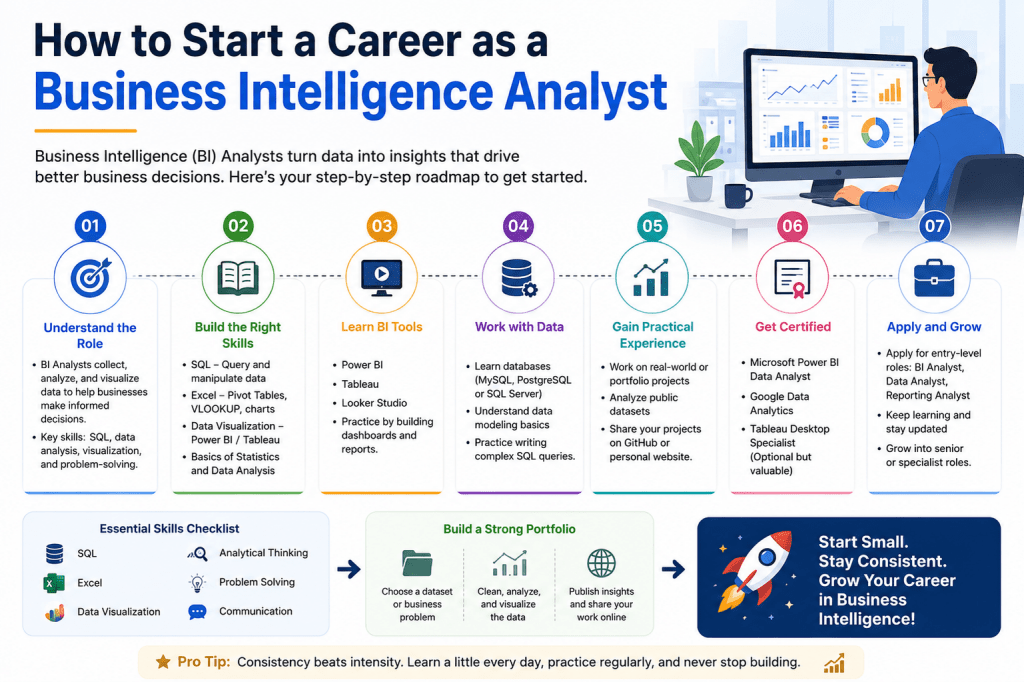
Business intelligence has become one of the most important areas in modern organizations because companies now rely heavily on data to make decisions. Every interaction, transaction, customer activity, and operational process creates information that businesses want to understand. A Business Intelligence Analyst helps transform this raw information into meaningful insights that guide strategies, improve performance, and support long-term growth. This role combines technical expertise with business understanding, making it an attractive career path for people who enjoy both technology and problem-solving.
A Business Intelligence Analyst works closely with data, software tools, business managers, and company leadership. Their primary responsibility is to analyze data and create reports that help organizations make smarter decisions. Instead of relying on guesswork, businesses use analytics to identify trends, forecast outcomes, and discover opportunities for improvement. The analyst becomes the bridge between technical systems and business objectives.
The growing importance of digital transformation has increased the demand for skilled analysts across industries. Companies in healthcare, finance, retail, logistics, manufacturing, education, and technology all depend on data-driven strategies. As businesses collect larger amounts of information, the need for professionals who can organize and interpret data continues to grow rapidly. This demand makes business intelligence one of the most promising career choices for individuals with analytical thinking and technical knowledge.
Why Business Intelligence Is a Strong Career Choice
One of the biggest reasons people pursue a career in business intelligence is the combination of stability, growth potential, and career flexibility. Organizations are continuously investing in analytics platforms and data infrastructure because competition is becoming more data-focused. Companies that understand customer behavior, operational efficiency, and market trends gain significant advantages over competitors.
Business intelligence also offers opportunities for career advancement. Many professionals begin as junior analysts and eventually move into senior analyst positions, analytics management, data science, consulting, or executive leadership roles. Because BI professionals work closely with decision-makers, they gain exposure to strategic planning and business operations. This exposure helps develop management skills that can lead to higher-level responsibilities.
Another reason this field attracts many professionals is the variety of work involved. Business intelligence analysts do more than create spreadsheets or reports. They investigate problems, identify trends, automate processes, visualize information, and communicate findings to stakeholders. Every project introduces new challenges and opportunities to learn. This variety keeps the work dynamic and intellectually engaging.
The profession also allows individuals from different backgrounds to transition into analytics careers. IT professionals, database administrators, software developers, financial analysts, and even business graduates can enter the field by developing the right combination of skills. Technical knowledge is valuable, but curiosity, communication, and critical thinking are equally important.
How Data Changed Modern Business Operations
In earlier years, businesses collected data mainly for recordkeeping purposes. Information was stored in basic databases and used for limited reporting activities. As technology evolved, companies gained access to affordable storage systems, cloud computing, and advanced analytics platforms. This shift allowed organizations to collect enormous amounts of information from websites, applications, sensors, customer interactions, and internal systems.
Modern businesses now use analytics to understand customer preferences, improve operational efficiency, optimize marketing strategies, and predict future outcomes. Instead of reacting to problems after they occur, companies use data to make proactive decisions. This approach improves productivity and helps businesses stay competitive in rapidly changing markets.
Business intelligence analysts play a major role in this transformation. They gather data from multiple sources, clean and organize it, analyze patterns, and present findings in understandable formats. Their insights influence decisions related to product development, customer service, financial planning, inventory management, and strategic growth.
As organizations continue adopting digital technologies, the importance of data analytics keeps increasing. Businesses no longer see analytics as optional. Instead, data-driven decision-making has become a core part of modern business strategy.
The Core Responsibilities of a BI Analyst
A Business Intelligence Analyst performs several important tasks that support organizational decision-making. One of the most important responsibilities is collecting and organizing data from various systems. This data may come from customer databases, financial applications, sales systems, or operational software platforms.
Once the data is gathered, the analyst cleans and structures it to ensure accuracy. Raw data often contains errors, duplicate records, or missing information. Without proper preparation, analysis can produce misleading results. Data cleaning is therefore one of the most critical stages in the analytics process.
After preparing the data, analysts use tools and programming languages to identify patterns and trends. They may compare historical performance, analyze customer behavior, or evaluate operational efficiency. These insights help organizations understand what is happening within the business and why certain outcomes occur.
Another important responsibility involves creating dashboards and reports. Executives and managers need clear visual representations of data that support quick decision-making. BI analysts design charts, graphs, and interactive dashboards that simplify complex information.
Communication is also a major part of the role. Analysts must explain technical findings to non-technical stakeholders in simple language. The ability to translate data into meaningful business recommendations is one of the qualities that separates successful analysts from purely technical professionals.
The Importance of Technical Skills in Business Intelligence
Technical skills form the foundation of business intelligence careers. Analysts work with databases, analytics software, and programming languages daily. Without strong technical knowledge, it becomes difficult to manage and interpret large datasets effectively.
One of the most essential technical skills is database management. Organizations store data in relational database systems, and analysts need to understand how these systems work. Structured Query Language, commonly known as SQL, is used to retrieve, manipulate, and analyze data within databases. SQL allows analysts to filter information, combine datasets, and generate reports efficiently.
Database knowledge also helps analysts understand how data flows through organizational systems. They learn how information is stored, connected, and accessed across different departments. This understanding improves analytical accuracy and supports better reporting.
In addition to databases, analysts must become familiar with data visualization platforms. Visualization tools help transform raw numbers into interactive charts and dashboards that are easy to understand. Effective visualization improves communication and helps stakeholders identify trends quickly.
Cloud technologies are also becoming increasingly important in analytics environments. Many organizations now store and process data using cloud-based platforms. Analysts who understand cloud systems gain an advantage because businesses continue migrating their infrastructure to modern cloud environments.
Technical expertise does not require becoming an advanced software engineer. However, analysts must feel comfortable working with databases, analytical tools, and automation technologies to succeed in the field.
Why SQL Is Essential for BI Analysts
SQL is often considered the most important technical skill for business intelligence professionals. Almost every organization stores information in databases, and SQL provides the ability to access and analyze that information efficiently.
Analysts use SQL to retrieve data from multiple tables, filter records, calculate metrics, and generate reports. A strong understanding of SQL helps professionals work faster and solve complex business problems more effectively. Since data analysis depends heavily on accurate information retrieval, SQL becomes a daily tool for most analysts.
Learning SQL also improves problem-solving abilities because analysts develop a deeper understanding of database structures and relationships. They learn how to connect different datasets and identify patterns that support business decisions.
Many employers prioritize SQL knowledge when hiring business intelligence professionals because it demonstrates technical competence and analytical capability. Even entry-level analyst positions usually require SQL familiarity.
As analysts progress in their careers, they often work with more advanced SQL functions involving automation, optimization, and large-scale data processing. Strong SQL skills create a solid foundation for future growth in analytics and data-related careers.
How Python Supports Business Intelligence Work
Python has become one of the most valuable programming languages in analytics because of its simplicity and flexibility. Many business intelligence professionals use Python to automate repetitive tasks, clean datasets, analyze trends, and create predictive models.
One reason Python is popular is its readability. Compared to many programming languages, Python is easier to learn and understand. This accessibility allows analysts to focus more on solving business problems instead of struggling with complicated syntax.
Python also supports powerful analytics libraries that simplify data processing. Analysts use these libraries to structure datasets, perform calculations, generate visualizations, and automate workflows. Instead of manually processing large amounts of information, Python allows professionals to complete tasks efficiently and accurately.
Automation is especially important in business intelligence because organizations often work with constantly changing datasets. Analysts may need to generate recurring reports, monitor business performance, or process information from multiple systems regularly. Python helps reduce manual effort while improving consistency and speed.
As businesses continue investing in artificial intelligence and advanced analytics, Python skills are becoming even more valuable. Learning Python not only supports business intelligence work but also opens pathways into data science and machine learning careers.
The Role of Data Visualization in Business Intelligence
Data visualization is one of the most visible aspects of business intelligence. Organizations rely on dashboards, reports, and charts to understand performance quickly. Without effective visualization, even the best analysis can become difficult to interpret.
Business intelligence analysts use visualization tools to present information clearly and professionally. Executives and managers often make decisions under time pressure, so reports must communicate insights efficiently. Well-designed dashboards allow leaders to identify trends, monitor performance, and respond to changes quickly.
Visualization also improves collaboration between departments. Teams across finance, sales, operations, and marketing can review the same dashboards and align their strategies using shared information.
Good visualization requires more than technical ability. Analysts must understand how people interpret information visually. Choosing the right chart type, organizing dashboards logically, and highlighting important metrics are all essential skills.
Interactive dashboards have become especially valuable because they allow users to explore data independently. Managers can filter information, compare performance periods, and investigate trends without relying entirely on technical teams.
Strong visualization skills help analysts communicate more effectively and increase the impact of their work within organizations.
Why Business Knowledge Matters in Analytics
Technical expertise alone is not enough to become a successful business intelligence analyst. Understanding how businesses operate is equally important because analytics exists to support organizational goals.
Analysts must understand financial metrics, operational processes, customer behavior, and strategic objectives. Without business context, data analysis can lose relevance. A report may be technically accurate but fail to answer meaningful business questions.
Business knowledge helps analysts identify which metrics matter most. For example, a retail company may prioritize customer retention and inventory turnover, while a healthcare organization focuses on patient outcomes and operational efficiency. Understanding these priorities allows analysts to create more valuable insights.
Communication also becomes easier when analysts understand business terminology and workflows. Stakeholders are more likely to trust recommendations from professionals who understand operational challenges and organizational goals.
Developing business knowledge often involves working closely with departments across the company. Analysts learn how different teams operate and how data supports decision-making at multiple levels.
The combination of technical and business expertise is what makes business intelligence professionals highly valuable in modern organizations.
Building Strong Analytical Thinking Skills
Analytical thinking is one of the most important qualities for a Business Intelligence Analyst because the role involves solving business problems using data. Companies do not simply need people who can create charts or run database queries. They need professionals who can identify patterns, uncover hidden problems, and provide actionable recommendations that improve operations and performance.
Analytical thinking starts with curiosity. Successful analysts constantly ask questions about why trends are happening, what factors influence outcomes, and how organizations can improve processes. Instead of accepting numbers at face value, they investigate deeper relationships within the data.
For example, if sales suddenly decline, a BI analyst does not stop at identifying the drop. They examine customer behavior, market conditions, operational issues, seasonal patterns, and competitor activity to determine the root cause. This ability to interpret information critically helps organizations make smarter decisions.
Problem-solving skills are equally valuable because analysts frequently encounter incomplete data, inconsistent reports, and technical limitations. They must develop logical solutions while maintaining accuracy and efficiency. Over time, analytical thinking becomes one of the defining characteristics that separate experienced professionals from beginners in the field.
Understanding Data Warehousing Concepts
Data warehousing is a major component of business intelligence because organizations store massive amounts of information from different systems in centralized repositories. A data warehouse allows businesses to combine information from multiple departments and create a unified source for reporting and analytics.
Business intelligence analysts often work with these warehouses to retrieve and analyze data efficiently. Understanding how data warehouses operate helps analysts create better reports and avoid inconsistencies in analysis.
Unlike traditional databases that focus on daily operations, data warehouses are designed specifically for analytical tasks. They organize historical data in a structured way that supports trend analysis and long-term reporting. This structure allows organizations to compare performance across months, quarters, or operational cycles.
Analysts also need to understand concepts such as data extraction, transformation, and loading processes. These processes move information from operational systems into analytical environments. During transformation, raw data is cleaned and standardized to improve consistency.
Knowledge of data warehousing improves an analyst’s ability to work with large datasets and create reliable business insights. As organizations continue expanding their digital operations, data warehouses remain essential for managing enterprise-level analytics.
Learning the Importance of Data Accuracy
One of the biggest challenges in analytics is ensuring data accuracy. Even advanced dashboards and sophisticated reports become useless if the underlying information is incorrect. Business intelligence analysts are responsible for maintaining trust in organizational data.
Data inaccuracies can occur for many reasons. Duplicate records, incomplete entries, human errors, software integration issues, and outdated systems all contribute to poor data quality. Analysts must identify these issues before performing analysis.
Data validation is therefore an important part of the analytics workflow. Analysts compare datasets, verify calculations, and monitor inconsistencies to ensure reports remain accurate. This process may seem repetitive, but it protects organizations from making poor decisions based on flawed information.
Strong attention to detail becomes extremely valuable in this area. Analysts must carefully examine datasets and identify small inconsistencies that could affect larger business conclusions. Even a minor reporting error can influence strategic decisions involving budgets, operations, or customer relationships.
Organizations increasingly recognize the importance of data governance and quality management. BI analysts who understand data integrity practices become highly valuable because they help maintain confidence in business reporting systems.
How Communication Skills Influence Success
Many people assume business intelligence is purely technical, but communication skills are equally important. Analysts spend significant time explaining findings, presenting reports, and discussing recommendations with managers and executives.
Technical knowledge alone does not create impact if stakeholders cannot understand the insights being presented. Analysts must simplify complex information and communicate clearly to audiences with varying technical backgrounds.
Presentation skills are especially important when delivering reports to leadership teams. Executives often prefer concise summaries focused on outcomes and recommendations rather than technical explanations. Analysts must tailor their communication style depending on the audience.
Collaboration also plays a major role in analytics projects. BI analysts work with IT teams, financial departments, operations managers, marketing professionals, and senior leadership. Effective communication improves teamwork and ensures everyone understands project goals and reporting requirements.
Listening skills are another overlooked aspect of communication. Analysts must understand business problems before analyzing data. By asking thoughtful questions and understanding organizational challenges, they can provide more relevant insights.
Professionals who combine technical expertise with strong communication abilities often progress faster in their careers because they become trusted advisors within organizations.
The Value of Dashboard Development Skills
Dashboards are one of the most recognizable outputs in business intelligence. Organizations rely on dashboards to monitor key performance indicators, track operational metrics, and evaluate business performance in real time.
A dashboard combines data visualization, reporting, and analytics into an interactive interface that decision-makers can easily understand. Instead of reviewing long spreadsheets, managers can view summarized metrics through charts, graphs, and visual indicators.
Business intelligence analysts design dashboards that align with organizational objectives. They determine which metrics matter most and organize information in ways that support quick decision-making. Effective dashboards simplify complex datasets while maintaining clarity and accuracy.
Dashboard development also requires understanding user experience principles. Reports should be intuitive, visually balanced, and easy to navigate. Poorly designed dashboards can overwhelm users with unnecessary information and reduce effectiveness.
Modern BI platforms provide advanced dashboard capabilities, including real-time updates, interactive filtering, and mobile accessibility. Analysts who master these tools improve organizational efficiency because stakeholders gain immediate access to important information.
Strong dashboard development skills increase an analyst’s value because businesses increasingly depend on visual analytics for operational monitoring and strategic planning.
Why Excel Still Matters in Business Intelligence
Although modern analytics platforms dominate the industry, Excel remains an important tool for business intelligence professionals. Many organizations still rely heavily on spreadsheets for reporting, budgeting, forecasting, and operational analysis.
Excel provides flexibility for quick calculations, data cleaning, pivot tables, and preliminary analysis. Analysts often use it during the early stages of projects before transferring data into advanced BI platforms.
Understanding formulas, conditional formatting, lookup functions, and pivot tables can significantly improve productivity. Many smaller businesses especially depend on Excel because it is accessible and widely understood across departments.
Excel also serves as a valuable learning platform for beginners entering analytics. It introduces fundamental concepts such as data organization, visualization, and trend analysis. Professionals who become comfortable with spreadsheet-based analysis often transition more easily into advanced analytics tools later.
Despite the rise of cloud-based analytics systems, Excel continues evolving with features related to automation, business intelligence integration, and data connectivity. Analysts who ignore Excel may struggle in environments where spreadsheets remain deeply integrated into business operations.
The best BI professionals understand how to combine traditional tools like Excel with modern analytics platforms to create efficient workflows and practical reporting solutions.
Developing a Strong Understanding of Business Metrics
Business intelligence analysts work with performance metrics daily, making it essential to understand how organizations measure success. Different industries prioritize different indicators, but every company depends on metrics to evaluate progress and identify opportunities.
Financial metrics often include revenue growth, profit margins, operating costs, and return on investment. Sales teams may focus on customer acquisition, conversion rates, and retention metrics. Operational departments monitor efficiency, productivity, and process performance.
A BI analyst must understand which metrics matter most for each business function. This understanding allows them to create meaningful reports and support strategic decision-making effectively.
Metrics also help organizations identify weaknesses before problems escalate. For example, declining customer retention rates may signal service quality issues or competitive pressures. Analysts help organizations detect these patterns early and respond proactively.
Understanding metrics requires both technical and business knowledge. Analysts must know how to calculate indicators accurately while understanding their practical significance within organizational strategy.
Professionals who develop strong business metric expertise become valuable contributors because they can connect analytical findings directly to operational performance and business goals.
How BI Analysts Support Decision-Making
One of the main purposes of business intelligence is improving organizational decision-making. Companies generate enormous amounts of information, but raw data alone does not create value. BI analysts convert information into insights that support better choices.
Decision-makers rely on analysts to provide accurate reports, identify risks, and highlight opportunities. This support allows organizations to reduce uncertainty and make informed strategic moves.
For example, analysts may help identify underperforming products, forecast customer demand, optimize supply chains, or improve employee productivity. Their findings influence both short-term operational decisions and long-term business planning.
Analysts also help organizations evaluate performance after implementing strategies. By monitoring results and comparing outcomes against objectives, companies can measure effectiveness and adjust plans accordingly.
The ability to support decision-making requires a balance between technical analysis and business understanding. Analysts must know which insights are most relevant and how to communicate recommendations clearly.
As businesses become increasingly data-driven, the influence of BI analysts on organizational strategy continues growing across industries.
The Growing Importance of Cloud Analytics
Cloud technology has transformed the way organizations manage and analyze data. Instead of relying entirely on on-premise infrastructure, businesses now use cloud platforms to store information, run analytics workloads, and scale operations efficiently.
Cloud analytics provides flexibility, cost savings, and improved accessibility. Teams can access dashboards and reports from multiple locations, supporting collaboration across departments and regions.
Business intelligence analysts increasingly work with cloud-based platforms because organizations continue modernizing their infrastructure. Understanding cloud environments improves career opportunities and prepares professionals for future industry trends.
Cloud platforms also support advanced analytics capabilities such as artificial intelligence, machine learning, and real-time data processing. Analysts who understand these systems gain exposure to more sophisticated analytical methods.
Security and data governance remain important considerations in cloud analytics environments. Analysts must understand how to manage sensitive information responsibly while maintaining compliance with organizational policies.
The shift toward cloud-based business intelligence continues accelerating, making cloud knowledge an increasingly valuable skill for aspiring analysts.
Why Continuous Learning Is Essential in BI Careers
Business intelligence is constantly evolving because technology, business strategies, and analytical methods continue changing rapidly. Professionals who stop learning may quickly fall behind industry trends and technical advancements.
Continuous learning helps analysts remain competitive and adaptable. New tools, programming languages, visualization platforms, and data management technologies emerge regularly. Staying updated improves efficiency and expands career opportunities.
Learning does not always require formal education. Many professionals develop skills through hands-on projects, online courses, certifications, technical communities, and practical workplace experience. Consistent practice often matters more than memorizing theoretical concepts.
Industry trends such as artificial intelligence, predictive analytics, automation, and big data processing are reshaping analytics careers. Analysts who embrace these technologies position themselves for long-term success.
Continuous learning also improves confidence. As professionals gain new skills, they become more comfortable handling complex datasets, solving advanced problems, and contributing to strategic initiatives.
The most successful business intelligence analysts maintain a mindset focused on growth, curiosity, and adaptability throughout their careers.
How Certifications Can Help a Business Intelligence Career
Certifications can play an important role in helping aspiring Business Intelligence Analysts build credibility and strengthen their resumes. While certifications alone do not guarantee success, they demonstrate commitment to learning and validate technical skills that employers often seek during hiring processes.
Many professionals entering the BI field use certifications to gain structured knowledge in databases, analytics platforms, data visualization, and cloud technologies. Certifications are especially helpful for individuals transitioning from other IT or business roles because they provide a recognized way to showcase expertise.
Technical certifications focused on SQL, data analysis, cloud systems, and visualization tools are among the most valuable. Employers often appreciate candidates who have completed professional training because it shows discipline and practical understanding of industry technologies.
Another advantage of certifications is the learning structure they provide. Many beginners feel overwhelmed by the wide range of analytics concepts available. Certification paths organize topics logically, helping learners focus on the most important skills first.
However, certifications should complement practical experience rather than replace it. Employers typically value hands-on problem-solving abilities more than theoretical knowledge alone. Combining certifications with real-world projects creates a much stronger professional profile.
Professionals who continue updating their certifications also demonstrate adaptability, which is important in an industry where technologies evolve rapidly.
The Importance of Hands-On Experience
Practical experience is one of the most valuable assets for a future Business Intelligence Analyst. Reading about analytics concepts helps build understanding, but applying those concepts in real projects develops true professional capability.
Hands-on practice allows aspiring analysts to work with messy datasets, solve technical problems, and create meaningful reports. Real-world data rarely arrives perfectly organized, so experience handling inconsistencies and errors becomes extremely important.
Many beginners start by creating personal projects using publicly available datasets. They practice cleaning data, building dashboards, writing SQL queries, and generating business insights. These projects help strengthen both technical and analytical skills.
Internships and entry-level positions also provide valuable exposure to professional analytics environments. Working within organizations teaches analysts how teams collaborate, how business requirements are gathered, and how reporting systems operate in practice.
Hands-on experience improves confidence as well. Many technical skills feel difficult initially, but regular practice gradually makes tools and workflows more familiar. Over time, analysts become more efficient and capable of handling larger and more complex projects.
Employers often prioritize practical skills because they demonstrate the ability to contribute immediately. A strong portfolio of projects can sometimes outweigh formal credentials when applying for analytics roles.
How Problem-Solving Defines Great Analysts
Business intelligence is fundamentally about solving problems. Organizations use analytics to understand challenges, improve efficiency, and discover opportunities for growth. Because of this, problem-solving becomes one of the most important qualities for successful analysts.
Problem-solving in BI involves more than identifying issues. Analysts must investigate causes, analyze data relationships, and recommend actionable solutions. This process requires patience, logical thinking, and creativity.
For example, a company experiencing declining customer satisfaction may ask analysts to identify the cause. The analyst might examine customer feedback, service response times, purchasing patterns, and operational data to uncover underlying problems.
Strong problem-solvers also understand that business challenges are rarely simple. Multiple factors often influence outcomes, requiring analysts to evaluate different possibilities before drawing conclusions.
Technical skills support problem-solving, but mindset matters equally. Successful analysts remain curious and persistent when facing difficult situations. They continue exploring data until they find meaningful insights that support business improvement.
Organizations value professionals who can solve problems independently because they reduce uncertainty and contribute directly to strategic success.
The Role of Critical Thinking in Business Intelligence
Critical thinking allows BI analysts to evaluate information objectively and make informed judgments. In analytics, data can sometimes appear misleading if interpreted without proper context. Analysts must therefore think carefully before presenting conclusions.
Critical thinking involves questioning assumptions, examining evidence, and considering alternative explanations. Analysts who rely solely on surface-level trends may overlook important details that influence business outcomes.
For example, increased website traffic might initially seem positive. However, deeper analysis could reveal declining conversion rates or reduced customer engagement. A critical thinker investigates these relationships rather than accepting metrics at face value.
This skill also helps analysts avoid biased conclusions. Data interpretation should remain objective and evidence-based rather than influenced by assumptions or personal opinions.
Critical thinking improves decision-making quality because it encourages thorough analysis and careful reasoning. Organizations depend on accurate insights, making this ability highly valuable in analytics environments.
Professionals who develop strong critical thinking skills often become trusted advisors because they consistently provide thoughtful and reliable recommendations.
How BI Analysts Work with Different Departments
Business intelligence analysts rarely work in isolation. They collaborate with multiple departments to gather requirements, analyze performance, and support organizational objectives.
Finance teams may need reports related to budgeting, profitability, or operational costs. Marketing departments often require customer behavior analysis and campaign performance insights. Operations managers may focus on efficiency, inventory management, and productivity metrics.
Working with different teams helps analysts understand how organizations function as interconnected systems. This understanding improves the quality of analysis because analysts can evaluate data within broader business contexts.
Collaboration also improves communication skills. Analysts learn how to explain technical findings to different audiences and adjust their approach depending on departmental needs.
In many organizations, BI analysts serve as connectors between technical teams and business leadership. They translate business goals into analytical projects while ensuring technical systems support operational objectives.
Professionals who collaborate effectively across departments often gain broader organizational influence and stronger career advancement opportunities.
Understanding Big Data in Modern Analytics
Big data refers to extremely large and complex datasets that traditional processing methods struggle to handle efficiently. As businesses generate more information through digital systems, social media, online transactions, and connected devices, big data has become increasingly important.
Business intelligence analysts often work with large datasets that require scalable storage and processing solutions. Understanding big data concepts helps analysts manage information more effectively and support advanced analytics initiatives.
Big data environments typically involve distributed computing systems that process information across multiple servers. These systems improve speed and allow organizations to analyze enormous amounts of data in real time.
The ability to analyze large datasets provides businesses with deeper insights into customer behavior, operational trends, and market conditions. Companies use this information to optimize strategies, improve efficiency, and gain competitive advantages.
While not every BI analyst works directly with advanced big data technologies, understanding the concepts improves adaptability and career flexibility. As organizations continue expanding their digital operations, big data skills become increasingly valuable.
Professionals familiar with large-scale data processing often transition more easily into advanced analytics and data engineering roles later in their careers.
Why Time Management Matters for BI Analysts
Business intelligence professionals often manage multiple projects, reports, and deadlines simultaneously. Effective time management is therefore essential for maintaining productivity and delivering reliable results.
Analysts may handle recurring reports, urgent business requests, dashboard updates, and long-term analytical projects at the same time. Without strong organizational skills, workloads can quickly become overwhelming.
Time management involves prioritizing tasks based on business impact and urgency. Analysts must determine which projects require immediate attention while maintaining progress on ongoing responsibilities.
Automation helps improve efficiency in many analytics workflows. By automating repetitive tasks such as data extraction and report generation, analysts can focus more on strategic analysis and problem-solving.
Planning and scheduling are equally important. Experienced analysts often create structured workflows that improve consistency and reduce stress during busy periods.
Organizations value professionals who manage time effectively because reliable reporting supports operational stability and informed decision-making.
Strong time management also improves work quality by reducing rushed analysis and preventing avoidable errors.
The Growing Demand for Real-Time Analytics
Modern organizations increasingly rely on real-time analytics to respond quickly to changing conditions. Instead of waiting for weekly or monthly reports, businesses now monitor performance continuously through live dashboards and automated alerts.
Real-time analytics helps organizations react faster to operational issues, customer behavior changes, and market trends. This capability improves decision-making speed and supports more agile business strategies.
Business intelligence analysts contribute to real-time analytics by designing systems that process and display live information efficiently. These systems often integrate data from multiple sources, including websites, applications, sales platforms, and operational systems.
Industries such as finance, logistics, healthcare, and e-commerce especially benefit from real-time insights because rapid decision-making directly affects performance and customer satisfaction.
Understanding real-time analytics technologies improves career opportunities for BI professionals because businesses increasingly prioritize immediate access to information.
As technology continues evolving, real-time reporting and monitoring are expected to become even more important across industries.
How Soft Skills Improve Career Growth
Technical expertise is critical in business intelligence, but soft skills often determine long-term career success. Professionals who communicate effectively, collaborate well, and adapt to challenges usually advance faster within organizations.
Adaptability is particularly important because analytics environments change constantly. New technologies, reporting requirements, and business priorities require analysts to remain flexible and open to learning.
Leadership skills also become valuable as professionals gain experience. Senior analysts often guide junior team members, manage projects, and participate in strategic planning discussions.
Emotional intelligence helps analysts work effectively with colleagues and stakeholders. Understanding how people respond to information improves collaboration and strengthens professional relationships.
Confidence is another important soft skill. Analysts frequently present findings to decision-makers, so the ability to explain recommendations clearly and professionally is essential.
Organizations increasingly recognize that successful analysts need both technical and interpersonal strengths. Professionals who balance these qualities often become influential contributors within their companies.
How Networking Supports BI Career Development
Networking can significantly improve career opportunities in business intelligence. Building relationships with other professionals helps analysts learn industry trends, discover job openings, and exchange technical knowledge.
Professional networking occurs through conferences, online communities, training programs, and workplace collaboration. Engaging with analytics communities exposes professionals to new tools, methodologies, and career paths.
Networking also helps aspiring analysts gain mentorship opportunities. Experienced professionals can provide guidance about skill development, certifications, career planning, and industry expectations.
Online platforms dedicated to professional networking allow analysts to showcase projects, connect with recruiters, and participate in technical discussions. Maintaining an active professional presence increases visibility within the industry.
Relationships built through networking often lead to collaborations, referrals, and career advancement opportunities that may not appear through traditional job searches.
Successful networking focuses on genuine professional engagement rather than simply seeking immediate benefits. Professionals who contribute knowledge and support others often build stronger long-term connections.
As the business intelligence field continues growing, strong professional networks become increasingly valuable for career development and continuous learning.
Why Adaptability Is Essential in Analytics Careers
Technology evolves rapidly, and business intelligence professionals must adapt continuously to remain effective. Tools, platforms, and analytical methods that dominate today may change significantly in the future.
Adaptability allows analysts to embrace new technologies and workflows without becoming resistant to change. Organizations value professionals who learn quickly and remain comfortable working in evolving environments.
The rise of artificial intelligence, automation, and cloud computing continues reshaping analytics careers. Analysts who adapt to these trends position themselves for long-term success and broader career opportunities.
Adaptability also improves resilience during organizational changes. Businesses frequently modify reporting structures, operational priorities, and technology systems. Flexible professionals adjust more effectively and continue contributing productively.
Continuous learning supports adaptability by helping analysts stay updated on industry developments. Reading technical content, practicing new tools, and participating in professional communities all contribute to long-term growth.
The most successful BI analysts view change as an opportunity rather than a challenge. This mindset allows them to remain competitive and valuable throughout their careers.
Conclusion
Becoming a Business Intelligence Analyst is a rewarding career path for individuals who enjoy working with data, solving problems, and helping businesses make smarter decisions. The field combines technical expertise with business understanding, making it one of the most valuable roles in modern organizations. As companies continue relying on data to improve operations, customer experiences, and long-term strategies, the demand for skilled BI professionals will continue to grow.
Success in this profession requires continuous learning, strong analytical thinking, communication skills, and hands-on experience with data tools and reporting systems. Building knowledge in SQL, data visualization, databases, and business processes creates a strong foundation for long-term growth. At the same time, adaptability and curiosity help professionals stay competitive in a rapidly evolving industry.
Business intelligence offers opportunities across multiple industries, including healthcare, finance, retail, manufacturing, and technology. Whether starting from an IT background or transitioning from another field, individuals who stay committed to improving their skills can build a successful and stable career in analytics.
With the increasing importance of data-driven decision-making, Business Intelligence Analysts will continue playing a key role in helping organizations grow, innovate, and remain competitive in the modern business world.