
Infrastructure as Code, commonly known as IaC, has transformed the way organizations manage infrastructure in modern IT environments. Instead of manually configuring servers, networks, and services, teams now use code to automate and manage infrastructure operations with greater speed and consistency. This approach reduces human error, improves deployment efficiency, and creates a more scalable environment for businesses operating in rapidly changing digital ecosystems.
The Growing Importance of IaC
As organizations continue adopting cloud computing, containerization, and DevOps methodologies, Infrastructure as Code becomes increasingly valuable. Traditional infrastructure management often involved repetitive manual processes that consumed time and introduced configuration inconsistencies. IaC eliminates many of these challenges by enabling teams to define infrastructure requirements in machine-readable configuration files. These files can be reused, versioned, modified, and deployed repeatedly across multiple environments.
Software Development Principles in Infrastructure Management
One of the most important aspects of Infrastructure as Code is its ability to bring software development principles into infrastructure management. Developers and system administrators can work collaboratively using version control systems, testing strategies, and automation pipelines to manage infrastructure in the same way applications are managed. This creates a unified operational workflow that improves reliability and accelerates innovation.
Automation and Orchestration in IaC
Although Infrastructure as Code is often discussed as a single concept, it consists of two distinct operational approaches: automation and orchestration. These approaches work together to improve infrastructure management, but they serve different purposes and solve different operational problems. Understanding the distinction between automation and orchestration is essential for organizations aiming to build efficient, scalable, and resilient infrastructure systems.
The Core Concept Behind Infrastructure as Code
Infrastructure as Code focuses on treating infrastructure configurations as programmable assets. Instead of logging into servers individually and configuring them manually, teams define infrastructure requirements through scripts, templates, and configuration files. These files describe how infrastructure should be created, configured, and maintained.
Consistency Across Multiple Environments
This methodology allows organizations to create consistent environments across development, testing, staging, and production systems. Since infrastructure definitions are stored as code, teams can track changes, review updates, and roll back configurations whenever necessary. This level of visibility and control significantly improves operational stability.
Repeatability in Infrastructure Deployment
IaC also supports repeatability. Once a configuration is written and tested, it can be deployed multiple times without introducing inconsistencies. This repeatability becomes critical when organizations scale their environments across multiple regions, cloud providers, or application workloads.
Improved Collaboration Through IaC
Another major advantage is collaboration. Developers, operations teams, and security professionals can work from the same infrastructure definitions. This reduces communication gaps and ensures everyone understands how systems are configured and maintained.
Understanding Automation in IaC
Automation is one of the foundational elements of Infrastructure as Code. In simple terms, automation refers to using scripts and configuration tools to perform infrastructure tasks automatically instead of manually. These tasks may include server provisioning, software installation, network configuration, patch management, security updates, and resource deployment.
Reducing Repetitive Operational Work
Automation removes repetitive operational work from IT teams. Instead of performing the same task repeatedly across multiple systems, administrators can write scripts that execute these actions automatically. This not only saves time but also reduces the possibility of human mistakes.
Automation in Real Infrastructure Environments
For example, consider an organization deploying multiple application servers for a growing web platform. Without automation, administrators might need to manually install operating systems, configure software packages, set network policies, and apply security settings on every server individually. This process becomes increasingly difficult as infrastructure grows.
Standardized Server Deployment
With automation, these configurations can be defined once in code and applied automatically to every server. The result is a faster deployment process with consistent configurations across the entire infrastructure environment.
Operational Efficiency Through Automation
Automation greatly improves operational efficiency by reducing manual intervention. Tasks that once required hours of repetitive work can now be completed in minutes through automated workflows. This allows IT teams to focus on strategic projects instead of routine maintenance activities.
Reducing Infrastructure Downtime
Automated systems also reduce downtime risks caused by configuration inconsistencies. When infrastructure configurations are standardized through automation scripts, every environment behaves predictably. Applications become easier to troubleshoot because the underlying infrastructure remains consistent across deployments.
Scalability Through Automation
Automation additionally improves scalability. Modern organizations often experience fluctuating workloads that require rapid infrastructure expansion. Automated provisioning tools can quickly create additional resources when demand increases and remove unused resources when demand decreases.
Cloud Resource Optimization
This flexibility is particularly important in cloud computing environments where businesses need to optimize resource utilization and operational costs. Automated scaling mechanisms ensure organizations only use the resources they need while maintaining application performance.
Configuration Drift Challenges
One of the biggest challenges in traditional infrastructure management is configuration drift. Configuration drift occurs when systems that were initially identical gradually become different over time because of manual changes, inconsistent updates, or undocumented modifications.
Standardization Through Automation
Automation addresses this problem by enforcing standardized configurations across all systems. Every server, network device, or cloud resource is deployed according to predefined templates and scripts. If changes are required, teams update the configuration files and redeploy the infrastructure consistently.
Security and Compliance Improvements
This standardization improves system reliability and security. Security policies, firewall rules, software versions, and operational settings remain aligned across the entire environment. Compliance requirements also become easier to maintain because organizations can demonstrate how infrastructure is configured and managed.
Version Control in Infrastructure Management
Version control further strengthens consistency. Since infrastructure definitions are stored in repositories, teams can review changes, compare versions, and track configuration history. This visibility improves accountability and reduces operational uncertainty.
Faster Deployment Cycles With Automation
Modern software development practices demand rapid deployment cycles. Businesses must release new features, updates, and fixes quickly to remain competitive. Manual infrastructure management often becomes a bottleneck that slows down application delivery.
On-Demand Infrastructure Provisioning
Automation accelerates deployment processes by enabling infrastructure provisioning on demand. Development teams can spin up testing environments, staging systems, and production resources automatically whenever needed. This reduces delays and improves overall development agility.
Continuous Deployment Integration
Continuous deployment pipelines also rely heavily on automation. Infrastructure configurations can be integrated directly into deployment workflows, ensuring applications are deployed alongside properly configured environments.
Automated Deployment Pipelines
For example, when a new application version is pushed to a repository, automated pipelines can trigger infrastructure updates, configure load balancers, provision additional servers, and deploy containers automatically. This creates a seamless workflow from code development to production deployment.
Automation in Cloud Computing
Cloud computing environments are deeply connected to Infrastructure as Code automation. Public cloud platforms provide APIs that allow infrastructure resources to be created and managed programmatically. Automation tools leverage these APIs to provision servers, databases, storage systems, networking components, and security services automatically.
Benefits of Automated Cloud Management
Organizations operating in cloud environments benefit significantly from automated resource management. Instead of manually configuring virtual machines or storage resources through web dashboards, teams define infrastructure requirements in code and deploy resources consistently across regions and environments.
Disaster Recovery Through Automation
Automation also improves disaster recovery strategies in cloud ecosystems. Infrastructure templates can recreate entire environments rapidly during outages or failures. This reduces recovery time and improves business continuity.
Cost Optimization in Cloud Infrastructure
Cloud automation additionally supports cost optimization. Automated policies can identify underutilized resources and remove unnecessary infrastructure components, helping organizations control cloud spending effectively.
Ansible for Infrastructure Automation
Ansible is one of the most popular automation platforms used for configuration management and infrastructure deployment. It uses YAML-based playbooks that define operational tasks in a human-readable format. Ansible operates without requiring agents on target systems, making it relatively easy to deploy and manage.
Operational Flexibility With Ansible
Ansible is frequently used for server configuration, application deployment, security enforcement, and operational automation. Its simplicity and flexibility make it suitable for organizations of various sizes.
Chef for Configuration Management
Chef is another powerful automation platform focused on infrastructure configuration management. It uses code-based recipes to define system configurations and operational policies. Chef supports complex infrastructure environments and allows administrators to automate highly customized workflows.
Puppet and Declarative Automation
Puppet is widely recognized for its declarative approach to configuration management. Administrators define the desired state of infrastructure, and Puppet automatically enforces that state across systems. This helps organizations maintain consistency and compliance throughout large infrastructure environments.
Terraform for Multi-Cloud Infrastructure
Terraform is commonly used for infrastructure provisioning across multiple cloud platforms. It enables teams to define cloud infrastructure using declarative configuration files. Terraform supports hybrid and multi-cloud environments, making it valuable for organizations operating across different providers.
Cloud-Native Infrastructure Tools
Cloud-native automation tools are also commonly used. AWS CloudFormation allows teams to define Amazon Web Services infrastructure using templates. Microsoft Azure Resource Manager templates provide similar functionality for Azure environments. These tools integrate directly with their respective cloud ecosystems and simplify cloud resource deployment.
The Expanding Role of Infrastructure Automation
Infrastructure automation is no longer limited to server deployment and software installation. Modern organizations now automate networking, storage systems, cloud services, security operations, backups, and monitoring processes. As infrastructure environments continue growing, automation becomes essential for managing resources efficiently and consistently.
Managing Large Infrastructure Environments
Organizations often manage hundreds or even thousands of servers, applications, and cloud resources simultaneously. Handling these environments manually creates delays, inconsistencies, and operational risks. Automation allows teams to manage large infrastructures without increasing administrative complexity.
Reducing Manual Configuration Tasks
Manual configuration tasks consume significant time and often lead to human errors. Automation removes repetitive operational work by allowing systems to configure infrastructure automatically. This helps administrators focus on optimization, innovation, and performance improvements instead of routine maintenance.
Automation and Infrastructure Stability
One major advantage of automation is improved stability. When the same infrastructure templates are deployed repeatedly, systems remain consistent across all environments. This reduces unexpected behavior and makes troubleshooting easier for IT teams.
Infrastructure Standardization Through Code
Infrastructure automation helps organizations maintain standard configurations across development, testing, and production environments. Since every deployment follows the same configuration files, infrastructure behaves predictably regardless of where workloads are deployed.
The Importance of Security Automation
Security automation has become a critical part of modern infrastructure management. Organizations face increasing cybersecurity threats, making it important to apply security policies consistently across all systems. Automation helps enforce these policies without relying entirely on manual oversight.
Automated Security Policy Enforcement
Automated systems can configure firewalls, apply access controls, manage user permissions, and enforce encryption policies automatically. This ensures infrastructure security settings remain consistent throughout the environment.
Patch Management With Automation
Keeping systems updated manually can be difficult in large environments. Automation allows organizations to deploy patches and updates quickly across multiple systems. This reduces exposure to vulnerabilities and strengthens overall infrastructure security.
Automated Threat Detection
Monitoring platforms can use automation to detect suspicious activities in real time. If abnormal behavior is identified, automated workflows can trigger alerts, isolate systems, or initiate remediation processes before threats spread further.
Infrastructure Compliance Management
Many organizations must follow strict compliance requirements related to security and operational standards. Infrastructure automation simplifies compliance management by ensuring systems are configured according to approved policies and regulatory guidelines.
Improving Monitoring With Automation
Modern infrastructure environments generate large amounts of performance and operational data. Automation helps organizations monitor infrastructure health continuously without requiring constant manual supervision.
Real-Time Performance Tracking
Automated monitoring systems track server health, application performance, storage utilization, and network traffic continuously. These systems provide visibility into infrastructure behavior and help teams identify problems early.
Automated Failure Detection
Automation allows monitoring systems to detect failures immediately. If an application crashes or a server becomes unavailable, automated alerts notify administrators so corrective actions can begin quickly.
Self-Healing Infrastructure Systems
Some automation platforms support self-healing capabilities. When failures occur, systems can automatically restart services, redeploy workloads, or shift traffic to healthy resources without requiring manual intervention.
Resource Optimization Through Automation
Automation also improves resource utilization. Infrastructure resources can scale dynamically depending on workload demands. Additional resources are deployed automatically during traffic spikes, while unused resources are removed during low-demand periods.
Automation in DevOps Workflows
DevOps practices rely heavily on automation to improve collaboration between development and operations teams. Automation removes operational bottlenecks and helps organizations deliver applications faster and more reliably.
Accelerating Application Deployments
Without automation, infrastructure provisioning often delays software releases. Development teams may wait for operations teams to configure servers and environments manually. Automation speeds up this process significantly.
Continuous Integration and Automation
Continuous Integration pipelines depend on automation to build and test applications automatically whenever developers submit code updates. Automated workflows reduce delays and improve software quality.
Continuous Deployment Pipelines
Continuous Deployment environments also use automation extensively. Applications can move from development to production automatically after passing testing and validation processes.
Improving Deployment Consistency
Automation ensures applications are deployed in consistent environments every time. This reduces deployment failures and minimizes compatibility issues between development and production systems.
Infrastructure Testing With Automation
Testing infrastructure configurations before deployment is extremely important. Automation allows organizations to validate templates, security policies, and operational settings before introducing changes into production environments.
Reducing Deployment Risks
Automated testing identifies configuration errors early in the deployment process. This helps organizations prevent service disruptions caused by faulty infrastructure changes.
Disaster Recovery Validation
Organizations can also use automation to test disaster recovery procedures. Automated workflows simulate outages and verify whether backup and recovery systems function correctly during emergencies.
Managing Automation Complexity
Although automation improves efficiency, managing large automation environments can become challenging. As infrastructure grows, organizations may accumulate hundreds of scripts, templates, and workflows that require proper organization and maintenance.
The Need for Proper Documentation
Clear documentation becomes essential in automated environments. Teams must understand how infrastructure scripts work, what systems they affect, and how dependencies interact across the environment.
Version Control for Infrastructure Code
Version control systems help organizations track changes to infrastructure configurations. Teams can review modifications, restore previous versions, and monitor configuration history more effectively.
Maintaining Automation Workflows
Infrastructure automation workflows require regular updates and maintenance. Cloud services, operating systems, and application requirements evolve continuously, making it necessary to refine automation processes regularly.
Skill Requirements for Infrastructure Automation
Infrastructure automation requires technical expertise in scripting, cloud computing, networking, security, and configuration management. Organizations often invest heavily in training to help teams develop these skills.
Learning Modern Automation Platforms
Engineers working with Infrastructure as Code frequently use multiple tools and platforms simultaneously. Understanding automation technologies like Ansible, Terraform, and cloud-native services requires ongoing learning and hands-on experience.
The Transition From Manual Operations
Organizations transitioning from traditional infrastructure management may initially struggle with automation adoption. Teams accustomed to manual processes often require time to adapt to code-driven operational models.
Why Automation Alone Is Not Enough
Although automation solves many operational problems, it does not fully manage the complexity of modern distributed environments. Automation focuses mainly on executing tasks, but large infrastructures also require centralized coordination.
Understanding Infrastructure Coordination
Modern applications often run across multiple servers, containers, databases, and cloud services simultaneously. Managing how these components interact requires more than isolated automation tasks.
The Introduction of Orchestration
This need for coordination introduces orchestration. Orchestration acts as the management layer that organizes automated tasks and ensures infrastructure components work together efficiently.
How Orchestration Works in IaC
Orchestration focuses on coordinating infrastructure resources, application services, scaling operations, and system communication. Instead of simply executing tasks, orchestration manages workflows across the entire infrastructure environment.
Automation Versus Orchestration
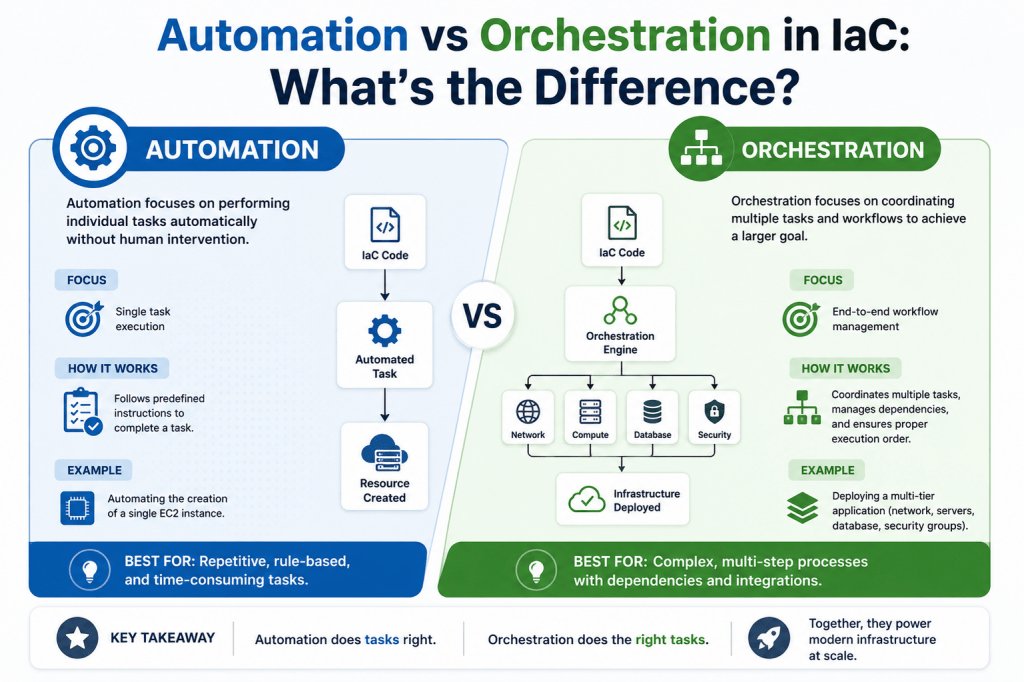
Automation and orchestration are closely related but serve different purposes. Automation performs specific operational activities automatically, while orchestration coordinates multiple automated tasks into a unified workflow.
A Simple Difference Between the Two
An easy way to understand the difference is to think of automation as completing individual tasks while orchestration manages the overall process. Automation provisions servers, while orchestration manages how servers interact within the infrastructure ecosystem.
The Importance of Orchestration in Modern Infrastructure
Modern applications rely heavily on distributed systems and microservices architectures. These environments require constant coordination between workloads, services, storage systems, and networking resources.
Managing Distributed Applications
Without orchestration, managing distributed applications becomes extremely difficult. Administrators would need to manually handle workload placement, service communication, scaling operations, and failure recovery across multiple systems.
How Orchestration Improves Scalability
Orchestration platforms automatically scale applications depending on workload demand. When traffic increases, additional application instances are deployed automatically to maintain performance.
Improving Application Availability
Orchestration also improves availability by redistributing workloads when failures occur. If a server becomes unavailable, orchestration systems can move workloads to healthy nodes automatically.
Containerization and Orchestration Growth
The widespread adoption of containers significantly increased the importance of orchestration. Containers simplify application deployment, but managing large numbers of containers manually quickly becomes impractical.
The Role of Container Orchestration
Container orchestration platforms automate container deployment, scheduling, networking, scaling, and monitoring. These platforms simplify the management of containerized applications operating across distributed environments.
Kubernetes in Modern Infrastructure
Kubernetes has become one of the most widely used orchestration platforms in modern IT environments. It provides extensive capabilities for managing containerized applications across large infrastructure clusters.
Automated Workload Management With Kubernetes
Kubernetes automatically schedules workloads, monitors application health, and restarts failed containers when necessary. This improves application resilience and reduces operational overhead.
Scaling Applications With Kubernetes
Kubernetes allows organizations to scale applications dynamically depending on workload demands. Resources can increase or decrease automatically while maintaining service availability.
Docker Swarm as an Orchestration Platform
Docker Swarm is another orchestration solution designed for containerized environments. It integrates directly with Docker and focuses on simplicity and ease of use.
Simplified Container Management
Organizations already using Docker often prefer Docker Swarm because it simplifies cluster management and application deployment. Smaller teams may find it easier to implement than more advanced orchestration platforms.
Service Discovery in Orchestration
Distributed applications require services to communicate dynamically across infrastructure environments. Orchestration platforms provide service discovery capabilities that allow applications to locate each other automatically.
Networking Automation in Orchestration
Orchestration systems also automate networking configurations, traffic routing, and load balancing. This ensures applications communicate securely and efficiently across distributed systems.
Dynamic Infrastructure Coordination
Modern infrastructures constantly change as workloads scale, restart, or move across environments. Orchestration platforms manage these changes automatically while maintaining operational stability and performance.
Challenges in Infrastructure Orchestration
Infrastructure orchestration provides significant operational benefits, but it also introduces new challenges that organizations must manage carefully. As environments become larger and more distributed, orchestration platforms require proper planning, monitoring, and governance to function efficiently.
Managing Complex Distributed Systems
Modern orchestration environments often involve containers, cloud services, databases, networking systems, APIs, and storage platforms operating together. Coordinating these components across multiple environments increases infrastructure complexity significantly.
The Difficulty of Multi-Service Coordination
Applications built using microservices architectures may contain dozens or even hundreds of interconnected services. Orchestration platforms must ensure these services communicate properly while maintaining performance and availability.
Security Challenges in Orchestrated Environments
Security becomes more complicated in orchestration platforms because workloads continuously move across infrastructure environments. Containers may restart, scale dynamically, or shift between servers automatically.
Protecting Dynamic Infrastructure Resources
Traditional security methods designed for static infrastructure often struggle in dynamic orchestration environments. Organizations must implement automated security controls capable of adapting to constantly changing workloads.
Managing Access Control Policies
Access management becomes critical in orchestration systems. Administrators must carefully control which users, applications, and services can access infrastructure resources and sensitive operational data.
Securing Containerized Applications
Containerized applications require strong isolation and monitoring policies. Vulnerabilities inside a single container could potentially impact other workloads if security configurations are not properly managed.
The Importance of Network Security
Orchestration platforms manage large amounts of network traffic between distributed services. Securing these communications requires encryption, segmentation, firewall policies, and traffic filtering mechanisms.
Infrastructure Visibility Challenges
As orchestration environments expand, maintaining visibility across infrastructure components becomes increasingly difficult. Organizations must monitor application health, workload distribution, network traffic, and system performance continuously.
Real-Time Monitoring Requirements
Orchestrated infrastructures require real-time monitoring systems capable of identifying failures, bottlenecks, and abnormal behavior immediately. Delayed detection may impact application availability and user experience.
The Need for Centralized Monitoring Platforms
Centralized monitoring dashboards help administrators observe infrastructure activity from a single location. These platforms improve operational visibility and simplify troubleshooting processes.
Handling Infrastructure Failures Automatically
One of orchestration’s primary goals is improving system resilience. When failures occur, orchestration systems should respond automatically without waiting for manual intervention.
Self-Healing Infrastructure Systems
Modern orchestration platforms support self-healing capabilities that automatically restart failed workloads, relocate services, and restore operational stability during infrastructure disruptions.
Reducing Downtime Through Automation
Automatic recovery mechanisms reduce downtime significantly. Instead of waiting for administrators to diagnose and repair failures manually, orchestration systems respond immediately when issues occur.
Infrastructure Scalability Challenges
Scaling infrastructure manually becomes extremely difficult in large environments. Orchestration platforms simplify this process, but organizations must still design scaling policies carefully to avoid resource inefficiencies.
Dynamic Resource Allocation
Orchestration systems can allocate additional computing resources automatically during periods of high demand. When workloads decrease, unused resources may be removed to optimize infrastructure utilization.
Preventing Resource Overconsumption
Improper scaling configurations may lead to excessive infrastructure consumption and unnecessary operational costs. Organizations must balance performance requirements with efficient resource management.
Learning Curves in Orchestration Technologies
Orchestration platforms often require advanced technical expertise. Technologies like Kubernetes involve networking, storage, security, automation, and container management concepts that can be difficult for new teams to learn.
Training Infrastructure Teams
Organizations adopting orchestration technologies frequently invest in training programs to help employees develop the necessary operational skills. Strong technical knowledge is essential for managing distributed environments effectively.
The Challenge of Operational Complexity
Even experienced teams may struggle with orchestration complexity during large-scale deployments. Infrastructure environments continue evolving rapidly, requiring ongoing learning and operational adjustments.
Infrastructure Maintenance Responsibilities
Orchestration platforms require continuous maintenance and updates. Administrators must manage platform upgrades, security patches, workload optimization, and configuration improvements regularly.
Version Compatibility Management
Large orchestration environments often contain multiple integrated technologies. Ensuring compatibility between these systems becomes critical for maintaining infrastructure stability.
Configuration Management in Orchestration
Infrastructure configurations must remain consistent across orchestrated environments. Misconfigured workloads, networking settings, or security policies can create operational failures quickly.
Using Declarative Infrastructure Models
Many orchestration platforms use declarative configuration models. Administrators define the desired infrastructure state, and the platform automatically works to maintain that configuration continuously.
Reducing Configuration Drift
Declarative management helps prevent configuration drift by ensuring infrastructure components always match predefined operational settings. This improves consistency and reliability.
The Importance of Infrastructure Documentation
Proper documentation becomes extremely important in orchestration environments. Teams must understand how workloads interact, how services communicate, and how operational dependencies function.
Supporting Team Collaboration
Clear documentation improves collaboration between development, operations, and security teams. Shared visibility into infrastructure architecture reduces misunderstandings and operational confusion.
Orchestration in Cloud-Native Environments
Cloud-native infrastructures rely heavily on orchestration technologies. Applications running across cloud environments require automated workload management, resource allocation, and service coordination.
Managing Multi-Cloud Deployments
Many organizations now operate across multiple cloud providers simultaneously. Orchestration platforms simplify the management of workloads distributed across different cloud environments.
Hybrid Cloud Infrastructure Coordination
Hybrid cloud environments combine on-premise infrastructure with public cloud services. Orchestration tools help coordinate workloads and resources across these different operational models.
Application Portability Through Orchestration
Orchestration platforms improve workload portability by allowing applications to move between environments more easily. This flexibility supports disaster recovery, cost optimization, and infrastructure scalability.
The Role of APIs in Orchestration
Application Programming Interfaces play a major role in orchestration environments. APIs allow orchestration systems to communicate with cloud services, infrastructure platforms, networking devices, and monitoring tools.
Automating Infrastructure Communication
APIs enable orchestration platforms to automate infrastructure coordination efficiently. Systems can provision resources, monitor workloads, update configurations, and manage services automatically through API integrations.
Improving Operational Integration
API-driven orchestration improves integration between infrastructure components. This creates smoother workflows and allows organizations to build more flexible operational ecosystems.
Microservices and Orchestration
Microservices architectures depend heavily on orchestration technologies. Instead of running applications as single monolithic systems, organizations deploy smaller independent services that communicate together.
Managing Independent Application Services
Each microservice may operate independently while still depending on other services within the application ecosystem. Orchestration platforms coordinate these interactions automatically.
Scaling Microservices Efficiently
Different microservices may require different scaling policies depending on workload demand. Orchestration platforms manage these scaling operations dynamically to maintain application performance.
Improving Application Resilience
Microservices architectures improve fault tolerance because failures in one service may not necessarily impact the entire application. Orchestration systems strengthen this resilience further through automated recovery processes.
Container Scheduling and Resource Management
Container orchestration platforms continuously decide where workloads should operate within infrastructure clusters. These scheduling decisions consider resource availability, performance requirements, and operational policies.
Optimizing Workload Placement
Efficient workload placement improves infrastructure utilization and application performance. Orchestration systems distribute workloads intelligently across available infrastructure resources.
Balancing Infrastructure Loads
Load balancing mechanisms help distribute traffic evenly across application instances. This prevents infrastructure bottlenecks and improves overall user experience.
Persistent Storage Management
Applications often require persistent storage for databases, files, logs, and operational data. Orchestration platforms help manage storage resources across distributed environments.
Maintaining Data Availability
Storage orchestration ensures applications maintain reliable access to data even during infrastructure failures or workload migrations.
Automating Backup Operations
Many orchestration environments also automate backup processes to protect operational data and improve disaster recovery readiness.
Continuous Delivery and Orchestration
Orchestration technologies play a critical role in Continuous Delivery pipelines. Applications move through testing, staging, and production environments using automated deployment workflows.
Reducing Deployment Delays
Automated orchestration workflows reduce manual deployment delays and improve release consistency across infrastructure environments.
Improving Deployment Reliability
Standardized orchestration processes help reduce application deployment failures. Infrastructure environments remain predictable and easier to manage.
Rollback and Recovery Mechanisms
Orchestration systems often support rollback capabilities that restore previous application versions if deployment problems occur. This reduces operational risks during software releases.
Infrastructure Resilience in Modern IT
Modern businesses depend heavily on infrastructure availability. Downtime can disrupt operations, impact revenue, and damage customer trust. Orchestration improves resilience by automating recovery processes and maintaining service continuity.
Fault Tolerance Through Orchestration
Fault-tolerant infrastructures continue operating even when hardware or software failures occur. Orchestration platforms automatically reroute workloads and restore failed services.
Improving Business Continuity
Organizations using orchestration technologies often achieve stronger business continuity because systems can recover more quickly during operational disruptions.
The Evolution of Infrastructure Operations
Infrastructure management continues evolving rapidly as organizations adopt cloud-native technologies, containerization, and distributed computing models. Orchestration platforms have become central to managing these modern environments.
The Future of Intelligent Infrastructure Management
Future infrastructure environments will likely become even more automated and intelligent. Artificial intelligence, predictive analytics, and advanced automation systems may further enhance orchestration capabilities.
Combining Automation and Orchestration
Automation and orchestration work together to create efficient infrastructure ecosystems. Automation handles individual operational tasks, while orchestration coordinates these tasks across larger environments.
Building Scalable Infrastructure Systems
Organizations that combine automation and orchestration effectively can build scalable, reliable, and highly efficient infrastructure environments capable of supporting modern business demands.
Supporting Digital Transformation
Infrastructure as Code, automation, and orchestration continue driving digital transformation across industries. These technologies help organizations innovate faster while maintaining operational control and infrastructure stability.
Integrating Automation and Orchestration in IaC
Automation and orchestration are most effective when they work together within the same Infrastructure as Code environment. Automation focuses on completing tasks automatically, while orchestration coordinates how those tasks operate across the infrastructure ecosystem. Combining both approaches creates a highly scalable and efficient operational model.
Creating Unified Infrastructure Workflows
Organizations often manage thousands of infrastructure operations daily. Servers must be deployed, applications updated, security policies enforced, and workloads balanced continuously. Integrating automation and orchestration allows these activities to function together within unified workflows.
Improving Operational Coordination
Without orchestration, automation tasks may operate independently without proper coordination. Orchestration ensures every automated process follows the correct sequence and interacts properly with other infrastructure components.
Infrastructure as a Complete Ecosystem
Modern infrastructure environments are no longer isolated systems. Applications, databases, APIs, storage platforms, networking components, and cloud services must work together continuously. IaC helps organizations manage this ecosystem through programmable infrastructure management.
The Importance of Workflow Standardization
Standardized workflows improve operational consistency. Infrastructure teams can deploy environments repeatedly using the same automation and orchestration processes without introducing unnecessary configuration differences.
Continuous Integration in Modern Infrastructure
Continuous Integration environments rely heavily on Infrastructure as Code. Developers submit application changes frequently, requiring automated systems capable of building, testing, and validating software rapidly.
Automating Build Pipelines
Automation tools help compile applications, run tests, configure infrastructure, and prepare deployment environments automatically. This reduces manual delays during software development cycles.
Orchestration in Deployment Pipelines
Orchestration platforms coordinate deployment pipelines by ensuring infrastructure resources are available before application releases occur. These systems also manage workload placement and service communication during deployments.
Improving Software Delivery Speed
Organizations using integrated automation and orchestration workflows can release software updates faster while maintaining infrastructure reliability and operational stability.
Infrastructure Provisioning at Scale
Large organizations frequently provision infrastructure resources across multiple environments simultaneously. Automation allows resources to be deployed rapidly, while orchestration manages how those resources operate together.
Scaling Cloud Resources Efficiently
Cloud-native infrastructures benefit greatly from integrated IaC environments. Automated provisioning combined with orchestration enables dynamic scaling based on real-time workload requirements.
Handling Rapid Traffic Growth
Applications experiencing sudden traffic increases require additional resources immediately. Automation provisions new infrastructure while orchestration distributes workloads and balances traffic automatically.
Reducing Infrastructure Bottlenecks
Integrated orchestration systems prevent infrastructure bottlenecks by coordinating compute resources, storage systems, networking policies, and application services efficiently.
Multi-Cloud Infrastructure Management
Many organizations now operate across multiple cloud providers. Managing workloads across different platforms manually can become extremely difficult and time-consuming.
Orchestration Across Multiple Cloud Platforms
Orchestration platforms help coordinate infrastructure resources operating in multi-cloud environments. Workloads can move between providers while maintaining consistent operational behavior.
Simplifying Hybrid Cloud Operations
Hybrid cloud infrastructures combine on-premise systems with cloud resources. Infrastructure as Code helps organizations manage these environments using centralized automation and orchestration workflows.
Improving Infrastructure Flexibility
Integrated IaC environments improve infrastructure flexibility significantly. Organizations can deploy workloads wherever resources are most efficient without redesigning operational processes entirely.
The Role of Kubernetes in Modern IaC
Kubernetes has become one of the most important orchestration technologies in Infrastructure as Code environments. It allows organizations to manage distributed containerized applications at scale.
Automating Container Management
Kubernetes automates workload scheduling, scaling operations, networking configurations, and application recovery processes. This reduces operational complexity in containerized environments.
Self-Healing Application Environments
Kubernetes supports self-healing infrastructure capabilities. Failed workloads can restart automatically, and unhealthy containers may be replaced without manual intervention.
Dynamic Infrastructure Scaling
Kubernetes continuously monitors infrastructure demand and adjusts resource allocation dynamically. This ensures applications maintain stable performance during fluctuating workloads.
Terraform and Infrastructure Provisioning
Terraform remains one of the most widely used Infrastructure as Code provisioning tools. Organizations use Terraform to define infrastructure resources through declarative configuration files.
Managing Infrastructure Across Providers
Terraform supports multiple cloud providers, allowing organizations to provision infrastructure consistently across different platforms using a single operational model.
Infrastructure Version Control
Terraform configurations can be stored in version control repositories, improving visibility into infrastructure changes and simplifying collaboration between operational teams.
Ansible in Automated Infrastructure Operations
Ansible is frequently used alongside orchestration platforms to automate infrastructure configuration tasks. It simplifies software installation, system updates, security enforcement, and operational maintenance.
Agentless Infrastructure Management
Ansible’s agentless architecture makes it easier to deploy and manage across large infrastructure environments. Administrators can configure systems remotely using simple automation playbooks.
Combining Ansible With Orchestration Platforms
Organizations often integrate Ansible with orchestration technologies like Kubernetes to automate both infrastructure provisioning and operational management simultaneously.
Infrastructure Resilience Through IaC
Resilience is one of the most important goals in modern infrastructure management. Organizations require systems capable of handling failures without disrupting application availability.
Improving Fault Tolerance
Automation and orchestration improve fault tolerance by enabling rapid recovery from failures. Workloads can restart, relocate, or scale automatically during infrastructure disruptions.
Disaster Recovery Automation
Infrastructure as Code simplifies disaster recovery planning. Entire environments can be recreated quickly using predefined infrastructure templates and orchestration workflows.
Reducing Recovery Time Objectives
Automated infrastructure recovery significantly reduces downtime during outages. Businesses can restore services faster and minimize operational disruptions.
Monitoring and Observability in IaC
Infrastructure monitoring is critical for maintaining healthy environments. Automation and orchestration systems rely heavily on monitoring data to make operational decisions.
Collecting Real-Time Infrastructure Data
Modern monitoring systems collect performance metrics, logs, and operational events continuously. This visibility helps organizations identify infrastructure issues early.
Automated Incident Response
Integrated automation systems can respond to operational incidents automatically. Workflows may trigger alerts, restart services, or allocate additional resources during performance problems.
Observability in Distributed Systems
Distributed cloud-native environments require advanced observability capabilities. Organizations must understand how services interact and where performance bottlenecks occur.
Security Integration in IaC Pipelines
Security has become deeply integrated into Infrastructure as Code workflows. Automated security policies help organizations protect infrastructure environments continuously.
Infrastructure Security as Code
Security configurations can now be defined directly within infrastructure templates. This ensures security standards remain consistent throughout deployment pipelines.
Automated Compliance Validation
Organizations can automatically validate infrastructure against compliance requirements before deployments occur. This reduces operational risks and improves governance.
Reducing Human Security Errors
Automated security enforcement reduces the likelihood of configuration mistakes that could expose infrastructure environments to cyber threats.
Cost Optimization Through Automation
Cloud infrastructure costs can increase rapidly without proper management. Automation and orchestration help organizations optimize resource usage efficiently.
Eliminating Unused Infrastructure Resources
Automated systems can identify underutilized infrastructure resources and remove unnecessary workloads automatically. This improves operational efficiency and reduces cloud expenses.
Dynamic Resource Allocation
Orchestration platforms allocate infrastructure dynamically depending on workload demand. Resources expand during high traffic periods and shrink during low-demand conditions.
Operational Efficiency Improvements
Organizations using Infrastructure as Code often experience significant operational efficiency improvements. Infrastructure deployments become faster, more predictable, and easier to manage.
Reducing Administrative Workloads
Automation eliminates many repetitive administrative tasks. Operations teams can focus on infrastructure optimization instead of routine maintenance activities.
Improving Team Collaboration
IaC environments improve collaboration between developers, operations teams, and security professionals. Shared infrastructure definitions create greater transparency and alignment.
Accelerating Innovation
Faster infrastructure deployment enables organizations to innovate more rapidly. Teams can test new applications, services, and operational models without long provisioning delays.
The Evolution of Infrastructure Management
Infrastructure management continues evolving as businesses adopt cloud computing, edge computing, artificial intelligence, and distributed architectures. Automation and orchestration will remain central to this transformation.
The Future of Infrastructure as Code
Future Infrastructure as Code environments will likely include more intelligent automation capabilities. Artificial intelligence and predictive analytics may help optimize infrastructure management even further.
Increasing Adoption of Cloud-Native Technologies
Organizations across industries continue adopting cloud-native architectures, containerization, and microservices platforms. These technologies increase the importance of orchestration and automated infrastructure management.
The Growing Demand for Scalability
Modern digital services require highly scalable infrastructures capable of supporting millions of users and workloads simultaneously. Infrastructure as Code helps organizations meet these demands efficiently.
Conclusion
Infrastructure as Code has transformed modern infrastructure management by introducing automation, consistency, scalability, and operational efficiency into IT environments. Instead of relying on manual processes, organizations now manage infrastructure through programmable configurations that improve deployment reliability and simplify large-scale operations.
Automation plays a critical role by handling repetitive infrastructure tasks such as provisioning, configuration management, monitoring, scaling, and security enforcement. It reduces human error, accelerates deployments, and improves infrastructure consistency across environments.
Orchestration expands these capabilities by coordinating automated tasks across distributed systems. It ensures workloads, applications, services, and infrastructure resources operate together efficiently while maintaining scalability, resilience, and availability.
Together, automation and orchestration create powerful Infrastructure as Code ecosystems capable of supporting modern cloud-native applications, DevOps pipelines, containerized workloads, and multi-cloud environments. Organizations that successfully integrate these technologies gain stronger operational control, faster software delivery, improved resilience, and greater flexibility in managing digital infrastructure.
As technology continues evolving, Infrastructure as Code will remain a foundational element of modern IT operations. Businesses adopting automation and orchestration effectively will be better positioned to scale efficiently, innovate rapidly, and maintain reliable infrastructure environments in increasingly complex digital ecosystems.