
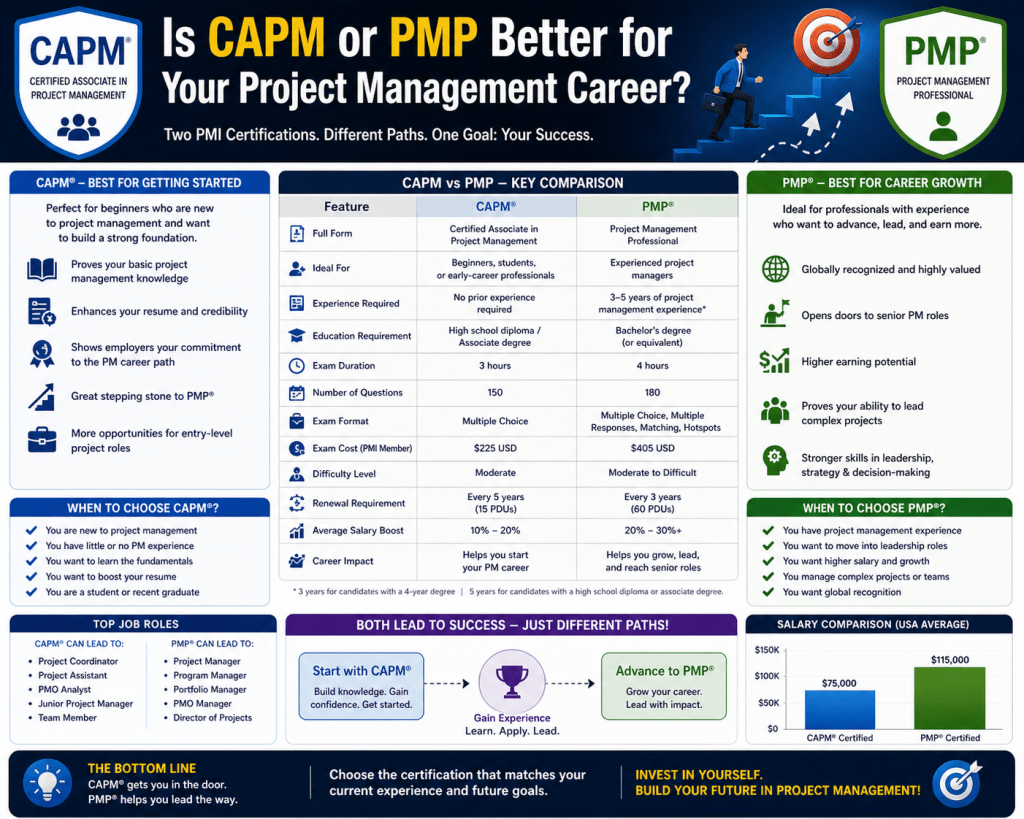
Project management certifications play a critical role in standardizing how professionals are evaluated across industries that rely on structured planning, execution discipline, and delivery accountability. Organizations increasingly depend on certified individuals to ensure that projects are completed within defined constraints such as scope, budget, schedule, and quality expectations. Within this ecosystem, two certification levels are commonly compared because they represent different stages of professional development within the same methodological framework. One is positioned for individuals entering structured project environments, while the other is designed for experienced professionals who already operate in leadership roles. Both certifications are grounded in globally accepted project management principles, yet they differ significantly in purpose, complexity, and expected application. Understanding these differences requires a structured examination of how each certification aligns with career progression, workplace responsibilities, and competency validation.
Structural Positioning of Entry-Level and Professional-Level Credentials
The distinction between entry-level and professional-level project management certifications is primarily defined by depth of experience and level of responsibility. Entry-level certification is designed for individuals who are developing familiarity with structured project environments and require foundational knowledge of how projects are initiated, planned, executed, monitored, and closed. It emphasizes comprehension of terminology, process frameworks, and basic coordination principles. Professional-level certification, on the other hand, is intended for individuals who have already demonstrated practical experience managing projects independently. It evaluates the ability to apply structured methodologies in complex environments where competing priorities, stakeholder conflicts, and resource constraints must be balanced. This structural separation ensures that individuals progress through a logical development path, starting with conceptual understanding and advancing toward strategic execution capability.
Core Frameworks and Knowledge Domains in Project Management
Both certification levels are based on a standardized set of project management knowledge areas that define how projects are structured and controlled. These include scope management, which ensures that project objectives are clearly defined and controlled; schedule management, which focuses on timeline planning and milestone tracking; cost management, which involves budgeting and financial oversight; quality management, which ensures deliverables meet required standards; communication management, which governs information flow between stakeholders; risk management, which identifies and mitigates uncertainties; procurement management, which handles external resource acquisition; and stakeholder management, which ensures engagement and alignment across all involved parties. While both certifications reference these domains, the depth of application differs significantly. Entry-level certification focuses on recognizing and understanding these domains, while professional-level certification requires the ability to apply them dynamically in real-world scenarios.
Evolution of Project Management as a Professional Discipline
Project management has evolved from a loosely defined operational function into a structured discipline with standardized methodologies and global recognition. This evolution has been driven by increasing complexity in business operations, technological advancement, and the need for predictable delivery outcomes. Organizations now rely on formal project management frameworks to reduce inefficiencies and improve coordination across departments. As a result, certification has become a key differentiator in professional development. Entry-level certification emerged to provide accessibility for individuals entering the field, ensuring they understand foundational concepts before taking on responsibilities. Professional-level certification is developed to validate advanced competence, ensuring that individuals in leadership positions can manage large-scale initiatives effectively. This evolution reflects the growing importance of structured project governance in modern organizational environments.
Eligibility Structure and Experience Expectations
Eligibility requirements for entry-level certification are designed to accommodate individuals with limited exposure to formal project environments. These requirements typically include basic educational qualifications and minimal project-related experience or structured training hours. The goal is to ensure accessibility while still maintaining a baseline understanding of project management principles. Professional-level certification requires significantly more extensive experience, often including documented involvement in leading or directing projects over multiple years. Candidates are expected to demonstrate not only participation but also leadership in project execution. This includes responsibility for planning, execution oversight, team coordination, and delivery outcomes. The difference in eligibility criteria reflects the intended career stage alignment of each certification, with one focusing on entry into the field and the other focusing on validation of established expertise.
Examination Design and Cognitive Complexity
The design of certification examinations reflects the level of cognitive complexity expected from candidates. Entry-level examinations are structured to assess knowledge comprehension and conceptual understanding. Questions typically focus on identifying correct definitions, understanding process relationships, and recognizing appropriate theoretical responses within structured scenarios. The emphasis is on ensuring that candidates understand how project management systems function at a foundational level. Professional-level examinations are significantly more complex and are designed to evaluate applied reasoning and decision-making ability. Candidates are presented with realistic project scenarios that require analysis of multiple variables, prioritization of actions, and selection of optimal solutions. These scenarios simulate real-world project environments where conditions are uncertain, and decisions must be made based on incomplete or competing information. This difference in examination design ensures that certification outcomes accurately reflect professional capability.
Knowledge Application Versus Conceptual Understanding
A key distinction between the two certification levels lies in the transition from conceptual understanding to applied execution. Entry-level certification emphasizes learning structured frameworks and understanding how different project components interact. Candidates are expected to develop familiarity with standardized processes and recognize how they are applied in controlled environments. Professional-level certification requires the ability to integrate these frameworks into practical decision-making processes. This includes adapting methodologies to suit specific project constraints, resolving conflicts between competing priorities, and ensuring alignment between project objectives and organizational strategy. The shift from theoretical knowledge to applied execution represents a significant advancement in professional capability and is a defining characteristic of progression in project management careers.
Role Differentiation in Professional Environments
In workplace environments, certification level often influences the type of responsibilities assigned to individuals. Entry-level certification holders typically operate in supporting roles where they assist with coordination, documentation, scheduling, and communication tracking. These roles are essential for maintaining structure within project teams and ensuring that information flows effectively between stakeholders. Professional-level certification holders are typically assigned leadership roles where they are responsible for managing entire project lifecycles. This includes defining project scope, allocating resources, managing risks, overseeing timelines, and ensuring successful delivery outcomes. The difference in responsibility reflects the level of trust and accountability placed on individuals based on their demonstrated capability and certification level.
Decision-Making Authority and Accountability Scope
Decision-making authority increases significantly as individuals progress from entry-level to professional-level certification. At the entry level, decision-making is typically limited to task execution and operational support under supervision. Individuals contribute to project success by following established processes and providing input into team-based decisions. At the professional level, individuals are expected to make independent decisions that directly impact project outcomes. This includes selecting project strategies, adjusting plans in response to changing conditions, and managing stakeholder expectations. Accountability also increases accordingly, as professional-level certification holders are responsible for overall project success or failure. This elevated responsibility requires strong analytical skills, leadership capability, and the ability to manage complex interpersonal dynamics within project teams.
Industry Adoption and Professional Recognition Trends
Project management certification has become widely recognized across industries such as information systems, engineering, construction, healthcare, and finance. Entry-level certification is often used as a gateway for individuals transitioning into project-based roles, particularly from technical or administrative backgrounds. It provides validation of foundational knowledge and demonstrates readiness to participate in structured project environments. Professional-level certification is more commonly associated with senior roles and is often required for positions involving significant leadership responsibility. Its recognition across industries reflects its emphasis on applied expertise and strategic execution capability. Organizations value both certification levels, but they serve different purposes within workforce development strategies.
Learning Progression and Skill Development Pathways
The progression from entry-level to professional-level certification reflects a structured learning pathway in project management development. Individuals typically begin by acquiring foundational knowledge of project frameworks, terminology, and basic processes. This stage builds cognitive understanding and prepares individuals for participation in structured project environments. As experience increases, individuals develop the ability to apply these concepts in real-world scenarios, gradually transitioning into leadership roles where they manage project components independently. Professional-level certification represents the culmination of this progression, validating the ability to manage complex projects with full accountability. This staged development ensures that professionals build both theoretical understanding and practical expertise over time.
Strategic Importance of Certification in Career Development
Certification plays a strategic role in shaping career trajectories within project management. Entry-level certification provides access to structured project environments and serves as a foundation for skill development. It is particularly valuable for individuals seeking to transition into project-related roles or formalize their understanding of project management principles. Professional-level certification supports career advancement into leadership positions where strategic decision-making and organizational impact are critical. It signals readiness for senior responsibilities and enhances professional credibility. Together, these certifications create a pathway for continuous professional development, enabling individuals to progress from foundational knowledge to advanced leadership capability within structured project environments.
Expanding Competency Depth in Project Management Development
Project management competency develops progressively through structured exposure to both theoretical frameworks and real-world execution environments. At early stages, individuals are primarily focused on understanding how projects are structured, how tasks are organized, and how different stakeholders interact within a controlled workflow. This stage emphasizes comprehension of standardized terminology and process alignment rather than independent leadership. As professionals advance, the expectation shifts toward applying these principles dynamically in environments where uncertainty, risk, and competing priorities must be managed simultaneously. This progression reflects a transition from knowledge acquisition to performance-based execution, where success is measured not by theoretical understanding but by the ability to deliver consistent outcomes in real operational conditions.
Foundational Learning Focus in Entry-Level Certification Pathways
Entry-level project management certification is structured to introduce learners to the essential building blocks of project environments. This includes understanding what constitutes a project, how project phases are structured, and how responsibilities are distributed across teams. The focus is on building familiarity with process groups such as initiation, planning, execution, monitoring, and closure, along with the supporting knowledge areas that guide decision-making. Learners are expected to develop a structured mindset that allows them to interpret project documentation, understand workflows, and contribute effectively within a team environment. The emphasis is not on leading projects independently but on becoming capable contributors who understand how their work fits into broader project objectives.
Applied Leadership Expectations in Advanced Certification Levels
Advanced project management certification is designed to evaluate leadership capability in complex environments where decision-making has direct consequences on project outcomes. Individuals at this level are expected to manage multiple constraints simultaneously, including time limitations, budget restrictions, resource availability, and stakeholder expectations. They must be able to assess risks, develop mitigation strategies, and adjust project plans in response to changing conditions. Leadership in this context involves not only managing tasks but also guiding teams, resolving conflicts, and ensuring alignment between project goals and organizational strategy. The expectation is that certified professionals can operate independently, taking full ownership of project delivery from initiation through completion.
Examination Philosophy and Cognitive Demand Differences
The structure of certification examinations reflects the level of cognitive engagement required at each stage of professional development. Entry-level assessments are designed to measure recognition and comprehension of established concepts. Questions typically focus on identifying correct definitions, understanding process relationships, and selecting appropriate theoretical responses. This ensures that candidates have a solid grasp of foundational principles. Advanced-level examinations, however, are designed to simulate real-world decision-making scenarios. Candidates are presented with complex situations that require analysis of multiple variables, prioritization of actions, and selection of the most effective course of action. These assessments are not based on memorization but on the ability to apply structured thinking in dynamic environments.
Transition from Structured Learning to Adaptive Execution
One of the most significant shifts in project management development is the transition from structured learning to adaptive execution. In entry-level environments, processes are clearly defined, and individuals are expected to follow established procedures. This creates a controlled learning environment where mistakes can be corrected without a significant impact on project outcomes. As professionals progress, they are increasingly required to operate in environments where processes must be adapted to suit specific project conditions. This requires a deeper understanding of underlying principles rather than reliance on rigid procedures. Adaptive execution involves making informed decisions when standard processes are insufficient, requiring both analytical thinking and practical judgment.
Organizational Integration of Project Management Roles
Organizations integrate project management roles based on a hierarchy of responsibility and expertise. Entry-level professionals are typically integrated into support functions where they assist in coordination, documentation, and communication management. These roles are essential for maintaining project structure and ensuring that information flows efficiently across teams. Advanced professionals are integrated into leadership roles where they are responsible for overseeing entire project lifecycles. This includes defining objectives, managing resources, tracking progress, and ensuring that deliverables align with strategic goals. The integration of these roles ensures that projects are managed efficiently across all levels of complexity, with each role contributing to overall project success.
Skill Progression Through Real-World Exposure
Skill development in project management is heavily influenced by real-world exposure. Entry-level professionals build their skills by participating in structured environments where they can observe how projects are managed and gradually take on more responsibility. This exposure helps them understand how theoretical concepts are applied in practice. As they gain experience, they begin to manage smaller project components independently, developing confidence in decision-making and problem-solving. Advanced professionals refine their skills through direct leadership experience, where they are responsible for managing entire projects. This stage requires the integration of technical knowledge, leadership ability, and strategic thinking to ensure successful project outcomes.
Communication Complexity Across Certification Levels
Communication plays a critical role in project management and becomes increasingly complex as professionals advance. At the entry level, communication responsibilities typically involve reporting progress, documenting tasks, and ensuring that information is accurately recorded and shared within teams. The focus is on clarity and consistency in information flow. At the advanced level, communication expands to include stakeholder negotiation, conflict resolution, and strategic alignment discussions. Professionals must be able to communicate effectively with diverse audiences, including technical teams, executives, and external stakeholders. This requires the ability to translate complex project information into meaningful insights that support decision-making at multiple organizational levels.
Risk Awareness and Decision-Making Maturity
Risk management is a core component of project management that evolves significantly with experience. Entry-level professionals are introduced to basic risk identification and documentation processes. They learn how to recognize potential issues and escalate them appropriately within project structures. Advanced professionals are responsible for actively managing risk throughout the project lifecycle. This includes identifying potential threats, evaluating their impact, developing mitigation strategies, and implementing contingency plans. Decision-making at this level requires maturity and the ability to anticipate consequences across multiple dimensions of a project. Effective risk management is a key differentiator between operational support roles and leadership positions.
Resource Management and Allocation Strategy Development
Resource management becomes increasingly strategic as professionals progress in their careers. At the entry level, individuals may assist in tracking resource allocation and ensuring that tasks are assigned appropriately. Their involvement is typically operational and focused on maintaining accuracy in resource records. At the advanced level, professionals are responsible for developing resource allocation strategies that optimize efficiency and ensure project success. This includes balancing workloads, managing budget constraints, and ensuring that the right skills are applied to the right tasks. Strategic resource management requires a deep understanding of project requirements and the ability to anticipate future needs based on project trajectory.
Scheduling Discipline and Timeline Optimization
Scheduling is a fundamental aspect of project management that becomes more complex as the project scale increases. Entry-level professionals are introduced to basic scheduling concepts such as task sequencing, milestone tracking, and dependency identification. Their role is primarily supportive, ensuring that schedules are updated and accurately maintained. Advanced professionals are responsible for developing and optimizing project schedules that account for multiple constraints and uncertainties. This includes adjusting timelines in response to changing conditions, managing critical paths, and ensuring that project delivery remains aligned with organizational expectations. Effective scheduling at this level requires both analytical precision and strategic foresight.
Stakeholder Engagement and Relationship Management
Stakeholder management is a critical competency that evolves significantly across certification levels. Entry-level professionals typically support stakeholder communication by ensuring that updates are distributed accurately and that feedback is documented appropriately. Their role is primarily administrative in nature. Advanced professionals are responsible for actively managing stakeholder relationships, ensuring alignment between project objectives and stakeholder expectations. This includes negotiating priorities, resolving conflicts, and maintaining engagement throughout the project lifecycle. Strong stakeholder management is essential for ensuring project success, particularly in complex environments where multiple interests must be balanced.
Strategic Alignment of Project Objectives with Organizational Goals
At advanced levels of project management, professionals are expected to ensure that project objectives align with broader organizational strategies. This requires an understanding of business priorities and the ability to translate strategic goals into actionable project plans. Entry-level professionals are typically not responsible for strategic alignment but contribute by supporting execution activities that enable alignment. Advanced professionals must continuously evaluate whether project direction remains consistent with organizational objectives and make adjustments when necessary. This strategic alignment ensures that projects contribute meaningful value to organizational growth and long-term success.
Analytical Thinking and Problem-Solving Evolution
Analytical thinking becomes increasingly important as professionals advance in project management roles. Entry-level professionals develop basic problem-solving skills by following established procedures and escalating issues when necessary. Their focus is on accurate identification and reporting of problems. Advanced professionals are expected to independently analyze complex issues, identify root causes, and develop effective solutions. This requires the ability to synthesize information from multiple sources and evaluate potential outcomes before making decisions. Strong analytical thinking is essential for managing complex projects where multiple variables interact simultaneously.
Professional Identity Formation Through Certification Progression
Certification progression contributes significantly to the formation of professional identity in project management careers. Entry-level certification helps individuals establish foundational credibility and gain access to structured project environments. It provides recognition of basic competency and readiness to contribute to project teams. Advanced certification reinforces professional identity by validating leadership capability and strategic execution skills. It signals that an individual is capable of managing complex initiatives independently and contributing to organizational success at a higher level. This progression helps shape career trajectories and influences how professionals are perceived within their industries.
Increasing Complexity of Project Environments Over Time
Project environments have become increasingly complex due to globalization, technological advancement, and organizational interconnectivity. Modern projects often involve distributed teams, digital collaboration tools, and rapidly changing requirements. Entry-level professionals are introduced to these environments in structured ways that allow them to learn gradually. Advanced professionals must navigate this complexity independently, making decisions that account for multiple variables and unpredictable conditions. The ability to manage complexity effectively is a defining characteristic of advanced project management capability and is essential for success in modern organizational environments.
Long-Term Career Trajectory in Project Management Fields
Project management careers are typically structured as progressive pathways that evolve from foundational participation to advanced leadership responsibility. Early career stages focus on learning how projects operate within controlled environments, where individuals observe planning cycles, execution workflows, and reporting structures. As professionals gain experience, they gradually take on more responsibility, moving from supporting roles into positions where they manage individual project components independently. Over time, this progression leads to full project ownership, where professionals are responsible for end-to-end delivery, stakeholder alignment, and strategic execution. Advanced certification aligns with this stage of career development, where individuals are expected to demonstrate mastery in managing complexity, uncertainty, and organizational expectations simultaneously.
Organizational Dependence on Structured Project Leadership
Modern organizations rely heavily on structured project leadership to ensure that initiatives are delivered efficiently and consistently. Projects today often involve multiple departments, distributed teams, and rapidly changing requirements. This complexity requires individuals who can interpret organizational goals and translate them into actionable project plans. Entry-level professionals contribute to this system by supporting execution activities and ensuring that operational processes are followed accurately. Advanced professionals take responsibility for ensuring that entire project ecosystems function effectively, coordinating resources, managing risks, and ensuring alignment between project outputs and business objectives. This layered structure allows organizations to maintain control while scaling project operations across diverse environments.
Increasing Importance of Cross-Functional Collaboration
Cross-functional collaboration has become a central component of modern project environments. Projects frequently require input from technical teams, business analysts, financial departments, and external stakeholders. Entry-level professionals are typically involved in facilitating communication within these groups by ensuring that updates are documented and shared appropriately. Their role supports information consistency and reduces communication gaps. Advanced professionals are responsible for actively managing cross-functional relationships, resolving conflicts between departments, and ensuring that all stakeholders remain aligned with project objectives. This requires strong interpersonal skills and the ability to balance competing priorities while maintaining project momentum.
Decision-Making Complexity in Real-World Project Scenarios
Decision-making in project management becomes increasingly complex as projects grow in scale and uncertainty. Entry-level professionals are usually guided by established procedures and escalate decisions when necessary. Their focus is on ensuring accuracy in execution rather than determining strategic direction. Advanced professionals must make independent decisions that directly affect project outcomes. These decisions often involve trade-offs between time, cost, and quality, requiring careful evaluation of potential consequences. In many cases, decisions must be made with incomplete information, adding another layer of complexity. The ability to navigate uncertainty and still maintain project stability is a defining characteristic of advanced project leadership.
Risk Management Maturity and Strategic Anticipation
Risk management evolves significantly as professionals progress in their careers. At foundational levels, risk awareness is primarily focused on identification and documentation. Individuals learn to recognize potential issues and communicate them to senior team members. At advanced levels, risk management becomes a proactive and continuous process. Professionals are expected to anticipate potential challenges before they occur, evaluate their impact, and implement mitigation strategies that reduce disruption. This requires not only analytical thinking but also strategic foresight. Effective risk management ensures that projects remain resilient even in changing environments, which is essential for maintaining delivery consistency.
Resource Optimization and Strategic Allocation
Resource management becomes more strategic as professionals advance in project roles. Entry-level involvement typically includes tracking resource usage and ensuring that assignments are recorded accurately. The focus is on maintaining operational clarity. Advanced professionals are responsible for designing resource allocation strategies that maximize efficiency and ensure optimal use of available assets. This includes balancing workloads across teams, managing financial constraints, and aligning resource distribution with project priorities. Strategic resource management requires an understanding of both current project needs and future demands, ensuring that resources are used effectively throughout the project lifecycle.
Scheduling Dynamics and Time Management Strategy
Scheduling in project management is not simply about assigning deadlines but about optimizing workflows to ensure efficient delivery. Entry-level professionals support scheduling activities by updating timelines, tracking milestones, and maintaining task records. Their role ensures that project schedules remain accurate and up to date. Advanced professionals are responsible for designing comprehensive project schedules that account for dependencies, risks, and resource availability. They must also adjust schedules dynamically in response to changes in project conditions. This requires a deep understanding of critical path analysis and the ability to anticipate how delays in one area may impact the entire project timeline.
Stakeholder Complexity and Relationship Governance
Stakeholder management becomes increasingly complex in large-scale projects involving multiple internal and external parties. Entry-level professionals typically assist in communication processes by distributing updates and documenting feedback. Their role supports transparency and ensures that information is accessible. Advanced professionals are responsible for managing stakeholder expectations, negotiating priorities, and resolving conflicts between competing interests. This requires strong communication skills and emotional intelligence, as well as the ability to maintain professional relationships under pressure. Effective stakeholder management is essential for ensuring project success, particularly in environments where priorities frequently shift.
Integration of Technology in Modern Project Execution
Technology plays an increasingly important role in project management, influencing how teams collaborate, track progress, and communicate. Entry-level professionals are often introduced to project management tools that help them organize tasks and monitor progress. These tools support structured learning and improve operational efficiency. Advanced professionals use technology strategically to manage complex projects, analyze performance data, and optimize decision-making processes. This includes leveraging digital platforms for collaboration, reporting, and resource management. The integration of technology enhances visibility and control, enabling more efficient project execution across distributed teams.
Communication Strategy and Information Flow Management
Effective communication is essential for maintaining alignment across project teams. At entry levels, communication responsibilities are primarily focused on ensuring that information is accurately recorded and shared within defined channels. This includes reporting progress and documenting task completion. At advanced levels, communication becomes more strategic and involves managing expectations across multiple stakeholder groups. Professionals must ensure that information is not only accurate but also relevant and timely. They must also adapt communication styles to suit different audiences, ranging from technical teams to executive leadership. Strong communication management is critical for maintaining project cohesion.
Analytical Skill Development Through Progressive Responsibility
Analytical thinking is developed gradually through exposure to increasingly complex project environments. Entry-level professionals begin by learning how to interpret data, identify patterns, and understand basic project relationships. Their analytical role is limited to supporting decision-making processes. Advanced professionals must analyze complex datasets, evaluate project performance metrics, and identify underlying causes of issues. This requires the ability to synthesize information from multiple sources and develop actionable insights. Strong analytical skills enable professionals to make informed decisions that improve project outcomes and reduce operational risks.
Leadership Evolution in Project Management Roles
Leadership in project management evolves from supportive participation to full ownership of outcomes. Entry-level professionals contribute to team efforts by executing assigned tasks and supporting coordination activities. Their leadership role is limited and often indirect. Advanced professionals are expected to lead entire project teams, set direction, and ensure accountability for results. This includes motivating team members, resolving conflicts, and maintaining focus on project objectives. Leadership at this level requires a combination of technical knowledge, interpersonal skills, and strategic thinking, all of which contribute to successful project delivery.
Organizational Impact of Advanced Project Management Capability
Advanced project management capability has a direct impact on organizational performance. Projects that are managed effectively contribute to improved efficiency, reduced costs, and higher quality outcomes. Entry-level professionals support this impact by ensuring that project processes are followed correctly and that operational tasks are completed accurately. Advanced professionals drive this impact by ensuring that projects align with strategic goals and deliver measurable value. Their ability to manage complexity and uncertainty allows organizations to execute large-scale initiatives successfully and maintain competitive advantage in dynamic environments.
Continuous Professional Growth and Skill Enhancement
Project management is a field that requires continuous learning and skill development. Entry-level professionals build foundational knowledge that prepares them for more advanced responsibilities. As they gain experience, they refine their skills through practical application and exposure to real-world challenges. Advanced professionals continue to develop their capabilities by managing increasingly complex projects and adapting to evolving industry practices. This continuous growth ensures that project managers remain effective in dynamic environments where methodologies, technologies, and organizational needs are constantly changing.
Strategic Value of Certification Progression in Career Development
Certification progression plays a strategic role in shaping long-term career development in project management. Entry-level certification provides access to structured learning environments and foundational knowledge that supports early career growth. Advanced certification validates the ability to manage complex projects and leads to opportunities in leadership roles. Together, these certifications create a structured pathway for professional development, enabling individuals to transition from foundational contributors to strategic decision-makers within organizations.
Conclusion
Project management certification represents more than a credentialing system; it functions as a structured pathway for developing professional capability, shaping how individuals transition from operational contributors to strategic decision-makers within organizations. Across both entry-level and advanced certification stages, the underlying objective remains consistent: to build a disciplined understanding of how projects are initiated, structured, executed, and delivered in alignment with defined business objectives. However, the depth of responsibility, analytical expectation, and leadership accountability expands significantly as professionals move from foundational knowledge into applied expertise.
At the entry level, certification serves as an introduction to the language and logic of project environments. It equips individuals with the ability to understand structured workflows, interpret project documentation, and participate effectively within teams operating under established frameworks. This stage is essential because it creates cognitive alignment with standardized project management principles. Without this foundation, individuals often struggle to interpret the structured nature of project execution, especially in environments where multiple teams, dependencies, and timelines must be coordinated simultaneously. Entry-level certification helps reduce this gap by ensuring that professionals develop a consistent baseline understanding of processes such as scope definition, scheduling logic, resource coordination, and communication flow.
As individuals gain exposure to real-world project environments, their understanding begins to shift from theoretical recognition to practical familiarity. They start to see how planning frameworks interact with execution realities, how risks emerge during implementation, and how stakeholder expectations influence project direction. This experiential learning becomes the bridge between entry-level understanding and advanced capability. It is during this phase that professionals begin to recognize that project management is not simply a set of processes but a dynamic system requiring continuous adaptation and decision-making.
Advanced certification builds on this foundation by evaluating whether individuals can operate effectively within complex and often unpredictable project environments. At this level, professionals are expected to demonstrate not only knowledge of structured methodologies but also the ability to apply them under real constraints. These constraints may include limited resources, shifting priorities, tight deadlines, and conflicting stakeholder demands. The expectation is no longer passive understanding but active leadership. Professionals must be capable of making decisions that influence project outcomes, often with incomplete information and under significant pressure.
One of the most significant distinctions between foundational and advanced certification lies in decision-making. Entry-level roles typically involve executing assigned tasks and escalating issues when necessary. Decision authority is limited, and responsibility is distributed across more experienced team members. In contrast, advanced roles require full ownership of decision-making processes. Professionals must evaluate multiple options, assess potential risks, and select courses of action that align with both project objectives and organizational strategy. This level of responsibility demands not only technical understanding but also judgment, foresight, and the ability to balance competing priorities.
Another important dimension of progression is the development of leadership capability. Leadership in project management is not limited to managing people; it also involves guiding processes, maintaining alignment, and ensuring that project objectives remain clear throughout the lifecycle. Entry-level professionals contribute to leadership indirectly by supporting coordination and maintaining communication flow. Advanced professionals, however, are directly responsible for leading teams, resolving conflicts, and ensuring that all stakeholders remain aligned with project goals. This requires strong interpersonal skills, emotional intelligence, and the ability to manage diverse perspectives within a structured framework.
Communication also evolves significantly across certification levels. At foundational stages, communication is primarily operational, focused on reporting progress, documenting tasks, and sharing updates within defined channels. As professionals advance, communication becomes strategic. It involves negotiation, expectation management, and the ability to translate complex project information into meaningful insights for different audiences. Advanced professionals must communicate effectively with technical teams, business stakeholders, and executive leadership, each of whom may require different levels of detail and contextual framing. This adaptability in communication is essential for maintaining alignment and ensuring that project objectives are clearly understood across the organization.
Risk management further illustrates the progression from basic awareness to strategic execution. Entry-level professionals are typically introduced to the concept of risk identification and documentation. They learn how to recognize potential issues and report them through established channels. At advanced levels, risk management becomes an ongoing strategic function. Professionals are expected to anticipate risks before they materialize, evaluate their potential impact, and implement mitigation strategies that reduce disruption. This requires a proactive mindset and the ability to think several steps ahead, considering how different variables may interact throughout the project lifecycle.
Resource and schedule management also increases in complexity as professionals progress. Early-stage involvement often focuses on maintaining accurate records and supporting scheduling updates. Advanced roles require the design and optimization of entire project schedules, taking into account dependencies, constraints, and resource availability. Similarly, resource management evolves from tracking allocations to strategically optimizing how personnel, budget, and tools are distributed across competing priorities. These responsibilities require a systems-level understanding of how different components of a project interact and influence one another.
Stakeholder management becomes increasingly central at advanced levels of practice. In complex projects, stakeholders often have differing priorities, expectations, and levels of influence. Entry-level professionals support communication processes that keep stakeholders informed. Advanced professionals must actively manage relationships, negotiate priorities, and resolve conflicts that arise between competing interests. This requires a high degree of diplomacy, negotiation skills, and the ability to maintain alignment even when objectives are not fully aligned across all parties.
Technology also plays a growing role in modern project environments, influencing how work is planned, tracked, and delivered. While entry-level professionals may use tools primarily for task tracking and documentation, advanced professionals leverage technology for strategic oversight, performance analysis, and decision support. This includes interpreting data trends, identifying inefficiencies, and using digital systems to improve overall project visibility and control. The integration of technology enhances both efficiency and accuracy in project execution, particularly in environments where teams are distributed or operating across multiple time zones.
Ultimately, the progression from entry-level to advanced certification reflects a broader transformation in professional identity. At the entry stage, individuals are learners and contributors, focused on understanding structure and building competence. At the advanced stage, they become leaders and decision-makers, responsible for delivering outcomes that have direct organizational impact. This transformation is not instantaneous but develops through accumulated experience, applied learning, and continuous exposure to increasingly complex responsibilities.
The value of this progression lies in its alignment with real-world organizational needs. Businesses require professionals who can not only understand project frameworks but also apply them effectively in dynamic environments. Entry-level certification ensures that individuals enter the field with a standardized foundation, while advanced certification ensures that experienced professionals are capable of managing complexity at scale. Together, these stages create a structured pathway for professional growth that supports both individual career development and organizational success.