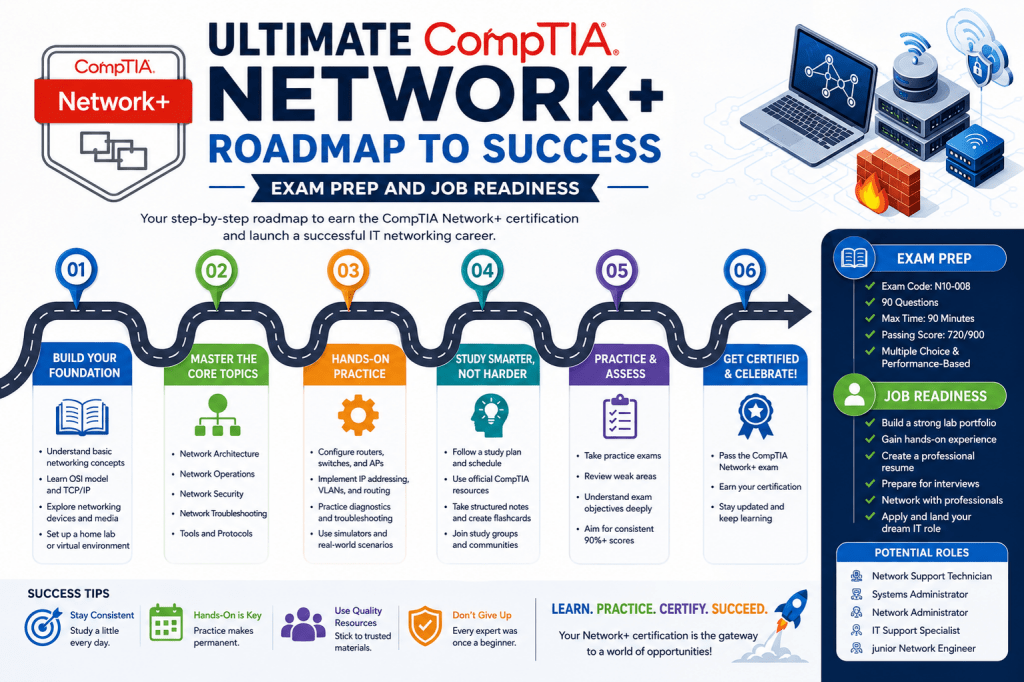
Roadmap to Success is a structured learning approach designed to help individuals understand how certification-based learning can support entry into information technology roles. It focuses on building awareness of technical skill development, understanding how different areas of knowledge connect, and identifying practical steps that can be taken to progress from foundational learning into job-ready capabilities. In the context of networking, one of the most widely recognized entry points is the CompTIA Network+ certification, which is designed to validate core networking knowledge and practical troubleshooting ability. This certification is often chosen by individuals who are beginning their careers in information technology and want to establish a strong base in network systems, communication principles, and infrastructure support.
Introduction to Networking as a Career Foundation
Networking forms the backbone of modern digital environments, connecting devices, systems, and users across local and global infrastructures. A strong understanding of networking concepts is essential for many roles in information technology because nearly every system relies on connectivity in some form. Entry-level professionals who begin with networking often develop skills that allow them to understand how data moves across systems, how devices communicate, and how network performance can be maintained and secured. The CompTIA Network+ certification is positioned as a foundational milestone for individuals who want to build this understanding in a structured and practical way. It helps learners transition from basic IT familiarity into more specialized technical roles by focusing on real-world networking scenarios and problem-solving skills.
Purpose and Scope of the Certification
The CompTIA Network+ certification is designed to validate essential networking knowledge required for supporting, maintaining, and troubleshooting network infrastructures. It covers a broad range of topics that include network design principles, device configuration, network operations, and security fundamentals. The scope of this certification is intentionally vendor-neutral, meaning the concepts learned are applicable across different systems and technologies rather than being tied to a specific product or platform. This makes it particularly useful for individuals who are still exploring different areas within IT and want flexibility in their career direction. The certification emphasizes both theoretical understanding and practical application, ensuring that learners are not only familiar with concepts but also capable of applying them in workplace environments.
Core Skills Developed Through Networking Study
A key aspect of the CompTIA Network+ learning path is the development of practical technical skills. These include the ability to configure basic network devices, understand network topologies, identify connectivity issues, and apply troubleshooting methodologies. Learners also develop knowledge of wireless technologies, wired network structures, and communication protocols that govern how data is transmitted and received. In addition to technical configuration, the certification also emphasizes understanding network documentation practices, which are essential for maintaining clarity in complex environments. Security awareness is another important component, focusing on identifying vulnerabilities, applying basic protections, and understanding how secure communication is maintained across systems. These combined skills create a foundation that supports a wide range of IT responsibilities.
Recommended Experience and Preparation Level
While the certification is considered entry-level, it is generally recommended that learners have some prior exposure to information technology environments. This may include several months of experience working with computers, basic networking exposure, or familiarity with system support tasks. This background helps learners better understand the practical context of networking concepts. However, the certification is also structured in a way that allows motivated beginners to progress successfully through consistent study and hands-on practice. Preparation typically involves learning foundational concepts first, followed by applied practice through simulation of network scenarios and troubleshooting exercises. The goal is to gradually build confidence in understanding how networks function in real-world environments.
Structure and Nature of the Examination
The certification is assessed through a single comprehensive examination that evaluates both theoretical knowledge and practical understanding. The exam includes a variety of question formats such as multiple-choice questions, scenario-based problem solving, and performance-style questions that require analytical thinking. The duration is typically around ninety minutes, during which candidates must demonstrate understanding across multiple domains of networking knowledge. The exam is designed to assess not only memorization but also the ability to interpret network situations and respond appropriately. This approach ensures that successful candidates are capable of applying their knowledge in practical job environments rather than relying solely on theoretical understanding.
Key Knowledge Areas Assessed
The examination covers several important domains of networking knowledge. These include network architecture, which focuses on how different systems are structured and connected. It also includes network operations, which involve managing and maintaining network performance over time. Another important area is security, which focuses on protecting data and ensuring secure communication between systems. Troubleshooting is also a significant component, requiring candidates to diagnose and resolve network issues efficiently. In addition, candidates are expected to understand network tools and technologies that assist in monitoring and maintaining system performance. Together, these areas provide a comprehensive understanding of how modern networks operate and are maintained.
Approach to Effective Study and Preparation
Successful preparation for networking certification requires a structured and consistent approach. Learners typically benefit from breaking down study material into manageable sections, focusing on one topic at a time. Practical experience is highly valuable, as it allows learners to connect theoretical knowledge with real-world application. Setting a study schedule helps maintain consistency and ensures that all topics are covered thoroughly before attempting the examination. Reviewing concepts regularly and practicing troubleshooting scenarios can significantly improve understanding. It is also important to focus on understanding underlying principles rather than memorizing information, as networking environments often require adaptive thinking.
Career Opportunities After Certification
Completion of a foundational networking certification can open doors to several entry-level roles within information technology. These roles may include network support positions, technical assistance roles, system support functions, and infrastructure maintenance responsibilities. Individuals may also work in environments where they assist with device installation, network configuration, and user support. Over time, professionals can progress into more advanced roles such as network administration or system engineering, depending on experience and additional learning. The certification serves as a stepping stone that helps individuals transition into more specialized technical careers by providing essential knowledge and practical skills.
Understanding Recertification and Continuing Development
Technical certifications often require ongoing validation to ensure that knowledge remains current with evolving technologies. This involves periodic renewal through continuing education or re-examination. The purpose of recertification is to ensure that professionals stay updated with changes in networking technologies, security practices, and infrastructure management techniques. Continuous learning is an important part of an IT career because technology evolves rapidly. Professionals who engage in ongoing development are better equipped to handle new challenges and adapt to changing environments. This approach supports long-term career growth and ensures that skills remain relevant in the industry.
Career Growth and Progression Pathways
After gaining foundational networking knowledge, individuals often explore more advanced areas of specialization. These may include security-focused roles, cloud-based infrastructure, or enterprise-level system administration. The progression typically depends on personal interest, workplace requirements, and exposure to different technologies. Some individuals may choose to deepen their networking expertise, while others may expand into related fields such as cybersecurity or systems engineering. The flexibility of foundational networking knowledge allows professionals to explore multiple directions within the broader information technology landscape. Career growth is usually supported by continued learning, hands-on experience, and exposure to increasingly complex environments.
Broader Certification Pathway Understanding
Within the information technology field, certifications are often structured in progressive levels that build from foundational knowledge to advanced specialization. Entry-level certifications focus on basic concepts and skills, while intermediate and advanced certifications address more complex systems and enterprise environments. Networking certifications are commonly part of this structured progression, serving as a base for more specialized learning paths. This layered approach allows individuals to develop expertise gradually, ensuring that each stage of learning builds upon the previous one. It also helps professionals identify their strengths and interests before committing to a specific specialization.
Final Thoughts on Building a Networking Career Path
Developing a career in networking requires a combination of structured learning, practical experience, and continuous skill development. Foundational certifications provide a clear starting point by introducing essential concepts and practical techniques used in real-world environments. As individuals progress, they gain the ability to manage more complex systems and contribute to larger infrastructure projects. The journey from beginner to skilled professional is gradual and requires consistent effort, but it provides strong long-term career potential. Networking remains a critical component of modern technology environments, making it a valuable and stable area of specialization for those entering the information technology field.