
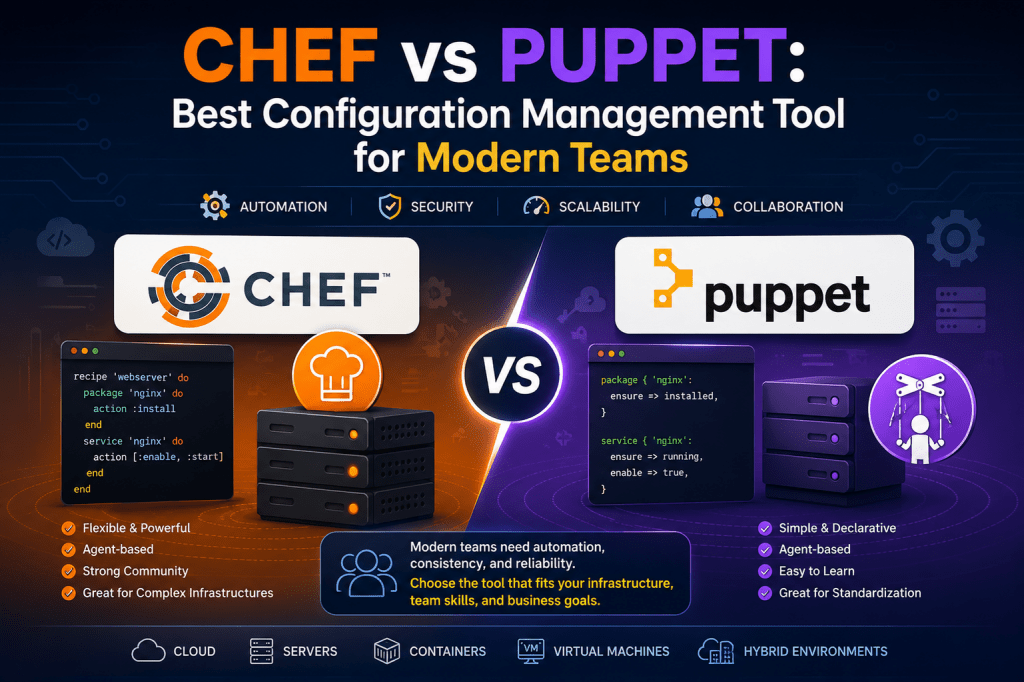
Managing servers and infrastructure manually becomes difficult as businesses grow. Configuration management tools help automate system setup, software installation, updates, security policies, and server consistency. Instead of configuring every machine one by one, organizations can define rules once and apply them across the entire infrastructure.
Two of the most popular tools in this space are Chef and Puppet. Both help automate infrastructure management, reduce human error, and improve deployment speed. Even though they solve similar problems, their working style and approach are very different.
Organizations choosing between Chef and Puppet should understand how each platform handles automation, scalability, infrastructure changes, and team collaboration. The right choice depends on company goals, technical skills, and operational requirements.
Why Configuration Management Is Important
Modern IT environments contain hundreds or even thousands of servers running across cloud and on-premises platforms. Managing these systems manually creates inconsistency and increases the risk of errors.
Configuration management tools ensure every server follows the same setup rules. This improves stability, security, and operational efficiency. If a server fails, teams can quickly recreate it using predefined configurations instead of rebuilding everything manually.
These tools also support scalability. Businesses can add or remove infrastructure quickly without spending hours configuring systems by hand. Automation reduces downtime, improves deployment speed, and keeps environments consistent.
Another major advantage is compliance and auditing. Organizations can track changes, monitor system states, and identify configuration issues faster. This is especially useful for industries with strict security and regulatory requirements.
How Chef Works
Chef focuses heavily on flexibility and infrastructure automation through code. It uses the Ruby programming language, allowing teams to create highly customizable automation workflows.
Chef organizes configurations into recipes and cookbooks. Recipes contain automation instructions, while cookbooks group multiple recipes together for easier management. This structure allows teams to reuse code and standardize infrastructure processes.
Chef also includes a component called Workstation, where engineers can test configurations before deployment. This reduces the risk of broken updates and improves deployment reliability.
Because Chef behaves similarly to software development frameworks, developers often prefer it. Teams can integrate infrastructure automation directly into development pipelines and continuous deployment systems.
Why DevOps Teams Prefer Chef
Chef is strongly connected with DevOps culture because it supports fast deployments and rapid infrastructure changes. Organizations following DevOps practices often need automation tools that can scale quickly and adapt to changing environments.
Chef enables infrastructure to be treated like application code. Teams can use version control, automated testing, and continuous integration for infrastructure management. This improves collaboration between development and operations teams.
Cloud-focused organizations also favor Chef because of its strong integration with cloud platforms and scalable environments. It works well for businesses managing dynamic infrastructure and continuous deployment pipelines.
The platform’s flexibility makes it useful for complex systems where custom automation is required. Developers can create advanced workflows, conditional logic, and reusable infrastructure components.
Benefits of Using Chef
One of Chef’s biggest advantages is flexibility. Teams can build highly customized infrastructure automation based on their exact requirements. Since it uses Ruby, developers familiar with programming concepts can adapt quickly.
Chef also supports reusable automation patterns. Organizations can standardize deployments and reduce repetitive manual tasks. This improves efficiency and accelerates infrastructure provisioning.
Another strength is scalability. Chef works well in large cloud environments where infrastructure changes frequently. Businesses can automate deployments across multiple environments while maintaining consistency.
Chef also supports strong testing capabilities. Teams can validate infrastructure changes before deployment, reducing the chances of operational failures.
Challenges of Chef
Although Chef is powerful, it can be difficult for beginners. Teams without programming experience may struggle with Ruby-based automation. The learning curve is usually steeper compared to more structured configuration management platforms.
Its flexibility can also create complexity. Poorly written automation code may become difficult to maintain over time. Organizations need strong coding standards and testing processes to manage Chef effectively.
Chef is often better suited for developer-focused environments rather than traditional system administration teams. Companies that prefer highly structured workflows may find it too open-ended.
How Puppet Works
Puppet takes a more structured and declarative approach to configuration management. Instead of defining detailed procedural steps, administrators describe the desired state of systems.
Puppet then automatically determines how to achieve and maintain that state. This simplifies infrastructure management and reduces the need for advanced programming knowledge.
Puppet uses its own domain-specific language designed specifically for infrastructure automation. Many system administrators prefer this approach because it focuses more on operational stability and consistency.
The platform continuously checks managed systems and automatically corrects configuration drift. If servers move away from the intended setup, Puppet restores them to the desired state.
Why System Administrators Prefer Puppet
Puppet is often considered more beginner-friendly for operations teams. Its declarative approach reduces scripting complexity and makes infrastructure definitions easier to understand.
Organizations focused on stability and governance usually appreciate Puppet’s structured workflow. It provides strong auditing capabilities and detailed visibility into infrastructure changes.
Puppet also includes simulation features that allow teams to preview changes before deployment. This helps reduce operational risks and improves infrastructure safety.
Many enterprises choose Puppet because of its mature ecosystem and long-standing reputation in configuration management. It is widely used in traditional enterprise environments where consistency and compliance are top priorities.
Benefits of Using Puppet
Puppet’s biggest strength is simplicity and predictability. Administrators define system states clearly, and Puppet handles enforcement automatically. This reduces configuration errors and improves infrastructure consistency.
The platform also provides excellent reporting and auditing features. Teams can monitor managed resources, track dependencies, and maintain compliance more easily.
Puppet works well in environments where controlled infrastructure changes are important. Organizations that prioritize operational stability often prefer its structured approach.
Another major advantage is its large community and mature documentation ecosystem. Businesses can find extensive resources, modules, and support for implementation.
Challenges of Puppet
While Puppet simplifies many tasks, it may feel less flexible for developers who want advanced customization. Its domain-specific language can also feel limiting compared to general-purpose programming languages like Ruby.
Organizations focused heavily on rapid DevOps workflows may find Puppet slower for highly dynamic infrastructure environments. Although Puppet supports automation effectively, its philosophy prioritizes safety and consistency over maximum flexibility.
Teams that require highly customized deployment logic sometimes prefer Chef because of its programming capabilities.
Chef vs Puppet: Key Differences
The biggest difference between Chef and Puppet is their automation philosophy. Chef focuses on procedural automation using Ruby code, while Puppet emphasizes declarative infrastructure definitions.
Chef is usually favored by developers and DevOps teams because it supports deep customization and rapid infrastructure changes. Puppet is commonly preferred by system administrators and enterprise IT teams because it prioritizes structure and operational safety.
Chef offers greater flexibility, but that flexibility often requires stronger programming skills. Puppet provides a more controlled environment that simplifies infrastructure management for many organizations.
Another difference is change management. Chef encourages fast iteration and dynamic deployments, while Puppet focuses more on stability and compliance-driven automation.
Both tools support scalability, automation, cloud environments, and infrastructure consistency. The right choice depends on company culture, technical expertise, and operational priorities.
Infrastructure Automation and Scalability
As organizations grow, infrastructure management becomes more complicated. Servers, databases, cloud services, applications, and networking components must work together consistently. Manual administration slows operations and increases the chances of configuration errors. This is why automation has become one of the most important parts of modern IT operations.
Both Chef and Puppet are designed to simplify infrastructure automation, but they approach scalability differently. Companies choosing between these tools must understand how each platform handles large environments, deployment speed, and infrastructure growth.
Automation is not only about reducing workload. It also improves consistency, reliability, and operational efficiency. When systems are automated properly, organizations can deploy servers faster, recover from failures quickly, and maintain stable infrastructure across multiple environments.
How Chef Handles Scalability
Chef is designed for highly dynamic infrastructure environments. It works especially well in cloud-native systems where servers are frequently created, updated, or removed. Its flexibility allows teams to automate complex workflows and adapt infrastructure rapidly.
One major advantage of Chef is its strong cloud integration. Organizations using cloud platforms often need infrastructure that scales automatically based on traffic or resource demands. Chef supports this kind of dynamic provisioning very effectively.
Chef also allows teams to manage infrastructure through reusable cookbooks and recipes. Instead of repeating the same configuration tasks manually, organizations can create reusable automation components that work across multiple systems.
This reusable structure improves operational efficiency and reduces deployment time. Teams can standardize infrastructure configurations while still maintaining flexibility for custom requirements.
Another reason Chef performs well in scalable environments is its compatibility with continuous deployment pipelines. Infrastructure changes can move through automated testing and deployment processes alongside application updates.
This integration supports faster product releases and quicker infrastructure modifications.
Chef in Cloud Environments
Cloud infrastructure changes constantly. Businesses may add new servers during high traffic periods and remove them when demand decreases. Managing these changes manually is impractical.
Chef helps organizations automate cloud provisioning and maintain infrastructure consistency during rapid scaling events. Teams can deploy identical server configurations automatically across different cloud environments.
Chef is frequently used in hybrid cloud systems where infrastructure exists across both public and private cloud platforms. Its flexible architecture allows organizations to manage diverse environments from a centralized automation framework.
Because Chef supports infrastructure as code, teams can recreate entire environments quickly when needed. This improves disaster recovery and reduces operational downtime.
Organizations focused on agility and rapid infrastructure scaling often consider Chef a strong choice for cloud-based operations.
How Puppet Handles Scalability
While Puppet is also capable of managing large infrastructures, its approach focuses more on stability and consistency than rapid flexibility. Puppet emphasizes maintaining desired system states across all managed nodes.
This continuous enforcement model helps organizations maintain predictable environments even as infrastructure grows. Puppet automatically checks systems for configuration drift and corrects issues when inconsistencies appear.
For enterprises managing thousands of servers, this consistency becomes extremely valuable. Teams can ensure that every machine follows approved configurations without requiring constant manual oversight.
Puppet’s declarative model also simplifies infrastructure management for larger operations teams. Administrators define what systems should look like, and Puppet handles enforcement automatically.
This structure reduces operational complexity and makes large environments easier to maintain.
Puppet in Enterprise Environments
Large enterprises often prioritize governance, compliance, and infrastructure stability. Puppet aligns well with these goals because of its controlled and structured management approach.
Many organizations operating regulated environments need detailed auditing and reporting capabilities. Puppet provides visibility into infrastructure changes and system relationships, helping teams maintain compliance standards.
Puppet also supports role-based access and centralized policy management. This allows organizations to control infrastructure changes more carefully and reduce operational risks.
In environments where change management processes are strict, Puppet’s predictable workflow can be extremely beneficial. Infrastructure changes can be reviewed, tested, and approved systematically before deployment.
This controlled approach is one reason Puppet remains popular in traditional enterprise IT environments.
Learning Curve and Team Skills
One of the biggest factors when choosing between Chef and Puppet is the skill level of the team managing the infrastructure.
Chef typically requires stronger programming knowledge because it relies heavily on Ruby. Developers and DevOps engineers often adapt to Chef quickly because its workflow resembles software development practices.
Teams with coding experience usually appreciate Chef’s flexibility and customization capabilities. They can build advanced automation workflows and integrate infrastructure management deeply into deployment pipelines.
However, system administrators without programming backgrounds may find Chef more difficult to learn. Writing and maintaining infrastructure code requires strong scripting knowledge and testing discipline.
Puppet is generally considered easier for traditional operations teams. Its declarative language focuses on defining system states rather than writing detailed procedural logic.
Because of this simpler approach, many administrators find Puppet easier to understand and maintain. Organizations transitioning from manual infrastructure management often prefer Puppet because it reduces coding complexity.
The best choice often depends on whether the company’s infrastructure team is more development-oriented or operations-focused.
Infrastructure Testing and Validation
Testing infrastructure changes is critical for maintaining reliable environments. Even small configuration mistakes can cause application failures or security vulnerabilities.
Chef includes strong testing capabilities through its workstation environment. Teams can validate infrastructure changes locally before pushing them to production systems. This reduces deployment risks and improves automation quality.
Because Chef integrates well with DevOps pipelines, organizations can include automated testing in continuous deployment workflows. Infrastructure changes can move through testing stages just like application code.
This approach supports rapid innovation while maintaining operational reliability.
Puppet also supports testing and simulation features. Administrators can preview infrastructure changes and evaluate potential impacts before deployment.
This focus on controlled deployment helps organizations reduce accidental configuration errors. Puppet’s structured approach makes infrastructure changes easier to audit and verify.
Both tools support reliable infrastructure testing, but Chef often provides more flexibility for developer-driven automation pipelines.
Security and Compliance Management
Security is a major concern for every organization managing large infrastructure environments. Misconfigured systems can expose businesses to operational failures and cyber threats.
Both Chef and Puppet help improve security by enforcing consistent configurations across servers. Instead of relying on manual administration, teams can automate security policies and apply them uniformly across infrastructure.
Chef supports customizable security automation workflows. Teams can create advanced policies tailored to specific operational requirements. This flexibility is useful for organizations with unique compliance or security standards.
However, because Chef allows extensive customization, organizations must maintain strong governance practices to avoid configuration inconsistencies.
Puppet focuses heavily on policy enforcement and compliance visibility. Its declarative model helps organizations maintain approved configurations consistently across all systems.
Puppet’s auditing features also help organizations track changes and demonstrate compliance during security reviews. Teams can monitor which systems are managed, what configurations are applied, and when changes occur.
This structured approach makes Puppet especially appealing for industries with strict regulatory requirements.
Community Support and Ecosystem
Both Chef and Puppet have strong user communities and extensive ecosystems, but there are differences in maturity and focus.
Puppet has been widely used in enterprise environments for many years and has a large collection of modules and documentation resources. Organizations can often find existing solutions for common infrastructure tasks without building everything from scratch.
Its mature ecosystem makes implementation easier for many enterprise teams.
Chef also has a strong community and extensive integration support, particularly within DevOps and cloud-focused environments. Developers often appreciate Chef’s flexibility and compatibility with modern infrastructure technologies.
Both platforms offer reusable automation modules that accelerate deployment processes and reduce repetitive work.
Community support is important because infrastructure automation tools can become deeply integrated into organizational operations. Access to documentation, tutorials, and community expertise helps teams troubleshoot problems and improve deployment efficiency.
Performance and Operational Flexibility
Chef is often viewed as more flexible because it allows teams to define highly customized automation behavior. Organizations can build advanced deployment workflows, dynamic scaling systems, and detailed infrastructure logic.
This flexibility benefits companies operating fast-moving digital platforms or rapidly changing cloud environments.
However, flexibility sometimes increases operational complexity. Teams must manage infrastructure code carefully to maintain readability and consistency.
Puppet prioritizes operational predictability over unrestricted customization. Its declarative model reduces complexity and helps organizations maintain standardized environments more easily.
This structured approach can improve long-term maintainability, especially in large enterprise systems where stability matters more than rapid experimentation.
Companies that prioritize innovation and agile infrastructure management often lean toward Chef, while organizations focused on consistency and governance frequently prefer Puppet.
Choosing the Right Tool for Your Organization
There is no universal answer when comparing Chef and Puppet. The best choice depends entirely on business goals, infrastructure complexity, and team expertise.
Organizations with strong DevOps cultures and developer-focused teams often prefer Chef because of its flexibility, cloud integration, and programmable automation capabilities.
Businesses focused on operational stability, compliance, and centralized infrastructure management frequently choose Puppet because of its structured workflow and strong governance features.
Infrastructure scale also matters. Dynamic cloud-native platforms may benefit from Chef’s adaptability, while traditional enterprise systems often align better with Puppet’s controlled environment.
Companies should also evaluate long-term maintenance requirements. Infrastructure automation becomes a core operational dependency, so choosing a platform that matches internal skills and workflows is extremely important.
Both Chef and Puppet remain powerful and respected configuration management tools capable of handling complex enterprise infrastructure. The ideal platform is the one that best supports the organization’s operational style, deployment strategy, and future growth plans.
Deployment Speed and Infrastructure Changes
Modern businesses need faster deployment cycles to stay competitive. Infrastructure teams are expected to release updates quickly, scale environments instantly, and maintain system stability without downtime. Configuration management tools play a major role in achieving these goals.
Both Chef and Puppet support automated deployments, but their methods differ significantly. Some organizations prioritize rapid infrastructure changes, while others focus more on controlled and predictable deployment processes.
Understanding how these platforms manage updates and infrastructure modifications helps businesses choose the right solution for their operational strategy.
Chef and Rapid Deployment Workflows
Chef is designed for organizations that need fast and flexible infrastructure management. It supports continuous deployment pipelines where infrastructure changes happen frequently and automatically.
Development-focused teams often prefer Chef because infrastructure can be treated like application code. Engineers can create automation scripts, test them, and deploy changes quickly across multiple environments.
This workflow is especially useful for businesses running cloud-native applications or high-traffic digital platforms. Infrastructure can scale rapidly based on demand while maintaining consistency.
Chef also supports advanced automation logic. Teams can create dynamic deployment workflows using conditions, reusable functions, and custom scripts. This flexibility makes Chef highly adaptable for complex infrastructures.
Organizations practicing DevOps usually benefit from Chef’s speed and programmability. Infrastructure updates become faster, and collaboration between developers and operations teams improves significantly.
How Chef Supports Continuous Integration
Continuous integration and continuous deployment are important parts of modern software development. These practices allow teams to release updates more frequently while reducing operational risks.
Chef integrates well with CI/CD pipelines, allowing infrastructure updates to move through automated testing and deployment stages. Teams can validate changes before they reach production systems.
This process improves reliability and reduces downtime caused by manual configuration errors. Infrastructure changes become more controlled even in fast-moving environments.
Chef’s programmable structure also allows businesses to automate repetitive tasks such as server provisioning, software installation, application deployment, and environment configuration.
For organizations managing large-scale cloud systems, this automation saves significant time and operational effort.
Puppet and Controlled Infrastructure Changes
While Chef focuses heavily on flexibility and rapid deployments, Puppet takes a more controlled approach. Puppet prioritizes infrastructure consistency, stability, and predictable operations.
Instead of encouraging rapid procedural changes, Puppet emphasizes defining desired system states clearly and enforcing them continuously.
This structure works well for organizations where infrastructure stability is more important than deployment speed. Many enterprises prefer slower and safer deployment processes to reduce operational risks.
Puppet also provides strong auditing and reporting capabilities. Teams can track changes carefully and review infrastructure modifications before deployment.
This controlled workflow helps organizations maintain governance standards and avoid accidental misconfigurations.
Puppet’s Focus on Stability
Puppet continuously checks managed systems to ensure they match approved configurations. If systems drift from the intended setup, Puppet automatically restores them.
This enforcement model improves long-term consistency across infrastructure environments. Organizations managing sensitive systems often appreciate this reliability.
Puppet also allows teams to simulate infrastructure changes before applying them. Administrators can preview potential impacts and reduce deployment risks.
For industries with strict compliance requirements, this structured approach is extremely valuable. Infrastructure modifications can be documented, reviewed, and monitored systematically.
Although Puppet may not feel as fast or flexible as Chef, its focus on stability makes it attractive for enterprise operations.
Infrastructure as Code Philosophy
Both Chef and Puppet support infrastructure as code, but they implement the concept differently.
Chef approaches infrastructure like software development. Engineers write automation logic using Ruby, creating highly customizable workflows and reusable deployment components.
This method gives teams deep control over infrastructure behavior. Developers can build advanced automation systems tailored to specific business requirements.
Puppet approaches infrastructure as a declarative system. Administrators define what the infrastructure should look like rather than describing every procedural step.
This reduces scripting complexity and simplifies infrastructure management for many operations teams.
The difference between these approaches often influences which teams prefer each platform. Development-oriented environments usually lean toward Chef, while operations-focused organizations often prefer Puppet.
Customization and Flexibility
Chef is widely recognized for its flexibility. Teams can create highly customized automation logic using Ruby-based scripting. This allows organizations to adapt infrastructure workflows to unique operational requirements.
Businesses operating complex cloud environments often benefit from this level of customization. Chef can integrate with multiple systems and support advanced deployment strategies.
However, flexibility also increases responsibility. Teams must maintain clean infrastructure code and strong testing practices to prevent automation problems.
Puppet offers customization as well, but within a more structured framework. Its declarative language simplifies many infrastructure tasks and reduces the risk of overly complicated automation scripts.
Organizations that prioritize standardization often appreciate Puppet’s controlled environment because it keeps infrastructure definitions easier to manage.
Cloud Compatibility and Hybrid Infrastructure
Cloud computing has transformed infrastructure management. Many organizations now operate across public clouds, private clouds, and on-premises environments simultaneously.
Chef performs especially well in dynamic cloud systems. Its flexibility supports rapid provisioning, automated scaling, and cloud-native deployment models.
Organizations using microservices, containers, or distributed applications often prefer Chef because it adapts easily to changing infrastructure requirements.
Chef’s integration capabilities also allow businesses to connect automation workflows with multiple cloud providers and deployment tools.
Puppet also supports cloud infrastructure management, but its strength lies more in maintaining consistency across environments. Enterprises managing hybrid systems often use Puppet to enforce configuration standards across diverse infrastructure platforms.
Both tools support hybrid infrastructure, but Chef usually appeals more to highly dynamic cloud environments, while Puppet is often preferred for stable enterprise ecosystems.
Operational Visibility and Monitoring
Monitoring infrastructure changes is essential for maintaining reliable operations. Both Chef and Puppet provide visibility into managed systems, but their reporting styles differ.
Chef focuses more on automation flexibility and integration capabilities. Teams can connect Chef workflows with monitoring platforms and deployment systems to create centralized operational pipelines.
This integration supports real-time infrastructure management and automated response workflows.
Puppet emphasizes infrastructure visibility and auditing. Organizations can track resources, dependencies, configuration states, and policy enforcement from centralized dashboards.
This reporting capability improves operational transparency and helps organizations maintain compliance standards.
Businesses operating heavily regulated environments often value Puppet’s auditing features because they simplify reporting and governance processes.
Team Collaboration and Workflow Management
Infrastructure management is no longer limited to system administrators alone. Modern environments require collaboration between developers, operations teams, security engineers, and cloud architects.
Chef supports collaborative DevOps workflows by allowing infrastructure automation to integrate directly into development processes. Teams can manage infrastructure changes using version control systems, peer reviews, and automated testing pipelines.
This shared workflow improves communication between departments and accelerates deployment cycles.
Puppet supports collaboration differently by emphasizing centralized policy management and operational governance. Infrastructure definitions remain standardized and easier to review across large teams.
Organizations with structured operational hierarchies often appreciate Puppet’s governance-focused workflow.
The best choice depends largely on how teams collaborate internally and how infrastructure responsibilities are distributed across the organization.
Cost and Resource Considerations
Implementing configuration management platforms requires investment in training, maintenance, and operational planning. Businesses should evaluate not only software capabilities but also the internal resources needed for successful adoption.
Chef may require stronger development expertise because of its Ruby-based automation model. Organizations lacking programming experience may need additional training and onboarding time.
However, businesses with mature DevOps teams often find Chef highly efficient once implementation is complete.
Puppet may reduce training complexity for traditional operations teams because its declarative language is generally easier to understand. This can simplify adoption in enterprise environments with large infrastructure teams.
Long-term maintenance is another important consideration. Infrastructure automation systems become deeply integrated into operational processes, so maintainability and team familiarity are critical.
Organizations should choose the platform that aligns best with their technical capabilities and operational workflows.
Community Ecosystem and Long-Term Adoption
Both Chef and Puppet have strong communities and extensive ecosystems. Businesses can access modules, automation templates, documentation, and support resources for implementation.
Puppet has long been associated with enterprise infrastructure management and has a mature ecosystem for compliance-focused environments.
Chef has built a strong reputation among DevOps and cloud-focused organizations because of its flexibility and integration capabilities.
Long-term adoption success depends heavily on internal expertise and operational alignment. A powerful tool is only effective when teams can manage it efficiently and maintain automation workflows consistently.
Organizations should evaluate future infrastructure plans before choosing a platform. The right tool should support not only current requirements but also future scalability, automation, and operational goals.
Choosing Between Speed and Stability
The comparison between Chef and Puppet often comes down to one major question: Does the organization prioritize speed or stability?
Chef is ideal for businesses that need flexible automation, rapid deployments, and deep customization. It supports agile infrastructure management and works exceptionally well in cloud-native environments.
Puppet is better suited for organizations focused on consistency, governance, and operational control. Its structured approach reduces complexity and improves infrastructure reliability.
Neither platform is universally better. Both are powerful configuration management tools trusted by organizations worldwide.
The right decision depends on infrastructure complexity, company culture, deployment strategy, and team expertise. Businesses that understand their operational priorities clearly are far more likely to choose the platform that delivers long-term success.
Security Management and Infrastructure Reliability
Security is one of the biggest reasons organizations invest in configuration management tools. Manual infrastructure management often creates inconsistencies that lead to vulnerabilities and operational risks. Automated systems help enforce security policies across every server and environment consistently.
Both Chef and Puppet improve infrastructure security by automating updates, permissions, configurations, and compliance tasks. However, each platform handles security management differently.
Chef provides flexible security automation through programmable workflows. Teams can create customized policies, automate patch management, and integrate security checks directly into deployment pipelines. This makes Chef useful for organizations with complex security requirements and rapidly changing infrastructure.
Puppet focuses more on policy enforcement and infrastructure consistency. It continuously checks systems against approved configurations and automatically corrects unauthorized changes. This helps organizations maintain stable and secure environments over long periods.
Businesses operating in regulated industries often prefer Puppet because of its strong auditing and compliance features. Teams can track configuration changes, review system states, and maintain detailed records for compliance reporting.
Infrastructure Reliability and System Consistency
Reliable infrastructure is critical for business continuity. Even small configuration differences between servers can create application failures or unexpected downtime.
Chef helps maintain reliability through reusable automation code and testing workflows. Teams can validate infrastructure changes before deployment and reduce operational risks through automated testing practices.
Because Chef supports highly customizable automation, organizations can adapt infrastructure behavior to different environments and workloads quickly. This flexibility is valuable for businesses operating large-scale cloud platforms or fast-growing applications.
Puppet improves reliability through continuous enforcement. Instead of only applying configurations once, Puppet regularly checks systems to ensure they remain compliant with approved policies.
This reduces configuration drift and keeps infrastructure environments stable over time. Enterprises managing thousands of servers often rely on Puppet’s consistency to maintain predictable operations.
Ease of Maintenance and Long-Term Management
Infrastructure automation tools become long-term operational dependencies. Organizations must consider how easy each platform is to maintain as environments grow more complex.
Chef offers extensive flexibility, but maintaining infrastructure code may require experienced developers and strong testing practices. Teams must manage automation carefully to avoid overly complicated workflows.
Organizations with mature DevOps cultures often handle this complexity effectively because their teams are already comfortable with coding and automation pipelines.
Puppet simplifies maintenance for many operations teams by using a declarative model. Infrastructure definitions are often easier to read, manage, and standardize across large environments.
This structured approach can reduce operational complexity and improve long-term maintainability for enterprise systems.
The ideal choice depends heavily on team expertise and operational style. Developer-focused teams may prefer Chef’s flexibility, while traditional infrastructure teams often appreciate Puppet’s simplicity.
Community Support and Industry Adoption
Both Chef and Puppet have strong industry reputations and large user communities. Organizations can access documentation, reusable modules, and community-driven support resources for implementation and troubleshooting.
Puppet has long been popular in enterprise environments because of its stability and governance-focused approach. Many large organizations continue using Puppet for centralized infrastructure management and compliance monitoring.
Chef is widely respected in DevOps and cloud-native environments because of its integration capabilities and automation flexibility. Businesses focused on rapid scaling and continuous deployment often prefer Chef’s adaptable ecosystem.
Both platforms continue to evolve alongside modern infrastructure technologies, making them reliable choices for enterprise automation.
Which Tool Is Better for Your Organization
Choosing between Chef and Puppet depends entirely on business goals, infrastructure requirements, and team capabilities.
Organizations focused on rapid deployments, cloud scalability, and DevOps workflows often prefer Chef because of its flexibility and strong programming capabilities. It works especially well for development-oriented teams managing highly dynamic environments.
Businesses prioritizing operational stability, compliance, and centralized governance frequently choose Puppet because of its structured automation model and consistent policy enforcement.
Chef provides greater customization, while Puppet emphasizes simplicity and predictability. Neither platform is universally superior because both solve infrastructure management challenges effectively in different ways.
The best configuration management tool is the one that aligns most closely with the organization’s culture, operational processes, and long-term infrastructure strategy.
Final Conclusion
Chef and Puppet remain two of the most respected configuration management platforms in the IT industry. Both help organizations automate infrastructure, improve scalability, reduce manual work, and maintain system consistency.
Chef stands out for flexibility, developer-focused automation, and cloud-native scalability. It is ideal for businesses embracing DevOps culture and rapid infrastructure changes.
Puppet excels in operational control, infrastructure stability, and compliance-focused management. It is often the preferred choice for enterprises that value predictable workflows and long-term consistency.
Before choosing either platform, organizations should carefully evaluate team expertise, infrastructure complexity, deployment speed requirements, and operational priorities. A well-matched configuration management tool can improve efficiency, strengthen security, and support long-term business growth.