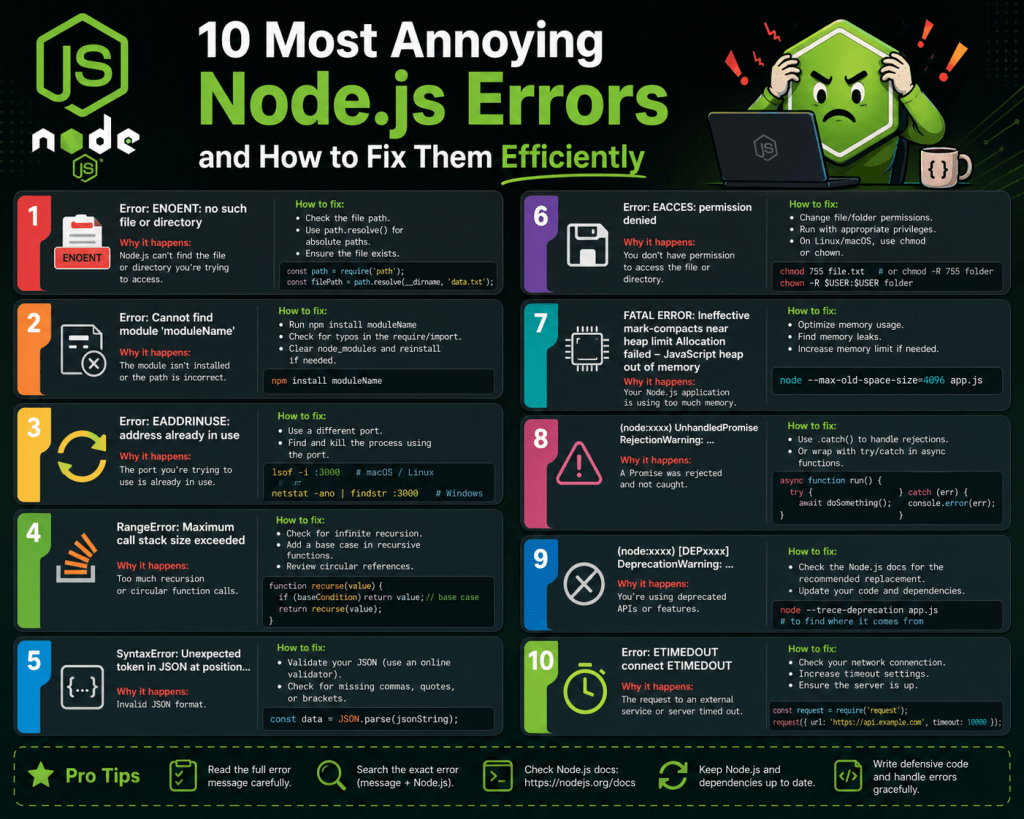
Node.js operates on a single-threaded event-driven architecture built on top of the V8 JavaScript engine. This design makes it highly efficient for I/O-heavy workloads, but it also means that small code-level mistakes can have immediate and sometimes cascading effects on application stability. Many runtime issues in Node.js are not caused by infrastructure but by misunderstandings of how JavaScript executes, manages scope, handles data types, and resolves modules. A strong grasp of foundational error categories is essential before moving into more advanced system design or scaling considerations.
Syntax Errors and Parsing Failures in Execution Flow
Syntax errors represent the earliest stage of failure in a Node.js application lifecycle. Before any code is executed, the JavaScript engine performs a parsing phase where it converts raw source code into an abstract syntax structure. If the code violates grammatical rules, execution halts immediately.
These errors often originate from structural imbalances in the code, such as missing parentheses, unclosed blocks, or incorrectly formed expressions. Because JavaScript allows flexible formatting, developers sometimes overlook subtle structural inconsistencies that prevent proper parsing. Even a single missing bracket in a deeply nested structure can invalidate an entire module.
Another common source of syntax failure is incorrect token usage. This includes misspelled reserved keywords, incorrect operator placement, or invalid variable naming conventions. Since parsing occurs before runtime execution, these errors are deterministic and consistently reproducible, making them easier to isolate compared to logical failures.
A key challenge in large-scale applications is that syntax errors may originate far from the reported location. The engine often flags the point where it can no longer interpret the structure, not necessarily where the actual mistake occurred. This makes contextual inspection necessary rather than relying solely on line indicators.
Effective resolution involves analyzing structural symmetry across the surrounding code region, particularly in nested function definitions, object literals, and control flow blocks. Developers typically rely on consistent formatting patterns to visually detect imbalance.
Preventive discipline plays a critical role here. Consistent indentation practices improve the readability of nested structures, while static validation tools help detect structural issues before execution. In modern development environments, real-time parsing feedback significantly reduces the likelihood of shipping syntax-invalid code.
Reference Errors and Execution Scope Violations
Reference errors occur during runtime when the engine attempts to access identifiers that are not available in the current execution context. Unlike syntax issues, these errors do not prevent the application from starting. Instead, they emerge during execution when a specific variable or function is referenced incorrectly.
The most frequent cause is attempting to access variables that have not been declared. In JavaScript, variable declaration is mandatory for controlled access, and undeclared identifiers result in immediate failure when referenced. This behavior is tightly connected to the language’s scoping model, which determines visibility boundaries based on function, block, or module context.
Scope violations are another major contributor. Variables declared inside a function or block are not accessible outside that boundary. When developers mistakenly assume global availability, reference errors occur. This is particularly common in asynchronous code where execution order does not align with logical expectations.
Naming inconsistencies also play a significant role. Since JavaScript is case-sensitive, minor variations in spelling or capitalization result in entirely different identifiers. In large codebases, this becomes a subtle but frequent source of runtime failure.
In modular systems, reference issues often appear due to missing imports or incorrect export mapping. When a module is not properly exposed or imported, the runtime treats the identifier as undefined, leading to execution failure at the point of usage.
Debugging reference errors requires tracing the execution path backward from the failure point. Developers examine whether the variable was initialized in the expected scope and whether it was modified or shadowed by another declaration. Shadowing occurs when a local variable unintentionally overrides a higher-scope variable, leading to unexpected behavior.
Prevention strategies focus on strict declaration discipline and predictable naming conventions. Reducing global variable usage significantly lowers the risk of unintended access. Structured modular design further isolates scope boundaries, minimizing cross-context contamination.
Type Errors and Dynamic Value Misinterpretation
Type errors arise when operations are performed on values that do not match the expected data structure. Because JavaScript is dynamically typed, variables are not bound to a fixed type, which increases flexibility but also introduces runtime uncertainty.
A common scenario involves invoking a value as a function when it is not callable. This typically happens when variables are reassigned or when data is transformed unexpectedly during execution. Another frequent issue is attempting to access properties on undefined or null values, which breaks object traversal logic.
Arithmetic operations on incompatible types also generate type-level failures. For example, performing numeric operations on string-based values without proper conversion leads to invalid computation states. Similarly, applying array-specific methods on non-array structures results in an execution breakdown.
These errors are particularly difficult to diagnose in complex applications where data flows through multiple transformation layers. The source of incorrect typing may be far removed from the location where the error is triggered. This makes tracing essential for resolution.
Effective debugging involves inspecting the actual runtime value at the point of failure rather than relying on assumptions based on variable naming. Understanding how data changes across function boundaries is critical for identifying where type inconsistency is introduced.
Preventing type-related issues requires structured validation of inputs before processing. Ensuring that data conforms to expected formats significantly reduces unexpected behavior later in execution. Defensive programming techniques, where assumptions about data type are explicitly verified, improve overall system stability.
In more advanced systems, type consistency is enforced through external validation layers or stricter development paradigms. This reduces ambiguity and ensures predictable execution paths across modules.
Module Resolution and Dependency Loading Failures
Node.js applications rely heavily on modular architecture, where functionality is distributed across independent files and external dependencies. Module resolution errors occur when the runtime cannot locate or properly load a required module.
One of the most common causes is missing dependencies. If a required package is not installed or is removed unintentionally, the runtime cannot resolve its reference during execution. This leads to immediate failure at the import stage.
Incorrect path specification is another frequent issue, especially in custom modules. Relative path miscalculations, such as incorrect directory traversal, can result in unresolved imports. In large projects with deeply nested structures, maintaining accurate path references becomes increasingly complex.
Version mismatches in dependencies can also lead to resolution inconsistencies. When a module expects a different interface than the installed version provides, runtime errors occur even if the module is technically present.
Another subtle cause is incorrect export configuration. If a module does not expose its functionality properly, importing files may fail to access expected properties, resulting in undefined behavior.
Diagnosing module-related issues requires verifying the existence of dependencies in the expected resolution path. Developers also inspect import statements to ensure alignment with the actual file structure. In some cases, rebuilding dependency trees resolves inconsistencies caused by partial installations or corrupted modules.
Preventive measures include maintaining consistent dependency management practices and avoiding manual alterations to package structures. Clear project organization reduces ambiguity in module referencing and improves long-term maintainability.
Asynchronous Execution Failures in Event-Driven Architecture
Asynchronous behavior is one of the defining characteristics of Node.js, but it is also a common source of runtime complexity. Errors in asynchronous execution typically arise from improper handling of callbacks, unresolved promises, or incorrect sequencing of operations.
One of the primary issues is unhandled promise rejection. When asynchronous operations fail without proper error handling, the runtime generates warnings or unexpected termination depending on the configuration. This occurs when error states are not explicitly captured during promise resolution.
Callback-based structures can also lead to deeply nested execution chains where error handling becomes inconsistent. This pattern increases the likelihood of missed error propagation and makes debugging significantly more complex.
Timing issues are another major factor. Because asynchronous operations do not execute sequentially by default, dependent operations may attempt to access results before they are available. This leads to undefined or incomplete data states.
In modern Node.js development, asynchronous patterns have shifted toward structured promise handling and async control flow management. However, misuse of these patterns still results in execution instability when error handling is not properly implemented.
Debugging asynchronous failures requires tracing execution order rather than reading code linearly. Developers must analyze when operations are triggered and when results are resolved. Understanding the event loop is essential for identifying mismatches between expected and actual execution timing.
Prevention strategies focus on consistent error handling across all asynchronous operations. Ensuring that every asynchronous path includes failure handling reduces the risk of silent breakdowns. Structured flow control improves predictability in concurrent execution environments.
Runtime Stability Challenges in Node.js Execution Models
Beyond individual error types, Node.js applications face broader stability challenges related to runtime behavior. Since the platform relies on a single-threaded event loop, blocking operations can degrade performance and amplify the impact of underlying errors.
Heavy computation, unoptimized loops, or synchronous blocking calls can delay the event loop, causing delays in handling incoming requests. While not always classified as errors, these conditions contribute to system instability and can trigger secondary failures.
Memory pressure is another contributing factor to runtime instability. When applications allocate memory without proper cleanup, overall system performance degrades. Over time, this can escalate into memory exhaustion scenarios where the runtime can no longer allocate additional resources.
File system bottlenecks, excessive logging, or unoptimized network requests can also amplify execution latency. These issues often interact with error conditions, making debugging more complex as multiple factors contribute to observed failures.
Understanding runtime stability requires viewing errors not as isolated events but as part of a larger execution ecosystem. Each error type interacts with system resources, execution flow, and dependency structures, influencing overall application behavior.
Effective Node.js development, therefore,e depends on both micro-level error handling and macro-level architectural awareness.
Asynchronous Execution Challenges and Event Loop Behavior in Node.js
Node.js is fundamentally built around an event-driven, non-blocking architecture. This design allows it to handle a large number of concurrent operations efficiently, especially I/O-bound tasks such as file handling, database queries, and network communication. However, this same architecture introduces a distinct category of errors and debugging complexity centered on asynchronous execution.
At the core of Node.js lies the event loop, which continuously processes queued tasks. When asynchronous operations are initiated, they are delegated to system-level APIs or worker threads, and their completion is handled later via callbacks, promises, or async functions. This separation between initiation and completion is powerful but can easily lead to execution mismatches if not properly managed.
One of the most common issues in asynchronous systems is timing inconsistency. Developers often assume sequential execution, when in reality asynchronous functions may complete in an entirely different order than they were called. This mismatch leads to situations where dependent logic runs before required data is available, producing undefined or incomplete states.
Another frequent issue is callback mismanagement. In earlier Node.js patterns, deeply nested callbacks were common, creating structures where error handling became inconsistent and difficult to maintain. This often resulted in partial execution flows where errors in lower-level callbacks were never properly propagated upward.
Modern JavaScript introduced promises and async functions to address this complexity, but improper usage still creates similar issues. A common problem is forgetting to return a promise in a chain, which breaks the flow of error propagation. When a promise is not properly returned, subsequent operations may execute prematurely, leading to unpredictable results.
Unhandled promise rejections represent another critical issue in asynchronous execution. When a promise fails, and no catch handler is attached, the error may go unnoticed or trigger runtime warnings depending on the environment configuration. In production systems, this can lead to silent failures that are difficult to trace.
Async/await syntax simplifies asynchronous code by allowing developers to write in a synchronous style, but it does not eliminate the need for error handling. Forgetting to wrap async operations in structured error handling mechanisms can still result in uncaught exceptions that disrupt execution flow.
Debugging asynchronous issues requires shifting perspective from linear execution to temporal execution. Instead of reading code top to bottom, developers must analyze when operations are scheduled, when they are executed, and when their results are resolved. The event loop becomes a critical mental model for understanding these behaviors.
In complex systems, asynchronous operations often interact with external services such as databases or APIs. Network latency introduces additional unpredictability, meaning that execution timing is influenced not just by code structure but also by external system performance. This increases the importance of timeout handling and fallback mechanisms.
Proper asynchronous design requires consistent error propagation strategies. Every asynchronous boundary should explicitly define how errors are handled and passed along. Without this discipline, failures can become isolated within execution branches and never reach central logging or monitoring systems.
Memory Management Issues and Resource Leakage in Long-Running Processes
Node.js applications, particularly backend services, are often designed to run continuously over long periods. This makes memory management a critical aspect of application stability. Unlike short-lived scripts, long-running services must carefully manage resource allocation to avoid gradual degradation.
Memory leaks occur when allocated memory is no longer needed but is not released by the system. Over time, this leads to increasing memory consumption, which can eventually degrade performance or cause application crashes. In Node.js, memory leaks are often subtle and do not immediately manifest as errors.
One common cause of memory leakage is the improper use of global variables. When objects are stored in the global scope without proper cleanup, they remain in memory for the lifetime of the application. This prevents garbage collection from reclaiming unused resources.
Event listeners are another frequent source of memory leaks. When listeners are attached but not removed after use, they continue to accumulate references. In long-running systems, this accumulation can lead to significant memory overhead and unexpected behavior during event processing.
Closures can also contribute to memory retention issues. When inner functions retain references to outer scope variables, those variables cannot be garbage collected until the closure itself is released. In complex applications, this can lead to unintended memory retention patterns.
Another contributing factor is caching without expiration policies. While caching improves performance, uncontrolled cache growth leads to memory exhaustion over time. Without proper invalidation mechanisms, cached data may accumulate indefinitely.
Detecting memory issues requires observing application behavior over time rather than at a single point in execution. Gradual increases in memory usage are often the first indicator of a leak. Tools that inspect heap snapshots and memory allocation patterns are commonly used for diagnosis.
Preventing memory-related issues involves disciplined resource management. Event listeners should always be removed when no longer needed, and global state should be minimized. Data structures that grow dynamically must include limits or cleanup strategies to prevent uncontrolled expansion.
Efficient memory usage is closely tied to application architecture. Systems that separate concerns and isolate responsibilities tend to have clearer ownership of data, making it easier to manage lifecycle and cleanup processes.
Port Conflicts and Service Binding Failures
In Node.js applications that run as servers, port binding is a fundamental operation. Each server listens on a specific network port to handle incoming requests. However, when a port is already in use, the application cannot bind to it, resulting in a runtime failure.
This issue typically occurs when multiple instances of the same service are started unintentionally or when another application is already occupying the required port. The operating system prevents multiple processes from binding to the same port simultaneously to avoid network conflicts.
Port conflicts are particularly common during development environments where services are frequently restarted. If a previous process was not terminated correctly, it may continue running in the background, occupying the required port.
Another scenario involves microservice architectures where multiple services are deployed on shared infrastructure. Without proper coordination, two services may attempt to use the same port, leading to deployment failures.
Diagnosing port-related issues involves identifying which process is currently using the port. Once identified, the conflicting process can be terminated, or the application can be configured to use an alternative port.
Dynamic port assignment is sometimes used to avoid conflicts altogether. In this approach, the system selects an available port automatically rather than relying on a fixed configuration. While this reduces conflicts, it requires additional handling in environments where fixed routing is necessary.
Proper service lifecycle management is essential to prevent port conflicts. Ensuring that processes are cleanly terminated during shutdown reduces the likelihood of orphaned processes continuing to occupy ports.
Network-Level Errors and External Communication Failures
Node.js applications frequently interact with external services over networks, making them vulnerable to a wide range of connectivity issues. Network errors occur when communication between the application and external systems fails due to connectivity, configuration, or environmental constraints.
One of the most common network failures is connection refusal. This occurs when the target service is not accepting connections on the specified port or is not running at all. In such cases, the client application cannot establish a connection, resulting in immediate failure.
Timeout errors occur when a request takes longer than the configured threshold to complete. This can be caused by slow network conditions, overloaded servers, or inefficient processing on the receiving end. Without proper timeout handling, applications may hang or degrade in responsiveness.
DNS resolution failures are another category of network issues. When a hostname cannot be resolved into an IP address, the request cannot proceed. This is often caused by misconfigured DNS settings or temporary network disruptions.
Intermittent network instability introduces additional complexity. Unlike deterministic errors, these failures may occur sporadically, making them difficult to reproduce and diagnose. Applications must therefore be designed to handle transient failures gracefully.
Retry mechanisms are commonly used to mitigate temporary network issues. However, improper retry implementation can lead to cascading failures if not controlled. Excessive retries may overload external services or create additional latency.
Effective network error handling requires distinguishing between permanent and temporary failures. Permanent failures require configuration or code changes, while temporary failures may be resolved through retries or fallback strategies.
Monitoring network interactions is essential for diagnosing systemic issues. Patterns of repeated failures often indicate deeper infrastructure or configuration problems that must be addressed at the system level.
Input Handling Issues and Data Integrity Failures
Node.js applications often process external input from APIs, user requests, or file systems. Improper handling of input data can lead to a range of runtime issues, including crashes, unexpected behavior, and security vulnerabilities.
One common issue is assuming input structure without validation. When applications expect data in a specific format but receive inconsistent or malformed input, processing logic may fail. This is particularly common in loosely structured data environments.
Another issue arises when input types do notmatch thee expected processing logic. For example, treating numeric input as a string or vice versa can lead to incorrect computations or type-related failures during execution.
Null or undefined values in input streams can also cause unexpected runtime behavior. If not properly handled, these values may propagate through the system and trigger errors at later stages of execution.
Data transformation pipelines introduce additional risk. As input passes through multiple processing layers, small inconsistencies can accumulate and lead to significant downstream issues. Without strict validation at each stage, corrupted data may persist unnoticed.
Ensuring input integrity requires validation at the earliest possible stage of processing. This prevents invalid data from entering deeper system layers. Structured validation rules help enforce consistency and reduce ambiguity in data handling.
In distributed systems, input validation becomes even more critical due to the variety of external sources. Each external system may follow different conventions, requiring normalization before processing.
Execution Stability and System-Level Reliability Considerations
Beyond individual error categories, Node.js applications must maintain overall execution stability in real-world environments. Stability is influenced not only by code correctness but also by system architecture, resource allocation, and external dependencies.
Single-threaded execution means that blocking operations can significantly impact responsiveness. CPU-intensive tasks, when not properly managed, can delay the event loop and reduce system throughput. This can amplify the effects of other runtime issues.
Concurrency management is therefore essential for maintaining stability. Proper separation of heavy computation from event-driven operations ensures that the main execution loop remains responsive.
Resource saturation is another factor affecting stability. When system resources such as memory, CPU, or network capacity are fully utilized, even correctly written applications may begin to degrade in performance.
External dependencies also play a major role in system reliability. When external services experience downtime or performance degradation, dependent Node.js applications are directly affected unless proper fallback mechanisms are in place.
Designing for stability requires anticipating failure conditions and ensuring that systems degrade gracefully rather than failing abruptly. This includes implementing structured error handling, fallback logic, and resource monitoring.
A stable Node.js system is not defined by the absence of errors but by its ability to handle errors predictably and recover from them without compromising core functionality.
Advanced Runtime Failures and System-Level Instability in Node.js
As Node.js applications evolve from small scripts into distributed backend systems, the nature of errors shifts from simple coding mistakes to complex runtime instability patterns. At this stage, failures are no longer isolated to syntax or variable misuse; instead, they emerge from interactions between system resources, concurrency, external services, and long-running execution states.
In production-grade environments, Node.js operates under continuous load, often handling thousands of concurrent requests. This exposes deeper architectural weaknesses that are not visible during development. Understanding these advanced failure modes is essential for building resilient systems that maintain predictable behavior under stress.
Out of Memory Conditions and Heap Exhaustion Behavior
Memory exhaustion represents one of the most severe runtime failures in Node.js applications. Unlike transient errors, memory exhaustion gradually builds over time until the runtime can no longer allocate additional space for execution. At that point, the process terminates abruptly, often without graceful recovery.
Node.js relies on the V8 engine’s garbage collector to manage memory automatically. However, garbage collection is not instantaneous and depends heavily on how references are managed within the application. When objects remain referenced unintentionally, they are excluded from cleanup cycles, causing memory accumulation.
Heap exhaustion typically occurs when applications process large datasets without proper segmentation. Loading entire files, database result sets, or API responses into memory at once can overwhelm the heap space. This is especially problematic in environments where memory limits are restricted by default runtime configurations.
Another contributing factor is uncontrolled object growth. When objects are continuously appended to in-memory structures such as arrays or maps without pruning or expiration policies, memory usage increases indefinitely. Over time, this leads to saturation of available heap space.
Closures also play a critical role in memory retention. When functions capture external variables, those variables remain in memory as long as the function reference exists. In long-running asynchronous systems, this can create hidden retention chains that are difficult to detect.
Detecting memory exhaustion requires observing long-term memory trends rather than short-term snapshots. Gradual upward drift in memory usage is often the first indicator of a leak. In advanced systems, heap snapshots are analyzed to identify retained objects and their reference paths.
Mitigation strategies involve breaking large workloads into smaller chunks, ensuring proper release of references, and minimizing long-lived in-memory storage. Efficient memory design focuses on predictable lifecycle management rather than unrestricted accumulation of data.
CPU Blocking and Event Loop Starvation
Node.js is designed around a single-threaded event loop, which processes asynchronous callbacks in a continuous cycle. While this architecture is efficient for I/O-heavy workloads, it becomes vulnerable when CPU-intensive tasks are introduced.
CPU blocking occurs when synchronous operations take too long to complete, preventing the event loop from processing other queued tasks. During this time, the entire application becomes unresponsive to incoming requests.
Common sources of CPU blocking include complex computations, large data transformations, and poorly optimized loops. Even seemingly simple operations can become problematic when executed repeatedly at scale.
When the event loop is blocked, asynchronous callbacks are delayed, network requests time out, and system responsiveness degrades. This creates a cascading effect where delays accumulate across multiple layers of execution.
Event loop starvation is a related condition where the loop is continuously occupied with long-running tasks, leaving no opportunity for lower-priority operations to execute. This results in uneven request handling and unpredictable response times.
To mitigate CPU blocking, heavy computations are often delegated to worker threads or external services. This separation ensures that the main event loop remains responsive to incoming requests.
Another approach involves breaking large tasks into smaller asynchronous segments. Instead of executing a long-running operation in a single cycle, the task is divided into smaller chunks that yield control back to the event loop between iterations.
Monitoring event loop lag is a common technique used to detect performance degradation. Increasing lag values indicate that the system is spending excessive time on synchronous processing.
Concurrency Issues and Race Condition Scenarios
Although Node.js runs on a single-threaded event loop, concurrency issues can still arise due to asynchronous execution patterns. Race conditions occur when multiple asynchronous operations attempt to access or modify shared resources without proper coordination.
One common scenario involves simultaneous modification of shared in-memory data structures. When multiple asynchronous functions read and write to the same object, the final state may depend on unpredictable execution order.
Another example is overlapping database operations. When multiple requests attempt to update the same record concurrently, inconsistencies can occur if proper locking or transactional control is not enforced.
Race conditions are particularly difficult to diagnose because they are non-deterministic. The same code may behave correctly under light load but fail under high concurrency conditions due to timing variations.
In distributed systems, concurrency issues become even more complex. Multiple instances of a Node.js application may operate on shared external resources, increasing the likelihood of conflicting updates.
Preventing race conditions requires careful control of shared state. Reducing reliance on mutable global structures significantly improves consistency. Instead, isolated data flows and immutable patterns help ensure predictable outcomes.
In database-driven systems, transactions and locking mechanisms provide structured control over concurrent modifications. These mechanisms ensure that operations are executed in a controlled sequence, preventing conflicts.
Unstable Dependency Behavior and Package Ecosystem Risks
Node.js applications rely heavily on external dependencies, which introduces a layer of uncertainty into system stability. While modular design accelerates development, it also increases exposure to external failures.
One major risk is dependency instability. When external packages introduce breaking changes, applications may fail even without internal code modifications. This is particularly common in rapidly evolving ecosystems where frequent updates are released.
Version conflicts between dependencies can also lead to unpredictable behavior. When different modules require incompatible versions of the same dependency, resolution conflicts may arise, resulting in runtime errors or unexpected behavior.
Another issue is incomplete or broken installations. If dependency installation processes are interrupted or corrupted, missing modules may cause application failure during runtime initialization.
Security vulnerabilities in dependencies also pose indirect stability risks. Exploited vulnerabilities can lead to performance degradation, unauthorized access, or system instability under malicious conditions.
To mitigate dependency-related risks, version pinning is commonly used. By locking dependencies to specific versions, developers ensure consistent behavior across environments. However, this must be balanced with regular updates to avoid long-term stagnation.
Dependency audits and monitoring tools are also used to identify known vulnerabilities and outdated packages. Maintaining a healthy dependency ecosystem is essential for long-term application stability.
File System Bottlenecks and I/O Saturation
File system operations in Node.js are asynchronous, but they still depend on the underlying operating system performance. When applications perform excessive file reads or writes, I/O bottlenecks can occur.
One common issue is repeated synchronous file access within performance-critical paths. Even though Node.js provides asynchronous APIs, misuse of synchronous variants can block execution and degrade system responsiveness.
Another issue is high-frequency file operations. Logging systems that write continuously to disk without buffering or batching can saturate I/O channels, leading to delays in other operations.
Large file processing also introduces challenges. When files are read entirely into memory without streaming, both memory and I/O resources are strained simultaneously.
File descriptor exhaustion is another system-level issue. Operating systems impose limits on the number of open file handles. When applications fail to close files properly, these limits can be reached, preventing further file operations.
Efficient file handling relies on streaming data instead of loading it entirely into memory. Streams allow incremental processing, reducing both memory and I/O pressure.
Proper resource cleanup is essential. Ensuring that file handles are closed after use prevents descriptor leaks and maintains system stability.
Network Instability and Distributed Communication Failures
Modern Node.js applications often operate in distributed environments where communication between services is essential. This introduces a wide range of network-related instability scenarios.
One common issue is intermittent connectivity failure. Unlike permanent failures, these occur sporadically and are often caused by network congestion, routing issues, or temporary service unavailability.
Latency fluctuations also impact system performance. When response times vary significantly, downstream services may experience timeouts or delayed processing.
DNS resolution inconsistencies can lead to intermittent request failures. If hostname resolution fails temporarily, dependent services become unreachable even if they are operational.
In microservice architectures, cascading failures are a major concern. When one service becomes unstable, dependent services may also degrade due to repeated failed requests or retry loops.
Retry storms are another network-related risk. When multiple services simultaneously retry failed requests without backoff strategies, system load increases dramatically, worsening the original issue.
Mitigation strategies include implementing exponential backoff for retries, circuit breaker patterns to prevent cascading failures, and caching strategies to reduce dependency on external systems.
Process-Level Instability and Application Lifecycle Failures
Node.js applications operate as long-running processes, making process lifecycle management critical for stability. Improper handling of startup, shutdown, and restart behavior can lead to inconsistent states.
One common issue is improper shutdown handling. If an application terminates without cleaning up active connections or ongoing operations, data inconsistency or resource leaks may occur.
Signal handling is essential for graceful termination. Applications must respond to system signals in a controlled manner, ensuring that ongoing tasks are completed or safely aborted.
Another issue is orphaned processes. When child processes are spawned but not properly managed, they may continue running independently, consuming system resources.
Process crashes due to unhandled exceptions can also destabilize entire systems, especially in environments where multiple services depend on each other.
Robust process management includes structured startup initialization, controlled shutdown sequences, and consistent error recovery strategies.
Systemic Stability and Architectural Resilience
At the highest level, Node.js stability depends on architectural decisions rather than isolated code fixes. Systems must be designed with failure tolerance in mind, acknowledging that errors are inevitable in distributed environments.
Resilient systems isolate failures so that they do not propagate across components. This involves decoupling services, implementing fallback mechanisms, and ensuring that critical functionality remains available even during partial failures.
Load distribution also plays a key role in stability. Systems that evenly distribute workload across instances are less likely to experience bottlenecks or resource exhaustion.
Observability is another critical factor. Without proper monitoring and logging, identifying the root cause of system instability becomes significantly more difficult. Structured telemetry provides visibility into performance trends, error rates, and resource usage.
Ultimately, stability in Node.js systems emerges from a combination of disciplined coding practices, controlled resource management, and carefully designed system architecture that anticipates failure rather than attempting to eliminate it.
Conclusion
Node.js has become a foundational technology for modern backend development due to its non-blocking architecture, high scalability, and strong performance in I/O-intensive environments. However, as seen across the full spectrum of runtime and application-level issues, its flexibility also introduces a wide range of error conditions that developers must understand in depth to build stable systems. These errors are not isolated incidents but interconnected behaviors that emerge from how JavaScript executes within a single-threaded, event-driven runtime.
At the most fundamental level, syntax errors highlight the importance of structural correctness before execution even begins. Since Node.js depends on a strict parsing phase prior to runtime, even minor structural inconsistencies can halt execution completely. These issues reinforce the necessity of disciplined coding practices, consistent formatting, and awareness of JavaScript grammar rules. While simple in nature, syntax-related failures often serve as the first barrier to stable execution and set the foundation for more complex debugging scenarios.
Reference errors expand this complexity by introducing scope-based execution constraints. In a dynamic language environment, variables and functions are only accessible within defined boundaries. When developers lose track of scope hierarchy or execution order, runtime failures occur. These issues are particularly common in modular and asynchronous systems where execution flow is not strictly linear. Understanding scope resolution and variable lifecycle is essential for preventing these types of runtime disruptions.
Type-related failures further demonstrate the challenges of working with a dynamically typed language at scale. Since JavaScript does not enforce strict type constraints, values can shift between types during execution, often without immediate visibility. This flexibility, while powerful, increases the likelihood of unexpected behavior when operations assume a specific structure. Many runtime crashes originate not from incorrect logic but from incorrect assumptions about data shape. As systems grow, enforcing predictable data contracts becomes increasingly important to maintain stability.
Module resolution issues introduce another layer of dependency complexity. Modern Node.js applications rely heavily on external packages and modular design patterns. When dependencies are missing, misconfigured, or incorrectly referenced, runtime failures occur during initialization or execution. These issues highlight the importance of consistent dependency management and structured project organization. As applications scale, maintaining clarity in module relationships becomes essential for long-term maintainability.
Asynchronous execution challenges represent one of the most defining aspects of Node.js development. The event-driven model allows for high concurrency, but it also introduces non-linear execution patterns that are difficult to reason about without a strong mental model of the event loop. Timing inconsistencies, unhandled promise rejections, and callback mismanagement can all lead to unpredictable behavior. Proper handling of asynchronous flows requires disciplined error propagation and a clear understanding of execution timing across concurrent operations.
Memory management issues add another dimension of complexity, especially in long-running applications. Unlike short-lived scripts, server-side Node.js applications must manage memory continuously over extended periods. Memory leaks, caused by unintended object retention, event listener accumulation, or uncontrolled data growth, can degrade performance gradually until system failure occurs. These issues are particularly dangerous because they often remain invisible until they reach a critical threshold. Effective memory management depends on careful resource lifecycle control and structured cleanup strategies.
Port conflicts and service binding failures demonstrate how system-level constraints can impact application availability. When multiple processes attempt to bind to the same network port, conflicts prevent successful startup. These issues are often encountered in development and deployment environments where process lifecycle management is not strictly controlled. Understanding how operating systems manage network bindings is essential for preventing service initialization failures.
Network-related errors further extend the complexity of distributed systems. Connection refusals, timeouts, and DNS resolution failures all represent external dependencies that can fail independently of application logic. In distributed architectures, these failures are not exceptions but expected conditions. Building resilience into network communication requires retry strategies, timeout controls, and fallback mechanisms to ensure continuity under unstable conditions.
Beyond individual error types, system-wide stability becomes the central concern in production environments. Node.js applications must operate reliably under varying loads, resource constraints, and external dependencies. CPU blocking, event loop starvation, and concurrency conflicts can all degrade system responsiveness even when no explicit errors are thrown. These performance-related issues highlight the importance of architectural design in addition to code correctness.
Concurrency introduces additional complexity through race conditions and shared resource conflicts. Even in a single-threaded environment, asynchronous execution patterns can create situations where multiple operations interact with shared data unpredictably. Without proper synchronization or isolation, these interactions can lead to inconsistent system states. Managing concurrency effectively requires careful control over shared resources and predictable execution flows.
Dependency instability also plays a significant role in system reliability. External packages introduce variability into the application ecosystem, where updates, version mismatches, or breaking changes can impact functionality without internal code modifications. Maintaining stable dependency structures requires controlled versioning practices and regular ecosystem monitoring.
File system and I/O constraints further contribute to runtime instability. Excessive file operations, improper stream handling, or descriptor leaks can exhaust system resources over time. Efficient I/O management relies on streaming techniques and disciplined resource cleanup to maintain consistent performance under load.
At the system level, process lifecycle management and architectural resilience determine overall stability more than any individual error handling mechanism. Applications must be designed to handle partial failures gracefully rather than assuming perfect execution conditions. This includes structured startup and shutdown procedures, controlled failure propagation, and observability mechanisms that provide insight into system behavior.
Ultimately, Node.js error management is not about eliminating failures entirely but about controlling their impact. Every category of error, from syntax-level mistakes to distributed network failures, reflects a different layer of system complexity. Mastery of Node.js development requires understanding how these layers interact and how failures propagate through them. Stable systems are built not by avoiding errors but by designing structures that anticipate, contain, and recover from them effectively.