
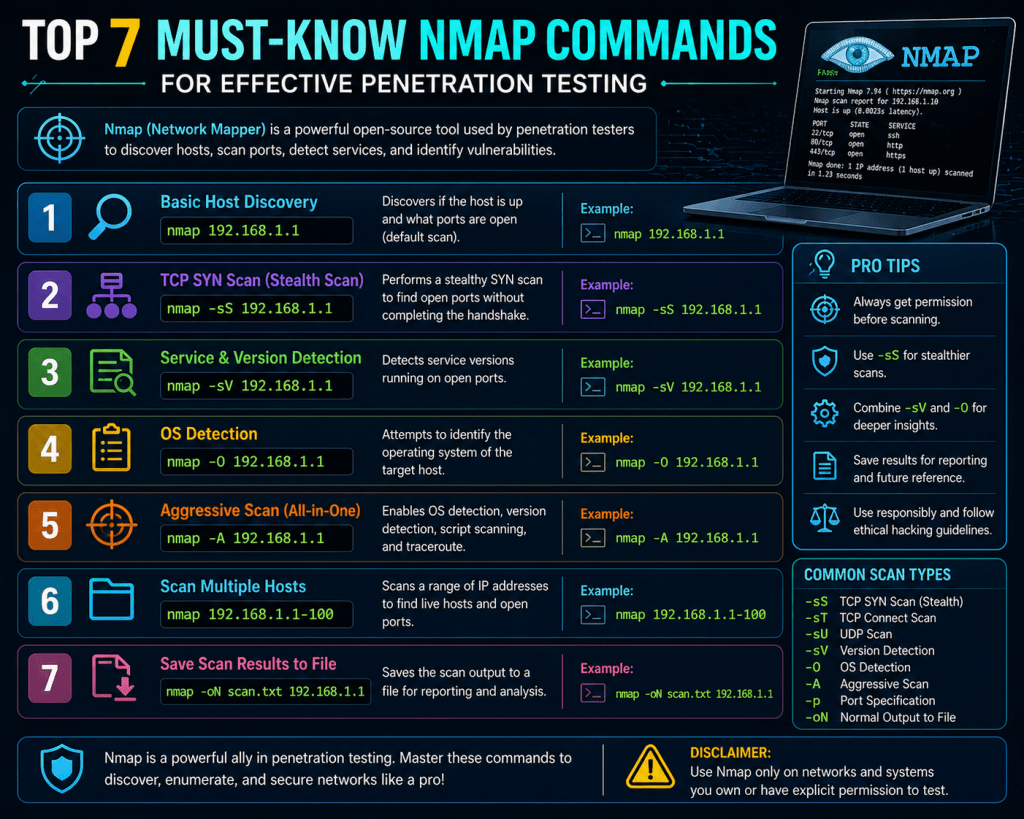
Kali Linux is widely recognized as a specialized environment designed for security assessment workflows. It brings together a large collection of tools that support different stages of penetration testing, including reconnaissance, enumeration, vulnerability analysis, and exploitation preparation. Despite the large number of utilities available, experienced testers tend to rely on a small subset repeatedly. This is because effective penetration testing is not defined by tool quantity but by how precisely a few essential tools are used during structured analysis. Among these, Nmap stands out as the primary instrument for understanding network exposure before any deeper interaction with systems occurs.
In practical security assessments, the first challenge is not exploitation but visibility. Systems inside a network are often unknown at the start of an engagement. Without mapping active devices and services, any further testing becomes speculative and inefficient. This is where Nmap plays a foundational role. It transforms a raw network range into an organized representation of live systems, open ports, and exposed services. This structured output allows testers to move from uncertainty to a clear operational picture of the environment.
The Purpose of Network Mapping in Penetration Testing Workflows
Network mapping is the process of identifying devices, services, and communication points within a given infrastructure. In penetration testing, this step is critical because modern environments often contain layered systems with firewalls, segmented subnets, and hidden services. Attempting to interact with systems without mapping them first leads to incomplete assessments and missed vulnerabilities.
Nmap performs this function by sending carefully crafted network probes and analyzing responses. These responses help determine whether a system is active, what services it exposes, and how it behaves under different types of network interaction. Instead of relying on assumptions, testers build a factual model of the network based on observed behavior. This model becomes the foundation for all subsequent testing activities.
Host Discovery and Identifying Active Systems on a Network
The first technical step in using Nmap is host discovery. In any given network range, not every IP address corresponds to an active system. Many addresses may be unused, blocked, or reserved. Host discovery helps filter out inactive targets and focus only on systems that respond to network probes.
This process works by sending lightweight requests and analyzing responses such as acknowledgments or unreachable messages. Active systems respond in predictable ways, allowing Nmap to compile a list of live hosts. This stage is essential in large environments where scanning every port on every address would be inefficient and unnecessary.
By narrowing the scope to active hosts, testers reduce noise and improve the efficiency of all subsequent scanning stages. It also helps prevent unnecessary load on the network, which is especially important in controlled or sensitive environments where excessive traffic may be restricted.
Understanding Port Scanning and Service Exposure Analysis
Once active systems are identified, the next step is port scanning. Ports represent communication endpoints used by applications and services. Each open port corresponds to a potential entry point into a system. Nmap examines a range of commonly used ports to determine which ones are accepting connections.
The results of a port scan provide a structural overview of system exposure. Open ports indicate services that are reachable, closed ports indicate services that are present but not accepting connections, and filtered ports suggest the presence of network controls such as firewalls. This classification helps testers understand not only what is exposed but also how network defenses are configured.
Port scanning is not about connecting to services directly but about mapping communication possibilities. It reveals the surface area of a system, which is the first step in identifying potential weaknesses or misconfigurations.
Service Detection and Understanding Application Behavior
After identifying open ports, it becomes necessary to understand what services are running behind them. Nmap performs service detection by analyzing responses from each open port and comparing them against known patterns. This allows it to identify applications such as web servers, file transfer services, remote login interfaces, and database systems.
This step is important because a port number alone does not provide enough information about risk. For example, a web service and a custom application may both run on different ports, but their security implications differ significantly. Identifying the actual service helps testers determine what kind of security analysis is required.
Service detection also includes version identification in many cases. Knowing the version of a service can reveal whether it is outdated or potentially vulnerable. Many security issues are tied to specific versions rather than the service type itself, making this information critical for prioritization.
Operating System Fingerprinting and Behavioral Signatures
Nmap is capable of estimating the operating system of a remote machine by analyzing network behavior. This process is known as operating system fingerprinting. Instead of directly querying the system, it observes how the system responds to specific network conditions such as packet structure, timing differences, and protocol handling variations.
Different operating systems implement network protocols in slightly different ways. These subtle differences allow Nmap to compare observed behavior against a database of known patterns. While this method is not always perfectly accurate, it often provides a reliable approximation of the underlying system type.
Understanding the operating system is important because it influences vulnerability exposure, configuration defaults, and available attack paths. A Linux-based system, for example, may have different service configurations compared to a Windows-based system, even if both are running similar applications.
Scanning Beyond Default Ports for Hidden Services
Default scanning focuses on commonly used ports, but real-world systems often use non-standard ports to reduce visibility or avoid automated detection. These services may not appear in initial scans unless a broader port range is examined.
Expanding the scan to include all possible ports allows testers to uncover services that are intentionally or unintentionally hidden. These may include backup services, administrative interfaces, or experimental applications that were never properly secured. Discovering such services is often a key breakthrough in penetration testing because they are frequently overlooked by system administrators.
Hidden services can represent significant security risks because they are less likely to be monitored or patched. Identifying them early provides a more complete understanding of system exposure.
The Importance of Structured Enumeration Discipline
Enumeration is the process of systematically gathering detailed information about a system after initial discovery. In penetration testing, this stage is critical because it prevents premature assumptions and ensures that all available data is considered before any action is taken.
A structured enumeration process involves reviewing each open port, identifying the associated service, analyzing its configuration, and documenting its behavior. Skipping steps or rushing into interaction can lead to missed vulnerabilities or incomplete assessments.
Disciplined enumeration ensures that testers maintain a complete view of the environment. It also reduces the risk of focusing too early on a single service while ignoring other potentially more valuable targets.
The Role of Script-Based Analysis in Expanding Visibility
Nmap includes a scripting system that extends its capabilities beyond basic scanning. These scripts allow automated checks against services to identify misconfigurations, weak settings, or known security patterns.
Instead of manually testing each service, scripts can be applied to perform structured checks across multiple targets. This improves efficiency and consistency during reconnaissance. Script-based analysis can reveal issues such as anonymous access, weak configurations, or outdated service behavior that may not be immediately visible through standard scanning.
This layer of analysis enhances the depth of reconnaissance without requiring manual interaction with each service. It bridges the gap between basic scanning and deeper vulnerability assessment.
Detection of Misconfigurations and Unsecured Access Points
One of the most valuable outcomes of scripted analysis is the identification of misconfigurations. These include services that allow unrestricted access, lack proper authentication, or expose sensitive functionality unintentionally.
Misconfigurations are particularly important because they often represent direct entry points into a system without requiring complex exploitation. In many cases, they are the result of administrative oversight rather than technical vulnerability in software itself.
Identifying these issues early allows testers to prioritize simple but impactful attack paths. These findings often provide faster access than more complex vulnerability chains.
Database and Web Service Exposure in Network Environments
Database systems and web services are commonly exposed in network environments. These services often store or manage critical application data, making them high-value targets during assessments. Identifying their presence is only the first step; understanding their configuration and access restrictions is equally important.
Web services may host applications, administrative panels, or APIs, while database services may expose data storage interfaces. Both require careful analysis because improper configuration can lead to data exposure or unauthorized access.
Nmap helps identify these services early in the reconnaissance phase, allowing testers to plan deeper analysis steps such as directory exploration or authentication testing.
Version-Based Risk Identification and Vulnerability Prioritization
Once service versions are identified, they become a key factor in assessing potential risk. Older versions of software may contain known security issues that have been publicly documented. Even without attempting exploitation, identifying outdated services helps prioritize further testing efforts.
Version-based analysis allows testers to focus on systems that are more likely to contain exploitable weaknesses. This improves efficiency and ensures that time is allocated to the most relevant targets.
In professional security assessments, this prioritization step is essential for managing large environments where multiple services may be exposed simultaneously.
Understanding UDP Services in Network Reconnaissance
While TCP is the dominant protocol in most environments, UDP services are also present and must be considered during reconnaissance. UDP behaves differently because it does not establish a formal connection before transmitting data. This makes scanning more complex but also potentially more revealing.
UDP services may include domain resolution, file transfer mechanisms, or network discovery protocols. These services are often overlooked because they are less commonly used, but they can still expose valuable attack surfaces.
Including UDP analysis ensures that reconnaissance is complete and not limited to only the most visible services. It provides a broader understanding of network behavior and potential vulnerabilities.
Building a Complete Reconnaissance Workflow Using Nmap
Effective penetration testing relies on a structured workflow rather than isolated commands. Nmap fits into this workflow as the initial tool that establishes visibility. The process typically begins with identifying active systems, followed by scanning ports, analyzing services, determining versions, and applying scripted checks for deeper insights.
Each step builds upon the previous one, gradually increasing the level of detail. This layered approach ensures that no part of the network is overlooked and that all findings are contextualized within a broader understanding of system behavior.
This structured methodology is what transforms raw scan data into actionable intelligence, forming the basis for deeper security analysis in subsequent phases.
Advanced Nmap Scanning Techniques for Professional Penetration Testing
Building on foundational reconnaissance, advanced Nmap usage focuses on extracting deeper intelligence from target environments. At this stage, the objective shifts from simple discovery to precision mapping of services, behaviors, and security weaknesses. Professional penetration testers rely on refined scanning strategies to reduce noise, improve accuracy, and uncover less obvious attack surfaces that basic scans may miss. These techniques are particularly important in enterprise environments where defensive controls such as intrusion detection systems, segmentation, and traffic filtering can obscure visibility.
Advanced scanning is not about speed or volume alone; it is about control. Each scan parameter influences how a target system perceives probing activity, and how much information is revealed in response. Understanding this relationship allows testers to tailor their approach based on engagement rules, network complexity, and detection risk.
Stealth-Oriented Scanning and Evasion Considerations
In many real-world assessments, direct and aggressive scanning is not ideal. Security systems may detect excessive probing and respond with logging, blocking, or alert generation. To mitigate this, testers often adopt more subtle scanning techniques that distribute or limit network visibility.
Stealth-oriented scanning does not mean hiding activity entirely but rather controlling its footprint. By adjusting timing, packet behavior, and scan intensity, it becomes possible to gather information while minimizing detection probability. This approach is especially relevant in environments with mature monitoring systems.
Careful adjustment of scan parameters also helps reduce false positives. When systems are overloaded with requests, responses may become inconsistent. Controlled scanning ensures more reliable data collection and clearer interpretation of results.
TCP Connect vs SYN-Based Scanning Behavior
Nmap supports multiple scanning methodologies depending on how much interaction is required with the target system. One of the most important distinctions is between full connection-based scanning and partial handshake scanning.
A full connection scan completes the entire TCP handshake, meaning the system fully registers a connection attempt. While reliable, this method is more visible and leaves stronger traces in logs.
SYN-based scanning, on the other hand, initiates a connection but does not complete it. This allows testers to observe whether ports are open without fully establishing a session. It is faster and often less intrusive, making it more suitable for large-scale reconnaissance.
The choice between these methods depends on the testing environment and the level of visibility required. In controlled environments, both may be used interchangeably, while in sensitive engagements, partial handshake scanning is often preferred.
Timing Controls and Performance Tuning in Network Scanning
One of the most overlooked aspects of Nmap usage is timing control. Every scan generates network traffic, and the rate at which this traffic is sent can significantly impact both detection likelihood and scan accuracy.
Nmap allows adjustments to scan speed, ranging from highly cautious to extremely aggressive modes. Slower scans reduce the chance of detection but take longer to complete, while faster scans improve efficiency at the cost of increased visibility.
In complex environments, timing tuning becomes essential. Networks with latency, congestion, or defensive systems may behave unpredictably under heavy scanning loads. Adjusting timing helps ensure that results remain consistent and interpretable.
Professional testers often adapt timing dynamically based on initial responses, gradually increasing or decreasing intensity depending on system behavior.
Service Fingerprinting and Deep Application Identification
Beyond basic service detection, advanced fingerprinting techniques focus on extracting highly detailed information about running applications. This includes not only the service type but also subtle behavioral traits that distinguish one implementation from another.
Different software implementations of the same protocol may respond differently under edge conditions. These differences allow Nmap to refine identification beyond generic labels and move toward precise application recognition.
Deep fingerprinting is particularly useful when dealing with custom or modified services that may not follow standard patterns. In such cases, even small behavioral deviations can provide clues about underlying technology stacks.
This level of analysis is critical when assessing environments with custom applications or proprietary systems that do not behave like standard network services.
Aggressive Scan Modes and Comprehensive System Profiling
Nmap includes a comprehensive scanning mode that combines multiple reconnaissance techniques into a single execution flow. This mode typically includes service detection, version analysis, operating system fingerprinting, and additional probing techniques.
While highly informative, this approach generates a significant amount of network activity and may not be suitable for all environments. It is best used when a broad overview of a target is required and detection risk is acceptable.
Aggressive scanning is particularly useful during internal assessments where visibility is more important than stealth. It provides a consolidated view of the system, reducing the need for multiple separate scans.
However, because it generates extensive data, interpretation requires careful analysis to avoid misclassification or overgeneralization of results.
Nmap Scripting Engine for Deep Security Intelligence
The scripting engine is one of the most powerful extensions of Nmap. It allows automated execution of specialized checks that go far beyond basic scanning. These scripts can interact with services, test configurations, and identify security weaknesses based on predefined logic.
Scripts are categorized based on functionality, covering areas such as discovery, authentication testing, vulnerability detection, and service enumeration. This modular structure allows testers to selectively apply relevant scripts depending on the target environment.
Instead of manually probing each service, scripts automate repetitive and detailed checks, significantly improving efficiency. This is especially useful in large environments where manual inspection would be impractical.
The scripting engine effectively transforms Nmap into a lightweight security analysis platform capable of performing targeted assessments during reconnaissance.
Discovery-Oriented Scripts and Environmental Mapping
Discovery scripts focus on expanding visibility rather than testing for vulnerabilities. They extract additional information from services such as configuration details, network relationships, or hidden functionalities.
These scripts are particularly useful when initial scans reveal limited information. They help uncover additional layers of data that may not be visible through standard scanning alone.
In many cases, discovery scripts reveal contextual information such as service banners, internal host references, or configuration metadata. This information can significantly enhance understanding of how a system is structured internally.
Discovery-based analysis is a key step between surface-level scanning and deeper exploitation planning.
Vulnerability Detection Through Script-Based Automation
One of the most valuable uses of the scripting engine is automated vulnerability detection. These scripts compare service behavior against known vulnerability patterns and misconfigurations.
Rather than attempting exploitation directly, they test for indicators of weakness such as outdated software behavior, insecure configurations, or known protocol flaws.
This approach allows testers to quickly identify high-risk systems without manually testing each vulnerability. It also reduces the chance of accidental disruption during assessment.
Automated vulnerability detection provides a prioritized view of risk, helping testers focus on the most critical findings first.
Exploit-Relevant Intelligence Gathering During Enumeration
While Nmap does not perform exploitation itself, it plays a key role in identifying conditions that may lead to exploitation later. This includes identifying service versions, exposed interfaces, and misconfigured systems.
This intelligence is essential for building a structured attack path. Instead of randomly testing vulnerabilities, testers use scan data to determine which services are most likely to yield meaningful results.
Exploit-relevant intelligence ensures that penetration testing remains methodical and evidence-driven rather than speculative.
Firewall and Filtering Behavior Analysis
Modern networks often include filtering mechanisms that modify or restrict traffic flow. Nmap can help identify these controls by analyzing how different ports respond to probes.
Filtered responses often indicate the presence of firewalls or access control systems. These systems may block, modify, or silently drop packets depending on configuration.
Understanding filtering behavior is important because it reveals how defensive systems are structured. It also helps testers adjust scanning strategies to improve visibility.
In some cases, filtering behavior itself may indicate misconfiguration or overly permissive rules that can be further investigated.
Port State Interpretation in Complex Network Environments
Port states in Nmap output provide more than simple open or closed indicators. They represent how a system interacts with external requests under different conditions.
Open ports indicate active listening services, while closed ports indicate reachable systems without active services. Filtered ports suggest that traffic is being modified or blocked.
Additional states may appear in complex environments where intermediate devices affect response behavior. Interpreting these states correctly is essential for accurate reconnaissance.
Misinterpretation of port states can lead to incorrect assumptions about system availability or security posture.
Combining Multiple Scan Types for Layered Reconnaissance
Advanced penetration testing rarely relies on a single scan type. Instead, multiple scanning methods are combined to build a layered understanding of the target environment.
A typical workflow might begin with host discovery, followed by basic port scanning, then service detection, and finally scripted analysis. Each layer adds detail and refines understanding.
This layered approach ensures that no single scan provides incomplete or misleading information. It also allows testers to validate findings across multiple methods.
Combining scan types improves accuracy and reduces the risk of overlooking important details in complex environments.
Data Interpretation and Structuring Scan Results
Raw scan output is only useful when properly interpreted. In advanced testing, the focus shifts from collecting data to organizing it into meaningful structures.
This involves grouping services by type, identifying patterns across systems, and prioritizing findings based on potential impact.
Structured interpretation allows testers to move from technical output to strategic analysis. It transforms raw network data into actionable insights that guide further testing phases.
Without structured interpretation, even detailed scans can become overwhelming and difficult to apply effectively.
Transitioning from Advanced Scanning to Targeted Analysis
At the end of advanced scanning, the environment is typically well-mapped and documented. At this stage, testers transition from broad reconnaissance to targeted analysis of specific services.
This transition is critical because it marks the shift from discovery to exploitation planning. All previously gathered information is now used to select high-value targets and define testing priorities.
Advanced Nmap usage therefore acts as the bridge between initial visibility and focused security assessment, ensuring that later stages of penetration testing are based on accurate and comprehensive intelligence.
Deep Network Enumeration Strategies Using Nmap in Real-World Environments
At this stage of penetration testing, the focus shifts from broad reconnaissance to deep enumeration. While earlier phases establish visibility, deep enumeration aims to extract contextual intelligence from every discovered service. This includes understanding how services interact, what internal structures exist, and where hidden or secondary attack surfaces may reside.
In real-world environments, systems are rarely isolated. They often form interconnected service chains where one exposed endpoint reveals information about internal infrastructure. Nmap plays a central role in uncovering these relationships by systematically probing services and interpreting responses at multiple layers. The goal is not just to identify what is exposed but to understand how the environment is constructed.
Deep enumeration requires patience and structure. Instead of focusing on immediate results, testers analyze patterns across multiple services and systems. This approach often reveals indirect vulnerabilities that are not visible through surface-level scanning.
Multi-Stage Service Analysis and Dependency Mapping
Modern systems often rely on interconnected services such as web applications, backend databases, authentication servers, and file storage systems. These dependencies form operational chains that can be partially exposed through network scanning.
Nmap assists in identifying these dependencies by revealing service banners, response behaviors, and communication endpoints. When multiple services are discovered on a single host or across a subnet, their relationships can often be inferred through version similarities, port usage patterns, or protocol dependencies.
For example, a web service may interact with a database service running on another port within the same system. Identifying both services allows testers to understand potential data flow paths. This mapping becomes crucial when assessing how an attacker might move laterally within an environment.
Dependency mapping also highlights critical infrastructure components that support multiple services. These components often become high-value targets because compromising them can affect multiple systems simultaneously.
Advanced Host Relationship Discovery Across Subnets
In larger environments, systems are often distributed across multiple subnets. Nmap can be used to identify patterns of communication and exposure between these subnets by analyzing response consistency and service distribution.
When scanning across segmented networks, differences in service exposure can indicate the presence of internal zoning or security segmentation. Some subnets may expose administrative services, while others may only expose application-layer services.
By comparing scan results across multiple ranges, testers can infer how the network is architected. This helps identify trust boundaries, internal segmentation policies, and potential misconfigurations that allow unintended cross-network communication.
Understanding subnet relationships is essential for identifying lateral movement opportunities, where access to one segment may lead to another.
Service Correlation and Pattern Recognition in Scan Data
As scan results accumulate, patterns begin to emerge. These patterns often reveal how systems are structured, configured, or deployed across an environment.
Service correlation involves grouping similar services together and analyzing their configuration similarities. For example, multiple systems running identical web server versions may indicate a standardized deployment model. Alternatively, inconsistent versions may suggest unpatched or unmanaged systems.
Pattern recognition also helps identify anomalies. A single system running outdated services while others are updated may represent a security gap. These anomalies often become priority targets during penetration testing.
By correlating data across multiple hosts, testers move beyond individual system analysis and begin understanding the environment as a whole.
Banner Analysis and Information Leakage Detection
Service banners are messages returned by applications when a connection is established. These banners often contain version information, configuration details, or system identifiers.
Nmap captures these banners during scanning and uses them for service identification. However, they also serve another purpose: identifying information leakage.
In many cases, banners reveal more information than necessary, such as internal hostnames, software build details, or debugging information. This type of exposure can assist attackers in building more accurate attack models.
Banner analysis involves carefully reviewing all returned service messages and identifying sensitive or unnecessary disclosures. Even small pieces of information can contribute to building a more complete understanding of the environment.
Internal Infrastructure Exposure Through Service Enumeration
During deep enumeration, testers often uncover internal infrastructure components that were not intended for external exposure. These may include administrative interfaces, development services, or internal APIs.
Nmap helps reveal these components by identifying non-standard services or unexpected port activity. Once discovered, these services can provide insight into internal architecture and operational workflows.
Exposure of internal infrastructure is particularly significant because it often indicates misconfiguration or segmentation failures. These weaknesses can lead to broader access if properly analyzed.
Understanding internal exposure requires careful interpretation of scan results in context with other discovered services.
Timing Variability and Response Behavior Analysis
Beyond simple connectivity, advanced scanning involves analyzing how systems respond over time. Response timing can reveal important characteristics about system performance, load handling, and security controls.
Some systems respond consistently, while others introduce delays or variability under scanning conditions. These differences can indicate the presence of load balancing, rate limiting, or security filtering mechanisms.
Nmap timing analysis helps testers identify these behaviors without directly interacting with system internals. By observing response patterns, it becomes possible to infer architectural decisions and defensive strategies.
Timing variability is also useful for identifying unstable or overloaded systems that may behave unpredictably under stress.
Identifying Hidden Administrative Interfaces and Management Services
Many systems expose administrative or management interfaces on non-standard ports. These interfaces are often overlooked during standard deployment but can provide significant control over system functionality.
Nmap assists in identifying these interfaces by scanning full port ranges and analyzing service responses. Once identified, these services may reveal configuration panels, debugging tools, or system control endpoints.
Administrative interfaces are particularly sensitive because they often bypass normal application-level security controls. Even limited exposure can represent a significant security risk.
Detecting these interfaces early in the enumeration phase is critical for understanding potential privilege escalation paths.
Service Misconfiguration Clustering Across Multiple Hosts
In larger environments, misconfigurations are rarely isolated. Instead, they often appear across multiple systems due to standardized deployment errors or shared configuration templates.
Nmap results can be used to cluster misconfigurations by identifying repeated patterns across hosts. For example, multiple systems allowing anonymous access or exposing outdated services may indicate a systemic issue.
Clustering these findings helps prioritize remediation efforts and identify root causes rather than treating each issue independently.
This approach also helps testers understand how configuration practices are applied across an organization.
Protocol Behavior Anomalies and Edge Case Detection
Advanced enumeration involves analyzing how services behave under non-standard or unexpected conditions. These edge cases often reveal inconsistencies in protocol implementation.
Nmap can trigger subtle variations in service responses that highlight these anomalies. For example, a service may respond differently to malformed requests or unusual packet structures.
These inconsistencies can indicate weak implementation, unsupported configurations, or potential vulnerabilities.
Detecting protocol anomalies requires careful analysis of scan output and comparison across multiple systems.
Cross-Service Interaction Indicators in Network Responses
Some services interact with each other in ways that are visible through network responses. For example, a web service may reference a backend database or authentication service in its response headers or error messages.
Nmap helps identify these interactions indirectly by capturing service output and correlating it across multiple endpoints.
Understanding cross-service interaction is essential for identifying attack chains where compromising one service may lead to access in another.
This form of analysis moves beyond individual service enumeration and focuses on system-wide behavior.
Security Posture Assessment Through Exposure Density
Exposure density refers to the number of services and ports exposed on a system relative to its expected role. For example, a simple web server should expose limited services, while a multi-purpose server may expose more.
Nmap results can be used to evaluate whether a system is overexposed. High exposure density often indicates misconfiguration or poor segmentation.
Low exposure density with minimal services typically indicates better security posture, assuming services are properly configured.
Assessing exposure density helps prioritize systems that may present higher risk due to excessive service availability.
Identifying Legacy Systems and Deprecated Services
Legacy systems often run outdated software that is no longer actively maintained. These systems can be identified through version detection and service behavior analysis.
Nmap plays a key role in identifying such systems by revealing older service versions or deprecated protocols.
Legacy systems are particularly important because they often contain known vulnerabilities or lack modern security controls.
Identifying and isolating these systems is a key step in assessing long-term infrastructure risk.
Network Architecture Inference from Scan Patterns
By analyzing scan results across multiple systems, it becomes possible to infer the underlying network architecture.
Patterns such as consistent service placement, repeated port usage, or segmented service exposure provide clues about how systems are organized.
This inference allows testers to reconstruct logical network diagrams without direct access to internal documentation.
Understanding architecture is essential for identifying trust boundaries, security zones, and potential lateral movement paths.
Data Consolidation and Intelligence Structuring from Large Scan Sets
Deep enumeration often generates large volumes of data. Without proper structuring, this data becomes difficult to interpret effectively.
Nmap output must be organized into meaningful categories such as service type, exposure level, and system role.
Structured data allows testers to prioritize findings and identify relationships between systems.
This step transforms raw scan output into actionable intelligence that can be used for strategic decision-making.
Preparing Enumeration Output for Attack Path Development
At the end of deep enumeration, all collected data is used to construct potential attack paths. These paths represent logical sequences of exploitation opportunities based on discovered services and configurations.
Each identified service contributes to a broader understanding of how access might be achieved or escalated.
This stage does not involve exploitation itself but rather preparation for controlled testing in later phases.
Well-structured enumeration output ensures that attack path development is based on accurate and complete information.
Transition from Enumeration to Strategic Exploitation Planning
Once deep enumeration is complete, the testing process transitions into strategic planning. At this point, all systems have been mapped, services identified, and potential weaknesses documented.
The focus shifts from discovery to validation, where identified risks are tested in controlled conditions.
This transition marks the completion of the reconnaissance phase and establishes the foundation for all subsequent penetration testing activities.
Deep enumeration ensures that exploitation is not random but guided by structured intelligence gathered through systematic Nmap analysis.
Conclusion
Nmap remains one of the most foundational tools in penetration testing because it bridges the gap between unknown environments and structured technical understanding. Across all stages of reconnaissance, enumeration, and deep analysis, it consistently functions as a primary source of truth about network exposure. Its value is not limited to port scanning alone but extends into service identification, behavioral analysis, and architectural inference. When used correctly, it transforms raw network space into a clearly defined map of systems, services, and potential risk areas that can be systematically evaluated.
In professional security assessments, the importance of structured visibility cannot be overstated. Most real-world environments are complex, distributed, and layered with defensive controls that obscure direct observation. Nmap provides a controlled method for bypassing this uncertainty without interacting destructively with systems. By carefully probing responses rather than forcing interaction, it enables testers to gather reliable data while maintaining operational safety. This balance between depth and non-intrusiveness is one of the primary reasons it remains central to penetration testing workflows.
Another key strength of Nmap lies in its adaptability across different phases of analysis. In early reconnaissance, it is used to identify active hosts and basic exposure. In intermediate stages, it reveals services, versions, and operating system characteristics. In advanced stages, it supports scripted analysis and behavioral inspection of services. This layered functionality means that the same tool can support multiple investigative objectives without requiring constant transitions between different utilities. As a result, it becomes a unifying element in the testing methodology rather than a single-purpose scanner.
The structured nature of Nmap output also plays a critical role in decision-making during assessments. Raw data alone is not sufficient; it must be interpreted in context. Open ports, service versions, and response behaviors only become meaningful when analyzed collectively. Nmap enables this by presenting information in a consistent format that can be compared across systems. This consistency allows testers to identify patterns, anomalies, and deviations that may indicate misconfiguration or potential vulnerability. Over time, this comparative analysis becomes more valuable than individual scan results.
A significant aspect of professional usage involves understanding how Nmap contributes to attack surface reduction. By identifying unnecessary services, outdated applications, or improperly exposed interfaces, testers can highlight areas where systems exceed their intended operational footprint. This concept of exposure minimization is central to modern security principles. Systems are expected to expose only what is required for functionality, and any deviation from this principle increases risk. Nmap provides the visibility required to evaluate whether this standard is being met.
In addition to exposure analysis, Nmap also supports the identification of hidden or non-standard services that may not be documented in system inventories. These services often arise from development artifacts, misconfigurations, or legacy installations. Because they operate outside expected parameters, they are frequently overlooked during routine maintenance. However, from a security perspective, they can represent significant entry points. Nmap’s ability to detect these services through full-range scanning ensures that assessments are not limited to assumptions about system design.
Another important dimension is the role of Nmap in understanding network architecture indirectly. While it does not provide diagrams or structural documentation, it enables testers to infer architecture through observed behavior. Patterns such as service distribution, port consistency, and response characteristics across multiple systems help reconstruct logical relationships between network components. This form of inference is particularly valuable in environments where documentation is incomplete, outdated, or unavailable. By analyzing these patterns, testers can develop a functional understanding of how systems interact within the infrastructure.
From a methodological perspective, Nmap also reinforces the importance of disciplined workflow in penetration testing. Effective use of the tool requires structured progression through stages rather than random execution of commands. Host discovery must precede port scanning, which must precede service identification, which in turn must precede deeper behavioral analysis. This sequence ensures that each layer of information builds upon the previous one. Skipping steps or reversing order can lead to incomplete understanding or missed vulnerabilities. The tool therefore encourages a systematic approach that aligns with professional security practices.
The scripting capabilities integrated into Nmap further extend its analytical depth. Instead of relying solely on manual inspection, testers can apply automated logic to evaluate services against known conditions. This reduces workload while increasing coverage consistency. However, the true value of scripting lies not in automation alone but in its ability to standardize repetitive checks across diverse environments. This ensures that every service is evaluated under the same criteria, improving reliability of findings and reducing human oversight errors.
Despite its capabilities, Nmap is not a standalone solution for penetration testing. It is an entry point into deeper analysis rather than a complete assessment tool. The information it provides must be validated, contextualized, and expanded using additional techniques. Service detection alone does not confirm vulnerability, and open ports alone do not indicate exploitability. The tool’s real value lies in guiding subsequent investigation rather than replacing it. It establishes direction, not conclusions.
Another important consideration is the interpretation of scan results in dynamic environments. Modern networks often include load balancers, virtualized services, and adaptive security controls that can alter responses based on timing or request patterns. This means that results may vary depending on scanning conditions. Experienced testers account for this variability by conducting controlled repeat scans and comparing outcomes. This ensures that conclusions are based on stable patterns rather than transient responses.
In terms of professional practice, Nmap also reinforces the importance of documentation. Each scan contributes to a larger dataset that must be organized, interpreted, and preserved for reporting purposes. Without structured documentation, even detailed scans lose their value over time. Proper organization of results allows for traceability, validation, and collaborative analysis. This is especially important in team-based assessments where multiple analysts may contribute to the same engagement.
Ultimately, Nmap’s enduring relevance comes from its ability to unify multiple layers of network analysis into a single coherent process. It does not rely on complexity for effectiveness but on precision, consistency, and adaptability. Whether used for initial discovery or advanced enumeration, it provides a stable framework for understanding network environments in a controlled and methodical way. Its outputs serve as the foundation upon which deeper security analysis is built, making it an indispensable component of modern penetration testing methodology.