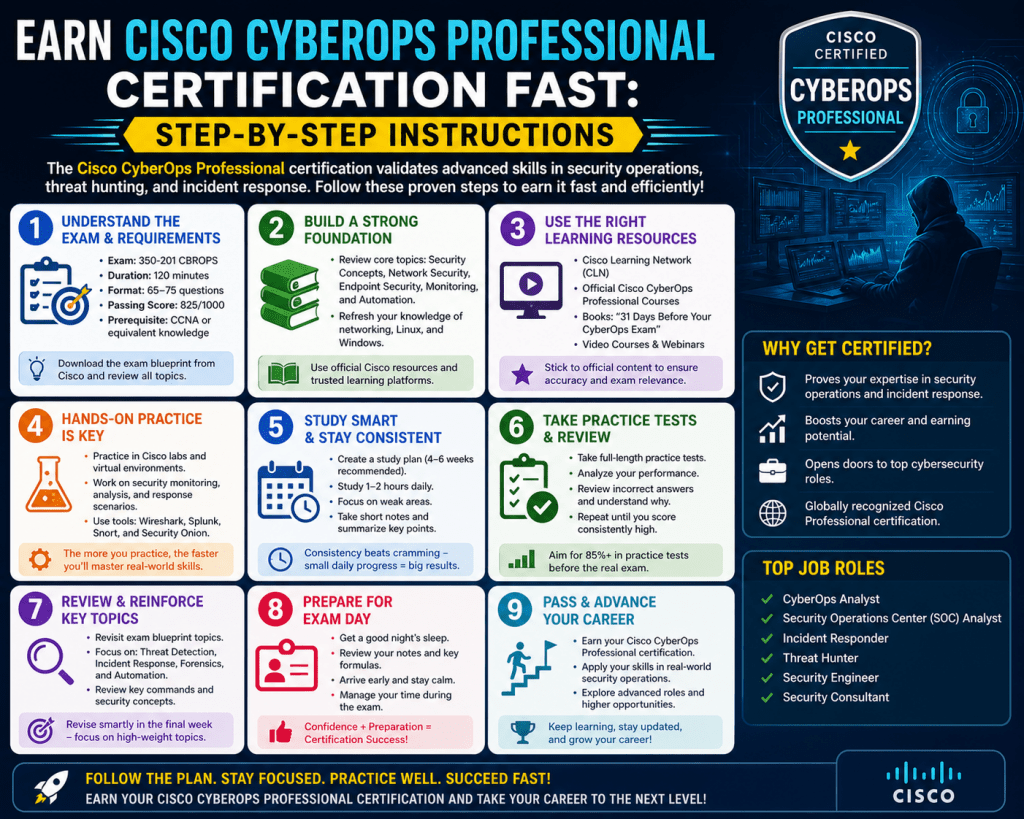
Cybersecurity has become one of the most essential pillars of modern information technology as organizations continue to expand their digital infrastructure. With increasing reliance on cloud computing, remote access systems, and interconnected networks, the attack surface for cyber threats has grown significantly. As a result, organizations now prioritize professionals who can demonstrate verified skills in security monitoring, threat detection, and incident response. Certifications have become an industry-standard method of validating these skills because they provide a structured framework that measures both theoretical understanding and practical readiness. Among the various certification pathways available in cybersecurity operations, Cisco CyberOps Professional certification represents an advanced milestone designed for individuals aiming to work in high-level security operations roles. It focuses on developing the ability to detect, analyze, and respond to security incidents across complex environments where speed and accuracy are critical.
Understanding the Role of Cybersecurity Operations in Modern IT Environments
Cybersecurity operations refer to the continuous monitoring, detection, analysis, and response to security events across an organization’s digital infrastructure. Professionals working in this field operate in environments where threats are constantly evolving, requiring them to interpret large volumes of data from security tools and systems. The goal is not only to identify malicious activity but also to understand attacker behavior, prevent escalation, and ensure system integrity. Cybersecurity operations teams typically function as the first line of defense against cyber threats, making their role highly critical in maintaining organizational security. These teams rely on tools such as intrusion detection systems, security information and event management platforms, endpoint monitoring solutions, and threat intelligence feeds. The CyberOps Professional certification aligns with these responsibilities by focusing on the skills needed to manage real-world security incidents effectively.
Overview of Cisco CyberOps Professional Certification Structure
Cisco CyberOps Professional certification is structured to validate advanced-level knowledge in cybersecurity operations. It is designed for individuals who already possess foundational IT or cybersecurity experience and are ready to progress into more complex operational roles. Unlike entry-level certifications that focus primarily on basic concepts, this certification evaluates the ability to apply knowledge in practical scenarios. The structure typically includes multiple examinations that assess different aspects of cybersecurity operations. This structure ensures that certified professionals possess both broad and specialized skills necessary for handling modern security challenges. The certification is recognized as a benchmark for professionals working in security operations centers and related environments.
Importance of Building Strong Foundational Knowledge Before Certification
Before attempting an advanced cybersecurity certification, it is essential to build a strong foundation in core IT and security concepts. Networking knowledge is particularly important because cybersecurity operations heavily depend on understanding how data flows across systems. This includes knowledge of protocols, network architecture, routing mechanisms, and traffic behavior. Without this understanding, it becomes difficult to interpret security logs or identify abnormal network activity. Operating system knowledge is equally important, especially familiarity with Linux and Windows environments, as many security tools and logs originate from these systems. Security fundamentals such as authentication, authorization, encryption, and access control mechanisms also play a crucial role in understanding how systems are protected. Together, these foundational areas form the base upon which advanced cybersecurity operations skills are built.
Developing Core Cybersecurity Awareness and Analytical Thinking
Cybersecurity is not only a technical discipline but also an analytical one. Professionals must develop the ability to think critically about security events and understand the broader implications of suspicious activity. This involves recognizing patterns, identifying anomalies, and correlating data from multiple sources. Analytical thinking helps professionals determine whether an alert represents a false positive or a genuine security incident. It also supports decision-making during incident response situations where time is limited and accuracy is essential. Developing this mindset requires exposure to real-world scenarios, case studies, and simulated environments where security incidents are analyzed in detail. Over time, this builds intuition and improves the ability to respond effectively under pressure.
Introduction to CyberOps Professional Skill Expectations
The CyberOps Professional certification expects candidates to demonstrate advanced understanding of cybersecurity operations concepts. This includes knowledge of threat detection techniques, incident response procedures, forensic analysis principles, and security monitoring strategies. Candidates are expected to understand how attackers exploit vulnerabilities, how systems can be compromised, and how such incidents can be identified and mitigated. The certification also evaluates understanding of automation in cybersecurity, which plays an increasingly important role in modern security operations. Automation helps reduce response time and improves efficiency by enabling systems to detect and respond to threats with minimal human intervention. Understanding these expectations is essential for effective preparation and long-term career development.
Understanding Real-World Cybersecurity Operations Environments
In real-world environments, cybersecurity operations teams work continuously to monitor systems and respond to incidents as they occur. These environments are often referred to as security operations centers, where analysts review alerts generated by security tools and determine appropriate responses. The work involves analyzing logs, investigating suspicious behavior, and coordinating with other IT teams to resolve security issues. Professionals must also document incidents, track attacker behavior, and ensure that vulnerabilities are addressed to prevent future occurrences. The CyberOps Professional certification reflects these real-world responsibilities by testing candidates on scenarios that simulate actual security operations challenges.
The Role of Incident Detection and Response in CyberOps
Incident detection and response form the core of cybersecurity operations. Detection involves identifying potential security threats through monitoring systems and analyzing data patterns. Response involves taking appropriate action to contain and mitigate the threat. This may include isolating affected systems, removing malicious files, or blocking unauthorized access. Effective incident response requires a combination of technical knowledge, analytical skills, and structured processes. Professionals must follow predefined procedures while also adapting to unique situations that arise during security incidents. The ability to respond quickly and accurately is critical in minimizing damage and preventing further compromise.
Importance of Threat Intelligence and Behavioral Analysis
Threat intelligence plays a key role in cybersecurity operations by providing information about known threats, attacker techniques, and emerging vulnerabilities. This information helps security teams anticipate potential attacks and strengthen defenses. Behavioral analysis involves studying patterns of activity within systems to identify unusual behavior that may indicate malicious activity. By combining threat intelligence with behavioral analysis, professionals can improve their ability to detect sophisticated attacks that may not be identified through traditional methods. This approach is essential in modern cybersecurity environments where attackers often use advanced techniques to evade detection.
Preparing for Advanced Cybersecurity Learning Pathways
Preparation for a professional cybersecurity certification involves structured learning and consistent practice. Candidates must gradually build their knowledge by studying core concepts and applying them in practical scenarios. This includes working with simulated environments, analyzing security logs, and practicing incident response procedures. Over time, this approach helps develop both technical skills and decision-making abilities. It is also important to stay consistent with study schedules, as cybersecurity is a complex field that requires continuous learning. Structured preparation ensures that all necessary topics are covered and that candidates are well-prepared for advanced-level assessments.
Developing Technical Confidence Through Practical Exposure
Technical confidence is developed through hands-on experience with cybersecurity tools and systems. This includes working with network monitoring tools, security analysis platforms, and log management systems. Practical exposure helps reinforce theoretical knowledge and improves understanding of how security concepts are applied in real environments. It also helps candidates become familiar with the types of challenges they may encounter during certification exams and professional roles. Over time, this exposure builds confidence and enhances problem-solving abilities, which are essential for success in cybersecurity operations.
Establishing a Strong Direction for Certification Progression
Having a clear direction is essential when pursuing an advanced cybersecurity certification. This involves understanding the overall structure of cybersecurity operations, identifying key skill areas, and setting realistic goals for preparation. A clear direction helps maintain focus and ensures that study efforts are aligned with certification requirements. It also helps candidates prioritize topics based on their importance and difficulty level. By establishing a structured approach, candidates can improve their efficiency and increase their chances of success in both certification exams and professional roles.
Understanding the Overall Certification Examination Framework
The Cisco CyberOps Professional certification is structured around a multi-exam framework designed to evaluate both broad cybersecurity knowledge and specialized operational expertise. Unlike entry-level certifications that focus primarily on definitions and basic concepts, this professional-level certification emphasizes applied skills in real-world cybersecurity environments. The structure is intentionally designed to mirror the responsibilities of cybersecurity operations teams, where professionals must continuously monitor systems, analyze security events, and respond to incidents under time-sensitive conditions. The certification framework typically includes a core examination that assesses general cybersecurity operations knowledge and a second specialized examination that focuses on either incident response or threat analysis. This dual-structure approach ensures that certified professionals are capable of handling both reactive and proactive security responsibilities within an organization.
Role of the Core Cybersecurity Operations Examination
The core examination serves as the foundation of the CyberOps Professional certification path. It evaluates a candidate’s understanding of essential cybersecurity principles that are required in any security operations environment. This includes knowledge of system monitoring, threat detection methodologies, security processes, and automation techniques. The purpose of this examination is to ensure that candidates have a broad understanding of how cybersecurity operations function at a conceptual and practical level. It also tests the ability to interpret security data and understand how different components of a security infrastructure interact. The core exam acts as a gateway to more specialized knowledge areas and ensures that all candidates share a common baseline of cybersecurity expertise before advancing further in the certification path.
Cybersecurity Fundamentals as a Core Domain
Cybersecurity fundamentals form a critical part of the certification structure. This domain focuses on the basic principles that govern information security, including confidentiality, integrity, and availability. These principles are essential for understanding how systems are protected and how security breaches can impact organizations. The fundamentals also include knowledge of authentication mechanisms, access control systems, encryption methods, and network security principles. Understanding these concepts is necessary for analyzing how attacks occur and how defenses are structured. In cybersecurity operations, professionals must constantly evaluate whether systems are operating securely and whether any deviations from expected behavior indicate potential threats. A strong grasp of fundamentals allows professionals to make informed decisions during incident investigations.
Techniques Used in Cybersecurity Operations
Cybersecurity techniques refer to the methods used to detect, analyze, and respond to security incidents. These techniques include log analysis, traffic inspection, endpoint monitoring, and anomaly detection. Log analysis involves reviewing system and application logs to identify unusual activity that may indicate a security breach. Traffic inspection focuses on monitoring network data to detect unauthorized access or malicious communication patterns. Endpoint monitoring involves tracking activity on individual devices to identify suspicious behavior such as unauthorized file changes or unusual process execution. Anomaly detection uses statistical and behavioral models to identify deviations from normal system activity. Together, these techniques form the foundation of cybersecurity operations and are heavily emphasized in the certification structure.
Understanding Cybersecurity Processes in Operational Environments
Cybersecurity processes refer to the structured workflows used by security teams to manage incidents and maintain system integrity. These processes include incident detection, classification, escalation, containment, eradication, and recovery. Each stage of the process plays a critical role in ensuring that security incidents are handled effectively and efficiently. Detection involves identifying potential threats through monitoring systems. Classification determines the severity and type of incident. Escalation ensures that critical incidents are assigned to appropriate response teams. Containment involves limiting the impact of the incident, while eradication focuses on removing the threat from the system. Recovery ensures that affected systems are restored to normal operation. Understanding these processes is essential for managing real-world cybersecurity incidents.
Automation in Cybersecurity Operations
Automation has become an increasingly important aspect of modern cybersecurity operations. It involves using technology to perform repetitive or time-sensitive tasks without manual intervention. In security operations centers, automation is used to filter alerts, correlate security events, and initiate predefined response actions. This helps reduce response times and allows security analysts to focus on more complex investigations. Automation also improves accuracy by reducing the likelihood of human error in routine tasks. However, it still requires human oversight to ensure that automated actions are appropriate and effective. The certification framework includes automation as a key domain to ensure that professionals understand how to leverage technology to improve security efficiency.
Introduction to Specialized Examination Paths
In addition to the core examination, the CyberOps Professional certification includes specialized examination paths that focus on advanced areas of cybersecurity operations. These paths allow candidates to choose a focus area based on their career interests and professional goals. The two primary specialization options typically involve either forensic analysis and incident response or threat detection and threat hunting. Each specialization evaluates different skill sets but builds upon the same foundational cybersecurity knowledge. This structure allows professionals to tailor their certification experience while still maintaining a consistent level of core competency across all candidates.
Forensic Analysis and Incident Response Domain Overview
The forensic analysis and incident response specialization focuses on investigating security incidents after they occur and determining how breaches happened. This involves analyzing system logs, recovering evidence, and reconstructing attack timelines. Forensic analysis requires a detailed understanding of operating systems, file structures, and network activity. Incident response involves taking immediate action to contain and mitigate threats while preserving evidence for further investigation. Professionals in this domain must be able to work under pressure and follow structured investigative procedures. They must also understand legal and compliance considerations when handling sensitive security data. This specialization is essential for roles that involve investigating cyberattacks and responding to security breaches.
Threat Detection and Threat Hunting Domain Overview
The threat detection and threat hunting specialization focuses on identifying potential threats before they cause significant damage. Unlike forensic analysis, which is reactive, threat hunting is proactive. It involves searching for hidden threats within systems, analyzing behavioral patterns, and identifying indicators of compromise. Threat hunters use intelligence data, anomaly detection techniques, and behavioral analysis to uncover advanced persistent threats. This specialization requires a deep understanding of attacker tactics, techniques, and procedures. Professionals in this domain must be able to anticipate attacker behavior and identify subtle signs of malicious activity that may not trigger traditional alerts.
Comparison of Incident Response and Threat Hunting Approaches
Incident response and threat hunting represent two complementary approaches within cybersecurity operations. Incident response focuses on reacting to confirmed security incidents and mitigating their impact. It is structured, process-driven, and often time-sensitive. Threat hunting, on the other hand, is proactive and investigative in nature. It involves searching for unknown threats that may already exist within the system. While incident response deals with known issues, threat hunting focuses on discovering hidden risks. Both approaches are essential for a comprehensive cybersecurity strategy, and professionals who understand both can provide significant value to security operations teams.
Role of Security Monitoring and Alert Management
Security monitoring is a continuous process that involves observing network activity, system behavior, and application logs for signs of suspicious activity. Security tools generate alerts when potential threats are detected, and these alerts must be analyzed to determine their validity. Alert management involves filtering false positives, prioritizing critical incidents, and ensuring that genuine threats are escalated appropriately. Effective monitoring requires a combination of automated tools and human analysis. Professionals must be able to interpret alerts accurately and determine whether they represent real security incidents. This skill is essential for maintaining efficient cybersecurity operations.
Importance of Log Analysis in Cybersecurity Operations
Log analysis is one of the most important skills in cybersecurity operations. Logs provide detailed records of system activity, including user actions, network connections, and application behavior. By analyzing logs, security professionals can identify unusual patterns that may indicate malicious activity. Log analysis also helps reconstruct events during incident investigations, allowing professionals to understand how an attack occurred. This process requires attention to detail and the ability to correlate information from multiple sources. Effective log analysis is essential for both incident response and threat detection activities.
Understanding Security Event Correlation
Security event correlation involves analyzing multiple security events to identify relationships between them. Individual events may not appear suspicious on their own, but when combined with other data, they may reveal patterns of malicious activity. Correlation helps security teams identify complex attacks that involve multiple stages or systems. This process often involves using security tools that automatically group related events and highlight potential threats. However, human analysis is still required to interpret these correlations and determine their significance. Event correlation is a critical component of modern cybersecurity operations.
Role of Network Traffic Analysis in Threat Detection
Network traffic analysis involves monitoring data moving across networks to identify suspicious behavior. This includes detecting unauthorized connections, unusual data transfers, and communication with malicious servers. Network traffic analysis helps identify attacks such as data exfiltration, denial-of-service attacks, and lateral movement within networks. Security professionals use specialized tools to capture and analyze network packets, allowing them to understand how data flows within the system. This skill is essential for identifying advanced threats that may not be detected through traditional monitoring methods.
Developing Operational Thinking in Cybersecurity Environments
Operational thinking refers to the ability to understand how cybersecurity systems function in real-world environments. This includes understanding how different security tools interact, how data flows through systems, and how incidents progress over time. Operational thinking helps professionals anticipate potential risks and respond effectively to security incidents. It also supports decision-making during complex investigations where multiple factors must be considered simultaneously. Developing this mindset requires practical experience and exposure to real-world cybersecurity scenarios.
Developing a Structured Preparation Strategy for Cybersecurity Operations
Preparing for an advanced cybersecurity certification requires a structured and disciplined approach that goes beyond casual study habits. Cybersecurity operations is a practical field, meaning success depends on how well theoretical knowledge can be applied in real-world scenarios. A structured preparation strategy begins with breaking down the certification objectives into manageable domains and allocating focused study time for each area. Instead of attempting to learn everything at once, candidates should progress through foundational concepts, followed by applied techniques, and finally scenario-based understanding. This layered approach ensures that knowledge is built progressively and retained more effectively over time. Consistency is more important than intensity, as cybersecurity concepts require reinforcement through repeated exposure and practical application.
Building Strong Conceptual Clarity in Core Cybersecurity Principles
Before attempting to solve complex security scenarios, it is important to develop a clear conceptual understanding of cybersecurity fundamentals. These include principles such as confidentiality, integrity, and availability, which form the foundation of all security systems. Understanding how these principles apply in real environments helps professionals evaluate whether systems are functioning securely. Additionally, concepts such as authentication, authorization, encryption, and access control mechanisms must be fully understood. Without conceptual clarity, it becomes difficult to interpret security events or understand the impact of vulnerabilities. Strong conceptual knowledge also supports decision-making during incident response, where professionals must quickly determine the severity and scope of a security issue.
Strengthening Analytical Skills for Security Operations
Cybersecurity operations require strong analytical skills because professionals must interpret large volumes of data from different sources. This includes logs, network traffic, system alerts, and endpoint behavior. Analytical thinking involves identifying patterns, detecting anomalies, and correlating seemingly unrelated events. For example, a single failed login attempt may not be significant, but multiple failed attempts across different systems could indicate a brute force attack. Developing analytical skills requires practice in evaluating different scenarios and learning how to distinguish between normal and suspicious behavior. Over time, this helps build intuition, which is essential for working in fast-paced security environments.
Hands-On Exposure Through Practical Cybersecurity Scenarios
Practical exposure plays a crucial role in preparing for cybersecurity operations certification. While theoretical knowledge provides the foundation, hands-on practice helps reinforce understanding and develop real-world problem-solving abilities. Practical scenarios may include analyzing logs, investigating simulated security incidents, or identifying malicious network activity. These exercises help candidates understand how security tools function and how data is interpreted in operational environments. Exposure to real-world-like scenarios also improves confidence and reduces uncertainty during actual certification exams or professional situations. The more familiar candidates become with practical workflows, the more effectively they can apply their knowledge under pressure.
Understanding the Importance of Time Management During Preparation
Time management is a critical factor in successful certification preparation. Cybersecurity is a broad field with many interconnected topics, and without proper planning, it is easy to become overwhelmed. Effective time management involves setting realistic study goals, creating a consistent study schedule, and tracking progress regularly. Candidates should allocate more time to complex topics such as incident response and threat analysis while maintaining regular review of foundational concepts. Breaking study sessions into focused intervals helps improve concentration and retention. Over time, structured time management ensures steady progress and reduces last-minute stress before examinations.
Choosing Between Specialization Paths in CyberOps Professional Certification
One of the key decisions in the CyberOps Professional certification journey is choosing between specialization paths. These paths typically focus on either forensic analysis and incident response or threat detection and threat hunting. The choice depends on individual interests, career goals, and existing skill sets. Forensic analysis is more suitable for individuals who prefer investigative work and enjoy analyzing past security incidents in detail. Threat hunting is more suitable for those who prefer proactive security work and enjoy identifying hidden threats before they cause damage. Both paths are valuable, but they require different mindsets and skill sets. Understanding personal strengths helps in selecting the most appropriate specialization.
Forensic Analysis and Incident Response Skill Development
Forensic analysis involves examining digital evidence to understand how a security incident occurred. This includes analyzing system logs, recovering deleted files, and reconstructing timelines of attacker activity. Incident response focuses on containing threats, minimizing damage, and restoring normal system operations. Professionals in this field must be detail-oriented and methodical in their approach. They must also be able to work under pressure, as security incidents often require immediate action. Developing skills in this area involves learning how to use forensic tools, understanding operating system behavior, and practicing structured investigation techniques. These skills are essential for roles that involve responding to cyberattacks and conducting post-incident analysis.
Threat Hunting and Proactive Security Techniques
Threat hunting focuses on identifying threats that are already present within systems but have not yet been detected by automated tools. This requires a proactive mindset and the ability to think like an attacker. Threat hunters analyze patterns of behavior, search for indicators of compromise, and use intelligence data to identify potential threats. This process often involves forming hypotheses about possible attack vectors and testing them through data analysis. Threat hunting is an advanced skill that requires a deep understanding of system behavior, network activity, and attacker methodologies. It is particularly valuable in environments where advanced persistent threats are a concern.
Developing Decision-Making Skills in Security Operations
Decision-making is a critical skill in cybersecurity operations because professionals often need to act quickly based on incomplete information. During a security incident, analysts must decide whether an alert is a false positive or a genuine threat. They must also determine the appropriate response actions, such as isolating systems or escalating incidents. Effective decision-making requires a combination of technical knowledge, analytical thinking, and experience. It also involves understanding risk levels and prioritizing actions based on potential impact. Developing this skill takes time and exposure to real-world scenarios, but it is essential for success in cybersecurity roles.
Understanding the Role of Automation in Security Environments
Automation plays an increasingly important role in cybersecurity operations by reducing manual workload and improving response efficiency. Automated systems can filter alerts, correlate events, and execute predefined response actions. This allows security teams to focus on more complex investigations rather than repetitive tasks. However, automation must be carefully configured to avoid false positives and unnecessary disruptions. Professionals must understand how automation tools function and how to integrate them into security workflows. While automation enhances efficiency, human oversight remains essential to ensure accuracy and effectiveness in decision-making.
Improving Incident Response Efficiency Through Structured Processes
Incident response efficiency depends on the following structured processes that guide how security incidents are handled. These processes typically include detection, analysis, containment, eradication, recovery, and post-incident review. Each stage plays a specific role in minimizing damage and restoring normal operations. Structured processes ensure that incidents are handled consistently and systematically, reducing the risk of errors or missed steps. Efficiency is improved when professionals are familiar with these processes and can apply them quickly during real incidents. Regular practice and simulation exercises help reinforce these workflows and improve response times.
Enhancing Knowledge Through Continuous Learning Practices
Cybersecurity is a constantly evolving field, and continuous learning is essential for staying up to date with new threats and technologies. Professionals must regularly update their knowledge of attack techniques, security tools, and industry best practices. Continuous learning can be achieved through reading technical material, analyzing case studies, and practicing new skills in simulated environments. Staying informed about emerging threats helps professionals anticipate potential risks and adapt their security strategies accordingly. This ongoing learning process is essential for long-term success in cybersecurity operations roles.
Developing Confidence for Certification and Real-World Application
Confidence plays an important role in both certification success and professional performance. Confidence is built through preparation, practice, and familiarity with cybersecurity concepts. As candidates gain experience with practical scenarios and theoretical knowledge, their ability to handle complex situations improves. Confidence also helps reduce stress during examinations and real-world incidents, allowing professionals to think more clearly and make better decisions. It is important to develop confidence gradually through consistent practice rather than relying on last-minute preparation.
Transitioning from Certification to Professional Cybersecurity Roles
Achieving certification is not the final step but rather a transition point into professional cybersecurity roles. After certification, individuals are better prepared to enter roles such as security analyst, incident responder, or threat detection specialist. These roles involve working in dynamic environments where continuous monitoring and rapid response are required. Certified professionals are expected to apply their knowledge in real-world situations and contribute to organizational security efforts. The certification serves as a validation of skills, but practical experience continues to play a critical role in career development.
Long-Term Career Development in Cybersecurity Operations
Cybersecurity operations offer long-term career growth opportunities for individuals who continue to develop their skills. As professionals gain experience, they can move into more advanced roles such as senior analyst, security engineer, or security operations manager. Career progression is influenced by both technical expertise and practical experience in handling security incidents. Continuous learning and skill development are essential for advancing in this field. Over time, professionals may also specialize further in areas such as threat intelligence, digital forensics, or security architecture.
Conclusion
The Cisco CyberOps Professional certification represents more than just an academic milestone; it reflects a shift toward practical cybersecurity competence in an industry that is becoming increasingly dependent on real-time defense capabilities. As organizations continue to expand their digital ecosystems, the need for professionals who can interpret complex security data, respond to incidents quickly, and anticipate evolving threats has become essential. This certification path is designed to validate exactly those abilities, ensuring that individuals who achieve it are prepared for the operational demands of modern security environments.
One of the most important takeaways from the CyberOps Professional journey is that cybersecurity is no longer a purely theoretical discipline. It is a dynamic field that requires continuous observation, analysis, and decision-making under pressure. The certification structure reinforces this reality by focusing on applied knowledge rather than memorization. Candidates are expected to understand how systems behave under normal conditions, how attackers exploit weaknesses, and how defensive mechanisms can be used to detect and mitigate threats. This practical orientation ensures that certified professionals are not only knowledgeable but also capable of functioning effectively in real-world security operations centers.
Another key aspect of this certification journey is the emphasis on structured thinking. Cybersecurity operations require professionals to process large volumes of data and extract meaningful insights from seemingly unrelated events. This ability does not develop overnight; it is cultivated through consistent exposure to security concepts, analytical practice, and scenario-based learning. Over time, individuals learn how to identify patterns, correlate events, and distinguish between benign and malicious activity. This analytical mindset becomes one of the most valuable assets in any cybersecurity role, as it directly impacts the ability to detect and respond to threats effectively.
The certification also highlights the importance of specialization within cybersecurity operations. While the core knowledge provides a broad understanding of security principles, the specialized paths allow professionals to focus on specific areas such as forensic analysis or threat hunting. Each specialization develops a different perspective on cybersecurity. For example, forensic analysis emphasizes understanding what has already occurred, reconstructing incidents, and identifying root causes. On the other hand, threat hunting focuses on proactively searching for hidden threats and preventing attacks before they escalate. Both approaches are essential in a comprehensive security strategy, and understanding both enhances overall professional capability.
In addition to technical skills, the certification journey emphasizes the importance of operational discipline. Cybersecurity environments are structured and process-driven, requiring professionals to follow defined workflows when responding to incidents. These workflows ensure consistency, reduce errors, and improve response times during critical situations. Learning to operate within these structured environments helps individuals develop discipline, attention to detail, and the ability to remain calm under pressure. These qualities are essential not only for certification success but also for long-term career performance in cybersecurity roles.
Another important dimension of the CyberOps Professional path is exposure to automation and modern security technologies. As cybersecurity environments become more complex, automation plays a key role in handling repetitive tasks and improving response efficiency. However, automation does not replace human judgment; instead, it enhances it. Professionals must understand how automated systems function, how alerts are generated, and how responses are triggered. This understanding allows them to fine-tune systems, reduce false positives, and ensure that automation supports rather than disrupts security operations. The integration of human expertise with automated systems represents the future of cybersecurity operations.
Preparation for this certification also encourages continuous learning, which is a critical requirement in the cybersecurity field. Threat landscapes evolve rapidly, and new vulnerabilities emerge regularly. Professionals must stay updated on emerging attack techniques, security tools, and defensive strategies. This continuous learning process ensures that their skills remain relevant and effective. It also encourages adaptability, which is one of the most important traits in cybersecurity. Professionals who commit to ongoing learning are better equipped to handle new challenges and contribute meaningfully to organizational security.
From a career perspective, achieving CyberOps Professional certification can serve as a significant turning point. It opens opportunities for advanced roles in security operations centers, incident response teams, and threat intelligence units. These roles are highly valued in the industry because they directly contribute to an organization’s ability to defend against cyber threats. As professionals gain experience, they can progress into senior positions where they take on leadership responsibilities, design security strategies, and manage complex security infrastructures. The certification provides a strong foundation for this progression by ensuring that individuals have both theoretical knowledge and practical capability.
It is also important to recognize that success in cybersecurity is not defined solely by certification achievements. While certifications provide validation, real expertise is developed through experience, problem-solving, and continuous adaptation. Professionals must apply their knowledge in real-world environments, learn from incidents, and refine their skills over time. The CyberOps Professional certification acts as a catalyst in this journey, providing structure and direction, but long-term success depends on sustained effort and engagement with the field.
Another significant outcome of pursuing this certification is the development of confidence in handling complex security scenarios. Confidence is not simply about knowing the right answers but about being able to make informed decisions when information is incomplete or time is limited. Cybersecurity professionals often work in high-pressure environments where quick judgment is required. Through structured preparation and practical exposure, individuals develop the ability to think clearly, prioritize effectively, and act decisively. This confidence becomes a defining characteristic of successful cybersecurity practitioners.
Furthermore, the certification reinforces the importance of collaboration within security teams. Cybersecurity operations are rarely performed in isolation. Professionals must work with other analysts, engineers, and stakeholders to investigate incidents, share information, and coordinate responses. Effective communication and teamwork are essential for ensuring that security incidents are resolved efficiently. The CyberOps Professional path helps build awareness of these collaborative dynamics, preparing individuals to function effectively in team-based environments.
Ultimately, the Cisco CyberOps Professional certification represents a comprehensive journey into advanced cybersecurity operations. It combines technical knowledge, analytical thinking, operational discipline, and practical application into a unified learning experience. It challenges individuals to move beyond basic understanding and develop the ability to operate effectively in complex, real-world security environments. While the path requires commitment and effort, the skills developed along the way are highly valuable and directly applicable to modern cybersecurity roles.
For individuals pursuing a career in cybersecurity, this certification serves as both a benchmark and a development framework. It validates existing knowledge while also guiding future growth. It encourages continuous improvement, practical engagement, and strategic thinking. As the cybersecurity landscape continues to evolve, professionals who follow this path position themselves to meet the demands of an increasingly complex and high-risk digital world.