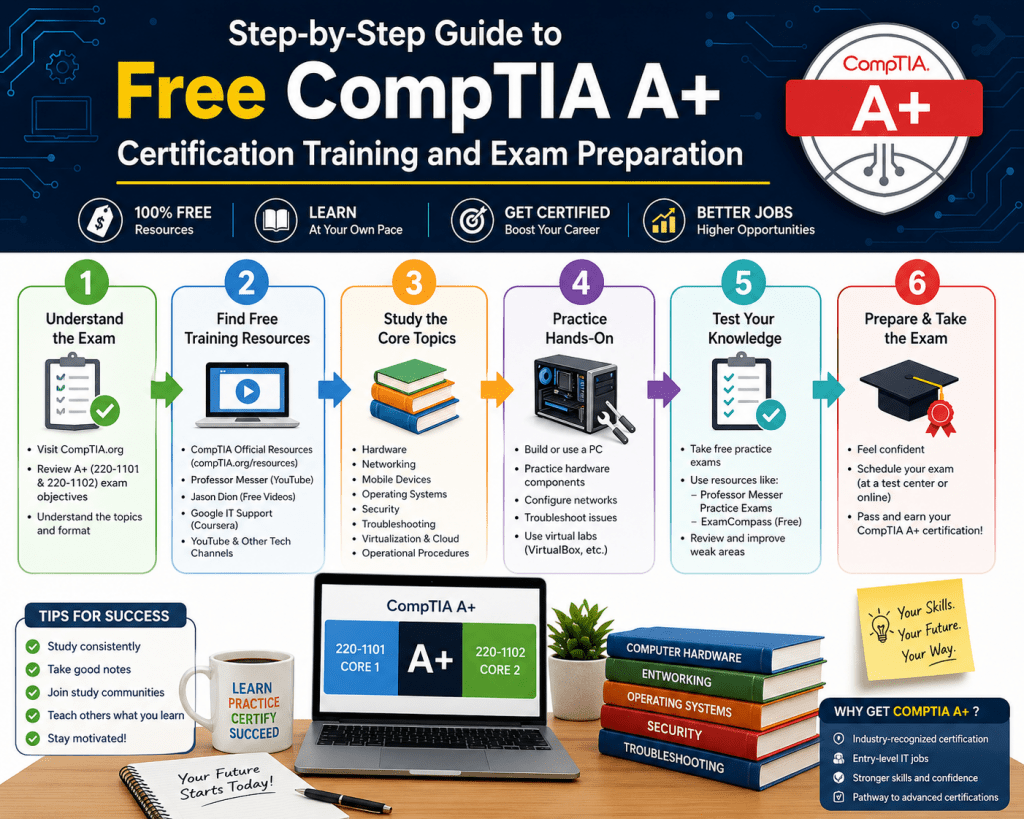
The A+ certification is widely regarded as one of the most foundational credentials in the information technology industry. It is designed to establish baseline technical competence for individuals who are beginning their professional journey in IT support and infrastructure-related roles. Unlike highly specialized certifications that focus on a narrow technology domain, this certification takes a broad, vendor-neutral approach that reflects real-world technical environments where multiple systems and technologies coexist.
At its core, the certification validates practical knowledge across several essential domains, including hardware systems, operating systems, software troubleshooting, networking fundamentals, security principles, and operational procedures. These areas collectively represent the daily responsibilities of entry-level IT professionals. The intent is not to produce specialists in any one area but to ensure that candidates can function effectively in a general technical support environment.
This broad scope is one of the defining characteristics of the certification. In real-world IT environments, problems rarely occur in isolation. A single issue may involve hardware malfunction, software misconfiguration, and network connectivity challenges simultaneously. The certification reflects this complexity by requiring candidates to understand how different systems interact rather than focusing on isolated technical concepts.
The entry-level positioning of this certification does not imply simplicity. Instead, it reflects accessibility in terms of prerequisites rather than difficulty. There are no formal educational or certification requirements needed before attempting the exams. However, the depth and breadth of knowledge required means that candidates must develop a strong understanding of foundational IT principles to succeed. This combination of accessibility and complexity makes it a unique credential in the IT landscape.
The Structure and Scope of Foundational IT Knowledge
The knowledge areas covered in this certification can be grouped into several interconnected domains that reflect the structure of modern computing environments. Hardware knowledge includes understanding physical components such as processors, memory modules, storage devices, and peripheral equipment. Candidates are expected to know how these components function individually and how they interact within a complete system.
Operating system knowledge spans multiple platforms and environments. This includes understanding installation processes, configuration settings, user management, and system navigation. Since modern workplaces often use a mix of operating systems, candidates must be able to adapt to different interfaces and workflows. This adaptability is a key skill in technical support roles where diversity of systems is the norm rather than the exception.
Software troubleshooting focuses on diagnosing and resolving issues related to applications and system performance. This requires analytical thinking and the ability to identify root causes rather than simply addressing symptoms. For example, a slow system may be caused by hardware limitations, software conflicts, or background processes consuming resources. Understanding how to isolate these variables is essential for effective problem-solving.
Networking fundamentals introduce the concepts that enable communication between devices. This includes a basic understanding of IP addressing, network configurations, wireless connectivity, and common communication protocols. While advanced networking is not required at this level, candidates must understand how devices connect and communicate within both local and broader network environments.
Security principles are also an essential component. Entry-level professionals are expected to recognize common security risks and understand basic protective measures. This includes awareness of malware, phishing attempts, secure authentication practices, and data protection principles. In modern IT environments, security awareness is no longer optional, even for entry-level roles.
Operational procedures cover the professional and procedural aspects of IT work. This includes documentation practices, communication standards, safety procedures, and best practices for maintaining systems. While less technical in nature, this domain is critical for ensuring consistency, reliability, and professionalism in IT operations.
The Challenge of Entry-Level Certification in Practical Terms
Although this certification is often described as entry-level, it presents a significant challenge for individuals without prior hands-on experience. The primary difficulty lies in the integration of multiple knowledge domains into scenario-based problem solving. Rather than testing isolated facts, the certification often requires candidates to analyze situations that involve overlapping technical issues.
For example, a single troubleshooting scenario may require an understanding of hardware performance, operating system behavior, and network connectivity. This integrated approach reflects real-world job expectations but can be difficult for beginners who are still learning individual concepts in isolation. As a result, theoretical knowledge alone is often insufficient without some form of practical exposure.
Another challenge is the pace of the exam itself. Candidates are required to answer a large number of questions within a limited time frame. This creates pressure not only to know the correct information but also to apply it quickly and accurately. Time management becomes an essential skill, as candidates must balance speed with accuracy while navigating both multiple-choice and scenario-based questions.
The certification also requires adaptability in thinking. Because it is vendor-neutral, questions are not tied to a single technology or brand. Instead, candidates must understand general principles that apply across different systems. This abstraction can be challenging for individuals who are accustomed to learning through specific tools or platforms.
Barriers to Entry and Financial Considerations
One of the most significant barriers associated with this certification is the financial investment required. The certification process involves multiple examinations, and each exam carries a separate cost. This creates a cumulative expense that can be challenging for individuals who are entering the workforce or transitioning from unrelated fields.
Beyond exam fees, additional costs often include study materials, practice tools, and structured training programs. These resources can significantly increase the overall investment required to prepare effectively. For many candidates, especially those without employer sponsorship or financial support, this creates a substantial obstacle.
As a result, many individuals seek alternative preparation strategies that minimize costs while still providing effective learning outcomes. This has led to increased interest in self-directed learning approaches that rely on freely available educational resources. However, these approaches require strong discipline and careful selection of materials, as the quality and depth of free resources can vary widely.
The financial barrier also contributes to a broader challenge in the IT industry: the experience paradox. Many entry-level positions require certification, while certification preparation is often easier with practical experience. This creates a cycle where newcomers struggle to gain either experience or credentials without first overcoming the other. Breaking this cycle often requires strategic use of accessible learning methods.
Building Foundational Knowledge Without Formal Training Systems
For individuals without access to formal training programs, self-directed learning becomes the primary pathway to preparation. This approach requires a structured mindset, even in the absence of structured resources. Candidates must take responsibility for identifying topics, organizing study materials, and tracking progress across different knowledge domains.
Introductory learning materials are typically the starting point. These resources focus on explaining basic IT concepts in simplified terms, helping learners build an overall understanding of how systems function. While they may not provide in-depth technical detail, they are valuable for establishing context and reducing the complexity of advanced topics later in the learning process.
Practice assessments play a critical role in self-directed preparation. These tools allow candidates to evaluate their understanding of key concepts and identify areas of weakness. Unlike formal examinations, practice assessments are designed for learning rather than evaluation. They help learners become familiar with question formats and develop confidence in applying knowledge under timed conditions.
Another important aspect of self-directed learning is incremental skill development. Instead of attempting to learn all topics simultaneously, candidates benefit from focusing on one domain at a time. For example, they may begin with hardware fundamentals before progressing to networking or security concepts. This gradual approach reduces cognitive overload and improves retention.
Developing Practical Understanding Through Concept Application
One of the most effective ways to build competence in IT fundamentals is through applied learning. This involves actively engaging with systems and observing how theoretical concepts manifest in real environments. Even without access to enterprise infrastructure, individuals can gain valuable experience by working with personal devices and simulated environments.
For instance, understanding operating system behavior becomes more intuitive when users install, configure, and troubleshoot systems themselves. Similarly, networking concepts become clearer when individuals experiment with local connections, wireless configurations, and basic routing scenarios. These hands-on experiences help bridge the gap between theory and practice.
Problem-solving exercises also play an important role. Instead of memorizing solutions, candidates should focus on understanding the logic behind troubleshooting steps. This includes identifying symptoms, isolating variables, testing hypotheses, and verifying outcomes. These structured approaches mirror professional IT workflows and are essential for success in real-world roles.
Another important skill is analytical thinking. IT support roles often require interpreting incomplete or ambiguous information. Developing the ability to ask the right questions, identify patterns, and eliminate unlikely causes is a critical part of technical problem-solving. This skill improves with practice and exposure to diverse scenarios.
Time Management and Study Strategy Development
Effective preparation for this certification requires more than just knowledge acquisition. It also demands strategic time management and structured study planning. Given the broad scope of topics, candidates must allocate time efficiently across different domains based on their strengths and weaknesses.
A common challenge is uneven familiarity with topics. Some candidates may have prior exposure to hardware concepts but a limited understanding of networking or security. Identifying these gaps early allows for targeted study efforts, improving overall efficiency. Without this self-assessment, candidates risk spending excessive time on familiar topics while neglecting weaker areas.
Consistency is another key factor. Irregular study patterns often lead to fragmented understanding and poor retention. Establishing a consistent learning routine helps reinforce concepts over time and builds long-term memory. Even short, focused study sessions can be effective when maintained consistently.
Tracking progress is also important. Candidates benefit from periodically reviewing their performance in practice assessments and adjusting their study strategies accordingly. This iterative approach ensures continuous improvement and helps maintain motivation throughout the preparation process.
The Broader Impact of Foundational IT Certification
Beyond exam preparation, this certification serves a broader purpose in shaping early IT careers. It introduces candidates to the structured thinking required in technical environments and provides a framework for understanding complex systems. The knowledge gained during preparation often extends beyond the certification itself and becomes foundational for future learning.
It also plays a role in career positioning. While not a guarantee of employment, it signals to employers that candidates have invested time in developing essential technical skills. This can be particularly valuable in competitive job markets where formal experience may be limited.
Additionally, the certification encourages lifelong learning. The IT industry evolves rapidly, and foundational knowledge serves as a stepping stone for more advanced certifications and specializations. Individuals who develop strong fundamentals are better equipped to adapt to new technologies and evolving job requirements.
Building a Practical Path Toward Entry-Level IT Competency
The journey toward entry-level IT certification success is not defined solely by memorization or theoretical study. It is fundamentally about building practical competency that aligns with real-world technical environments. In modern IT support roles, professionals are expected to diagnose issues, understand system interactions, and apply structured troubleshooting methods under time pressure. This makes hands-on familiarity just as important as conceptual knowledge.
A key aspect of preparation is understanding how different IT domains interconnect. Hardware, software, networking, and security are not isolated subjects; they operate as part of a unified ecosystem. A malfunction in one area often impacts others, and effective troubleshooting requires a holistic understanding of the system. For example, a network connectivity issue may originate from a misconfigured operating system setting, a faulty cable, or an incorrect router configuration. Recognizing these relationships is essential for building professional-level problem-solving skills.
Developing this interconnected understanding requires more than reading or passive learning. It requires structured exposure to scenarios that simulate real-world conditions. Even without enterprise-level equipment, individuals can develop meaningful experience by working with personal systems, experimenting with configurations, and observing system behavior under different conditions. This type of experiential learning helps transform abstract concepts into practical knowledge.
Understanding Hardware Systems Through Applied Learning
Hardware knowledge forms one of the foundational pillars of IT competency. Entry-level professionals are expected to understand how physical components interact within a computing system. This includes processors, memory modules, storage devices, power systems, and peripheral hardware. However, simply memorizing component names is not sufficient. The real value comes from understanding how these components function together.
For instance, memory performance directly impacts system responsiveness, while storage speed affects data access and application loading times. The processor acts as the central execution unit, coordinating instructions across all system components. When hardware issues arise, identifying the affected component requires an understanding of these relationships.
Practical exposure enhances this understanding significantly. Observing system startup processes, monitoring hardware performance, and diagnosing physical connection issues helps reinforce theoretical knowledge. Even simple actions such as replacing storage drives or upgrading memory modules provide insight into system architecture and hardware dependencies.
Another important aspect of hardware learning is peripheral device management. Devices such as printers, external storage, input devices, and display systems often introduce compatibility and configuration challenges. Understanding how these devices communicate with the system helps in diagnosing issues that may appear software-related but are rooted in hardware communication failures.
Operating Systems as the Core of User Interaction
Operating systems serve as the interface between users and hardware resources. They manage system processes, allocate memory, control device communication, and provide the environment in which applications run. Entry-level IT professionals must understand how operating systems function across different platforms, including Windows, Linux, and macOS environments.
Each operating system has its own structure, configuration methods, and troubleshooting approaches. However, the underlying principles remain consistent. Processes must be managed efficiently, resources must be allocated appropriately, and system stability must be maintained. Understanding these principles allows professionals to adapt to different environments without relying on platform-specific memorization.
Installation and configuration are key areas of focus. This includes setting up operating systems from scratch, configuring user accounts, managing permissions, and installing essential drivers. These tasks form the foundation of system administration and are frequently encountered in entry-level IT roles.
System navigation and command-line usage also play an important role. While graphical interfaces are common, many troubleshooting tasks require the use of command-line tools. These tools provide direct access to system functions and allow for more precise control over configurations and diagnostics.
Software Troubleshooting as a Structured Diagnostic Process
Software troubleshooting is one of the most critical skills in IT support environments. It involves identifying, analyzing, and resolving issues that affect application performance or system stability. Unlike hardware problems, software issues can often be less predictable, requiring structured analytical approaches rather than straightforward replacement or repair.
A systematic troubleshooting process typically begins with identifying symptoms. These symptoms may include application crashes, slow performance, error messages, or system instability. The next step involves isolating the problem by determining whether it is caused by software conflicts, system configurations, or external factors.
Understanding dependencies is essential in this process. Many software applications rely on shared system resources, libraries, or background services. A failure in one component can affect multiple applications simultaneously. Recognizing these dependencies helps narrow down potential causes more efficiently.
Testing is another critical component. By modifying variables one at a time, technicians can determine the exact cause of an issue. This methodical approach reduces guesswork and ensures that solutions are based on evidence rather than assumptions.
Networking Fundamentals and Communication Principles
Networking is a core component of modern IT systems, enabling communication between devices across local and global environments. Entry-level professionals are expected to understand basic networking concepts such as IP addressing, subnetting fundamentals, and device connectivity.
At a foundational level, networking involves the transmission of data between devices through wired or wireless connections. This communication is governed by protocols that define how data is formatted, transmitted, and received. Understanding these protocols is essential for diagnosing connectivity issues and ensuring stable communication between systems.
IP addressing is one of the most important concepts in networking. Each device on a network must have a unique identifier to communicate effectively. Misconfigured addressing can lead to connectivity failures, making this a common area of troubleshooting in IT environments.
Wireless networking introduces additional complexity due to signal strength, interference, and security configurations. Understanding how wireless networks operate helps in diagnosing issues related to connectivity drops, slow speeds, and authentication failures.
Security Awareness in Entry-Level IT Roles
Security is an increasingly important aspect of all IT roles, including entry-level positions. Professionals are expected to understand basic security principles and recognize common threats that can impact systems and networks.
Malware, phishing attacks, unauthorized access, and data breaches are common security concerns. Understanding how these threats operate helps in implementing preventive measures and responding effectively to incidents. Security awareness is not limited to specialized roles; it is a fundamental responsibility across all IT positions.
Authentication and access control are key components of system security. Ensuring that only authorized users can access systems and data is essential for maintaining integrity and confidentiality. This includes managing passwords, implementing user permissions, and understanding multi-factor authentication concepts.
Physical security also plays a role in IT environments. Protecting hardware from unauthorized access, environmental damage, and physical tampering is an important aspect of overall system security.
Operational Procedures and Professional Standards
Operational procedures define how IT professionals interact with systems, users, and organizational processes. These procedures ensure consistency, reliability, and accountability in technical environments.
Documentation is a critical component of operational procedures. Accurate records of system configurations, troubleshooting steps, and changes help maintain continuity and support future problem resolution. Without proper documentation, recurring issues become more difficult to diagnose and resolve.
Communication skills are also essential. IT professionals must be able to explain technical issues in clear, understandable terms to non-technical users. This requires translating complex concepts into simple language without losing accuracy.
Safety procedures ensure that systems are handled responsibly. This includes proper handling of hardware components, following electrical safety guidelines, and maintaining secure environments for sensitive equipment.
Challenges Faced by Beginners in IT Learning
One of the most significant challenges faced by beginners is the overwhelming volume of information. IT encompasses a wide range of topics, and it can be difficult to determine where to begin. Without a structured approach, learners may feel lost or frustrated.
Another challenge is the lack of real-world exposure. Many concepts become clearer only when applied in practical scenarios. Without hands-on experience, theoretical knowledge can feel abstract and disconnected from reality.
Time management is also a common difficulty. Many learners attempt to cover too much material too quickly, leading to burnout or incomplete understanding. A more effective approach involves gradual learning with consistent reinforcement.
Developing a Self-Guided Learning Strategy
Self-directed learning is often the most practical approach for individuals preparing without formal training programs. This requires discipline, organization, and the ability to evaluate learning progress independently.
A structured learning plan should begin with foundational topics before progressing to more complex areas. This ensures that core concepts are well understood before introducing advanced material.
Regular self-assessment is also important. Identifying strengths and weaknesses allows learners to adjust their focus and allocate time more effectively. This iterative process helps improve efficiency and retention.
Practical application should be integrated into the learning process whenever possible. Experimenting with systems, simulating troubleshooting scenarios, and observing system behavior enhances understanding and builds confidence.
The Role of Practice-Based Learning in Skill Development
Practice-based learning is one of the most effective methods for developing IT competency. It allows learners to apply theoretical knowledge in realistic scenarios, reinforcing understanding through experience.
Simulated environments and personal systems can be used to practice installation, configuration, and troubleshooting tasks. These exercises help bridge the gap between theory and real-world application.
Repetition is also important. Repeated exposure to similar problems improves pattern recognition and strengthens problem-solving abilities. Over time, learners develop the ability to quickly identify and resolve issues.
Preparing for Real-World IT Responsibilities
Ultimately, the goal of foundational IT certification preparation is not just to pass exams but to prepare for real-world responsibilities. Entry-level IT professionals are expected to support users, maintain systems, and resolve technical issues efficiently.
This requires a combination of technical knowledge, analytical thinking, and communication skills. Professionals must be able to diagnose problems, implement solutions, and explain outcomes clearly.
Adaptability is also essential. Technology environments are constantly evolving, and IT professionals must be able to learn new systems and tools as needed. A strong foundation makes this adaptation easier and more effective.
By focusing on structured learning, practical application, and consistent improvement, candidates can develop the skills necessary to succeed in entry-level IT roles and build a strong foundation for future career growth.
Developing Advanced Readiness for Entry-Level IT Certification Success
Progressing toward entry-level IT certification mastery requires moving beyond foundational understanding into structured problem-solving and applied technical reasoning. At this stage, learners are expected to synthesize knowledge from multiple domains and apply it in realistic scenarios that resemble workplace conditions. This includes integrating hardware knowledge with operating system behavior, aligning networking concepts with connectivity troubleshooting, and applying security awareness in day-to-day system interactions.
The transition from basic understanding to applied readiness is often the most challenging phase. Many candidates can recall definitions or explain individual concepts, but struggle when required to apply them under time constraints or in complex scenarios. This gap between theoretical knowledge and practical execution is where most preparation strategies must evolve. The focus must shift from passive learning to active analysis, where each concept is evaluated in terms of how it functions within a broader system environment.
At this level, IT competency is defined not only by what a candidate knows but by how effectively they can use that knowledge to solve problems. This includes identifying root causes, prioritizing troubleshooting steps, and eliminating irrelevant variables. These cognitive processes are essential in real-world IT support roles, where efficiency and accuracy are equally important.
System-Level Thinking in IT Problem Solving
One of the most important skills in IT environments is system-level thinking. This involves understanding how individual components interact within a larger ecosystem. Instead of viewing hardware, software, networking, and security as separate subjects, professionals must recognize them as interconnected layers of a unified system.
For example, a performance issue in a workstation may involve multiple contributing factors. Insufficient memory, background applications, network latency, or operating system misconfiguration could all contribute to the same symptom. A system-level thinker does not focus on a single possibility but evaluates the entire environment to identify the most likely cause.
This approach requires structured reasoning. The troubleshooting process typically begins with symptom identification, followed by hypothesis generation, testing, and validation. Each step must be executed logically to avoid misdiagnosis. Random or unstructured troubleshooting often leads to wasted time and unresolved issues.
System-level thinking also improves decision-making under pressure. In IT support environments, issues often need to be resolved quickly to minimize downtime. Professionals who can analyze systems holistically are better equipped to make accurate decisions efficiently.
Deepening Hardware Diagnostic Understanding
Hardware diagnostics become significantly more complex when moving beyond basic identification of components. At an advanced entry-level stage, candidates are expected to understand failure patterns, performance degradation indicators, and compatibility issues between components.
For instance, memory-related issues may not always result in system failure. Instead, they may manifest as slow performance, application crashes, or random system instability. Similarly, storage devices may degrade gradually, leading to longer load times or corrupted files before complete failure occurs.
Understanding these patterns requires observation and analytical interpretation. Hardware issues are often subtle and may mimic software or network problems. Developing the ability to distinguish between these categories is essential for accurate troubleshooting.
Another important aspect is hardware compatibility. Systems are composed of multiple components that must work together seamlessly. Incompatibility between hardware versions, driver mismatches, or power supply limitations can all lead to system instability. Recognizing these relationships is critical for diagnosing complex issues.
Peripheral devices also introduce additional layers of complexity. Printers, external drives, and input devices often depend on drivers and system configurations. When these devices fail, the issue may not always be hardware-related but could stem from software or operating system conflicts.
Advanced Operating System Interaction and Control
Operating systems serve as the control layer between hardware and user applications, and a deeper understanding of their behavior is essential for IT professionals. Beyond basic navigation and installation, candidates must understand process management, resource allocation, and system optimization.
Process management involves monitoring active applications and system services. Each process consumes system resources such as CPU and memory. When systems become slow or unresponsive, analyzing process behavior is often the first step in identifying the cause.
Resource allocation is another key concept. Operating systems dynamically distribute resources based on demand. However, inefficient allocation or excessive background processes can lead to performance degradation. Understanding how to monitor and adjust these allocations helps in optimizing system performance.
System configuration settings also play a critical role. Adjustments to startup programs, user permissions, and system policies can significantly impact performance and security. Knowing how to manage these settings allows IT professionals to tailor systems to specific operational needs.
Cross-platform familiarity is also increasingly important. Modern IT environments often include multiple operating systems working together. Understanding the differences and similarities between these systems helps professionals adapt quickly and troubleshoot more effectively.
Structured Networking Analysis and Connectivity Troubleshooting
Networking becomes significantly more complex when moving from basic concepts to applied troubleshooting. Entry-level professionals must understand not only how networks function but also how to diagnose and resolve connectivity issues in real environments.
At a deeper level, networking involves understanding data flow between devices. This includes recognizing how packets are transmitted, routed, and received across networks. When connectivity issues arise, analyzing this flow helps identify where breakdowns occur.
IP configuration problems are among the most common networking issues. Incorrect addressing, subnet misconfigurations, or gateway errors can prevent devices from communicating properly. Understanding how to verify and correct these settings is essential for resolving connectivity failures.
Wireless networking introduces additional variables such as signal interference, authentication errors, and bandwidth limitations. These factors can cause intermittent connectivity issues that are more difficult to diagnose than wired network problems.
DNS-related issues are another common challenge. When domain name resolution fails, users may experience an inability to access websites or network services even when physical connectivity is intact. Recognizing the role of DNS in network communication is crucial for accurate diagnosis.
Security Application in Everyday IT Operations
Security is not a standalone subject but an integrated component of all IT operations. Entry-level professionals must apply security principles in every aspect of their work, from system configuration to user support.
One of the most important security concepts is least privilege access. This principle ensures that users and applications only have the permissions necessary to perform their tasks. Misconfigured permissions can lead to security vulnerabilities or operational issues.
Authentication systems also play a central role in security. Understanding how credentials are verified and how access is granted helps in identifying potential weaknesses. Weak passwords, improper authentication methods, and a lack of multi-factor authentication can all increase risk exposure.
Malware detection and prevention are also essential skills. Recognizing signs of infection, such as system slowdown, unexpected pop-ups, or unauthorized changes,s helps in early identification of threats. Once identified, containment and remediation steps must be applied systematically.
Security awareness also extends to user behavior. Many security incidents are caused by human error, such as clicking on malicious links or downloading unsafe files. IT professionals must not only secure systems but also educate users about safe practices.
Operational Efficiency and Workplace Readiness
Operational procedures define how IT tasks are performed in structured environments. These procedures ensure consistency, reduce errors, and improve communication across teams.
Documentation is a critical element of operational efficiency. Every troubleshooting step, configuration change, or system update should be recorded. This creates a historical record that can be referenced in future problem-solving scenarios.
Communication is equally important. IT professionals often interact with non-technical users who require clear explanations of technical issues. The ability to translate complex concepts into simple language improves user satisfaction and reduces misunderstandings.
Time management also plays a key role in operational efficiency. IT environments often involve multiple simultaneous issues, requiring prioritization and structured task management. Professionals must be able to assess urgency and allocate time accordingly.
Cognitive Development in Technical Problem Solving
Beyond technical knowledge, IT certification preparation develops cognitive skills that are essential in professional environments. These include analytical thinking, logical reasoning, and pattern recognition.
Analytical thinking involves breaking down complex problems into smaller components. This allows professionals to isolate variables and identify root causes more effectively.
Logical reasoning ensures that troubleshooting steps follow a structured sequence. Jumping between unrelated solutions can lead to confusion and inefficiency. A logical approach ensures that each step builds upon the previous one.
Pattern recognition improves with experience. Over time, professionals begin to recognize common issues and their typical causes. This reduces diagnostic time and improves accuracy.
Adapting to Real-World IT Environments
Real-world IT environments are dynamic and unpredictable. Systems vary widely in configuration, users have different levels of technical understanding, and issues arise without warning. Entry-level professionals must be prepared to adapt quickly to these conditions.
Flexibility is essential. A solution that works in one environment may not apply in another. Understanding underlying principles rather than relying on memorized steps allows for greater adaptability.
Continuous learning is also a core requirement. Technology evolves rapidly, and IT professionals must keep their knowledge up to date. Foundational certifications provide a starting point, but ongoing learning is necessary for long-term career development.
Building Long-Term Technical Competence
Long-term success in IT is not determined solely by certification achievement but by the ability to continue developing skills over time. Foundational certification preparation builds habits that support lifelong learning, including structured study, practical experimentation, and analytical thinking.
These habits extend beyond exam preparation and into professional practice. IT environments require continuous adaptation, problem-solving, and skill refinement. Professionals who develop strong foundational competencies are better positioned to grow into more advanced roles.
The value of structured preparation lies not only in passing examinations but in developing the mindset required for technical careers. This includes discipline, curiosity, and the ability to learn independently.
Integrating Knowledge into Professional Capability
Ultimately, the goal of foundational IT certification preparation is to transform theoretical understanding into professional capability. This involves combining technical knowledge with practical application, analytical reasoning, and communication skills.
Candidates who successfully integrate these elements are well-prepared for entry-level IT roles. They are capable of diagnosing issues, implementing solutions, and supporting users effectively. More importantly, they possess the foundational skills necessary for continued growth in the IT field.
This integration of knowledge and practice represents the final stage of readiness. It marks the transition from learner to practitioner and establishes the foundation for long-term career development in information technology environments.
Conclusion
The path toward foundational IT certification readiness represents more than a simple academic or technical exercise. It is a structured development process that gradually transforms an individual from a beginner with fragmented technical awareness into a capable entry-level professional who can interpret, analyze, and resolve real-world system issues. This transformation does not occur through memorization alone but through a combination of conceptual understanding, applied reasoning, and consistent practical exposure to IT environments.
At its core, entry-level IT competency is built on the ability to understand systems as interconnected structures rather than isolated components. Hardware, software, networking, and security do not function independently in real environments. Instead, they continuously interact, influence one another, and contribute collectively to system behavior. A minor issue in one layer can cascade into broader operational problems across multiple layers. Developing awareness of these relationships is essential for accurate diagnosis and efficient problem resolution.
One of the most important outcomes of this preparation journey is the development of structured thinking. IT professionals are required to approach problems methodically rather than reactively. This means identifying symptoms carefully, gathering relevant information, forming logical hypotheses, testing potential causes, and verifying outcomes before implementing permanent solutions. This structured approach reduces errors, improves efficiency, and ensures that solutions address root causes rather than temporary symptoms.
Another critical aspect of readiness is adaptability. Modern IT environments are highly diverse, consisting of different operating systems, hardware configurations, network architectures, and user requirements. There is no single standardized environment that professionals can rely on exclusively. As a result, adaptability becomes a core skill. Individuals must be able to apply general principles across varying systems rather than relying on rigid procedures that only apply in specific contexts.
This adaptability is closely tied to conceptual clarity. When learners understand why systems behave in certain ways, they are better equipped to adjust their approach in unfamiliar situations. For example, understanding how memory usage impacts system performance allows a professional to diagnose performance issues across different platforms, regardless of interface differences. Similarly, understanding how network communication flows enables troubleshooting across both wired and wireless environments without dependency on specific tools or environments.
Time management and cognitive discipline also play a significant role in successful preparation. The volume of knowledge required for entry-level IT competency can be overwhelming if approached without structure. Breaking down complex topics into manageable segments and progressing step by step helps reduce cognitive overload. Consistent review and reinforcement ensure that knowledge is retained over time rather than forgotten shortly after initial exposure.
Practical exposure is another essential component of readiness. While theoretical knowledge provides the foundation, practical interaction with systems reinforces understanding and builds confidence. Engaging with real or simulated environments allows learners to observe how theoretical concepts manifest in practice. This includes system behavior during configuration changes, network connectivity variations under different conditions, and software performance under varying workloads. These experiences help bridge the gap between knowledge and application.
Problem-solving ability is one of the most valuable skills developed through this process. Entry-level IT roles frequently involve diagnosing issues that do not have immediately obvious causes. In such situations, professionals must rely on logical reasoning, elimination techniques, and systematic testing. Over time, repeated exposure to such scenarios improves analytical speed and accuracy, allowing professionals to resolve issues more efficiently.
Communication is another often underestimated but essential competency. Technical knowledge alone is not sufficient in professional environments. IT professionals must also be able to communicate issues, solutions, and recommendations clearly to individuals who may not have technical backgrounds. This requires simplifying complex concepts without losing accuracy and ensuring that information is understood by diverse audiences. Strong communication skills enhance collaboration and improve overall service quality.
Security awareness has also become a fundamental expectation rather than a specialized skill. Even at the entry level, professionals are expected to understand basic security principles and apply them consistently. This includes recognizing potential threats, following safe operational practices, and ensuring that systems are configured to minimize vulnerabilities. Security is no longer a separate domain but an integrated aspect of all IT responsibilities.
As individuals progress through their preparation journey, they also develop a deeper understanding of professional responsibility. IT systems are critical to organizational operations, and even small errors can have significant consequences. This awareness encourages careful decision-making, attention to detail, and adherence to established procedures. These professional habits are as important as technical knowledge in real-world environments.
Another important outcome of this learning process is confidence. As learners gain exposure to different concepts and scenarios, they begin to develop trust in their own ability to analyze and resolve technical problems. This confidence is not based on memorization but on repeated practice and successful problem-solving experiences. It enables individuals to approach unfamiliar situations with a calm and structured mindset rather than uncertainty.
Long-term career development in IT depends heavily on the foundation built during this initial stage. Entry-level knowledge serves as the base upon which more advanced skills are developed. Without a strong understanding of core principles, progression into specialized areas becomes significantly more difficult. Therefore, investing time and effort in building solid foundational competency has long-term benefits that extend far beyond initial certification goals.