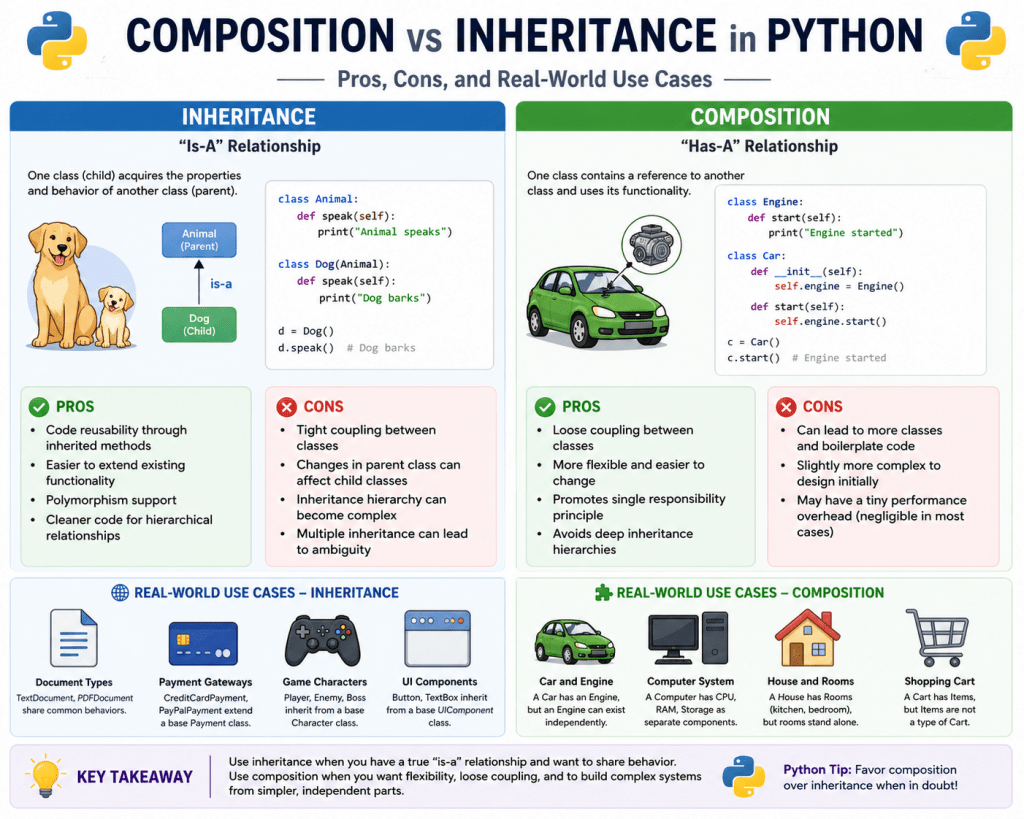
To build maintainable and scalable software systems, developers must understand how objects interact and depend on each other. One of the most important object-oriented design techniques used to achieve this is class composition. It is a structural principle that allows complex systems to be built from smaller, independent components. Instead of designing large and tightly bound classes, composition encourages breaking functionality into reusable units that collaborate to form larger behaviors.
Class Composition as a Design Philosophy in Object-Oriented Programming
In software design, this approach helps reduce complexity by separating concerns. Each class focuses on a specific responsibility rather than trying to handle multiple unrelated tasks. This separation improves clarity, making it easier for developers to understand, maintain, and extend the system over time. When systems are broken into smaller components, debugging also becomes more efficient because issues can be isolated to specific parts of the structure.
Class composition is not tied to any specific programming language. It is a universal concept in object-oriented design that appears across many programming environments. However, its implementation is particularly common in Python due to the language’s flexibility and support for dynamic object structures. Python allows objects to be assigned as attributes of other objects without strict constraints, making composition easy to implement and highly expressive.
Structure of Classes: Attributes and Methods in Composition
At a fundamental level, a class represents a blueprint for creating objects. These objects contain two primary elements: attributes and methods. Attributes define the state of an object, while methods define its behavior. In a compositional structure, attributes may include not only simple data types such as strings or integers but also instances of other classes. This enables complex object relationships to be built in a modular fashion.
When one class includes another class as an attribute, it establishes a dependency relationship between the two. However, this dependency is typically designed to be loose rather than rigid. Loose coupling ensures that changes in one component do not heavily impact other components. This is one of the key benefits of composition and is essential for building scalable architectures.
Has-A Relationship in Real-World Software Modeling
A common example used to understand composition involves organizational systems. Consider an employee management system where an employee has various attributes such as identification details, job role, and compensation structure. Instead of embedding all compensation-related logic directly within the employee class, it is more efficient to create a separate compensation or benefits class. The employee class then includes this benefits class as one of its attributes.
This separation allows the benefits structure to evolve independently of the employee structure. If organizational policies change, only the benefits component needs to be updated. The employee class remains unaffected, provided the interface between the two remains consistent. This design significantly reduces the risk of unintended side effects during system updates.
Reusability and Modular Design in Composition
Another important aspect of composition is reusability. Once a class is designed to perform a specific function, it can be reused in multiple contexts. For instance, a benefits component can be used not only for full-time employees but also for contractors, freelancers, or part-time workers. This reduces redundancy and ensures consistency across different parts of the system.
Reusability becomes especially important in large applications where similar functionality is required in multiple modules. Instead of rewriting logic, developers can simply reuse existing components. This not only saves development time but also reduces the likelihood of errors caused by duplicated logic.
Flexibility and Runtime Behavior in Composed Systems
Composition also enhances system flexibility. Because components are loosely connected, they can be replaced or modified without affecting the entire system. This makes it easier to introduce new features or modify existing behavior. For example, an employee system may need to support different types of benefit packages. Instead of rewriting the employee class, different benefit classes can be created and assigned dynamically based on context.
This dynamic assignment is one of the most powerful aspects of composition. Objects can be constructed at runtime using different combinations of components, allowing systems to adapt to changing requirements. This flexibility is particularly valuable in applications where business rules frequently change or need to be configured based on external inputs.
Encapsulation and Data Protection in Composition
Encapsulation is another important principle that works closely with composition. Each component maintains its own internal state and exposes functionality through well-defined methods. Other components do not need to understand the internal workings of a class in order to use it. This abstraction reduces complexity and improves security by limiting direct access to internal data.
By hiding implementation details, encapsulation ensures that changes within a class do not affect external components as long as the public interface remains unchanged. This allows developers to refactor or optimize individual components without disrupting the overall system.
Single Responsibility and System Organization
Composition also supports better system organization. When systems are designed using compositional principles, each class has a clearly defined responsibility. This aligns with the principle of single responsibility, which states that a class should have only one reason to change. By adhering to this principle, developers can create systems that are easier to understand and maintain.
In addition, composition encourages a more natural mapping between real-world systems and software models. Real-world entities are often made up of smaller parts that work together. For example, a vehicle is composed of an engine, wheels, and a transmission system. Modeling software in the same way makes it more intuitive and easier to reason about.
Testing and Isolation in Compositional Systems
Testing is also significantly improved when using composition. Because components are independent, they can be tested in isolation. This allows developers to verify the correctness of individual parts before integrating them into the larger system. Isolated testing reduces the complexity of test cases and increases confidence in system reliability.
In addition, composed systems are easier to mock during testing. If a component depends on external services or complex dependencies, those dependencies can be replaced with simplified versions during test execution. This allows developers to focus on specific functionality without interference from unrelated components.
Maintainability and Long-Term System Stability
Another benefit of composition is improved maintainability. As systems grow, maintaining tightly coupled classes becomes increasingly difficult. Composition helps prevent this by ensuring that each class remains small, focused, and independent. When changes are required, they can be made in a localized manner without affecting unrelated parts of the system.
Scalability is also enhanced through composition. As applications expand, new components can be added without modifying existing ones. This incremental growth model allows systems to evolve without requiring major redesigns. New features can be introduced by simply adding new classes and integrating them with existing structures.
System Evolution and Extensibility Through Composition
Composition also plays a key role in modern software architecture patterns. Many architectural styles rely on the idea of assembling systems from independent services or components. These designs emphasize modularity and separation of concerns, both of which are central to composition.
In large-scale systems, composition helps manage complexity by dividing functionality into manageable units. Each unit can be developed, deployed, and maintained independently. This reduces coordination overhead and allows teams to work in parallel on different parts of the system.
Another important consideration is that composition encourages forward-compatible design. Because components are independent, new functionality can be added without breaking existing systems. This makes applications more resilient to change and reduces long-term maintenance costs.
Design Considerations and Practical Limitations
Despite its advantages, composition requires thoughtful design. Poorly structured compositions can lead to unnecessary complexity if too many small components are created without a clear purpose. It is important to strike a balance between modularity and simplicity.
Designing effective compositions involves understanding how components interact and ensuring that each class has a clear and meaningful responsibility. Relationships between components should be logical and reflect real-world interactions as closely as possible.
Performance considerations may also arise in heavily composed systems. Since composition involves multiple objects working together, there may be a slight overhead associated with method calls and object interactions. However, in most modern systems, this overhead is negligible compared to the benefits gained in maintainability and flexibility.
Another key design consideration is lifecycle management. Developers must determine how composed objects are created, managed, and destroyed. Proper lifecycle management ensures that system resources are used efficiently and prevents issues such as memory leaks or unnecessary resource consumption.
Documentation and Team Collaboration in Composed Systems
Documentation plays an important role in compositional design. As systems become more modular, understanding how components interact becomes essential. Clear documentation helps developers navigate complex relationships and ensures consistent usage of components across the system.
Composition also supports better collaboration in development teams. Different developers can work on different components independently, reducing dependency conflicts and improving productivity. This parallel development approach is particularly useful in large projects with multiple contributors.
Expanding Class Composition in Python: Advanced Design Thinking and System Architecture
Building on the foundational understanding of class composition, it becomes essential to explore how this concept operates in more advanced software design scenarios. In real-world applications, systems rarely consist of simple isolated classes. Instead, they involve interconnected components that must coordinate efficiently while remaining independently maintainable. Composition plays a central role in enabling this level of architectural sophistication.
At a deeper level, composition is not just a coding technique but a design philosophy that influences how developers think about system structure. Rather than focusing on inheritance hierarchies or rigid class trees, composition encourages developers to think in terms of collaboration between independent modules. This shift in perspective is critical when building scalable systems that must evolve without breaking existing functionality.
Moving Beyond Basic Composition: System-Level Design
In simple implementations, composition might involve embedding one class inside another as an attribute. However, in complex systems, composition extends beyond individual relationships and becomes a structural backbone for entire architectures. Large applications are often composed of multiple layers, each containing its own set of composed objects that interact through defined interfaces.
For example, in a typical multi-layered application, the presentation layer may consist of UI components, each composed of smaller widgets and utilities. The business logic layer may include service classes that are composed of domain models and helper components. The data access layer may include repository objects that are composed of database connectors and query builders. Each layer is composed independently, yet all layers work together to form a cohesive system.
This layered compositional approach ensures separation of concerns across the entire architecture. Each layer focuses on a specific responsibility, and composition ensures that functionality is delegated appropriately rather than centralized in monolithic structures.
Composition vs Coupling in Large Systems
One of the most important considerations in system design is coupling, which refers to how dependent different components are on each other. Composition naturally promotes loose coupling when implemented correctly. Loose coupling means that changes in one component do not force changes in another, as long as the interface between them remains stable.
In contrast, tight coupling occurs when components are heavily dependent on each other’s internal structure. This makes systems fragile and difficult to modify. Composition helps avoid tight coupling by ensuring that objects interact through abstraction rather than direct dependency on internal implementation details.
For example, instead of allowing a class to directly manipulate the internal logic of another class, composition encourages interaction through method calls and defined interfaces. This ensures that internal changes remain isolated and do not propagate across the system.
Dynamic Composition and Runtime Behavior Control
One of the most powerful aspects of composition in Python is its ability to support dynamic behavior at runtime. Unlike static class structures, composed objects can be assembled, modified, or replaced while the program is running. This enables highly flexible system behavior that can adapt to changing conditions.
Dynamic composition is commonly used in configuration-driven systems. Instead of hardcoding behavior, applications can load different components based on external configuration files, user input, or environmental conditions. This allows a single system to behave differently without modifying its underlying codebase.
For instance, a logging system may use different logging strategies depending on the environment. In development, logs may be printed to the console, while in production, they may be written to external monitoring services. By composing the logging component dynamically, the system can switch between behaviors seamlessly.
This ability to alter system behavior at runtime is one of the key reasons composition is preferred in modern software design. It provides adaptability without sacrificing structure or maintainability.
Composition as a Foundation for Design Patterns
Many well-known design patterns rely heavily on composition to achieve flexibility and reusability. Instead of relying on inheritance hierarchies, these patterns use object composition to build relationships between components.
One common example is the strategy pattern, where different algorithms are encapsulated in separate classes and composed into a context object. The context object does not implement the algorithm itself but delegates execution to the composed strategy object. This allows algorithms to be swapped dynamically without modifying the context class.
Another example is the decorator pattern, which allows behavior to be added to objects dynamically by wrapping them in additional layers of functionality. Each decorator is a separate class that composes the original object and extends its behavior without modifying its structure.
These patterns demonstrate how composition enables flexible system design by decoupling behavior from structure. Instead of relying on inheritance to extend functionality, composition allows behavior to be assembled dynamically from interchangeable components.
Composition in Modular and Microservice Architectures
In modern distributed systems, composition extends beyond individual applications and becomes a principle of system-level architecture. Microservice architectures, for example, are built on the idea of composing independent services that communicate through APIs.
Each microservice represents a self-contained unit of functionality. These services are composed together to form a complete system. Unlike monolithic architectures, where all components are tightly integrated, microservice-based systems rely on composition at the service level.
This approach improves scalability and maintainability by allowing individual services to be developed, deployed, and scaled independently. Changes to one service do not require changes to others, as long as communication contracts remain consistent.
Composition in this context is not limited to code structure but extends to system design, deployment strategies, and communication protocols.
Data Flow and Composition in Processing Pipelines
Another important application of composition is in data processing pipelines. In such systems, data flows through a series of composed components, each responsible for a specific transformation or operation.
For example, a data pipeline may include components for data ingestion, validation, transformation, enrichment, and storage. Each component is independent and performs a specific task. These components are composed into a pipeline where the output of one stage becomes the input of the next.
This compositional approach ensures that each stage remains simple and focused. It also allows stages to be added, removed, or modified without affecting the entire pipeline. This flexibility is essential in data-intensive systems where processing requirements frequently change.
Composition and Dependency Management
Dependency management is a critical aspect of software design, and composition plays a key role in controlling dependencies between components. In a well-designed compositional system, dependencies are explicitly defined and injected rather than hardcoded.
This approach, often referred to as dependency injection, allows components to receive their dependencies from external sources rather than creating them internally. This further reduces coupling and improves testability.
By managing dependencies externally, developers can replace components with mock implementations during testing or swap implementations in production without modifying the dependent class. This level of control is essential for building robust and testable systems.
Lifecycle Management in Composed Systems
When using composition extensively, lifecycle management becomes an important consideration. Since composed objects are often created dynamically, developers must determine how long these objects should exist and when they should be destroyed.
Improper lifecycle management can lead to resource leaks or inefficient memory usage. In large systems, this can have significant performance implications. Therefore, it is important to establish clear ownership rules for composed objects.
In some cases, the parent object is responsible for managing the lifecycle of its components. In other cases, components may be shared across multiple objects and managed independently. The correct approach depends on the system design and usage patterns.
Scalability Through Compositional Design
Scalability is one of the most important goals in modern software systems, and composition plays a direct role in achieving it. By breaking systems into smaller, independent components, developers can scale individual parts of the system without affecting others.
For example, in a web application, different components such as authentication, data processing, and notification services can be scaled independently based on demand. This ensures efficient resource utilization and improved system performance.
Composition also supports horizontal scaling, where multiple instances of a component can be deployed to handle increased load. Because components are independent, they can be duplicated and distributed across different environments without affecting system integrity.
Error Handling and Fault Isolation in Composed Systems
In complex systems, failures are inevitable. Composition helps isolate failures by ensuring that components are independent. If one component fails, it does not necessarily bring down the entire system.
This fault isolation is critical in building resilient systems. Each component can handle its own errors and provide fallback mechanisms if necessary. This ensures that the system continues to function even in the presence of partial failures.
For example, if a logging component fails, the core business logic can continue to operate without interruption. This separation of concerns improves overall system reliability.
Extensibility and Future-Proof Design
One of the long-term benefits of composition is extensibility. Systems designed using composition can evolve without requiring major restructuring. New functionality can be added by introducing new components rather than modifying existing ones.
This makes compositional systems inherently future-proof. As requirements change, developers can extend the system by composing new behaviors rather than rewriting existing logic.
This incremental approach to development reduces risk and supports continuous improvement. It allows systems to grow organically while maintaining structural integrity.
Final Perspective on Advanced Composition
At an advanced level, composition is not just a coding technique but a foundational principle of system architecture. It influences how developers design, structure, and evolve software systems. By emphasizing modularity, flexibility, and independence, composition enables the creation of robust systems that can adapt to changing requirements.
Understanding and applying composition effectively is essential for any developer aiming to build scalable and maintainable software systems.
Class Inheritance in Python: Structural Hierarchies and Object Specialization
Class inheritance is one of the most fundamental concepts in object-oriented programming and plays a central role in how developers model hierarchical relationships in software systems. It allows a new class to derive properties and behaviors from an existing class, enabling the reuse of code and the creation of structured relationships between entities. While composition focuses on building systems through independent components, inheritance focuses on extending existing structures in a hierarchical manner.
Inheritance is based on an is-a relationship. This means that the derived class is a specialized version of the base class. For example, a car is a vehicle, a dog is an animal, and a savings account is a bank account. These relationships naturally form hierarchies, where general characteristics are defined in a base class and more specific behaviors are defined in derived classes.
In Python, inheritance allows a child class to automatically access attributes and methods of a parent class. This reduces redundancy because shared functionality does not need to be rewritten in every class. Instead, it is defined once in the base class and reused across all derived classes.
Understanding the Structure of Inheritance in Object-Oriented Design
Inheritance introduces a parent-child relationship between classes. The parent class, often referred to as the superclass, contains general attributes and methods that are common across multiple related classes. The child class, also known as the subclass, inherits these features and may extend or override them to introduce more specific behavior.
This structure creates a hierarchical model of abstraction. At the top level, the base class defines general concepts. As we move down the hierarchy, subclasses become more specialized. This allows developers to model real-world relationships in a structured and logical way.
For example, a general class called vehicle may define attributes such as speed, color, and model. It may also include methods such as start and stop. A subclass, such as a car or a motorcycle, can inherit these attributes and methods while also introducing additional features specific to that type of vehicle.
Code Reusability and the DRY Principle in Inheritance
One of the primary advantages of inheritance is code reuse. By placing shared functionality in a base class, developers avoid duplicating code across multiple classes. This aligns with the DRY principle, which emphasizes reducing repetition in software design.
When multiple classes share similar behavior, inheritance provides a clean way to centralize that behavior. Instead of writing the same logic in multiple places, it is defined once in the parent class and automatically inherited by all subclasses.
This reduces maintenance overhead. If a shared behavior needs to be updated, it only needs to be changed in one place. All subclasses automatically receive the updated behavior, ensuring consistency across the system.
Method Overriding and Behavioral Customization
While inheritance promotes reuse, it also allows customization through method overriding. Method overriding occurs when a subclass provides its own implementation of a method that already exists in the parent class. This allows subclasses to modify or extend inherited behavior without altering the base class.
This feature is particularly useful when different subclasses need to behave differently while still sharing a common structure. For example, a base class animal may define a method called sound. A dog subclass may override this method to produce a barking sound, while a cat subclass may override it to produce a meowing sound.
Method overriding enables polymorphism, which allows objects of different classes to be treated as instances of a common base class while still exhibiting different behaviors.
Extending Functionality Through Subclassing
Inheritance is not limited to reusing existing functionality. It also allows subclasses to extend the capabilities of the base class. Subclasses can introduce new attributes and methods that are not present in the parent class.
This extension mechanism is what makes inheritance powerful in modeling specialized entities. A base class provides a foundation, while subclasses build on that foundation to introduce more specific behavior.
For example, a base class employee may define general attributes such as name and salary. A subclass manager may extend this by adding additional attributes such as team size or department responsibility.
This layered structure allows systems to grow in complexity without losing organization.
Hierarchical Design and Real-World Modeling
Inheritance is particularly useful when modeling hierarchical relationships that naturally exist in the real world. Many domains contain categories and subcategories that fit naturally into inheritance structures.
For example, in a transportation system, a general vehicle category can be divided into cars, trucks, and motorcycles. Each of these can be further specialized. This hierarchical modeling allows developers to represent real-world structures logically and intuitively.
However, while inheritance mirrors real-world relationships, it is important to ensure that the hierarchy remains meaningful. Poorly designed inheritance structures can become rigid and difficult to maintain.
The Risk of Tight Coupling in Inheritance
One of the major drawbacks of inheritance is tight coupling between parent and child classes. In a tightly coupled system, changes in the base class can unintentionally affect all subclasses. This can lead to unexpected behavior and maintenance challenges.
Because subclasses depend on the internal structure of the parent class, modifications to the base class must be carefully managed. Even small changes can have wide-reaching effects across the inheritance hierarchy.
This tight coupling makes inheritance less flexible compared to composition. While inheritance provides structure, it can also introduce rigidity if not used carefully.
Inheritance Hierarchies and Complexity Management
As inheritance hierarchies grow, they can become complex and difficult to manage. Deep inheritance chains, where classes inherit from multiple levels of parent classes, can make it difficult to understand how behavior is defined and where it originates.
This complexity can lead to confusion and bugs, especially when multiple levels of inheritance override methods or introduce new behavior. Developers must carefully design inheritance structures to avoid unnecessary depth and complexity.
A flatter inheritance structure is often easier to maintain and understand than a deeply nested one. Simpler hierarchies reduce cognitive load and improve code readability.
Polymorphism and Dynamic Behavior in Inheritance
One of the key benefits of inheritance is polymorphism. Polymorphism allows objects of different subclasses to be treated as instances of a common parent class. This enables flexible and dynamic behavior in software systems.
For example, a function that accepts a vehicle object can work with any subclass of vehicle, such as a car, truck, or motorcycle. Each subclass may implement its own version of a method, but the function can interact with them uniformly.
This ability to treat different objects in a consistent way simplifies system design and reduces the need for conditional logic.
Inheritance vs Composition in Design Decisions
While inheritance is powerful, it is not always the best solution. In many cases, composition provides a more flexible alternative. The key difference lies in the type of relationship being modeled.
Inheritance is best used when there is a clear is-a relationship between classes. Composition is better suited for has-a relationships where objects are composed of independent components.
Choosing between inheritance and composition is a critical design decision. Using inheritance inappropriately can lead to rigid and fragile systems, while composition can introduce unnecessary complexity if overused.
Best Practices for Using Inheritance
To use inheritance effectively, it is important to follow certain design principles. One key principle is to avoid deep inheritance hierarchies. Keeping inheritance structures shallow improves readability and reduces complexity.
Another important practice is to ensure that subclasses genuinely represent specialized versions of the parent class. If this relationship is not natural, composition may be a better alternative.
It is also important to design base classes carefully. A well-designed base class should provide a stable foundation that is unlikely to change frequently. This reduces the risk of breaking subclasses when modifications are made.
Maintainability Challenges in Inheritance-Based Systems
While inheritance promotes reuse, it can also create maintainability challenges. Because subclasses depend on the structure of the parent class, changes must be made carefully to avoid unintended side effects.
Over time, inheritance-based systems can become difficult to modify if the hierarchy becomes too complex or tightly coupled. This is why careful planning is essential when designing inheritance structures.
Refactoring inheritance hierarchies can also be challenging, especially in large systems where many classes depend on a single base class.
Scalability Considerations in Inheritance
Inheritance can support scalability when used correctly, but it must be applied with caution. As systems grow, inheritance hierarchies may become more complex, making them harder to manage.
In some cases, composition may scale more effectively because it avoids rigid hierarchies. However, inheritance still plays an important role in scenarios where structured relationships are required.
The key to scalability is balance. Developers must choose the right tool based on the specific requirements of the system.
Conclusion
The concepts of class composition and class inheritance represent two foundational but fundamentally different approaches to object-oriented design, and understanding their distinction is essential for building robust, scalable, and maintainable software systems. Both techniques address the same core problem—how to structure relationships between objects—but they do so in different ways, with different trade-offs in flexibility, complexity, and long-term maintainability. A well-designed system rarely relies exclusively on one approach; instead, it strategically combines both based on the nature of the problem being solved.
Class inheritance is primarily concerned with hierarchical relationships. It models systems using an is-a relationship, where specialized classes derive from more general ones. This structure allows shared behavior to be defined once in a base class and reused across multiple derived classes. It promotes code reuse and can significantly reduce duplication, especially in systems where multiple entities share a large portion of common functionality. Inheritance also enables polymorphism, allowing different objects to be treated uniformly through a shared interface while still exhibiting distinct behaviors. This capability is particularly useful in scenarios where flexibility in behavior is required under a unified abstraction.
However, inheritance also introduces structural rigidity. Because subclasses depend on the internal design of their parent classes, changes in the base class can propagate throughout the hierarchy. This tight coupling can make systems more fragile over time, especially as they grow in complexity. Deep inheritance trees can also become difficult to understand and maintain, as behavior may be distributed across multiple levels of abstraction. Developers must trace method definitions through the hierarchy to fully understand how a particular behavior is implemented, which increases cognitive load and reduces transparency.
In contrast, class composition takes a fundamentally different approach. Rather than organizing code through hierarchical relationships, it builds systems by combining independent components. Composition follows a has-a relationship, where objects are constructed from other objects that each handle a specific responsibility. This approach emphasizes modularity, separation of concerns, and loose coupling. Each component is designed to perform a focused task, and complex behavior emerges from the interaction of these smaller parts.
One of the most important advantages of composition is flexibility. Because components are independent, they can be replaced, modified, or extended without affecting the overall structure of the system. This makes composition particularly well-suited for applications that must evolve or adapt to changing requirements. Instead of modifying a rigid class hierarchy, developers can simply swap or reconfigure components at runtime or during design, enabling more dynamic and adaptable systems.
Composition also improves maintainability by reducing hidden dependencies. In inheritance-based systems, changes in a parent class can have unintended consequences across all child classes. In compositional systems, changes are typically isolated within individual components, reducing the risk of side effects. This isolation makes debugging easier, as issues can be traced to specific components rather than distributed across an inheritance chain. It also simplifies testing, since individual components can be validated independently before being integrated into larger systems.
From a design perspective, composition encourages thinking in terms of responsibilities rather than hierarchies. Instead of asking how classes should inherit from one another, developers focus on what responsibilities each component should have and how those components should interact. This leads to more modular architectures where functionality is distributed across well-defined boundaries. Such systems tend to be more resilient to change because they avoid tight structural dependencies.
Despite their differences, inheritance and composition are not mutually exclusive. In fact, many well-designed systems use both techniques together. Inheritance is often useful for defining broad conceptual relationships and shared interfaces, while composition is used to assemble flexible, reusable functionality. The key lies in understanding when each approach is appropriate. Inheritance works best when there is a clear hierarchical relationship that is unlikely to change frequently. Composition is better suited for situations where flexibility, reuse, and dynamic behavior are more important than strict structural hierarchy.
A common design principle that helps guide this decision is favoring composition over inheritance in many scenarios. This principle is not a rejection of inheritance but rather a recognition that composition tends to produce more adaptable systems in practice. By reducing coupling and increasing modularity, composition often leads to designs that are easier to extend and maintain over time. Inheritance still plays a valuable role, but it must be applied carefully to avoid creating overly rigid structures.
Another important aspect to consider is system evolution. Software systems rarely remain static; they evolve as requirements change, new features are added, and existing functionality is refined. Inheritance-based systems can become difficult to modify because changes ripple through the class hierarchy. Composition-based systems, on the other hand, are naturally more adaptable because components can be adjusted independently. This makes composition particularly valuable in long-lived systems where change is inevitable.
Performance considerations also play a role in design decisions, although they are often secondary to maintainability and flexibility. Inheritance may offer a slightly more direct method of resolution in some cases, while composition introduces additional object interactions. However, in most modern applications, the difference is negligible compared to the architectural benefits composition provides. The real trade-off lies not in performance but in clarity, adaptability, and long-term maintainability.
Ultimately, mastering both inheritance and composition requires more than understanding syntax or implementation details. It requires developing a design mindset that focuses on relationships, responsibilities, and system evolution. Inheritance teaches how to model shared characteristics through structure, while composition teaches how to build complex systems through collaboration. Together, they form a complete toolkit for object-oriented design.
Developers who understand when to apply each approach are better equipped to design systems that are both robust and flexible. They can avoid the pitfalls of overly rigid hierarchies while still leveraging the power of abstraction and reuse. Over time, this leads to software that is easier to extend, easier to debug, and easier to reason about.
In practice, the most effective systems are those that strike a balance between structure and flexibility. Inheritance provides order and clarity through hierarchy, while composition provides adaptability through modularity. When used thoughtfully, these two concepts complement each other and enable the creation of software systems that are both logically structured and capable of evolving with changing requirements.