
Virtual private networks have become deeply embedded in modern digital environments, shaping how individuals and organizations approach online security. The constant exposure to discussions about secure browsing, remote work access, and data protection has made VPNs feel like a necessary layer rather than an optional tool. Their importance is frequently emphasized, yet the technical reasoning behind their use is often overlooked or simplified into general advice about staying safe online.
At their core, VPNs exist to solve a fundamental problem: the internet was not originally designed with strong security in mind. Data traveling across networks can pass through multiple systems, each representing a potential point of observation or interception. Without proper safeguards, sensitive information such as login credentials, financial data, and internal communications could be exposed. VPN technology addresses this issue by creating a secure and controlled pathway for data transmission.
Understanding how VPNs function begins with recognizing that they are not just tools for hiding activity or bypassing restrictions. They are structured systems built on established security principles that aim to protect data in motion. By exploring these principles in depth, it becomes easier to understand why VPNs are widely adopted across industries and why they continue to play a critical role in digital security strategies.
The Concept of Secure Tunneling
One of the defining characteristics of a VPN is its ability to create a secure tunnel between a user’s device and a destination network. This tunnel acts as a protective layer that encapsulates data, shielding it from external observation. Instead of sending information directly across the internet in its original form, the VPN wraps it in encryption and routes it through a designated endpoint.
This endpoint can take many forms, including servers hosted in data centers, cloud-based systems, or dedicated network appliances within an organization. Regardless of its physical location, the endpoint serves as the termination point for the encrypted connection. Once data reaches this point, it is decrypted and forwarded to its final destination.
The concept of tunneling is significant because it changes how data is perceived by intermediate systems. Routers, switches, and other network devices can still direct traffic to its destination, but they cannot interpret the contents of the data. This separation between routing and visibility is a key factor in maintaining secure communications across shared and potentially untrusted networks.
The CIA Triad as the Foundation of VPN Security
The effectiveness of VPN technology is closely tied to a fundamental framework in information security known as the CIA triad. This model consists of three essential components: confidentiality, integrity, and availability. Each of these elements plays a distinct role in ensuring that data remains secure and accessible under appropriate conditions.
Confidentiality focuses on restricting access to information so that only authorized parties can view it. VPNs achieve this through encryption, which transforms readable data into an encoded format. Without the appropriate keys, this data cannot be interpreted, even if it is intercepted during transmission.
Integrity ensures that data remains consistent and unaltered as it travels from one point to another. This is accomplished through mechanisms that detect any changes in the data. If the information is modified in transit, the system can identify the discrepancy and prevent compromised data from being accepted.
Availability ensures that systems and data are accessible when needed. VPNs support this by limiting exposure to external threats. By controlling access to resources and reducing the number of entry points, they help maintain system stability and reduce the likelihood of disruptions.
Encryption and Its Role in Protecting Data
Encryption is the most prominent feature of VPN technology and serves as the primary method for securing data. It works by applying mathematical algorithms to transform plain text into ciphertext. This process relies on cryptographic keys, which are used to encode and decode the information.
When a user sends data through a VPN, it is encrypted before leaving the device. The encrypted data then travels through the tunnel to the VPN endpoint, where it is decrypted. This ensures that the data remains protected throughout its journey, even if it passes through multiple networks.
Different encryption standards can be used depending on the VPN protocol and configuration. Strong encryption methods are designed to resist unauthorized decryption attempts, making it extremely difficult for attackers to access the underlying information. The effectiveness of encryption depends not only on the algorithm used but also on how it is implemented and managed.
The Importance of Integrity in Data Transmission
While encryption protects data from being read, it does not guarantee that the data remains unchanged. This is where integrity mechanisms come into play. These mechanisms ensure that the information received is the same as the information sent.
Integrity is typically maintained through the use of hashing algorithms. A hash function takes a block of data and produces a fixed-length value that represents that data. Even a minor change in the original data results in a completely different hash value.
When data is transmitted through a VPN, a hash is generated and sent along with the encrypted data. The receiving system calculates its own hash of the decrypted data and compares it to the original. If the two values match, the data is considered intact. If they differ, it indicates that the data may have been altered during transit.
Ensuring Availability Through Controlled Access
Availability is a critical aspect of any secure system, as it determines whether users can access the resources they need. VPNs contribute to availability by reducing the exposure of systems to external threats.
By placing resources behind a VPN, organizations limit access to authenticated users בלבד. This means that services are not directly exposed to the public internet, reducing the likelihood of attacks such as unauthorized access attempts or service disruptions.
This controlled access model also allows organizations to monitor and manage user activity more effectively. By centralizing access through a VPN, they can enforce security policies and respond more quickly to potential threats. This approach helps maintain system stability while ensuring that legitimate users can continue their work without interruption.
VPNs in the Context of Modern Internet Usage
The widespread adoption of secure web protocols has led to a perception that VPNs may no longer be necessary. Many websites now use encryption to protect data transmitted between users and servers, providing a baseline level of security for everyday browsing.
However, this type of encryption only protects specific types of traffic and does not address all aspects of network security. For example, it does not conceal the origin of the traffic or protect non-browser applications. VPNs fill these gaps by securing all network traffic from a device and masking identifying information.
This comprehensive approach makes VPNs particularly valuable in environments where privacy and security are priorities. They provide an additional layer of protection that complements existing security measures, rather than replacing them.
Privacy and the Masking of Network Identity
One of the key benefits of using a VPN is the ability to mask a user’s network identity. When connected to a VPN, the user’s traffic appears to originate from the VPN endpoint rather than their actual location. This helps obscure the user’s identity and makes it more difficult to track their activity.
This feature is especially important in situations where users want to maintain a level of anonymity. By routing traffic through a different location, VPNs reduce the amount of information that can be used to identify or profile a user.
While VPNs do not provide complete anonymity, they significantly enhance privacy by limiting the visibility of user activity. This makes them a valuable tool for protecting personal and professional information in an increasingly monitored digital landscape.
The Growth of Remote Work and VPN Dependence
The shift toward remote work has dramatically increased the reliance on VPN technology. Employees are no longer confined to office networks and often need to access internal systems from various locations. This creates new challenges for maintaining security and protecting sensitive data.
VPNs address these challenges by providing a secure connection between remote users and organizational resources. This allows employees to work from different environments without compromising security. The VPN effectively extends the organization’s network to wherever the user is located.
This capability has become essential for maintaining productivity and ensuring that security standards are upheld. As remote work continues to evolve, the role of VPNs in supporting distributed operations is likely to grow even further.
Common Applications of VPN Technology
VPNs are used in a wide range of scenarios, each with its own requirements and objectives. In corporate environments, they are commonly used to provide secure access to internal systems. This allows employees to connect to company resources from outside the office.
They are also used to connect multiple networks, enabling secure communication between different locations. This is particularly useful for organizations with multiple offices or data centers, as it ensures that data can be transmitted safely between them.
For individual users, VPNs provide a way to enhance privacy and protect personal data. This includes securing online transactions, preventing unauthorized tracking, and maintaining confidentiality in digital communications.
Preparing for a Deeper Exploration of VPN Protocols
With a solid understanding of the principles behind VPN technology, the next step is to explore how these systems are implemented. This involves examining the protocols that govern how VPNs operate and how they achieve their security objectives.
Different protocols offer different advantages, depending on the specific needs of the user or organization. Some prioritize performance, while others focus on flexibility or ease of deployment. Understanding these differences is essential for selecting the most appropriate solution.
Introduction to VPN Protocol Architecture
Virtual private networks rely on structured protocols to establish secure communication channels across potentially untrusted networks. These protocols define how data is encrypted, authenticated, transmitted, and verified between endpoints. While the concept of a VPN may appear straightforward from a user perspective, the underlying architecture is complex and carefully designed to balance security, performance, and compatibility.
Among the many VPN protocols developed over time, IPSec and OpenVPN have emerged as two of the most widely used solutions. Each follows a different architectural philosophy, resulting in distinct advantages and trade-offs. Understanding these protocols at a deeper level requires examining how they operate internally, how they manage encryption and authentication, and how they interact with network systems.
Understanding IPSec as a Protocol Suite
IPSec is not a single protocol but a collection of protocols designed to secure Internet communications at the network layer. It operates directly within the IP stack, making it a foundational component of many enterprise-grade networking solutions. Its design allows it to secure data between hosts, between networks, or between a host and a network.
The primary goal of IPSec is to provide confidentiality, integrity, and authentication for IP packets. It achieves this through a combination of protocols that work together to encrypt data, verify its authenticity, and ensure that it has not been altered during transmission.
One of the defining characteristics of IPSec is its integration into the operating system kernel. This positioning allows it to process packets efficiently, resulting in strong performance and minimal overhead compared to solutions that operate at higher levels of the system.
Core Components of IPSec
IPSec relies on several key components to perform its functions. These include the Authentication Header, the Encapsulating Security Payload, and the Internet Key Exchange mechanism. Each plays a specific role in securing communications.
The Authentication Header is responsible for ensuring data integrity and authenticity. It verifies that the data has not been modified and confirms the identity of the sender. However, it does not provide encryption, meaning that the data remains visible.
The Encapsulating Security Payload provides both encryption and integrity. It encrypts the data portion of the packet and includes mechanisms to verify that the data has not been tampered with. This makes it the more commonly used component in most IPSec implementations.
The Internet Key Exchange protocol is used to establish secure connections between endpoints. It negotiates encryption algorithms, authentication methods, and cryptographic keys. This process is essential for creating a secure communication channel without exposing sensitive information.
Encryption and Authentication in IPSec
Encryption within IPSec is handled through well-established cryptographic algorithms. These algorithms transform readable data into an encrypted format that can only be decoded with the correct key. Common encryption standards include advanced symmetric algorithms that are widely trusted for their strength and reliability.
Authentication ensures that the parties involved in the communication are legitimate. This can be achieved through pre-shared keys or digital certificates. Pre-shared keys are simpler to implement but can be less secure if not managed properly. Digital certificates provide a higher level of security by enabling scalable and verifiable identity management.
The combination of encryption and authentication ensures that data remains both private and trustworthy. Without these mechanisms, secure communication would not be possible in environments where multiple parties interact across shared networks.
Transport Mode and Tunnel Mode in IPSec
IPSec can operate in two distinct modes: transport mode and tunnel mode. Each mode determines how data is protected and how it is transmitted across the network.
Transport mode encrypts only the payload of the IP packet while leaving the header intact. This allows network devices to route the packet based on its destination information. Transport mode is typically used for direct communication between two hosts.
Tunnel mode encrypts the entire IP packet, including both the header and the payload. The original packet is encapsulated within a new packet, which is then transmitted through the network. This mode is commonly used for site-to-site connections, where entire networks communicate securely through gateways.
The choice between these modes depends on the specific use case and the level of security required. Tunnel mode offers greater protection but may introduce additional overhead, while transport mode provides efficiency for certain scenarios.
Key Exchange and Security Associations
A critical aspect of IPSec is the establishment of security associations. These associations define the parameters for secure communication, including encryption algorithms, keys, and authentication methods.
The process begins with a negotiation phase, during which the endpoints agree on how the connection will be secured. This involves exchanging information about supported algorithms and selecting a mutually compatible configuration.
Once the parameters are agreed upon, cryptographic keys are generated and exchanged securely. These keys are then used to encrypt and decrypt data during the session. The entire process is designed to ensure that sensitive information is never exposed during the setup phase.
Security associations are maintained for the duration of the connection and can be updated periodically to enhance security. This dynamic approach helps protect against potential threats that may arise over time.
Deployment Scenarios for IPSec
IPSec is widely used in enterprise environments due to its robustness and flexibility. One common use case is site-to-site VPNs, where it connects multiple networks across different locations. This allows organizations to operate as a unified system while maintaining secure communication between offices.
Another common scenario is remote access VPNs, where individual users connect to a corporate network. In this setup, the user’s device establishes a secure connection with a gateway, enabling access to internal resources.
IPSec is also used in hybrid environments that combine on-premises infrastructure with cloud services. In these cases, it provides a secure link between different environments, ensuring that data can move safely across them.
Challenges and Limitations of IPSec
Despite its strengths, IPSec has certain challenges that can affect its usability. One of the primary issues is its complexity. Configuring IPSec requires a detailed understanding of networking concepts and careful coordination between endpoints.
Another challenge is compatibility. Because IPSec operates at the network layer, it must be implemented differently across operating systems. This can lead to inconsistencies and require additional configuration efforts.
Firewall traversal can also be problematic for IPSec. It relies on specific ports and protocols that may be restricted in certain network environments. This can limit its effectiveness in scenarios where network policies are tightly controlled.
Introduction to OpenVPN and Its Design Philosophy
OpenVPN represents a different approach to VPN implementation. It is an open-source protocol that operates in user space rather than within the kernel. This design choice makes it highly flexible and easier to deploy across a wide range of systems.
Instead of building its own cryptographic framework, OpenVPN relies on established libraries that implement secure communication protocols. This allows it to leverage existing security standards while focusing on ease of use and adaptability.
The open-source nature of OpenVPN has contributed to its widespread adoption. It can be integrated into various platforms and customized to meet specific requirements, making it a popular choice for both individuals and organizations.
How OpenVPN Handles Encryption and Authentication
OpenVPN uses secure communication protocols to handle encryption and authentication. These protocols are widely used across the internet and are trusted for their reliability and security.
Encryption in OpenVPN is achieved through symmetric algorithms, similar to those used in IPSec. Authentication can be performed using certificates, usernames and passwords, or a combination of methods. This flexibility allows administrators to choose the level of security that best suits their needs.
The use of certificates is particularly important in large-scale deployments. It enables secure identity verification and simplifies the management of user access. Certificates can be issued, revoked, and updated without affecting the entire system.
OpenVPN and Port Flexibility
One of the key advantages of OpenVPN is its ability to operate on any port. This makes it highly adaptable in environments where network restrictions are in place.
By running on commonly allowed ports, OpenVPN can bypass many firewall limitations. This ensures that users can establish connections even in restrictive networks, such as public Wi-Fi or corporate environments with strict policies.
This flexibility also enhances reliability, as it reduces the likelihood of connection failures بسبب blocked ports. It allows OpenVPN to maintain consistent performance across a wide range of network conditions.
User Space Implementation and Its Impact
Operating in user space means that OpenVPN runs as an application rather than being embedded in the operating system kernel. This has several implications for performance and usability.
On one hand, user space implementation introduces additional processing overhead, which can result in slightly lower performance compared to kernel-based solutions. On the other hand, it simplifies deployment and maintenance, as it does not require deep integration with the operating system.
This approach also makes OpenVPN more portable. It can run on different platforms without requiring significant modifications, making it easier to support diverse environments.
Reliability and Stability in OpenVPN Connections
OpenVPN is known for its stability, particularly in challenging network conditions. It supports both connection-oriented and connectionless communication methods, allowing it to adapt to different scenarios.
In unstable networks, it can use mechanisms that ensure data is delivered reliably, even if packets are lost or delayed. This makes it well-suited for mobile users or environments with inconsistent connectivity.
The ability to maintain stable connections under varying conditions is a significant advantage, especially for users who rely on continuous access to remote systems.
Deployment and Integration of OpenVPN
OpenVPN can be deployed in a variety of configurations, ranging from simple setups for individual users to complex environments for large organizations. Its flexibility allows it to be integrated into existing systems without major changes.
It is commonly used for remote access, where users connect to a central server. It can also be used for site-to-site connections, similar to IPSec, although this is less common in large enterprise environments.
The availability of extensive configuration options allows administrators to tailor the system to their specific needs. This includes adjusting encryption settings, authentication methods, and network parameters.
Comparing Architectural Philosophies
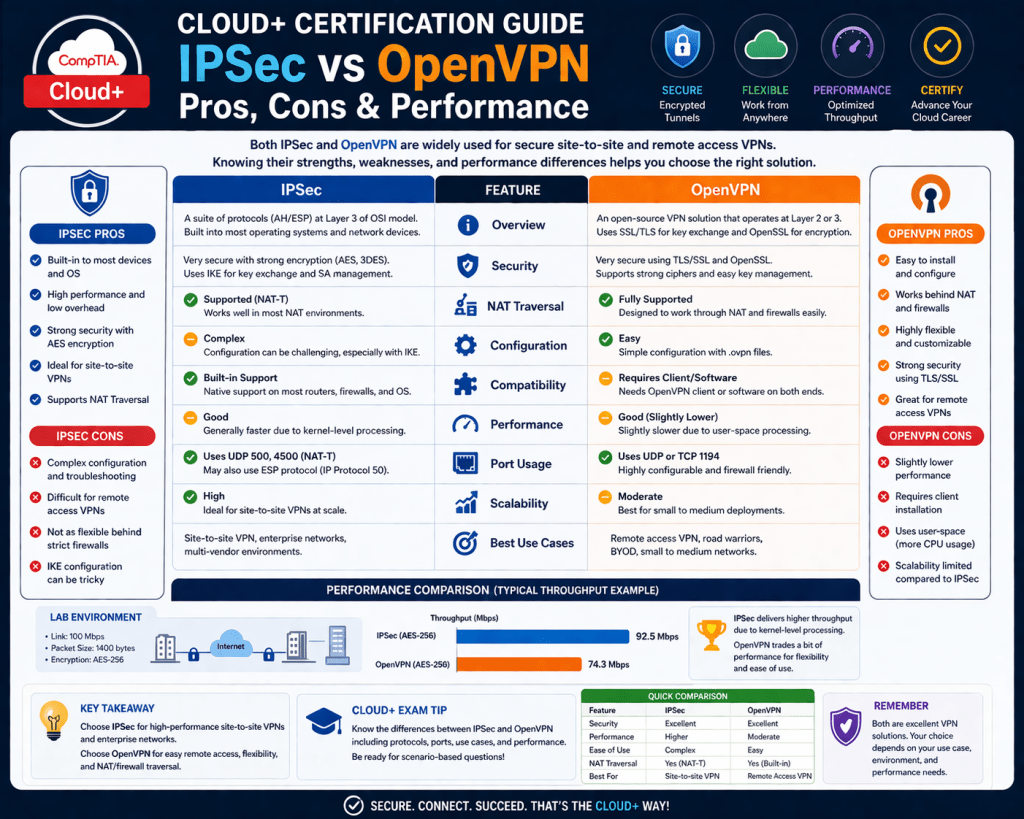
The differences between IPSec and OpenVPN are rooted in their architectural design. IPSec operates at a lower level within the network stack, providing high performance and deep integration with system networking functions.
OpenVPN, on the other hand, operates at a higher level, prioritizing flexibility and ease of use. Its reliance on established security libraries and its user space implementation make it more accessible and adaptable.
These contrasting approaches highlight the trade-offs between performance and usability. While IPSec offers efficiency and standardization, OpenVPN provides versatility and simplicity.
Preparing for Direct Comparison
With a detailed understanding of both IPSec and OpenVPN architectures, the next step is to compare them directly across key factors such as security, performance, implementation, and reliability.
This comparison will provide a clearer picture of how each protocol performs in real-world scenarios and help identify the situations in which one may be more suitable than the other.
Direct Comparison of IPSec and OpenVPN in Real World Environments
When evaluating VPN protocols in practical scenarios, the comparison between IPSec and OpenVPN becomes more nuanced than simple feature lists. Both technologies are capable of delivering strong security and reliable connectivity, but their differences become more visible when applied to real-world use cases. These differences often influence decisions in enterprise environments, remote work setups, and individual usage patterns.
In real deployments, factors such as network conditions, administrative expertise, scalability requirements, and compatibility with existing infrastructure all play a role. A protocol that performs well in a controlled environment may face challenges when exposed to diverse network conditions or large-scale deployments. Understanding how IPSec and OpenVPN behave under these conditions helps clarify their strengths and limitations.
The decision is rarely about which protocol is universally better. Instead, it is about selecting the one that aligns most effectively with the operational and security requirements of a specific environment.
Security Strength and Practical Implementation
Both IPSec and OpenVPN are considered highly secure when properly configured. They rely on strong encryption standards and robust authentication methods to protect data. However, the effectiveness of their security depends heavily on how they are implemented rather than the protocol itself.
IPSec benefits from being a long-established standard with well-defined specifications. Its structured framework ensures consistency across implementations, which is valuable in environments that require strict compliance and predictable behavior. When configured correctly with modern encryption algorithms and certificate-based authentication, it provides a high level of protection.
OpenVPN achieves comparable security by leveraging trusted encryption libraries. Its flexibility allows administrators to customize security settings according to their needs. This adaptability can be an advantage, but it also introduces the possibility of misconfiguration if not managed carefully.
In practice, both protocols are capable of meeting high security standards. The key difference lies in how easily those standards can be achieved and maintained within a given environment.
Performance and Speed Considerations
Performance is a critical factor in VPN selection, especially for applications that require high data throughput or low latency. IPSec generally has an advantage in this area due to its integration within the operating system kernel. This allows it to process data more efficiently, resulting in faster encryption and decryption.
The lower-level operation of IPSec reduces overhead and enables it to handle large volumes of traffic with minimal performance impact. This makes it particularly suitable for site-to-site connections and environments where speed is a priority.
OpenVPN, operating in user space, introduces additional processing overhead. This can lead to slightly lower performance compared to IPSec, especially in high traffic scenarios. However, the difference is often negligible for typical use cases, such as remote access or personal browsing.
In environments where network conditions are unstable, OpenVPN may actually provide a better user experience. Its ability to maintain stable connections and recover from disruptions can outweigh its performance limitations in certain situations.
Ease of Deployment and Configuration
The complexity of deployment is another important consideration. IPSec is known for its intricate configuration process, which requires a solid understanding of networking concepts and careful coordination between endpoints. Setting up IPSec involves defining multiple parameters, including encryption algorithms, authentication methods, and security associations.
This complexity can be a barrier for smaller organizations or individuals without dedicated network expertise. Even minor configuration errors can prevent connections from being established or reduce the effectiveness of the security measures.
OpenVPN offers a more straightforward deployment process. Its user space implementation allows it to be installed and configured as an application, without requiring deep integration with the operating system. Configuration files can be easily distributed and modified, making them more accessible to a wider range of users.
This simplicity makes OpenVPN a popular choice for environments where ease of use and quick deployment are important. It reduces the time and effort required to establish secure connections, particularly in dynamic or rapidly changing environments.
Compatibility Across Devices and Systems
Compatibility plays a significant role in determining which VPN protocol is more suitable for a given environment. IPSec is widely supported by many operating systems and network devices, often built directly into their networking stacks. This native support can simplify integration in enterprise environments with standardized hardware and software.
However, differences in implementation across platforms can create challenges. Each operating system may handle IPSec configuration differently, leading to inconsistencies and additional troubleshooting efforts.
OpenVPN excels in cross-platform compatibility. Its application-based design allows it to run on a wide variety of systems with minimal changes. This makes it easier to support diverse environments that include different operating systems and device types.
The ability to maintain consistent behavior across platforms is a significant advantage, particularly in organizations with mixed technology environments. It ensures that users can connect reliably regardless of the device they are using.
Firewall Traversal and Network Restrictions
One of the practical challenges in VPN deployment is dealing with network restrictions. Firewalls and network policies can block certain types of traffic, preventing VPN connections from being established.
IPSec relies on specific ports and protocols, which can be restricted in tightly controlled networks. This can make it difficult to use in environments where outbound traffic is limited to a small set of allowed ports.
OpenVPN offers greater flexibility in this area. It can operate on a wide range of ports, including those commonly used for standard web traffic. This allows it to bypass many network restrictions and establish connections in environments where other protocols may fail.
This adaptability makes OpenVPN particularly useful for users who need to connect from restrictive networks, such as public access points or heavily regulated corporate environments.
Stability in Changing Network Conditions
Network stability is an important factor for users who rely on continuous connectivity. This is especially relevant for remote workers and mobile users who may experience fluctuating network quality.
OpenVPN is known for its ability to maintain stable connections in challenging conditions. It can handle packet loss and network interruptions more effectively, ensuring that connections remain active even when the network is unreliable.
IPSec, while efficient, can be more sensitive to changes in network conditions. In some cases, disruptions may require the connection to be reestablished, which can interrupt ongoing activities.
The ability to maintain stability under varying conditions makes OpenVPN a strong choice for environments where consistent connectivity is essential.
Scalability and Enterprise Use Cases
Scalability is a key consideration for large organizations that need to support many users and connections. IPSec is often favored in enterprise environments due to its performance and integration with network hardware.
Its ability to handle high volumes of traffic efficiently makes it suitable for large-scale deployments, such as connecting multiple offices or supporting a large remote workforce. Hardware acceleration and dedicated network devices can further enhance its performance.
OpenVPN can also scale effectively, particularly in cloud-based environments. Its flexibility allows it to be deployed across multiple servers and adjusted to meet changing demands. However, achieving the same level of performance as IPSec in very large deployments may require additional resources.
Both protocols can support scalable solutions, but the choice often depends on the existing infrastructure and the specific requirements of the organization.
Maintenance and Long-Term Management
Maintaining a VPN system over time involves updating configurations, managing user access, and ensuring that security standards remain up to date. The ease of maintenance can significantly impact the overall effectiveness of the solution.
IPSec requires ongoing management of its configuration parameters and security associations. Changes to the network environment may necessitate adjustments to the setup, which can be complex and time-consuming.
OpenVPN simplifies maintenance through its configuration files and centralized management options. Updates can be applied more easily, and changes can be distributed across multiple systems.
This ease of management can reduce the administrative burden and make it easier to maintain a secure and reliable VPN environment over the long term.
Use Case Driven Decision Making
Choosing between IPSec and OpenVPN often comes down to the specific use case. For site-to-site connections and high-performance environments, IPSec is often the preferred choice due to its efficiency and integration with network infrastructure.
For remote access and environments with diverse devices and network conditions, OpenVPN provides greater flexibility and ease of use. Its ability to adapt to different scenarios makes it a versatile solution for many applications.
Understanding the requirements of the environment is essential for making the right decision. Factors such as user behavior, network conditions, and administrative capabilities all influence which protocol will perform best.
Balancing Performance, Security, and Usability
The comparison between IPSec and OpenVPN highlights the importance of balancing multiple factors when selecting a VPN protocol. Performance, security, and usability are all critical, but they often involve trade-offs.
IPSec offers strong performance and standardized security, making it ideal for structured environments with consistent requirements. OpenVPN provides flexibility and ease of deployment, making it suitable for dynamic and diverse scenarios.
Neither protocol is inherently superior in all situations. The most effective choice depends on how well the protocol aligns with the specific needs and constraints of the environment.
The Evolving Role of VPN Protocols
As technology continues to evolve, so do the requirements for secure communication. New challenges such as increased mobility, cloud integration, and changing threat landscapes are shaping how VPN protocols are used.
Both IPSec and OpenVPN have adapted to these changes, maintaining their relevance in modern environments. Their continued development ensures that they can meet the demands of increasingly complex systems.
Understanding their differences and capabilities provides a strong foundation for making informed decisions about secure communication strategies.
Conclusion
Virtual private networks have evolved from specialized enterprise tools into essential components of modern digital security, shaping how individuals and organizations protect data, maintain privacy, and enable secure access across distributed environments. The exploration of VPN fundamentals, along with the detailed comparison of IPSec and OpenVPN, reveals that these technologies are not simply interchangeable solutions but carefully designed systems built on distinct philosophies and technical approaches. Understanding these differences is critical for making informed decisions that align with specific operational and security requirements.
At a foundational level, VPNs address the inherent vulnerabilities of open networks by introducing encryption, authentication, and controlled access mechanisms. These capabilities directly support the core principles of confidentiality, integrity, and availability, ensuring that data remains protected, accurate, and accessible. While these principles may appear abstract, their practical implementation through VPN protocols has a direct impact on how securely information travels across the internet. The effectiveness of a VPN is therefore not only determined by its presence but by how well it enforces these principles in real-world conditions.
The comparison between IPSec and OpenVPN highlights how different design choices influence performance, usability, and adaptability. IPSec, with its deep integration into the network layer, offers efficiency and high throughput, making it well-suited for structured environments where performance and standardization are priorities. Its ability to operate within the operating system kernel allows it to handle large volumes of traffic with minimal overhead, which is particularly valuable in enterprise scenarios involving site-to-site connections or high-demand networks. However, this same integration introduces complexity, requiring careful configuration and a higher level of expertise to deploy and maintain effectively.
OpenVPN, in contrast, emphasizes flexibility and accessibility. Its user space implementation and reliance on established encryption libraries make it easier to deploy across a wide range of platforms and environments. This adaptability is one of its strongest advantages, allowing it to function reliably in diverse conditions, including networks with strict firewall rules or unstable connectivity. While it may not match the raw performance of IPSec in every scenario, its ability to maintain stable connections and simplify configuration often makes it the more practical choice for remote access and mixed device environments.
The role of network conditions and user behavior cannot be overlooked when evaluating these protocols. In controlled environments with stable infrastructure, IPSec can deliver consistent and high-performance results. In contrast, environments characterized by variability, such as mobile networks or public access points, often benefit from the resilience and flexibility of OpenVPN. This distinction underscores the importance of context in protocol selection, as the optimal solution depends heavily on how and where the VPN will be used.
Scalability and long-term management further differentiate these protocols. Large organizations with established network infrastructure may find IPSec more aligned with their needs, particularly when integrated with dedicated hardware and centralized management systems. Its structured approach supports predictable behavior and efficient handling of large-scale deployments. On the other hand, organizations that prioritize agility and ease of maintenance may prefer OpenVPN, as it allows for quicker adjustments and simpler distribution of configuration changes. This can be especially valuable in environments where requirements evolve rapidly or where resources for specialized network management are limited.
Security remains a central consideration, and both IPSec and OpenVPN are capable of providing strong protection when properly configured. The key factor is not the inherent strength of the protocol but the quality of its implementation. Misconfigurations, weak authentication methods, or outdated encryption standards can undermine the effectiveness of any VPN solution. This reinforces the importance of ongoing management, regular updates, and adherence to best practices in maintaining a secure environment.
Another important aspect is the balance between visibility and privacy. VPNs not only protect data from interception but also obscure identifying information such as the origin of traffic. This added layer of privacy has become increasingly relevant in a digital landscape where data collection and monitoring are widespread. By masking network identity and securing all forms of traffic, VPNs provide a more comprehensive approach to privacy than individual encryption methods alone.
The evolution of work environments has further emphasized the importance of VPN technology. As remote work and cloud-based systems become more prevalent, the need for secure and reliable access to resources from any location has grown significantly. VPNs serve as a bridge between users and organizational networks, enabling productivity without compromising security. This role is likely to expand as digital transformation continues to reshape how systems are accessed and managed.
Ultimately, the decision between IPSec and OpenVPN is not about choosing a universally superior protocol but about understanding which one aligns best with specific needs. Each protocol offers a distinct set of advantages that cater to different priorities, whether those priorities are performance, flexibility, ease of use, or scalability. By evaluating these factors in the context of actual requirements, organizations and individuals can implement solutions that provide both security and efficiency.
The broader takeaway is that VPN technology is not a one-size-fits-all solution. Its effectiveness depends on thoughtful selection, careful implementation, and ongoing management. As digital environments continue to evolve, the ability to adapt security strategies to changing conditions will remain essential. A clear understanding of how VPNs function and how different protocols operate provides a strong foundation for building secure and resilient systems that can meet the demands of modern connectivity.