
Project management in IT environments has evolved from a specialized discipline into a widely distributed responsibility embedded across multiple technical roles. In modern organizations, engineers, analysts, administrators, and architects frequently find themselves participating in structured initiatives that require planning, coordination, risk evaluation, and delivery tracking. This shift has blurred the traditional boundaries between technical execution and formal project leadership.
As organizations adopt faster development cycles, hybrid infrastructures, cloud-native architectures, and distributed teams, the need for structured coordination has intensified. Even small-scale technical changes often require formal planning, stakeholder communication, and controlled execution. This environment has made project management competencies highly relevant across IT career paths.
For many professionals, this naturally raises the question of formal validation. While experience provides practical knowledge, certification frameworks offer structured recognition of that experience. They also introduce standardized terminology, which becomes essential in cross-functional environments where clarity and alignment are critical for success.
Project management certifications are not simply academic achievements. They function as professional benchmarks that signal readiness for structured execution environments. They also help professionals transition from task-based roles into responsibility-driven roles where outcomes, timelines, and stakeholder expectations must be balanced.
The Certification Landscape and Its Structural Divide
The project management certification ecosystem is shaped by two primary organizational philosophies that define how knowledge is validated and applied. These philosophies influence eligibility requirements, exam design, career relevance, and long-term professional outcomes.
The first philosophy is centered on broad technical and operational applicability. This approach prioritizes practical exposure and recognizes that project management skills are often developed incidentally in technical roles. Certifications aligned with this philosophy focus on foundational knowledge that can be applied across multiple IT functions without requiring deep specialization.
The second philosophy is rooted in a formalized project management discipline. It emphasizes structured methodologies, standardized frameworks, and verified professional experience. Certifications within this category are designed for individuals who are either already operating as project managers or are preparing to assume leadership responsibility over complex initiatives.
These two philosophies create a layered certification structure. At the foundational level, professionals are introduced to basic coordination principles. At intermediate levels, structured methodologies are introduced. At advanced levels, leadership, governance, and strategic project execution become the primary focus.
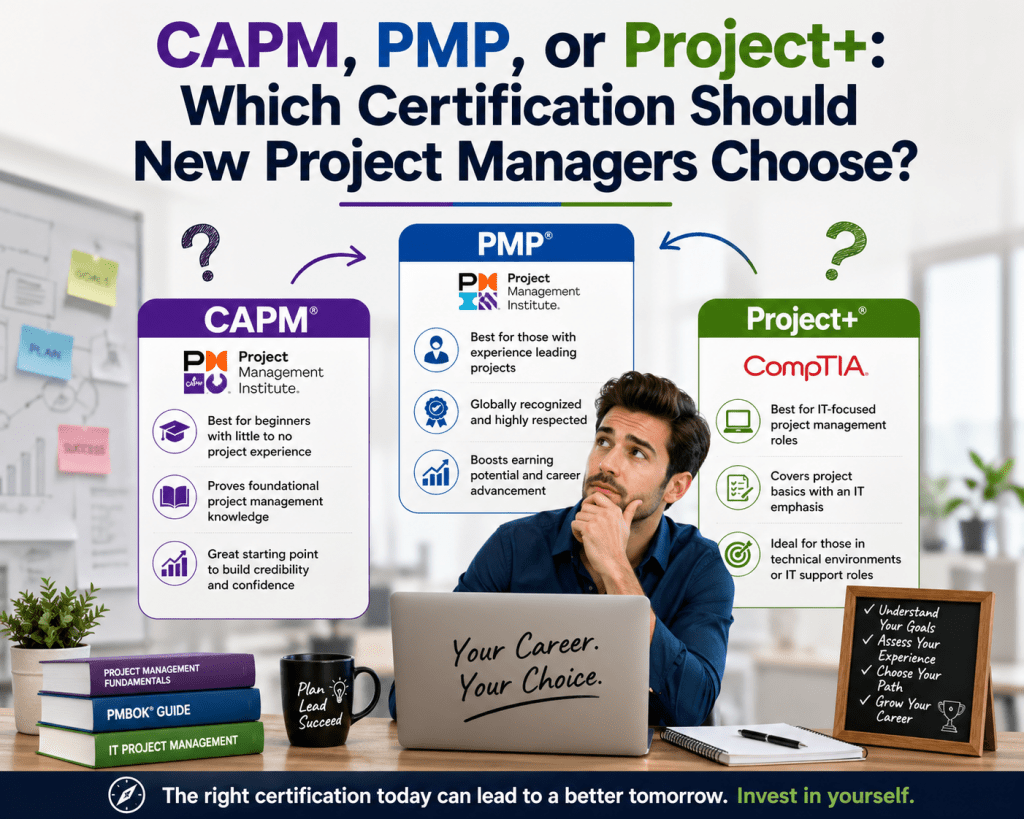
Within this structured ecosystem, three certifications consistently emerge as the most relevant for IT professionals: CompTIA Project+, Certified Associate in Project Management (CAPM), and Project Management Professional (PMP). Each represents a different stage of maturity within the project management discipline.
CompTIA Project+ and Its Position in Technical Work Environments
CompTIA Project+ is designed specifically for professionals who operate in environments where project responsibilities are distributed rather than centralized. It is particularly relevant in IT roles where individuals are expected to contribute to project delivery without formally managing the entire lifecycle.
In practical terms, Project+ reflects the realities of modern IT work environments. Many professionals are not assigned the title of project manager but still participate in tasks such as requirement gathering, scheduling coordination, deployment planning, and stakeholder communication. This certification provides a structured framework for understanding these responsibilities.
One of the defining characteristics of Project+ is its accessibility. It does not require extensive formal experience in project leadership. Instead, it assumes that candidates have been exposed to project environments in some capacity, even if informally. This makes it particularly suitable for early-career IT professionals or those transitioning from purely technical roles.
The certification emphasizes applied knowledge rather than theoretical depth. Candidates are expected to understand how projects progress through different stages, how teams collaborate during execution, and how communication flows across stakeholders. These concepts are presented in a way that reflects real operational environments rather than abstract methodologies.
Unlike certifications that are tied to specific project management frameworks, Project+ adopts a neutral approach. It incorporates elements from multiple methodologies without enforcing strict adherence to any single model. This flexibility reflects the reality of IT environments, where organizations often use hybrid approaches depending on project complexity and organizational culture.
Operational Knowledge Areas Covered in Project+
Project+ focuses on a set of operational knowledge areas that align closely with day-to-day project participation in technical environments. These areas are designed to build situational awareness rather than deep specialization.
One key area is project lifecycle understanding. This includes how projects are initiated, how requirements are defined, how planning activities are structured, and how execution is monitored. The lifecycle perspective helps professionals understand how individual tasks contribute to broader project outcomes.
Another important area is the communication structure. In project environments, communication is not incidental; it is a managed process. Project+ introduces the importance of stakeholder identification, communication planning, and information distribution. These concepts are critical in IT environments where miscommunication can lead to deployment delays or system disruptions.
Resource coordination is also a major focus. IT projects often involve limited resources that must be allocated across competing priorities. Project+ introduces basic concepts of resource balancing, task assignment, and timeline management without requiring advanced optimization techniques.
Risk awareness is another foundational component. Rather than focusing on complex predictive models, Project+ emphasizes early identification of potential issues, documentation of risks, and escalation through appropriate channels. This helps professionals develop proactive thinking patterns rather than reactive responses.
Change awareness is also included, particularly in relation to scope adjustments and evolving project requirements. In IT environments, change is constant, and professionals must understand how modifications impact timelines, resources, and deliverables.
Practical Application of Project+ in IT Roles
In real-world IT environments, Project+ functions as a bridge between technical execution and structured coordination. It is particularly valuable in roles where individuals are required to operate within project teams but are not responsible for overall project governance.
For example, system administrators involved in infrastructure upgrades often need to coordinate downtime windows, communicate with stakeholders, and ensure task sequencing aligns with operational requirements. Similarly, network engineers working on deployment projects must align configurations with project timelines and dependencies.
In these scenarios, Project+ provides a framework for understanding how individual contributions fit into larger project structures. It helps professionals interpret project documentation, participate in planning sessions, and communicate effectively with other stakeholders.
Another practical application is in service delivery environments where IT teams support ongoing business operations. In such contexts, small-scale projects such as software rollouts, system updates, or security patches require structured coordination even if they are not large enterprise initiatives.
Project+ enhances the ability to participate in these activities without requiring full project management authority. It reinforces the importance of structured thinking, documentation discipline, and predictable execution patterns.
Career Utility and Skill Translation Value of Project+
One of the most significant advantages of Project+ lies in its ability to translate informal experience into recognized competency. Many IT professionals accumulate project-related experience without formal acknowledgment. This includes coordinating technical tasks, supporting deployments, and contributing to cross-team initiatives.
Project+ helps convert this informal exposure into structured knowledge. It provides terminology and frameworks that allow professionals to articulate their experience more effectively in career development contexts.
This translation effect is particularly valuable in competitive job markets where employers seek evidence of both technical capability and organizational awareness. While technical certifications validate specific skills, project management certifications validate the ability to operate within structured environments.
Project+ also serves as a stepping stone for individuals considering more advanced project management pathways. It introduces foundational concepts that become increasingly relevant as professionals move toward more complex certifications or leadership roles.
However, its value is not limited to career progression. It also enhances day-to-day performance by improving clarity in task execution, reducing communication gaps, and increasing predictability in collaborative work environments.
Organizational Impact of Foundational Project Awareness
At the organizational level, widespread adoption of foundational project awareness contributes to improved operational consistency. When team members share a basic understanding of project structure, collaboration becomes more efficient and predictable.
This is particularly important in IT environments where multiple teams may be working on interconnected systems. Without shared understanding, coordination gaps can lead to delays, misaligned expectations, and operational inefficiencies.
Project+ contributes to creating a common baseline of understanding across teams. It ensures that even non-managerial staff can interpret project documentation, participate in planning discussions, and understand delivery expectations.
This shared awareness improves project transparency and reduces dependency on a small number of individuals for coordination tasks. It also supports scalability by enabling larger teams to function effectively without centralized bottlenecks.
Transitioning from Foundational Knowledge to Structured Project Management Practice
As IT professionals gain experience in project-driven environments, their responsibilities often expand beyond task execution into structured coordination and decision influence. This shift marks a transition from incidental project participation toward intentional project management practice. At this stage, foundational certifications like entry-level IT project credentials begin to feel limiting, and professionals start seeking more structured frameworks that define how projects should be initiated, planned, executed, and controlled.
This is where structured project management certifications become relevant. Unlike foundational credentials that focus on awareness and participation, structured certifications introduce formal methodologies that govern how projects are managed from end to end. These methodologies emphasize repeatable processes, standardized documentation, and disciplined execution frameworks that apply across industries.
Within this transition space, CAPM (Certified Associate in Project Management) becomes particularly important. It represents a bridge between basic project awareness and full professional project management authority. It is designed for individuals who are not yet fully experienced project managers but are actively moving in that direction.
The significance of this transition lies in mindset evolution. Professionals shift from asking “what is my task?” to “how does this task contribute to project success?” This change in perspective is critical for moving into structured leadership roles where accountability extends beyond individual deliverables to overall project outcomes.
CAPM as a Structured Entry Point into Formal Project Management
CAPM is designed to introduce professionals to standardized project management methodology without requiring extensive leadership experience. It is particularly relevant for individuals who understand project environments but lack formal training in structured frameworks.
Unlike general IT project credentials, CAPM is deeply aligned with formal project management standards. It introduces structured terminology, lifecycle models, and process groups that define how projects should be managed in a controlled environment. This makes it significantly more rigorous in conceptual depth compared to foundational certifications.
One of the defining characteristics of CAPM is its emphasis on methodology comprehension. Candidates are expected to understand how project phases are structured, how processes interact, and how project constraints influence decision-making. This includes understanding scope definition, scheduling frameworks, cost considerations, quality management principles, and stakeholder engagement models.
CAPM does not require extensive leadership experience, but it does require formal educational exposure to project management concepts. This ensures that candidates are not simply relying on workplace exposure but are also grounded in standardized theory.
This combination of theoretical grounding and early-stage professional exposure makes CAPM particularly suitable for individuals who are intentionally pursuing project management as a career direction rather than as a supplementary skill.
Methodological Depth and Learning Structure in CAPM
CAPM introduces professionals to structured project management thinking through defined process groups. These process groups typically include initiation, planning, execution, monitoring and controlling, and closure. Each group represents a specific phase in the lifecycle of a project and contains structured activities that must be performed in sequence or in coordination with other processes.
The initiation phase focuses on defining the project purpose and aligning it with organizational objectives. In this phase, professionals learn how project authorization occurs and how high-level requirements are identified.
The planning phase introduces structured approaches to defining scope, creating schedules, estimating resources, and identifying risks. This phase is critical because it sets the foundation for all subsequent project activities.
Execution involves coordinating teams, managing resources, and ensuring that deliverables are produced according to plan. Monitoring and controlling run in parallel to execution and focus on tracking performance, identifying deviations, and implementing corrective actions.
Closure involves formalizing project completion, documenting outcomes, and ensuring that deliverables are accepted by stakeholders.
CAPM emphasizes understanding how these phases interact rather than treating them as isolated steps. This systemic perspective is essential for developing the ability to manage projects holistically rather than as a collection of independent tasks.
Professional Relevance of CAPM in Early Career Development
CAPM is particularly valuable for early-career professionals who want to establish credibility in structured project environments. It provides formal recognition of knowledge that may otherwise be acquired informally through workplace exposure.
In many organizations, individuals begin their careers in technical roles and gradually assume more coordination responsibilities. CAPM helps formalize this progression by providing a structured framework that aligns with industry standards.
It also enhances employability by signaling familiarity with structured project methodologies. Employers often view CAPM as evidence that a candidate understands how formal project environments operate, even if they have limited leadership experience.
Another important aspect of CAPM is its role in career direction validation. Many professionals are uncertain whether they want to pursue technical specialization or transition into project leadership. CAPM provides a structured introduction that helps clarify this direction by exposing individuals to the realities of project management work.
CAPM Compared to Foundational IT Project Certifications
When compared to foundational IT project certifications, CAPM represents a significant increase in depth and rigor. While foundational certifications focus on participation and awareness, CAPM focuses on structured methodology and process adherence.
Foundational certifications typically emphasize practical involvement in projects without requiring a deep understanding of underlying frameworks. CAPM, on the other hand, requires comprehension of standardized project management principles that govern how projects are structured and executed.
This difference is important because it reflects a shift from operational participation to analytical understanding. CAPM candidates are expected to understand why project processes exist, not just how to participate in them.
This makes CAPM more suitable for individuals who are preparing for formal project management responsibilities rather than those who simply contribute to project activities as part of technical roles.
Skill Development Focus Areas in CAPM
CAPM develops several critical skill areas that are essential for structured project management environments. These include planning discipline, process awareness, stakeholder understanding, and structured communication.
Planning discipline involves understanding how to define project scope clearly, break down work into manageable components, and estimate timelines realistically. This requires analytical thinking and an understanding of dependencies between tasks.
Process awareness focuses on understanding how standardized project management frameworks operate. This includes recognizing how different processes interact and how decisions in one phase impact outcomes in another.
Stakeholder understanding is another key area. Projects often involve multiple stakeholders with different expectations and priorities. CAPM introduces structured approaches to identifying stakeholders, analyzing their influence, and managing their expectations throughout the project lifecycle.
Structured communication is also emphasized. Unlike informal workplace communication, project communication must be intentional, documented, and aligned with project objectives. CAPM introduces principles for ensuring that information flows appropriately across teams and decision-makers.
CAPM as a Foundation for Advanced Project Management Roles
CAPM serves as a foundational stepping stone toward more advanced project management roles. It prepares professionals for certifications and responsibilities that require deeper experience and leadership capability.
One of its key functions is to establish familiarity with industry-standard terminology. This is essential for progressing into environments where advanced project management frameworks are used extensively.
CAPM also helps professionals develop structured thinking habits. This includes the ability to evaluate problems systematically, consider multiple constraints, and make decisions based on process-driven logic rather than ad hoc reasoning.
These skills become increasingly important as professionals move toward roles involving larger teams, higher budgets, and more complex project environments.
Organizational Value of CAPM-Certified Professionals
From an organizational perspective, CAPM-certified professionals contribute to improved consistency in project execution. They bring standardized knowledge that aligns with widely accepted project management frameworks.
This reduces variability in how projects are understood and executed across teams. It also improves communication efficiency because team members share a common understanding of terminology and processes.
CAPM-certified individuals are often better equipped to support structured project environments because they understand how different components of a project interact. This reduces coordination friction and improves alignment between technical and managerial teams.
Organizations also benefit from increased scalability. As teams grow, structured project knowledge becomes essential for maintaining consistency across multiple initiatives.
Limitations of CAPM in Advanced Project Contexts
While CAPM provides strong foundational knowledge, it is not designed for advanced project leadership roles. It does not require extensive real-world project leadership experience, which limits its applicability in highly complex environments.
It also focuses primarily on standardized frameworks rather than adaptive or hybrid methodologies used in dynamic project environments. As a result, professionals often need additional experience or advanced certifications to handle large-scale enterprise projects.
Despite these limitations, CAPM remains highly valuable as an entry-level structured certification that prepares professionals for more advanced responsibilities.
Advanced Project Management Maturity and the Role of PMP in Professional Leadership
As professionals progress beyond foundational and intermediate stages of project management knowledge, the focus shifts significantly from participation and structured learning to leadership, accountability, and enterprise-level decision-making. At this stage, project management is no longer about understanding processes in isolation; it becomes about orchestrating entire systems of work that span teams, departments, budgets, and organizational objectives.
This is where the PMP (Project Management Professional) certification becomes relevant. Unlike entry-level or associate certifications that emphasize understanding and structured learning, PMP is positioned at a professional maturity level where individuals are expected to lead projects independently and make high-impact decisions.
PMP represents a transition into full accountability for project outcomes. It is not simply about knowing project management principles; it is about applying them in complex, unpredictable environments where constraints constantly shift, and stakeholder expectations must be continuously balanced.
In this context, PMP is widely regarded as a benchmark for professional project leadership capability. It is often associated with individuals who are already functioning as project managers or who are preparing to take on senior leadership roles within project-driven organizations.
PMP as a Framework for Enterprise-Level Project Execution
PMP is built around the concept of managing projects as integrated systems rather than isolated tasks. At this level, projects are no longer simple sequences of activities; they are dynamic ecosystems involving interdependent components that must be carefully coordinated.
The certification emphasizes five major performance domains that reflect the realities of modern project leadership: initiating, planning, executing, monitoring and controlling, and closing. However, unlike entry-level frameworks, PMP approaches these domains with significantly greater depth, complexity, and interconnectivity.
In the initiating phase, professionals are expected to align projects with strategic organizational goals. This involves understanding business justification, stakeholder influence, and long-term value creation. Projects are not initiated simply because they are requested; they are evaluated in terms of strategic relevance and feasibility.
Planning in PMP is significantly more advanced than in earlier certifications. It involves detailed scope definition, risk modeling, resource optimization, cost estimation, scheduling integration, and communication architecture design. Planning is treated as a continuous process rather than a single phase, requiring ongoing refinement as new information becomes available.
Execution focuses on leadership in action. At this stage, project managers are responsible for guiding teams, resolving conflicts, ensuring alignment, and maintaining productivity under changing conditions. Execution is not simply task completion; it is active leadership across multiple dimensions of project delivery.
Monitoring and controlling introduce advanced performance tracking. This includes evaluating key performance indicators, identifying deviations from baseline plans, and implementing corrective or preventive actions. It also involves managing change requests and ensuring that the project scope remains aligned with objectives.
Closure in PMP extends beyond formal completion. It includes performance evaluation, knowledge transfer, documentation of lessons learned, and organizational feedback integration. This ensures that project outcomes contribute to continuous improvement across future initiatives.
Experience Requirements and Professional Expectations in PMP
One of the defining characteristics of PMP is its strong emphasis on real-world experience. Unlike entry-level certifications, PMP requires candidates to demonstrate significant involvement in leading and directing projects.
This requirement reflects the certification’s focus on applied leadership rather than theoretical knowledge. Candidates are expected to have managed projects of varying complexity, often involving cross-functional teams and multiple constraints.
The experience requirement ensures that PMP-certified professionals are not only familiar with project management principles but have also applied them under real operational pressures. This includes handling competing priorities, managing stakeholder expectations, resolving conflicts, and adapting to unexpected changes.
In addition to experience, PMP also requires structured education in project management principles. This ensures that practical experience is supported by a formal understanding of standardized methodologies.
The combination of experience and structured knowledge creates a certification profile that emphasizes both capability and discipline. PMP-certified professionals are expected to operate with a high degree of autonomy while maintaining alignment with organizational governance frameworks.
Cognitive and Leadership Demands of PMP-Level Work
PMP-level project management requires a significant shift in cognitive approach. Professionals must move beyond task-oriented thinking and adopt systems-level thinking. This means understanding how different components of a project interact and how decisions in one area impact outcomes in others.
For example, a change in project scope may affect resource allocation, timeline feasibility, budget constraints, and stakeholder satisfaction simultaneously. Managing these interdependencies requires advanced analytical reasoning and strategic foresight.
Leadership capability is also a critical component. PMP professionals are expected to lead without relying solely on authority. This involves influencing stakeholders, motivating teams, and maintaining alignment across diverse groups with different priorities.
Conflict resolution becomes a central responsibility. In complex projects, disagreements are inevitable. PMP-level professionals must be able to mediate conflicts, negotiate solutions, and maintain project momentum without compromising quality or objectives.
Decision-making under uncertainty is another key requirement. Unlike structured learning environments, real-world projects often involve incomplete information. PMP professionals must make informed decisions based on available data while accounting for potential risks and unknown variables.
Strategic Alignment and Organizational Integration
One of the most important aspects of PMP is its emphasis on strategic alignment. Projects are not treated as isolated operational efforts; they are viewed as mechanisms for achieving organizational objectives.
This requires project managers to understand business strategy, organizational priorities, and long-term goals. Projects must be evaluated not only in terms of execution success but also in terms of strategic contribution.
PMP professionals are expected to ensure that project outcomes align with broader organizational direction. This includes maintaining stakeholder alignment, ensuring resource justification, and delivering measurable value.
Integration with organizational systems is also critical. Projects often interact with multiple departments, each with its own processes, constraints, and objectives. PMP professionals must navigate these complexities while maintaining coherence across the project environment.
Advanced Risk and Uncertainty Management
Risk management at the PMP level is significantly more sophisticated than in foundational certifications. It involves identifying potential risks across multiple dimensions, including technical, financial, operational, and organizational factors.
Rather than simply documenting risks, PMP professionals are expected to analyze probability, impact, and interdependencies. They must also develop mitigation strategies that are integrated into the overall project plan.
Uncertainty management is also critical. Unlike predictable environments, large-scale projects often involve unknown variables that cannot be fully quantified in advance. PMP professionals must develop adaptive strategies that allow projects to remain stable under changing conditions.
This requires continuous monitoring and iterative adjustment of plans. Risk management is not a one-time activity but an ongoing process integrated into all phases of the project lifecycle.
Communication Complexity in PMP-Level Projects
Communication at the PMP level is significantly more complex than in foundational or intermediate certifications. It involves multiple stakeholder groups, each with different information needs, priorities, and communication preferences.
Project managers must design communication strategies that ensure clarity, consistency, and relevance. This includes determining what information should be shared, when it should be shared, and how it should be delivered.
Miscommunication at this level can have significant consequences, including project delays, cost overruns, and stakeholder dissatisfaction. As a result, communication management becomes a critical leadership function rather than a supporting activity.
PMP professionals must also manage upward, downward, and lateral communication simultaneously. This includes reporting to executives, coordinating with teams, and collaborating with external stakeholders.
Organizational Impact of PMP-Certified Professionals
PMP-certified professionals often have a significant impact on organizational performance. Their ability to manage complex projects contributes to improved delivery consistency, better resource utilization, and higher project success rates.
They also contribute to organizational maturity by introducing structured project management practices across teams. This helps standardize processes, reduce inefficiencies, and improve overall coordination.
In many organizations, PMP certification is associated with senior project roles, program management responsibilities, and leadership positions. This reflects the advanced nature of the certification and its focus on enterprise-level execution.
Comparative Positioning Across Certification Levels
When viewed across the full spectrum of project management certifications, PMP represents the highest level of professional maturity among the three core certifications discussed.
Project+ focuses on foundational participation in project environments. CAPM focuses on structured learning and early-stage professional development. PMP focuses on leadership, execution, and strategic alignment at an enterprise level.
This progression reflects a natural career development pathway for IT professionals who begin with technical responsibilities and gradually move into structured project leadership roles.
Each certification plays a distinct role in this progression. Project+ builds awareness, CAPM builds structure, and PMP builds leadership capability.
Conclusion
The evolution from entry-level IT participation to advanced project leadership reflects a broader transformation in how modern organizations structure work, allocate responsibility, and measure success. Project management certifications such as CompTIA Project+, CAPM, and PMP are not isolated credentials; they represent a continuum of professional development that aligns with increasing levels of complexity, accountability, and strategic influence.
At the foundational level, professionals are primarily concerned with understanding how structured work environments operate. Many IT roles naturally expose individuals to project-like activities without formally labeling them as such. Tasks such as system deployments, infrastructure upgrades, software rollouts, and security implementations all require coordination, sequencing, and communication. However, without a formal structure, this experience often remains fragmented. Entry-level certifications help consolidate this exposure into a coherent framework, allowing professionals to recognize patterns in how projects are initiated, planned, and executed.
As professionals gain experience, the limitations of purely foundational understanding become more visible. While it is possible to contribute effectively to projects without formal training, larger organizational environments demand consistency, predictability, and shared understanding. This is where structured learning frameworks become critical. Certifications at the associate level introduce standardized terminology and process-based thinking that reduce ambiguity in collaborative environments. This shift is not merely academic; it directly influences how teams communicate, how tasks are interpreted, and how responsibilities are distributed.
A key aspect of this progression is the development of systems thinking. In early-stage roles, individuals often focus on isolated tasks. As responsibility increases, it becomes necessary to understand how those tasks interact with broader project systems. A delay in one area can affect multiple downstream dependencies. A misalignment in communication can impact entire delivery timelines. Structured project management education helps professionals anticipate these interdependencies and respond to them proactively rather than reactively.
As professionals move further along the maturity curve, leadership capability becomes the defining factor. Advanced project management is no longer centered on understanding processes but on applying judgment in complex and uncertain environments. At this stage, decision-making involves balancing competing constraints such as scope, time, cost, quality, and stakeholder expectations. These constraints rarely align perfectly, and successful project leadership requires the ability to prioritize effectively under pressure.
Another important dimension of advanced project management is organizational alignment. Projects are not standalone efforts; they exist within larger strategic frameworks. Every project is expected to contribute to broader organizational goals, whether those involve operational efficiency, technological advancement, market expansion, or risk mitigation. Professionals operating at advanced levels must therefore understand not only how to deliver a project but also why that project matters in a strategic context.
This strategic awareness distinguishes advanced certification holders from those at earlier stages. It requires the ability to interpret business objectives, translate them into actionable project plans, and ensure that execution remains aligned with intended outcomes. Misalignment at this level can result in significant inefficiencies, even if individual tasks are completed successfully. Therefore, strategic clarity becomes as important as technical execution.
Communication also evolves significantly across certification levels. At foundational stages, communication is typically task-oriented and focused on immediate coordination. At advanced levels, communication becomes multidirectional and highly structured. It must accommodate executives, technical teams, external stakeholders, and cross-functional contributors simultaneously. Each group requires different levels of detail and different framing of information. Managing this complexity requires both clarity of expression and discipline in information governance.
Risk management similarly becomes more sophisticated as professionals advance. Instead of simply identifying risks, advanced practitioners are expected to evaluate systemic vulnerabilities, anticipate cascading impacts, and develop mitigation strategies that are integrated into the overall project architecture. Risk is no longer treated as a separate function but as an embedded aspect of every decision made throughout the project lifecycle.
In addition to technical and managerial competencies, advanced project management also requires emotional and behavioral skills. Leadership in complex environments involves managing conflict, maintaining team motivation, and navigating organizational dynamics. Projects often involve competing priorities among stakeholders, and resolving these tensions requires negotiation, diplomacy, and resilience. These skills are not always explicitly taught in technical environments, but become essential at higher levels of responsibility.
One of the most significant aspects of professional project management development is its cumulative nature. Each certification level builds upon the previous one, creating a layered understanding of how projects function. Foundational awareness provides the initial vocabulary. Structured frameworks provide process discipline. Advanced certifications develop leadership capability and strategic judgment. Together, these layers form a comprehensive skill set that supports long-term career growth.
However, it is important to recognize that certification alone does not define professional capability. Real-world experience remains essential at every stage. Certifications provide structure and validation, but practical application develops judgment, adaptability, and situational awareness. The most effective project professionals are those who combine theoretical understanding with consistent hands-on experience in diverse project environments.
Another important consideration is adaptability across industries and methodologies. Modern project environments rarely rely on a single framework. Instead, organizations often blend predictive, agile, and hybrid approaches depending on project type and complexity. Professionals who understand multiple methodologies are better equipped to operate in dynamic environments where flexibility is essential. This adaptability becomes increasingly valuable as organizations adopt more iterative and responsive delivery models.
From a career development perspective, project management certifications also influence mobility and role expansion. Professionals with structured credentials are often considered for roles that involve greater responsibility, broader scope, or cross-functional coordination. This is not solely due to certification itself,f but due to the signal it sends regarding structured thinking and readiness for complex environments.
Over time, the accumulation of project management experience and credentials contributes to a shift in professional identity. Individuals move from being task contributors to system coordinators and eventually to strategic decision-makers. This transformation reflects not only increased technical capability but also an expanded perspective on how organizations function and deliver value.
Ultimately, the pathway through project management certifications represents more than a sequence of exams or credentials. It reflects a structured approach to professional growth in environments where coordination, complexity, and strategic alignment are essential. Each stage builds upon the last, creating a progressive development model that supports both individual career advancement and organizational effectiveness.
The long-term impact of this progression is the creation of professionals who can operate across multiple levels of abstraction. They can engage with technical details when necessary, manage operational execution when required, and contribute to strategic decision-making when appropriate. This versatility is one of the most valuable outcomes of structured project management development and is increasingly important in modern IT-driven organizations.