
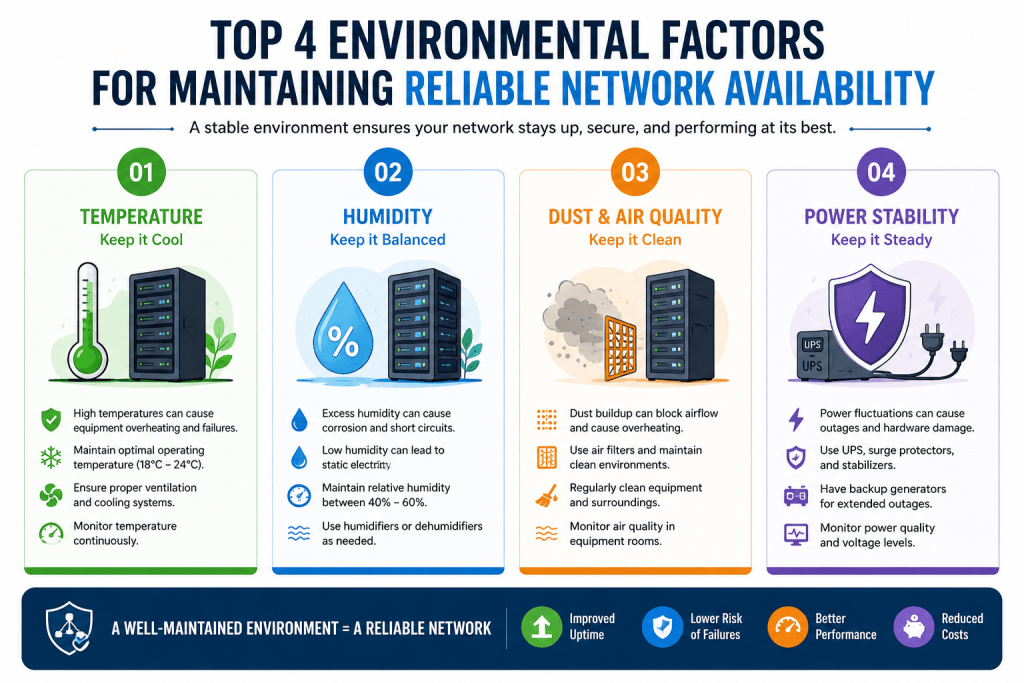
Environmental factors refer to the physical conditions surrounding IT infrastructure that can influence the stability, performance, and operational lifespan of hardware systems. These conditions exist outside of software and logical configurations but have a direct impact on whether a network remains continuously available. In modern computing environments, where organizations rely heavily on uninterrupted connectivity for applications, storage, and communication, even small environmental disruptions can lead to significant operational issues. Understanding and managing these physical influences is essential for maintaining consistent network availability and reducing avoidable downtime.
Understanding Environmental Conditions in IT Infrastructure
IT infrastructure operates within physical spaces that must support sensitive electronic equipment. These environments include data centers, server rooms, and network closets, all of which require controlled conditions to function effectively. Environmental factors include temperature variations, moisture levels, electrical stability, and exposure to physical risks such as water intrusion. Unlike logical failures that can often be resolved through configuration changes or software updates, environmental issues tend to affect hardware directly and can cause immediate or gradual degradation.
Temperature Control and Its Impact on IT Systems
Temperature is one of the most influential environmental factors affecting IT equipment. Electronic components generate heat during operation, and if this heat is not properly managed, it can accumulate and cause system instability. Excessive heat forces processors and other components to reduce performance in order to prevent overheating, a process that directly impacts network efficiency and responsiveness.
High temperatures can also shorten the lifespan of hardware components. Continuous exposure to heat accelerates wear on circuits, storage devices, and power supplies. Over time, this increases the likelihood of unexpected failures. On the opposite end of the spectrum, excessively low temperatures can also create risks. Rapid temperature changes can lead to condensation forming inside equipment, which introduces moisture into sensitive electronic areas.
Proper airflow design is critical in managing temperature effectively. Data centers often use structured cooling methods to separate hot and cold air streams, ensuring that heat is efficiently removed from active equipment zones. Strategic placement of cooling units, combined with continuous monitoring, helps maintain stable operating conditions. Temperature regulation is not only about preventing overheating but also about ensuring consistency across all equipment zones to avoid localized hot spots that may go unnoticed without proper monitoring systems.
Managing Humidity for Equipment Stability
Humidity plays a dual role in IT environments. While excessive moisture is harmful, completely dry conditions can also create risks. Maintaining balanced humidity levels is important for both equipment safety and operational reliability. When humidity is too high, moisture can accumulate on surfaces, leading to corrosion and electrical short circuits. This moisture can also combine with airborne dust, forming conductive residues that interfere with hardware performance.
On the other hand, very low humidity increases the risk of electrostatic discharge. Static electricity can build up on surfaces and discharge suddenly when contact is made with electronic components. Even small static discharges can damage sensitive circuits, especially in densely packed hardware environments.
Electrical Stability and Power Quality Considerations
Electrical conditions are another critical environmental factor that directly influences network availability. IT equipment depends on a stable and consistent power supply to function correctly. Variations in voltage, sudden surges, or unexpected power loss can all disrupt operations and potentially damage hardware components.
Power instability can originate from external sources such as utility fluctuations or internal issues like overloaded circuits. When voltage levels fluctuate beyond acceptable ranges, sensitive components may malfunction or degrade over time. In severe cases, sudden power spikes can permanently damage equipment.
To reduce these risks, stable power distribution systems are implemented to regulate and protect electrical flow. Backup systems are commonly used to provide temporary power during outages, ensuring that critical systems remain operational or shut down safely. Power conditioning mechanisms also help smooth out irregularities in the electrical supply, reducing stress on equipment.
Monitoring electrical conditions is essential for identifying inefficiencies or risks in power usage. By tracking consumption patterns and detecting anomalies, IT teams can proactively address potential failures before they escalate into larger outages. Electrical stability is therefore a foundational requirement for maintaining uninterrupted network performance.
Water Exposure and Flooding Risks in IT Environments
Water exposure represents one of the most physically destructive environmental risks for IT infrastructure. Even small amounts of moisture can cause significant damage if they come into contact with electronic components. While large-scale flooding events are rare in controlled environments, smaller leaks or condensation issues can still pose serious threats.
Water can cause short circuits, corrosion, and irreversible hardware failure. In addition to direct damage, moisture can also affect cooling systems and power distribution units, creating cascading failures across the infrastructure. Because of this, water-related risks must be considered even in environments that appear secure from external flooding.
Preventive measures typically involve careful facility design, including raised flooring and controlled drainage systems. Leak detection technologies are often used to identify moisture at early stages, allowing immediate response before damage occurs. Early detection is critical, as even minor water intrusion can escalate quickly if left unnoticed.
Managing water risk is not only about preventing catastrophic flooding but also about addressing subtle issues such as air conditioning leaks or pipe condensation. These small factors can have long-term impacts on system reliability if not properly monitored and controlled.
Environmental Monitoring Systems and Sensor Integration
Environmental monitoring systems provide continuous visibility into physical conditions affecting IT infrastructure. These systems rely on various sensors that track temperature, humidity, electrical activity, and moisture levels. By collecting real-time data, they allow IT teams to respond quickly to changing conditions.
Temperature sensors help identify overheating zones within equipment racks. Humidity sensors track moisture levels to ensure balanced environmental conditions. Water detection systems identify leaks at early stages, while electrical sensors monitor power stability and consumption patterns. Together, these systems create a comprehensive view of environmental health.
Airflow monitoring systems also play an important role in maintaining efficient cooling. They help ensure that air is properly distributed throughout equipment spaces, preventing the formation of hot spots. Pressure monitoring systems further support airflow management by ensuring that air circulation remains balanced across different zones.
The effectiveness of these systems depends not only on the sensors themselves but also on how well they are integrated into centralized monitoring platforms. This integration allows data from multiple sources to be analyzed together, providing a complete picture of environmental conditions.
Sensor Placement and Infrastructure Design Considerations
The placement of environmental sensors significantly affects the accuracy and usefulness of collected data. Sensors must be positioned strategically to capture meaningful readings from critical areas. Placing sensors too far from heat sources or moisture-prone zones can result in incomplete monitoring and delayed detection of issues.
In structured environments, sensors are often distributed across different vertical and horizontal points within equipment racks. This approach helps capture variations in temperature and airflow that may occur at different levels. Positioning sensors near airflow paths also helps identify inefficiencies in cooling systems.
Environmental design also plays a role in sensor effectiveness. Proper cable management, rack organization, and airflow structuring contribute to more accurate monitoring results. When sensors are correctly placed and integrated, they provide actionable insights that support proactive maintenance and system optimization.
Operational Practices for Maintaining Environmental Stability
Maintaining stable environmental conditions requires continuous monitoring and responsive operational practices. Real-time alert systems help identify deviations from normal conditions, allowing teams to act quickly before issues escalate. Automated responses can also be configured to trigger actions such as adjusting cooling levels or activating backup systems.
Regular maintenance of environmental systems is essential to ensure long-term accuracy and reliability. Sensors must be calibrated periodically to maintain precision, and cooling systems must be inspected to ensure they are functioning correctly. Without ongoing maintenance, even advanced monitoring systems can produce unreliable data.
Predictive analysis can further enhance operational efficiency by identifying patterns that suggest future risks. By analyzing historical environmental data, it becomes possible to anticipate potential failures and take preventive action in advance. This approach reduces downtime and improves overall system resilience.
Benefits of Environmental Awareness in IT Infrastructure
Managing environmental conditions effectively provides multiple benefits for IT operations. One of the most important advantages is improved system reliability. When hardware operates within optimal conditions, it experiences fewer failures and maintains consistent performance over time.
Another benefit is reduced downtime. Early detection of environmental issues allows problems to be resolved before they escalate into system-wide outages. This helps maintain continuous network availability, which is essential for business operations that depend on uninterrupted access to digital resources.
Environmental management also contributes to cost efficiency. Preventing hardware damage reduces repair and replacement expenses, while optimized cooling and power usage improve energy efficiency. Over time, this leads to more sustainable infrastructure operations.
In addition, maintaining controlled environments helps extend the lifespan of IT equipment. Hardware that operates under stable conditions experiences less stress, resulting in longer operational life cycles and improved return on investment.
Conclusion
Environmental factors play a fundamental role in determining the reliability and performance of IT networks. Temperature, humidity, electrical stability, and water exposure all have the potential to disrupt operations if not properly managed. By understanding these influences and implementing structured monitoring systems, organizations can significantly reduce the risk of unexpected failures.
Effective environmental management is not a one-time setup but an ongoing process that requires continuous attention and adjustment. Through proper monitoring, strategic sensor placement, and proactive maintenance practices, IT environments can maintain stability even under changing conditions. This ultimately supports consistent network availability and strengthens the overall resilience of infrastructure systems.