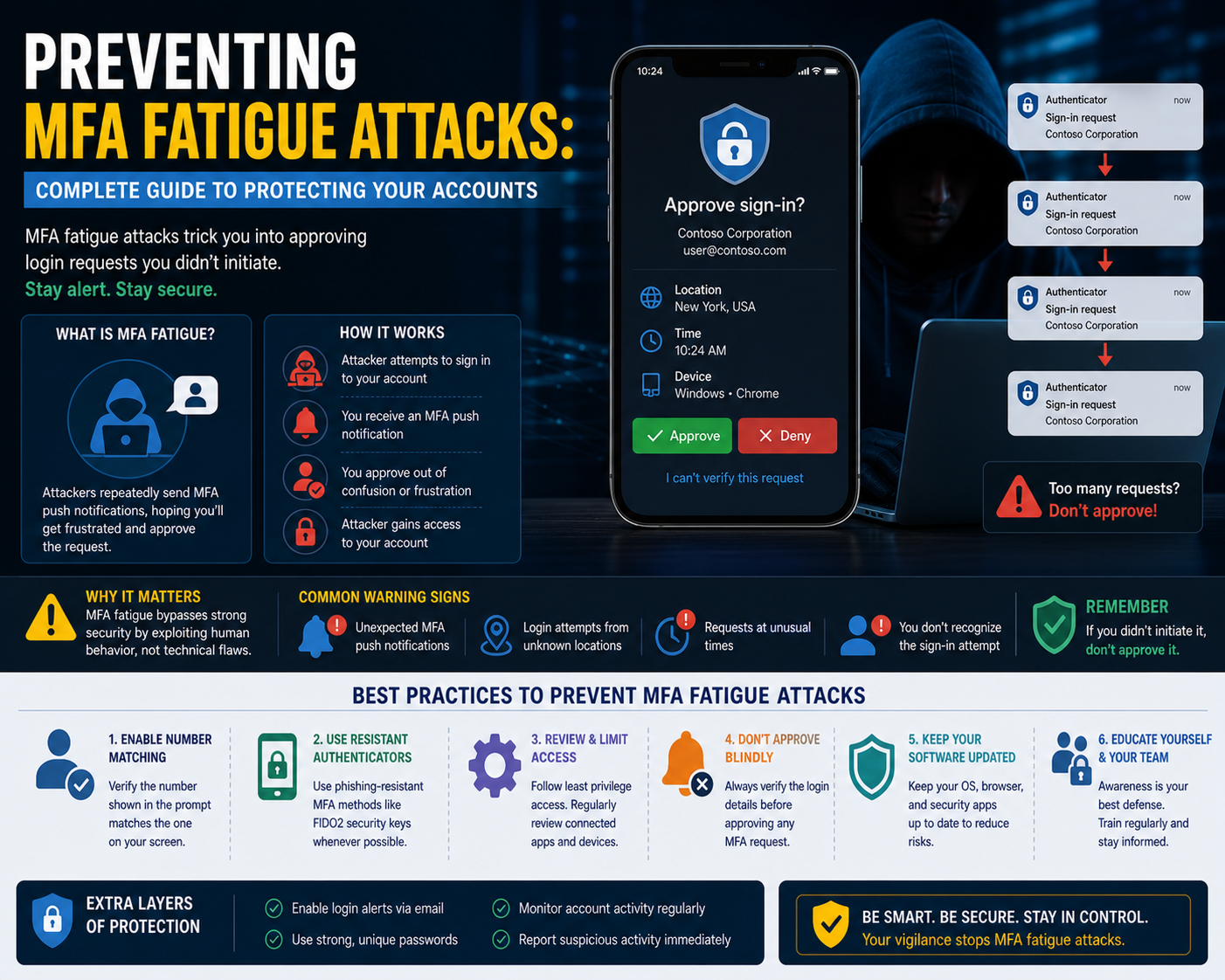
Multifactor authentication is a structured security mechanism designed to enforce identity verification through multiple independent validation layers before granting access to digital systems. It is built on the principle that a single authentication factor, most commonly a password, is insufficient to defend against modern cyber threats due to widespread credential leaks, phishing campaigns, brute-force automation, and password reuse behaviors. In contemporary cybersecurity architectures, multifactor authentication functions as a control mechanism that reduces the probability of unauthorized access by requiring additional proof of identity beyond static credentials. This approach aligns with modern zero-trust principles, where no user or device is inherently trusted without verification. The system continuously assumes potential compromise and therefore enforces layered authentication checks at critical access points.
The increasing complexity of digital environments has made identity the primary security boundary. As organizations adopt cloud services, remote access frameworks, and distributed applications, traditional perimeter-based defenses have become less effective. Multifactor authentication addresses this shift by strengthening identity verification at the user level rather than relying on network location or device boundaries. It ensures that access decisions are not solely dependent on knowledge-based credentials but are reinforced through dynamic verification mechanisms that are harder for attackers to replicate.
Core Authentication Factors and Identity Verification Models
Multifactor authentication is structured around three fundamental categories of identity verification: knowledge factors, possession factors, and inherence factors. Knowledge factors refer to information that the user knows, such as passwords, PIN codes, or security questions. These are the most commonly used authentication elements but are also the most vulnerable due to human behavior patterns such as reuse and weak password selection.
Possession factors involve physical or digital objects that the user owns. These include mobile devices receiving authentication prompts, hardware security tokens generating time-based codes, or smart cards embedded with cryptographic credentials. Possession factors are significantly stronger than knowledge factors because they require physical access to a device or token, making remote compromise more difficult.
Inherence factors rely on biometric characteristics unique to the user. These may include fingerprint recognition, facial structure analysis, voice patterns, or behavioral biometrics such as typing rhythm. Biometric authentication provides a high level of assurance because these traits are inherently tied to the individual and cannot be easily replicated or transferred. However, biometric systems must be carefully designed to avoid false positives, spoofing attempts, and privacy concerns.
The combination of these factors creates a layered defense model in which compromise of one factor does not guarantee system access. This redundancy is the core strength of multifactor authentication, significantly increasing the difficulty for attackers attempting unauthorized entry.
Authentication Workflows in Enterprise Systems
The authentication workflow in a multifactor environment follows a sequential validation process designed to progressively verify user identity. The process begins when a user submits primary credentials, typically a username and password, to the authentication server. These credentials are validated against stored identity records. If the initial verification is successful, the system initiates a secondary authentication challenge.
This secondary step varies depending on the implementation but commonly involves push notifications sent to registered devices, time-based one-time passwords generated by authentication applications, or biometric verification prompts. The user must respond correctly to this second factor within a limited time window. The system then evaluates both primary and secondary inputs before granting or denying access.
Advanced authentication workflows may also incorporate adaptive mechanisms that adjust verification requirements based on contextual risk signals. These signals may include device reputation, login location, IP address consistency, and behavioral patterns. If anomalies are detected, the system may escalate authentication requirements or introduce additional verification steps. This dynamic approach enhances security by aligning authentication complexity with perceived risk levels.
Architecture and Implementation Requirements Across Systems
Effective multifactor authentication requires careful integration within both client-side and server-side infrastructures. On the client side, devices must be capable of securely receiving authentication requests, processing verification codes, and maintaining protected communication channels with authentication servers. This includes ensuring that authentication applications are resistant to tampering and that communication channels are encrypted to prevent interception.
On the server side, authentication systems must maintain secure identity databases, manage session validation processes, and enforce strict verification logic. The server is responsible for coordinating authentication factor validation, tracking authentication attempts, and enforcing access control policies. Proper synchronization between client and server systems is essential to maintain authentication integrity.
Additionally, identity and access management systems must be configured to handle multifactor workflows without introducing usability bottlenecks or security gaps. Misconfigured authentication policies can result in inconsistent enforcement, creating opportunities for attackers to bypass intended security controls. Scalability is also a critical consideration, as large enterprise environments may require authentication processing for thousands of simultaneous users across distributed systems.
Credential Theft Ecosystem and Attack Entry Points
Before multifactor authentication can be challenged, attackers typically require valid primary credentials. These credentials are often obtained through external compromise methods rather than direct system intrusion. One of the most common methods is phishing, where users are tricked into entering credentials into fraudulent interfaces that mimic legitimate login pages. Another major source is data breaches, where large volumes of usernames and passwords are exposed due to vulnerabilities in third-party systems.
Credential stuffing attacks also play a significant role, where attackers use automated tools to test previously leaked username and password combinations across multiple platforms. Since many users reuse passwords across services, this method can yield successful logins without requiring advanced exploitation techniques.
Social engineering is another widely used approach, where attackers manipulate individuals into voluntarily disclosing sensitive credentials. This can occur through impersonation, deceptive communication, or psychological manipulation. Once valid credentials are obtained, attackers can attempt to access systems protected by multifactor authentication, triggering secondary verification mechanisms.
Introduction to Authentication Pressure Exploitation Techniques
In environments where multifactor authentication is properly implemented, attackers may shift their focus from technical bypass attempts to behavioral exploitation strategies. One such strategy involves repeatedly triggering authentication requests in an attempt to overwhelm or confuse the user. This method does not target cryptographic weaknesses or system vulnerabilities but instead leverages human cognitive limitations.
The underlying objective is to induce user fatigue through persistent notification pressure. When authentication prompts appear repeatedly within short time intervals, users may begin to perceive them as system errors or unnecessary interruptions. Over time, this can reduce vigilance and increase the likelihood of accidental approval. This approach relies heavily on psychological conditioning rather than technical exploitation.
Device Trust Relationships and Notification Channels
Multifactor authentication systems rely on trusted device relationships to deliver authentication challenges. These devices act as secure endpoints for receiving verification prompts, generating codes, or confirming identity requests. The trust relationship between authentication systems and devices is established through enrollment processes that bind devices to user identities.
However, this trust channel can become a point of interaction-based exploitation when repeated authentication requests are sent to the same device. Mobile devices, in particular, are highly susceptible to notification fatigue due to their always-on nature and frequent alert systems. Continuous authentication prompts can blend with other notifications, reducing user attention and increasing the likelihood of unintended responses.
The effectiveness of this mechanism depends on how well the system manages notification frequency, clarity of authentication requests, and contextual information provided to the user. Poorly designed notification systems can unintentionally increase vulnerability to repetitive authentication pressure.
Security Design Limitations in Repeated Prompt Scenarios
While multifactor authentication significantly enhances security, repeated prompt scenarios expose certain design limitations in user interaction systems. One limitation is the absence of strict rate-limiting controls on authentication attempts. Without restrictions on the number of authentication requests within a given time period, systems may allow excessive prompting that leads to user desensitization.
Another limitation is uniformity in authentication prompts. When every authentication request appears visually identical regardless of context or risk level, users may become less attentive to individual request details. This uniformity can reduce the effectiveness of authentication warnings and increase susceptibility to accidental approval under fatigue conditions.
Additionally, systems that do not differentiate between legitimate login attempts and suspicious repeated requests may fail to escalate security responses appropriately. This lack of adaptive behavior can create opportunities for attackers to exploit predictable authentication patterns.
Context-Aware Authentication and Behavioral Signals
To address limitations in static authentication systems, modern security architectures increasingly incorporate contextual and behavioral analysis. Context-aware authentication evaluates multiple factors such as device location consistency, login time patterns, network reputation, and historical user behavior. These signals help determine whether an authentication attempt aligns with expected user activity.
Behavioral authentication models analyze patterns such as typing speed, interaction habits, and device usage trends to establish a baseline of normal behavior. When deviations occur, systems can increase authentication requirements or introduce additional verification steps. This adaptive approach reduces reliance on repetitive user prompts and improves resistance to pressure-based exploitation techniques.
By integrating contextual awareness, authentication systems can dynamically adjust security responses based on real-time risk assessment rather than treating all login attempts equally. This reduces the effectiveness of repetitive authentication triggering strategies and strengthens overall identity protection mechanisms.
How MFA Fatigue Attacks Work in Real-World Cybersecurity Scenarios
MFA fatigue attacks operate by exploiting a gap between technical authentication systems and human behavioral response patterns. Instead of attempting to break encryption, bypass authentication protocols, or exploit software vulnerabilities, attackers focus on overwhelming the user with repeated authentication requests. The fundamental idea is to induce cognitive overload, where the user becomes desensitized to repeated prompts and eventually approves a request without careful validation.
The attack typically begins after an attacker has obtained valid login credentials through external means such as phishing campaigns, credential leaks, or credential stuffing attacks. Once these credentials are available, the attacker initiates repeated login attempts against the target account. Each attempt triggers a multifactor authentication prompt on the user’s registered device. In a properly functioning system, these prompts are expected and represent legitimate authentication challenges. However, when they occur in rapid succession, they begin to lose their perceived legitimacy in the user’s mind.
Over time, the user may interpret the repeated prompts as system errors, malfunctioning notifications, or background noise. This psychological shift is critical because it reduces the user’s vigilance and increases the probability of accidental approval. In some cases, the user may approve a request simply to stop the continuous interruptions, especially when they are engaged in other tasks or under time pressure.
Authentication Prompt Flooding and Cognitive Overload Mechanisms
The core mechanism behind MFA fatigue attacks is authentication prompt flooding. This involves generating a high volume of authentication requests within a short time period. Each request is delivered through legitimate authentication channels, making them appear authentic and trustworthy. Unlike traditional spam or phishing messages, these prompts originate from the actual authentication infrastructure, which increases their credibility.
Cognitive overload occurs when the brain is forced to process more information than it can effectively handle within a given time frame. In the context of MFA fatigue attacks, repeated authentication prompts create a constant stream of decision points for the user. Each prompt requires attention, interpretation, and response. As the frequency of these prompts increases, the user’s ability to critically evaluate each request decreases.
This state of reduced cognitive capacity leads to decision fatigue. Decision fatigue is a psychological phenomenon where the quality of decisions deteriorates after a long session of decision-making. In MFA fatigue scenarios, attackers exploit this condition by ensuring that the user is forced to make repeated authentication decisions in rapid succession.
Role of Credential Compromise in Initiating MFA Fatigue Attacks
A critical requirement for MFA fatigue attacks is the availability of valid primary credentials. Without correct usernames and passwords, authentication systems will not trigger secondary verification processes. This means attackers must first compromise credentials before initiating the fatigue mechanism.
Credential compromise can occur through multiple vectors. Phishing remains one of the most common methods, where users are deceived into entering their credentials into fraudulent login pages. These pages often mimic legitimate authentication portals with high accuracy, making detection difficult for untrained users.
Data breaches are another major source of credential exposure. When large databases are compromised, attackers gain access to millions of username and password combinations. These credentials are often sold or shared on underground platforms, enabling widespread reuse in automated attacks.
Credential reuse significantly amplifies the risk of MFA fatigue attacks. When users employ the same password across multiple services, a breach in one system can compromise multiple accounts. Attackers exploit this behavior by testing known credentials across different platforms until they find valid matches.
Once valid credentials are identified, attackers can repeatedly attempt logins to trigger multifactor authentication prompts, initiating the fatigue cycle.
Push Notification Systems and Their Role in Authentication Exploitation
Push-based authentication systems are commonly used in multifactor authentication due to their convenience and ease of use. These systems send a notification to a registered device, prompting the user to approve or deny a login attempt. While this method is user-friendly, it also introduces potential vulnerabilities when exploited through repetition.
In MFA fatigue attacks, push notifications become the primary attack vector. Each login attempt generates a push notification, which appears on the user’s device as a legitimate authentication request. When these notifications are delivered repeatedly, they can create confusion and frustration.
Mobile devices are particularly susceptible to this type of exploitation because they are designed to deliver frequent alerts for various applications. Authentication prompts blend into the general notification ecosystem, making it harder for users to distinguish between legitimate and suspicious activity under high-frequency conditions.
Attackers rely on this blending effect to normalize authentication requests. Once normalization occurs, the user becomes more likely to approve requests without verifying their origin or context.
Psychological Manipulation and Behavioral Exploitation Techniques
MFA fatigue attacks are fundamentally psychological rather than technical in nature. They rely on manipulating human behavior under repetitive stress conditions. The primary psychological mechanisms involved include annoyance, habituation, and impulsive decision-making.
Annoyance occurs when repeated notifications disrupt the user’s workflow. As interruptions increase, the user becomes increasingly frustrated. This frustration can lead to careless behavior, including approving authentication requests without proper evaluation.
Habituation refers to the process by which individuals become desensitized to repeated stimuli. When authentication prompts are delivered continuously, the user begins to perceive them as normal background noise rather than meaningful security events. This reduces the perceived importance of each individual prompt.
Impulsive decision-making occurs when users prioritize immediate relief over careful analysis. In MFA fatigue scenarios, approving a request may appear to be the quickest way to stop interruptions, even if it introduces security risks. Attackers exploit this tendency by maintaining sustained prompt pressure until an impulsive approval occurs.
Attack Automation and Scalability in Authentication Bombing
One of the reasons MFA fatigue attacks have become more prevalent is their ease of automation. Attackers can use scripts or automated tools to continuously initiate login attempts using valid credentials. Each attempt triggers a new authentication prompt, allowing the attacker to scale the attack without manual intervention.
Automation enables attackers to target multiple users simultaneously, increasing the overall probability of success. Since the attack does not rely on technical exploitation, it can be executed with relatively low resources compared to other cyberattack methods.
The scalability of MFA fatigue attacks makes them attractive in large-scale campaigns. Attackers can distribute credential sets across multiple targets and continuously cycle authentication attempts until a user eventually approves a request. This probabilistic approach does not guarantee immediate success but increases the likelihood of eventual compromise over time.
System Design Weaknesses Contributing to Authentication Fatigue
Certain design characteristics in authentication systems can unintentionally contribute to MFA fatigue vulnerability. One major factor is the absence of rate-limiting controls on authentication attempts. Without restrictions, attackers can generate unlimited login attempts, resulting in continuous authentication prompts.
Another contributing factor is the lack of contextual differentiation in authentication notifications. When all authentication prompts appear identical regardless of device, location, or risk level, users have no visual or informational cues to assess legitimacy. This uniformity reduces situational awareness and increases reliance on habitual responses.
Additionally, some systems fail to implement escalation mechanisms for repeated failed authentication attempts. Without escalation, repeated login attempts continue generating prompts without triggering additional security measures such as temporary account lockouts or step-up authentication requirements.
These design limitations create an environment where repetitive prompting can occur unchecked, increasing the likelihood of user fatigue.
Interaction Between Remote Work Environments and MFA Fatigue Exposure
Remote work environments have increased the exposure surface for MFA fatigue attacks. With users accessing systems from various locations and devices, authentication systems must accommodate a wide range of login behaviors. This flexibility, while necessary for usability, also introduces challenges for security enforcement.
In remote environments, users often rely heavily on mobile devices for authentication approval. Since these devices are used for multiple communication and productivity functions, authentication prompts become part of a broader notification stream. This increases the likelihood that authentication requests will be overlooked or misinterpreted.
Additionally, remote work often involves multitasking across multiple applications and platforms. This reduces the user’s ability to carefully evaluate each authentication request, making them more susceptible to repeated prompt fatigue.
Threat Actor Objectives in MFA Fatigue Campaigns
The primary objective of MFA fatigue attacks is unauthorized account access. However, the attack is not designed to bypass multifactor authentication directly. Instead, it aims to exploit human error to achieve voluntary approval of authentication requests.
Once access is gained, attackers may perform a range of malicious activities including data exfiltration, privilege escalation, lateral movement within networks, or deployment of additional malware. The initial access obtained through MFA fatigue serves as an entry point for broader compromise activities.
In many cases, attackers combine MFA fatigue with other techniques such as credential stuffing or phishing to increase success probability. This layered approach enhances effectiveness by ensuring that valid credentials and repeated authentication pressure work together.
Limitations of Traditional Authentication Defense Models Against Fatigue Attacks
Traditional authentication models focus primarily on verifying identity factors rather than analyzing user behavior under stress conditions. While multifactor authentication significantly improves security against credential-based attacks, it does not inherently prevent psychological exploitation.
The main limitation lies in the assumption that user approval is always a valid indicator of legitimacy. In MFA fatigue scenarios, this assumption breaks down because approval may result from frustration or confusion rather than genuine authentication intent.
Another limitation is the lack of adaptive response mechanisms in some authentication systems. Without adaptive controls, systems treat each authentication request independently, failing to recognize patterns of repeated prompting that may indicate an ongoing attack.
Emerging Security Awareness Trends in Authentication Systems
To address the growing prevalence of MFA fatigue attacks, modern authentication systems are evolving toward more intelligent and adaptive security models. These models incorporate behavioral analytics, risk scoring, and contextual evaluation to reduce reliance on repetitive user interaction.
Behavioral analytics systems monitor user interaction patterns to establish baseline behavior profiles. When deviations are detected, the system can adjust authentication requirements dynamically. Risk scoring models evaluate each login attempt based on multiple factors such as device reputation, geographic location, and historical behavior.
Contextual authentication enhances decision-making by incorporating environmental signals into authentication logic. This reduces the need for repeated prompts by determining legitimacy before issuing authentication requests.
These evolving models aim to reduce the effectiveness of fatigue-based attacks by minimizing unnecessary user interaction and increasing system intelligence.
Advanced Attack Techniques Used in MFA Fatigue Exploitation Campaigns
MFA fatigue attacks have evolved beyond simple repetitive prompting and now often integrate with more advanced intrusion strategies. In modern threat environments, attackers rarely rely on a single technique. Instead, they combine authentication fatigue with credential reuse, session hijacking attempts, and social engineering to increase the probability of success. The fatigue mechanism acts as a psychological pressure layer on top of already compromised credentials.
In more advanced campaigns, attackers may strategically time authentication requests to coincide with periods when users are likely to be distracted, such as during work transitions, meetings, or off-hours. This increases the likelihood that users will approve requests without critical evaluation. Some attackers also attempt to mimic legitimate system behavior by spacing out authentication prompts rather than flooding them continuously, creating a more subtle and persistent pressure effect that is harder to detect.
Another sophisticated variation involves coordinating MFA fatigue attacks with help desk impersonation attempts. In this scenario, attackers may contact users pretending to be technical support staff, advising them to approve authentication requests for “system verification” or “security updates.” This combination of social engineering and authentication bombing significantly increases the likelihood of user compliance.
Behavioral Psychology Behind Authentication Approval Fatigue
The success of MFA fatigue attacks is deeply rooted in behavioral psychology. Human decision-making under repetitive stress is influenced by cognitive load, attention fatigue, and emotional response patterns. When users are exposed to repeated authentication prompts, their cognitive resources become gradually depleted, reducing their ability to evaluate each request critically.
One of the key psychological mechanisms involved is habituation. When a stimulus is repeated frequently, the brain begins to treat it as less significant. In the context of authentication prompts, repeated notifications lose their urgency and are increasingly perceived as routine background events rather than security-critical alerts.
Another important factor is decision fatigue, which occurs when individuals are required to make a large number of decisions in a short period of time. As decision fatigue increases, individuals tend to rely on shortcuts or default responses rather than engaging in careful analysis. In MFA fatigue scenarios, the default response often becomes approval, especially when the user’s primary goal is to eliminate interruptions.
Frustration also plays a significant role. Continuous authentication prompts can generate emotional stress, particularly when users are engaged in time-sensitive tasks. This frustration can lead to impulsive behavior, where the user prioritizes stopping the interruption over verifying its legitimacy.
Authentication System Design Flaws That Enable Fatigue Attacks
While multifactor authentication is a strong security mechanism, certain design decisions can unintentionally increase susceptibility to fatigue-based exploitation. One such issue is the lack of rate-limiting controls on authentication requests. Without restrictions on how frequently authentication prompts can be generated, attackers are free to continuously trigger login attempts.
Another design limitation is insufficient contextual differentiation in authentication notifications. When all authentication prompts appear identical regardless of device type, location, or risk level, users are unable to distinguish between normal and suspicious activity. This lack of differentiation reduces situational awareness and increases reliance on habitual approval behavior.
Some systems also fail to implement escalation logic when repeated authentication failures occur. In properly hardened environments, repeated failed login attempts should trigger additional safeguards such as temporary account lockouts, administrative alerts, or step-up authentication requirements. Without these controls, attackers can continue generating authentication prompts indefinitely.
Additionally, overly simplistic push-based authentication systems can contribute to fatigue risk. When a single tap is sufficient to approve access without additional verification context, users are more likely to approve requests reflexively under pressure conditions.
Role of Authentication Channel Overload in User Decision Degradation
Authentication channel overload occurs when a user receives more authentication-related messages than they can reasonably process within a given timeframe. In MFA fatigue attacks, this overload is intentionally induced through repeated login attempts that generate continuous notifications.
As overload increases, users begin to experience reduced attention span and diminished analytical capability. This state leads to what is known as cognitive tunneling, where the user focuses only on immediate relief from notifications rather than long-term security implications.
Mobile devices amplify this effect because they are designed for real-time communication and frequently deliver notifications from multiple applications simultaneously. Authentication prompts become part of a broader stream of alerts, making it harder for users to prioritize security-related messages over other notifications.
The degradation of decision quality under overload conditions is a critical factor that attackers exploit. By maintaining a steady stream of authentication requests, they ensure that users remain in a state of continuous interruption, increasing the probability of eventual approval.
Credential Lifecycle Weaknesses and Attack Entry Expansion
MFA fatigue attacks depend heavily on weaknesses in credential lifecycle management. Credentials that are reused across multiple platforms or stored insecurely are particularly vulnerable to compromise. Once credentials are exposed through a breach or phishing campaign, they can be reused indefinitely until changed.
Many users do not regularly update passwords or use unique credentials for different systems, which expands the potential attack surface. When attackers obtain a valid credential set, they can initiate authentication attempts repeatedly without needing further exploitation techniques.
Credential recycling from previous data breaches also plays a major role. Large datasets of leaked credentials are frequently available in underground ecosystems, allowing attackers to automate login attempts across multiple services. This increases the likelihood of finding active accounts that can be targeted with MFA fatigue techniques.
Weak credential lifecycle management combined with MFA fatigue creates a layered vulnerability where both initial access and secondary authentication defenses are compromised through different mechanisms.
Impact of Remote Access Infrastructure on Authentication Exposure
The widespread adoption of remote access technologies has significantly expanded the attack surface for MFA fatigue exploitation. Remote access systems are designed to allow users to authenticate from diverse locations and devices, which increases flexibility but reduces environmental predictability.
In remote environments, authentication requests are often processed through cloud-based identity systems that rely heavily on push notifications and mobile device verification. These systems prioritize usability and accessibility, which can inadvertently increase susceptibility to repeated prompt attacks.
Remote users are also more likely to operate outside controlled network environments, reducing the effectiveness of network-based anomaly detection systems. This makes it more difficult to distinguish between legitimate remote login attempts and malicious repeated authentication triggers.
Additionally, remote work often involves frequent context switching between applications, which reduces user focus on individual authentication events. This fragmented attention environment increases the likelihood of accidental approval under fatigue conditions.
Adaptive Authentication Systems and Risk-Based Mitigation Strategies
Modern security architectures increasingly rely on adaptive authentication systems to counter MFA fatigue attacks. These systems evaluate each authentication attempt based on a combination of contextual and behavioral signals before determining the appropriate response level.
Risk-based authentication assigns a dynamic risk score to each login attempt. This score is calculated using factors such as device reputation, geographic location consistency, time of access, and historical user behavior patterns. When risk scores exceed predefined thresholds, additional verification steps are required.
Adaptive systems may also implement progressive authentication controls. For example, low-risk login attempts may require only standard multifactor authentication, while high-risk attempts may trigger step-up verification processes such as biometric confirmation or administrative approval.
Behavioral analytics further enhance adaptive authentication by monitoring user interaction patterns over time. Deviations from established behavioral baselines can indicate potential compromise, allowing systems to respond proactively before access is granted.
These adaptive mechanisms reduce reliance on static authentication prompts and significantly decrease the effectiveness of repeated notification-based attacks.
Organizational Exposure Factors and Security Awareness Gaps
Organizational environments often introduce additional exposure factors that increase vulnerability to MFA fatigue attacks. One of the most significant factors is inconsistent user awareness regarding authentication threats. Users who are not trained to recognize repeated authentication prompts as potential attack signals may be more likely to approve them under pressure.
Another factor is lack of standardized authentication policies across departments. Inconsistent implementation of multifactor authentication can create confusion among users, especially in large organizations with diverse systems and access controls.
High workload environments also contribute to vulnerability. Users who are under operational pressure are more likely to prioritize task completion over security verification, increasing susceptibility to fatigue-based exploitation.
Additionally, organizations that rely heavily on mobile authentication without supplementary verification layers may face increased exposure, as mobile devices are more prone to notification overload and distraction.
Limitations of Push-Based Authentication in High-Frequency Attack Scenarios
Push-based authentication systems are widely used due to their convenience and ease of deployment. However, they present specific limitations when exposed to high-frequency authentication request scenarios.
The primary limitation is the binary nature of approval prompts. Users are typically presented with a simple approve or deny option without additional contextual information. This simplicity can become a weakness under fatigue conditions, as users may default to approval without fully assessing the request.
Another limitation is the lack of built-in throttling in some implementations. Without restrictions on the number of push notifications that can be generated within a given timeframe, systems may inadvertently allow repeated prompt generation.
Push-based systems also rely heavily on user attentiveness, which can vary significantly depending on context, workload, and device usage patterns. This variability introduces inconsistency in authentication decision quality.
Future Directions in Authentication Security Design
The evolution of authentication security is increasingly focused on reducing reliance on explicit user interaction and increasing automation in risk assessment. Future systems are expected to incorporate deeper behavioral intelligence, continuous authentication mechanisms, and passive verification models.
Continuous authentication involves ongoing verification of user identity throughout a session rather than relying solely on login-time checks. This reduces dependence on repeated authentication prompts and minimizes opportunities for fatigue-based exploitation.
Passive authentication models use behavioral and environmental signals to verify identity without requiring active user input. These signals may include device usage patterns, location consistency, and interaction behavior.
Machine learning-based risk engines are also expected to play a larger role in authentication systems. These engines analyze large datasets of authentication events to identify anomalies and predict potential attack patterns.
By reducing reliance on repetitive user prompts and increasing system-driven decision-making, future authentication models aim to significantly reduce the effectiveness of MFA fatigue attacks.
Strategic Importance of Reducing Human Dependency in Authentication Loops
A key long-term objective in authentication security design is reducing dependency on human decision-making in critical security paths. MFA fatigue attacks demonstrate that human interaction, while essential for usability, can also become a vulnerability under sustained pressure conditions.
Reducing human dependency involves shifting verification responsibility from users to intelligent systems capable of interpreting contextual and behavioral data. This includes automated risk evaluation, dynamic authentication adjustment, and elimination of unnecessary user prompts.
By minimizing repetitive user decisions in authentication workflows, systems can reduce cognitive fatigue, improve consistency in security responses, and limit opportunities for psychological exploitation.
The strategic direction of authentication security is therefore moving toward systems that balance usability with adaptive intelligence, ensuring that security decisions are both accurate and resistant to behavioral manipulation.
Conclusion
Multifactor authentication remains one of the most effective defenses against unauthorized access in modern cybersecurity environments, primarily because it introduces multiple independent verification layers that significantly increase the difficulty of credential-based attacks. By requiring a combination of knowledge factors, possession factors, and biometric identifiers, MFA reduces the likelihood that a single compromised element will lead to a full account takeover. However, as authentication systems have matured, attackers have shifted their focus from purely technical exploitation to human-centered vulnerabilities, resulting in the emergence of MFA fatigue attacks as a persistent threat model.
MFA fatigue attacks highlight an important reality in security design: even strong cryptographic and identity verification systems can be undermined when human behavior becomes the weakest link. These attacks do not attempt to break encryption or bypass authentication protocols directly. Instead, they exploit psychological patterns such as habituation, decision fatigue, and cognitive overload. When users are repeatedly exposed to authentication prompts, especially in high-frequency bursts, their ability to critically evaluate each request diminishes. Over time, what should be a deliberate security decision becomes a routine interaction, increasing the likelihood of accidental or impulsive approval.
One of the key insights from analyzing MFA fatigue attacks is that security effectiveness depends not only on technological strength but also on interaction design. Authentication systems that rely heavily on push notifications or simple approval mechanisms can unintentionally create conditions where repeated prompting becomes possible. Without rate limiting, contextual differentiation, or escalation controls, attackers can continuously trigger authentication requests using valid credentials obtained through external compromise methods. This creates a situation where the system itself becomes a channel for psychological pressure rather than a purely defensive mechanism.
Credential compromise remains the foundational enabler of MFA fatigue attacks. Without valid usernames and passwords, attackers cannot initiate authentication workflows that generate secondary prompts. This reinforces the continued importance of strong credential hygiene practices, including unique password usage, regular credential rotation, and protection against phishing and credential stuffing. However, even strong credential policies alone are not sufficient if secondary authentication layers can be manipulated through user behavior.
The role of push-based authentication systems is particularly significant in understanding this threat. While push notifications improve usability and reduce friction in authentication processes, they also introduce a binary decision model that can be exploited under fatigue conditions. When users are repeatedly asked to approve or deny access requests without sufficient contextual information, they may eventually default to approval as a means of eliminating interruptions. This behavior is not a technical failure but a predictable human response to persistent stimuli.
Another important factor is the increasing reliance on mobile devices as primary authentication endpoints. Mobile devices are designed for constant engagement and frequent notifications, which makes them inherently susceptible to attention fragmentation. When authentication prompts are delivered alongside other application alerts, their significance can become diluted. This blending effect contributes to reduced vigilance and increases the likelihood of incorrect user responses under sustained pressure.
From an organizational perspective, MFA fatigue attacks expose gaps in security awareness and operational design. Many users are not trained to recognize the implications of repeated authentication prompts or understand that legitimate authentication systems should not continuously request approval without context. In environments where security training is inconsistent or outdated, users may misinterpret repeated prompts as system errors rather than potential attack indicators. This misunderstanding directly increases the risk of successful exploitation.
System design limitations also play a critical role in enabling these attacks. Authentication systems that lack adaptive risk evaluation are particularly vulnerable because they treat each login attempt as an isolated event rather than part of a behavioral sequence. Without the ability to detect patterns such as repeated failed logins followed by continuous authentication prompting, systems cannot effectively distinguish between legitimate usage and attack behavior. Modern security architectures increasingly address this limitation through risk-based authentication models, which evaluate multiple contextual signals before issuing prompts.
Behavioral analytics and contextual authentication represent a significant advancement in mitigating MFA fatigue attacks. By analyzing user behavior patterns such as typical login times, device usage history, and geographic consistency, systems can assign risk scores to authentication attempts. When anomalies are detected, systems can escalate verification requirements or suppress unnecessary prompts. This reduces the frequency of authentication interruptions and limits opportunities for attackers to apply psychological pressure.
Despite these advancements, the human factor remains central to authentication security. Even the most sophisticated systems must ultimately rely on user interaction at some level. This makes user awareness and behavioral resilience critical components of overall security posture. Educating users about the nature of authentication fatigue, encouraging careful evaluation of each prompt, and reinforcing the importance of verifying unexpected login requests are all essential measures in reducing vulnerability.
At a broader level, MFA fatigue attacks illustrate a fundamental challenge in cybersecurity: balancing usability with security. Systems must be easy enough for users to adopt and use consistently, yet robust enough to resist manipulation under adverse conditions. Overly complex authentication processes can lead to user frustration and workarounds, while overly simple processes can be exploited through behavioral pressure. Achieving this balance requires continuous refinement of authentication design principles.
The future of authentication security is likely to move toward more passive and continuous verification models. Instead of relying solely on discrete approval events, systems are increasingly exploring continuous authentication mechanisms that monitor user behavior throughout a session. These approaches reduce dependence on repetitive prompts and shift security validation toward background processes that require minimal user interaction. Such models significantly reduce the attack surface for MFA fatigue techniques by eliminating the repetitive decision points that attackers exploit.
In addition, machine learning-driven authentication systems are expected to play a larger role in identifying abnormal authentication patterns. By analyzing large volumes of authentication data, these systems can detect unusual sequences of login attempts and automatically adjust security responses. This may include temporarily blocking repeated requests, requiring additional verification factors, or alerting security teams to potential attack activity.
Ultimately, MFA fatigue attacks serve as a reminder that cybersecurity is not solely a technical discipline but also a behavioral one. Security systems must account for human psychology, operational context, and environmental conditions in addition to cryptographic strength and protocol design. As attackers continue to evolve their methods, defensive strategies must similarly evolve to address not only system vulnerabilities but also human interaction patterns.
The most effective defense against MFA fatigue attacks is therefore a layered approach that combines strong authentication mechanisms, adaptive risk analysis, user education, and intelligent system design. When these elements work together, the likelihood of successful exploitation is significantly reduced, and authentication systems become more resilient against both technical and psychological forms of attack.