
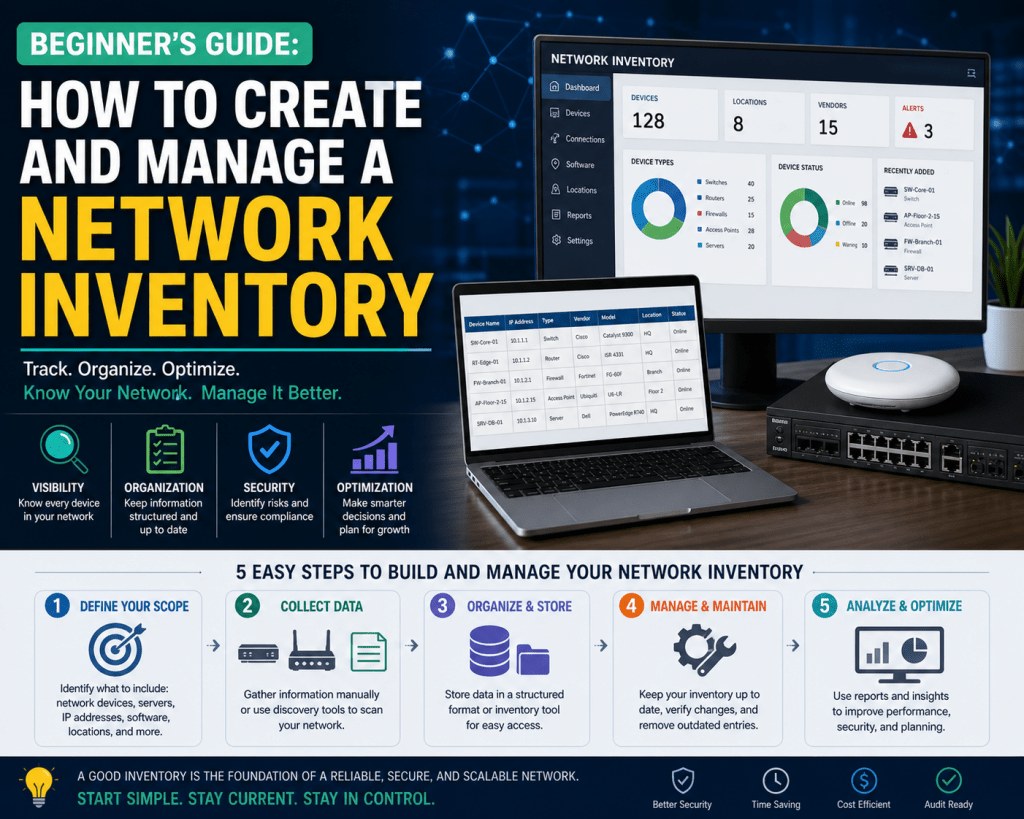
Network inventory refers to the systematic process of identifying, documenting, and managing every device, connection, and resource within a computer network. This includes servers, routers, switches, firewalls, endpoints, virtual machines, cloud-linked resources, and even peripheral infrastructure that interacts with core systems. In modern IT environments, where hybrid and distributed architectures are common, network inventory is no longer optional but a fundamental requirement for operational stability.
At its core, network inventory is about visibility. Without knowing what exists in an environment, it becomes impossible to secure, optimize, or scale it effectively. Organizations rely on structured inventory systems to maintain accurate records of all connected assets, their configurations, and their interdependencies. This structured visibility enables better control over performance, security, compliance, and long-term planning.
The Role of Foundational Networking Knowledge
A strong understanding of networking principles significantly enhances the effectiveness of inventory management. Concepts such as IP addressing, subnetting, routing protocols, switching behavior, and network segmentation provide the context needed to interpret inventory data correctly. Without this foundational knowledge, raw inventory data becomes difficult to analyze or act upon.
For example, recognizing how data flows between different network segments allows administrators to identify bottlenecks or misconfigured routes. Understanding device roles helps differentiate between core infrastructure and peripheral endpoints. This knowledge is essential when building an inventory system that is both accurate and meaningful. It also improves decision-making when troubleshooting or planning network expansion.
Why Visibility is the Core of Network Control
Visibility is the central principle behind effective network inventory management. In small environments, it may be easy to manually track devices and connections. However, as networks scale into hundreds or thousands of nodes, manual tracking becomes unreliable and inefficient.
A lack of visibility can lead to several operational risks, including unknown devices connected to the network, outdated configurations, and unmonitored endpoints. These blind spots create vulnerabilities that can affect performance and security. A structured inventory system eliminates these blind spots by continuously tracking and updating information about all network assets.
With complete visibility, IT teams can quickly identify what is connected, how it is configured, and how it interacts with other components. This level of awareness is essential for maintaining control over complex environments.
Scalability Challenges in Growing Network Architectures
As organizations expand, their network infrastructure becomes increasingly complex. Additional devices, remote offices, cloud integrations, and virtual environments all contribute to this complexity. Without a structured inventory system, scaling such environments becomes difficult and error-prone.
One of the major challenges in scaling networks is maintaining consistency. Devices may be deployed across different locations with varying configurations, making it difficult to maintain uniform standards. Inventory systems help solve this problem by centralizing data and ensuring that all assets are tracked under a unified framework.
Scalability also introduces challenges in terms of performance monitoring and resource allocation. As traffic increases, networks must be optimized to handle higher loads. Inventory systems provide the necessary data to support capacity planning and ensure that infrastructure can scale efficiently without compromising performance.
Operational Efficiency Through Structured Asset Management
Network inventory management directly contributes to operational efficiency. By maintaining accurate records of all devices and configurations, organizations can reduce time spent on troubleshooting, maintenance, and auditing. When an issue arises, administrators can quickly reference inventory data to identify affected components and resolve problems faster.
Structured asset management also reduces redundancy. Without proper tracking, organizations may unknowingly deploy duplicate resources or underutilize existing infrastructure. Inventory systems help optimize resource usage by providing a clear overview of available assets and their current status.
This efficiency extends to both technical and administrative operations, ensuring that IT teams can focus on strategic tasks rather than manual tracking activities.
Security Enhancement Through Complete Asset Visibility
Security is one of the most critical reasons for implementing network inventory systems. Every device connected to a network represents a potential entry point for threats. Without proper tracking, unauthorized or unknown devices may go undetected, increasing the risk of security breaches.
Inventory systems help mitigate these risks by continuously monitoring connected devices and identifying anomalies. They provide detailed information about each asset, including configuration settings, operating status, and access permissions. This allows security teams to enforce consistent policies across all endpoints.
Additionally, inventory systems support vulnerability management by identifying outdated hardware or software that may require updates. This proactive approach reduces the likelihood of exploitation and strengthens the overall security posture of the organization.
Compliance and Regulatory Requirements in Network Management
Many industries operate under strict regulatory frameworks that require organizations to maintain accurate records of their IT infrastructure. Compliance standards often mandate detailed documentation of all network assets, configurations, and access controls.
Network inventory systems play a critical role in meeting these requirements. By maintaining up-to-date records, organizations can demonstrate compliance during audits and inspections. This reduces the risk of penalties and ensures adherence to industry standards.
Compliance also extends to data protection regulations, where organizations must ensure that sensitive information is properly secured. Inventory systems help enforce these requirements by tracking data flow and identifying potential security gaps.
Financial Optimization Through Asset Tracking
Effective network inventory management contributes to financial optimization by reducing unnecessary expenses. Without accurate tracking, organizations may continue paying for unused licenses, outdated hardware, or redundant services.
Inventory systems provide detailed insights into resource utilization, allowing organizations to identify inefficiencies and optimize spending. For example, unused software licenses can be reassigned or removed, while underutilized hardware can be repurposed or decommissioned.
This level of financial control ensures that IT budgets are used effectively and that investments are aligned with operational needs.
Importance of Lifecycle Management in IT Assets
Every network device has a lifecycle that includes deployment, usage, maintenance, and eventual retirement. Managing this lifecycle effectively is essential for maintaining network performance and reliability.
Inventory systems support lifecycle management by tracking the age, usage patterns, and performance of each asset. This allows organizations to plan upgrades and replacements in a structured manner rather than reacting to failures.
Lifecycle management also helps reduce downtime by ensuring that critical infrastructure is maintained proactively. Devices approaching the end of their lifecycle can be replaced before they cause disruptions.
Network Dependency Mapping and Its Importance
Understanding how devices interact within a network is crucial for maintaining stability. Network dependency mapping involves identifying relationships between different components and understanding how they influence each other.
For example, a single server failure may impact multiple services if dependencies are not properly understood. Inventory systems provide visibility into these relationships, allowing administrators to assess the impact of potential failures.
This information is also valuable for planning changes or upgrades, as it helps ensure that modifications do not unintentionally disrupt critical services.
Supporting Digital Transformation Initiatives
As organizations adopt digital transformation strategies, their reliance on complex IT infrastructure increases. Cloud services, virtualization, and hybrid environments all introduce new layers of complexity that must be managed effectively.
Network inventory systems provide the foundation for managing these environments by offering centralized visibility across physical and virtual assets. This ensures that organizations can maintain control over their infrastructure even as it evolves.
Digital transformation requires agility, and inventory systems enable this by providing real-time insights into network performance and structure.
The Role of Standardization in Inventory Management
Standardization is essential for maintaining consistency across network environments. Without standardized naming conventions, configuration policies, and asset tracking methods, inventory data can become fragmented and difficult to interpret.
Inventory systems help enforce standardization by providing structured frameworks for data collection and organization. This ensures that all assets are documented in a consistent manner, making it easier to analyze and manage network information.
Standardization also improves collaboration between IT teams by ensuring that everyone works with the same structured data set.
Preparing for Advanced Network Management Practices
A well-established network inventory system serves as the foundation for more advanced IT practices such as automation, predictive analytics, and AI-driven monitoring. Without accurate inventory data, these advanced systems cannot function effectively.
By building a strong inventory foundation, organizations position themselves for future technological advancements. This includes the ability to implement automated responses to network events, predictive maintenance strategies, and intelligent resource allocation systems.
A strong inventory system is not just a management tool; it is a strategic asset that supports long-term technological growth and innovation.
The Role of Network Discovery in Inventory Systems
Network discovery is the foundational process that enables inventory systems to identify and catalog all devices within an IT environment. It works by scanning network segments to detect active hosts, communication endpoints, and infrastructure components. Without discovery mechanisms, an inventory system would rely entirely on manual input, which is neither scalable nor reliable in modern environments.
Discovery operates continuously or on scheduled intervals depending on the configuration of the system. It ensures that any new device joining the network is automatically detected and evaluated for inclusion in the inventory database. This is critical in dynamic environments where devices frequently connect and disconnect, such as enterprise networks, hybrid cloud infrastructures, and distributed office systems.
The primary objective of network discovery is to eliminate blind spots. Every device that communicates on the network leaves a digital footprint, and discovery tools are designed to capture and interpret this information in a structured format. This allows IT teams to maintain an accurate and up-to-date view of the entire infrastructure.
IP-Based Scanning and Its Role in Asset Identification
IP scanning is one of the most widely used methods in network discovery. It involves scanning a range of IP addresses to identify active devices and determine their availability on the network. Each responding IP address typically represents a device or service that is currently operational.
This method is particularly effective in identifying endpoints such as workstations, servers, printers, and network appliances. It provides a baseline understanding of how many devices are active within a given subnet or network segment. However, IP scanning alone does not provide detailed information about device configuration or functionality, which is why it is often combined with other discovery methods.
IP scanning also helps identify unauthorized or rogue devices. Any active IP address that does not match known inventory records can be flagged for further investigation. This enhances security by ensuring that all devices connected to the network are accounted for and approved.
SNMP-Based Data Collection for Network Devices
Simple Network Management Protocol (SNMP) is a critical component in advanced inventory systems. It allows devices such as routers, switches, and firewalls to share structured information about their status, configuration, and performance.
SNMP operates through a structured query-response mechanism where the inventory system requests specific data points from network devices. These data points may include device model, firmware version, interface statistics, uptime, and serial numbers. This level of detail is essential for building a comprehensive inventory database.
One of the key advantages of SNMP is its standardization across network hardware. Most enterprise-grade devices support SNMP, making it a reliable method for collecting consistent data across diverse environments. It also enables continuous monitoring of device health, which supports proactive maintenance strategies.
WMI-Based Discovery for Windows Environments
Windows Management Instrumentation (WMI) is a framework used to collect detailed information from Windows-based systems. In network inventory systems, WMI plays a crucial role in gathering data from servers, desktops, and virtual machines running Windows operating systems.
WMI provides deep insights into system configuration, including installed software, hardware specifications, running services, and system performance metrics. This level of granularity allows IT teams to maintain detailed records of each endpoint within the network.
Unlike IP scanning, which provides basic connectivity information, WMI delivers structured system-level data. This makes it an essential component for organizations that rely heavily on Windows infrastructure.
Building a Centralized Network Inventory Database
Once data is collected through discovery methods such as IP scanning, SNMP, and WMI, it is stored in a centralized inventory database. This database acts as the single source of truth for all network-related information.
The database organizes data into structured categories such as device type, location, configuration, status, and connectivity relationships. This structured approach allows administrators to quickly search, filter, and analyze network assets based on specific criteria.
A centralized database also supports historical tracking. Changes to devices, configurations, and network topology are recorded over time, enabling trend analysis and auditing capabilities. This historical perspective is critical for identifying long-term patterns and making informed infrastructure decisions.
Network Mapping for Structural Visualization
Network mapping is the process of transforming raw inventory data into visual representations of the network structure. These maps provide a graphical overview of how devices are connected and how data flows between them.
There are several types of network maps, each serving a different purpose. Logical maps focus on data flow and network segmentation, while physical maps represent actual hardware connections. Topological maps provide a high-level overview of how different network segments and locations are interconnected.
These visual tools are essential for simplifying complex environments. Instead of analyzing raw data, administrators can use maps to quickly understand relationships between devices and identify potential issues in the network structure.
Logical Network Mapping and Traffic Flow Analysis
Logical network maps focus on how data moves through the network rather than physical connections. They illustrate IP addressing schemes, routing paths, VLAN configurations, and communication flows between systems.
This type of mapping is particularly useful for troubleshooting performance issues. By analyzing traffic paths, administrators can identify bottlenecks, inefficient routing, or misconfigured network segments. Logical maps also help in planning network expansions and optimizing data flow.
Understanding logical relationships between devices is essential for maintaining efficient communication across distributed systems.
Physical Network Mapping and Infrastructure Layout
Physical network maps provide a detailed representation of hardware components and their physical connections. This includes cabling structures, switch connections, server racks, and endpoint placements.
Physical mapping is especially important in large data center environments where hardware layout plays a critical role in performance and maintenance. It allows technicians to quickly locate devices and understand physical dependencies.
Accurate physical maps also support disaster recovery planning by providing clear documentation of infrastructure layout and hardware placement.
Topological Mapping for Multi-Site Environments
Topological maps provide a high-level overview of multiple network segments, often spanning different geographic locations. These maps are essential for organizations with distributed infrastructure, such as branch offices, cloud environments, and remote data centers.
They illustrate how different sites are interconnected through wide area networks and external communication links. This visibility helps administrators understand global network structure and identify potential points of failure across regions.
Topological mapping is also useful for capacity planning and optimization in large-scale environments.
The Role of Automation in Network Inventory Systems
Automation is a key component of modern network inventory management. It eliminates the need for manual data collection and ensures that inventory records are continuously updated.
Automated systems can detect new devices, update configuration changes, and remove inactive assets without human intervention. This reduces administrative workload and improves data accuracy.
Automation also enables real-time monitoring of network changes, allowing IT teams to respond quickly to emerging issues.
Continuous Device Monitoring and State Tracking
Continuous monitoring ensures that all devices within the network are tracked in real time. This includes monitoring system health, connectivity status, and configuration compliance.
By continuously tracking device states, inventory systems can detect anomalies such as unexpected shutdowns, configuration changes, or performance degradation. This proactive approach helps prevent downtime and ensures system reliability.
Continuous monitoring also supports compliance by ensuring that all devices adhere to predefined security and configuration standards.
Integration Between Inventory and Monitoring Systems
Modern IT environments often integrate inventory systems with network monitoring platforms. This integration provides a unified view of both structural and performance data.
While inventory systems focus on what exists in the network, monitoring systems focus on how those components are performing. When combined, they provide a complete operational picture.
This integration improves troubleshooting efficiency by allowing administrators to correlate performance issues with specific devices or configurations.
Scalability Challenges in Automated Inventory Systems
As networks grow, inventory systems must scale to handle increased data volume and device complexity. Scalability challenges include processing large numbers of discovery requests, storing historical data, and maintaining performance across distributed environments.
Scalable systems are designed to handle growth without compromising accuracy or speed. They often use distributed architectures and optimized data processing techniques to manage large-scale environments efficiently.
Scalability is essential for organizations that anticipate long-term growth or operate across multiple locations.
Role of Protocols in Data Collection and Communication
Network inventory systems rely on standardized protocols to communicate with devices and collect data. These protocols ensure consistent information exchange across different hardware and software platforms.
SNMP is commonly used for network devices, while WMI is used for Windows-based systems. Other protocols may be used for specialized environments or cloud-based systems.
Proper configuration of these protocols is essential for accurate and reliable data collection.
Importance of Real-Time Inventory Accuracy
Real-time accuracy ensures that inventory data reflects the current state of the network at any given moment. This is essential for decision-making, troubleshooting, and security management.
Without real-time updates, inventory data can quickly become outdated, leading to misinformed decisions and operational inefficiencies. Real-time systems continuously synchronize data to maintain accuracy.
This capability is especially important in dynamic environments where devices frequently connect, disconnect, or change configuration.
Preparing Infrastructure for Intelligent Network Management
Advanced inventory systems serve as the foundation for intelligent network management strategies. These include automation, predictive analytics, and AI-driven optimization.
By maintaining accurate and structured inventory data, organizations can implement systems that automatically respond to network conditions, predict failures, and optimize resource allocation.
This transforms network management from a reactive process into a proactive and intelligent system capable of self-optimization.
Dynamic Network Inventory Management as a Continuous Process
Dynamic network inventory management represents a shift from static documentation to continuously updated system awareness. In traditional environments, inventory records were often maintained manually or updated periodically, which led to discrepancies between documented assets and actual infrastructure. Modern dynamic systems eliminate this gap by continuously synchronizing with the live network environment.
This continuous synchronization ensures that any addition, removal, or modification of devices is immediately reflected in the inventory system. As a result, administrators gain a near real-time understanding of infrastructure state. This is particularly important in environments where devices frequently connect and disconnect, such as cloud-integrated systems, virtualized environments, and distributed enterprise networks.
Dynamic inventory systems reduce the risk of outdated information, which is one of the most common causes of mismanagement in large-scale IT operations. They also provide a foundation for automation, allowing systems to react intelligently to network changes without manual intervention.
Policy-Driven Network Inventory Governance
Policy-driven governance is a critical component of advanced network inventory management. Instead of relying on manual oversight, organizations define structured policies that determine how network assets should be identified, classified, and managed.
These policies typically include rules for device naming conventions, asset categorization, access permissions, and monitoring priorities. By enforcing standardized policies across the network, organizations ensure consistency and reduce configuration errors.
Policy-driven systems also help align network operations with organizational objectives. For example, critical infrastructure devices can be assigned higher monitoring priority, while less essential endpoints may be subject to reduced tracking intensity. This ensures that resources are allocated efficiently and strategically.
Change Detection and Event-Driven Inventory Updates
Change detection mechanisms are essential for maintaining accurate inventory records. These systems continuously monitor the network for any modifications, including new device connections, configuration updates, or hardware replacements.
When a change is detected, the system automatically logs the event and updates the inventory database accordingly. This event-driven approach ensures that no modification goes unnoticed, reducing the risk of configuration drift or undocumented changes.
Change detection also supports auditability by maintaining a historical record of all modifications. This allows administrators to trace the evolution of network infrastructure over time, which is useful for troubleshooting and compliance reporting.
Alerting Systems for Real-Time Network Awareness
Alerting systems play a vital role in ensuring that administrators are immediately informed of significant network events. These alerts can be triggered by a wide range of conditions, including unauthorized device connections, performance degradation, or configuration changes outside defined policies.
Effective alerting systems are designed to prioritize notifications based on severity. Critical alerts are escalated immediately, while lower-priority events may be grouped or delayed to reduce notification overload.
This structured approach ensures that administrators can focus on the most important issues without being overwhelmed by excessive notifications. It also improves response times for critical incidents.
Escalation Frameworks for Incident Management
Escalation frameworks define how network issues are handled when they exceed predefined thresholds or require specialized attention. These frameworks ensure that problems are routed to the appropriate teams based on severity and type.
For example, hardware-related issues may be escalated to infrastructure teams, while security incidents are directed to cybersecurity specialists. This structured escalation process reduces resolution time and ensures that expertise is applied efficiently.
Escalation frameworks also help maintain accountability by clearly defining roles and responsibilities during incident response scenarios.
Establishing Network Baselines for Behavioral Analysis
A network baseline represents the normal operational behavior of an IT environment. It includes metrics such as typical traffic volumes, device performance levels, and standard configuration states.
Establishing a baseline is essential for identifying deviations that may indicate issues or anomalies. Without a baseline, it becomes difficult to distinguish between normal fluctuations and genuine problems.
Inventory systems use baseline data to detect abnormal behavior patterns, such as unexpected traffic spikes, unauthorized access attempts, or performance degradation. This enables proactive issue detection before problems escalate into critical failures.
Inventory Optimization for Large-Scale Infrastructure
As networks grow in size and complexity, optimization becomes a key requirement for maintaining efficiency. Large-scale environments generate significant amounts of data, which can overwhelm poorly designed inventory systems.
Optimization strategies include filtering unnecessary data, prioritizing critical assets, and implementing efficient data storage mechanisms. These techniques ensure that systems remain responsive and manageable even as infrastructure scales.
Optimization also involves balancing visibility with performance. Not all devices require the same level of monitoring intensity, and systems must be configured accordingly to avoid unnecessary overhead.
Lifecycle Management and Asset Evolution Tracking
Lifecycle management is a structured approach to tracking network assets from deployment to retirement. Every device within a network has a lifecycle that includes procurement, installation, operation, maintenance, and decommissioning.
Inventory systems track each stage of this lifecycle, allowing organizations to make informed decisions about upgrades, replacements, and maintenance schedules. This ensures that infrastructure remains efficient and reliable over time.
Lifecycle tracking also helps reduce unexpected failures by identifying aging or underperforming assets before they cause disruptions.
Strategic Resource Allocation Through Inventory Insights
Inventory data provides valuable insights that support strategic resource allocation. By analyzing usage patterns, organizations can determine which resources are underutilized and which are operating at maximum capacity.
This information enables better planning for future expansions and infrastructure investments. It also helps reduce waste by ensuring that resources are allocated based on actual demand rather than assumptions.
Strategic allocation improves overall efficiency and ensures that IT investments align with business priorities.
Integration of Inventory Systems with Security Frameworks
Modern cybersecurity strategies rely heavily on accurate network inventory data. Without a clear understanding of what devices exist within a network, it becomes difficult to enforce security policies effectively.
Inventory systems integrate with security frameworks to provide continuous visibility into connected devices. This allows security teams to identify unauthorized access, enforce compliance policies, and respond to threats more efficiently.
Integration also supports vulnerability management by identifying outdated systems that may require updates or patches.
Threat Detection Through Asset Behavior Monitoring
Inventory systems contribute to threat detection by monitoring device behavior over time. Any deviation from normal behavior patterns can indicate potential security threats, such as malware infections or unauthorized access attempts.
Behavioral monitoring allows systems to detect threats that may not be identified through traditional signature-based security methods. This enhances overall security effectiveness and reduces the risk of undetected breaches.
Early detection is critical in minimizing the impact of security incidents and maintaining operational stability.
Managing Bring Your Own Device (BYOD) Environments
Bring Your Own Device environments introduce additional complexity into network inventory management. Personal devices such as smartphones, laptops, and tablets are frequently used for accessing organizational resources.
While BYOD policies offer flexibility and cost savings, they also introduce security and management challenges. Inventory systems must be able to track and monitor these devices without compromising user privacy or system performance.
Proper segmentation and policy enforcement are essential in BYOD environments to ensure that personal devices do not compromise network security.
Network Segmentation and Controlled Access Design
Network segmentation is a critical strategy for controlling access and improving security. It involves dividing a network into smaller segments based on function, security requirements, or operational roles.
Inventory systems support segmentation by providing visibility into which devices belong to each segment and how they interact with other parts of the network. This helps enforce access controls and reduce the spread of potential threats.
Segmentation also improves performance by isolating traffic and reducing congestion in critical network areas.
Physical and Logical Security Alignment
Effective network inventory management requires alignment between physical and logical security controls. Physical security involves protecting hardware assets, while logical security focuses on data access and network communication.
Inventory systems help bridge the gap between these two domains by providing unified visibility into both physical and logical components. This ensures that security policies are consistently applied across all layers of the infrastructure.
Ensuring Compliance in Regulated Network Environments
Organizations operating in regulated industries must adhere to strict compliance requirements. These regulations often require detailed documentation of network assets, configurations, and security controls.
Inventory systems play a central role in compliance by maintaining accurate and auditable records of all network activity. This simplifies reporting and ensures that organizations can demonstrate adherence to regulatory standards when required.
Compliance management also reduces the risk of penalties and legal issues associated with improper data handling or security breaches.
Advanced Analytics and Predictive Network Management
Advanced inventory systems increasingly incorporate analytics capabilities that enable predictive network management. By analyzing historical data, these systems can identify trends and predict potential failures or performance issues.
Predictive analytics allows organizations to address problems before they occur, improving reliability and reducing downtime. It also supports capacity planning by forecasting future resource requirements based on historical usage patterns.
This shift from reactive to predictive management represents a major advancement in network operations.
Automation-Driven Infrastructure Optimization
Automation is one of the most powerful features of modern network inventory systems. It allows routine tasks such as device discovery, configuration updates, and compliance checks to be performed automatically.
Automation reduces human error and increases operational efficiency. It also frees IT teams to focus on strategic initiatives rather than repetitive administrative tasks.
As automation capabilities continue to evolve, network inventory systems are becoming increasingly intelligent and self-managing.
Future-Ready Network Inventory Architecture
Future-ready inventory systems are designed to support emerging technologies such as cloud computing, edge computing, and artificial intelligence-driven networks. These systems must be flexible, scalable, and capable of integrating with diverse infrastructure components.
By building a strong inventory foundation, organizations position themselves to adapt to future technological changes without requiring complete system redesigns. This ensures long-term sustainability and operational resilience in rapidly evolving IT environments.
Conclusion
Network inventory management ultimately serves as the structural backbone of modern IT operations. Across increasingly complex environments—spanning on-premises systems, cloud platforms, virtualized workloads, and distributed endpoints—the ability to maintain a continuously accurate understanding of infrastructure is what separates stable, secure networks from fragile and unpredictable ones. What begins as a simple process of listing devices evolves into a disciplined operational framework that influences security posture, financial efficiency, compliance readiness, and long-term scalability.
At a fundamental level, the value of network inventory lies in visibility. When organizations can clearly identify every connected asset, understand how those assets communicate, and track how they change over time, they gain a level of operational control that is otherwise impossible to achieve. This visibility eliminates uncertainty, which is one of the most significant risks in IT environments. Unknown devices, undocumented changes, and unmanaged endpoints all represent potential vulnerabilities. A well-maintained inventory system reduces these blind spots by ensuring that every asset is accounted for and continuously monitored.
Beyond visibility, consistency becomes a defining benefit. Networks are dynamic by nature, with frequent changes occurring through deployments, upgrades, migrations, and user-driven modifications. Without structured inventory management, these changes quickly lead to configuration drift, where systems no longer align with intended standards. Over time, this drift creates instability and increases the likelihood of performance issues or security gaps. Inventory systems counteract this by enforcing structured data collection, standardized asset classification, and continuous synchronization with live environments.
Another critical dimension is operational efficiency. IT teams often spend a significant amount of time troubleshooting issues that stem from incomplete or outdated information. When inventory systems are properly implemented, they reduce this inefficiency by providing immediate access to accurate data about device status, configuration history, and network relationships. This accelerates problem resolution and reduces downtime, which directly impacts productivity across the organization. In environments where uptime is critical, even small improvements in response time can translate into substantial operational gains.
Security is equally dependent on effective inventory management. Every connected device represents a potential attack surface, and without proper tracking, malicious or unauthorized systems can remain undetected within the network. Inventory systems support security by maintaining a complete record of all endpoints and their behaviors. This enables organizations to identify anomalies, enforce compliance policies, and detect unauthorized activity more effectively. When combined with monitoring and alerting mechanisms, inventory data becomes a powerful tool for proactive threat detection rather than reactive incident response.
Compliance requirements further reinforce the importance of structured inventory systems. Regulatory frameworks across industries demand accurate documentation of IT assets, access controls, and system configurations. Organizations that lack reliable inventory data often struggle during audits, exposing themselves to penalties and reputational risk. A well-maintained inventory system simplifies compliance by ensuring that all required information is readily available, traceable, and consistently updated. It also supports long-term governance by maintaining historical records that demonstrate adherence to regulatory standards over time.
Financial optimization is another often overlooked benefit of network inventory management. IT environments frequently accumulate redundant hardware, unused software licenses, and underutilized resources simply due to lack of visibility. Inventory systems expose these inefficiencies by providing detailed insights into asset usage and lifecycle status. This allows organizations to make informed decisions about procurement, consolidation, and decommissioning. As a result, resources are allocated more effectively, and unnecessary expenditures are reduced.
Scalability is where the importance of inventory systems becomes even more apparent. As networks grow, complexity increases exponentially. New devices, remote sites, cloud integrations, and hybrid architectures introduce layers of interdependence that cannot be managed manually. Inventory systems provide the structural framework needed to handle this growth without losing control. They ensure that expansion does not compromise visibility or operational stability, allowing organizations to scale confidently while maintaining governance over their infrastructure.
Automation plays a transformative role in modern inventory practices. Instead of relying on manual updates, automated systems continuously discover devices, track configuration changes, and update records in real time. This reduces human error and ensures that inventory data remains accurate even in highly dynamic environments. Automation also enables faster response to network changes, improving both operational efficiency and security responsiveness.
The integration of inventory systems with broader IT management tools further enhances their value. When combined with monitoring, security, and analytics platforms, inventory data becomes part of a unified operational ecosystem. This integration allows organizations to correlate performance metrics with asset data, identify root causes of issues more efficiently, and gain deeper insights into infrastructure behavior. It transforms inventory from a static record-keeping function into an active intelligence layer within IT operations.
Looking forward, the role of network inventory will continue to expand as IT environments become more distributed and software-defined. Emerging technologies such as edge computing, artificial intelligence-driven automation, and multi-cloud architectures will increase the need for precise and adaptive inventory systems. Organizations that invest in strong inventory foundations will be better positioned to adapt to these changes without disruption.
Ultimately, network inventory management is not simply a technical requirement but a strategic capability. It influences how effectively an organization can operate, secure, and evolve its digital infrastructure. By maintaining accurate, dynamic, and comprehensive visibility into all network assets, organizations establish the foundation needed for resilience, efficiency, and long-term technological growth.