The Certified Information Systems Security Professional credential is widely recognized in the cybersecurity industry as a benchmark for advanced knowledge, practical experience, and professional responsibility. It is designed for individuals involved in designing, implementing, and managing security programs in complex environments. Unlike entry-level certifications that focus primarily on theoretical understanding, this credential evaluates a combination of real-world experience and structured knowledge across multiple security domains. The certification is administered by a globally recognized cybersecurity professional organization that sets strict standards for eligibility and conduct. These standards are intended to ensure that individuals who earn the credential are capable of handling critical security responsibilities in enterprise environments. The certification process is structured to validate both technical and managerial competencies, reflecting the diverse responsibilities of cybersecurity professionals. Candidates are expected to demonstrate expertise across areas such as risk management, asset security, security architecture, communication security, and identity management. The breadth of these domains highlights the expectation that certified professionals possess a holistic understanding of security operations. The certification is not designed to be quickly achieved but rather to reflect long-term professional development. This makes it highly respected among employers and industry peers who rely on certified individuals to safeguard organizational systems and data.
Role of Experience in Eligibility
A defining requirement of this certification is the emphasis on professional experience. Candidates must demonstrate several years of full-time work in relevant cybersecurity domains. This requirement ensures that individuals are not only familiar with theoretical concepts but have also applied them in real operational environments. Experience is evaluated across multiple domains, and candidates must show that they have contributed meaningfully to security-related responsibilities. These responsibilities may include designing security controls, responding to incidents, managing risk frameworks, or implementing compliance measures. The experience requirement is intended to ensure that certified professionals can make informed decisions in high-pressure situations where security risks are present. It also ensures that candidates understand the practical implications of security policies and technologies. Without sufficient experience, individuals may lack the judgment required to handle complex security challenges. The certification process, therefore, places significant emphasis on validating work history to confirm that candidates meet the expected standard. This validation is closely tied to the endorsement process, where professional verification plays a key role in confirming the authenticity of claimed experience.
Importance of Endorsement in Certification Integrity
Endorsement is a critical component of the certification process and serves as a mechanism for validating a candidate’s professional background. It requires a certified professional to confirm that the candidate has the experience and skills necessary to meet certification standards. This peer-based validation system strengthens the credibility of the certification by ensuring that claims are reviewed by individuals who understand the expectations of the role. The endorsement process is not a casual recommendation but a structured evaluation that requires careful review of the candidate’s work history. It acts as a safeguard against misrepresentation and ensures that only qualified individuals are certified. The integrity of the certification depends heavily on this step, as it introduces accountability into the verification process. By involving experienced professionals in the validation process, the certification body ensures that standards remain consistent across all candidates. This approach also reinforces trust within the cybersecurity industry, where organizations rely on certified professionals to protect sensitive systems and data. The endorsement requirement reflects the importance of peer accountability in maintaining professional standards.
How Sponsorship Fits into the Verification System
Sponsorship functions as a formal verification mechanism that bridges the gap between candidate experience and certification approval. It involves a certified professional reviewing and confirming the accuracy of a candidate’s claimed experience. This step ensures that the information provided during the application process is consistent with actual work history. The sponsor is expected to have direct knowledge of the candidate’s professional capabilities or access to sufficient information to make an informed judgment. This system helps maintain a high level of trust in the certification by ensuring that every candidate is reviewed by someone who understands the technical and professional expectations of the field. Sponsorship also serves as a form of mentorship in some cases, where experienced professionals guide candidates through the certification requirements. The process is designed to be objective and structured, reducing the likelihood of errors or misrepresentation. It also reinforces the collaborative nature of the cybersecurity profession, where experienced individuals contribute to the development of future professionals. The verification system as a whole ensures that certification holders meet consistent standards regardless of geographical location or organizational background.
Professional Standards and Ethical Expectations
The certification process places strong emphasis on professional ethics and responsible conduct. Candidates are expected to adhere to high standards of honesty when representing their experience and qualifications. This expectation is reinforced throughout the endorsement and verification stages, where accuracy and transparency are essential. Ethical conduct is considered a core principle of the certification framework, reflecting the sensitive nature of cybersecurity work. Professionals in this field are often responsible for protecting critical infrastructure, confidential data, and organizational assets. As a result, integrity is not optional but a fundamental requirement. The endorsement process helps reinforce these expectations by requiring external validation of candidate claims. This ensures that ethical standards are maintained not only during certification but also throughout professional practice. Candidates are encouraged to maintain accurate records of their work experience and responsibilities to support the verification process. Ethical alignment between candidates and certified professionals is essential for maintaining trust in the certification system and the broader cybersecurity community.
Building Foundation Before Seeking Sponsorship
Before seeking sponsorship, candidates must establish a strong professional foundation that clearly demonstrates relevant experience. This involves gaining exposure to multiple areas of cybersecurity practice and documenting responsibilities in a structured manner. A well-developed foundation includes hands-on experience with security tools, risk management processes, incident response activities, and system protection strategies. Candidates should focus on building depth in their roles rather than simply accumulating years of employment. The quality of experience is as important as the duration, as it reflects the candidate’s ability to apply knowledge effectively. Developing a broad understanding of security principles across different environments also strengthens eligibility. Candidates should seek opportunities that allow them to work on diverse security challenges, as this enhances both technical and analytical skills. A strong foundation not only improves certification readiness but also makes the endorsement process smoother by providing clear evidence of capability. Without this foundation, securing sponsorship becomes more difficult due to insufficient proof of relevant experience.
Documentation and Career Evidence Preparation
Proper documentation plays a crucial role in the certification process, particularly during endorsement. Candidates are expected to maintain detailed records of their job roles, responsibilities, and achievements. This documentation serves as evidence of professional experience and helps validate claims during the review process. Clear and organized records make it easier for sponsors to assess eligibility and confirm accuracy. Candidates should ensure that their documentation includes specific details about security-related tasks and projects. General job descriptions are often insufficient, as the focus is on cybersecurity contributions rather than general employment history. Maintaining a structured record of professional activities over time can significantly reduce delays during verification. Documentation may also include project summaries, role descriptions, and examples of security implementations. These records help establish a clear connection between experience and certification requirements. Proper preparation of documentation demonstrates professionalism and readiness for certification evaluation.
Networking and Professional Relationship Development
Building professional relationships is an important aspect of finding a suitable sponsor. Networking allows candidates to connect with experienced professionals who may later serve as endorsers. These relationships are often developed through workplace collaboration, industry engagement, and participation in cybersecurity communities. Strong professional networks provide access to individuals who understand the certification requirements and are willing to support qualified candidates. Networking also helps candidates gain insights into industry practices and expectations, which can improve their overall preparedness. Developing trust within professional relationships is essential, as sponsorship requires a level of confidence in the candidate’s abilities. Consistent engagement with peers helps establish credibility over time. Candidates who actively participate in collaborative environments are more likely to find sponsors who can validate their experience. Networking should be viewed as a long-term strategy rather than a short-term requirement for certification.
Organizational Review and Validation Approach
The certification process includes a structured review system designed to ensure consistency and accuracy in evaluating candidates. This system involves examining professional experience, verifying documentation, and confirming alignment with required domains. Sponsors play a key role in this process by providing validation based on their understanding of the candidate’s work. The review approach is systematic and follows defined criteria to ensure fairness. Each application is assessed based on relevance, depth, and authenticity of experience. The goal is to ensure that all certified professionals meet the same standard regardless of their background. This structured approach helps maintain the reputation of the certification as a globally recognized benchmark. It also ensures that the verification process is transparent and consistent across all applicants. Candidates are expected to cooperate fully during the review process by providing accurate and complete information.
Common Misunderstandings About Sponsorship
Many candidates misunderstand the purpose and requirements of sponsorship, often viewing it as a barrier rather than a validation step. One common misconception is that sponsorship is optional or informal, when in reality it is a structured requirement. Another misunderstanding is that any professional acquaintance can serve as a sponsor, whereas the expectation is that the sponsor must be able to meaningfully validate the candidate’s experience. Some candidates also believe that sponsorship is solely a formality, without realizing its importance in maintaining certification integrity. There is also confusion about timing, with some assuming sponsorship can be arranged after passing the exam without prior preparation. In reality, planning for sponsorship should begin early in the certification journey. Understanding these misconceptions helps candidates approach the process with greater clarity and preparedness.
Preparing for the Structured Verification Process
The verification process requires candidates to present accurate and well-organized information about their professional experience. Preparation involves ensuring that all relevant documentation is complete and accessible. Candidates should be ready to provide detailed explanations of their roles and responsibilities in cybersecurity environments. The verification process may involve cross-checking information with employers or reviewing project history. This structured evaluation ensures that all claims are substantiated and consistent with actual work experience. Candidates who prepare thoroughly are more likely to navigate the process smoothly. Attention to detail is essential, as incomplete or unclear information can lead to delays. The verification process ultimately ensures that only qualified professionals are awarded certification, maintaining the credibility and value of the credential in the cybersecurity industry.
Strategies for Identifying a Suitable CISSP Sponsor
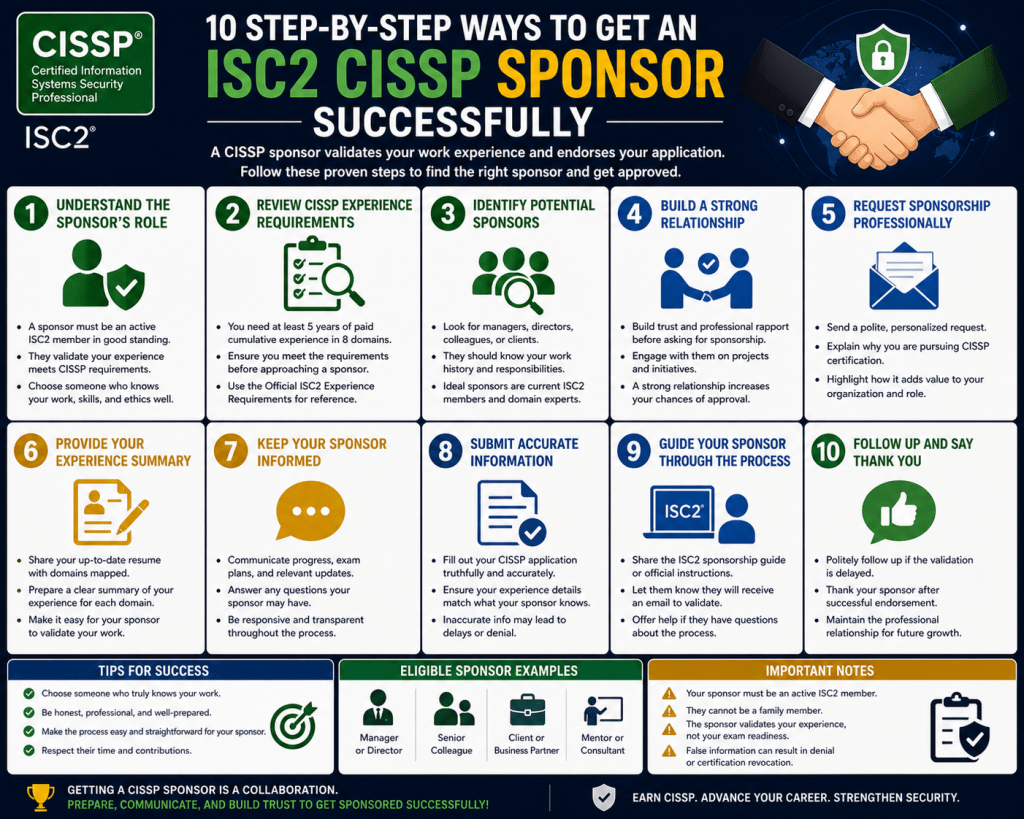
Finding a suitable sponsor for the CISSP certification requires a structured and intentional approach rather than relying on chance connections. A sponsor must be a certified professional who understands the requirements of the certification and is capable of validating your cybersecurity experience. This means the process begins long before the actual endorsement stage. Candidates need to position themselves within environments where certified professionals are present and active. Workplace settings are often the most effective starting point, especially in organizations with dedicated security teams. In such environments, collaboration on security projects naturally creates opportunities to build professional trust. When colleagues observe your work firsthand, they are better positioned to validate your experience when required. Beyond the workplace, industry exposure plays a significant role. Participation in cybersecurity-related projects, cross-functional teams, and security initiatives increases visibility among experienced professionals. These interactions help establish credibility over time, making it easier to identify potential sponsors. The key is to focus on meaningful professional engagement rather than superficial networking. Sponsors are more likely to support candidates whose skills and experience they have directly observed or can confidently verify.
Leveraging Workplace Relationships for Sponsorship
The most straightforward path to finding a CISSP sponsor often exists within the workplace. Organizations with established cybersecurity teams usually employ professionals who already hold the certification. These individuals are ideal candidates for sponsorship because they understand both the technical and procedural requirements involved. Building strong professional relationships within your organization is essential for this approach. Collaboration on security projects, incident response activities, and compliance initiatives provides opportunities to demonstrate your capabilities. Consistent performance and reliability help establish trust, which is a critical factor in sponsorship decisions. It is important to engage with senior security professionals professionally and respectfully, focusing on shared objectives rather than personal requests. Over time, these relationships naturally evolve into mentorship opportunities. When the time comes for endorsement, these professionals are often willing to validate your experience because they have firsthand knowledge of your work. Internal sponsorship is often the most efficient option because it eliminates the need for external verification and reduces uncertainty in the process.
Expanding Professional Networks Beyond the Workplace
When workplace options are limited, expanding your professional network becomes essential. Cybersecurity is a field that thrives on collaboration, and many experienced professionals are active in broader industry circles. Building connections outside your immediate organization increases your chances of finding a qualified sponsor. Professional networking should focus on meaningful engagement rather than simply increasing contact numbers. Participating in cybersecurity discussions, collaborative projects, and knowledge-sharing activities helps establish your presence in the field. Over time, these interactions build familiarity and trust among peers. Networking also provides exposure to different perspectives and practices, which enhances your overall understanding of the industry. Strong professional relationships are often built gradually through consistent participation and contribution. When individuals recognize your expertise and professionalism, they are more likely to support your certification journey. The goal is to become part of a professional ecosystem where knowledge exchange and mutual support are common practices. This approach significantly increases the likelihood of identifying a sponsor who is both qualified and willing to endorse your experience.
Role of Mentorship in Sponsorship Opportunities
Mentorship relationships often play a significant role in securing sponsorship for certification. Experienced cybersecurity professionals frequently mentor individuals who are developing their careers in the field. These relationships are built on guidance, knowledge sharing, and professional development. A mentor who has observed your progress over time is often well-positioned to act as a sponsor when needed. Mentorship provides a structured environment for demonstrating skills, problem-solving abilities, and professional growth. Unlike casual professional interactions, mentorship involves ongoing evaluation and feedback. This continuous engagement allows mentors to gain a clear understanding of your capabilities. When the endorsement stage arrives, mentors can confidently validate your experience because they have been involved in your development journey. Establishing a mentorship relationship requires initiative and commitment. Candidates must actively seek opportunities to learn from experienced professionals and demonstrate a willingness to improve. Over time, these relationships often evolve into sponsorship opportunities, making mentorship a valuable long-term strategy for certification success.
Engaging in Cybersecurity Communities and Forums
Cybersecurity communities provide an important platform for professional interaction and knowledge exchange. These communities often include certified professionals who are familiar with the CISSP requirements and endorsement process. Active participation in such environments helps candidates build visibility and credibility within the industry. Engagement can include discussions on security topics, participation in collaborative problem-solving, and contribution to shared knowledge resources. These activities help demonstrate expertise and commitment to the field. Over time, consistent participation leads to recognition among peers. This recognition can be valuable when seeking sponsorship, as it establishes a reputation for competence and professionalism. Online and offline communities both offer opportunities for meaningful engagement. However, the focus should remain on contributing value rather than simply seeking assistance. Professionals are more likely to support candidates who actively contribute to the community. Building trust within these environments takes time, but it can significantly expand access to potential sponsors. Community involvement also enhances learning and keeps candidates updated on industry trends and practices.
Evaluating Sponsor Eligibility and Suitability
Not every certified professional is suitable to act as a sponsor. It is important to evaluate potential sponsors carefully before making a request. A suitable sponsor should have a clear understanding of your professional background and be able to verify your experience accurately. Familiarity with your work is essential, as sponsorship requires more than a formal certification status. Candidates should consider whether the potential sponsor has directly observed their work or has sufficient knowledge of their responsibilities. Trust and professional respect are key factors in this evaluation. A strong sponsor-candidate relationship is built on credibility and transparency. It is also important to consider the sponsor’s availability and willingness to participate in the endorsement process. Some professionals may be certified but not actively engaged in sponsorship activities. Selecting the right sponsor increases the likelihood of a smooth verification process. Careful evaluation helps avoid delays and ensures that the endorsement is both accurate and reliable.
Preparing to Approach a Potential Sponsor
Approaching a potential sponsor requires professionalism and preparation. Candidates should be ready to clearly explain their experience, responsibilities, and alignment with certification requirements. Before initiating contact, it is important to organize documentation that supports your work history. This includes detailed descriptions of security-related tasks, projects, and achievements. Clarity and structure are essential when presenting this information. The goal is to make it easy for the potential sponsor to understand and evaluate your experience. Communication should be respectful and focused on professional alignment rather than personal requests. It is also helpful to highlight shared work experiences or collaborative projects. This reinforces familiarity and builds confidence in your capabilities. Candidates should be prepared for questions or requests for additional information. A well-prepared approach demonstrates seriousness and professionalism, increasing the likelihood of a positive response. The interaction should reflect mutual respect and a shared understanding of professional standards.
Importance of Consistent Professional Performance
Consistent performance in cybersecurity roles plays a critical role in securing sponsorship. Sponsors are more likely to endorse individuals who demonstrate reliability, competence, and professionalism over time. Consistency builds trust, which is essential for validation. Professionals who consistently contribute to security initiatives, respond effectively to incidents, and maintain strong technical skills are more likely to be recognized as capable candidates. Performance is not limited to technical ability alone but also includes communication, teamwork, and problem-solving skills. Sponsors evaluate candidates based on their overall contribution to the organization and their ability to handle complex security challenges. Maintaining high standards of performance ensures that when endorsement is requested, there is a strong foundation of trust and credibility. This consistency should be evident across different roles and responsibilities. Over time, it creates a professional reputation that supports certification objectives.
Overcoming Challenges in Finding a Sponsor
Many candidates face challenges when trying to identify a suitable sponsor, especially if they work in small organizations or isolated roles. In such cases, limited access to certified professionals can make the process more difficult. However, these challenges can be addressed through strategic networking and professional engagement. Expanding exposure to industry activities and building external connections can help overcome organizational limitations. Persistence is important, as finding the right sponsor may take time. Candidates should remain focused on building professional relationships and demonstrating their capabilities. Challenges often arise from a lack of visibility rather than a lack of qualification. Increasing professional presence within the industry helps mitigate this issue. It is also important to remain patient and methodical throughout the process. Rushing the sponsorship stage can lead to unsuitable endorsements or delays in certification. A structured and consistent approach increases the likelihood of success.
Maintaining Professional Documentation for Verification
Accurate documentation is essential throughout the sponsorship and verification process. Candidates should maintain detailed records of their professional experience, including roles, responsibilities, and specific security-related tasks. This documentation serves as evidence during endorsement and helps sponsors evaluate eligibility. Clear and organized records reduce ambiguity and make the verification process more efficient. Documentation should reflect real contributions to cybersecurity activities rather than general job duties. The level of detail provided can significantly influence the ease of endorsement. Candidates should update their records regularly to ensure accuracy. This ongoing documentation practice also helps in career development by providing a clear overview of professional growth. Proper record-keeping is a critical component of certification preparation and should not be overlooked.
Building Long-Term Professional Credibility
Sponsorship is closely tied to professional credibility, which is built over time through consistent experience and ethical conduct. Candidates who maintain strong professional reputations are more likely to receive endorsement support. Credibility is established through demonstrated expertise, reliability, and integrity in the workplace. It also involves active participation in cybersecurity initiatives and continuous skill development. Professionals who are recognized for their contributions are naturally more likely to be supported by peers. Building credibility is a long-term process that extends beyond certification goals. It influences career progression, leadership opportunities, and industry recognition. Sponsorship becomes a natural outcome of sustained professional excellence rather than a standalone requirement.
Navigating the CISSP Endorsement Process Step by Step
The endorsement stage in the CISSP certification journey represents the final validation of a candidate’s professional experience and readiness. Once the exam requirement is completed, the endorsement process begins as a structured review of the candidate’s submitted work history and qualifications. This step ensures that all claims made during the application are accurate and aligned with the certification requirements. The process is designed to be methodical, requiring clear documentation and confirmation from a certified professional sponsor. During this stage, candidates are expected to provide detailed evidence of their cybersecurity experience, including roles, responsibilities, and the specific security domains they have worked in. The sponsor then reviews this information and confirms whether it accurately reflects the candidate’s professional background. This validation process is essential for maintaining the integrity of the certification, as it ensures that only qualified individuals are granted certification status. The endorsement stage is not a formality but a critical checkpoint that reinforces the credibility of the entire certification framework.
Understanding the Structure of Experience Validation
Experience validation is a core component of the endorsement process and focuses on verifying that candidates meet the required professional standards. The certification requires candidates to demonstrate experience across multiple security domains, ensuring a well-rounded understanding of cybersecurity principles. These domains include areas such as risk management, security architecture, identity and access control, and incident response. Candidates must show that they have practical exposure to these areas in real-world environments. The validation process involves reviewing job descriptions, project involvement, and specific security-related responsibilities. Sponsors play a key role in confirming that the candidate’s experience is both accurate and relevant. The structure of this validation ensures consistency across all applicants, regardless of industry or location. It also helps maintain a high level of trust in the certification by ensuring that all certified professionals meet the same baseline requirements. Proper documentation and clear communication are essential for successful validation.
Role of Documentation in Verification Success
Documentation is one of the most important elements in the endorsement process. Candidates are required to present clear and detailed records of their professional experience to support their application. This includes descriptions of job roles, responsibilities, and specific cybersecurity tasks performed over time. The quality of documentation can significantly impact the efficiency of the verification process. Well-organized records make it easier for sponsors to assess eligibility and confirm accuracy. Candidates should ensure that their documentation reflects actual security-related contributions rather than general job functions. Each entry should clearly demonstrate how the candidate has engaged with cybersecurity principles in practice. Supporting evidence, such as project summaries and role descriptions, can further strengthen the application. Maintaining accurate documentation throughout one’s career simplifies the endorsement process and reduces the likelihood of delays or additional inquiries. Proper record-keeping is a continuous practice that supports both certification and long-term professional development.
How Sponsors Evaluate Candidate Experience
Sponsors are responsible for evaluating whether a candidate’s experience meets the required certification standards. This evaluation is based on a review of submitted documentation and, in some cases, personal knowledge of the candidate’s work. Sponsors assess the depth, relevance, and authenticity of the candidate’s experience across different security domains. They must ensure that the information provided aligns with the expectations of the certification framework. This includes verifying that the candidate has sufficient exposure to real-world cybersecurity challenges. Sponsors may also consider the candidate’s professional conduct, consistency, and overall contribution to security-related activities. The evaluation process requires careful judgment and a clear understanding of certification requirements. Sponsors act as gatekeepers who help maintain the integrity of the certification by ensuring that only qualified individuals are endorsed. Their role is essential in preserving the credibility of the certification across the global cybersecurity community.
Addressing Challenges During Endorsement Review
Candidates may encounter challenges during the endorsement review process, particularly if documentation is incomplete or unclear. One common issue is insufficient detail in job descriptions, which can make it difficult for sponsors to verify experience. Another challenge arises when candidates have worked in roles where cybersecurity responsibilities were not formally defined. In such cases, it may be necessary to clearly articulate how security-related tasks were integrated into broader job functions. Delays can also occur if sponsors require additional clarification or supporting evidence. To address these challenges, candidates should prepare comprehensive and well-structured documentation in advance. Clear communication with sponsors is also essential to avoid misunderstandings. Being proactive in providing additional information can help resolve issues efficiently. Understanding potential challenges in advance allows candidates to navigate the endorsement process more effectively and reduces the risk of delays.
Importance of Accuracy and Transparency
Accuracy and transparency are fundamental principles in the endorsement process. Candidates are expected to provide truthful and precise information about their professional experience. Any discrepancies or inconsistencies in documentation can lead to delays or rejection of the application. Transparency ensures that sponsors can make informed decisions when validating experience. It also helps maintain trust between candidates, sponsors, and the certification body. Candidates should avoid exaggerating responsibilities or omitting relevant details from their work history. Instead, they should focus on clearly presenting their actual contributions to cybersecurity activities. Honest representation of experience not only supports certification success but also reflects professional integrity. Transparency is a key factor in maintaining the credibility of the certification and ensuring that all certified professionals meet consistent standards.
Understanding Audit Possibilities in the Certification Process
In some cases, candidates may be subject to additional review or audit if sponsorship is not available or if further verification is required. An audit involves a more detailed examination of the candidate’s professional experience and supporting documentation. This process may include reviewing job descriptions, verifying employment history, and assessing alignment with certification requirements. While audits may seem intensive, they are designed to ensure fairness and accuracy in the certification process. Candidates undergoing audit should be prepared to provide comprehensive documentation and respond to verification requests. This may include contacting previous employers or providing additional evidence of cybersecurity responsibilities. The audit process reinforces the importance of maintaining accurate records throughout one’s career. It also highlights the value of transparency and thorough preparation in achieving certification success.
Maintaining Professional Communication with Sponsors
Effective communication with sponsors is essential for a smooth endorsement process. Candidates should maintain a professional and respectful tone when interacting with potential or confirmed sponsors. Clear communication helps ensure that expectations are understood on both sides. Candidates should provide organized and concise information when presenting their experience. It is also important to respond promptly to any requests for clarification or additional documentation. Sponsors appreciate candidates who are prepared, responsive, and professional in their approach. Maintaining open communication helps build trust and reduces the likelihood of misunderstandings. This professional interaction reflects positively on the candidate and supports a successful endorsement outcome. Strong communication skills are also valuable in broader cybersecurity roles, where collaboration and clarity are essential.
Building Confidence Through Structured Preparation
Preparation plays a significant role in ensuring confidence during the endorsement process. Candidates who organize their documentation, understand their experience, and maintain clear records are better equipped to handle verification requirements. Structured preparation involves reviewing work history, identifying relevant cybersecurity tasks, and aligning experience with certification domains. This process helps candidates present their qualifications in a clear and coherent manner. Confidence is built through a clear and coherent background and readiness to explain it in detail. Preparation also reduces stress during sponsor interactions and verification reviews. A well-prepared candidate is more likely to navigate the endorsement process smoothly and efficiently. Structured preparation is therefore a key factor in achieving certification success.
Maintaining Consistency Across Career Documentation
Consistency in documentation is essential for successful verification. Candidates should ensure that all records of their professional experience align across different platforms, including resumes, job descriptions, and application forms. Inconsistencies can lead to delays or additional scrutiny during the endorsement process. Consistent documentation helps sponsors easily verify experience and reduces ambiguity. It also reflects professionalism and attention to detail. Candidates should regularly review and update their records to ensure alignment with their actual responsibilities. This ongoing process helps maintain accuracy and supports long-term career development. Consistency in documentation is a reflection of reliability, which is an important trait in cybersecurity professionals.
Professional Growth Through Certification Journey
The certification process contributes significantly to professional growth by encouraging candidates to reflect on their experience and skills. It provides an opportunity to evaluate career progress and identify areas of strength and improvement. The endorsement stage reinforces the importance of accountability and professional responsibility. Candidates develop a deeper understanding of cybersecurity principles through the process of documenting and validating their experience. This reflection enhances both technical and managerial skills. The certification journey also promotes continuous learning and adaptability, which are essential in the evolving field of cybersecurity. Professional growth achieved through this process extends beyond certification and influences long-term career development.
Sustaining Career Development After Certification
Achieving certification marks a significant milestone, but professional development continues beyond this point. Certified professionals are expected to maintain their knowledge and stay updated with industry developments. Continuous learning is essential in cybersecurity due to the constantly changing threat landscape. Professionals must engage in ongoing education, skill enhancement, and practical application of knowledge. Certification holders also contribute to the professional community by sharing expertise and supporting others in their certification journey. Sustaining career development ensures long-term relevance and effectiveness in the field. The certification serves as a foundation for continued growth rather than a final achievement.
Long-Term Value of Endorsement-Based Certification
The endorsement-based structure of the certification adds long-term value by ensuring that all certified professionals meet consistent and verified standards. This approach enhances trust among employers, organizations, and industry peers. It also reinforces the importance of experience validation in professional certification. The endorsement process ensures that certification holders are not only knowledgeable but also proven practitioners in cybersecurity. This combination of knowledge and verified experience contributes to the high regard in which the certification is held globally. The long-term value lies in the credibility, recognition, and professional opportunities that come with certification.
Conclusion
The Certified Information Systems Security Professional certification represents far more than a technical milestone or an exam-based achievement. It reflects a structured validation of professional experience, ethical responsibility, and applied cybersecurity knowledge in real-world environments. The journey toward earning it is intentionally demanding, not to create barriers, but to ensure that individuals who hold the credential are genuinely capable of managing complex security challenges in modern organizations. This level of rigor is what gives the certification its global recognition and trust among employers, peers, and industry leaders.
Throughout the certification journey, candidates are required to demonstrate both theoretical understanding and practical application of cybersecurity principles. However, what truly distinguishes this certification from many others is the emphasis on verified experience. Unlike certifications that rely solely on testing knowledge, this process ensures that candidates have actually worked in environments where security decisions carry real consequences. This connection between knowledge and experience is what elevates the value of the credential and makes it a respected standard in the industry.
The sponsorship and endorsement requirements play a central role in maintaining this standard. It ensures that every candidate is reviewed by a qualified professional who can validate their experience. This peer-based verification system adds an important layer of accountability. It prevents misrepresentation and reinforces trust in the certification process. More importantly, it ensures that certification holders are not only self-assessed but externally validated by individuals who understand the expectations of the field. This system strengthens the credibility of the certification and supports its long-standing reputation for quality.
Finding a sponsor is often viewed as one of the more challenging aspects of the process, but in reality, it is closely tied to professional development and relationship building. Candidates who invest time in building meaningful connections within their workplace and the broader cybersecurity community are naturally more likely to identify suitable sponsors. These relationships are not formed overnight. They develop through consistent collaboration, trust, and demonstrated competence. When professionals work together on security initiatives, incident response efforts, or risk management tasks, they gain firsthand insight into each other’s capabilities. This shared experience becomes the foundation for endorsement.
Documentation also plays a critical role in the overall process. Maintaining clear and detailed records of professional responsibilities ensures that candidates can accurately present their experience when required. This includes describing roles, outlining security-related tasks, and highlighting contributions to cybersecurity initiatives. Well-prepared documentation not only simplifies the endorsement process but also reflects a candidate’s professionalism and attention to detail. It allows sponsors to make informed decisions based on clear evidence rather than assumptions or incomplete information. In many cases, the quality of documentation can significantly influence the smoothness of the verification process.
Another important aspect of the certification journey is the development of professional credibility. Candidates are encouraged, often indirectly, to build a strong reputation through consistent performance, ethical conduct, and active participation in cybersecurity-related activities. This credibility is not built through certification alone but through years of demonstrated competence. It is this reputation that often leads to sponsorship opportunities. Professionals who are known for their reliability and expertise are more likely to receive support from peers when it comes time for endorsement. In this sense, sponsorship is not an isolated requirement but a reflection of broader professional standing.
The process also highlights the importance of ethical responsibility in cybersecurity. Candidates are expected to present their experience truthfully and accurately. Any exaggeration or misrepresentation can undermine not only the certification process but also professional integrity. Cybersecurity is a field built on trust, and professionals are often entrusted with protecting sensitive systems and data. As such, honesty and transparency are essential qualities. The endorsement process reinforces these values by requiring external validation of claims, ensuring that ethical standards are upheld throughout the certification journey.
Challenges are a natural part of this process, especially for individuals who may not have direct access to certified professionals within their immediate environment. However, these challenges can be addressed through strategic networking, mentorship, and active engagement in the cybersecurity community. Building professional relationships outside one’s organization can open doors to potential sponsors and provide valuable exposure to industry practices. Participation in collaborative environments allows candidates to demonstrate their skills and establish credibility over time. These efforts not only support certification goals but also contribute to long-term career growth.
It is also important to recognize that the endorsement process is not designed to exclude candidates but to ensure fairness and consistency. Every applicant is evaluated against the same standards, regardless of geographic location, job title, or organizational background. This consistency is essential for maintaining the global value of the certification. It ensures that employers can trust the credential as a reliable indicator of skill and experience. The structured nature of the process also helps candidates understand what is expected of them and how to prepare effectively.
Beyond certification, the entire journey contributes to professional development in meaningful ways. Candidates gain a deeper understanding of their own experience as they document and evaluate their career history. They develop stronger communication skills as they interact with sponsors and provide detailed explanations of their work. They also strengthen their ability to organize and present information clearly, which is valuable in many professional contexts. In this way, the certification process itself becomes a learning experience that enhances both technical and professional capabilities.
Once certification is achieved, the responsibility does not end. Certified professionals are expected to continue developing their skills and staying current with industry changes. Cybersecurity is a constantly evolving field, with new threats, technologies, and methodologies emerging regularly. Maintaining relevance requires ongoing learning and adaptation. Certified individuals are also often looked upon as leaders within their organizations, expected to contribute to security strategy and mentor others entering the field. This continued responsibility reflects the long-term value of the certification.
Ultimately, the certification represents a combination of knowledge, experience, validation, and professional integrity. Each component of the process, including sponsorship, serves a specific purpose in ensuring that certified individuals meet high standards. The journey may be demanding, but it is designed to produce professionals who are capable, trustworthy, and well-prepared for the challenges of modern cybersecurity environments. Over time, this rigorous approach has helped establish the certification as one of the most respected credentials in the industry, valued not only for what it represents but for the standard of excellence it upholds.