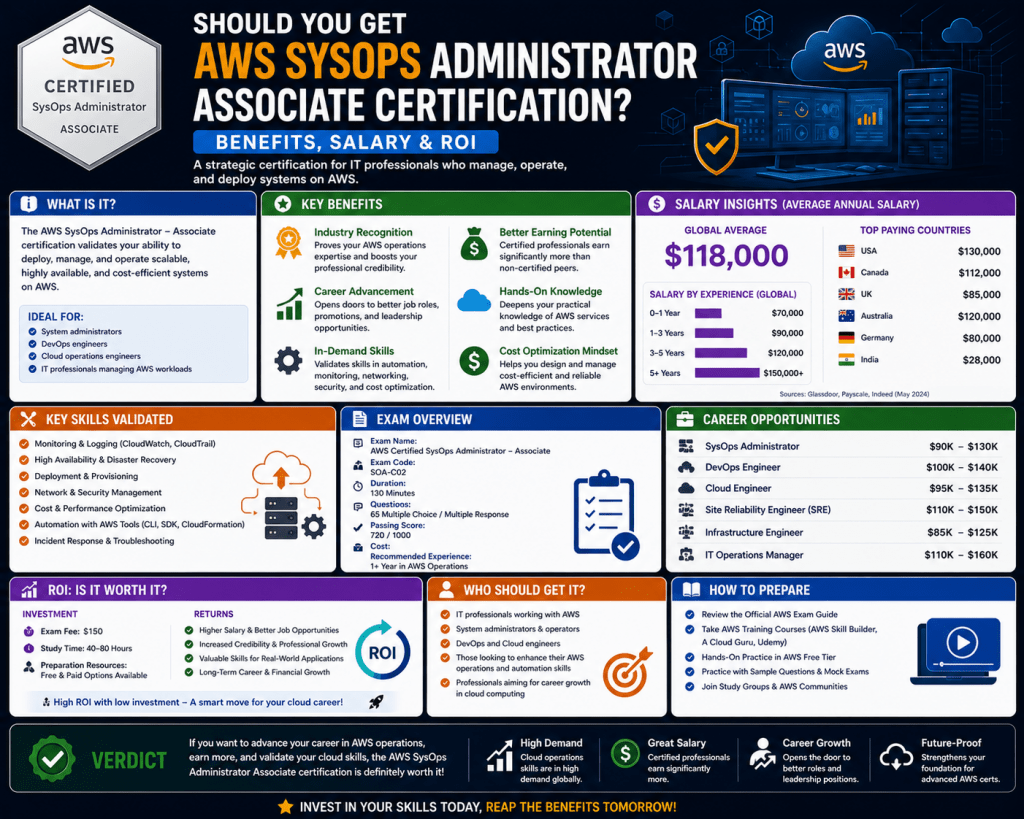
Cloud computing has fundamentally changed how modern IT systems are designed, deployed, and maintained. Organizations across industries now rely on scalable cloud platforms to host applications, manage data, and deliver services globally. Among the leading providers in this space, Amazon Web Services has established a dominant position by offering a highly diverse ecosystem of cloud tools and infrastructure services. As adoption continues to grow, demand for skilled professionals to manage cloud environments efficiently has increased significantly. This shift has made certifications an important benchmark for validating real-world technical capability. The AWS SysOps Administrator Associate certification is one of the most recognized credentials focused specifically on cloud operations and system management. It is designed for individuals who are actively involved in administering, monitoring, and maintaining cloud-based systems in production environments. Unlike entry-level certifications that emphasize conceptual understanding, this certification focuses heavily on operational execution and hands-on technical ability. It is widely considered one of the more demanding associate-level certifications due to its broad scope and practical focus. Professionals pursuing this certification are expected to demonstrate a strong understanding of cloud infrastructure, including deployment strategies, system monitoring, security implementation, and operational optimization. The certification reflects real-world responsibilities, making it highly relevant for system administrators, cloud engineers, and IT professionals working in operational roles.
Core purpose and real-world relevance of AWS SysOps certification
The primary goal of the AWS SysOps Administrator Associate certification is to validate the ability to manage cloud infrastructure in a production environment. It is not limited to theoretical knowledge but instead emphasizes practical skills required to maintain reliable and efficient systems. This includes managing cloud resources, ensuring system availability, optimizing performance, and implementing operational best practices. In real-world IT environments, systems must remain stable, secure, and responsive under varying workloads. This certification ensures that professionals are capable of meeting these demands by applying structured operational methodologies. One of its key strengths is its focus on end-to-end system management, which includes provisioning resources, configuring services, and maintaining operational health. It also emphasizes the importance of monitoring system behavior and responding to performance issues in real time. In addition, professionals are expected to understand how to implement cost-effective strategies that optimize resource usage without compromising performance. This balance between efficiency and reliability is a core principle of cloud operations and is heavily reflected throughout the certification objectives. Another important aspect of its relevance is its alignment with modern cloud adoption trends. As organizations migrate from traditional infrastructure to cloud-based systems, the need for professionals who understand operational cloud management has become critical. This certification helps bridge that skill gap by focusing on the practical challenges of running cloud environments at scale.
Scope of skills validated through the certification
The certification covers a wide range of operational skills that are essential for managing cloud environments effectively. These skills are grouped into several functional areas that reflect the daily responsibilities of cloud operations professionals. One of the primary skill areas is system deployment and provisioning, which involves creating and configuring cloud resources based on specific requirements. This includes understanding how to select appropriate services, configure infrastructure components, and ensure that deployments are executed efficiently. Another critical skill area is monitoring and reporting, which focuses on maintaining visibility into system performance and operational health. Professionals must be able to track metrics, analyze performance data, and respond to system alerts promptly. Security and compliance are also major components of the certification. Candidates are expected to understand how to implement access controls, manage identity and permissions, and ensure that systems comply with organizational and industry standards. Networking is another essential area, requiring knowledge of how cloud systems communicate internally and externally. This includes configuring virtual networks, troubleshooting connectivity issues, and ensuring secure data transmission. Storage and data management skills are also evaluated, particularly in relation to data retention, backup strategies, and encryption practices. Additionally, automation and optimization play a key role in modern cloud operations. Professionals must be able to automate repetitive tasks, streamline workflows, and optimize resource usage to improve efficiency and reduce operational overhead. Together, these skill areas ensure that certified individuals are capable of managing complex cloud environments in a structured and efficient manner.
Importance of monitoring and operational visibility in cloud environments
Monitoring plays a central role in cloud system management because it provides continuous insight into the health and performance of infrastructure components. Without proper monitoring, it becomes difficult to identify issues before they impact system performance or user experience. The certification places strong emphasis on understanding how to implement monitoring solutions that track key performance indicators across cloud resources. This includes identifying relevant metrics, setting up alerting mechanisms, and interpreting system data to detect anomalies. Operational visibility is not limited to technical performance alone but also includes understanding system behavior under different workloads. This helps professionals anticipate potential bottlenecks and take proactive measures to prevent downtime. Monitoring also supports capacity planning by providing data that helps predict future resource needs. In addition, effective monitoring enables faster troubleshooting by quickly isolating the root cause of system issues. This reduces downtime and improves overall system reliability. The ability to interpret monitoring data and take corrective action is a critical skill for cloud operations professionals, as it directly impacts system stability and performance efficiency. In modern IT environments, where systems are expected to operate continuously with minimal interruption, monitoring is not optional but essential.
Deployment, provisioning, and system lifecycle management
Deployment and provisioning represent the foundational steps in cloud operations, as they involve creating and configuring the infrastructure required to run applications and services. The certification emphasizes the ability to deploy resources in a structured and repeatable manner. This includes understanding how to define infrastructure requirements, select appropriate services, and configure systems for optimal performance. Provisioning is not limited to initial setup but also includes ongoing management of system resources throughout their lifecycle. This involves scaling resources up or down based on demand, updating configurations, and ensuring that systems remain aligned with operational requirements. Lifecycle management also includes addressing deployment issues that may arise during implementation. This requires strong problem-solving skills and the ability to quickly identify and resolve configuration errors or performance bottlenecks. In cloud environments, deployment processes are often automated to improve efficiency and consistency. Understanding how to leverage automation tools is therefore an important part of this skill area. Proper deployment and provisioning practices ensure that systems are reliable, scalable, and capable of meeting business demands without interruption.
Security principles and compliance in cloud operations
Security is a fundamental aspect of cloud computing and plays a critical role in system operations. The certification emphasizes the importance of implementing strong security controls to protect data and infrastructure. This includes managing user access, configuring identity and authentication mechanisms, and enforcing security policies across cloud resources. One of the key principles covered is the shared responsibility model, which defines how security responsibilities are divided between the cloud provider and the customer. Understanding this model is essential for ensuring that all security requirements are properly addressed. Compliance is another important consideration, particularly for organizations that must adhere to regulatory standards. Professionals must be able to implement controls that ensure data protection, encryption, and secure access management. Security also extends to network configurations, where proper design can prevent unauthorized access and reduce vulnerability exposure. In addition, monitoring security events and responding to potential threats is a critical operational responsibility. Effective security management requires continuous attention and proactive measures to ensure that systems remain protected against evolving risks.
Networking and communication within cloud systems
Networking is a core component of cloud operations, as it enables communication between different system components and external users. The certification includes a strong focus on understanding how cloud networking functions and how to manage it effectively. This involves configuring virtual networks, managing routing rules, and ensuring secure data transmission between resources. Professionals must also be able to troubleshoot network connectivity issues, which requires a deep understanding of how data flows within cloud environments. Networking in the cloud is more dynamic than traditional infrastructure, as resources can be created and modified rapidly. This requires flexible and scalable network configurations that can adapt to changing demands. Security also plays an important role in networking, as proper configuration can help prevent unauthorized access and protect sensitive data. In addition, networking supports system performance by ensuring that data is transmitted efficiently between services. Understanding these principles is essential for maintaining reliable and high-performing cloud systems.
Automation, optimization, and operational efficiency
Automation has become a key component of modern cloud operations due to its ability to reduce manual effort and improve consistency. The certification emphasizes the importance of using automation tools to streamline repetitive tasks and improve operational efficiency. This includes automating system deployment, configuration management, and monitoring processes. Automation not only saves time but also reduces the likelihood of human error, which can significantly impact system stability. Optimization is closely related to automation and focuses on improving resource utilization and reducing operational costs. This involves analyzing system performance and making adjustments to ensure that resources are used efficiently. Cost optimization is particularly important in cloud environments, where usage-based pricing models can lead to increased expenses if not properly managed. Professionals must be able to identify underutilized resources and implement strategies to improve efficiency. Together, automation and optimization contribute to more efficient, scalable, and cost-effective cloud operations.
Aws sysops administrator associate certification experience requirements and foundational knowledge
Building a strong foundation for the AWS SysOps Administrator Associate certification begins with understanding the level of practical experience expected from candidates. Although there are no mandatory prerequisites imposed by the certification body, the exam is structured in a way that assumes familiarity with real-world cloud environments. This means that theoretical learning alone is not sufficient for success. Candidates are expected to have hands-on exposure to system administration tasks within cloud platforms, particularly those involving operational management, deployment, and troubleshooting.
A typical candidate profile includes individuals with at least some experience working in IT operations or system administration roles. This experience may involve managing servers, configuring networks, handling system monitoring tools, or supporting application environments. Exposure to cloud-based systems is highly beneficial, especially when it involves working directly with cloud services, command-line tools, and automation frameworks.
Understanding basic infrastructure concepts is essential. This includes knowledge of how computing resources are allocated, how storage systems function, and how networks are structured. While these concepts exist in traditional IT environments, cloud computing introduces additional layers of abstraction and flexibility that must be understood in context.
The certification also assumes familiarity with operating systems, particularly Linux and Windows environments. Many cloud workloads run on virtual machines that require system-level configuration and maintenance. Candidates should be comfortable navigating system interfaces, managing services, and troubleshooting performance issues.
Although not required, exposure to scripting and automation tools provides a significant advantage. Cloud environments often rely on automation to manage resources efficiently, and understanding how to use scripts for repetitive tasks helps improve operational effectiveness.
Importance of hands-on cloud experience in sysops preparation
Hands-on experience plays a critical role in preparing for the AWS SysOps Administrator Associate certification. Unlike purely theoretical exams, this certification evaluates the ability to apply knowledge in practical scenarios. This means that candidates must be able to interact with cloud services directly and understand how different components behave in real environments.
Working with cloud infrastructure allows candidates to develop a deeper understanding of how services interact. For example, deploying a virtual server is not just about creating a resource but also involves configuring networking, security, storage, and monitoring. Each of these components must be properly aligned to ensure system stability.
Practical experience also helps candidates become familiar with troubleshooting scenarios. In real-world environments, systems do not always behave as expected. Issues such as performance degradation, connectivity failures, or configuration errors are common. Being able to diagnose and resolve these issues is a key skill evaluated in the certification.
Another important aspect of hands-on experience is familiarity with automation tools. Cloud environments often use infrastructure-as-code approaches to manage resources. Understanding how to deploy and configure systems using automated templates improves efficiency and reduces manual errors.
Candidates who regularly work with cloud services develop intuition about system behavior. This intuition is valuable during the exam, as it helps in analyzing scenario-based questions and selecting the most appropriate solutions.
The role of system administration experience in cloud operations
System administration experience forms the backbone of preparation for this certification. Traditional system administration involves managing servers, maintaining software, ensuring system uptime, and handling user access. These responsibilities translate directly into cloud environments, although the tools and methods may differ.
In cloud systems, administrators are responsible for managing virtualized infrastructure rather than physical hardware. This includes provisioning virtual machines, configuring storage volumes, and managing network settings. The core principles remain the same, but the execution is more dynamic and scalable.
Understanding system performance is a key aspect of administration. Administrators must monitor resource usage, identify bottlenecks, and implement solutions to maintain optimal performance. This includes managing CPU usage, memory allocation, and disk performance.
Security management is also a critical responsibility. System administrators must ensure that only authorized users have access to resources and that systems are protected against unauthorized activity. This involves configuring authentication mechanisms, managing permissions, and implementing security policies.
In cloud environments, system administration extends to managing distributed systems. Unlike traditional setups where systems may be localized, cloud infrastructure often spans multiple regions and availability zones. This requires a broader understanding of system architecture and data flow.
Cloud infrastructure fundamentals and operational concepts
A strong understanding of cloud infrastructure is essential for success in this certification. Cloud infrastructure refers to the collection of computing resources, storage systems, and networking components that form the foundation of cloud services. These resources are typically abstracted and delivered as services that can be configured and managed on demand.
One of the key advantages of cloud infrastructure is scalability. Resources can be adjusted dynamically based on workload requirements. This means that systems can handle varying levels of traffic without requiring manual intervention.
Another important concept is elasticity, which refers to the ability of systems to automatically scale resources up or down. This ensures that performance remains consistent while optimizing resource usage.
High availability is also a core principle of cloud infrastructure. Systems are designed to remain operational even in the event of component failures. This is achieved through redundancy, load balancing, and distributed architecture.
Understanding these concepts is essential for managing cloud systems effectively. They form the foundation for many operational decisions, including deployment strategies, monitoring approaches, and cost optimization techniques.
Monitoring systems and performance management in cloud environments
Monitoring is one of the most critical aspects of cloud operations. It involves continuously tracking system performance and identifying potential issues before they impact users. Effective monitoring provides visibility into how systems are functioning and helps ensure stability and reliability.
In cloud environments, monitoring typically involves collecting metrics such as CPU usage, memory consumption, network traffic, and disk performance. These metrics provide insights into system behavior and help identify anomalies.
Performance management goes beyond simple monitoring. It involves analyzing collected data and making informed decisions to improve system efficiency. This may include adjusting resource allocations, optimizing configurations, or scaling systems to handle increased demand.
Alerting mechanisms are also an important part of monitoring systems. Alerts notify administrators when certain thresholds are exceeded or when abnormal behavior is detected. This enables rapid response to potential issues.
Monitoring also plays a role in capacity planning. By analyzing historical data, administrators can predict future resource needs and plan accordingly. This helps prevent system overloads and ensures smooth operation.
Deployment strategies and infrastructure provisioning techniques
Deployment and provisioning are central to cloud operations. They involve creating and configuring infrastructure components required to run applications and services. In cloud environments, this process is often automated to ensure consistency and efficiency.
Provisioning begins with defining infrastructure requirements. This includes determining the type of resources needed, such as virtual machines, storage systems, and networking components. Once requirements are defined, resources are allocated and configured accordingly.
Deployment strategies vary depending on the application and workload requirements. Some systems require gradual rollouts, while others may use full-scale deployments. Understanding different deployment approaches is essential for minimizing risk and ensuring system stability.
Infrastructure provisioning also involves lifecycle management. Resources must be maintained, updated, and scaled as needed. This requires continuous monitoring and adjustment based on system performance and demand.
Troubleshooting deployment issues is another important skill. Problems may arise due to configuration errors, resource limitations, or compatibility issues. Being able to identify and resolve these problems quickly is critical for maintaining system reliability.
Security implementation and access control in cloud systems
Security is a foundational element of cloud operations. It involves protecting systems, data, and applications from unauthorized access and potential threats. In cloud environments, security is implemented through a combination of policies, tools, and best practices.
Access control is one of the primary components of cloud security. It determines who can access specific resources and what actions they are allowed to perform. Proper access management helps prevent unauthorized activity and reduces security risks.
Identity management is also a key aspect of security. It involves verifying user identities and ensuring that only authorized individuals can access systems. This often includes multi-factor authentication and role-based access control.
Data protection is another critical area. Sensitive information must be encrypted both at rest and in transit to prevent unauthorized access. Encryption ensures that even if data is intercepted, it cannot be read without proper authorization.
Security also includes monitoring for suspicious activity. This involves tracking system logs, analyzing access patterns, and identifying potential threats.
Networking fundamentals and connectivity in cloud environments
Networking is essential for enabling communication between cloud resources. It involves configuring how systems connect and exchange data within and outside the cloud environment.
Virtual networks are commonly used to isolate and organize resources. These networks allow administrators to define communication rules and control traffic flow.
Routing plays a key role in directing data between different systems. Proper routing ensures that data reaches its destination efficiently and securely.
Connectivity between on-premises systems and cloud infrastructure is also important. Many organizations use hybrid environments that combine both traditional and cloud-based systems.
Troubleshooting network issues requires understanding how data flows through different components. This includes identifying bottlenecks, misconfigurations, and connectivity failures.
Automation and operational efficiency in cloud management
Automation is a key driver of efficiency in cloud environments. It reduces manual workload and ensures consistency across operations.
Automated deployment processes allow systems to be configured and launched without manual intervention. This improves speed and reduces errors.
Automation is also used for monitoring and alerting. Systems can automatically detect issues and trigger responses without human involvement.
Operational efficiency is achieved by optimizing resource usage and reducing waste. This includes scaling resources based on demand and shutting down unused systems.
Automation also supports compliance by ensuring that systems follow predefined configurations and policies.
Cost management and resource optimization strategies
Cost management is an important aspect of cloud operations. Since cloud resources are typically billed based on usage, inefficient management can lead to unnecessary expenses.
Resource optimization involves analyzing system usage and adjusting configurations to improve efficiency. This may include resizing resources, eliminating unused components, or improving workload distribution.
Cost tracking tools help administrators monitor spending and identify areas where costs can be reduced.
Effective cost management ensures that organizations maximize the value of their cloud investments while maintaining performance and reliability.
Preparation mindset for cloud operational certification success
Preparing for this certification requires a combination of theoretical understanding and practical experience. Candidates must develop the ability to analyze complex scenarios and apply appropriate solutions.
A structured learning approach helps in covering all required domains systematically. Hands-on practice is essential for reinforcing concepts and building confidence.
Consistency in preparation is important, as cloud operations involve multiple interconnected systems. Understanding how these systems interact improves decision-making ability.
Developing problem-solving skills is also critical. Many exam scenarios require analyzing situations and selecting the most effective solution based on operational requirements.
A strong preparation mindset focuses on continuous learning, practical application, and conceptual clarity.
Career Impact of AWS SysOps Administrator Associate Certification in the Modern IT Industry
The AWS SysOps Administrator Associate certification plays a significant role in shaping career opportunities in modern cloud-driven IT environments. As organizations continue to adopt cloud-first strategies, professionals who can manage and operate cloud infrastructure efficiently are becoming increasingly valuable. This certification is widely recognized as a practical validation of operational cloud skills, making it relevant for a variety of technical roles.
In many IT organizations, cloud operations have replaced traditional on-premises system management. This shift has created a demand for professionals who understand how to maintain availability, security, and performance in distributed cloud systems. The certification directly aligns with these needs by focusing on real-world operational responsibilities.
Professionals who hold this certification are often considered for roles that involve system administration, cloud operations engineering, infrastructure support, and DevOps-related responsibilities. These roles require the ability to manage dynamic environments where resources are constantly changing based on demand.
One of the key career impacts of this certification is improved employability. Employers often view it as evidence that a candidate possesses hands-on cloud experience and understands operational best practices. This can help candidates stand out in competitive job markets where cloud skills are in high demand.
Another important aspect is career progression. The certification serves as a foundation for more advanced cloud roles. It helps professionals transition from traditional IT roles into cloud-focused positions, opening opportunities for higher-level responsibilities and specialized domains.
How sysops certification aligns with systems administrator roles
Systems administrators form the backbone of IT infrastructure management, and the AWS SysOps Administrator Associate certification aligns closely with their responsibilities. In traditional environments, system administrators manage servers, maintain networks, handle software updates, and ensure system availability. In cloud environments, these responsibilities evolve but remain fundamentally similar.
In cloud-based systems, administrators are responsible for managing virtual machines instead of physical servers. They configure operating systems, monitor performance, and ensure that applications run smoothly. The certification validates these skills within a cloud context, ensuring that professionals can handle modern infrastructure environments.
A key part of this alignment is system monitoring. Administrators must continuously observe system behavior to ensure optimal performance. This includes tracking resource usage, identifying bottlenecks, and responding to system alerts.
Security management is another overlapping responsibility. System administrators must enforce access controls, manage user permissions, and ensure that systems are protected from unauthorized access. In cloud environments, this becomes more complex due to distributed architectures.
The certification also supports automation skills, which are increasingly important for system administrators. Automating routine tasks helps reduce manual workload and improve consistency across systems.
Overall, the certification enhances the skill set of system administrators by aligning traditional responsibilities with modern cloud operations practices.
Role of certification in cloud engineering and DevOps environments
Cloud engineering and DevOps practices rely heavily on automation, scalability, and continuous monitoring. The AWS SysOps Administrator Associate certification supports these principles by focusing on operational efficiency and infrastructure management.
In DevOps environments, development and operations teams work closely together to deliver applications rapidly and reliably. This requires strong knowledge of deployment pipelines, infrastructure automation, and system monitoring.
The certification helps professionals understand how to manage infrastructure as code, which is a core DevOps concept. This involves defining infrastructure configurations in a programmatic way, allowing systems to be deployed consistently and efficiently.
Monitoring and feedback loops are also essential in DevOps workflows. The certification emphasizes the ability to track system performance and respond quickly to issues, which aligns with continuous improvement practices.
Cloud engineers benefit from the certification because it strengthens their ability to design and maintain scalable systems. It provides practical knowledge of resource provisioning, network configuration, and system optimization.
Automation is a central theme in both cloud engineering and DevOps. The certification reinforces the importance of reducing manual processes and improving operational efficiency through automation tools.
Importance of operational skills in cloud-based job roles
Operational skills are at the core of cloud-based job roles. Unlike traditional IT environments, where systems are relatively static, cloud environments are dynamic and constantly changing. This requires professionals to have strong operational capabilities.
One of the most important operational skills is system monitoring. Professionals must be able to observe system behavior and detect anomalies before they escalate into major issues.
Another critical skill is troubleshooting. Cloud environments often involve complex architectures with multiple interconnected services. Identifying the root cause of issues requires a structured approach and a deep understanding of system interactions.
Resource management is also essential. Professionals must ensure that cloud resources are used efficiently and scaled appropriately based on demand.
Security operations are another key area. This includes managing access controls, monitoring for suspicious activity, and ensuring compliance with security policies.
The certification reinforces all of these operational skills, making it highly relevant for job roles that require hands-on cloud management experience.
Cloud migration and enterprise transformation relevance
Many organizations are currently undergoing cloud migration initiatives, moving from traditional infrastructure to cloud-based systems. This transformation requires careful planning and execution to ensure minimal disruption to business operations.
The certification includes knowledge areas that are directly relevant to migration projects. This includes understanding how to move workloads from on-premises environments to cloud platforms, configuring resources appropriately, and ensuring data integrity during the transition.
Migration is not just a technical process but also an operational challenge. Systems must remain available during the transition, and performance must not degrade. This requires careful coordination and monitoring.
The certification also emphasizes cost considerations during migration. Cloud adoption can introduce new pricing models, and professionals must understand how to manage these costs effectively.
Enterprise transformation goes beyond migration and includes ongoing optimization of cloud systems. This involves continuously improving performance, security, and efficiency after migration is complete.
Professionals with this certification are often involved in planning and executing these transformation initiatives, making it highly relevant for enterprise IT environments.
Monitoring, incident response, and system reliability engineering
Monitoring and incident response are essential components of cloud operations. Systems must be continuously observed to ensure reliability and performance.
Incident response involves identifying, analyzing, and resolving system issues as quickly as possible. This requires strong analytical skills and the ability to work under pressure.
System reliability engineering focuses on designing systems that are resilient and capable of handling failures without significant impact. This includes implementing redundancy, failover mechanisms, and automated recovery processes.
The certification emphasizes these principles by requiring candidates to understand how to maintain system availability and respond to operational issues.
Monitoring tools provide the data needed for incident detection. These tools track system performance and generate alerts when anomalies are detected.
Effective incident response requires structured procedures and clear escalation paths. Professionals must be able to quickly assess the severity of issues and take appropriate action.
Reliability engineering ensures that systems are designed to minimize downtime and maintain consistent performance.
Automation in modern cloud operations and infrastructure management
Automation has become a fundamental part of modern cloud operations. It allows organizations to manage complex systems efficiently while reducing manual effort.
Infrastructure automation involves defining system configurations programmatically. This ensures that environments can be replicated consistently across different stages.
Automation is also used for deployment processes. Applications can be deployed automatically based on predefined workflows, reducing human intervention.
Monitoring automation allows systems to detect issues and respond without manual input. This improves response times and system reliability.
Backup and recovery processes can also be automated, ensuring that data is protected and can be restored quickly in case of failure.
The certification emphasizes the importance of automation in reducing operational overhead and improving efficiency.
Security operations and governance in cloud environments
Security operations are critical in cloud environments due to the distributed and shared nature of infrastructure.
Governance involves defining policies and controls that regulate how systems are used. This includes access management, data protection, and compliance requirements.
Identity and access management is a core component of cloud security. It ensures that only authorized users can access specific resources.
Encryption is used to protect data both in transit and at rest. This ensures that sensitive information remains secure even if intercepted.
Security monitoring involves tracking system activity and identifying potential threats. This requires continuous observation and analysis.
The certification reinforces these concepts by focusing on practical security implementation within cloud environments.
Network architecture and distributed system communication
Cloud systems rely heavily on network architecture to enable communication between components.
Virtual networks allow resources to be logically grouped and isolated. This improves security and organization.
Routing mechanisms determine how data flows between systems. Proper routing ensures efficient communication and reduced latency.
Load balancing distributes traffic across multiple resources to improve performance and availability.
Network troubleshooting is an important skill that involves identifying connectivity issues and resolving them quickly.
Understanding distributed system communication is essential for managing cloud-based applications effectively.
Cost optimization and resource efficiency in cloud environments
Cost optimization is a key responsibility in cloud operations. Since cloud resources are billed based on usage, inefficient management can lead to high expenses.
Resource efficiency involves ensuring that systems use only the necessary amount of computing power, storage, and networking resources.
Scaling strategies help adjust resource allocation based on demand. This ensures that performance remains stable while minimizing costs.
Cost monitoring tools provide insights into usage patterns and help identify areas for optimization.
Unnecessary resources should be identified and removed to reduce waste.
The certification emphasizes the importance of balancing performance with cost efficiency.
Conclusion
The AWS SysOps Administrator Associate certification represents a significant milestone for professionals aiming to build or strengthen a career in cloud operations. It is not simply a credential that validates theoretical knowledge, but rather one that reflects practical capability in managing real-world cloud environments. In today’s IT landscape, where cloud computing has become the default foundation for modern infrastructure, the importance of operational expertise cannot be overstated. Organizations depend heavily on professionals who can ensure that systems remain reliable, secure, scalable, and cost-efficient, and this certification is closely aligned with those expectations.
One of the most important takeaways from studying this certification is the emphasis on applied knowledge. Many IT roles today require more than just understanding how systems work in theory. They demand the ability to configure, monitor, troubleshoot, and optimize systems in dynamic environments where workloads can change rapidly. The certification reinforces this reality by focusing heavily on scenario-based operational tasks. This approach ensures that individuals who pursue it develop a mindset that is oriented toward solving real problems rather than memorizing abstract concepts.
Another key aspect is the way this certification bridges the gap between traditional IT infrastructure and modern cloud systems. Many professionals entering cloud computing come from backgrounds in system administration, networking, or infrastructure support. While the foundational principles remain similar, cloud environments introduce new layers of complexity, including virtualization, distributed architecture, automation, and pay-as-you-go resource models. The certification helps professionals transition smoothly into this new paradigm by reinforcing how traditional skills apply within cloud ecosystems while also introducing cloud-specific operational practices.
The relevance of monitoring and system reliability also stands out as a core strength of this certification. In cloud environments, systems are expected to operate continuously with minimal downtime. This requires constant visibility into performance metrics, proactive identification of potential issues, and rapid response to incidents. Professionals who develop expertise in these areas become essential contributors to organizational stability. They are not just maintaining systems; they are actively ensuring business continuity. This operational awareness is one of the most valuable outcomes of pursuing this certification.
Security is another dimension that carries significant weight throughout the certification’s scope. As cloud adoption increases, so do concerns around data protection, identity management, and compliance. The certification emphasizes a strong understanding of access control mechanisms, encryption practices, and security monitoring. This is particularly important because cloud environments often operate under shared responsibility models, where both the provider and the customer play roles in maintaining security. Understanding how to implement and manage security controls within this framework is essential for any cloud operations professional.
The certification also highlights the growing importance of automation in modern IT environments. Manual processes are no longer sufficient for managing complex, scalable systems. Automation enables consistency, reduces human error, and improves efficiency across operations. By focusing on automation and optimization, the certification encourages professionals to think in terms of scalable solutions rather than individual tasks. This mindset shift is critical in environments where infrastructure must adapt quickly to changing demands.
Cost management is another practical area where this certification provides long-term value. Cloud computing introduces flexible pricing models, but without proper oversight, costs can quickly escalate. Professionals trained in sysops practices learn how to monitor resource usage, identify inefficiencies, and implement optimization strategies. This not only benefits organizations financially but also reinforces the importance of responsible resource management in cloud operations. It teaches professionals to think beyond technical performance and consider business impact as well.
From a career development perspective, this certification serves as a strong foundation for advancement into more specialized and senior roles. It provides a broad understanding of cloud operations that can be applied across various career paths, including cloud engineering, DevOps, infrastructure architecture, and security operations. Because it covers such a wide range of operational domains, it prepares professionals for the interconnected nature of cloud environments. This versatility makes it a valuable stepping stone for individuals planning to progress into advanced certifications or leadership roles in cloud infrastructure.
Another important outcome of pursuing this certification is the development of structured problem-solving skills. Cloud environments are complex, and issues often involve multiple interconnected systems. Professionals must be able to analyze situations systematically, identify root causes, and apply effective solutions. This analytical approach is reinforced throughout the certification content, helping individuals develop a disciplined way of thinking that is applicable far beyond cloud computing.
It is also worth noting that the certification promotes continuous learning and adaptability. Cloud technologies evolve rapidly, with new services, tools, and best practices emerging regularly. Professionals who engage with this certification are encouraged to stay updated and continuously refine their skills. This adaptability is essential in a field where long-term success depends on the ability to evolve alongside technology.
In terms of professional recognition, holding this certification signals to employers that an individual has practical, hands-on experience with cloud operations. It demonstrates that the candidate is not only familiar with cloud concepts but also capable of applying them in real-world environments. This distinction is particularly valuable in competitive job markets where employers seek candidates who can contribute immediately to operational efficiency and system reliability.
Overall, the AWS SysOps Administrator Associate certification represents more than just an academic achievement. It reflects a comprehensive understanding of cloud operations, combining technical knowledge with practical application. It prepares professionals to handle the challenges of modern IT infrastructure, where systems are distributed, dynamic, and highly dependent on continuous optimization. By focusing on real-world operational skills, it equips individuals with the ability to manage cloud environments effectively and confidently.
For anyone working in or transitioning into cloud computing, this certification offers a structured path to building essential operational expertise. It strengthens foundational knowledge, enhances practical skills, and opens doors to a wide range of career opportunities. As cloud adoption continues to expand globally, the value of such operational certifications is likely to increase even further, making it a meaningful investment in long-term professional growth.