
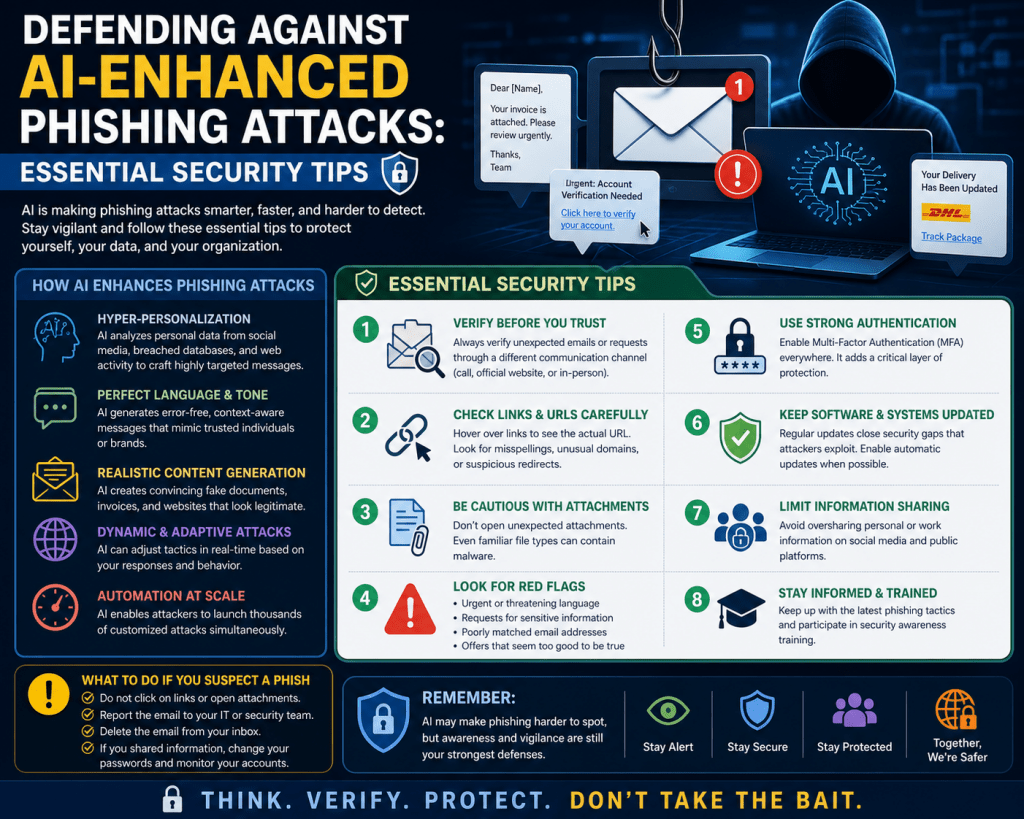
Phishing attacks have undergone a fundamental transformation with the rise of artificial intelligence, shifting from crude, easily detectable scams into highly adaptive and precision-targeted cyber threats. In earlier phases of digital communication, phishing relied on simplicity and scale. Attackers would distribute mass emails to thousands or even millions of recipients, hoping that a small fraction would fall victim. These messages were typically easy to identify due to poor grammar, inconsistent formatting, suspicious sender addresses, and exaggerated claims that often lacked contextual relevance. The classic “Nigerian prince” style scam became symbolic of this era, representing a low-effort but wide-reaching approach to cyber deception.
The introduction of AI technologies has completely reshaped this landscape. Instead of relying on volume, attackers now prioritize accuracy, personalization, and behavioral manipulation. Machine learning models and generative AI systems enable cybercriminals to craft messages that closely mirror legitimate communication patterns within organizations. These systems can analyze vast datasets from publicly available sources, including professional networking platforms, corporate websites, and social media profiles. By extracting contextual information such as job titles, internal team structures, and communication styles, AI systems can generate phishing messages that appear highly relevant and credible.
Modern phishing campaigns no longer rely on obvious deception. Instead, they integrate seamlessly into everyday digital communication. A fraudulent email may resemble an internal memo, a vendor invoice, or a routine project update. This evolution significantly increases the likelihood of user interaction because the message aligns with expected workplace behavior. The psychological barrier that once protected users from obvious scams is now weakened by the realism of AI-generated content.
Transition from Mass Phishing to Hyper-Personalized Targeting
One of the most significant advancements introduced by artificial intelligence is the transition from generalized phishing attacks to hyper-personalized targeting strategies. In traditional phishing models, attackers focused on casting a wide net, sending identical messages to large groups of users without any customization. While inefficient, this approach still produced results due to the sheer volume of attempts.
AI has replaced this outdated model with data-driven personalization. Machine learning algorithms can now process and analyze publicly accessible digital footprints to construct detailed profiles of individuals. These profiles often include professional roles, recent projects, organizational hierarchies, communication preferences, and even behavioral tendencies inferred from online activity. With this information, attackers can generate messages that appear highly specific and contextually accurate.
For example, instead of receiving a generic greeting such as “Dear user,” a target may receive a message referencing a recent meeting, internal project discussion, or financial approval process. The language used in these messages is carefully structured to match the tone and communication style of the organization being impersonated. This level of personalization significantly increases trust, as recipients are more likely to believe that the communication originates from a legitimate internal source.
AI-driven natural language generation plays a central role in this transformation. These systems can replicate sentence structure, vocabulary patterns, and even emotional tone. As a result, phishing messages no longer contain the linguistic errors that previously served as warning signs. The absence of obvious mistakes makes detection significantly more challenging, even for individuals with cybersecurity awareness.
Psychological Manipulation and Behavioral Exploitation Through AI
Beyond technical sophistication, AI-powered phishing introduces a deeper layer of psychological manipulation. Traditional phishing attacks often relied on basic emotional triggers such as fear, curiosity, or urgency. However, AI systems enable attackers to refine these triggers based on behavioral analysis and contextual understanding.
By analyzing communication patterns and digital behavior, AI can infer psychological traits such as risk tolerance, responsiveness to authority, and decision-making speed. This allows attackers to tailor messages that exploit specific cognitive vulnerabilities. For instance, individuals who frequently respond to urgent requests may be targeted with time-sensitive financial instructions, while those in administrative roles may receive messages related to compliance or system updates.
The effectiveness of these strategies lies in their subtlety. Instead of forcing action through obvious threats, AI-generated phishing messages create a sense of natural workflow disruption. The recipient perceives the message as part of normal operations rather than an external attack attempt. This blending of malicious intent with routine communication significantly reduces suspicion and increases compliance rates.
Authority-based manipulation is another commonly used technique. AI systems can replicate the tone and structure of senior executives or organizational leaders, making instructions appear legitimate. When combined with urgency, this creates a powerful psychological pressure that can override rational decision-making processes.
Expansion of Phishing Across Multiple Digital Communication Channels
Phishing is no longer confined to email-based communication. AI technologies have enabled attackers to expand their reach across multiple digital platforms, including voice calls, messaging applications, and video conferencing systems. This diversification increases the complexity of detection and expands the range of potential attack vectors.
Voice-based phishing, enhanced through AI-driven speech synthesis, allows attackers to replicate the voices of trusted individuals with high accuracy. These synthetic voices can be used in phone calls to request sensitive information, authorize transactions, or manipulate employees into bypassing security protocols. The realism of these voice models has improved significantly, making it increasingly difficult to distinguish between authentic and fabricated speech without technical verification.
Similarly, AI-generated video content has introduced a new dimension of threat. Deepfake technology enables the creation of realistic video simulations that replicate facial expressions, gestures, and environmental settings. When combined with voice cloning, these videos can simulate live interactions with executives or colleagues. This creates a powerful illusion of authenticity that can easily deceive recipients, particularly in high-pressure situations.
Messaging platforms are also heavily exploited in AI-driven phishing campaigns. Chatbots powered by generative AI can engage in real-time conversations, respond to user inquiries, and gradually build trust over extended interactions. These systems mimic human conversational behavior, making it difficult for users to recognize malicious intent. By integrating into everyday communication channels, attackers increase the likelihood of sustained engagement and successful exploitation.
AI-Enhanced Reconnaissance and Automated Attack Preparation
Artificial intelligence has also revolutionized the reconnaissance phase of phishing attacks. In traditional models, attackers manually gathered information about targets through social media research, corporate websites, and public records. This process was time-consuming and limited in scope. AI systems have automated this stage, enabling rapid and large-scale data collection.
Machine learning algorithms can scan vast amounts of publicly available data to identify organizational structures, employee relationships, and communication patterns. This information is then processed to generate detailed attack profiles. These profiles allow attackers to design highly targeted campaigns with minimal manual effort.
Automation also enables continuous adaptation. AI systems can adjust phishing strategies based on real-time feedback, improving message effectiveness over time. If a particular approach fails, the system can modify tone, structure, or content to increase success rates. This dynamic adaptability represents a major shift from static phishing campaigns to intelligent, evolving attack systems.
The scalability of AI-driven reconnaissance means that attackers can simultaneously target thousands of individuals with unique, customized messages. Each message is slightly different, reducing the likelihood of detection through pattern recognition. This variability makes it significantly more challenging for traditional security systems to identify and block phishing attempts.
Organizational Impact of AI-Driven Phishing Threats
The increasing sophistication of AI-powered phishing has significant implications for organizational security. Traditional defense mechanisms, such as spam filters and basic user awareness training, are no longer sufficient to address the evolving threat landscape. AI-generated messages can bypass conventional filtering systems due to their linguistic accuracy and contextual relevance.
Organizations face increased risk of credential theft, financial fraud, and unauthorized access to sensitive systems. The ability of AI to replicate internal communication styles means that employees may unknowingly respond to malicious requests that appear legitimate. This creates vulnerabilities not only at the individual level but across entire organizational structures.
The integration of AI into phishing strategies also increases the speed and scale of attacks. Automated systems can launch coordinated campaigns across multiple channels simultaneously, overwhelming traditional defense mechanisms. This requires organizations to adopt more advanced, adaptive security frameworks that incorporate behavioral analysis and anomaly detection.
In response to these evolving threats, cybersecurity strategies must evolve to incorporate multi-layered defense systems. These systems combine technical controls, behavioral monitoring, and continuous risk assessment to identify and mitigate potential phishing attempts. The growing sophistication of AI-driven attacks highlights the need for proactive security measures that anticipate rather than react to threats.
AI-Powered Phishing Attack Techniques and Their Operational Structure
Artificial intelligence has significantly changed the internal structure of phishing campaigns by introducing automation, scalability, and contextual intelligence. Traditional phishing operations relied heavily on manual effort, where attackers would individually design emails, collect target data, and distribute messages through bulk mailing systems. This approach was not only time-consuming but also limited in precision and adaptability.
Modern AI-powered phishing systems operate more like automated cyber-ecosystems. They integrate data collection, message generation, delivery optimization, and behavioral adaptation into a continuous workflow. Machine learning models analyze target environments, identify vulnerabilities, and generate tailored communication at scale. This allows attackers to maintain persistent engagement with victims while continuously refining their tactics based on response patterns.
These systems often begin with reconnaissance automation. AI tools scan publicly accessible sources such as professional profiles, organizational directories, and digital footprints to build structured datasets about potential targets. This data is then categorized into behavioral, professional, and contextual attributes. The result is a highly detailed profile that enables precise message targeting.
Once profiles are constructed, generative AI systems produce phishing content that aligns with the target’s environment. These messages are not static templates but dynamically generated communications that mimic human interaction patterns. The language, tone, and structure are adjusted based on the recipient’s role, industry, and communication habits. This level of customization significantly increases the likelihood of engagement.
AI-Generated Email Phishing and Contextual Message Engineering
Email remains one of the primary channels for phishing attacks, but artificial intelligence has transformed how these emails are constructed and delivered. Instead of generic spam messages, attackers now deploy AI-generated emails that closely resemble legitimate organizational communication.
Natural language generation models allow attackers to produce grammatically correct, context-aware emails that reflect real workplace interactions. These systems can replicate internal communication styles, including formal business language, informal team messaging, and vendor-client correspondence. As a result, phishing emails often blend seamlessly into regular inbox traffic.
A key advancement in this area is contextual message engineering. AI systems analyze ongoing events within an organization, such as project updates, financial cycles, or operational changes, and incorporate these elements into phishing messages. For example, an email may reference an ongoing budget review or a scheduled system update, creating a sense of relevance and urgency.
These messages often include subtle psychological triggers. Instead of relying on obvious threats or incentives, they use professional context to encourage action. The recipient may feel that the message is part of their normal workflow, reducing suspicion and increasing compliance rates. This blending of legitimate context with malicious intent represents one of the most effective aspects of AI-driven phishing.
AI-Driven Spear Phishing and Target-Specific Manipulation
Spear phishing has become significantly more dangerous with the integration of artificial intelligence. Unlike traditional phishing, which targets large groups, spear phishing focuses on specific individuals within an organization. AI enhances this approach by enabling deep personalization and behavioral targeting.
Machine learning models analyze digital behavior patterns to identify high-value targets, such as executives, financial officers, or system administrators. Once identified, AI systems construct detailed psychological and professional profiles of these individuals. These profiles include communication preferences, decision-making tendencies, and exposure to organizational workflows.
Using this information, AI generates highly tailored phishing messages that reflect the target’s daily responsibilities and communication environment. For example, a financial officer may receive a message referencing invoice approvals, while an IT administrator may be targeted with system maintenance alerts. This level of specificity increases the perceived authenticity of the message.
AI also enhances timing optimization in spear phishing campaigns. Messages are often delivered during peak working hours or aligned with known organizational events. This increases the likelihood that the recipient will engage with the message without extensive scrutiny. The combination of timing, context, and personalization makes AI-driven spear phishing highly effective.
Automated Social Engineering and Behavioral Data Exploitation
Artificial intelligence has transformed social engineering from a manual, labor-intensive process into an automated, data-driven operation. AI systems can collect and analyze behavioral data from multiple sources to construct detailed psychological profiles of individuals.
This data includes online activity, communication patterns, professional interactions, and even linguistic tendencies. Machine learning algorithms process this information to identify behavioral vulnerabilities, such as susceptibility to urgency, authority influence, or social trust cues. These insights are then used to design targeted phishing strategies.
Automated social engineering systems can simulate human-like interaction patterns over extended periods. Instead of sending a single malicious message, attackers may engage in gradual trust-building conversations. These interactions are designed to establish credibility before introducing malicious requests.
AI systems can also adapt in real time based on user responses. If a target exhibits skepticism, the system can adjust tone, provide additional context, or introduce supporting information to reinforce trust. This dynamic adaptation makes it difficult for users to identify malicious intent during interaction.
The scalability of automated social engineering is particularly concerning. A single AI system can manage thousands of simultaneous interactions, each customized to a specific target. This level of automation significantly increases the reach and efficiency of phishing campaigns.
AI-Enhanced Credential Harvesting Mechanisms
Credential theft remains one of the primary objectives of phishing attacks, and artificial intelligence has made this process more sophisticated. AI-powered phishing pages and login interfaces are now capable of dynamically adapting to user input and environmental conditions.
These systems can replicate legitimate login portals with high accuracy, including branding elements, user interface design, and interactive behavior. Once a user enters their credentials, AI systems can validate input patterns to ensure authenticity and reduce suspicion. Some systems even simulate error messages or multi-step authentication processes to enhance realism.
AI also enables adaptive credential harvesting. If a user hesitates or attempts to verify authenticity, the system can modify its behavior to appear more legitimate. This may include generating additional verification steps or displaying contextual information relevant to the organization being impersonated.
Once credentials are captured, AI systems can immediately analyze their value and potential usage. Machine learning models assess whether credentials belong to high-privilege accounts, financial systems, or administrative platforms. This prioritization allows attackers to optimize exploitation strategies and maximize impact.
Deepfake Integration in Multi-Channel Phishing Campaigns
One of the most advanced applications of artificial intelligence in phishing is the use of deepfake technology. Deepfakes enable the creation of highly realistic audio and video content that can replicate real individuals with remarkable precision.
In phishing campaigns, deepfakes are often used to impersonate executives, managers, or trusted colleagues. These impersonations can occur through video calls, recorded messages, or live simulations. The realism of facial expressions, voice tone, and environmental background significantly enhances the credibility of the attack.
Deepfake-based phishing is particularly effective in high-pressure environments. Attackers often combine synthetic media with urgent requests, creating scenarios where recipients feel compelled to act quickly. The psychological impact of seeing and hearing a familiar authority figure reduces skepticism and increases compliance.
Multi-channel integration further amplifies the effectiveness of deepfake attacks. A single campaign may include email instructions, voice confirmation, and video validation, all generated through AI systems. This layered approach creates a strong illusion of legitimacy that is difficult to counter without advanced verification mechanisms.
AI-Driven Chatbot Impersonation and Real-Time Interaction Attacks
Artificial intelligence has enabled attackers to deploy chatbot-based phishing systems that simulate real-time human interaction. These chatbots can operate across messaging platforms, customer service systems, and internal communication tools.
Unlike static phishing messages, chatbot-based attacks engage users in dynamic conversations. They can answer questions, provide instructions, and maintain contextual awareness throughout the interaction. This creates a conversational experience that closely resembles legitimate support systems.
These chatbots are often designed to impersonate IT support teams, HR departments, or customer service representatives. They can request sensitive information, guide users through fake procedures, or direct them to malicious links. The interactive nature of these systems increases trust and reduces the likelihood of detection.
AI chatbots can also adapt based on user behavior. If a user becomes suspicious, the system can modify its responses to appear more professional or authoritative. This adaptability makes chatbot-based phishing one of the most challenging threats to detect in real time.
Adaptive Learning Systems in Phishing Campaign Optimization
One of the most powerful aspects of AI-driven phishing is the ability to continuously learn and adapt. Machine learning models analyze the success and failure rates of phishing attempts to refine future campaigns.
These systems track user interactions, response times, and engagement patterns. Based on this data, they adjust message structure, tone, and delivery timing. This iterative learning process ensures that phishing campaigns become increasingly effective over time.
Adaptive systems also enable A/B testing at scale. Multiple versions of phishing messages can be deployed simultaneously, with performance metrics used to determine the most effective approach. This data-driven optimization allows attackers to refine strategies with minimal manual intervention.
The continuous learning capability of AI systems represents a major shift in phishing methodology. Instead of static campaigns, attackers now deploy evolving systems that improve automatically based on real-world feedback. This makes long-term defense significantly more complex for cybersecurity professionals.
AI-Enhanced Reconnaissance and Large-Scale Target Profiling Systems
Artificial intelligence has fundamentally reshaped the reconnaissance phase of phishing operations by replacing manual research with automated, large-scale data intelligence systems. In earlier cyberattack models, attackers would manually gather information about targets using social media browsing, company websites, public records, and professional networking platforms. This process was slow, limited in scope, and often dependent on human effort and guesswork.
With the integration of AI, reconnaissance has become a continuous and automated process. Machine learning systems are capable of scanning massive volumes of publicly available data in real time. These systems extract structured and unstructured information from digital environments, including job roles, organizational hierarchies, communication patterns, recent activities, and behavioral indicators. The collected data is then processed into detailed intelligence profiles that map relationships between individuals, departments, and operational workflows.
This profiling capability allows attackers to understand not only who their targets are, but how they function within an organization. AI systems can identify communication chains, decision-making authorities, and access privileges. This information becomes the foundation for highly targeted phishing campaigns that are designed to blend seamlessly into organizational workflows.
The automation of reconnaissance also introduces persistence. Unlike manual methods, AI-driven systems continuously update profiles as new data becomes available. This ensures that phishing campaigns remain relevant and aligned with current organizational changes. As a result, attackers maintain an evolving understanding of their targets over time, significantly increasing the effectiveness of their operations.
AI-Driven Email Impersonation and Organizational Trust Exploitation
Email-based phishing has reached a new level of sophistication due to artificial intelligence, particularly in the area of impersonation. Modern AI systems can replicate internal communication styles with high accuracy, allowing attackers to mimic colleagues, executives, vendors, and service providers.
These systems analyze linguistic patterns, writing styles, and communication structures to generate emails that closely resemble legitimate organizational messages. The result is communication that integrates naturally into workplace environments, making detection significantly more difficult. Instead of obvious signs of fraud, recipients encounter messages that align with their expectations and routine interactions.
A critical element of AI-driven impersonation is trust exploitation. Attackers leverage authority cues, familiarity signals, and contextual relevance to increase credibility. For example, a message may appear to originate from a senior executive referencing ongoing operational tasks or financial approvals. The tone is often authoritative yet familiar, encouraging immediate compliance without suspicion.
AI systems also enhance threat hijacking capabilities. Instead of initiating new conversations, attackers can generate responses within existing email threads. This technique increases authenticity, as the message appears as part of an ongoing discussion. The integration of AI into email ecosystems has therefore transformed phishing into a seamless extension of legitimate communication flows.
AI-Based Voice Phishing and Synthetic Audio Manipulation
Voice phishing, commonly referred to as vishing, has become significantly more dangerous with the introduction of AI-driven voice synthesis technologies. These systems can replicate human voices with remarkable accuracy by analyzing short audio samples and generating synthetic speech patterns that match tone, cadence, and emotional expression.
Attackers use AI-generated voices to impersonate trusted individuals such as executives, managers, or IT personnel. These synthetic voices are often deployed in phone calls or voice messages that request urgent actions, such as transferring funds, sharing credentials, or approving sensitive transactions. The realism of these voices reduces skepticism and increases compliance rates among victims.
A key factor in the effectiveness of AI voice phishing is emotional manipulation. Synthetic voices can be engineered to convey urgency, authority, or concern, depending on the desired outcome. This emotional framing influences decision-making processes and can override rational analysis in high-pressure situations.
AI systems also enable real-time voice adaptation. During live calls, synthetic voices can adjust tone and phrasing based on user responses. This interactive capability makes voice phishing more dynamic and harder to detect compared to static pre-recorded messages. The integration of AI into audio-based attacks represents a major escalation in phishing sophistication.
Deepfake Video Phishing and Visual Identity Simulation
Deepfake technology has introduced a new dimension to phishing attacks by enabling the creation of highly realistic video simulations of real individuals. These systems use generative adversarial networks to replicate facial expressions, body movements, and environmental context, resulting in videos that appear authentic even under close observation.
In phishing scenarios, deepfake videos are often used to impersonate authority figures such as executives or department heads. These videos may instruct employees to perform specific actions, such as approving financial transactions or sharing confidential information. The visual confirmation provided by video significantly increases perceived legitimacy.
The psychological impact of deepfake phishing is particularly strong because humans naturally trust visual and auditory cues. When combined, these cues create a powerful illusion of authenticity. Attackers exploit this by adding urgency or time-sensitive instructions, reducing the likelihood of verification.
Advanced deepfake systems can also simulate live video interactions, where the impersonated individual appears to respond in real time. This capability further reduces skepticism and increases the effectiveness of phishing attempts. As deepfake technology continues to evolve, visual verification alone is becoming an unreliable security measure.
AI-Driven Multi-Channel Phishing Coordination Systems
One of the most advanced developments in modern phishing is the integration of multi-channel coordination powered by artificial intelligence. Instead of relying on a single communication method, attackers now orchestrate campaigns across multiple platforms simultaneously, including email, messaging applications, voice calls, and video systems.
AI systems synchronize these channels to create consistent narratives that reinforce credibility. For example, a target may receive an email followed by a chatbot conversation and a voice call, all conveying the same fraudulent request. This multi-layered approach increases psychological pressure and reduces the likelihood of skepticism.
Coordination systems also ensure message consistency across platforms. AI models maintain contextual alignment so that all communication channels reflect the same tone, content, and intent. This consistency enhances realism and reduces discrepancies that might otherwise alert users to fraudulent activity.
The ability to manage multi-channel campaigns at scale allows attackers to engage with large numbers of targets simultaneously while maintaining individualized communication flows. This combination of scale and personalization represents one of the most powerful capabilities of AI-driven phishing systems.
AI-Based Behavioral Adaptation and Real-Time Attack Optimization
Artificial intelligence enables phishing systems to adapt dynamically based on user behavior and interaction patterns. This adaptive capability allows attackers to refine their strategies in real time, increasing the effectiveness of ongoing campaigns.
Machine learning models analyze how users respond to phishing attempts, including whether they open messages, click links, or engage in conversation. Based on this data, the system adjusts future interactions to improve success rates. For example, if a user exhibits hesitation, the system may introduce additional context or increase perceived urgency.
Behavioral adaptation also includes tone modification. AI systems can shift communication style from formal to casual or from neutral to authoritative depending on user response patterns. This flexibility ensures that phishing messages remain persuasive across different personality types and organizational roles.
Real-time optimization extends to delivery timing as well. AI systems can identify optimal moments for engagement based on user activity patterns. This increases the likelihood that messages will be read and acted upon quickly, reducing opportunities for verification.
Organizational Vulnerabilities in AI-Driven Threat Environments
The rise of AI-powered phishing has exposed significant vulnerabilities within modern organizational structures. Traditional security frameworks were designed to address predictable attack patterns, but AI introduces variability, adaptability, and scale that challenge conventional defenses.
One major vulnerability lies in human trust systems. Employees are trained to recognize basic phishing indicators, but AI-generated messages often bypass these indicators by eliminating obvious errors and incorporating contextual relevance. This reduces the effectiveness of traditional awareness training.
Another vulnerability is communication overload. Modern organizations rely heavily on digital communication platforms, resulting in high message volumes. AI phishing exploits this environment by blending malicious messages into normal communication flows, making detection more difficult.
Additionally, organizational hierarchies create trust-based communication channels that are difficult to secure. AI systems exploit these hierarchies by impersonating authority figures, increasing the likelihood of compliance without verification. This structural weakness is a key factor in the success of advanced phishing campaigns.
Adaptive Defense Challenges Against AI-Powered Phishing Systems
Defending against AI-driven phishing requires equally adaptive security strategies. Traditional rule-based systems are insufficient because they rely on predefined patterns that can be easily bypassed by dynamic AI-generated content.
One of the primary challenges is detection ambiguity. AI-generated messages often lack clear indicators of malicious intent, making it difficult for automated systems to classify them accurately. This increases reliance on behavioral analysis and anomaly detection techniques.
Another challenge is real-time adaptation. Since phishing systems evolve continuously, defensive mechanisms must also update dynamically. Static security models become obsolete quickly in environments where attack patterns change frequently.
Scalability is also a major concern. Organizations must defend against large volumes of highly personalized attacks, each requiring individual analysis. This places significant strain on security infrastructure and increases operational complexity.
The evolving nature of AI-driven phishing highlights the need for continuous monitoring, intelligent automation, and adaptive response systems capable of evolving alongside emerging threats.
Conclusion
AI-powered phishing represents one of the most significant shifts in modern cybersecurity because it fundamentally changes both the scale and the psychology of digital deception. What was once a relatively easy-to-detect category of cybercrime has evolved into a sophisticated ecosystem of automated targeting, behavioral modeling, and real-time adaptation. The conclusion that emerges from this transformation is not simply that phishing has become more advanced, but that the entire trust model of digital communication is under sustained pressure.
At its core, phishing has always relied on exploiting human trust. Artificial intelligence has amplified this principle by removing the flaws that previously acted as warning signals. Grammar mistakes, awkward phrasing, and inconsistent formatting used to serve as natural defense mechanisms for users. Those indicators are now largely obsolete because AI systems can generate linguistically accurate, context-aware, and emotionally calibrated messages at scale. This means that traditional “spot the error” approaches to cybersecurity awareness are no longer sufficient. The absence of mistakes is no longer a guarantee of legitimacy.
Another major shift is the collapse of boundaries between legitimate and malicious communication channels. In earlier cybersecurity environments, phishing attempts were often isolated from normal workflows and could be filtered or flagged based on anomalies. Today, AI-generated phishing integrates directly into the communication systems people rely on every day. Emails mimic internal threads, chat messages resemble corporate communication tools, and even voice and video interactions can be synthetically generated to impersonate trusted individuals. This blending effect reduces cognitive friction and makes verification more difficult in real time.
The psychological dimension of phishing has also become more pronounced. Artificial intelligence enables attackers to go beyond generic emotional manipulation and instead tailor influence strategies to individual behavioral profiles. This includes identifying how a person responds to urgency, authority, familiarity, or technical language. When these behavioral insights are combined with contextual awareness, phishing messages become highly persuasive because they align with the recipient’s expected environment and communication patterns. In practice, this means users are not only being targeted with believable messages, but messages that are optimized for their decision-making tendencies.
One of the most concerning aspects of AI-driven phishing is its scalability. Traditional social engineering attacks required significant manual effort, limiting the number of targets an attacker could realistically pursue. AI changes this constraint entirely. Automated systems can generate thousands of unique, personalized messages in a short period of time, each tailored to a specific individual. This shift from manual to automated targeting introduces a level of volume and precision that overwhelms conventional defensive strategies. Security teams are no longer dealing with isolated incidents but with continuous, adaptive campaigns.
The integration of deepfake technology further complicates the threat landscape. Visual and audio confirmation has historically been considered a strong form of verification in digital communication. However, AI-generated voice and video content undermines this assumption by making it possible to impersonate real individuals with high accuracy. This creates a situation where even direct interaction through voice or video channels can no longer be fully trusted without additional verification mechanisms. The psychological impact of seeing and hearing a familiar authority figure amplifies compliance pressure and reduces skepticism.
At the organizational level, AI-powered phishing exposes structural weaknesses in how trust is distributed. Many business processes rely on implicit trust in communication channels, especially when instructions come from perceived authority figures. AI exploits this by replicating hierarchical communication patterns and embedding fraudulent instructions within familiar workflows. The result is that phishing no longer appears as an external intrusion but as a natural extension of internal communication. This shift makes detection significantly more complex because malicious intent is no longer visually or structurally distinct from legitimate operations.
Another important consequence is the erosion of static cybersecurity training models. Traditional awareness programs often focus on identifying known indicators of phishing, such as suspicious links or grammatical inconsistencies. However, AI-generated phishing bypasses these indicators by design. As a result, organizations must shift toward behavioral awareness and decision-based verification rather than pattern recognition. Employees must be trained not only to recognize threats but to question context, verify identity through independent channels, and understand that authenticity cannot be assumed based on appearance alone.
Despite these challenges, the evolution of AI in phishing does not represent an insurmountable threat. It instead signals a necessary transformation in cybersecurity strategy. Defensive systems must evolve in parallel with offensive technologies. This includes the adoption of behavioral analytics, anomaly detection systems, and AI-driven defense mechanisms capable of identifying subtle deviations in communication patterns. Rather than relying solely on static rules, modern security frameworks must learn and adapt continuously.
Multi-layered security architectures become increasingly important in this environment. No single control mechanism is sufficient to prevent AI-enhanced phishing attacks because of their diversity and adaptability. Effective defense requires a combination of identity verification systems, access control policies, communication monitoring, and user behavior analysis. Each layer contributes to reducing risk exposure, even when individual layers are bypassed or compromised.
Another critical element in mitigating AI-driven phishing risk is verification discipline. Organizations and individuals must adopt consistent verification habits that extend beyond initial communication channels. This includes confirming sensitive requests through independent and trusted channels, validating identity before acting on instructions, and treating urgency as a potential risk factor rather than a justification for immediate action. These behavioral safeguards are essential because they address the psychological manipulation techniques that AI systems rely on.
From a broader perspective, AI-powered phishing reflects a larger trend in cybersecurity: the increasing use of automation and intelligence on both sides of the attack-defense equation. Just as attackers are leveraging AI to improve deception, defenders are also beginning to use AI to detect anomalies, analyze communication patterns, and respond to threats in real time. This creates a continuously evolving dynamic where security is not a fixed state but an ongoing process of adaptation.
Ultimately, the rise of AI in phishing highlights a fundamental shift in how digital trust must be understood. Trust can no longer be based on surface-level indicators such as appearance, tone, or familiarity. Instead, it must be grounded in verification, context awareness, and layered validation. The assumption that communication is safe by default is no longer viable in environments where synthetic content is indistinguishable from authentic interaction.
The future of cybersecurity will depend on the ability to integrate human awareness with intelligent systems that can interpret complex behavioral signals. While AI has made phishing more convincing and scalable, it has also forced the development of more resilient security practices. The challenge moving forward is not to eliminate deception, but to create systems and behaviors that can withstand continuous adaptation from adversarial AI.