
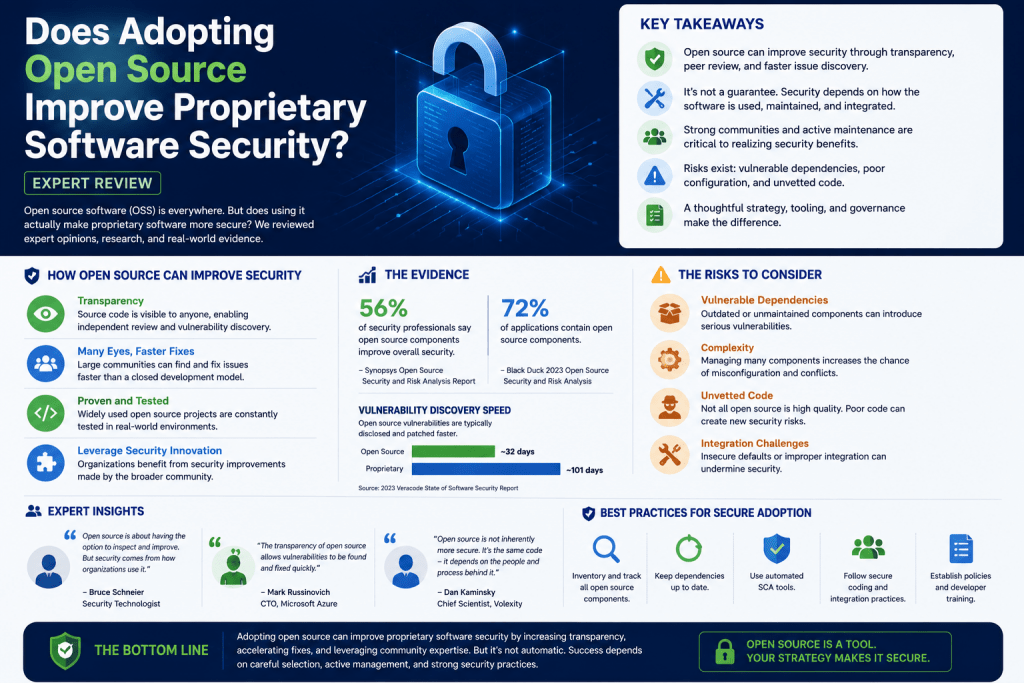
For decades, software security discussions have been shaped by a binary distinction between open source and proprietary systems. Open source software is built on the principle of accessible source code, allowing anyone to inspect, modify, and redistribute components under defined licensing conditions. Proprietary software, in contrast, restricts access to source code and places control in the hands of a single organization or vendor. These foundational differences created early assumptions about how security should be achieved, maintained, and evaluated in software systems.
In open source environments, security is often associated with transparency. The assumption is that publicly visible code increases the likelihood of vulnerability detection because a broader pool of developers can examine the system. In proprietary environments, security is traditionally associated with restricted access, where fewer individuals can view or modify the codebase, theoretically reducing exposure to malicious actors. However, both approaches rely on deeper structural factors such as code quality, architectural design, testing rigor, and ongoing maintenance.
Modern software ecosystems challenge these foundational distinctions. Applications are rarely purely open source or purely proprietary. Instead, they exist as hybrid systems where both models coexist. This blending has shifted the focus of security analysis away from licensing models and toward component management, dependency tracking, and lifecycle governance. As a result, understanding security now requires analyzing how different software philosophies interact within a single operational environment.
Historical Security Assumptions and Misconceptions
Early software engineering often treated proprietary systems as inherently more secure due to limited code visibility. This belief was rooted in the idea that hiding implementation details would reduce the likelihood of exploitation. This approach, commonly associated with security through obscurity, assumed that attackers would be unable to identify vulnerabilities without access to source code. While this model provided a superficial layer of protection, it did not address the underlying existence of vulnerabilities within the system.
Open source software, on the other hand, was historically viewed with skepticism in enterprise environments. Critics argued that exposing code publicly would make it easier for attackers to identify weaknesses. However, this perspective overlooked the role of defensive scrutiny. Publicly accessible code also enables security researchers and developers to identify and patch vulnerabilities more quickly in many cases.
Over time, real-world incidents demonstrated that neither model guarantees immunity from security flaws. Proprietary systems have experienced critical vulnerabilities despite restricted access, while open source projects have suffered from delayed patching due to limited maintainer resources. These outcomes revealed that security is not determined by visibility alone but by the effectiveness of response mechanisms, governance structures, and engineering discipline.
As software systems evolved, these historical assumptions began to lose relevance. The emergence of interconnected applications, cloud computing, and shared libraries introduced new security challenges that could not be addressed through traditional open versus closed comparisons.
Modern Software Supply Chain Complexity
One of the most significant changes in contemporary software development is the rise of the software supply chain. Applications are no longer built entirely from scratch. Instead, they are assembled from a combination of internal code, external libraries, frameworks, and third-party services. Many of these components originate from open source ecosystems, even within proprietary applications.
This layered structure introduces complexity into security management. Each dependency represents a potential vulnerability point, and each update cycle introduces potential instability. As dependencies accumulate, software systems become increasingly difficult to audit in their entirety. Security teams must not only evaluate their own code but also monitor external components for known vulnerabilities and updates.
The supply chain model also creates dependency chains, where one library depends on another, which in turn depends on additional components. This cascading structure makes it difficult to determine the full scope of risk exposure within an application. A vulnerability in a low-level dependency can propagate upward and impact multiple systems that rely on it indirectly.
As a result, software security has shifted from isolated code review practices to continuous monitoring of entire ecosystems. This includes tracking version updates, vulnerability disclosures, and compatibility changes across all integrated components. The complexity of this environment means that security is no longer a static attribute but a continuously evolving challenge.
Security Dynamics in Proprietary Systems
Proprietary software development typically operates within controlled organizational structures. Development teams follow defined workflows that include code review processes, testing phases, and release cycles. This centralized approach allows organizations to enforce internal security standards and maintain consistency across the codebase.
However, proprietary systems face inherent limitations in visibility and scale. Internal teams may not have the resources to identify every vulnerability, especially in large and complex applications. Additionally, security testing is often constrained by release schedules and business priorities, which can delay the identification and resolution of issues.
Another critical factor is dependency reliance. Even proprietary systems frequently depend on external libraries, many of which are open source. This introduces external risk factors that fall outside the direct control of the organization. Vulnerabilities in these dependencies can compromise proprietary applications even if the internal code is well secured.
Patch management also plays a significant role in proprietary security. Once vulnerabilities are discovered, organizations must develop and distribute fixes while ensuring that users apply updates in a timely manner. Delays in patch adoption can leave systems exposed, regardless of how quickly fixes are released.
Therefore, proprietary security is not solely determined by internal development practices but also by how effectively external dependencies and update cycles are managed.
Open Source Development and Community Security Model
Open source software operates on a distributed development model where contributors from diverse backgrounds collaborate on code creation and maintenance. This structure allows for continuous peer review, which can enhance vulnerability detection in widely adopted projects. High-visibility projects often benefit from active communities that identify and resolve issues rapidly.
The effectiveness of this model depends heavily on community engagement. Large, widely used projects tend to attract more contributors, increasing the likelihood of thorough code review. Security researchers and organizations may also actively monitor these projects due to their widespread adoption. This creates a feedback loop where popular software receives more attention, potentially improving its security posture.
However, not all open source projects benefit from this level of scrutiny. Smaller or niche projects may have limited contributors, reducing the effectiveness of peer review. In such cases, vulnerabilities can persist longer due to lack of active maintenance or oversight.
Open source development also enables rapid iteration. Updates and patches can be released frequently, allowing vulnerabilities to be addressed quickly when identified. This agility is one of the key advantages of the open source model, particularly in responding to newly discovered threats.
Despite these strengths, the model is not inherently secure. Its effectiveness depends on participation, governance, and maintenance quality rather than openness alone.
Limitations of Community-Based Security Models
While community involvement is a strength of open source development, it also introduces variability. Security improvements depend on voluntary contributions, which may not always prioritize critical vulnerabilities. Contributors often focus on features, performance enhancements, or specific use cases rather than comprehensive security auditing.
Another limitation is uneven expertise. Not all contributors possess advanced security knowledge, which can lead to inconsistent identification of vulnerabilities. Even when issues are identified, resolution timelines may vary depending on maintainer availability and project governance.
Additionally, open source projects can suffer from fragmentation. Forked versions of projects may diverge significantly, leading to inconsistent security updates across different implementations. This fragmentation can complicate vulnerability tracking and patch distribution.
Despite the principle of transparency, visibility does not guarantee action. A vulnerability may be publicly known but remain unresolved if maintainers lack resources or consensus. This creates scenarios where exposure exists without immediate remediation.
These limitations highlight that open source security is not automatically superior. It is a dynamic outcome influenced by community structure, resource availability, and governance mechanisms.
Hybrid Codebases and Dependency Explosion
Modern applications frequently combine proprietary code with open source components, resulting in hybrid architectures. This integration allows developers to leverage existing functionality without reinventing foundational systems. However, it also introduces dependency explosion, where applications rely on hundreds or even thousands of external components.
Each dependency carries its own lifecycle, update schedule, and vulnerability history. Managing this complexity requires continuous tracking of component versions and associated security advisories. Failure to monitor dependencies can result in unnoticed vulnerabilities persisting within production systems.
Hybrid codebases also blur responsibility boundaries. It may not always be clear whether a vulnerability originates from internal development or external components. This ambiguity complicates incident response and remediation efforts.
As software systems scale, dependency management becomes a central aspect of security strategy. Organizations must maintain visibility into their entire software stack, including indirect dependencies that may not be immediately visible in the primary codebase.
Shifting Definition of Software Security
The convergence of open source and proprietary software has fundamentally altered how security is defined. Security is no longer determined by access control alone but by the ability to manage complexity across interconnected systems. The focus has shifted toward continuous monitoring, rapid patching, and comprehensive dependency analysis.
In this environment, security is an operational discipline rather than a static property. It requires ongoing assessment of both internal and external components, as well as the processes used to integrate and maintain them. The distinction between open and closed systems becomes less relevant than the effectiveness of security practices applied across the entire software lifecycle.
The Expansion of Open Source Inside Proprietary Software Systems
Modern software development no longer operates within clean boundaries between open source and proprietary ecosystems. Instead, proprietary applications now routinely embed open source libraries, frameworks, and tools as foundational building blocks. This shift is driven primarily by efficiency. Developers avoid rebuilding common functionality such as encryption, networking, serialization, authentication, and data parsing by adopting pre-existing open source solutions.
This practice significantly accelerates development cycles and reduces engineering costs. However, it also fundamentally alters the security profile of proprietary systems. Even when the core application code is fully controlled by an organization, the inclusion of external components introduces new attack surfaces that must be continuously monitored.
The result is a layered architecture in which proprietary logic sits on top of a complex dependency network. Each layer inherits not only functionality but also risk. A vulnerability in a deeply nested open source dependency can propagate upward and compromise systems that appear, on the surface, to be entirely proprietary.
This structural dependency shift has created what is often referred to as software composition complexity. Security teams must now analyze not just the code they write, but the full ecosystem of components that support it. This includes direct dependencies as well as indirect transitive dependencies that may be several layers removed from the main application.
Dependency Chains and Hidden Security Exposure
One of the most significant security challenges in hybrid software systems is the existence of dependency chains. A single application may depend on a library, which itself depends on multiple other libraries, each with its own development cycle and vulnerability history. These chains can extend deeply, creating a network of interdependent components that are difficult to fully map.
The security risk arises from reduced visibility. Developers are typically aware of the immediate dependencies they integrate, but they may not fully understand the entire chain of transitive dependencies. This creates blind spots where vulnerabilities can exist without direct awareness from the development team.
These hidden layers are particularly dangerous because they can remain undetected for long periods. A vulnerability introduced in a low-level dependency may not be immediately visible in application behavior. Instead, it may only be discovered when actively exploited or when a security audit reveals the issue.
This complexity has led to increased emphasis on software supply chain security practices. Organizations are now investing in tools and processes designed to automatically map dependencies, identify known vulnerabilities, and track version changes across the entire software stack.
The goal is not only to identify risks but also to maintain continuous awareness of how external components evolve over time. Security is no longer a one-time verification process but a continuous monitoring function embedded into the development lifecycle.
The Role of Community Scale in Open Source Security
Open source security is heavily influenced by the size and activity level of its contributor community. Large-scale projects benefit from extensive peer review, where thousands of developers, researchers, and organizations contribute to code inspection and improvement. This distributed attention increases the likelihood of identifying vulnerabilities early.
High-profile open source projects often receive scrutiny from multiple perspectives, including academic researchers, independent security analysts, and enterprise users. This broad participation creates a form of distributed quality assurance that can exceed the capacity of most internal proprietary teams.
However, this advantage is not uniform across all open source projects. Smaller projects or niche libraries may lack sufficient contributors to perform regular code reviews. In such cases, vulnerabilities may persist unnoticed for extended periods.
Community size also affects responsiveness. Large communities can often react quickly to reported vulnerabilities, producing patches and updates in relatively short timeframes. Smaller communities may struggle to respond with the same speed due to limited resources or availability of maintainers.
This variability means that open source security is not inherently superior or inferior. Instead, it is highly context-dependent, influenced by adoption levels, contributor engagement, and governance structures.
Proprietary Security Models and Controlled Development Environments
Proprietary software development typically occurs within structured organizational environments where access to source code is restricted. This controlled model allows organizations to enforce internal security policies, standardize development practices, and manage release cycles more predictably.
In theory, this structure reduces exposure by limiting who can view and modify the codebase. Security testing is centralized, and changes are typically reviewed through formal processes before deployment. This can create a consistent baseline of quality assurance.
However, this model also introduces constraints. Security expertise is limited to internal teams, which may not match the scale of global open source communities. As software systems grow in complexity, internal teams may struggle to identify all potential vulnerabilities without external input.
Additionally, proprietary systems often depend on third-party components, many of which originate from open source ecosystems. This dependency reduces the effectiveness of strict access control as a security mechanism, since vulnerabilities can enter through external sources.
Another challenge is update distribution. Once a vulnerability is identified, organizations must develop patches and ensure they are deployed across all users. Delays in patch adoption can leave systems exposed even after fixes are available.
As a result, proprietary security depends heavily on internal discipline, process maturity, and effective dependency management rather than secrecy alone.
The Rise of Software Composition Analysis Practices
As software ecosystems have become more complex, organizations have adopted software composition analysis as a core security practice. This approach focuses on identifying and tracking all components within a software system, including open source libraries and third-party dependencies.
Software composition analysis tools are designed to scan codebases and detect known vulnerabilities by comparing components against vulnerability databases. These tools help organizations identify outdated libraries, insecure dependencies, and licensing conflicts.
The primary value of this approach lies in visibility. In hybrid software environments, where applications may contain hundreds of external components, manual tracking is no longer feasible. Automated analysis allows security teams to maintain a comprehensive view of their software supply chain.
However, detection alone is not sufficient. Organizations must also implement processes for remediation, which includes updating dependencies, replacing insecure components, and testing system stability after changes. This creates a continuous cycle of monitoring and maintenance.
Software composition analysis has become a critical layer in modern security architecture because it addresses one of the fundamental challenges of hybrid software systems: lack of transparency across dependencies.
The Impact of Vulnerability Databases on Security Response
The development of centralized vulnerability databases has significantly changed how security issues are managed across both open source and proprietary systems. These databases collect and catalog known vulnerabilities, allowing organizations to identify whether their systems are affected.
When a vulnerability is disclosed in a widely used open source component, it can rapidly impact thousands of applications across different industries. Vulnerability databases provide a structured way to track these issues and communicate risk levels.
This system has improved response times in many cases, allowing organizations to identify and patch affected systems more quickly. However, it also highlights the scale of interdependence within modern software ecosystems.
A single vulnerability in a widely used library can trigger widespread remediation efforts across both open source and proprietary environments. This interconnectedness means that security is no longer isolated within individual organizations but distributed across the entire software ecosystem.
The effectiveness of vulnerability management depends on how quickly organizations can respond to disclosures and how efficiently they can deploy updates across their systems.
Security Risks from Inactive or Abandoned Open Source Components
One of the less visible risks in open source integration is the use of inactive or abandoned components. Many software projects depend on libraries that are no longer actively maintained. While these components may continue to function, they no longer receive security updates or patches.
This creates long-term exposure risks. If a vulnerability is discovered in an abandoned library, there may be no official fix available. Organizations must then decide whether to replace the component, fork it, or implement their own patching solution.
Abandoned dependencies often remain unnoticed because they continue to function without immediate issues. However, they represent latent vulnerabilities that can become critical if exploited.
This problem is particularly common in large software systems with long dependency chains. Developers may not always be aware that certain components are no longer maintained, especially if they are several layers removed from the main application logic.
Managing this risk requires continuous auditing of dependency health, including monitoring maintenance activity and update frequency.
Interaction Between Development Speed and Security Posture
One of the central tensions in modern software engineering is the trade-off between development speed and security robustness. Open source integration often accelerates development by providing ready-made solutions, while proprietary development emphasizes controlled implementation and internal validation.
However, faster development cycles can introduce security risks if components are integrated without thorough evaluation. Conversely, slower development cycles may improve security but reduce responsiveness to market demands.
This tension is particularly visible in environments that prioritize rapid deployment and continuous delivery. In such systems, new features and updates are released frequently, increasing the potential for overlooked vulnerabilities.
Security must therefore be integrated into development workflows rather than treated as a separate phase. Continuous testing, automated vulnerability scanning, and dependency monitoring are essential to maintaining balance between speed and safety.
The challenge is not choosing between open source and proprietary models but managing how they interact within fast-moving development environments.
Emerging Security Responsibilities in Hybrid Ecosystems
As software systems become increasingly hybrid, security responsibility is distributed across multiple stakeholders. Developers, security engineers, operations teams, and third-party contributors all play roles in maintaining system integrity.
This distribution of responsibility requires coordination and shared visibility. Without centralized oversight of dependencies and vulnerabilities, security gaps can emerge between teams.
Hybrid ecosystems also require ongoing education and awareness. Developers must understand not only how to write code but also how to evaluate external components, assess dependency risks, and respond to vulnerability disclosures.
Security is no longer confined to specialized teams. It has become a shared responsibility embedded throughout the software lifecycle, from design and development to deployment and maintenance.
Software Security in a Fully Hybrid Open Source and Proprietary Landscape
The modern software ecosystem has reached a point where the distinction between open source and proprietary software is no longer meaningful in isolation. Nearly every production system today is a hybrid composition of both paradigms. Proprietary applications depend on open source libraries for efficiency, while open source projects frequently rely on proprietary infrastructure, cloud services, or commercial tooling for deployment and scaling.
This hybridization fundamentally changes how security must be understood. Instead of evaluating whether open source or proprietary software is more secure, the relevant question becomes how securely both are integrated, maintained, and monitored within a shared ecosystem. Security is no longer a property of origin but a property of interaction.
In this environment, the attack surface is distributed across internal code, external dependencies, build pipelines, deployment environments, and runtime configurations. Each layer introduces its own risks, and vulnerabilities can emerge from any point in the chain. The complexity of these interactions makes traditional binary security comparisons obsolete.
Security Implications of Shared Code Ecosystems
Shared code ecosystems introduce a model where software components are reused across multiple applications, organizations, and industries. This reuse is primarily driven by efficiency, as developers aim to avoid reinventing common functionality. However, reuse also amplifies risk exposure.
When a widely used open source library contains a vulnerability, the impact is not confined to a single application. Instead, it propagates across all systems that depend on it. This creates systemic risk, where a single weakness can affect thousands of downstream applications simultaneously.
The scale of this impact has transformed vulnerability management into a global coordination problem. Security disclosures are no longer local events but ecosystem-wide incidents that require rapid response across multiple stakeholders.
This shared dependency model also creates synchronization challenges. Different organizations may use different versions of the same library, meaning that vulnerability remediation occurs unevenly across the ecosystem. Some systems may be patched quickly, while others remain exposed due to delayed updates or compatibility constraints.
Propagation of Vulnerabilities Across Dependency Networks
In hybrid software systems, vulnerabilities rarely remain isolated. Instead, they propagate through dependency networks in complex ways. A flaw in a low-level component can affect multiple higher-level applications, even if those applications do not directly interact with the vulnerable code.
This propagation effect is amplified by transitive dependencies. A single library may depend on multiple sub-libraries, each of which introduces additional layers of exposure. As dependency depth increases, visibility decreases, making it more difficult to identify the full scope of risk.
This structure creates what can be described as cascading vulnerability pathways. Once a weakness is discovered in one component, security teams must trace its impact across the entire dependency tree. This process can be time-consuming and technically complex, especially in large-scale enterprise systems.
The challenge is not only identifying vulnerable components but also understanding how they interact within the broader system architecture. Some vulnerabilities may only become exploitable under specific conditions created by other dependencies, further complicating detection and remediation.
Security Monitoring in Continuous Integration Environments
Modern software development increasingly relies on continuous integration and continuous deployment pipelines. These systems automate the process of building, testing, and deploying code, allowing organizations to release updates rapidly and frequently.
While this approach improves development efficiency, it also introduces new security considerations. Each automated build may include updated dependencies, configuration changes, or newly introduced code that must be evaluated for security impact.
Continuous integration environments require automated security scanning to ensure that vulnerabilities are detected early in the development lifecycle. This includes static analysis of source code, dynamic testing of running applications, and dependency scanning for known vulnerabilities.
The challenge lies in maintaining speed without sacrificing security coverage. Automated systems must be configured to detect issues without generating excessive false positives that slow down development workflows. This balance is critical in ensuring that security does not become a bottleneck in rapid development environments.
Role of Open Source Governance in Security Outcomes
Open source projects vary significantly in how they are governed. Some are managed by individual maintainers, while others are overseen by foundations or large organizations. Governance structure plays a major role in determining security outcomes.
Well-governed projects typically have clear processes for code review, vulnerability disclosure, and patch release. These processes help ensure that security issues are addressed consistently and transparently.
In contrast, loosely governed projects may lack formal procedures for handling security incidents. In such cases, response times may vary, and responsibility for fixing vulnerabilities may be unclear.
Governance also affects accountability. In structured projects, maintainers are often clearly identified and responsible for specific components. In less structured environments, responsibility may be distributed or ambiguous, making coordination more difficult during security incidents.
The effectiveness of open source security is therefore closely tied to governance maturity rather than openness alone.
Enterprise Dependency on Open Source Infrastructure
Enterprise systems increasingly depend on open source infrastructure for core functionality. This includes operating systems, database systems, networking tools, and security frameworks. In many cases, these components form the foundation of critical business applications.
This dependency creates a paradoxical situation where proprietary systems are built on top of open source foundations. Even highly controlled environments rely on external codebases that are subject to independent development cycles and community-driven maintenance.
As a result, enterprises must treat open source components as first-class security concerns. This includes tracking versions, monitoring vulnerability disclosures, and ensuring timely updates across production systems.
The scale of enterprise dependency also increases the importance of inventory management. Organizations must maintain accurate records of all open source components in use, including indirect dependencies that may not be immediately visible.
Without this visibility, organizations risk operating with unknown exposure to vulnerabilities embedded deep within their software stack.
Security Risks Introduced by Rapid Innovation Cycles
The pace of software innovation has accelerated significantly, driven by cloud computing, microservices architectures, and agile development methodologies. While this acceleration enables faster delivery of features and improvements, it also increases security complexity.
Rapid release cycles can result in insufficient testing time for new components or updates. In environments where changes are deployed frequently, even small vulnerabilities can be introduced and propagated quickly.
Open source ecosystems contribute to this acceleration by providing reusable components that reduce development time. However, the combination of rapid integration and frequent updates can make it difficult to maintain consistent security validation.
Organizations must therefore implement continuous security validation mechanisms that operate alongside development workflows. This ensures that security considerations are not deferred until after deployment but are embedded throughout the development process.
Human Factors in Software Security Management
Despite advances in automation and tooling, human factors remain central to software security outcomes. Many vulnerabilities arise not from technical limitations but from development decisions, configuration errors, or oversight during integration.
Developers may assume that widely used open source components are inherently safe, leading to reduced scrutiny during adoption. Similarly, pressure to meet deadlines can result in security shortcuts or incomplete testing.
Operational teams also play a critical role in maintaining security. Failure to apply patches, misconfigured environments, or delayed updates can all contribute to exposure even when vulnerabilities are known and documented.
Security awareness across development and operations teams is therefore essential. Training, process enforcement, and cultural emphasis on security are all required to reduce human-driven risk factors.
Emergence of Automated Security Intelligence Systems
As software ecosystems grow more complex, organizations are increasingly relying on automated security intelligence systems. These systems analyze codebases, dependencies, and runtime behavior to identify potential vulnerabilities and anomalous patterns.
Automated systems can process large volumes of data far more efficiently than manual analysis. They can track dependency changes, correlate vulnerability disclosures, and generate risk assessments across entire software portfolios.
However, automation is not a complete solution. These systems must be configured correctly and interpreted by skilled professionals who understand the context of the findings. False positives, incomplete data, and contextual nuances can all affect accuracy.
The role of automation is therefore to augment human decision-making rather than replace it. Effective security strategies combine automated detection with human analysis and judgment.
Long-Term Evolution of Security in Hybrid Software Models
The long-term trajectory of software security is moving toward deeper integration between open source and proprietary systems. As hybrid models become the norm, security practices must evolve to address interconnected risk landscapes.
Future security models are likely to focus on real-time monitoring, predictive vulnerability detection, and automated remediation pipelines. These systems will need to operate across entire software ecosystems rather than isolated applications.
The emphasis will continue to shift from static security assessments to continuous adaptive security frameworks. In this model, security is treated as an ongoing operational function embedded within the software lifecycle.
As dependencies grow and systems become more interconnected, the ability to manage complexity will become the defining factor in software security effectiveness.
Conclusion
Across modern software ecosystems, the question of whether open source makes proprietary software more secure cannot be answered through a simple comparison. The original assumption that one model is inherently safer than the other no longer holds in environments where both are deeply intertwined. Security today is not a property of licensing structure but a result of how software is engineered, integrated, monitored, and maintained over time.
The evolution of software development has dissolved the traditional boundaries that once separated open source and proprietary paradigms. Proprietary systems now routinely incorporate open source components, and open source projects frequently depend on proprietary infrastructure and commercial services to scale and operate effectively. This interdependence has created a hybrid ecosystem where security outcomes are determined by the strength of integration practices rather than ideological differences in development models.
One of the most important realizations in this landscape is that exposure does not come from openness or closedness alone. Instead, exposure emerges from complexity. Every dependency added to a system introduces a potential point of failure. Every integration between systems creates a new interface that must be secured. As software stacks expand, the number of these interfaces increases exponentially, making complete visibility difficult without specialized tools and disciplined processes.
In this environment, open source contributes both strength and risk. Its strength lies in transparency, community review, and rapid iteration. Widely adopted projects benefit from continuous scrutiny, which can lead to faster identification and resolution of vulnerabilities. However, this benefit is unevenly distributed. Smaller or less active projects may lack the community engagement necessary to provide meaningful security oversight. As a result, the assumption that open source is always more secure due to visibility does not consistently hold true.
Proprietary software, on the other hand, benefits from controlled development environments, structured governance, and centralized accountability. These factors can create consistency in development practices and reduce uncontrolled changes to the codebase. However, proprietary systems are not isolated from external influence. They depend heavily on third-party libraries, many of which originate from open source ecosystems. This dependency weakens the traditional notion of security through isolation, as vulnerabilities can be introduced through external components that lie outside direct organizational control.
The widespread adoption of open source within proprietary systems has created a situation where most modern applications are effectively hybrid by design. This means that even highly controlled environments are exposed to the same ecosystem-level risks as open source projects. Vulnerabilities do not respect licensing boundaries. Once a flaw exists in a widely used component, it can propagate across both open and closed systems simultaneously.
This reality has shifted the focus of security practices toward software supply chain management. Instead of concentrating solely on internal code quality, organizations must now maintain visibility across all dependencies, including indirect ones. This requires continuous monitoring of component versions, vulnerability databases, and patch availability. Without this level of oversight, systems can remain exposed to known vulnerabilities long after fixes are available.
Another critical factor shaping modern security is the speed of development cycles. Agile methodologies, continuous integration, and rapid deployment pipelines have increased the velocity at which software changes are introduced into production environments. While this enables faster innovation, it also reduces the time available for thorough security validation. In fast-moving environments, even minor oversights can be quickly propagated into live systems.
Automation has become essential in addressing this challenge. Security tools that scan code, analyze dependencies, and detect vulnerabilities in real time are now a core part of development pipelines. However, automation alone is not sufficient. These tools must be paired with informed human oversight to interpret results, prioritize risks, and ensure that remediation actions are appropriate for the context of the system.
Human behavior remains one of the most significant factors influencing software security outcomes. Misconfigurations, delayed patching, and assumptions about component safety frequently contribute to vulnerabilities. Even in highly advanced technical environments, organizational discipline and security awareness play a decisive role in determining whether systems remain secure.
At a broader level, the increasing interconnection of software systems has created systemic risk conditions. A vulnerability in a single widely used library can impact thousands of applications across different industries and geographies. This interconnectedness means that security incidents are no longer isolated events but shared ecosystem challenges that require coordinated responses.
The management of this risk requires continuous lifecycle oversight. Security is no longer something that can be applied at the end of development or during periodic audits. It must be embedded throughout design, development, deployment, and maintenance phases. Every stage of the software lifecycle contributes to the overall security posture of the system.
Ultimately, the comparison between open source and proprietary software security has evolved into a more nuanced understanding of dependency-driven risk. Both models offer advantages and limitations, but neither provides inherent immunity from vulnerabilities. The real determinant of security is how effectively organizations manage complexity, maintain visibility across dependencies, and respond to emerging threats.
In this hybrid era, the most secure systems are not defined by whether their code is open or closed, but by how well they are governed, monitored, and maintained across their entire ecosystem. Security is achieved through disciplined engineering practices, continuous oversight, and an adaptive approach to risk management that reflects the interconnected nature of modern software environments.