The IT director role has evolved into one of the most strategically significant positions within modern organizations. It is no longer accurate to define this role as purely operational or technical in nature. Instead, it sits at the intersection of technology governance, enterprise strategy, and organizational performance. In today’s digital economy, almost every business function depends on technology infrastructure, which means IT directors influence not only how systems operate but how the business itself competes and grows.
An IT director is responsible for ensuring that technology environments are stable, scalable, secure, and aligned with business objectives. This requires a deep understanding of enterprise systems, cloud architecture, cybersecurity frameworks, and digital transformation principles. However, technical expertise alone is not sufficient. The role also demands leadership capability, financial oversight, risk management awareness, and strong communication skills across both technical and executive domains.
What distinguishes IT directors from other IT professionals is their level of accountability. While engineers and managers focus on execution, IT directors are responsible for outcomes. They are expected to ensure that technology investments generate measurable value, whether through cost reduction, productivity improvements, system reliability, or business enablement. This outcome-driven responsibility places them directly within the strategic decision-making layer of an organization.
Strategic Responsibilities of IT Leadership
At its core, the IT director role is defined by strategic oversight. This means setting direction for how technology will evolve within the organization over time. Rather than focusing on individual systems or short-term tasks, IT directors develop long-term roadmaps that align with business growth plans. These roadmaps typically include infrastructure modernization, cloud migration strategies, cybersecurity enhancements, and enterprise application integration.
A major part of this strategic function involves technology alignment with business goals. IT directors must understand organizational priorities such as revenue growth, market expansion, operational efficiency, and customer experience. They then translate these priorities into technical initiatives. For example, a company aiming to improve customer satisfaction may require upgrades to CRM systems, improved data analytics capabilities, or faster response time infrastructure.
This alignment process is not purely technical. It requires constant collaboration with business leaders, department heads, and executive stakeholders. IT directors must be able to interpret business requirements and convert them into actionable technology plans. This makes the role highly interdisciplinary, requiring both technical fluency and business literacy.
Another key aspect of strategic responsibility is technology governance. IT directors define policies, standards, and frameworks that guide how technology is used across the organization. This includes data governance rules, access control policies, infrastructure standards, and security protocols. Governance ensures consistency, reduces operational risk, and supports regulatory compliance.
Operational Oversight and Infrastructure Management
While IT directors are primarily strategic leaders, they also maintain oversight of operational systems. This includes ensuring that IT infrastructure remains reliable, scalable, and efficient. Infrastructure typically spans networks, servers, cloud environments, storage systems, and enterprise applications. Any disruption in these systems can significantly impact business operations, making stability a critical responsibility.
Operational oversight also includes performance monitoring. IT directors must ensure that systems meet performance benchmarks related to uptime, response time, and availability. They rely on technical teams to manage day-to-day operations but remain accountable for overall system health. When issues arise, IT directors are often involved in escalation management, ensuring that problems are resolved quickly and effectively.
Incident management is another critical operational responsibility. IT directors establish processes for handling system outages, security incidents, and performance degradation. These processes are designed to minimize downtime and reduce business disruption. Effective incident management requires coordination across multiple teams, including infrastructure, security, and application support groups.
Capacity planning is also part of operational oversight. As organizations grow, their technology needs expand. IT directors must anticipate future demand and ensure that systems can scale accordingly. This involves forecasting usage trends, evaluating infrastructure limitations, and planning upgrades or expansions before bottlenecks occur.
Leadership Across Technical Teams
One of the most important dimensions of the IT director’s role is leadership. Unlike individual contributors or technical managers, IT directors oversee multiple teams with different areas of specialization. These may include network engineering, systems administration, application development, cybersecurity, and IT support.
Leading these teams requires more than assigning tasks or managing schedules. IT directors must create alignment across departments that often operate with different priorities and technical perspectives. For example, cybersecurity teams prioritize risk reduction, while development teams prioritize speed and feature delivery. IT directors must balance these competing priorities in a way that supports overall business goals.
People management is a significant part of this leadership function. IT directors are responsible for hiring senior technical staff, developing leadership pipelines, and ensuring that teams have the necessary skills to meet evolving demands. This includes performance evaluation, mentoring, and professional development planning.
In addition to internal team leadership, IT directors often coordinate with external vendors and service providers. Many organizations rely on third-party solutions for cloud hosting, software platforms, cybersecurity tools, and managed services. IT directors evaluate vendor performance, manage contracts, and ensure that service level agreements are met.
Effective leadership also requires strong communication skills. IT directors must communicate complex technical concepts to non-technical stakeholders, including executives and board members. At the same time, they must translate business expectations into technical requirements for engineering teams. This bidirectional communication is essential for maintaining alignment across the organization.
Technology Decision-Making and Architecture Influence
IT directors play a significant role in shaping enterprise architecture. While they may not design systems at a granular level, they define the principles and standards that guide architectural decisions. This includes decisions about cloud adoption, system integration, scalability models, and data architecture.
Cloud strategy is one of the most important areas of architectural influence. Many organizations are transitioning from on-premises infrastructure to hybrid or fully cloud-based environments. IT directors evaluate cloud providers, determine migration strategies, and oversee cost management associated with cloud usage.
Another key area is system integration. Modern organizations use multiple applications that must communicate effectively. IT directors ensure that integration frameworks are in place to support data flow between systems such as ERP platforms, CRM systems, and analytics tools. Poor integration can lead to inefficiencies and data inconsistencies, making this a critical responsibility.
Data architecture is also a growing area of focus. As organizations become more data-driven, IT directors ensure that data is structured, stored, and accessed in ways that support analytics and decision-making. This includes defining data governance policies and ensuring that data quality standards are maintained across systems.
Security Governance and Risk Management Responsibilities
Cybersecurity is a core responsibility within the IT director role. While dedicated security teams may handle technical implementation, IT directors are ultimately accountable for security governance. This includes defining security policies, ensuring compliance, and overseeing risk mitigation strategies.
Risk management involves identifying potential vulnerabilities within IT systems and implementing controls to reduce exposure. This may include access management policies, encryption standards, network segmentation, and monitoring systems. IT directors must ensure that these controls are consistently applied across the organization.
Regulatory compliance is another important aspect of security governance. Depending on the industry, organizations may need to comply with frameworks related to data protection, financial reporting, or operational security. IT directors ensure that systems and processes meet these requirements, reducing legal and financial risk.
Incident response planning is also part of security governance. IT directors establish protocols for responding to security breaches or cyberattacks. These plans define roles, responsibilities, and escalation paths to ensure rapid and coordinated responses during incidents.
Business Integration and Executive Collaboration
One of the defining characteristics of IT directors is their role in executive collaboration. They frequently participate in strategic planning sessions with senior leadership teams, where they provide input on technology capabilities, constraints, and opportunities.
This collaboration requires strong business acumen. IT directors must understand financial metrics, operational KPIs, and market dynamics to contribute effectively to executive discussions. They are often responsible for justifying technology investments and demonstrating how those investments support business outcomes.
Budget planning is a key component of this collaboration. IT directors manage significant portions of organizational budgets, including hardware procurement, software licensing, cloud services, and staffing. They must allocate resources efficiently while ensuring that technology initiatives remain aligned with strategic priorities.
In many organizations, IT directors also play a role in innovation initiatives. This includes evaluating emerging technologies such as artificial intelligence, automation, and advanced analytics. They assess whether these technologies can provide competitive advantages and determine how they can be integrated into existing systems.
Variation in Organizational Contexts
The responsibilities of IT directors can vary significantly depending on organizational context. In small to mid-sized companies, IT directors often have broad responsibilities that cover all aspects of technology operations. They may be directly involved in hands-on problem-solving while also managing strategic planning.
In large enterprises, the role becomes more specialized. IT directors may focus on specific domains such as infrastructure, applications, or security. In these environments, they often report to senior executives such as CIOs or CTOs and operate within larger leadership structures.
Industry also plays a significant role in shaping responsibilities. In highly regulated industries such as healthcare or finance, compliance and risk management become more prominent. In technology companies, the focus may shift toward scalability, innovation, and rapid deployment cycles.
Geographic and organizational scale further influence role expectations. Global organizations require IT directors to manage distributed systems across multiple regions, adding complexity in terms of coordination, compliance, and infrastructure design.
Foundational Importance of the IT Director Role
The IT director role serves as a foundational pillar in modern digital organizations. As businesses become increasingly dependent on technology, the importance of effective IT leadership continues to grow. IT directors ensure that systems are not only functional but strategically aligned with business goals, secure from threats, and capable of supporting long-term growth.
This role requires a unique combination of technical knowledge, leadership capability, and business understanding. It is this combination that makes IT directors essential to organizational success in a technology-driven world.
How IT Director Compensation Is Structured in Modern Markets
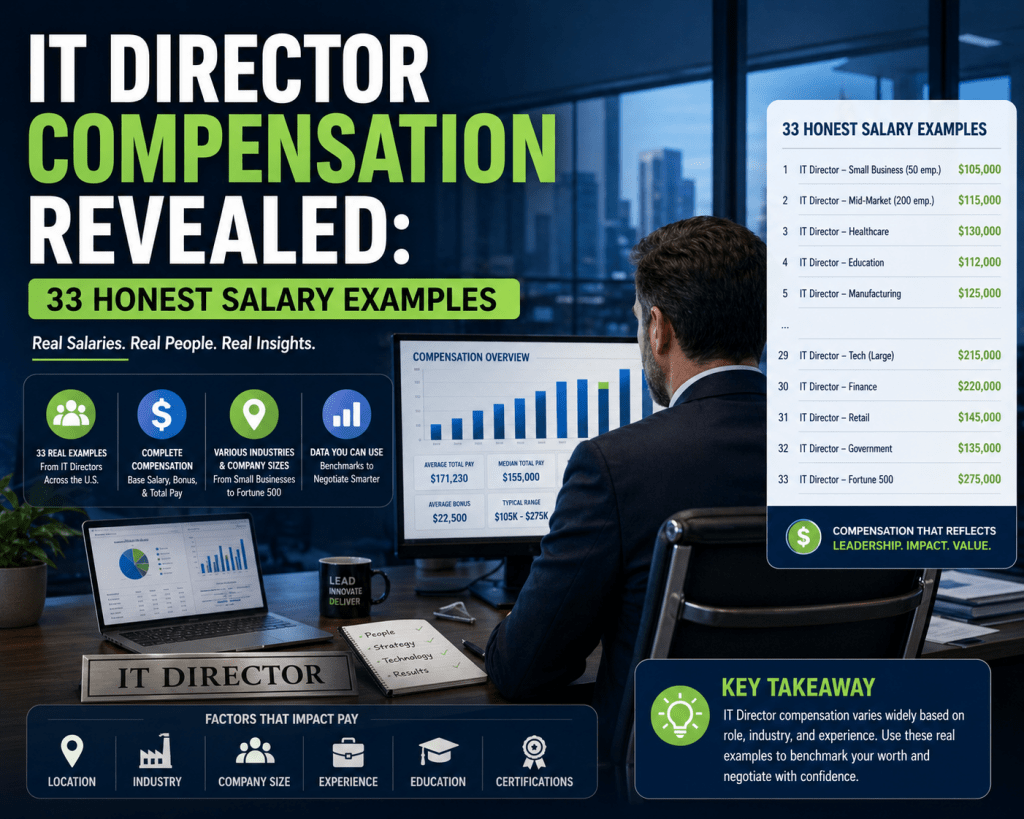
IT director compensation is not determined by a single factor but by a layered structure that reflects organizational complexity, geographic positioning, industry pressure, and leadership scope. Unlike entry-level IT roles, where salary bands are relatively fixed, IT director compensation operates within a broad and dynamic range that reflects both technical responsibility and executive-level accountability.
At a foundational level, compensation begins with base salary, which represents guaranteed annual income. However, in many organizations, especially larger enterprises, total compensation may also include performance-based bonuses, long-term incentive plans, and equity components. While equity is more common in executive or startup environments, performance bonuses are increasingly used to align IT leadership outcomes with business results.
The variability in compensation is largely due to the ambiguous nature of the IT director title itself. In some organizations, the role is closer to senior IT management, while in others it borders on executive leadership. This inconsistency creates wide salary dispersion across industries and regions, making it essential to evaluate compensation within context rather than relying on averages alone.
Another key factor influencing compensation structure is organizational maturity. Companies in early growth stages often offer lower base salaries but may compensate with equity or future growth potential. Mature enterprises, on the other hand, tend to offer higher fixed salaries with structured bonus systems tied to operational performance and enterprise goals.
Influence of Geographic Location on Salary Expectations
Geographic location remains one of the strongest determinants of IT director salary levels. Regions with high concentrations of technology companies or financial institutions tend to offer significantly higher compensation due to competitive labor markets and higher living costs. These markets also demand more specialized expertise, which further drives salary inflation.
In major metropolitan areas, IT directors are often expected to manage complex infrastructures, large-scale teams, and high-security environments. The increased operational complexity justifies higher compensation levels. Conversely, in smaller cities or regions with lower technology density, salary ranges tend to be more moderate, reflecting lower operational costs and reduced competitive pressure.
Remote work has introduced a new layer of complexity into geographic compensation models. Some organizations now decouple salary from physical location, instead basing compensation on role complexity and skill level. However, many companies still apply location-based adjustments to maintain internal equity across distributed teams.
Despite the rise of remote work, geographic differences remain significant. High-cost regions continue to set upper salary benchmarks, while lower-cost regions define baseline expectations. This creates a wide compensation spectrum that IT directors must navigate when evaluating career opportunities.
Industry-Specific Salary Differentiation in IT Leadership
Industry plays a critical role in shaping IT director compensation because different sectors place varying levels of dependency on technology systems. Industries with high regulatory pressure, large data volumes, or mission-critical systems tend to offer higher compensation due to increased risk exposure and operational complexity.
In financial services, IT directors often manage systems that handle sensitive transactional data, real-time processing, and regulatory reporting. These environments require strict uptime guarantees and robust security frameworks, leading to higher compensation levels.
Healthcare is another high-value sector where IT directors oversee electronic health records, patient data security, and compliance with strict privacy regulations. System reliability in this sector can directly impact patient outcomes, increasing the importance and value of IT leadership.
Technology companies often offer competitive compensation due to the fast-paced nature of product development and infrastructure scaling. IT directors in these environments are frequently involved in cloud optimization, system scalability, and rapid deployment cycles, all of which require advanced technical and strategic expertise.
In contrast, industries such as education, non-profit organizations, and public sector institutions may offer lower compensation levels. While these roles often provide stability and strong organizational purpose, they typically operate under budget constraints that limit salary growth.
Company Size and Organizational Complexity as Salary Drivers
Company size is one of the most direct indicators of IT director compensation levels. Smaller organizations generally have simpler IT infrastructures, fewer employees, and limited system complexity. As a result, IT directors in these environments often have broader but less complex responsibilities, which is reflected in more moderate salary ranges.
In mid-sized companies, IT directors typically begin to manage more structured teams and more complex systems. These organizations often rely on a mix of legacy systems and modern cloud infrastructure, requiring IT directors to balance modernization efforts with operational continuity.
Large enterprises present a fundamentally different level of complexity. IT directors in these organizations may oversee global infrastructure, multiple data centers, and distributed teams across different regions. The scale of operations requires advanced coordination, governance frameworks, and long-term strategic planning.
Organizational hierarchy also influences compensation. In flatter organizations, IT directors may operate closer to executive leadership, increasing their strategic influence. In more hierarchical environments, they may sit one or two levels below CIO or CTO roles, with compensation reflecting their position within the leadership structure.
The number of direct and indirect reports also affects salary levels. IT directors managing large teams or multiple departments typically command higher compensation due to increased leadership responsibility and operational oversight.
Experience Progression and Salary Evolution Over Time
Experience is a foundational driver of IT director compensation, but not simply in terms of years worked. More important is the progression of responsibility, scope, and decision-making authority over time. Early-stage IT directors often transition from senior technical roles where they have strong domain expertise but limited executive exposure.
At the early stage of IT leadership, professionals typically oversee a single domain such as infrastructure, support, or applications. Compensation at this level reflects both technical contribution and emerging leadership responsibilities. These roles often serve as transitional positions between senior engineering and full director-level accountability.
As experience increases, IT directors take on broader responsibilities that span multiple technical domains. They begin managing cross-functional teams, overseeing larger budgets, and participating in strategic planning discussions. This mid-level phase represents a significant compensation increase due to expanded organizational impact.
At senior levels, IT directors operate with enterprise-wide responsibility. They are involved in long-term strategic initiatives such as digital transformation, cloud modernization, and enterprise risk management. Compensation at this level reflects not only technical oversight but also direct influence on business outcomes.
Over time, many senior IT directors transition into executive roles such as CIO or VP of Technology. In these positions, compensation expands further to include performance bonuses, equity participation, and executive-level benefits.
The Role of Technical Expertise in Salary Differentiation
Technical expertise remains a key differentiator in IT director compensation, even though the role is primarily managerial. Directors with strong backgrounds in cloud architecture, cybersecurity, enterprise systems, or large-scale infrastructure tend to command higher salaries due to their ability to make informed strategic decisions.
Cloud expertise is particularly valuable in modern IT environments. As organizations shift from on-premises infrastructure to hybrid and cloud-native systems, IT directors with experience in cloud migration and optimization are highly sought after. Their ability to manage cost efficiency, scalability, and performance directly impacts organizational success.
Cybersecurity knowledge also plays a major role in compensation. IT directors who understand security frameworks, risk mitigation strategies, and compliance requirements are better positioned to lead secure environments. Given the increasing frequency and sophistication of cyber threats, this expertise is highly valued.
Enterprise system knowledge, including experience with ERP and CRM platforms, further enhances compensation potential. These systems form the backbone of many organizations, and directors who understand how to optimize and integrate them provide significant operational value.
While IT directors are not expected to perform deep technical implementation work, their ability to understand and evaluate technical decisions is essential. This technical literacy allows them to bridge the gap between engineering teams and executive leadership.
Business Impact and Value-Based Compensation Models
One of the most important shifts in IT director compensation is the increasing emphasis on business impact. Organizations are no longer evaluating IT leadership solely based on technical performance but on measurable contributions to business outcomes.
This includes cost optimization, system efficiency improvements, revenue enablement, and risk reduction. IT directors who can demonstrate clear links between technology initiatives and business performance are often rewarded with higher compensation.
Cost savings initiatives, such as infrastructure optimization or cloud cost management, are particularly valuable. These initiatives directly affect organizational profitability and are easily quantifiable, making them strong leverage points during compensation discussions.
Revenue enablement is another key factor. IT directors who support systems that enhance customer experience, improve sales processes, or enable new digital products contribute directly to revenue growth. This type of impact significantly strengthens compensation positioning.
Risk reduction also plays a major role in value-based compensation. Preventing downtime, mitigating security threats, and ensuring regulatory compliance all contribute to organizational stability, which is highly valued at the executive level.
Market Demand and Talent Competition Dynamics
The demand for IT directors continues to grow as organizations increasingly rely on digital infrastructure. This demand-supply imbalance contributes to rising salary expectations across industries. Companies are competing for experienced leaders who can manage complex systems and drive digital transformation.
Talent competition is particularly intense in sectors undergoing rapid technological change. Organizations are seeking IT directors who can modernize legacy systems, implement cloud strategies, and strengthen cybersecurity postures.
This competitive environment leads to salary inflation, especially for candidates with proven track records in large-scale system transformation. Organizations are often willing to pay premium compensation for leaders who can reduce operational risk and improve system efficiency.
Remote hiring has further intensified competition by expanding talent pools beyond geographic boundaries. Employers can now recruit from broader markets, but they must also compete with global organizations offering similar opportunities.
Structural Variability in IT Director Roles Across Organizations
The IT director role is highly variable across organizations, which directly impacts compensation structures. In some companies, the role is narrowly defined and focused on operational oversight. In others, it is broad and strategically oriented, encompassing enterprise architecture and executive collaboration.
This variability makes it difficult to standardize compensation benchmarks. Instead, salaries must be evaluated based on role scope, organizational complexity, and leadership expectations.
In smaller organizations, IT directors often perform hybrid roles that combine technical execution with strategic planning. In larger organizations, responsibilities are more segmented, with directors focusing on specific domains or functions.
This structural diversity means that two IT directors with identical titles may have significantly different compensation levels depending on organizational context and responsibility scope.
Evolving Market Expectations for IT Leadership
The expectations placed on IT directors continue to evolve as technology becomes more deeply integrated into business operations. Modern IT leadership requires not only technical expertise but also strategic foresight, financial literacy, and organizational influence.
As businesses continue to adopt cloud computing, automation, and data-driven decision-making, IT directors are increasingly expected to act as business leaders rather than purely technical managers. This shift is reflected in compensation trends, where strategic impact is becoming more important than technical execution alone.
The continued evolution of this role ensures that IT director compensation will remain dynamic, influenced by technological change, market demand, and organizational transformation priorities.
Advanced Skills That Define High-Earning IT Directors
At the senior end of the IT director spectrum, compensation is closely tied to a refined set of advanced skills that extend beyond foundational leadership and technical knowledge. These skills differentiate average performers from high-impact leaders who consistently command top-tier salaries. Organizations increasingly seek IT directors who can operate with executive-level thinking while maintaining strong technical awareness.
One of the most critical advanced competencies is strategic foresight. High-performing IT directors do not simply react to business needs; they anticipate them. They analyze market trends, emerging technologies, and internal performance data to forecast future requirements. This ability allows organizations to stay ahead of competitors by adopting new technologies at the right time rather than reacting too late.
Another defining skill is financial fluency. IT directors must understand budgeting, cost modeling, and return on investment at a deep level. They are often responsible for allocating large budgets across infrastructure, software, staffing, and innovation initiatives. High-earning IT directors are those who can justify spending decisions with clear financial logic, demonstrating how technology investments translate into measurable business value.
Vendor negotiation expertise also plays a major role. Organizations spend significant amounts on third-party services, including cloud providers, software vendors, and managed service partners. IT directors who can negotiate favorable terms, optimize licensing agreements, and reduce unnecessary costs directly contribute to organizational profitability. This cost optimization capability often influences salary growth.
Leadership maturity is another key factor. High-level IT directors manage not only teams but also other leaders. They build organizational structures, define reporting hierarchies, and create cultures that promote innovation and accountability. This level of leadership requires emotional intelligence, conflict resolution skills, and the ability to align diverse teams toward common goals.
The Expanding Role of Cloud Strategy in Compensation Growth
Cloud computing has become one of the most influential factors in IT director compensation. Organizations are rapidly transitioning from traditional on-premises infrastructure to cloud-based environments, creating demand for leaders who can manage this transformation effectively.
IT directors with strong cloud strategy experience are highly valued because they influence cost efficiency, scalability, and system performance. Cloud environments introduce new financial models, such as consumption-based pricing, which require careful management to avoid overspending. Directors who can optimize cloud usage while maintaining performance are seen as critical assets.
Migration strategy is another important component. Moving legacy systems to cloud platforms is complex and requires careful planning. IT directors must assess which applications should be migrated, re-architected, or retained on-premises. Poor migration decisions can lead to increased costs, reduced performance, or operational disruptions.
Security within cloud environments is also a major concern. IT directors must ensure that cloud deployments meet security and compliance standards. This includes managing access controls, encryption policies, and monitoring systems. Given the shared responsibility model in cloud computing, directors must clearly define security roles between internal teams and cloud providers.
Hybrid and multi-cloud strategies add another layer of complexity. Many organizations use multiple cloud platforms to avoid vendor lock-in and improve resilience. IT directors must design architectures that allow seamless integration across these platforms while maintaining consistent performance and security standards.
Cybersecurity Leadership as a Salary Multiplier
Cybersecurity has evolved into a core business concern, and IT directors who demonstrate strong security leadership often command higher compensation. Organizations face increasing threats from cyberattacks, data breaches, and regulatory penalties, making security governance a top priority.
IT directors play a central role in defining security strategies. They establish policies, oversee risk assessments, and ensure that security controls are implemented across all systems. While dedicated security teams handle technical implementation, IT directors are responsible for overall accountability.
Risk management is a key component of cybersecurity leadership. IT directors must identify potential vulnerabilities and evaluate their impact on business operations. This involves balancing security investments with operational efficiency, ensuring that systems remain both secure and functional.
Compliance requirements further elevate the importance of cybersecurity expertise. Many industries are subject to strict regulations regarding data protection and system integrity. IT directors must ensure that their organizations meet these requirements, reducing the risk of legal and financial penalties.
Incident response planning is another critical responsibility. IT directors develop strategies for handling security breaches, including detection, containment, and recovery processes. Effective incident response minimizes damage and ensures business continuity, which directly contributes to organizational stability.
Data-Driven Decision Making and Its Impact on IT Leadership Value
Data has become one of the most valuable assets in modern organizations, and IT directors play a key role in managing how data is collected, stored, and utilized. Directors who can leverage data to drive decision-making are increasingly recognized as high-value leaders.
Data governance is a foundational element. IT directors establish policies that ensure data accuracy, consistency, and security. Without proper governance, organizations risk making decisions based on unreliable information. Strong governance frameworks improve data quality and enable more effective analytics.
Analytics capability is another important factor. IT directors must ensure that systems are in place to collect and analyze data across different business functions. This includes implementing data warehouses, analytics platforms, and reporting tools that provide actionable insights.
Performance measurement is closely tied to data-driven leadership. IT directors use metrics to evaluate system performance, team productivity, and project outcomes. These metrics help identify areas for improvement and support data-backed decision-making.
Data-driven leadership also extends to business strategy. IT directors who can translate technical data into business insights provide significant value to executive teams. This ability strengthens their influence within the organization and contributes to higher compensation potential.
Digital Transformation Leadership and Organizational Influence
Digital transformation remains one of the most significant drivers of IT director relevance and compensation. Organizations across industries are investing heavily in modernizing their systems, automating processes, and improving customer experiences through technology.
IT directors lead these transformation efforts by defining strategies, selecting technologies, and overseeing implementation. This requires a deep understanding of both technical systems and business processes. Successful transformation initiatives often result in improved efficiency, reduced costs, and enhanced competitiveness.
Change management is a critical aspect of digital transformation. Introducing new technologies often requires employees to adapt to new workflows and systems. IT directors must ensure that these transitions are smooth and that teams receive adequate training and support.
Automation is another key component of transformation. IT directors identify opportunities to automate repetitive tasks, improving efficiency and reducing human error. Automation can significantly enhance productivity, making it a valuable focus area for organizations.
Innovation leadership also plays a role in transformation efforts. IT directors evaluate emerging technologies and determine how they can be integrated into existing systems. This includes technologies such as artificial intelligence, machine learning, and advanced analytics.
Cross-Functional Collaboration and Executive-Level Communication
One of the most distinguishing traits of successful IT directors is their ability to collaborate across departments and communicate effectively with executive leadership. Technology does not operate in isolation, and IT directors must ensure that systems support the needs of all business functions.
Cross-functional collaboration involves working with departments such as finance, operations, marketing, and human resources. IT directors must understand the unique requirements of each department and ensure that technology solutions meet those needs.
Executive communication is equally important. IT directors regularly present updates, proposals, and performance reports to senior leadership teams. These communications must be clear, concise, and focused on business impact rather than technical detail.
Influence within the executive team is a key factor in career progression. IT directors who can effectively communicate the value of technology initiatives are more likely to gain support for their projects. This influence often translates into greater responsibility and higher compensation.
Stakeholder management also plays a role in collaboration. IT directors must balance competing priorities and ensure that all stakeholders feel heard and supported. This requires strong negotiation skills and the ability to manage expectations.
Career Progression Beyond the IT Director Role
For many professionals, the IT director role serves as a stepping stone to executive leadership positions. Career progression at this level is driven by the ability to demonstrate strategic impact, leadership capability, and business understanding.
One common progression path leads to roles such as Chief Information Officer or Vice President of Technology. These positions involve greater responsibility for organizational strategy, governance, and innovation. Compensation at this level typically includes higher base salaries, performance bonuses, and long-term incentives.
Another potential path involves specialization in areas such as cybersecurity leadership or data strategy. Some IT directors transition into roles focused on security governance or data management, where they can leverage their expertise in specific domains.
Entrepreneurial opportunities also exist for experienced IT directors. Some professionals choose to transition into consulting or advisory roles, providing strategic guidance to multiple organizations. This path can offer flexibility and significant earning potential.
Regardless of the path chosen, continuous skill development is essential. Technology evolves rapidly, and IT leaders must stay current with emerging trends and best practices to remain competitive in the job market.
Long-Term Salary Growth Strategies for IT Directors
Sustained salary growth at the IT director level requires a combination of strategic positioning, skill development, and demonstrated impact. One of the most effective strategies is to take on high-visibility projects that influence organizational performance.
Leading enterprise-wide initiatives, such as system modernization or digital transformation, can significantly enhance an IT director’s profile. These projects often involve cross-functional collaboration and direct interaction with executive leadership, increasing visibility and influence.
Another important strategy is continuous learning. While technical skills remain important, IT directors must also develop expertise in areas such as business strategy, finance, and leadership. This broad skill set enables them to operate effectively at higher levels of the organization.
Networking and professional relationships also play a role in career advancement. Building connections with industry peers, executives, and thought leaders can open new opportunities and provide valuable insights into market trends.
Performance documentation is another key factor. IT directors should maintain records of their achievements, including cost savings, efficiency improvements, and successful project outcomes. These records provide evidence of value during performance reviews and salary negotiations.
Evolving Expectations in the IT Leadership Landscape
The expectations placed on IT directors continue to evolve as organizations become more technology-driven. Modern IT leadership requires a balance of technical expertise, strategic thinking, and business acumen. Directors must be able to adapt to changing technologies while maintaining operational stability.
Emerging technologies are reshaping the IT landscape. Artificial intelligence, automation, and advanced analytics are becoming integral to business operations. IT directors must understand these technologies and evaluate their potential impact on the organization.
Sustainability is also becoming a consideration in IT strategy. Organizations are increasingly focused on reducing energy consumption and environmental impact. IT directors play a role in implementing sustainable practices within technology operations.
Workforce dynamics are changing as well. Remote and hybrid work models require new approaches to infrastructure, security, and collaboration. IT directors must ensure that systems support these work environments while maintaining performance and security standards.
The increasing importance of customer experience further expands the role of IT directors. Technology systems directly influence how customers interact with businesses, making IT leadership a key factor in customer satisfaction and retention.
As these expectations continue to grow, IT directors who can adapt and evolve will remain in high demand. Their ability to align technology with business strategy ensures that they remain central to organizational success and long-term growth.
Conclusion
The role of an IT director has undergone a profound transformation, evolving from a primarily operational function into a central pillar of business strategy and organizational success. What once revolved around maintaining infrastructure and overseeing technical teams has now expanded into a multifaceted leadership position that directly influences growth, innovation, and competitive positioning. This shift reflects a broader reality: technology is no longer a support function but a core driver of how modern businesses operate, compete, and deliver value.
Understanding compensation at this level requires looking beyond simple salary figures and recognizing the layered factors that define earning potential. IT director salaries are shaped by a combination of geographic location, industry demands, organizational size, and the complexity of systems being managed. However, the most significant differentiator is not where someone works, but how effectively they contribute to business outcomes. Organizations increasingly reward leaders who can demonstrate measurable impact, whether through cost optimization, improved system reliability, enhanced security posture, or enabling revenue growth through technology.
The variability in salary ranges also highlights an important reality about the IT director title. It is not standardized across industries or organizations, and its meaning can shift dramatically depending on context. In one company, it may represent a senior operational role focused on infrastructure stability, while in another, it may function as a near-executive position responsible for enterprise-wide transformation. This inconsistency makes it essential for professionals to evaluate roles based on scope, authority, and expectations rather than relying solely on job titles.
Experience remains a foundational component of compensation, but it is not defined purely by years in the field. Instead, it is measured by the progression of responsibility, the scale of systems managed, and the level of influence within the organization. Early-stage IT directors often focus on managing specific functions, while more experienced leaders oversee multiple domains and contribute to long-term strategic planning. At the highest levels, IT directors operate with enterprise-wide accountability, influencing decisions that shape the future direction of the organization.
Technical expertise continues to play an important role, even as the position becomes more strategic. Directors who possess strong knowledge in areas such as cloud architecture, cybersecurity, and enterprise systems are better equipped to make informed decisions that impact scalability, performance, and risk management. However, technical knowledge alone is not sufficient to reach the upper tiers of compensation. The ability to translate that knowledge into business value is what ultimately distinguishes high-performing IT directors from their peers.
Leadership capability is another defining factor in long-term success. IT directors are responsible not only for managing systems but also for leading people, building teams, and fostering collaboration across departments. This requires a balance of technical credibility and interpersonal effectiveness. Leaders who can align diverse teams, manage competing priorities, and maintain a clear strategic vision are more likely to achieve sustained career growth and higher compensation.
Cybersecurity has also become a critical component of IT leadership, adding another dimension to the role. With the growing frequency and sophistication of cyber threats, organizations rely on IT directors to establish robust security frameworks and mitigate risks. This responsibility extends beyond technical controls to include governance, compliance, and incident response planning. Directors who demonstrate strong security leadership are often recognized with higher compensation due to the high stakes involved.
The future of the IT director role is closely tied to the continued integration of technology into every aspect of business operations. As organizations become more reliant on digital systems, the demand for skilled IT leadership will continue to grow. This demand creates opportunities for professionals who are prepared to evolve alongside the technology landscape and embrace the expanding scope of responsibilities.