DevOps has become a central pillar of modern software development and IT operations, reshaping how organizations build, deploy, and maintain applications. It represents a cultural and technical shift that emphasizes collaboration, automation, and continuous improvement. Instead of treating development and operations as separate functions, DevOps integrates them into a unified workflow that accelerates delivery while maintaining system stability. This approach has proven especially valuable in environments where rapid deployment cycles and high availability are critical.
The demand for DevOps professionals continues to grow as organizations adopt cloud computing, microservices architectures, and automated deployment pipelines. Companies seek individuals who can manage complex systems, streamline workflows, and ensure reliable application performance. Certifications play an important role in validating these skills, providing employers with a benchmark to assess a candidate’s capabilities. Among these certifications, the LPI DevOps Tools Engineer credential stands out as a comprehensive measure of practical DevOps knowledge.
The certification is developed to assess both technical expertise and the ability to work within collaborative environments. It focuses on widely used tools and methodologies that form the backbone of modern DevOps practices. By earning this certification, candidates demonstrate their understanding of key concepts such as automation, containerization, infrastructure management, and continuous delivery. These skills are essential for managing modern IT environments where efficiency and scalability are paramount.
A distinguishing feature of this certification is its emphasis on open-source technologies. Open-source tools are widely used in DevOps due to their flexibility, cost-effectiveness, and strong community support. Candidates are expected to understand how these tools function individually and how they integrate into larger systems. This knowledge enables professionals to design and manage workflows that are both efficient and adaptable.
The certification also reflects the evolving nature of IT roles. Traditional system administration and development roles are increasingly blending into hybrid positions that require a broader skill set. DevOps engineers must be comfortable working across different domains, from writing code to managing infrastructure. This multidisciplinary approach makes the certification particularly valuable for professionals looking to expand their expertise and adapt to changing industry demands.
Understanding the relevance of this certification requires recognizing the challenges faced by modern organizations. Rapid technological advancements have increased the complexity of IT systems, making manual processes inefficient and error-prone. Automation addresses these challenges by streamlining repetitive tasks and ensuring consistency across environments. DevOps practices build on this foundation, enabling teams to deliver high-quality software at a faster pace.
The certification serves as a structured pathway for learning these practices. It provides a clear framework for understanding the tools and techniques used in DevOps, helping candidates develop both theoretical knowledge and practical skills. This combination is essential for success in real-world environments, where the ability to apply concepts effectively is just as important as understanding them.
Detailed Overview of the LPI DevOps Tools Engineer 701 Exam Format
The LPI DevOps Tools Engineer certification is awarded to candidates who successfully pass the 701 exam. This exam is designed to evaluate a candidate’s ability to work with DevOps tools and methodologies in practical scenarios. It follows a structured format that tests knowledge across multiple domains, ensuring a comprehensive assessment of skills.
The exam typically consists of a set number of questions that must be completed within a limited time frame. These questions include multiple-choice and fill-in-the-blank formats, requiring candidates to recall information accurately and apply their knowledge effectively. The time constraint adds a layer of challenge, making time management an important aspect of exam preparation.
Each question is designed to test a specific concept or skill, often requiring candidates to analyze scenarios and choose the most appropriate solution. This approach ensures that the exam assesses not only theoretical knowledge but also the ability to apply concepts in real-world situations. Candidates must be familiar with the practical use of DevOps tools and understand how different components interact within a system.
The exam is divided into several objective domains, each representing a key area of DevOps practice. These domains are assigned different weights, reflecting their importance in the overall assessment. Understanding these weightings can help candidates prioritize their study efforts and allocate time effectively.
Software engineering concepts form a significant portion of the exam. This domain covers modern development practices, including version control, collaborative workflows, and continuous integration. Candidates must understand how code is managed, tested, and integrated into larger systems. Familiarity with version control systems is essential, as they play a critical role in enabling collaboration and maintaining code integrity.
Continuous integration and continuous delivery are central to this domain. These practices automate the process of integrating code changes and deploying applications, reducing the risk of errors and improving efficiency. Candidates should understand how pipelines are structured, how automation tools are used, and how these processes contribute to faster and more reliable software delivery.
Container management is another major domain within the exam. Containers have become a standard approach for packaging and deploying applications, providing consistency across different environments. This domain covers the use of containers, their deployment, and the infrastructure required to support them. Candidates must understand how containers are created, managed, and orchestrated in production environments.
The exam also includes a focus on machine deployment, which encompasses virtual machines, cloud environments, and system image creation. This domain ensures that candidates can deploy and manage systems efficiently across different platforms. Understanding how to automate deployments and maintain consistent environments is a key aspect of this section.
Configuration management is heavily emphasized in the exam, reflecting its importance in maintaining system consistency. Tools used for configuration management help automate repetitive tasks, enforce system states, and reduce manual errors. Candidates must understand how these tools operate and how they integrate into larger DevOps workflows.
Service operations round out the exam objectives, focusing on monitoring, logging, and maintaining system health. Effective monitoring ensures that systems perform reliably, while log management helps identify and resolve issues quickly. These skills are essential for maintaining uptime and ensuring a smooth user experience.
Breaking Down Core Exam Domains and Their Practical Importance
The domains covered in the LPI DevOps Tools Engineer exam are carefully selected to reflect real-world DevOps practices. Each domain represents a critical area of knowledge that contributes to the overall effectiveness of DevOps workflows. Understanding these domains in depth is essential for both exam success and professional growth.
Software engineering principles provide the foundation for DevOps practices. Modern development approaches emphasize collaboration, iterative development, and continuous improvement. Candidates must understand how these principles differ from traditional methodologies and how they contribute to faster and more efficient software delivery. Source code management systems are a key component of this domain, enabling teams to track changes, manage versions, and collaborate effectively.
Continuous integration and continuous delivery build on these principles by automating the process of integrating and deploying code. These practices reduce the risk of errors and improve efficiency by ensuring that code changes are tested and deployed automatically. Candidates must understand how pipelines are structured and how automation tools support these processes.
Container management introduces candidates to the concept of lightweight virtualization. Containers allow applications to run consistently across different environments by packaging all necessary dependencies. This domain covers not only the use of containers but also their orchestration and infrastructure. Understanding how containers are deployed, managed, and scaled is essential for working in modern DevOps environments.
Machine deployment focuses on provisioning and managing systems. Virtual machines remain an important part of many infrastructures, and candidates must understand how to deploy and configure them. Cloud deployment adds another layer of complexity, requiring knowledge of scalable and flexible environments. System image creation ensures consistency, allowing systems to be replicated efficiently.
Configuration management emphasizes automation and consistency. By defining system states and automating configurations, organizations can reduce errors and improve efficiency. Candidates must understand how configuration management tools work and how they integrate with other DevOps processes. This domain highlights the importance of maintaining consistent environments across development, testing, and production.
Service operations highlight the importance of maintaining system health. Monitoring tools provide insights into performance and availability, while logging systems help diagnose issues. Candidates must be familiar with techniques for analyzing logs and responding to system events. This domain ensures that professionals can maintain reliable systems and respond effectively to challenges.
These domains are interconnected, reflecting the holistic nature of DevOps. Success in the exam requires not only understanding each domain individually but also recognizing how they work together to create efficient and reliable systems. This integrated approach is what makes DevOps a powerful methodology for modern software development and IT operations.
Aligning Study Efforts with Exam Objectives for Effective Preparation
Preparing for the LPI DevOps Tools Engineer exam requires a structured and strategic approach. Candidates must align their study efforts with the exam objectives to ensure comprehensive coverage of all topics. This begins with a thorough review of the official exam outline, which provides a detailed breakdown of the domains and their respective weightings.
Understanding the scope of each domain helps candidates identify areas where they need to focus their efforts. Some domains may require more attention due to their complexity or higher weighting in the exam. By prioritizing these areas, candidates can optimize their study time and improve their chances of success.
Creating a study plan is an essential step in the preparation process. This plan should include a realistic timeline that accounts for the candidate’s availability and existing knowledge. Dividing the syllabus into manageable sections allows for focused study sessions and prevents overwhelm. Regular review sessions should be incorporated to reinforce learning and improve retention.
Hands-on practice is a critical component of effective preparation. DevOps is inherently practical, and many exam questions are designed to test real-world understanding. Setting up local environments to experiment with tools and workflows can significantly enhance comprehension. This approach allows candidates to apply theoretical knowledge and gain practical experience.
Time management is another important factor in exam preparation. Candidates must be able to answer questions efficiently within the given time frame. Practicing with timed tests can help build confidence and improve performance under exam conditions. This practice also helps identify areas where additional study is needed.
Consistency is key when preparing for a certification exam. Regular study sessions, combined with periodic reviews, help reinforce learning and ensure that knowledge remains fresh. Candidates should also track their progress, identifying strengths and weaknesses to adjust their study plan accordingly.
A well-structured approach to preparation not only improves exam performance but also builds a strong foundation for a career in DevOps. By aligning their study efforts with the exam objectives, candidates can develop a comprehensive understanding of the tools and practices that define modern DevOps environments.
Leveraging Official Learning Materials for Structured Exam Preparation
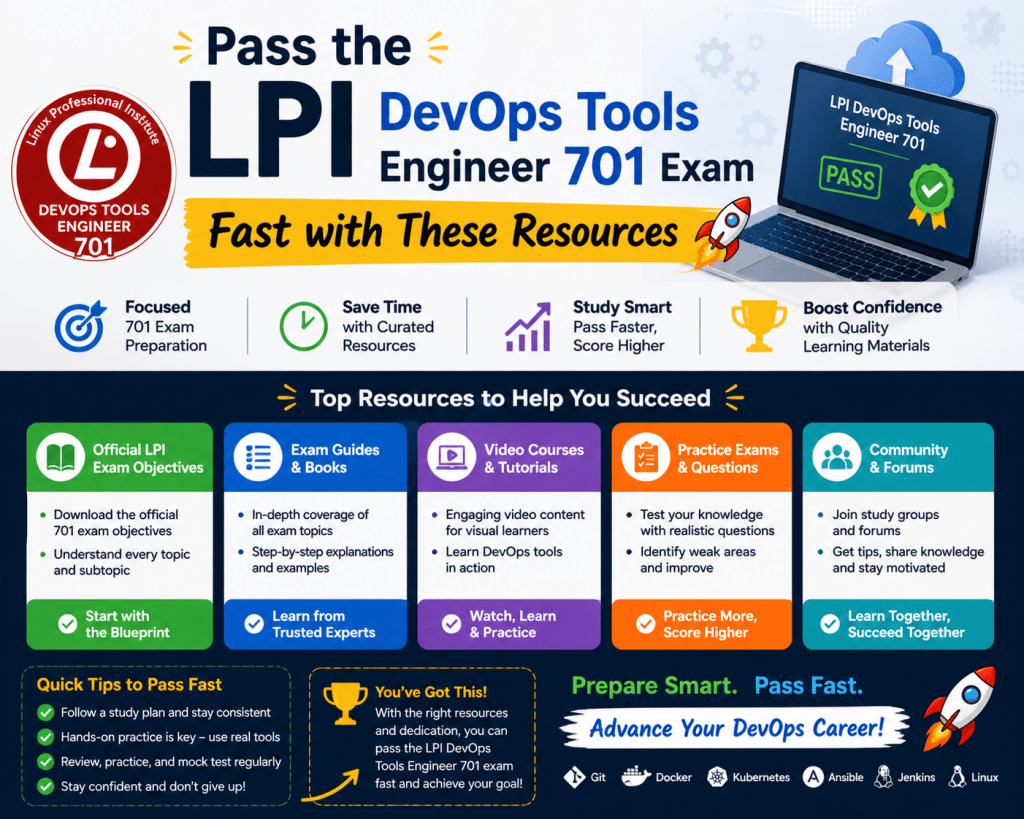
Preparing for the LPI DevOps Tools Engineer 701 exam requires a disciplined approach built on reliable and structured learning resources. Official materials are often the most aligned with exam objectives, making them a critical starting point for candidates. These resources are designed to reflect the scope, depth, and format of the certification exam, ensuring that learners focus on relevant topics without unnecessary distractions.
The official exam objectives document serves as a foundational guide for preparation. It outlines each domain in detail, breaking down the knowledge areas and skills that candidates are expected to master. By studying this document carefully, candidates can gain a clear understanding of what will be tested and how different topics are weighted. This clarity allows for better planning and prioritization during the study process.
In addition to the objectives, structured learning materials such as study guides provide deeper insights into each domain. These guides typically explain key concepts, offer examples, and present scenarios that mirror real-world DevOps environments. They help bridge the gap between theoretical knowledge and practical application, making complex topics easier to understand.
Sample questions and practice assessments included in official resources are particularly valuable. They give candidates a sense of the exam format and the types of questions they can expect. Practicing with these questions helps improve familiarity with the structure of the exam, reducing uncertainty and increasing confidence. It also allows candidates to identify areas where their understanding may be lacking.
Consistency in using official resources ensures that preparation remains aligned with the certification standards. Candidates who rely heavily on these materials are more likely to cover all relevant topics and avoid gaps in their knowledge. This structured approach forms the backbone of an effective study strategy.
Expanding Knowledge Through Books and Technical Publications
While official resources provide a strong foundation, expanding knowledge through technical publications can significantly enhance understanding. Books dedicated to DevOps practices, infrastructure management, and containerization offer in-depth explanations that go beyond basic concepts. These resources often include real-world case studies, practical examples, and detailed discussions that help candidates grasp complex topics.
Reading technical literature allows candidates to explore the reasoning behind DevOps methodologies. Instead of simply learning how to use tools, they gain insight into why certain practices are effective and how they contribute to improved system performance. This deeper understanding is essential for answering scenario-based questions in the exam.
Publications focused on infrastructure as code provide valuable knowledge about managing systems through automation. This approach is a core principle of DevOps, enabling consistent and repeatable deployments. By studying these concepts, candidates can better understand how to define and manage infrastructure using code-based approaches.
Books on containerization and orchestration offer detailed insights into how modern applications are deployed and managed. These resources explain how containers work, how they are orchestrated, and how they fit into larger DevOps workflows. Understanding these concepts is critical, as container management is a significant part of the exam.
Technical publications also help reinforce learning by presenting information in different formats. Reading explanations from multiple perspectives can clarify difficult concepts and improve retention. Combining these resources with hands-on practice creates a well-rounded learning experience.
Enhancing Skills with Online Courses and Video-Based Learning
Online courses and video tutorials provide a flexible and engaging way to prepare for the LPI DevOps Tools Engineer exam. These resources allow candidates to learn at their own pace, making them ideal for individuals with varying schedules and commitments. Video-based learning is particularly effective for visual learners, as it demonstrates concepts clearly and interactively.
Structured courses often follow the exam objectives, ensuring comprehensive coverage of all domains. They typically include lectures, demonstrations, and practical exercises that help reinforce learning. By following a structured course, candidates can ensure that they progress systematically through the syllabus.
One of the key advantages of video-based learning is the ability to see tools and processes in action. Watching demonstrations of automation workflows, container deployments, and configuration management tasks helps candidates understand how these processes work in real environments. This visual approach can make complex topics more accessible.
Interactive elements such as quizzes and assessments within courses provide opportunities for self-evaluation. These tools help candidates gauge their understanding and identify areas that need further study. Immediate feedback allows for quick correction of mistakes, improving overall learning efficiency.
Online learning platforms also offer the flexibility to revisit content as needed. Candidates can review challenging topics multiple times, ensuring a thorough understanding before moving on. This adaptability makes online courses a valuable component of exam preparation.
Developing Hands-On Expertise with Practical DevOps Tools
Practical experience is a cornerstone of DevOps expertise, and hands-on practice is essential for mastering the skills required for the 701 exam. While theoretical knowledge provides a foundation, real-world application brings concepts to life and deepens understanding.
Working with automation tools is a critical aspect of hands-on learning. Automation is at the heart of DevOps, enabling teams to streamline processes and reduce manual effort. Candidates should practice creating scripts and workflows that automate tasks such as deployment, configuration, and monitoring. This experience helps build confidence and reinforces theoretical concepts.
Containerization is another area where practical experience is invaluable. Setting up and managing containerized applications allows candidates to understand how containers function in different environments. Experimenting with container deployment and orchestration provides insight into how applications are scaled and managed in production.
Continuous integration and delivery pipelines can be explored through hands-on projects. Building pipelines that integrate code changes and deploy applications helps candidates understand the flow of data and the role of automation in these processes. This practical approach is essential for mastering one of the core domains of the exam.
Infrastructure management can be practiced by setting up virtual machines and experimenting with cloud environments. This allows candidates to understand how systems are provisioned, configured, and maintained. Learning to create and manage system images ensures consistency across deployments, a key requirement in DevOps workflows.
Monitoring and logging tools provide another opportunity for hands-on learning. Setting up monitoring systems and analyzing logs helps candidates develop problem-solving skills and understand how to maintain system health. This experience is crucial for the service operations domain of the exam.
Utilizing Open-Source Environments for Real-World Practice
Open-source environments provide an accessible and cost-effective way to gain practical experience with DevOps tools. These platforms allow candidates to create realistic scenarios and experiment with different workflows without significant financial investment.
Local development environments can be set up to simulate production systems. This enables candidates to test configurations, deploy applications, and troubleshoot issues in a controlled setting. By working in these environments, candidates can gain confidence in their ability to manage real-world systems.
Open-source tools often come with extensive documentation and community support. This makes it easier for candidates to learn how to use them and resolve any challenges they encounter. Engaging with these resources can enhance understanding and provide valuable insights into best practices.
Experimentation is a key benefit of open-source environments. Candidates can try different approaches, learn from mistakes, and refine their skills without the risk of impacting production systems. This freedom to explore is essential for developing a deep understanding of DevOps practices.
Using open-source tools also aligns with the focus of the certification, which emphasizes widely used technologies. Familiarity with these tools not only helps in the exam but also prepares candidates for real-world job roles where such tools are commonly used.
Engaging with Community Resources and Collaborative Learning
Community resources play a significant role in enhancing the learning experience. Engaging with other learners and professionals provides opportunities to exchange ideas, clarify doubts, and gain new perspectives. Collaborative learning can make complex topics more approachable and improve overall understanding.
Discussion forums and study groups allow candidates to connect with others preparing for the same certification. These platforms provide a space to ask questions, share insights, and discuss challenging topics. Learning from others’ experiences can offer valuable guidance and help avoid common mistakes.
Professional communities focused on DevOps practices offer additional learning opportunities. These communities often share updates, best practices, and real-world experiences that can enrich a candidate’s knowledge. Staying engaged with such communities helps candidates remain informed about industry trends.
Participating in group discussions encourages active learning. Explaining concepts to others reinforces understanding and highlights areas that may need further study. This interactive approach can be more effective than passive learning methods.
Collaborative learning also helps build communication skills, which are an important aspect of DevOps roles. The ability to work effectively with others and share knowledge is essential in modern IT environments.
Strengthening Knowledge with Practice Exams and Self-Assessment
Practice exams are a critical component of exam preparation, providing a way to evaluate knowledge and identify areas for improvement. Regular testing helps candidates become familiar with the exam format and build confidence in their abilities.
Taking practice exams under timed conditions simulates the actual exam environment. This helps candidates develop time management skills and reduces anxiety. It also provides a realistic assessment of readiness, allowing candidates to gauge their performance.
Reviewing incorrect answers is an essential part of the learning process. Understanding why a mistake was made helps candidates correct misconceptions and reinforce their knowledge. This targeted approach ensures continuous improvement.
Self-assessment tools can be used to track progress over time. By regularly evaluating their performance, candidates can identify trends and adjust their study plan accordingly. Focusing on weaker areas ensures a balanced understanding of all exam domains.
Combining practice exams with hands-on learning creates a comprehensive preparation strategy. This approach ensures that candidates are not only familiar with the exam format but also capable of applying their knowledge in practical scenarios.
Creating an Effective and Realistic Study Plan
A well-structured study plan is essential for success in the LPI DevOps Tools Engineer exam. Without a clear plan, candidates may struggle to cover all topics or manage their time effectively. A realistic and organized approach ensures consistent progress and reduces stress.
The first step in creating a study plan is setting a target exam date. This provides a clear goal and helps determine the amount of time available for preparation. Candidates should consider their existing knowledge and daily commitments when setting this timeline.
Breaking the syllabus into manageable sections allows for focused study sessions. Each domain should be allocated sufficient time based on its complexity and weight in the exam. This ensures balanced coverage and prevents last-minute cramming.
Incorporating different learning methods into the study plan enhances effectiveness. Combining reading, video learning, and hands-on practice provides a well-rounded approach. This variety keeps the learning process engaging and improves retention.
Regular review sessions are essential for reinforcing knowledge. Revisiting previously studied topics helps ensure that information remains fresh and easily accessible. Short, frequent reviews are often more effective than long, infrequent sessions.
Flexibility is an important aspect of any study plan. Candidates should be prepared to adjust their schedule based on progress and changing circumstances. This adaptability ensures that the plan remains realistic and achievable.
Tracking progress helps maintain motivation and accountability. Keeping a record of completed topics and practice test scores provides a sense of achievement and highlights areas that need further attention. This ongoing evaluation supports continuous improvement.
Balancing study with rest is crucial for maintaining focus and productivity. Adequate breaks and proper time management prevent burnout and ensure sustained performance throughout the preparation period.
By following a structured and realistic study plan, candidates can approach the exam with confidence. This disciplined approach not only improves the chances of success but also builds a strong foundation for a career in DevOps.
Refining Advanced DevOps Concepts for Exam Mastery
As candidates move into the final stage of preparation for the LPI DevOps Tools Engineer 701 exam, the focus should shift toward refining advanced concepts and strengthening integration across all domains. At this level, it is no longer enough to understand individual tools or isolated practices. Success depends on recognizing how various DevOps components interact within complex environments and how decisions in one area affect outcomes in another.
A deeper understanding of automation is essential. Automation in DevOps extends beyond simple scripting and includes orchestrating entire workflows that span development, testing, deployment, and monitoring. Candidates should be comfortable analyzing how automated processes reduce human error, improve efficiency, and ensure consistent system behavior. This includes understanding event-driven automation, pipeline triggers, and dependency management across different stages of deployment.
Another advanced concept involves system reliability and resilience. Modern DevOps practices emphasize designing systems that can recover quickly from failures. Candidates should understand how redundancy, load balancing, and fault tolerance contribute to system stability. These concepts are often tested indirectly through scenario-based questions that require analytical thinking rather than memorization.
Security integration is also an important aspect of advanced DevOps knowledge. While not always treated as a separate domain, security practices are embedded within DevOps workflows. Candidates should understand how secure coding practices, access control, and vulnerability management fit into continuous integration and delivery pipelines. This integration ensures that security is maintained without slowing down development processes.
Understanding performance optimization is equally important. DevOps engineers must ensure that applications run efficiently under varying loads. Candidates should be familiar with techniques for identifying bottlenecks, optimizing resource usage, and improving response times. These skills are critical for maintaining high-performing systems in production environments.
By refining these advanced concepts, candidates can move beyond basic knowledge and develop a comprehensive understanding of DevOps practices. This level of mastery is essential for tackling complex exam questions and performing effectively in real-world scenarios.
Mastering Continuous Integration and Continuous Delivery Workflows
Continuous integration and continuous delivery form the backbone of modern DevOps practices. These workflows enable teams to integrate code changes frequently, test them automatically, and deploy them with minimal manual intervention. Mastering these concepts is essential for success in the 701 exam.
Continuous integration focuses on merging code changes into a shared repository, where automated tests verify the integrity of the codebase. Candidates should understand how these processes help detect issues early, reducing the cost and complexity of fixing bugs. Knowledge of build automation, test execution, and feedback mechanisms is crucial.
Continuous delivery extends this concept by automating the deployment process. Candidates must understand how applications move from development to production environments through structured pipelines. This includes knowledge of staging environments, deployment strategies, and rollback mechanisms.
Pipeline design is a key aspect of this domain. Candidates should be able to analyze how pipelines are structured and how different stages interact. This includes understanding triggers, dependencies, and parallel execution. Efficient pipeline design ensures faster delivery while maintaining quality and reliability.
Version control integration is another critical component. Candidates must understand how code repositories interact with pipelines and how changes are tracked and managed. This includes knowledge of branching strategies, merge workflows, and conflict resolution.
Testing plays a central role in continuous integration and delivery. Automated tests ensure that code changes do not introduce new issues. Candidates should understand different types of testing, including unit, integration, and performance testing, and how they fit into the pipeline.
By mastering these workflows, candidates can demonstrate their ability to manage the entire software delivery lifecycle. This comprehensive understanding is essential for both the exam and real-world DevOps roles.
Deep Dive into Containerization and Orchestration Strategies
Containerization has revolutionized the way applications are developed and deployed. It allows developers to package applications with their dependencies, ensuring consistency across different environments. For the LPI DevOps Tools Engineer exam, a deep understanding of containerization is essential.
Candidates should understand how containers differ from traditional virtualization. Containers are lightweight and share the host operating system, making them more efficient and faster to deploy. This efficiency is a key advantage in modern DevOps environments where speed and scalability are critical.
Container orchestration is another important area. As applications grow in complexity, managing multiple containers becomes challenging. Orchestration tools help automate the deployment, scaling, and management of containerized applications. Candidates should understand how orchestration systems handle tasks such as load balancing, service discovery, and resource allocation.
Networking within container environments is a complex topic that requires careful attention. Candidates should understand how containers communicate with each other and with external systems. This includes knowledge of network configurations, port mapping, and service endpoints.
Storage management is also a key consideration. Containers are often ephemeral, meaning they do not retain data by default. Candidates must understand how to manage persistent storage and ensure data integrity. This includes knowledge of volumes, storage drivers, and backup strategies.
Security in container environments is another critical aspect. Candidates should understand how to secure container images, manage access controls, and monitor for vulnerabilities. This ensures that containerized applications remain secure throughout their lifecycle.
A deep understanding of containerization and orchestration enables candidates to design and manage scalable, efficient, and reliable systems. These skills are essential for both the exam and practical DevOps work.
Strengthening Configuration Management and Infrastructure Automation Skills
Configuration management is a cornerstone of DevOps, ensuring that systems remain consistent and predictable across different environments. Candidates preparing for the 701 exam must develop strong skills in this area, focusing on both theoretical understanding and practical application.
Configuration management involves defining the desired state of a system and using automation to maintain that state. Candidates should understand how configuration files are structured and how they are applied to systems. This includes knowledge of variables, templates, and reusable components.
Infrastructure automation extends these concepts to the provisioning and management of entire systems. Instead of manually configuring servers, candidates should understand how to use automation to deploy and manage infrastructure at scale. This approach improves efficiency and reduces the risk of errors.
Idempotency is a key concept in configuration management. It ensures that applying the same configuration multiple times produces the same result. Candidates should understand why this is important and how it contributes to system stability.
Version control integration is also essential. Configuration files and infrastructure definitions should be stored in version control systems, allowing teams to track changes and collaborate effectively. Candidates should understand how to manage these files and integrate them into DevOps workflows.
Testing and validation are important aspects of configuration management. Candidates should understand how to verify that configurations are applied correctly and how to troubleshoot issues when they arise. This includes knowledge of logging, debugging, and error handling.
By strengthening their skills in configuration management and infrastructure automation, candidates can ensure that they are well-prepared for this critical domain of the exam.
Enhancing Monitoring, Logging, and Service Reliability Practices
Monitoring and logging are essential for maintaining the health and performance of systems. These practices provide visibility into system behavior, enabling teams to detect and resolve issues quickly. For the 701 exam, candidates must develop a strong understanding of these concepts.
Monitoring involves collecting and analyzing metrics related to system performance. Candidates should understand how to track key indicators such as resource usage, response times, and error rates. This information helps identify potential issues before they impact users.
Logging provides detailed records of system events, offering insights into what is happening within an application or infrastructure. Candidates should understand how logs are generated, stored, and analyzed. This includes knowledge of log formats, aggregation, and search techniques.
Alerting is a critical component of monitoring. Candidates should understand how to set up alerts that notify teams of potential issues. This includes defining thresholds, configuring notification channels, and avoiding alert fatigue.
Incident response is another important area. Candidates should understand how to respond to system failures, including identifying the root cause and implementing solutions. This requires a combination of technical knowledge and problem-solving skills.
Service reliability focuses on ensuring that systems remain available and perform consistently. Candidates should understand concepts such as uptime, redundancy, and failover mechanisms. These practices help maintain a positive user experience and ensure business continuity.
By enhancing their knowledge of monitoring, logging, and service reliability, candidates can develop the skills needed to maintain robust and dependable systems.
Optimizing Exam Performance Through Strategic Practice Techniques
Achieving success in the LPI DevOps Tools Engineer exam requires more than just knowledge; it also depends on effective exam strategies. Candidates should focus on optimizing their performance through targeted practice and preparation techniques.
One of the most effective strategies is taking timed practice exams. This helps candidates become familiar with the pace required to complete the exam within the allotted time. It also reduces anxiety by simulating the actual exam environment.
Reviewing practice test results is essential for improvement. Candidates should analyze their mistakes and identify patterns in their errors. This allows them to focus on areas that need additional study and avoid repeating the same mistakes.
Time management during the exam is crucial. Candidates should allocate time to each question and avoid spending too long on difficult ones. Skipping challenging questions and returning to them later can help ensure that all questions are attempted.
Reading questions carefully is another important skill. Candidates should pay attention to details and avoid making assumptions. Understanding the context of each question is essential for selecting the correct answer.
Maintaining focus and composure during the exam is also important. Candidates should approach the exam with confidence and avoid rushing through questions. A calm and methodical approach can significantly improve performance.
By applying these strategic techniques, candidates can maximize their chances of success and perform at their best during the exam.
Developing Long-Term DevOps Expertise Beyond Certification
While passing the LPI DevOps Tools Engineer exam is a significant achievement, it is only the beginning of a continuous learning journey. DevOps is a dynamic field that evolves rapidly, requiring professionals to stay updated with new tools, practices, and technologies.
Continuous learning is essential for maintaining relevance in the industry. Candidates should regularly explore new developments in DevOps and expand their skill set. This includes experimenting with new tools, learning advanced techniques, and staying informed about industry trends.
Practical experience remains a key factor in long-term success. Candidates should seek opportunities to apply their knowledge in real-world scenarios, whether through professional work or personal projects. This hands-on experience reinforces learning and builds confidence.
Collaboration and communication skills are also important. DevOps emphasizes teamwork, and professionals must be able to work effectively with others. Developing these skills can enhance career prospects and improve overall performance.
Adaptability is another critical trait. As technology evolves, DevOps professionals must be able to adjust to new environments and challenges. This requires a willingness to learn and a proactive approach to problem-solving.
By focusing on long-term growth and continuous improvement, candidates can build a successful career in DevOps. The skills and knowledge gained during exam preparation provide a strong foundation for future development and professional advancement.
Conclusion
The journey toward earning the LPI DevOps Tools Engineer certification represents far more than preparing for a single exam. It reflects a deeper commitment to understanding how modern software systems are built, deployed, and maintained in an increasingly complex technological landscape. Throughout the preparation process, candidates are exposed to a wide range of concepts that shape the foundation of DevOps, from automation and containerization to continuous integration and system monitoring. These are not isolated skills but interconnected practices that collectively enable organizations to deliver reliable and scalable solutions.
One of the most important takeaways from this learning path is the value of integration. DevOps is not about mastering a single tool or technique; it is about understanding how different components work together to form efficient workflows. Whether it is connecting version control systems with deployment pipelines or ensuring that monitoring tools provide actionable insights, the ability to see the bigger picture is what distinguishes a competent DevOps professional. This holistic perspective becomes especially important when dealing with real-world challenges, where solutions often require coordination across multiple domains.
Another key aspect of the certification journey is the emphasis on practical experience. While theoretical knowledge provides a necessary foundation, it is hands-on practice that truly solidifies understanding. Working with real environments, experimenting with configurations, and troubleshooting issues helps transform abstract concepts into tangible skills. This practical approach not only prepares candidates for the exam but also equips them with the confidence to handle tasks in professional settings. The ability to apply knowledge effectively is ultimately what employers look for, and this certification process encourages that level of competence.
Consistency and discipline also play a crucial role in achieving success. Preparing for a comprehensive exam like the LPI DevOps Tools Engineer requires a structured study plan, regular review, and continuous self-assessment. Candidates who approach their preparation methodically are more likely to retain information and identify areas that need improvement. This disciplined approach mirrors the principles of DevOps itself, where consistency and automation are used to maintain stability and efficiency. In this way, the preparation process becomes a reflection of the practices being learned.
The certification journey also highlights the importance of adaptability. The field of DevOps is constantly evolving, with new tools and methodologies emerging regularly. Candidates must develop the ability to learn and adapt quickly, as this skill is essential for long-term success. The knowledge gained during exam preparation serves as a strong foundation, but it is the willingness to continue learning that ensures ongoing relevance in the industry. This mindset of continuous improvement is at the core of DevOps culture and is a valuable trait for any technology professional.
Collaboration is another critical element reinforced throughout this process. DevOps is built on the idea of breaking down silos between teams and fostering communication. Understanding how to work effectively with others, share knowledge, and contribute to collective goals is just as important as technical expertise. The certification encourages this mindset by focusing on tools and practices that support collaboration, such as version control and shared workflows. These skills are essential in modern work environments, where teamwork often determines the success of projects.
The benefits of earning this certification extend beyond immediate career opportunities. It provides a structured way to develop a comprehensive skill set that is applicable across various roles in the technology sector. Whether working in development, operations, or a hybrid role, the knowledge gained through this process enhances problem-solving abilities and improves overall efficiency. This versatility makes the certification a valuable asset for professionals looking to expand their capabilities and explore new career paths.
At the same time, the preparation process encourages a deeper appreciation for the challenges faced by modern organizations. Managing complex systems, ensuring reliability, and delivering high-quality software require a combination of technical expertise and strategic thinking. By studying these concepts, candidates gain insight into the broader context of their work, allowing them to make more informed decisions and contribute more effectively to their teams. This understanding is what transforms a technician into a well-rounded professional.
Ultimately, the LPI DevOps Tools Engineer certification represents a meaningful step in a professional’s growth. It validates not only technical knowledge but also the ability to think critically, adapt to change, and collaborate effectively. The journey toward achieving it is an opportunity to build skills that extend far beyond the exam itself. By embracing the principles of DevOps and committing to continuous learning, candidates position themselves for long-term success in a field that continues to shape the future of technology.