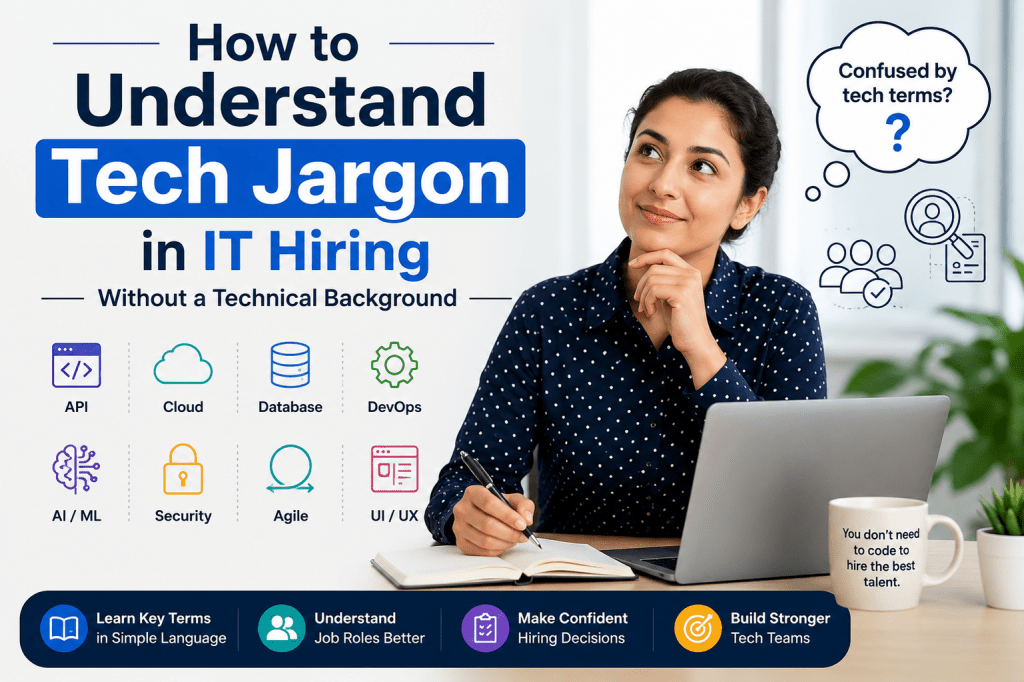
Hiring for technical positions can feel overwhelming for non-technical recruiters and managers. Many job descriptions are packed with unfamiliar terminology, abbreviations, and technical concepts that make the hiring process seem more complicated than it really is. Terms such as APIs, cloud infrastructure, automation, machine learning, and cybersecurity often create confusion for people without an IT background. However, understanding these concepts at a basic level can dramatically improve hiring decisions and communication between recruiters, managers, and technical teams.
Modern businesses rely heavily on technology to manage operations, communicate with customers, store data, and secure information. As a result, IT professionals are no longer limited to tech companies alone. Almost every industry requires developers, system administrators, cybersecurity experts, cloud engineers, and data specialists. Because of this growing demand, hiring managers need to understand the language of technology well enough to identify qualified candidates and accurately evaluate their skills.
Non-technical hiring teams often struggle because IT professionals use highly specialized vocabulary in resumes and interviews. A recruiter may see several candidates listing different programming languages, frameworks, and certifications without understanding how those skills apply to the role. This can lead to poor hiring decisions, unclear communication, or unrealistic job expectations. Developing a foundational understanding of IT terminology helps bridge that gap and creates a smoother hiring process for everyone involved.
The key to successful IT hiring is not becoming a software engineer overnight. Instead, it is about learning how technical roles function, understanding the purpose of commonly used tools, and recognizing how different technologies support business goals. Once hiring managers understand the basics, technical conversations become easier to follow, and evaluating candidates becomes far less intimidating.
Why Technical Terminology Matters in Recruitment
Technical terminology serves as the common language within IT teams. Developers, engineers, analysts, and administrators use specific words to describe tools, systems, and processes because those terms provide clarity and precision. For recruiters unfamiliar with the terminology, conversations can quickly become difficult to follow. Learning these terms allows hiring managers to communicate more confidently and ask better interview questions.
Many companies make the mistake of copying technical job descriptions from the internet without fully understanding the responsibilities involved. This often results in job listings that are either too vague or unrealistically demanding. Candidates may become confused about expectations, or qualified professionals may avoid applying because the listing appears inaccurate. Understanding the terminology behind the role helps recruiters create clearer and more effective job descriptions.
Technical knowledge also improves collaboration between HR departments and IT teams. Recruiters who understand the basics of software development, cybersecurity, or networking can work more efficiently with technical managers when defining hiring needs. This collaboration helps companies identify the right skills, certifications, and experience levels required for success.
Additionally, candidates tend to respond more positively when recruiters demonstrate at least a basic understanding of the role. Technical professionals often become frustrated when recruiters cannot explain the position or misunderstand key technologies. Even a small amount of technical literacy can build credibility and improve the overall candidate experience.
The Difference Between Technical Roles
One of the biggest challenges for non-technical hiring managers is understanding how IT roles differ from one another. Many positions sound similar on the surface but involve very different responsibilities and skill sets. Knowing the distinctions helps organizations avoid hiring the wrong person for the job.
For example, software developers and software engineers are often treated as interchangeable roles, even though they typically focus on different aspects of development. A software developer primarily writes code and creates applications or features. They focus heavily on implementation and functionality. Software engineers, on the other hand, often take a broader approach by designing systems, managing architecture, and ensuring scalability across larger environments.
Similarly, data analysts and data scientists both work with information and reporting, but their responsibilities differ significantly. Data analysts focus on organizing data, identifying trends, and creating reports that support decision-making. Data scientists usually work with predictive models, algorithms, and advanced analytics to forecast outcomes and solve complex problems.
System administrators and DevOps engineers also overlap in some areas, but their goals are different. System administrators manage servers, user accounts, updates, and network stability. DevOps engineers focus on improving collaboration between development and operations teams while automating software delivery processes.
Understanding these distinctions allows hiring teams to create more accurate expectations and avoid confusion during recruitment.
Understanding Software Development Roles
Software development is one of the most common areas in IT hiring. Developers create the applications, websites, systems, and tools businesses use every day. However, software development itself includes multiple specializations, each requiring different technical expertise.
Front-end developers focus on the visual and interactive parts of applications that users directly interact with. They work with technologies such as HTML, CSS, and JavaScript to create layouts, buttons, forms, and user interfaces. Their goal is to ensure websites and applications are visually appealing, responsive, and easy to use.
Back-end developers work behind the scenes on servers, databases, and application logic. They handle data processing, authentication systems, APIs, and overall application functionality. Programming languages commonly associated with back-end development include Python, Java, PHP, and C#.
Full-stack developers combine both front-end and back-end skills. These professionals can build complete applications independently because they understand both user interface development and server-side functionality. Companies often value full-stack developers because they offer versatility and flexibility.
Mobile developers specialize in creating applications for smartphones and tablets. Some focus specifically on Android development, while others specialize in iOS applications. Cross-platform development tools have also become popular, allowing developers to create applications that work across multiple operating systems.
Game developers, embedded systems developers, and enterprise application developers represent additional software development specializations. Each role requires unique tools, programming languages, and technical knowledge.
The Importance of Programming Languages
Programming languages are one of the most frequently misunderstood aspects of IT hiring. Many non-technical recruiters assume that all programming languages are interchangeable, but each language serves different purposes and industries.
Python is widely used because of its simplicity and versatility. It is popular in data analysis, machine learning, automation, web development, and scripting. Companies often seek Python developers for projects involving analytics, artificial intelligence, and backend systems.
Java remains one of the most commonly used enterprise programming languages. Large organizations frequently use Java for business applications, financial systems, and large-scale platforms because of its stability and scalability.
JavaScript is essential for web development. Front-end developers use it to create interactive user experiences, while back-end developers may use environments like Node.js to build server-side applications.
C# is commonly associated with enterprise software, Microsoft technologies, and game development. Many businesses using Microsoft infrastructure rely heavily on C# developers.
PHP remains popular for website development and content management systems. Many existing websites and platforms still rely on PHP frameworks and applications.
SQL differs slightly because it is specifically designed for managing databases rather than building applications. IT professionals use SQL to store, organize, retrieve, and manipulate data.
Understanding the purpose of each language helps recruiters determine whether a candidate’s experience aligns with the company’s technology stack.
Understanding APIs and System Integration
APIs are one of the most important concepts in modern software development. API stands for Application Programming Interface. While the term may sound complex, the concept is relatively simple. APIs allow different software systems to communicate and share information with one another.
Businesses rely on APIs constantly, often without realizing it. For example, when an online store processes a payment through a third-party payment provider, APIs are working behind the scenes to exchange information securely between systems.
Developers use APIs to integrate applications, automate workflows, and connect services. Many modern applications depend heavily on APIs because businesses rarely build every feature from scratch. Instead, developers integrate existing tools and services into applications to save time and improve functionality.
Candidates with API experience are often valuable because integration skills are essential in today’s technology landscape. Recruiters who understand the role of APIs can better evaluate how candidates contribute to software development projects.
Version Control and Collaboration Tools
Version control systems are another critical concept in software development. These tools help teams track changes made to code over time. Without version control, collaboration among developers would become extremely difficult.
Git is the most commonly used version control system. Developers use Git to save code changes, collaborate with teammates, review updates, and restore previous versions if problems occur. Platforms like GitHub, GitLab, and Bitbucket provide environments where teams can manage repositories and collaborate on projects.
Version control is important because software development rarely involves a single person working alone. Teams constantly update applications, fix bugs, and add features simultaneously. Version control systems ensure changes are organized and prevent developers from accidentally overwriting each other’s work.
Recruiters frequently see Git listed on resumes because it has become a standard requirement for developers. Understanding its purpose helps hiring teams recognize why collaboration tools are so important in technical environments.
Agile Development and Team Collaboration
Agile development is one of the most widely used project management approaches in software development. Instead of building large applications over long periods without feedback, Agile encourages teams to work in smaller cycles called sprints.
During each sprint, developers complete manageable pieces of work, test functionality, gather feedback, and make improvements continuously. This approach helps teams adapt quickly to changing requirements and deliver updates more efficiently.
Agile development emphasizes communication, collaboration, and flexibility. Teams often hold regular meetings to discuss progress, challenges, and priorities. Common Agile frameworks include Scrum and Kanban.
Hiring managers often encounter Agile terminology in resumes and interviews because many companies now structure development teams around Agile practices. Candidates with Agile experience are usually familiar with collaborative workflows, iterative development, and project management tools.
Understanding Agile also helps recruiters evaluate soft skills such as teamwork, adaptability, communication, and time management, which are essential in modern development environments.
The Growing Importance of Cloud Computing
Cloud computing has transformed how businesses manage technology infrastructure. Instead of relying entirely on physical servers located inside company offices, organizations now use cloud platforms to host applications, store data, and manage services remotely.
Cloud computing offers flexibility, scalability, and cost savings. Companies can increase or decrease resources based on demand without purchasing expensive hardware. This makes cloud technology especially attractive for growing businesses.
Three major cloud service models dominate the industry. Software as a Service provides ready-to-use applications accessible through the internet. Platform as a Service offers development environments where programmers can build and deploy applications. Infrastructure as a Service provides virtual servers, storage, and networking resources.
Major cloud providers include Amazon Web Services, Microsoft Azure, and Google Cloud Platform. Each platform offers different services and certifications.
Cloud skills are highly valuable because businesses increasingly migrate systems away from traditional on-site infrastructure. Recruiters who understand cloud terminology can better evaluate whether candidates possess relevant experience for modern IT environments.
Understanding IT Infrastructure and Networking
Networking forms the foundation of business technology systems. Every connected device within an organization relies on networks to communicate, share resources, and access data. Understanding networking basics helps non-technical hiring managers better understand infrastructure-related roles.
Networks consist of devices such as routers, switches, servers, and firewalls working together to manage communication between systems. Network engineers and administrators ensure these systems operate efficiently and securely.
An IP address serves as a unique identifier for devices connected to a network. Similar to a home address, it allows systems to locate and communicate with each other.
DNS converts human-friendly website names into numerical IP addresses computers can understand. Without DNS, users would need to memorize complex numerical addresses to access websites.
VPNs create secure connections between users and company networks, especially for remote work environments. Firewalls protect systems by filtering unauthorized traffic and blocking potential threats.
Bandwidth refers to the amount of data transmitted over a network within a given period. Slow bandwidth can affect application performance, video conferencing, and file transfers.
Understanding these concepts helps recruiters better interpret networking experience listed on resumes and communicate more effectively with infrastructure teams.
Understanding Technical Job Descriptions
Technical job descriptions often appear overwhelming because they include long lists of tools, frameworks, certifications, and responsibilities. For non-technical hiring managers, it can be difficult to determine which requirements are truly essential and which are simply preferred skills. Learning how to interpret technical job descriptions helps organizations hire more effectively and avoid unrealistic expectations.
Many companies make the mistake of creating job descriptions filled with every possible technology related to a role. This approach may discourage qualified candidates from applying because they assume they must meet every listed requirement. In reality, most experienced IT professionals understand multiple technologies and can adapt to new environments quickly. A better approach is focusing on the core responsibilities of the role and identifying the most critical technical skills needed for success.
Job descriptions should clearly explain what the employee will actually do daily. Instead of listing dozens of programming languages or tools, employers should describe practical responsibilities such as maintaining cloud systems, building web applications, analyzing customer data, or improving cybersecurity protections. Clear expectations attract stronger candidates and reduce confusion during interviews.
Technical managers and recruiters should collaborate closely when creating job listings. IT leaders understand the technical requirements, while recruiters know how to communicate those requirements effectively to candidates. This partnership ensures job descriptions remain accurate, realistic, and understandable.
Recognizing Essential Skills Versus Optional Skills
One of the biggest challenges in IT recruitment is separating must-have skills from optional experience. Many technologies overlap, and experienced professionals can often transition between similar tools without difficulty.
For example, a developer experienced in one programming language may quickly learn another if the underlying concepts are similar. A company hiring a back-end developer may list Java as a requirement, but a strong Python or C# developer could potentially adapt successfully with proper onboarding.
Cloud platforms provide another example. A candidate with experience in Amazon Web Services may transition effectively into a Microsoft Azure environment because many cloud concepts remain similar across providers. Recruiters who understand these relationships can expand candidate pools and avoid unnecessary hiring limitations.
The same principle applies to cybersecurity, networking, and database administration. Candidates with strong foundational knowledge often adapt faster than those with narrow experience limited to one specific tool.
Hiring managers should focus on whether candidates understand the core responsibilities of the role rather than expecting perfect matches for every technology listed in a job description.
Understanding Technical Experience Levels
Experience requirements in IT hiring can sometimes be misleading. Years of experience do not always accurately reflect a candidate’s skill level or ability. Some professionals gain advanced expertise quickly through hands-on projects, while others may spend years performing repetitive tasks without expanding their knowledge.
Entry-level IT positions typically focus on foundational skills, willingness to learn, and basic technical understanding. These roles may include help desk support, junior development, system monitoring, or technical troubleshooting. Candidates at this level often possess certifications, internships, personal projects, or educational backgrounds rather than extensive professional experience.
Mid-level professionals usually work independently and handle more complex responsibilities. They understand industry practices, contribute to projects confidently, and require less supervision. Mid-level developers, administrators, and analysts often mentor junior team members while continuing to expand their technical expertise.
Senior-level professionals take on leadership responsibilities, system architecture decisions, and strategic planning. They solve complex problems, guide technical direction, and support organizational growth. Senior candidates are often expected to communicate effectively with executives and cross-functional teams in addition to managing technical responsibilities.
Hiring managers should evaluate both practical experience and problem-solving ability instead of relying entirely on years listed on resumes.
The Importance of Technical Interviews
Technical interviews help organizations evaluate whether candidates possess the skills needed for specific roles. However, non-technical hiring managers sometimes feel intimidated during technical interviews because they cannot independently assess technical answers.
This is why collaboration with technical team members is essential. Recruiters and HR professionals should focus on communication skills, professionalism, adaptability, and cultural fit, while technical interviewers evaluate specialized expertise.
Good technical interviews do not simply test memorization. Instead, they explore how candidates approach problems, explain decisions, and adapt to challenges. A candidate who communicates clearly and demonstrates logical thinking often performs better long-term than someone who only recites technical terminology.
Behavioral questions are especially valuable in IT interviews. Asking candidates about previous challenges, project experiences, or troubleshooting situations reveals how they think and work under pressure.
For example, recruiters may ask candidates to explain how they resolved a system outage, handled conflicting project priorities, or collaborated with difficult team members. These discussions provide insight into communication abilities and professional maturity.
Technical assessments may also involve coding exercises, scenario-based troubleshooting, or infrastructure design discussions. The purpose is not necessarily finding flawless answers but understanding the candidate’s thought process and technical reasoning.
Understanding Front-End Development
Front-end development focuses on the visual side of applications and websites. These developers create the interfaces users interact with directly, including layouts, buttons, navigation menus, animations, and forms.
HTML provides the structure of web pages, while CSS controls styling and design elements. JavaScript adds interactivity and dynamic behavior to websites and applications.
Front-end developers must balance technical functionality with user experience. Applications need to work efficiently while remaining visually appealing and easy to navigate.
Responsive design has become especially important because users access websites from desktops, tablets, and smartphones with different screen sizes. Front-end developers ensure applications adjust properly across devices.
Modern front-end development often involves frameworks such as React, Angular, or Vue.js. These tools help developers build interactive interfaces more efficiently and manage complex applications.
Recruiters hiring front-end developers should understand that these professionals combine technical coding skills with creativity and design awareness. Strong communication and collaboration skills are also important because front-end developers frequently work closely with designers and product teams.
Understanding Back-End Development
Back-end development focuses on the server-side functionality powering applications behind the scenes. While front-end developers create user interfaces, back-end developers handle databases, application logic, authentication systems, and data processing.
Back-end developers ensure applications function correctly, process requests efficiently, and securely manage information. Their work supports everything users see on the front end.
Programming languages commonly used in back-end development include Python, Java, PHP, Ruby, and C#. Developers also work with databases, APIs, cloud infrastructure, and server management tools.
Scalability is a major concern in back-end development. Applications must continue performing efficiently even as user traffic and data volume increase. Skilled back-end developers design systems capable of handling growth without major performance problems.
Security is another critical responsibility. Back-end systems often manage sensitive customer information, payment processing, and authentication mechanisms. Developers must protect systems against vulnerabilities and unauthorized access.
Hiring managers evaluating back-end developers should look for candidates who understand architecture, databases, APIs, and system reliability in addition to programming languages.
Understanding Full-Stack Development
Full-stack developers combine front-end and back-end expertise. These professionals can build complete applications independently because they understand both user interfaces and server-side functionality.
Companies often value full-stack developers because they offer flexibility and can contribute across multiple areas of development. Startups and smaller businesses especially appreciate full-stack professionals because they can manage broader responsibilities with smaller teams.
However, hiring managers should recognize that full-stack development requires balancing many skills. Some full-stack developers may specialize more heavily in front-end work, while others focus more on back-end systems.
Full-stack developers typically work with front-end frameworks, databases, APIs, servers, cloud platforms, and deployment processes. Their broad knowledge allows them to understand how entire systems function together.
Communication skills are particularly valuable in full-stack roles because these professionals frequently collaborate with multiple departments and technical teams.
The Role of Quality Assurance Professionals
Quality Assurance professionals help ensure software works properly before reaching users. They identify bugs, performance problems, usability issues, and system failures that developers may overlook during development.
Manual testers interact directly with applications to identify issues through real-world usage scenarios. They verify functionality, test workflows, and document problems for development teams.
Automation testers use scripts and specialized tools to automate repetitive testing processes. Automated testing improves efficiency and allows organizations to test applications more frequently.
Quality Assurance professionals contribute significantly to customer satisfaction because stable and reliable software improves user experiences and reduces support issues.
Testing often includes performance evaluations, security checks, compatibility testing, and usability reviews. QA teams work closely with developers to resolve issues before software releases.
Recruiters should recognize that successful QA professionals require strong attention to detail, analytical thinking, communication skills, and patience in addition to technical knowledge.
Understanding Technical Support Roles
Technical support professionals help users solve hardware, software, and system-related issues. These roles are essential because even the most advanced technology environments require human support and troubleshooting.
Help desk technicians typically handle common technical problems such as password resets, software installations, printer issues, and connectivity problems. They often represent the first point of contact for employees experiencing technical difficulties.
Desktop support specialists provide more advanced troubleshooting for hardware and operating system issues. They may install workstations, configure devices, and support office infrastructure.
Higher-level support engineers handle complex issues involving servers, networking, cloud systems, and enterprise applications. These professionals often collaborate with infrastructure and development teams when diagnosing major problems.
Communication skills are extremely important in technical support roles because employees and customers may become frustrated during technical issues. Support professionals must remain patient, professional, and solution-oriented under pressure.
Hiring managers should prioritize customer service abilities and problem-solving skills alongside technical knowledge when evaluating support candidates.
Understanding Remote IT Work Environments
Remote work has significantly changed the IT industry. Many technical professionals now work fully remotely or within hybrid environments. Because technology roles often involve digital collaboration, many companies successfully support distributed teams across multiple locations.
Remote IT work requires strong communication skills, time management, and self-discipline. Employees must collaborate effectively through video meetings, messaging platforms, and project management tools.
Companies hiring remote IT professionals often prioritize candidates who demonstrate independence and accountability. Managers need confidence that employees can remain productive without constant supervision.
Cybersecurity becomes especially important in remote work environments because employees access company systems from various locations and devices. Organizations frequently use VPNs, multi-factor authentication, and endpoint security tools to protect remote access.
Cloud-based collaboration platforms also play a major role in remote IT operations. Teams rely on shared repositories, communication tools, and cloud infrastructure to maintain productivity across distributed environments.
Recruiters hiring remote technical professionals should evaluate both technical ability and communication habits to ensure candidates can succeed within virtual work settings.
The Value of Adaptability in Technology Careers
Technology evolves rapidly, making adaptability one of the most important traits in IT professionals. Tools, programming languages, cybersecurity threats, and cloud platforms constantly change, requiring continuous learning and professional growth.
Candidates who demonstrate curiosity and willingness to learn often succeed long-term even if they lack experience with every required technology. Employers increasingly value professionals who adapt quickly and remain open to new tools and processes.
Continuous learning may involve certifications, online courses, self-study, community participation, or hands-on experimentation. Strong candidates frequently build personal projects or contribute to collaborative technical communities outside their regular jobs.
Hiring managers should therefore avoid focusing exclusively on current technical skills. Evaluating a candidate’s learning mindset, flexibility, and problem-solving approach often provides better insight into future success.
Organizations also benefit when they create environments encouraging ongoing learning and development. Supporting employee growth helps businesses remain competitive while improving retention within highly competitive IT job markets.
Understanding Cloud Computing in Modern Businesses
Cloud computing has become one of the most important parts of modern business technology. Instead of storing data and running applications only on physical servers inside office buildings, companies now use cloud platforms to access computing resources through the internet. This shift has changed how organizations manage infrastructure, improve scalability, and reduce operational costs.
For non-technical hiring managers, cloud computing may sound complicated, but the concept is straightforward. Businesses rent computing resources such as servers, storage, databases, and software from cloud providers rather than purchasing and maintaining everything themselves.
This approach allows organizations to grow more efficiently. If a business suddenly experiences increased customer demand, cloud services can scale quickly without requiring expensive hardware upgrades. Companies also gain flexibility because employees can access systems remotely from different locations.
Three major cloud service categories dominate the industry. Software as a Service provides ready-to-use applications accessed online. Platform as a Service gives developers environments for building applications. Infrastructure as a Service offers virtual servers, storage, and networking resources.
Recruiters frequently encounter cloud-related terms such as AWS, Azure, Google Cloud, virtualization, and scalability in technical resumes. Understanding these concepts helps hiring managers identify candidates capable of supporting modern infrastructure environments.
Understanding Amazon Web Services and Cloud Platforms
Amazon Web Services, often called AWS, is one of the largest cloud computing platforms in the world. Businesses use AWS to host applications, store files, run databases, and manage scalable infrastructure.
Microsoft Azure and Google Cloud Platform are also widely used cloud providers. Although each platform offers unique services, they all support similar functions such as cloud storage, virtual machines, networking, security, and application hosting.
Cloud engineers and administrators specialize in managing these environments. Their responsibilities include configuring infrastructure, monitoring performance, securing cloud resources, and optimizing costs.
Cloud certifications have become extremely valuable because companies increasingly migrate systems away from traditional data centers. Recruiters often see certifications related to AWS, Azure, or Google Cloud when hiring infrastructure and DevOps professionals.
Understanding cloud terminology helps recruiters communicate more effectively with candidates and technical managers. Even basic familiarity with cloud platforms improves hiring confidence significantly.
The Importance of Scalability in IT Systems
Scalability refers to a system’s ability to handle growth without losing performance or stability. Modern businesses constantly deal with changing workloads, customer traffic, and data volumes, making scalability essential for long-term success.
For example, an online shopping platform may experience massive increases in traffic during promotions or seasonal events. Systems that cannot scale properly may crash under heavy demand, leading to lost revenue and poor customer experiences.
Cloud environments support scalability by allowing businesses to increase resources dynamically. Additional servers, storage, or processing power can be added automatically when demand increases.
Software developers, cloud engineers, and infrastructure teams work together to design scalable systems. Their goal is ensuring applications remain reliable even as user numbers and workloads grow.
Recruiters hiring for cloud or infrastructure roles should recognize scalability as an important technical concept because many organizations prioritize systems capable of supporting future growth.
Understanding Cybersecurity Fundamentals
Cybersecurity protects systems, applications, networks, and data from unauthorized access and malicious attacks. As businesses become increasingly digital, cybersecurity has evolved from a specialized IT function into a major organizational priority.
Cyber threats constantly evolve, making cybersecurity one of the fastest-changing areas in technology. Companies face risks such as ransomware attacks, phishing scams, data breaches, malware infections, and insider threats.
Cybersecurity professionals help organizations identify vulnerabilities, implement protective measures, monitor threats, and respond to security incidents. Their work protects both business operations and customer trust.
Non-technical hiring managers should understand that cybersecurity is not limited to antivirus software alone. It involves a combination of technology, policies, employee awareness, and risk management strategies.
Strong cybersecurity practices reduce financial losses, legal risks, operational disruptions, and reputational damage. Organizations increasingly invest in security professionals because cyber threats continue growing in complexity and frequency.
Understanding Encryption and Data Protection
Encryption is one of the most important cybersecurity concepts. It protects information by converting readable data into coded formats that can only be accessed using decryption keys.
Businesses use encryption to secure customer information, financial transactions, passwords, communications, and sensitive company data. Without encryption, information transmitted online would be vulnerable to interception and theft.
For example, online banking systems rely heavily on encryption to protect customer transactions and account information. Email systems, messaging platforms, and cloud storage services also use encryption to improve security.
Cybersecurity professionals manage encryption systems and ensure organizations follow secure data handling practices. Recruiters may encounter terms such as encryption keys, SSL certificates, or secure protocols in cybersecurity-related resumes.
Understanding the purpose of encryption helps non-technical managers better appreciate the importance of security-focused roles within organizations.
Understanding Multi-Factor Authentication
Multi-factor authentication, commonly abbreviated as MFA, adds extra layers of security when users access systems or applications. Instead of relying only on passwords, MFA requires additional forms of verification.
For example, after entering a password, users may receive a verification code on their phone or approve login attempts through authentication apps. Some systems also use biometric verification such as fingerprints or facial recognition.
MFA significantly improves security because stolen passwords alone are no longer enough to gain unauthorized access. Many businesses now require MFA for remote work environments, cloud platforms, financial systems, and administrative accounts.
Cybersecurity professionals often implement and manage MFA systems across organizations. Recruiters hiring security specialists should understand that authentication technologies play a major role in protecting business systems and customer data.
The Growing Threat of Malware and Ransomware
Malware refers to malicious software designed to damage systems, steal information, or disrupt operations. Cybercriminals use malware for various purposes including espionage, financial theft, and extortion.
Ransomware represents one of the most dangerous forms of malware. It encrypts company data and demands payment for restoration. Many organizations have experienced severe operational disruptions because of ransomware attacks.
Phishing attacks are another common threat. Cybercriminals trick employees into revealing passwords or sensitive information through deceptive emails or fake websites.
Cybersecurity teams monitor systems for suspicious activity, train employees on security awareness, and implement protective technologies to reduce risks.
Recruiters evaluating cybersecurity candidates should recognize that security professionals require strong analytical thinking, attention to detail, and adaptability because threats constantly evolve.
Understanding Penetration Testing
Penetration testing, often called pen testing, involves simulating cyberattacks to identify security weaknesses before real attackers exploit them. Penetration testers act like ethical hackers, testing systems for vulnerabilities under controlled conditions.
Organizations use penetration testing to evaluate network security, application security, cloud infrastructure, and employee awareness. The goal is identifying weaknesses early so companies can strengthen defenses proactively.
Penetration testers require deep technical knowledge and creative problem-solving abilities. They understand how attackers operate and use specialized tools to assess vulnerabilities.
Security-focused resumes often mention ethical hacking, penetration testing, vulnerability assessments, or security audits. Understanding these terms helps recruiters better identify cybersecurity specialists with offensive security expertise.
The Importance of Networking in Business Operations
Networking forms the backbone of modern IT infrastructure. Every connected device within a company relies on networks to communicate, transfer information, and access resources.
Network engineers and administrators design, manage, and troubleshoot these systems to ensure stable and secure communication between devices, applications, and users.
Routers and switches direct network traffic between systems. Firewalls protect networks by blocking unauthorized access. Wireless access points allow devices to connect through Wi-Fi.
Businesses rely heavily on stable networks because communication failures can interrupt operations, customer service, cloud access, and remote work capabilities.
Recruiters hiring network professionals should understand that networking involves both hardware and software expertise. Strong networking professionals also require troubleshooting skills and the ability to work under pressure during outages or emergencies.
Understanding IP Addresses and DNS
IP addresses serve as unique identifiers for devices connected to networks. Similar to mailing addresses, IP addresses allow systems to locate and communicate with one another.
DNS, or Domain Name System, translates website names into numerical IP addresses computers can understand. Without DNS, users would need to memorize complex number combinations to access websites and online services.
Network professionals manage IP configurations, DNS systems, and routing processes to ensure smooth communication across networks.
Although these concepts may seem highly technical, understanding their purpose helps recruiters communicate more effectively with infrastructure teams and candidates.
The Role of Firewalls and Network Security
Firewalls protect networks by filtering incoming and outgoing traffic based on security rules. They help prevent unauthorized access while allowing approved communication to pass through.
Organizations use firewalls to secure internal systems, protect sensitive data, and reduce exposure to cyber threats. Modern firewalls often include advanced features such as intrusion detection, traffic monitoring, and application filtering.
Network security professionals configure firewalls, monitor suspicious activity, and respond to security alerts. These roles require both networking expertise and cybersecurity knowledge.
Recruiters hiring for security or networking positions should understand that firewall management is a critical responsibility in many IT environments.
Understanding Bandwidth and Performance
Bandwidth refers to the amount of data that can move through a network within a given period. High bandwidth supports faster communication, video conferencing, file transfers, and application performance.
Poor bandwidth or network congestion can cause slow systems, interrupted meetings, and reduced productivity. Businesses with remote employees especially depend on reliable bandwidth to maintain communication and cloud access.
Network engineers monitor bandwidth usage and optimize performance to ensure stable operations. Recruiters may encounter terms such as latency, throughput, and traffic management when reviewing networking resumes.
Understanding these concepts helps hiring managers better appreciate the responsibilities associated with network administration roles.
The Rise of Artificial Intelligence in Business Technology
Artificial intelligence continues transforming how businesses operate and make decisions. AI systems analyze information, automate repetitive tasks, recognize patterns, and improve efficiency across many industries.
Machine learning, a branch of artificial intelligence, allows systems to improve performance based on data and experience rather than direct programming alone.
Businesses use AI for customer service chatbots, fraud detection, recommendation systems, predictive analytics, and process automation. AI adoption continues expanding rapidly across healthcare, finance, retail, manufacturing, and logistics industries.
Data scientists, machine learning engineers, and AI specialists work together to build intelligent systems and predictive models. These professionals often use programming languages such as Python along with advanced analytical frameworks.
Recruiters should recognize that AI-related roles require both technical expertise and strong mathematical or analytical backgrounds.
Understanding Automation in Modern IT
Automation helps businesses improve efficiency by reducing repetitive manual tasks. IT teams automate software deployments, infrastructure management, testing, monitoring, backups, and security processes.
Automation reduces human error while improving speed and consistency. DevOps engineers especially focus heavily on automation because modern software environments require rapid and reliable deployment processes.
Businesses benefit from automation because employees can focus more on strategic work instead of repetitive administrative tasks. Automation also improves scalability by allowing systems to respond dynamically to changing demands.
Recruiters frequently encounter automation tools listed in resumes for cloud engineers, DevOps professionals, and infrastructure specialists. Understanding the importance of automation helps hiring managers identify candidates prepared for modern technology environments.
How to Evaluate Technical Candidates Effectively
Evaluating technical candidates can feel intimidating for non-technical hiring managers, especially when candidates use unfamiliar terminology or discuss complex technologies. However, successful IT hiring does not require recruiters to become technical experts. The goal is understanding how to assess problem-solving abilities, communication skills, adaptability, and role alignment.
One of the most effective approaches is focusing on how candidates explain their experience. Strong IT professionals can usually simplify technical concepts and describe their work clearly. Candidates who communicate effectively often collaborate better with teams, managers, and clients.
Instead of concentrating entirely on technical jargon, hiring managers should ask candidates to describe projects they worked on, challenges they faced, and how they solved problems. These conversations provide valuable insight into both technical thinking and communication ability.
For example, asking a developer how they improved system performance or asking a cybersecurity analyst how they responded to a security threat reveals practical experience more effectively than memorized technical definitions.
Recruiters should also pay attention to curiosity and learning habits. Technology changes rapidly, and professionals who continuously improve their skills often adapt better over time.
The Importance of Problem-Solving Skills
Problem-solving is one of the most valuable abilities in IT. Technical professionals constantly face unexpected challenges such as software bugs, network outages, security vulnerabilities, and system failures.
Strong candidates approach problems logically and methodically. They gather information, identify root causes, test solutions, and adapt when necessary. Hiring managers should evaluate how candidates think through difficult situations rather than expecting perfect answers immediately.
Behavioral interview questions help reveal problem-solving abilities effectively. Candidates may be asked to describe situations where they resolved technical issues, handled project setbacks, or managed competing priorities.
For example, a recruiter might ask how a system administrator handled unexpected downtime or how a developer solved a difficult application bug. The goal is understanding the candidate’s thought process and ability to remain calm under pressure.
Technical environments frequently involve uncertainty, so adaptability and analytical thinking often matter just as much as technical knowledge.
Why Communication Skills Matter in IT
Many people assume technical professionals work independently with minimal interaction, but communication plays a massive role in modern IT environments. Developers collaborate with designers, analysts work with leadership teams, and cybersecurity professionals explain risks to executives.
Poor communication often creates project delays, misunderstandings, and operational problems. Technical employees who explain ideas clearly contribute more effectively to organizational success.
Communication becomes especially important when technical professionals interact with non-technical stakeholders. A strong candidate can translate complex concepts into understandable explanations without creating confusion.
For example, a cloud engineer may need to explain migration risks to company leadership, or a cybersecurity analyst may need to communicate security concerns to employees unfamiliar with technical terminology.
Hiring managers should therefore evaluate listening skills, clarity, professionalism, and collaboration abilities during interviews.
Understanding Team Collaboration in IT Environments
Modern technology projects rarely involve isolated work. Most IT environments rely heavily on teamwork, cross-functional collaboration, and shared responsibilities.
Software developers collaborate with quality assurance teams, project managers, designers, and infrastructure engineers. Cybersecurity professionals coordinate with administrators, executives, and compliance teams. Data analysts often work closely with marketing, finance, and operations departments.
Because of this collaborative environment, teamwork skills are extremely important. Technical professionals who communicate respectfully, support colleagues, and contribute positively to team dynamics usually perform better long-term.
Recruiters should ask candidates about previous team experiences, collaboration challenges, and project coordination responsibilities. Understanding how candidates interact with others helps identify professionals who fit organizational culture effectively.
Strong teamwork also improves productivity because employees share knowledge, solve problems together, and support project success more efficiently.
Understanding IT Project Management
Project management plays a major role in technology environments because IT projects often involve strict timelines, budgets, and coordination across multiple departments.
Technical project managers help organize tasks, track progress, manage resources, and ensure projects remain aligned with business goals. They serve as communication bridges between technical teams and company leadership.
Agile methodologies have become especially common in software development environments. Agile focuses on flexibility, iterative development, and continuous collaboration.
Instead of completing entire projects over long periods without feedback, Agile teams work in shorter cycles called sprints. During each sprint, teams complete manageable tasks, gather feedback, and make improvements continuously.
Scrum is one of the most popular Agile frameworks. Scrum teams typically include developers, testers, project managers, and product owners working collaboratively throughout development cycles.
Recruiters hiring project managers or technical leads should understand Agile terminology because many organizations structure development workflows around these methodologies.
The Role of Technical Documentation
Technical documentation helps organizations maintain consistency, improve communication, and support knowledge sharing. IT teams create documentation for systems, processes, applications, security procedures, and troubleshooting guides.
Good documentation allows teams to resolve issues more efficiently and reduces dependency on individual employees. Without proper documentation, organizations risk losing valuable operational knowledge when employees leave.
Developers often document APIs, system architecture, and application functionality. System administrators document infrastructure configurations and recovery procedures. Cybersecurity teams maintain incident response plans and compliance records.
Candidates who value documentation usually contribute positively to long-term operational stability because they help organizations preserve technical knowledge effectively.
Recruiters may encounter terms such as knowledge bases, documentation standards, or runbooks during interviews for infrastructure and operations roles.
Understanding Technical Certifications During Hiring
Technical certifications often appear prominently on resumes, but hiring managers should understand how to interpret them properly. Certifications demonstrate that candidates studied specific technologies or concepts, but they do not always guarantee practical expertise.
Entry-level certifications typically validate foundational knowledge. More advanced certifications often require hands-on experience and deeper technical understanding.
Cloud certifications indicate familiarity with cloud infrastructure and services. Networking certifications demonstrate expertise with routers, switches, and enterprise networks. Cybersecurity certifications validate security principles and risk management knowledge.
While certifications can strengthen a candidate’s profile, practical experience remains extremely important. Some candidates possess strong real-world expertise without extensive certifications, while others may hold certifications but lack practical troubleshooting ability.
The best hiring decisions balance certifications, communication skills, adaptability, and hands-on experience.
The Growing Importance of Remote Collaboration Tools
Remote and hybrid work environments have increased reliance on collaboration technologies. IT teams frequently use communication platforms, project management systems, and shared repositories to coordinate work across distributed locations.
Video conferencing platforms support meetings and technical discussions. Messaging applications allow teams to communicate quickly throughout the day. Shared repositories help developers collaborate on code and track changes efficiently.
Cloud-based collaboration tools have become essential because many organizations now operate with geographically distributed teams.
Candidates experienced in remote collaboration often demonstrate strong communication habits, organization skills, and self-management abilities. Recruiters hiring remote technical professionals should evaluate whether candidates can remain productive and engaged without constant supervision.
Remote work also increases the importance of cybersecurity awareness because employees access company systems from various networks and devices.
Why Adaptability Matters More Than Ever
Technology evolves constantly, making adaptability one of the most important traits in IT professionals. Programming languages, cloud platforms, security threats, and development tools continue changing rapidly.
Candidates who demonstrate curiosity and willingness to learn often outperform those who rely solely on existing technical knowledge. Employers increasingly value professionals who stay updated with industry trends and continuously improve their skills.
Adaptability also helps employees transition between technologies more effectively. A developer experienced in one framework may quickly learn another if they possess strong foundational knowledge and learning habits.
Recruiters should therefore evaluate how candidates respond to change and whether they actively pursue professional growth opportunities.
Questions about learning experiences, certifications, personal projects, or adapting to new technologies often reveal valuable information about long-term potential.
Understanding IT Career Growth Paths
IT careers often evolve quickly because professionals continuously gain new skills and responsibilities. Entry-level employees may eventually transition into leadership, architecture, or specialized technical roles.
For example, a help desk technician may grow into a system administrator position before eventually specializing in cloud infrastructure or cybersecurity. Developers may progress into technical leadership, architecture design, or engineering management roles.
Understanding these career paths helps recruiters evaluate candidate potential beyond immediate responsibilities. Ambitious professionals who actively pursue growth opportunities often contribute strongly to organizations over time.
Managers should also support internal career development because retaining skilled technical employees is often more cost-effective than constantly recruiting replacements.
Providing mentorship, training opportunities, certifications, and challenging projects helps organizations build stronger technical teams while improving employee satisfaction.
The Importance of Cultural Fit in Technical Hiring
Technical expertise alone does not guarantee long-term success. Cultural fit plays a major role in employee retention, collaboration, and workplace satisfaction.
Every organization has unique communication styles, leadership expectations, and team dynamics. Candidates who align well with company culture usually integrate more smoothly into teams and contribute more positively.
Recruiters should evaluate whether candidates value collaboration, accountability, communication, and adaptability in ways consistent with organizational culture.
For example, fast-moving startup environments may require flexibility and independence, while enterprise organizations may prioritize process management and structured workflows.
Balancing technical ability with personality fit helps organizations build stable and productive teams.
Building Confidence as a Non-Technical Recruiter
Many recruiters initially feel intimidated by IT hiring because of unfamiliar terminology and rapidly changing technologies. However, successful technical recruitment is built on communication, curiosity, preparation, and collaboration rather than deep programming expertise.
Recruiters who ask thoughtful questions, learn basic terminology, and work closely with technical teams gradually build confidence over time. Understanding core concepts such as cloud computing, cybersecurity, software development, networking, and data analysis significantly improves hiring effectiveness.
The most successful non-technical recruiters focus on understanding business needs, evaluating communication skills, and identifying candidates capable of learning and adapting.
Technology will continue evolving, creating new roles and responsibilities across industries. Recruiters who invest time in understanding IT fundamentals position themselves to hire more effectively and build stronger relationships with technical teams and candidates alike.
Final Thoughts
Hiring in the technology industry may seem complicated at first, but developing a foundational understanding of IT terminology and roles makes the process far more manageable. Non-technical hiring managers do not need advanced programming knowledge to recruit effectively. Instead, they need enough understanding to communicate clearly, evaluate candidate potential, and collaborate confidently with technical teams.
From software development and cloud computing to cybersecurity and networking, every area of IT contributes to business success in different ways. Understanding these roles helps recruiters create better job descriptions, conduct stronger interviews, and identify candidates who align with both technical requirements and company culture.
Successful IT hiring ultimately combines technical evaluation with strong communication, collaboration, adaptability, and long-term growth potential. Organizations that balance these factors build stronger technical teams capable of supporting innovation, security, and future business growth.