
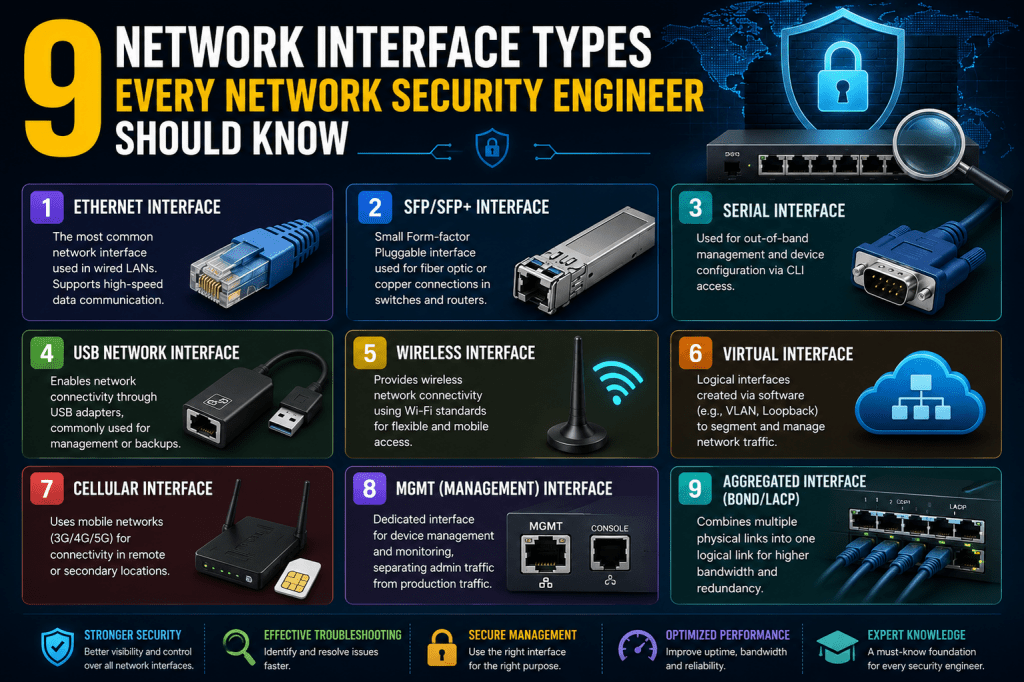
Network interfaces play a major role in firewall operations and network communication. Every firewall depends on interfaces to inspect, control, and forward traffic between networks. These interfaces create the connection point between devices and communication channels inside enterprise environments. Without proper interface configuration, security policies cannot work effectively and traffic visibility becomes limited. Network security engineers must understand interface behavior because modern infrastructures rely heavily on secure communication between internal systems, cloud resources, branch offices, and internet connections.
Purpose of Firewall Interfaces
A firewall interface allows traffic to enter and leave a security appliance while enabling monitoring and policy enforcement. Interfaces can be physical or logical depending on how the infrastructure is designed. Physical interfaces usually exist as Ethernet ports or network interface cards connected to switches, routers, servers, or internet circuits. Logical interfaces operate through software configuration and provide flexibility for segmentation and advanced networking functions. Both interface types are important because they help organizations manage traffic securely while supporting scalability and operational efficiency.
Network Segmentation Benefits
Network segmentation is achieved by dividing networks into smaller isolated sections using firewall interfaces and security zones. Segmentation limits unnecessary communication between systems and reduces the spread of threats inside the environment. For example, finance departments, HR systems, guest users, and production servers can operate in separate segments with different access rules. Firewall interfaces help enforce these boundaries by controlling traffic between zones. Proper segmentation improves security visibility, strengthens access control, and helps organizations reduce the impact of cyberattacks or unauthorized access attempts.
Physical Interface Functions
Physical interfaces provide the actual hardware connectivity used for network communication. These interfaces are responsible for sending and receiving data through copper or fiber connections at different transmission speeds. Enterprise firewalls may support interfaces running at 1 Gigabit, 10 Gigabit, or higher depending on business requirements. Physical interfaces connect directly to switches, routers, internet providers, and servers. Their performance determines how efficiently traffic flows through the firewall. Reliable physical interfaces are essential because network performance and security inspection depend heavily on stable hardware communication.
Logical Interface Functions
Logical interfaces are virtual configurations created on top of physical interfaces to improve flexibility and scalability. These interfaces allow administrators to separate traffic logically without adding extra hardware connections. Common examples include VLAN interfaces, tunnel interfaces, and loopback interfaces. Logical interfaces help organizations support multiple departments and applications through shared infrastructure while maintaining traffic separation. By using logical interfaces, enterprises can simplify network design, reduce hardware costs, and improve overall management efficiency. Logical segmentation also enhances policy enforcement and traffic monitoring capabilities.
Interface Role in Security Policies
Firewall interfaces directly affect how security policies are applied across the network. Traffic entering and leaving an interface is matched against configured policies before communication is allowed or denied. Different interfaces are assigned to separate security zones such as trusted, untrusted, or demilitarized zones. This structure helps define trust boundaries within the organization. If interfaces are configured incorrectly, traffic may bypass inspection or gain unauthorized access to sensitive resources. Proper interface assignment ensures that traffic is inspected consistently and that security rules operate as intended across all environments.
Interface Performance Considerations
Performance is an important factor when designing firewall interfaces because enterprise networks handle large volumes of traffic daily. High-bandwidth applications, cloud services, and remote access connections require interfaces capable of supporting stable throughput. Poor interface selection can create bottlenecks that reduce application performance and user experience. Network engineers must consider bandwidth requirements, redundancy needs, and traffic inspection loads during deployment planning. Properly designed interfaces help maintain consistent performance while ensuring that security inspection processes do not negatively impact business operations or communication reliability.
Layer 2 Interface Overview
A Layer 2 interface allows the firewall to operate similarly to a switch inside the same broadcast domain. Instead of routing traffic using IP addresses, the firewall forwards Ethernet frames according to MAC address information. Layer 2 interfaces are commonly used in environments where organizations want to maintain existing network structures without redesigning IP addressing schemes. This deployment model allows security policies to be enforced while preserving switching functionality. Layer 2 interfaces are especially useful for organizations transitioning from traditional switching environments toward more security-focused architectures.
Layer 2 Traffic Forwarding
Traffic passing through a Layer 2 interface remains within the same subnet and broadcast domain. Devices communicate using Ethernet frames while the firewall inspects traffic and forwards frames to the correct destination port. Because routing is not required, deployment becomes simpler and less disruptive to existing infrastructures. Administrators can introduce security inspection into the environment without changing network addressing or routing tables. This makes Layer 2 interfaces valuable in campus networks, office environments, and internal segmentation projects where maintaining operational continuity is extremely important.
VLAN Support in Layer 2 Interfaces
Layer 2 interfaces support VLAN technology, which allows traffic separation within the same physical infrastructure. VLANs create isolated broadcast domains for different departments, applications, or user groups while sharing common switching hardware. For example, finance users, HR staff, and guest devices can operate within separate VLANs for improved security and organization. Firewall policies can then control communication between these VLANs according to organizational requirements. VLAN support increases flexibility and allows administrators to build scalable environments while reducing unnecessary exposure between unrelated systems and users.
Spanning Tree and Layer 2 Stability
Spanning tree protocols help maintain stable Layer 2 network operations by preventing switching loops and broadcast storms. Layer 2 firewall interfaces can integrate with spanning tree environments to ensure reliable communication between connected switches. Proper spanning tree configuration improves redundancy while avoiding network instability caused by accidental loops. In enterprise deployments, stability is critical because switching failures can interrupt communication across large portions of the infrastructure. Firewall interfaces supporting spanning tree functionality help maintain uptime while still enforcing security inspection and policy controls throughout the network.
Benefits of Layer 2 Deployments
Layer 2 deployments provide several operational and security advantages for enterprise environments. They simplify firewall insertion into existing networks because routing changes are not required during deployment. Organizations can preserve their current IP addressing structures while adding traffic inspection and policy enforcement capabilities. Layer 2 interfaces also improve visibility into east-west traffic moving between internal devices within the same subnet. This visibility helps detect lateral movement attempts and internal threats that traditional perimeter-only security approaches may overlook. These benefits make Layer 2 deployments valuable for internal segmentation projects.
Layer 3 Interface Overview
Layer 3 interfaces operate at the network layer and route traffic using IP addresses between different networks and security zones. These interfaces are among the most widely used firewall interface types in enterprise environments. Each Layer 3 interface is assigned an IP address, subnet mask, and security zone to support routing and policy enforcement. Traffic moving between subnets passes through the firewall for inspection before reaching its destination. Layer 3 interfaces provide strong control over communication and allow administrators to implement detailed security and routing policies across networks.
Routing Functions in Layer 3 Interfaces
Layer 3 interfaces perform routing functions that allow communication between separate networks and VLANs. The firewall examines destination IP addresses and determines the appropriate path for forwarding traffic. Virtual routers are often configured alongside Layer 3 interfaces to manage routing tables and network paths efficiently. Dynamic routing protocols may also be used to support enterprise-scale connectivity between branch offices, data centers, and cloud environments. These routing capabilities help organizations maintain efficient traffic flow while ensuring that all communication remains subject to firewall inspection and security enforcement policies.
Security Advantages of Layer 3 Interfaces
Layer 3 interfaces improve security by creating clear boundaries between network segments and enforcing strict policy controls. Different departments, applications, and services can operate in separate subnets with dedicated security rules controlling communication. Administrators can apply policies based on source addresses, destination addresses, applications, users, and services. This granular control reduces unnecessary access and limits the spread of threats across the infrastructure. Layer 3 segmentation also improves visibility because traffic crossing subnet boundaries is inspected and logged by the firewall before communication is allowed.
Advanced Features in Layer 3 Interfaces
Modern Layer 3 interfaces support advanced networking features that improve flexibility and operational performance. These features may include Quality of Service controls, MTU adjustments, DHCP relay services, IPv6 support, dynamic DNS integration, and link negotiation settings. Enterprises rely on these capabilities to optimize traffic flow and support modern applications across distributed environments. Advanced features also improve compatibility with cloud platforms, remote offices, and large-scale enterprise infrastructures. Understanding these capabilities allows network security engineers to design more efficient and secure network architectures for complex business requirements.
Importance of Proper Layer 3 Planning
Proper planning is essential when deploying Layer 3 interfaces because routing and segmentation decisions directly affect connectivity and security. Administrators must carefully design IP addressing schemes, subnet allocations, routing paths, and security zones before implementation. Poor planning can create communication problems, routing conflicts, or unauthorized access between sensitive systems. Layer 3 interfaces also require careful integration with NAT policies, routing protocols, and external connectivity requirements. Effective planning ensures that traffic flows efficiently while maintaining strong security controls, operational reliability, and scalability for future infrastructure expansion.
vWire Interface Overview
A virtual wire interface allows a firewall to operate transparently between network devices without requiring major changes to the existing infrastructure. In this deployment model, two firewall interfaces are logically connected together so traffic can pass through the firewall for inspection while maintaining the original network addressing structure. Organizations often use virtual wire deployments when they want to introduce advanced security inspection into a network without redesigning IP addressing schemes or modifying routing configurations. This approach simplifies deployment and reduces operational disruption during firewall implementation projects.
Transparent Traffic Inspection
Virtual wire interfaces inspect traffic transparently while allowing communication to continue normally between connected devices. Since the firewall does not participate directly in routing decisions, no additional IP addresses or MAC address changes are required for the connected interfaces. Traffic enters one interface, passes through the firewall for inspection, and exits through the paired interface. This design allows organizations to add application visibility, threat prevention, and policy enforcement capabilities into an existing network environment without requiring major architectural modifications or complex migration processes during deployment.
Benefits of vWire Deployments
Virtual wire deployments provide several operational benefits for enterprise networks and security teams. One major advantage is deployment simplicity because organizations can insert the firewall into existing network paths without changing the surrounding infrastructure. This reduces downtime and lowers the risk of connectivity problems during migration projects. Virtual wire interfaces also allow administrators to inspect traffic that previously moved unchecked between network devices. These deployments improve visibility, strengthen security monitoring, and support advanced policy enforcement while preserving the existing routing and switching architecture already operating within the organization.
Security Features in vWire Interfaces
Virtual wire interfaces support many advanced security features commonly used in enterprise firewall environments. Administrators can apply security policies, intrusion prevention profiles, Quality of Service controls, denial-of-service protection, and application visibility features to inspected traffic flows. VLAN-tagged traffic can also be monitored and controlled through virtual wire deployments. Despite operating transparently, the firewall still performs deep traffic inspection and threat analysis before allowing communication to continue. This combination of transparency and advanced inspection makes virtual wire deployments highly valuable for organizations seeking stronger internal security visibility and control.
vWire Deployment Scenarios
Organizations commonly deploy virtual wire interfaces in environments where redesigning the network infrastructure would be difficult or risky. For example, data centers, campus networks, and enterprise branch offices may already contain established routing structures that administrators prefer not to modify. A virtual wire firewall can be inserted between switches, routers, or internet edge devices to inspect traffic without requiring readdressing or routing changes. This deployment approach is especially useful for security upgrades because it allows organizations to strengthen protection while minimizing operational impact and implementation complexity during migration projects.
Traffic Flow in vWire Environments
Traffic flow within a virtual wire deployment remains simple and efficient because the firewall operates transparently between connected devices. Packets and Ethernet frames pass through the firewall while retaining their original addressing information. The firewall examines the traffic, applies configured security policies, and forwards the communication if it meets the required criteria. Because the firewall does not modify routing paths, traffic continues moving naturally between connected systems. This transparent operation allows security inspection to occur without introducing unnecessary network complexity or requiring major infrastructure modifications across the environment.
Limitations of vWire Interfaces
Although virtual wire interfaces provide deployment flexibility, they also include certain operational limitations that engineers must understand. Since the firewall operates transparently, some routing-based features may not function in the same manner as they would in Layer 3 deployments. Organizations requiring advanced routing control or extensive subnet segmentation may need routed interfaces instead. Troubleshooting can also become more challenging because traffic flows transparently without visible routing boundaries. Despite these limitations, virtual wire deployments remain highly effective for organizations focused primarily on traffic inspection, visibility enhancement, and security monitoring improvements.
TAP Interface Overview
A TAP interface allows a firewall to monitor network traffic passively without directly participating in traffic forwarding decisions. In this deployment mode, the firewall receives copies of network traffic from a switch SPAN port or network TAP device for inspection and analysis. Traffic itself does not flow through the firewall, meaning the firewall cannot block or modify communication directly. TAP interfaces are commonly used for traffic visibility, security analysis, threat detection, and monitoring purposes where organizations need deep insight into network activity without affecting operational traffic flow within production environments.
Passive Monitoring Capabilities
TAP interfaces provide passive monitoring capabilities that allow administrators to observe traffic patterns without interrupting communication between devices. Since the firewall only analyzes copied traffic, there is no risk of introducing latency or connectivity failures into production systems. This deployment approach is especially valuable for organizations seeking enhanced visibility into network activity while maintaining operational stability. Security teams can monitor applications, inspect suspicious behavior, and analyze traffic trends without placing the firewall directly inline with critical communication paths. Passive monitoring helps improve detection capabilities without disrupting normal business operations.
Threat Detection Through TAP Interfaces
Even though TAP interfaces do not actively block traffic, they still provide valuable threat detection capabilities. Firewalls operating in TAP mode can inspect copied traffic for malware activity, suspicious applications, policy violations, and unauthorized communication attempts. Security teams receive alerts and detailed logs that help identify security incidents and unusual behavior across the environment. This visibility supports incident response efforts and allows administrators to understand network activity more effectively. TAP deployments are particularly useful in environments where monitoring and analysis are required without introducing additional risks to operational traffic flow.
SPAN Ports and Traffic Mirroring
Switch SPAN ports are commonly used to provide traffic copies to TAP interfaces for inspection. A SPAN port mirrors traffic from selected switch interfaces and forwards duplicated packets to the firewall for analysis. This method allows administrators to monitor communication between servers, user devices, applications, and network infrastructure components without affecting production traffic. Traffic mirroring improves visibility into east-west communication patterns and helps identify threats moving laterally across the network. Proper SPAN configuration is important because incomplete mirroring may limit the firewall’s ability to analyze network activity accurately and effectively.
Advantages of TAP Deployments
TAP deployments provide several advantages for security operations and traffic analysis environments. Because the firewall is not inline with production traffic, deployment becomes simpler and carries lower operational risk. Organizations can implement monitoring solutions without modifying routing paths or introducing additional latency into communication flows. TAP interfaces also provide flexibility because they can monitor specific network segments selectively based on organizational requirements. Security teams gain improved visibility into network behavior while maintaining production stability. These benefits make TAP deployments valuable for traffic analysis, security investigations, and compliance monitoring activities.
Limitations of TAP Interfaces
Although TAP interfaces improve visibility, they also have limitations compared to inline firewall deployments. Since traffic does not pass directly through the firewall, the firewall cannot actively block threats or enforce security policies on monitored communication. TAP interfaces provide detection capabilities rather than prevention capabilities. Organizations requiring active traffic control must deploy firewalls inline using other interface types. Additionally, incomplete mirrored traffic or overloaded SPAN ports may reduce monitoring accuracy. Despite these limitations, TAP deployments remain highly effective for visibility enhancement, monitoring operations, and network traffic analysis in enterprise environments.
Tunnel Interface Overview
A tunnel interface is a logical interface used to support secure communication between remote networks over untrusted environments such as the internet. Tunnel interfaces are commonly associated with VPN technologies that encrypt traffic between branch offices, cloud environments, and remote users. These interfaces create secure communication paths called tunnels that protect sensitive information from interception during transmission. Tunnel interfaces play a critical role in modern enterprise connectivity because organizations increasingly rely on secure remote access and inter-site communication across distributed infrastructures and cloud-based operational environments.
Secure Communication Through Tunnels
Tunnel interfaces allow organizations to transmit traffic securely by encrypting communication between tunnel endpoints. Data passing through the tunnel is protected from unauthorized viewing while traveling across public or shared networks. Encryption technologies ensure confidentiality and integrity throughout the communication process. Tunnel interfaces are commonly used in IPSec VPN deployments where firewalls establish encrypted tunnels between sites. This secure communication method enables organizations to connect branch offices, remote users, and cloud platforms safely while protecting sensitive corporate information from cyber threats and unauthorized interception attempts during network transmission.
Tunnel Interface Configuration
Configuring a tunnel interface requires careful planning to ensure stable and secure communication between endpoints. Administrators typically assign tunnel interfaces to security zones and virtual routers so that security policies and routing decisions can be applied correctly. The firewall must also establish tunnel parameters such as encryption methods, authentication settings, and proxy identifiers for secure connectivity. Proper configuration ensures that encrypted traffic moves through the correct tunnel path while remaining subject to firewall inspection and policy enforcement. Accurate tunnel configuration is essential for maintaining reliable and secure enterprise connectivity across remote environments.
Security Zones for Tunnel Interfaces
Tunnel interfaces are often placed within dedicated security zones to improve visibility and policy management for VPN traffic. For example, organizations may create a separate VPN zone specifically for encrypted communication between remote sites or remote users. This separation allows administrators to apply security rules independently from internal or internet-facing traffic. Dedicated zones improve control over tunnel communication and simplify policy troubleshooting. By isolating tunnel traffic into specific zones, organizations can strengthen segmentation, monitor VPN activity more effectively, and reduce unnecessary exposure between encrypted and non-encrypted network environments.
Tunnel Monitoring and Availability
Tunnel monitoring helps ensure that VPN connections remain operational and reliable across distributed environments. Firewalls can monitor tunnel status by sending periodic health checks through the encrypted connection. If the tunnel becomes unavailable, administrators can receive alerts or trigger automated failover mechanisms to maintain connectivity. Tunnel monitoring improves operational resilience because organizations depend heavily on VPN communication for branch office access, cloud connectivity, and remote work support. Reliable tunnel monitoring allows network teams to identify failures quickly and restore secure communication before business operations experience significant disruption or service interruption issues.
Dynamic Routing Across Tunnel Interfaces
Tunnel interfaces can support dynamic routing protocols that allow remote networks to exchange routing information automatically. This capability is especially useful in large enterprise environments where multiple branch offices or cloud regions require scalable connectivity management. Dynamic routing simplifies administration because routing updates occur automatically when network changes happen. Organizations can maintain efficient communication paths without manually updating static routes across every firewall or router. Combining tunnel interfaces with dynamic routing improves scalability, reduces administrative complexity, and supports resilient communication between distributed enterprise locations operating across secure VPN infrastructures.
Tunnel Interfaces in Enterprise Networks
Modern enterprise networks rely heavily on tunnel interfaces to support secure remote connectivity across distributed infrastructures. Organizations use tunnels to connect branch offices, cloud platforms, remote employees, business partners, and disaster recovery environments securely. As remote work and cloud adoption continue increasing, tunnel interfaces have become even more important for maintaining secure communication channels. Properly configured tunnels allow organizations to extend internal network services safely across external networks while preserving security visibility and policy enforcement. Tunnel interfaces therefore remain a critical component of modern cybersecurity and enterprise networking strategies.
vWire Sub-Interface Overview
vWire sub-interfaces are designed to provide additional traffic separation within virtual wire deployments. These interfaces allow administrators to classify and manage traffic from multiple VLANs while still maintaining the transparent behavior of a virtual wire configuration. Instead of using separate physical interfaces for each VLAN, administrators can create multiple sub-interfaces on the same virtual wire connection. This design improves scalability and simplifies network management. vWire sub-interfaces are especially useful in environments where organizations need detailed policy control and traffic segmentation without redesigning existing routing or switching infrastructures.
Traffic Separation with VLAN Tags
vWire sub-interfaces use VLAN tags to identify and separate traffic from different networks sharing the same physical infrastructure. Each VLAN can be associated with a dedicated sub-interface and assigned to its own security zone for policy enforcement. This allows organizations to apply different security rules to separate departments, user groups, or applications while maintaining transparent traffic forwarding. VLAN tagging improves organization and reduces unnecessary traffic exposure between systems. Administrators gain more control over network segmentation while preserving the operational simplicity and deployment flexibility offered by virtual wire environments.
Security Policy Flexibility
One major advantage of vWire sub-interfaces is the ability to apply granular security policies across different VLANs within a transparent deployment. Without sub-interfaces, all traffic passing through a virtual wire connection may be treated similarly. By creating VLAN-specific sub-interfaces, administrators can define unique policies for each traffic category. This improves security because sensitive traffic can be inspected more strictly while less critical communication may follow different rules. Granular policy control helps organizations strengthen access management, reduce attack surfaces, and improve visibility into communication patterns across segmented environments.
Simplifying Transparent Deployments
vWire sub-interfaces simplify transparent firewall deployments by allowing multiple network segments to share the same physical connection securely. Organizations can inspect and control traffic across different VLANs without introducing complex routing changes or deploying additional hardware interfaces. This approach reduces cabling requirements and minimizes infrastructure complexity while maintaining effective segmentation. Transparent deployments using sub-interfaces are especially beneficial in environments where network redesigns are difficult or operational downtime must remain minimal. The flexibility provided by vWire sub-interfaces supports scalable growth and improved security management within enterprise infrastructures.
Use Cases for vWire Sub-Interfaces
Organizations commonly use vWire sub-interfaces in campus networks, branch offices, and data centers where multiple VLANs require transparent inspection. For example, separate VLANs may exist for employees, guests, servers, and voice communication within the same infrastructure. Instead of deploying separate firewall interfaces for each VLAN, administrators can use sub-interfaces to manage all traffic efficiently through a shared virtual wire deployment. This approach improves operational efficiency while maintaining strong policy enforcement. vWire sub-interfaces are particularly useful when organizations need segmentation and visibility improvements without changing their underlying routing architecture or IP addressing schemes.
Traffic Visibility Improvements
vWire sub-interfaces improve visibility by allowing administrators to monitor VLAN-specific traffic independently within a transparent environment. Security teams can analyze communication patterns, inspect applications, and identify suspicious behavior across individual segments more effectively. Logs and monitoring data become easier to interpret because traffic categories remain separated according to VLAN assignments. Improved visibility supports faster incident response and better compliance monitoring. Organizations benefit from deeper insight into internal communication flows while maintaining the operational advantages of transparent firewall deployments. Visibility improvements also help administrators identify potential policy violations or unusual traffic behavior quickly and accurately.
Scalability of vWire Sub-Interfaces
Scalability is another important benefit of vWire sub-interfaces in enterprise environments. As organizations grow, new VLANs and traffic categories can be added without requiring major infrastructure modifications. Administrators can create additional sub-interfaces to support new departments, applications, or business services while maintaining centralized traffic inspection. This flexibility helps organizations adapt to changing operational requirements more efficiently. Scalable deployments reduce hardware expansion costs and simplify long-term management. vWire sub-interfaces therefore provide an effective balance between transparent deployment simplicity and enterprise-level segmentation capabilities within complex and rapidly growing network infrastructures.
Aggregate Interface Overview
An aggregate interface combines multiple physical interfaces into a single logical connection to improve bandwidth, redundancy, and operational stability. This technology is commonly referred to as link aggregation and is widely used in enterprise networks to support high-performance communication requirements. By grouping several Ethernet interfaces together, organizations can increase available throughput while maintaining continuous connectivity during individual link failures. Aggregate interfaces are especially important in data centers and high-traffic environments where reliable communication and high bandwidth utilization are critical for supporting business applications, cloud services, and large-scale user activity.
Bandwidth Improvements Through Aggregation
One of the primary advantages of aggregate interfaces is increased bandwidth capacity. Instead of relying on a single physical connection, traffic can be distributed across multiple links within the aggregate group. This approach improves throughput and supports higher traffic volumes without requiring a single high-capacity interface. Organizations handling large amounts of application traffic, cloud communication, or data center workloads benefit significantly from aggregated links. Improved bandwidth distribution reduces bottlenecks and helps maintain stable network performance during periods of heavy usage. Aggregate interfaces therefore play an important role in enterprise performance optimization strategies.
Redundancy and High Availability
Aggregate interfaces improve network availability by providing redundancy across multiple physical links. If one interface within the aggregate group fails, traffic can continue flowing through the remaining active links without interrupting communication. This redundancy helps organizations maintain connectivity during hardware failures, cable issues, or switch port problems. High availability is especially important for critical business applications and services that require continuous uptime. Aggregate interfaces reduce the risk of single points of failure while supporting resilient communication paths throughout the enterprise network infrastructure. Reliable redundancy improves operational stability and minimizes downtime across production environments.
Load Balancing Across Interfaces
Aggregate interfaces support load balancing by distributing traffic across multiple physical connections within the aggregated group. This distribution helps optimize resource utilization and prevents individual interfaces from becoming overloaded. Depending on the configuration, traffic may be balanced according to source addresses, destination addresses, sessions, or other network characteristics. Effective load balancing improves overall performance and supports efficient handling of large communication volumes. Enterprise environments with demanding workloads benefit greatly from this capability because balanced traffic distribution helps maintain stable application responsiveness and reduces congestion across critical network infrastructure components.
LACP and Aggregate Interfaces
Link Aggregation Control Protocol is commonly used to manage aggregate interfaces and ensure proper communication between connected devices. LACP allows switches and firewalls to negotiate aggregation settings automatically while monitoring link health and operational status. If a physical connection becomes unavailable, LACP can dynamically adjust traffic distribution across remaining links. This protocol improves reliability and simplifies aggregate interface management within enterprise environments. Administrators benefit from automated failure detection and improved operational efficiency. LACP support also enhances compatibility between networking devices and helps organizations maintain stable high-performance communication across aggregated network connections and infrastructure deployments.
Aggregate Interfaces in Data Centers
Data centers frequently use aggregate interfaces to support high-speed communication between servers, storage systems, and network devices. Large-scale virtualization environments generate significant traffic volumes that require reliable high-bandwidth connections. Aggregate interfaces help meet these requirements by combining multiple links into unified logical connections. This design improves throughput while providing redundancy for critical systems and applications. Data center deployments often depend on aggregate interfaces to maintain stable performance during peak traffic conditions. Reliable connectivity and scalability are essential in these environments because interruptions can affect business operations, cloud services, and enterprise application availability across multiple locations.
Scalability of Aggregate Interfaces
Aggregate interfaces support scalability by allowing organizations to expand bandwidth capacity incrementally as network demands increase. Instead of replacing existing hardware with higher-capacity interfaces immediately, administrators can add additional links to the aggregate group gradually. This approach provides flexibility and reduces infrastructure upgrade costs over time. Scalable aggregation strategies help organizations adapt to growing traffic requirements while maintaining operational continuity. Aggregate interfaces therefore support long-term infrastructure growth and performance optimization. Enterprises benefit from improved resource utilization, reduced downtime risks, and simplified expansion planning when implementing scalable aggregated network connectivity solutions across their environments.
Loopback Interface Overview
A loopback interface is a logical interface used primarily for internal communication and management purposes within firewall and routing environments. Unlike physical interfaces, loopback interfaces are virtual and remain operational as long as the firewall itself is functioning. These interfaces are commonly assigned IP addresses that support services such as management access, authentication systems, VPN services, and monitoring tools. Loopback interfaces provide stability because they are not dependent on physical cable connections or hardware port status. This reliability makes them valuable for enterprise management, routing, and security service deployments.
Management Services on Loopback Interfaces
Organizations often use loopback interfaces to host management-related services securely and consistently. Services such as administrative access, monitoring systems, captive portals, and remote authentication platforms can operate using loopback interface addresses instead of physical interface addresses. This approach improves stability because management communication remains available even if physical interface conditions change. Administrators also gain more flexibility when designing management architectures across enterprise environments. By separating management services from production traffic interfaces, organizations improve operational organization and reduce unnecessary exposure of sensitive administrative communication within the network infrastructure.
Loopback Interfaces in Routing Environments
Loopback interfaces are commonly used in routing environments to provide stable endpoint addresses for routing protocols and management communication. Since loopback interfaces remain continuously active regardless of physical link conditions, routing systems can rely on them for consistent identification and communication. Dynamic routing protocols often use loopback addresses when establishing neighbor relationships or exchanging routing information between devices. Stable addressing improves reliability and simplifies troubleshooting processes within enterprise networks. Loopback interfaces therefore play an important role in maintaining operational consistency across complex routing infrastructures and distributed communication environments.
Security Benefits of Loopback Interfaces
Loopback interfaces provide security advantages by allowing organizations to isolate management and service traffic from production communication paths. Administrators can apply dedicated security policies specifically for loopback-related services and restrict access according to organizational requirements. This segmentation reduces unnecessary exposure and helps protect critical management systems from unauthorized access attempts. Using loopback interfaces also improves visibility because management traffic can be monitored separately from user or application communication. Strong isolation and policy control enhance the security posture of enterprise environments while supporting stable access to essential administrative and operational services.
GlobalProtect and Loopback Interfaces
Remote access services commonly rely on loopback interfaces to provide stable connectivity for users and applications. For example, VPN services and secure remote access platforms may use loopback interface addresses as connection endpoints. Because loopback interfaces remain consistently available, remote users experience more reliable access to enterprise resources. This stability is especially important in distributed work environments where employees connect from different locations and devices. Organizations benefit from improved remote access reliability and simplified service management when loopback interfaces are integrated into secure connectivity architectures supporting remote workforce operations and enterprise communication requirements.
Loopback Interfaces in Enterprise Deployments
Enterprise networks frequently use loopback interfaces across firewalls, routers, and other infrastructure devices to support centralized management and stable communication. Large environments containing multiple sites, cloud platforms, and remote services depend on reliable management connectivity for monitoring and operational control. Loopback interfaces provide a dependable foundation for these requirements while supporting scalable deployment strategies. Administrators benefit from simplified addressing structures and improved service reliability. As enterprise infrastructures continue expanding, loopback interfaces remain an essential component for maintaining stable management communication and operational consistency across distributed network and cybersecurity architectures.
Decrypt Mirror Interface Overview
A decrypt mirror interface is a specialized firewall interface used to create copies of decrypted network traffic for external analysis and monitoring systems. When encrypted traffic passes through the firewall and is decrypted for inspection, the firewall can forward a duplicate copy of that readable traffic to a separate analysis platform through the decrypt mirror interface. This capability helps organizations perform advanced traffic inspection, forensic analysis, and data monitoring using dedicated tools. Decrypt mirror interfaces are valuable in environments where visibility into encrypted communication is essential for maintaining strong cybersecurity operations and threat detection capabilities.
Importance of Decrypted Traffic Visibility
Modern networks rely heavily on encrypted communication to protect sensitive information during transmission. Although encryption improves privacy and security, it can also hide malicious activity from traditional monitoring systems. Decrypt mirror interfaces solve this challenge by allowing security tools to analyze decrypted traffic after the firewall performs SSL or TLS decryption. This visibility helps organizations detect malware, suspicious applications, unauthorized data transfers, and insider threats hidden within encrypted sessions. Improved decrypted traffic visibility strengthens security monitoring and helps organizations identify risks that might otherwise remain undetected within encrypted communication channels.
Traffic Analysis Through Decrypt Mirroring
Decrypt mirror interfaces support detailed traffic analysis by forwarding readable copies of network sessions to monitoring tools such as packet analyzers, forensic systems, or Data Loss Prevention platforms. These external systems can inspect application content, user activity, and transferred files more thoroughly than standard logging systems. Traffic analysis helps security teams investigate incidents, monitor sensitive communication, and identify policy violations. Organizations gain deeper insight into network behavior while maintaining centralized traffic inspection at the firewall level. This combination improves overall security visibility and supports more accurate threat detection across enterprise environments and communication infrastructures.
Data Loss Prevention Integration
Data Loss Prevention systems commonly integrate with decrypt mirror interfaces to monitor sensitive information leaving the organization. Once encrypted traffic is decrypted by the firewall, the mirrored traffic copy can be analyzed for confidential data such as financial records, intellectual property, customer information, or internal documents. DLP platforms use predefined rules and pattern recognition techniques to identify unauthorized data transfers. This integration helps organizations prevent accidental or intentional data leaks while maintaining compliance with security regulations and privacy requirements. Decrypt mirror interfaces therefore play an important role in enterprise data protection strategies.
Monitoring Encrypted Applications
Many modern applications use encryption by default, including web services, cloud platforms, messaging tools, and remote access systems. While encryption protects communication privacy, it also limits visibility for traditional security monitoring tools. Decrypt mirror interfaces help organizations regain visibility into these encrypted applications by providing readable traffic copies for inspection. Security teams can identify risky applications, monitor usage patterns, and detect hidden threats more effectively. Improved application visibility supports stronger policy enforcement and helps organizations maintain better control over encrypted communication across enterprise networks and cloud-connected operational environments.
Security Benefits of Decrypt Mirroring
Decrypt mirror interfaces provide several security benefits that strengthen enterprise monitoring and incident response capabilities. Organizations gain deeper insight into encrypted traffic behavior while supporting advanced threat analysis using external monitoring tools. Security teams can detect malware communication, command-and-control activity, and unauthorized data transfers hidden inside encrypted sessions. This improved visibility reduces blind spots within the network and supports faster threat identification. Decrypt mirroring also enhances forensic investigations because analysts can review detailed traffic captures during incident response activities. These capabilities significantly improve enterprise cybersecurity visibility and operational awareness.
Challenges of Decrypt Mirror Deployments
Although decrypt mirror interfaces improve visibility, organizations must also address operational and privacy challenges during deployment. Mirrored decrypted traffic may contain sensitive user information, confidential business data, or regulated communication content. Proper access controls and monitoring policies are necessary to protect captured traffic from unauthorized access or misuse. Storage requirements can also become significant because decrypted traffic captures consume large amounts of disk space. Organizations must carefully design monitoring strategies to balance security visibility with privacy protection, operational efficiency, and compliance obligations when implementing decrypt mirror environments within enterprise infrastructures.
Understanding Firewall Interface Diversity
Enterprise firewalls support multiple interface types because modern networks require different operational and security capabilities. No single interface type can address every deployment scenario effectively. Some environments require routing functionality, while others need transparent inspection, passive monitoring, encrypted connectivity, or traffic aggregation. Understanding interface diversity allows network security engineers to choose the correct deployment model for each operational requirement. Different interface types provide flexibility and enable organizations to design secure architectures tailored to their infrastructure needs. Proper interface selection improves performance, visibility, scalability, and overall network protection across enterprise environments.
Interface Selection Based on Infrastructure Needs
Choosing the correct firewall interface depends heavily on infrastructure design and operational objectives. Organizations focused on internal segmentation may prefer Layer 2 or Layer 3 interfaces for policy enforcement between departments and applications. Environments requiring transparent deployment often benefit from virtual wire interfaces because they avoid major routing changes. Monitoring-focused environments may rely on TAP interfaces for passive inspection without affecting production traffic. Remote connectivity solutions require tunnel interfaces to support secure communication between locations. Understanding infrastructure requirements helps administrators deploy interfaces that align with security goals and operational priorities effectively.
Performance Considerations for Interfaces
Performance planning is essential when selecting and configuring firewall interfaces in enterprise environments. Different interface types support different operational requirements and traffic loads. High-bandwidth environments may require aggregate interfaces to provide additional throughput and redundancy. VPN-heavy infrastructures may depend on optimized tunnel interfaces to maintain stable encrypted communication. Monitoring environments using TAP or decrypt mirror interfaces may require sufficient processing capacity for traffic analysis operations. Proper performance planning ensures that interfaces can handle expected traffic volumes without creating bottlenecks, latency issues, or operational instability across critical business communication systems and applications.
Scalability in Interface Deployments
Scalable interface design allows organizations to expand network infrastructures without requiring complete architectural redesigns. Modern enterprises continuously adopt new cloud services, applications, remote access solutions, and branch office deployments. Firewall interfaces must support this growth efficiently. Logical interfaces such as VLANs, sub-interfaces, and aggregate groups improve scalability by allowing organizations to expand segmentation and bandwidth capacity gradually. Tunnel interfaces also support scalable secure communication between distributed locations. Scalable interface planning reduces future upgrade complexity and helps organizations adapt more easily to evolving operational requirements, business growth, and changing cybersecurity demands across enterprise environments.
Importance of Interface Visibility
Visibility is one of the most important benefits provided by modern firewall interfaces. Interfaces allow firewalls to inspect traffic, generate logs, monitor applications, and identify suspicious behavior across the network. Better visibility improves threat detection and helps security teams understand communication patterns between users, systems, and applications. Interfaces such as TAP and decrypt mirror deployments further enhance monitoring capabilities by supporting passive analysis and deep packet inspection. Strong visibility enables faster incident response, more accurate troubleshooting, and improved compliance reporting. Organizations therefore rely heavily on interface visibility to maintain effective cybersecurity operations and monitoring practices.
Operational Reliability Through Interfaces
Firewall interfaces contribute significantly to operational reliability within enterprise infrastructures. Aggregate interfaces provide redundancy during hardware failures, tunnel interfaces maintain secure communication between remote locations, and loopback interfaces support stable management connectivity. Reliable interfaces help organizations reduce downtime and maintain continuous access to critical business services. High availability is especially important in industries where communication interruptions can impact productivity, customer services, or financial operations. Proper interface design improves infrastructure resilience and supports long-term operational stability. Reliable firewall interfaces therefore remain essential for maintaining secure and uninterrupted enterprise network communication environments and business continuity strategies.
Role of Interfaces in Modern Cybersecurity
Modern cybersecurity strategies depend heavily on properly designed firewall interfaces to support segmentation, monitoring, policy enforcement, and secure communication. As cyber threats become more advanced, organizations require greater visibility and control across their infrastructures. Interfaces provide the foundation for traffic inspection and threat prevention capabilities within enterprise firewalls. They allow administrators to separate sensitive systems, monitor encrypted traffic, and secure communication between distributed locations. Understanding interface behavior therefore remains a critical skill for network security engineers responsible for protecting enterprise environments against evolving cybersecurity risks and increasingly sophisticated attack techniques.
Future Importance of Interface Technologies
Firewall interface technologies will continue evolving as enterprise networks become more distributed, cloud-focused, and application-driven. Organizations increasingly depend on secure remote connectivity, encrypted communication, and large-scale segmentation strategies to protect digital operations. Interface designs must therefore support greater scalability, automation, and visibility across hybrid environments. Future networking technologies will place even greater emphasis on flexible logical interfaces, secure tunnels, and advanced monitoring capabilities. Network security engineers who understand interface technologies thoroughly will remain highly valuable because secure communication infrastructure continues to be one of the most important foundations of modern enterprise cybersecurity operations.
Conclusion
Network interfaces are one of the most important components of firewall architecture because they control how traffic enters, leaves, and moves through a network. Every interface type serves a specific purpose and helps organizations manage communication securely across enterprise environments. From Layer 2 and Layer 3 interfaces to virtual wire, TAP, tunnel, aggregate, loopback, and decrypt mirror interfaces, each configuration supports different operational and security requirements.
Understanding these interfaces allows network security engineers to design infrastructures that provide strong segmentation, better traffic visibility, secure remote connectivity, and reliable performance. Proper interface configuration also improves policy enforcement, simplifies troubleshooting, and strengthens protection against cyber threats. Organizations rely on these interfaces to support modern applications, cloud services, remote users, and high-performance communication environments without compromising security or operational stability.
As enterprise networks continue growing in complexity, firewall interfaces will remain essential for maintaining secure and efficient communication between systems, users, and external networks. Engineers who understand how these interfaces operate can build scalable and resilient infrastructures capable of adapting to changing business and cybersecurity demands. Strong knowledge of firewall interface technologies not only improves network protection but also helps organizations maintain visibility, performance, reliability, and long-term operational success across modern digital environments.