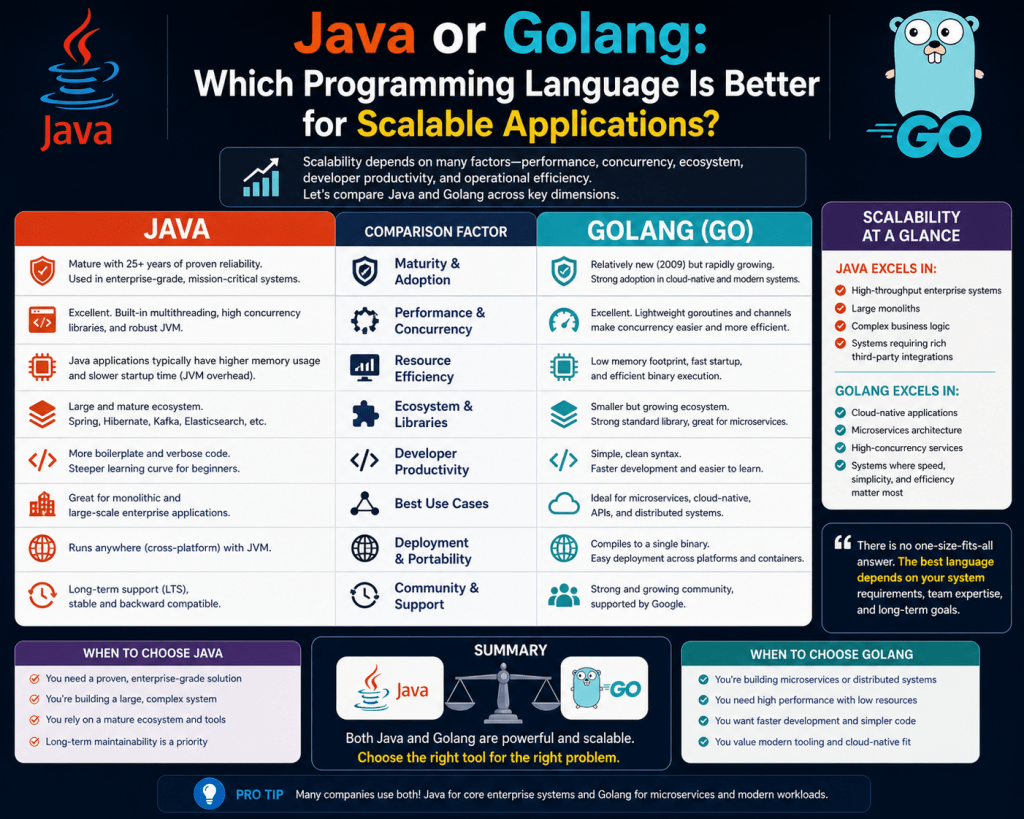
Golang and Java are two foundational programming languages that continue to play a major role in modern software engineering. Both are widely used across backend development, enterprise systems, distributed computing, and cloud-native architectures. Despite their shared relevance in large-scale application development, they differ significantly in how they approach performance, scalability, syntax design, and system architecture. These differences make them suitable for different categories of software problems, and understanding their core principles is essential for making informed technology decisions. In modern engineering environments where applications must handle millions of requests, process real-time data, and remain stable under heavy load, the choice between Go and Java becomes a strategic decision rather than a purely technical one. Each language represents a distinct philosophy of software design, with Go focusing on simplicity and concurrency efficiency while Java emphasizes structure, portability, and long-term system maintainability.
Evolution and Design Philosophy of Go
Go was created with the goal of simplifying large-scale software development while improving execution efficiency in distributed systems. Its design philosophy centers on minimalism, clarity, and high performance. Instead of introducing complex abstractions, Go provides a compact and readable syntax that reduces cognitive overhead for developers. This simplicity allows teams to build scalable systems without dealing with excessive configuration or architectural complexity.
A key aspect of Go’s evolution is its focus on modern computing needs, particularly cloud environments and microservices architectures. As systems shifted from monolithic applications to distributed services, Go emerged as a language that naturally fits these requirements. Its built-in support for concurrency allows developers to handle multiple processes simultaneously without relying on heavy system threads. This design choice reflects Go’s intention to solve real-world scalability problems in a direct and efficient way.
Go also prioritizes fast compilation and minimal runtime overhead. These characteristics make it highly effective for continuous deployment environments where systems must be built and deployed frequently. Its lightweight nature ensures that applications remain efficient even under high traffic conditions, making it a strong choice for backend services, APIs, and network-based applications.
Evolution and Design Philosophy of Java
Java has a long-standing history in software development and was designed with portability and reliability as its core principles. Its philosophy revolves around the concept of platform independence, allowing developers to write code once and run it on any system that supports a compatible runtime environment. This abstraction has made Java one of the most widely adopted languages in enterprise computing.
Over time, Java has evolved into a highly mature ecosystem that supports complex enterprise applications, mobile systems, and large-scale backend infrastructures. Its object-oriented design encourages modular programming, where applications are built using reusable components. This approach is particularly useful in large organizations where systems must be maintained and extended over long periods.
Java’s evolution also reflects a strong emphasis on stability and backward compatibility. Unlike many modern languages that introduce frequent breaking changes, Java ensures that older applications continue to run on newer versions with minimal modification. This stability is one of the reasons why it remains a dominant choice in enterprise environments where long-term system reliability is critical.
Language Architecture and Execution Models
Go and Java differ significantly in how they execute programs and manage system resources. Go is a compiled language that translates source code directly into machine-level instructions. This results in fast execution and predictable performance. The absence of a heavy runtime layer allows Go applications to start quickly and operate with minimal overhead, making them suitable for performance-sensitive systems.
Java, in contrast, uses a virtual machine-based execution model. Source code is compiled into an intermediate form known as bytecode, which is then executed by a runtime environment. This additional layer provides platform independence, enabling Java applications to run across different operating systems without modification. While this introduces some overhead compared to direct compilation, modern runtime optimizations have significantly improved Java’s performance over the years.
The architectural differences between these execution models influence how developers design systems. Go’s direct compilation model supports lightweight and efficient services, while Java’s virtual machine model enables portability and extensive runtime features that support complex applications.
Typing Systems and Code Structure
Both Go and Java are statically typed languages, meaning that variable types must be defined during development. This approach helps reduce runtime errors and improve code reliability. However, their type systems are implemented differently in terms of structure and flexibility.
Go uses a simplified type system that reduces unnecessary complexity in code definitions. It avoids deep inheritance hierarchies and instead relies on composition and interfaces to achieve modularity. This makes Go programs easier to read and maintain, especially in large-scale systems where clarity is essential.
Java, on the other hand, employs a more traditional object-oriented type system. It supports inheritance, polymorphism, and encapsulation, allowing developers to build highly structured applications. This approach is particularly effective in enterprise environments where complex relationships between system components must be clearly defined.
The difference in code structure also affects development workflows. Go encourages concise and straightforward code patterns, while Java supports more detailed architectural designs that may require additional planning but offer greater structural control.
Concurrency and Parallel Processing Models
Concurrency is one of the most important factors in modern application performance, especially in systems that handle multiple tasks simultaneously. Go introduces a lightweight concurrency model designed for simplicity and efficiency. Instead of relying on traditional threading mechanisms, it uses lightweight processes that allow thousands of concurrent operations to run efficiently within a single application. This design makes Go highly effective for real-time systems, distributed services, and network-intensive applications.
Java supports concurrency through traditional threading models and advanced concurrency frameworks. While powerful, Java threads are generally more resource-intensive compared to Go’s lightweight processes. However, Java provides fine-grained control over thread behavior, synchronization, and task scheduling, making it suitable for complex enterprise systems that require precise execution control.
Both languages are capable of handling concurrent operations, but their approaches differ in complexity and performance tradeoffs. Go focuses on simplicity and scalability, while Java emphasizes control and structured execution in multi-threaded environments.
Memory Management Strategies
Memory management plays a crucial role in application performance and stability. Go uses an automated garbage collection system designed to minimize latency and optimize resource usage. Its memory management model is designed to support high-performance applications that require consistent responsiveness under load. This makes it suitable for services that operate in real-time environments.
Java also uses garbage collection, but its system is more mature and configurable. Developers can choose from multiple garbage collection strategies depending on application needs. This flexibility allows Java to handle both small-scale applications and large enterprise systems with heavy memory requirements.
Both languages eliminate the need for manual memory management, reducing the risk of memory leaks and improving system stability. However, their optimization strategies differ, with Go focusing on low-latency performance and Java offering configurable memory control.
Compilation and Runtime Behavior
Go’s compilation process is straightforward and efficient. It compiles source code directly into native machine code, which contributes to fast execution and minimal startup time. This makes Go highly effective for microservices and cloud-native applications where performance consistency is important.
Java’s compilation process involves converting source code into bytecode, which is then interpreted or compiled at runtime by the virtual machine. This layered approach provides flexibility and portability but introduces additional runtime overhead. Despite this, modern runtime optimizations such as just-in-time compilation have significantly improved Java’s performance in production environments.
The differences in compilation and runtime behavior influence how each language performs under different workloads. Go excels in low-latency environments, while Java provides balanced performance with strong portability features.
Ecosystem Growth and Developer Adoption
Java has one of the largest and most mature ecosystems in software development. Over decades of evolution, it has accumulated extensive libraries, frameworks, and tools that support nearly every category of application development. This maturity makes it highly reliable for enterprise-scale systems and long-term projects.
Go, although newer, has experienced rapid adoption in cloud computing, DevOps tools, and microservices architectures. Its simplicity and performance efficiency have contributed to its growing popularity among modern development teams. While its ecosystem is smaller compared to Java, it is expanding quickly and is particularly strong in cloud-native environments.
Both languages benefit from active developer communities, but their ecosystems reflect different stages of technological evolution and specialization.
Early Practical Implications in System Design
In practical system design, the choice between Go and Java often depends on application requirements and architectural goals. Go is frequently chosen for systems that require high concurrency, fast execution, and lightweight infrastructure. It performs well in APIs, distributed systems, and cloud-based services where scalability is a primary concern.
Java is commonly selected for enterprise applications, complex business systems, and large-scale platforms that require structured architecture and long-term maintainability. Its extensive ecosystem and stability make it suitable for systems that evolve over many years.
Scalability Fundamentals in Go and Java Systems
Scalability is one of the most critical factors in modern software design, especially for systems expected to handle growing workloads over time. Both Go and Java offer strong scalability capabilities, but they achieve it through fundamentally different architectural approaches. Go is designed from the ground up with lightweight concurrency and efficient resource utilization in mind, which makes it highly effective for horizontally scalable systems. Java, on the other hand, achieves scalability through mature enterprise architecture patterns, robust frameworks, and powerful runtime optimization strategies.
In distributed environments, Go’s lightweight execution model allows services to scale quickly without excessive memory or CPU overhead. This is particularly important in microservices architectures where hundreds or thousands of small services must run simultaneously. Java scales effectively in large monolithic or modular enterprise systems where structured layering and centralized management are important. Its scalability is often enhanced through frameworks that manage complexity rather than reducing it at the language level.
The key difference lies in philosophy: Go scales through simplicity and concurrency efficiency, while Java scales through structure, tooling, and runtime optimization.
Concurrency Architecture and Execution Efficiency
Concurrency is one of the most defining differences between Go and Java. Go introduces a concurrency model built around lightweight execution units that operate independently while sharing memory efficiently. These units are managed by the Go runtime, which schedules them dynamically across available system resources. This approach allows developers to create highly concurrent systems without the overhead associated with traditional thread-based models.
In high-performance environments such as network servers, API gateways, and streaming platforms, Go’s concurrency model provides significant advantages. It enables thousands of simultaneous operations with minimal memory usage, which is essential for systems that must respond to large volumes of requests in real time. The simplicity of managing concurrency in Go also reduces the likelihood of common programming errors such as deadlocks and race conditions.
Java handles concurrency using traditional threads combined with advanced concurrency utilities. While threads are more resource-intensive compared to Go’s lightweight execution model, Java provides fine-grained control over synchronization, scheduling, and execution order. This makes Java suitable for complex enterprise systems where precise control over parallel execution is required. However, managing threads in Java requires careful design to avoid performance bottlenecks and resource contention.
Both languages support concurrent execution, but Go prioritizes efficiency and simplicity, while Java prioritizes control and flexibility.
Performance Characteristics in Real-World Scenarios
Performance is a major factor when comparing Go and Java, especially in systems that require low latency and high throughput. Go is known for its fast compilation times and efficient runtime performance. Because it compiles directly into machine code, Go applications typically have low startup latency and predictable execution behavior. This makes it ideal for services that must respond quickly to incoming requests.
Java achieves high performance through a combination of bytecode execution and runtime optimization techniques. Modern Java virtual machines use just-in-time compilation to improve execution speed over time by analyzing runtime behavior and optimizing frequently executed code paths. While Java applications may have slower startup times compared to Go, they can achieve very high sustained performance in long-running systems.
In scenarios such as real-time APIs or distributed microservices, Go often provides more consistent latency due to its lightweight runtime. In contrast, Java excels in long-running enterprise systems where performance improves over time due to runtime optimizations.
Memory Management and System Resource Utilization
Efficient memory management is essential for building scalable applications. Go uses an automated garbage collection system designed for low-latency environments. Its memory management strategy is optimized to reduce pauses and maintain consistent performance even under heavy workloads. This is particularly important in systems that require real-time responsiveness, such as streaming services and network applications.
Java also uses garbage collection, but its system is more advanced and configurable. It provides multiple garbage collection algorithms that can be tuned based on application needs. This allows developers to optimize memory usage for different workloads, such as high-throughput systems or memory-intensive applications. Java’s memory management system is highly mature and has been refined over decades of enterprise use.
While both languages eliminate manual memory management, their approaches differ in complexity and optimization control. Go prioritizes simplicity and low latency, while Java prioritizes configurability and adaptability.
System Architecture and Design Patterns
System architecture plays a significant role in determining how effectively a programming language can support large-scale applications. Go encourages minimalistic architecture with a focus on simplicity and modular service design. It is commonly used in microservices architectures where each service performs a specific function and communicates with others through lightweight protocols. This approach reduces system complexity and improves scalability.
Java, on the other hand, is heavily influenced by object-oriented design principles. It supports layered architectures where systems are built using reusable components organized into structured hierarchies. This makes Java particularly suitable for large enterprise systems where complexity must be managed across multiple teams and development cycles.
The architectural differences between Go and Java influence how systems evolve. Go promotes simplicity and independent service deployment, while Java supports structured, tightly integrated systems with extensive business logic layers.
Compilation Speed and Development Workflow Efficiency
Go is known for its extremely fast compilation speed, which significantly improves developer productivity. This allows for rapid iteration during development, making it easier to test and deploy changes frequently. Fast compilation also supports continuous integration and deployment pipelines, which are essential in modern software engineering practices.
Java compilation is generally slower due to its multi-stage process involving bytecode generation and runtime interpretation. However, modern build tools and incremental compilation techniques have improved Java’s development workflow efficiency. Despite this, Go still maintains an advantage in terms of raw compilation speed and simplicity of build processes.
The difference in compilation speed affects how developers interact with each language during development. Go enables quick feedback loops, while Java emphasizes structured build processes and long-term project organization.
Error Handling and System Reliability
Error handling is another important area where Go and Java differ significantly. Go uses explicit error-handling mechanisms where functions return error values that must be checked by the developer. This approach promotes clarity and forces developers to handle potential failures directly within the code. While this can result in more verbose code, it improves transparency and reduces unexpected runtime failures.
Java uses exception-based error handling, where errors are thrown and caught using structured mechanisms. This allows developers to separate error handling logic from main application logic, resulting in cleaner code structures. However, improper use of exceptions can lead to hidden control flow issues and reduced code clarity.
Both approaches have strengths depending on application requirements. Go emphasizes explicit control and simplicity, while Java emphasizes structured error propagation and separation of concerns.
Ecosystem Integration and Tooling Support
Java has one of the most comprehensive ecosystems in software development history. It includes a wide range of frameworks, libraries, and development tools that support everything from web applications to enterprise resource planning systems. This extensive ecosystem makes it easier to integrate Java into large organizational infrastructures.
Go has a smaller but rapidly evolving ecosystem focused on modern cloud-native development. It integrates well with containerized environments, orchestration platforms, and microservices frameworks. While it does not match Java’s breadth, it excels in modern distributed system tooling.
The difference in ecosystem maturity affects how each language is used in real-world projects. Java is often chosen for enterprise-grade systems with complex integration requirements, while Go is preferred for modern infrastructure and cloud-native development.
Security Models and Application Stability
Security is a critical consideration in software development, especially in enterprise and cloud environments. Java has a long history of built-in security features, including runtime verification, class loading restrictions, and encryption libraries. Its security model is designed to support large-scale enterprise systems where data protection and controlled execution are essential.
Go takes a more minimalistic approach to security, relying on simplicity and reduced attack surface. Its straightforward design reduces the number of potential vulnerabilities introduced through complex language features. While it may not have as extensive a built-in security framework as Java, its simplicity contributes to safer codebases in many scenarios.
Both languages support secure development practices, but Java offers more built-in enterprise-level security tools, while Go reduces complexity to minimize potential security risks.
Real-World Deployment and Infrastructure Considerations
In production environments, Go and Java are deployed differently based on system requirements. Go applications are typically deployed as standalone binaries, making them easy to distribute and run in containerized environments. This simplicity is highly beneficial in cloud-native systems where portability and fast deployment are essential.
Java applications are often deployed within managed runtime environments that provide additional services such as memory management, monitoring, and performance optimization. This makes Java well-suited for enterprise systems that require extensive operational control and observability.
Deployment strategies reflect the broader design philosophies of both languages. Go emphasizes simplicity and portability, while Java emphasizes structured deployment and operational control.
Performance Tradeoffs in Large-Scale Systems
When evaluating performance in large-scale systems, it is important to consider not only raw speed but also scalability, resource usage, and operational efficiency. Go performs exceptionally well in systems that require low latency and high concurrency. Its lightweight design ensures consistent performance even under heavy traffic conditions.
Java performs best in systems that require long-term stability, complex business logic, and large-scale data processing. Its runtime optimizations allow it to achieve high throughput in sustained workloads, making it suitable for enterprise applications and backend processing systems.
The tradeoff between Go and Java often comes down to simplicity versus complexity, and speed versus structure.
Engineering Decision Factors in Language Selection
Choosing between Go and Java requires careful evaluation of project requirements, team expertise, and long-term system goals. Go is often selected for systems that prioritize performance, simplicity, and scalability in distributed environments. Java is typically chosen for enterprise systems that require structured architecture, extensive tooling, and long-term maintainability.
Engineering teams must also consider factors such as deployment environment, system complexity, and expected traffic load. Both languages are capable of supporting modern software systems, but their strengths align with different categories of engineering challenges.
Enterprise Software Landscape and Language Positioning
In large-scale enterprise environments, both Go and Java have established strong but distinct positions. Java has traditionally dominated enterprise software due to its maturity, stability, and extensive ecosystem of frameworks designed for business-critical applications. It is commonly used in financial systems, banking platforms, insurance systems, government applications, and large transactional platforms where consistency and reliability are more important than raw simplicity.
Go, in contrast, has become increasingly dominant in modern infrastructure systems, especially those built around cloud-native architectures. It is widely used in container orchestration systems, distributed services, DevOps tooling, and high-performance backend APIs. Its rise is closely tied to the shift from monolithic systems to microservice architectures, where lightweight services and fast execution are essential.
The positioning of each language in the enterprise landscape reflects its design intent. Java is optimized for structured enterprise logic and long-term system evolution, while Go is optimized for distributed systems, automation, and performance-sensitive infrastructure.
Microservices Architecture and Distributed Systems
Microservices architecture has become a dominant pattern in modern software design, and both Go and Java play important roles in this ecosystem. Go is often preferred for microservices due to its lightweight runtime, fast startup time, and efficient concurrency model. Each microservice written in Go can run independently with minimal resource overhead, making it ideal for large-scale distributed systems with hundreds or thousands of services.
Go’s simplicity also reduces operational complexity in microservices environments. Services can be deployed quickly, scaled independently, and managed with minimal overhead. This makes Go especially useful in environments where agility and responsiveness are critical.
Java also supports microservices architecture effectively, particularly through mature frameworks that provide structured service management, dependency injection, and enterprise-level tooling. Java microservices tend to be more complex but offer greater control and flexibility in large organizations where strict architecture governance is required.
The key difference lies in design philosophy: Go microservices are lightweight and independent, while Java microservices are structured and framework-driven.
Cloud-Native Development and Infrastructure Integration
Cloud computing has significantly influenced the adoption of programming languages, and Go has become a major player in this domain. Its efficiency, portability, and fast execution make it ideal for cloud-native development. Many modern cloud tools, orchestration platforms, and infrastructure services are built using Go because it integrates well with containerized environments.
Go applications are typically deployed as single binary executables, which simplifies containerization and reduces deployment complexity. This aligns well with modern DevOps practices that emphasize automation, scalability, and continuous deployment.
Java also plays a major role in cloud environments, particularly in enterprise cloud systems where large-scale business logic and legacy integration are required. Java’s strong ecosystem and runtime environment support complex cloud applications that require high reliability and extensive monitoring capabilities.
While Go is often favored for infrastructure tools and lightweight cloud services, Java is frequently used for enterprise-grade cloud applications that require deep integration with existing systems.
Performance Optimization Techniques in Go
Go provides several built-in features that contribute to its performance efficiency. One of the most important is its garbage collector, which is designed for low-latency operation. This ensures that applications remain responsive even under heavy workloads. The simplicity of Go’s runtime also reduces overhead, allowing applications to execute more efficiently.
Another important performance feature in Go is its static compilation model. Since Go compiles directly into machine code, there is no need for intermediate interpretation layers. This results in faster execution and predictable performance characteristics.
Go’s concurrency model also contributes to performance optimization. Lightweight execution units allow systems to handle thousands of simultaneous tasks without overwhelming system resources. This makes Go particularly effective in high-throughput environments such as web servers, streaming platforms, and real-time data processing systems.
Performance Optimization Techniques in Java
Java achieves performance optimization through a combination of runtime compilation and adaptive optimization techniques. The Java Virtual Machine uses just-in-time compilation to analyze application behavior and optimize frequently executed code paths. This allows Java applications to improve performance over time as they run.
Java also provides advanced garbage collection mechanisms that can be tuned for different workloads. Developers can choose between low-latency garbage collectors or high-throughput collectors depending on system requirements. This flexibility allows Java to be used in both small-scale applications and large enterprise systems.
Another important optimization feature in Java is its rich ecosystem of performance monitoring and profiling tools. These tools allow developers to analyze memory usage, thread behavior, and execution performance in detail, making it easier to optimize large-scale systems.
Security Architecture and System Hardening
Security is a critical aspect of both languages, especially in enterprise and cloud environments. Java has a long-established security model that includes features such as runtime verification, secure class loading, and encryption support. These features make Java suitable for systems that require strict security controls, such as banking and government applications.
Java’s security architecture is also supported by decades of enterprise usage, which has led to continuous improvements and vulnerability mitigation strategies. This makes it one of the most trusted languages for secure application development.
Go approaches security differently by minimizing complexity and reducing the number of language features that could introduce vulnerabilities. Its simple design reduces the attack surface and makes it easier to audit code for security issues. While it may not have as many built-in security frameworks as Java, its simplicity contributes to safer code in many modern applications.
Scalability in High-Traffic Systems
Scalability is one of the most important factors in modern system design, particularly for applications that must handle millions of users. Go is highly effective in high-traffic environments due to its lightweight concurrency model and efficient memory usage. It can scale horizontally across multiple servers with minimal overhead, making it ideal for distributed systems.
Java also scales effectively but relies more on vertical scaling and structured architecture. Its scalability is often enhanced through enterprise frameworks that manage load balancing, caching, and distributed processing. This makes Java well-suited for large corporate systems that require predictable scaling behavior.
In practice, Go is often chosen for systems that require rapid scaling across distributed nodes, while Java is chosen for systems that require controlled and structured scalability within enterprise environments.
Developer Productivity and Learning Curve
Go is widely regarded as easy to learn due to its minimal syntax and straightforward design. Developers can quickly become productive in Go because the language avoids unnecessary complexity. This makes it particularly attractive for teams that want to reduce onboarding time and improve development speed.
Java has a steeper learning curve due to its object-oriented structure, extensive ecosystem, and more complex syntax. However, once mastered, it provides powerful tools for building large and maintainable systems. Java’s learning curve is often justified by its ability to handle complex enterprise applications effectively.
Developer productivity in Go is often associated with speed and simplicity, while Java productivity is associated with structure and long-term maintainability.
Tooling, Frameworks, and Development Ecosystem
Java has one of the most extensive ecosystems in software development history. It includes frameworks for web development, enterprise systems, mobile applications, and data processing. This extensive ecosystem makes it easier to build complex applications without reinventing core functionality.
Go has a smaller but rapidly growing ecosystem focused on modern software development needs. It is widely used in cloud infrastructure, networking tools, and microservices frameworks. While it does not have the same breadth as Java, its ecosystem is highly efficient and focused on performance-oriented applications.
The difference in ecosystem size reflects the maturity and specialization of each language rather than their effectiveness.
Real-World Industry Applications
Go is commonly used in industries that require high-performance backend systems, distributed services, and infrastructure automation. It is widely adopted in technology companies that operate large-scale cloud platforms and need efficient service orchestration.
Java is widely used in industries such as banking, insurance, healthcare, and government systems. These industries require high reliability, strong security, and long-term maintainability, all of which Java provides through its mature ecosystem.
Both languages are capable of supporting critical systems, but they are often chosen based on industry requirements and architectural needs.
Long-Term Maintenance and System Evolution
Long-term maintainability is an important factor in enterprise software development. Java excels in this area due to its structured architecture and strong backward compatibility. Systems built in Java can evolve over many years without requiring major rewrites, making it ideal for long-term enterprise applications.
Go supports maintainability through simplicity and minimal design. Its straightforward syntax and limited complexity make it easier to maintain over time, especially in microservices environments where individual services are small and independent.
Both languages offer maintainability advantages, but in different ways. Java focuses on structured long-term evolution, while Go focuses on simplicity and modular maintenance.
Strategic Decision-Making in Language Selection
Choosing between Go and Java requires a strategic understanding of system requirements, team capabilities, and long-term goals. Go is often selected for systems that require high performance, scalability, and simplicity in distributed environments. It is particularly effective in modern cloud-native architectures and microservices ecosystems.
Java is typically chosen for enterprise systems that require stability, complex business logic, and extensive integration capabilities. Its mature ecosystem and structured design make it suitable for long-term enterprise applications that must evolve over decades.
The decision is not about which language is universally better, but about which language aligns more closely with the technical and business requirements of the project.
Conclusion
Go and Java represent two very different generations of thinking in software engineering, and their comparison is less about which one is superior and more about how each one aligns with specific technical goals. Both languages have matured into stable, production-ready technologies that power critical systems across industries, but they approach problem-solving from different angles. Understanding their strengths in context is what allows developers and organizations to make effective decisions rather than relying on general popularity or assumptions.
Java has established itself as one of the most reliable enterprise programming languages in existence. Its long history has contributed to a deeply mature ecosystem, extensive tooling, and a vast global developer base. Over time, it has evolved from a general-purpose language into a foundational technology for enterprise systems, financial applications, mobile platforms, and large-scale distributed architectures. One of Java’s greatest strengths is its consistency. Systems built in Java tend to remain stable over long periods, which is essential for organizations that prioritize reliability and backward compatibility. This stability allows companies to maintain complex systems for decades without requiring complete rewrites, which is a major advantage in industries where downtime or system replacement carries high risk.
Another important strength of Java is its structured approach to software design. Object-oriented principles allow developers to build highly organized systems that can be scaled across large teams and long development cycles. This makes Java particularly effective in environments where multiple teams are working on interconnected systems. Its strict structure helps maintain clarity, enforce design standards, and reduce ambiguity in large codebases. Combined with its rich ecosystem of frameworks and libraries, Java becomes a powerful foundation for building enterprise-grade solutions that require robustness and flexibility at scale.
Go, on the other hand, represents a more modern philosophy centered around simplicity, efficiency, and concurrency. It was designed during a period when distributed systems, cloud computing, and microservices were becoming the dominant architectural patterns in software development. As a result, Go naturally aligns with modern infrastructure requirements. Its lightweight runtime, fast compilation speed, and efficient concurrency model make it ideal for systems that need to handle large numbers of simultaneous operations with minimal resource usage.
One of Go’s defining advantages is its ability to simplify complexity. It avoids many of the abstractions found in older languages, which reduces cognitive overhead for developers and makes systems easier to understand and maintain. This simplicity is particularly valuable in fast-moving environments where systems must be deployed, scaled, and updated rapidly. Go encourages a pragmatic approach to software design, where performance and clarity are prioritized over elaborate architectural patterns. This makes it especially effective in cloud-native environments where services must be lightweight, independent, and highly responsive.
Concurrency is another area where Go stands out significantly. Its model allows developers to build highly parallel systems without the complexity typically associated with traditional threading. This makes it well-suited for backend services, real-time applications, and distributed systems that require high throughput. In environments such as API services, streaming platforms, and network infrastructure tools, Go provides a level of efficiency that is difficult to achieve with more heavyweight concurrency models.
Despite their differences, both languages are capable of solving large-scale engineering problems. The key distinction lies in how they approach those problems. Java tends to solve complexity by adding structure, abstraction, and tooling support. Go solves complexity by reducing unnecessary layers and focusing on core efficiency. Java embraces depth and extensibility, while Go embraces simplicity and direct execution. These contrasting philosophies make each language more suitable for different types of systems rather than positioning one as universally better.
In real-world usage, it is increasingly common to see both languages used within the same organization. Large systems are often composed of multiple components, each with different requirements. Java is frequently used for core enterprise systems that manage business logic, transactional data, and long-term workflows. Go is often used for infrastructure services, microservices, and performance-critical components that require fast execution and efficient resource usage. This hybrid approach reflects the reality of modern software architecture, where no single language can efficiently solve every problem.
From a scalability perspective, both languages perform well, but in different ways. Java scales effectively in structured environments where systems are carefully designed and managed through enterprise frameworks. Its scalability is often vertical and architecture-driven. Go scales naturally in distributed environments where services need to operate independently and handle high concurrency. Its scalability is more horizontal and system-level, making it ideal for cloud-based architectures that rely on service replication and load distribution.
Performance considerations also vary depending on context. Go typically offers faster startup times and lower memory usage, making it highly efficient for lightweight services. Java, while potentially slower to start, can achieve very high performance in long-running applications due to runtime optimization. This means Go is often preferred for short-lived or stateless services, while Java is preferred for persistent, state-heavy applications that require consistent performance over time.
Maintainability is another important factor in long-term system design. Java benefits from decades of established best practices, design patterns, and architectural conventions. This makes it highly maintainable in large systems where consistency and structure are essential. Go, while simpler, achieves maintainability through minimalism. Its smaller feature set and straightforward syntax reduce the likelihood of overly complex codebases, making it easier to maintain systems that are broken into smaller services.
Ultimately, the decision between Go and Java should be driven by system requirements rather than language preference. Factors such as expected traffic, system complexity, team expertise, deployment environment, and long-term scalability goals all play a role in determining the right choice. Go is often the better fit for modern distributed systems, cloud-native applications, and performance-sensitive infrastructure. Java is often the better fit for enterprise systems, large-scale business applications, and long-term platform development.
Both languages continue to evolve, and neither is static in its capabilities. Java continues to modernize with improvements in performance, syntax, and runtime efficiency, while Go continues to expand its ecosystem and strengthen its position in cloud computing and infrastructure development. As software systems become increasingly complex and distributed, the demand for both types of languages remains strong.
In practice, the most effective engineering strategies often involve using each language where it performs best rather than attempting to standardize everything on a single technology. This pragmatic approach allows organizations to leverage the strengths of both Go and Java while minimizing their weaknesses. It also reflects a broader trend in software engineering, where flexibility and architectural diversity are becoming more important than uniformity.
The comparison between Go and Java ultimately highlights the evolution of programming itself. Java represents the era of structured enterprise computing, while Go represents the era of cloud-native simplicity and distributed scalability. Both are essential in their own right, and both continue to shape the future of software development in different but complementary ways.