
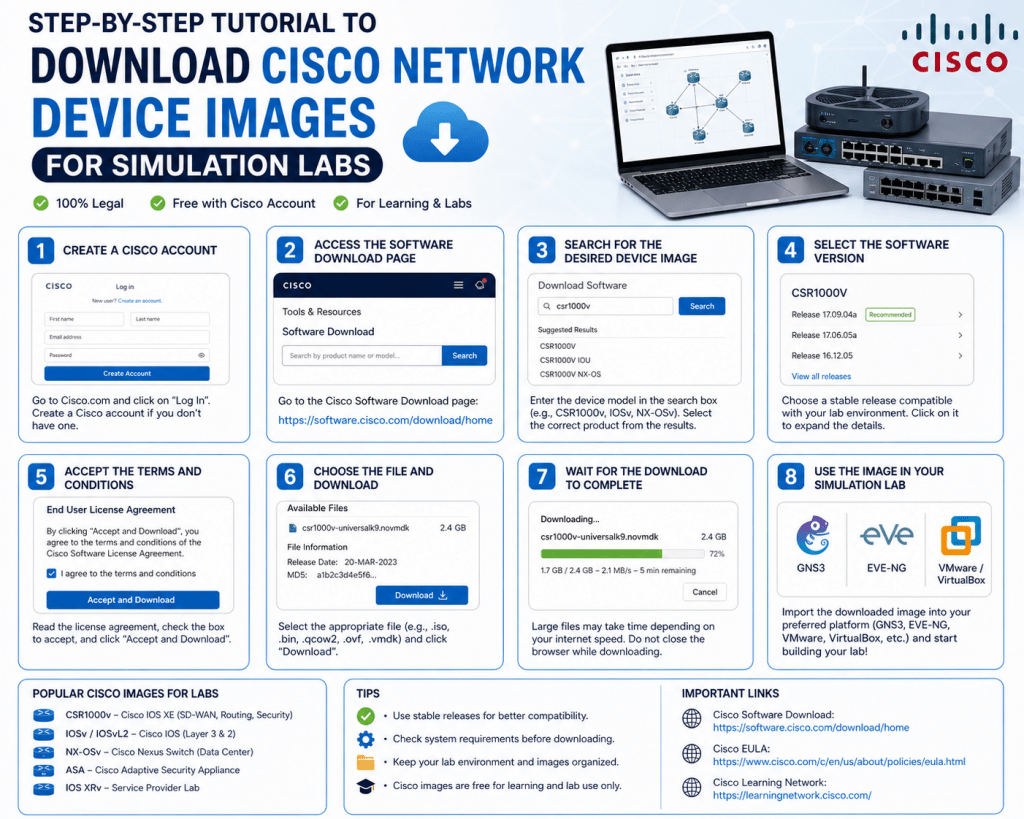
Cisco Packet Tracer has long been recognized as an entry-level tool for understanding fundamental networking concepts. It introduces learners to basic routing, switching, addressing, and protocol behavior in a simplified and controlled environment. For individuals preparing for foundational certifications, it provides a structured way to visualize network communication without requiring physical hardware. However, as learners advance toward professional-level certifications, the limitations of such simulation tools become increasingly apparent. The simplified logic used in Packet Tracer does not fully replicate the operational complexity found in real-world enterprise networks. Advanced certifications require an understanding of real operating system behavior, command-line intricacies, and protocol interactions that go beyond theoretical simulation. This gap naturally leads learners toward more advanced lab environments where actual network operating systems are executed in virtualized form. These environments allow users to interact with authentic device software, providing a far more realistic representation of enterprise networking conditions and preparing learners for production-level responsibilities.
Limitations of Simplified Simulation in Professional Certification Paths
As networking knowledge progresses beyond introductory concepts, the need for deeper operational realism becomes essential. Simplified simulators are designed to abstract complexity, which is beneficial for early learning stages but restrictive for advanced study. In higher certification levels, learners are expected to troubleshoot complex network behaviors, analyze protocol convergence issues, and configure advanced routing and switching features that behave exactly as they would in real infrastructure. Packet-level abstraction and limited feature support prevent learners from fully experiencing these scenarios. Additionally, enterprise technologies such as advanced redundancy mechanisms, scalable routing architectures, and service provider-grade configurations are not accurately represented. This creates a gap between theoretical knowledge and practical execution. Virtual network environments address this limitation by executing real network operating systems, allowing learners to observe authentic system responses, configuration outputs, and protocol behaviors. This shift is critical for developing the technical depth required in professional networking roles where accuracy and operational understanding are essential.
Evolution of Virtual Network Device-Based Learning Systems
The development of virtualized networking environments has transformed how advanced networking skills are acquired. Instead of relying on abstract simulation logic, learners now use environments that run actual network operating systems inside virtual machines. These systems replicate the behavior of physical networking devices with high fidelity, including boot processes, configuration syntax, and protocol implementation. This evolution represents a shift from conceptual visualization to operational replication. In these environments, learners can build complex topologies that mimic real enterprise and service provider infrastructures, including multi-layer architectures, redundant links, and segmented routing domains. The ability to deploy real device software in a controlled environment allows for experimentation with advanced configurations that would otherwise require expensive physical hardware. This transformation has significantly improved the quality of hands-on training available to networking professionals, enabling a deeper understanding of system interactions and network behavior under realistic conditions.
Role of Network Emulation in Advanced Skill Development
Network emulation plays a critical role in bridging theoretical knowledge and practical expertise. Unlike basic simulators, emulation platforms execute real operating systems, allowing devices to behave exactly as they would in production environments. This includes authentic handling of routing updates, switching decisions, and security policies. The value of emulation lies in its ability to reproduce real-world network behavior, including timing delays, protocol convergence, and system resource constraints. Learners gain exposure to scenarios such as network failures, route recalculations, and configuration conflicts that are difficult to replicate in simplified environments. This hands-on exposure is essential for developing troubleshooting skills, which are a major component of advanced certification requirements. By interacting with real device software, learners build familiarity with command-line interfaces, system logs, and configuration hierarchies that are identical to those used in enterprise networks. This level of realism ensures that skills acquired in lab environments translate directly into professional capabilities.
Categories of Virtual Network Devices in Professional Labs
Virtual network devices used in advanced labs represent a wide range of networking hardware functions. These devices are software implementations of real routers, switches, firewalls, and specialized networking appliances. Each category serves a distinct purpose within a network architecture. Routing devices are responsible for directing traffic between networks and handling dynamic routing protocols. Switching devices manage internal network segmentation, VLAN structures, and layer 2 and layer 3 forwarding decisions. Security appliances enforce access control policies, inspect traffic flows, and manage secure connectivity between network segments. Service provider-grade devices focus on scalability and high-performance routing for large-scale infrastructures. These virtual devices are built using actual network operating systems, ensuring that configuration syntax, feature sets, and operational behavior match physical hardware. This allows learners to gain experience with technologies used in enterprise and carrier environments without requiring access to physical infrastructure. The diversity of virtual devices enables the creation of comprehensive lab environments that simulate real-world network ecosystems.
Importance of Authentic Operating System Behavior in Lab Environments
One of the most significant advantages of using virtual network devices is the authenticity of operating system behavior. Unlike simulation tools that approximate functionality, virtual devices run real firmware designed for production hardware. This means that every configuration command, system response, and protocol interaction mirrors actual device behavior. This authenticity is critical for advanced learning because it ensures that skills developed in lab environments directly apply to real-world systems. Learners can explore detailed configuration structures, analyze system logs, and observe how devices respond to complex network changes. This level of interaction is essential for understanding advanced networking concepts such as route redistribution, policy-based routing, and security enforcement mechanisms. Additionally, real operating system behavior allows learners to develop troubleshooting skills based on actual system outputs rather than simulated responses. This prepares individuals for operational environments where accurate interpretation of system behavior is required to resolve network issues effectively.
Growth of Virtual Infrastructure in Networking Education
The adoption of virtual infrastructure in networking education reflects a broader shift in how technical skills are developed. Traditional methods relied heavily on physical hardware, which was expensive, difficult to scale, and limited in availability. Virtual environments eliminate these constraints by enabling multiple devices to run on a single physical machine. This scalability allows learners to build large and complex network topologies without requiring significant hardware investment. Educational programs and certification preparation paths have increasingly integrated virtual labs as a core component of training. This approach supports iterative learning, where configurations can be tested, modified, and reset without physical limitations. It also enables exposure to a wider range of technologies within a single environment. As networking systems continue to evolve toward virtualization, cloud integration, and software-defined architectures, virtual lab environments have become essential for keeping pace with industry requirements. This shift ensures that learners develop skills aligned with modern network design and operational practices.
Operational Realism and Its Impact on Certification Readiness
Operational realism is a key factor in preparing for advanced networking certifications. Certification exams at higher levels require not only theoretical understanding but also the ability to interpret real system behavior under complex conditions. Virtual network devices provide an environment where learners can experience these conditions firsthand. This includes handling configuration errors, analyzing routing inconsistencies, and resolving connectivity issues that arise in multi-layer network designs. The realism provided by virtual devices helps learners develop problem-solving skills that are directly applicable to certification scenarios and professional environments. It also enhances understanding of how different network components interact under load and failure conditions. By replicating real-world network behavior, virtual labs ensure that learners are not simply memorizing concepts but actively engaging with system operations. This experiential learning approach significantly improves retention and practical competence, which are critical for success in advanced certification paths.
Security and Integrity Considerations in Virtual Lab Usage
When working with virtual network environments, maintaining system integrity and security is an important consideration. Since these environments involve the execution of operating system images, ensuring that software sources are legitimate and properly authorized is essential. Unauthorized or unverified software can introduce risks such as instability, security vulnerabilities, or incorrect system behavior. Professional-grade virtual network devices are typically distributed through controlled channels that ensure authenticity and compliance with usage policies. This helps maintain a secure learning environment and ensures that system behavior accurately reflects production-grade software. Additionally, using verified images ensures that learners are exposed to stable and supported versions of network operating systems, which is important for certification alignment. Maintaining integrity in lab environments not only protects the user’s system but also ensures that learning outcomes are consistent with real-world networking standards and operational expectations.
Foundation for Advanced Networking Practice Environments
Virtual network devices form the foundation of modern advanced networking practice environments. They enable the construction of scalable, realistic, and flexible lab topologies that reflect enterprise and service provider architectures. These environments support deep exploration of routing protocols, switching mechanisms, security policies, and network optimization techniques. The ability to simulate complex network scenarios provides learners with a powerful tool for skill development. As networking technologies continue to evolve, the importance of such environments will only increase. They serve as a bridge between theoretical study and professional application, ensuring that learners are equipped with the technical depth required for advanced certification and real-world network engineering roles.
Legal Framework Governing Virtual Network Device Usage in Professional Labs
The use of virtual network device images is governed by strict licensing frameworks that define how software can be accessed, deployed, and operated within lab environments. These frameworks exist because network operating systems are proprietary software products that represent significant intellectual property investments. Licensing rules ensure that the software is used only in authorized contexts, such as training, certification preparation, or licensed production environments. In professional networking labs, this means that even though the software is executed in a virtualized form, it remains subject to the same legal constraints as physical deployments. Users must therefore operate within clearly defined usage boundaries that specify where and how these images can be used. These boundaries typically distinguish between educational usage under approved subscriptions, organizational entitlements tied to enterprise agreements, and restricted environments where redistribution or extraction of software components is not permitted. Understanding these frameworks is essential for learners preparing for advanced certifications, as compliance ensures both legal safety and alignment with industry standards.
Understanding Software Entitlement and Access Control Mechanisms
Access to virtual network device images is not universally open and is instead controlled through entitlement systems. These systems verify whether a user or organization has the right to download and use specific software versions. Entitlements are usually tied to support contracts, training subscriptions, or enterprise agreements that grant access to licensed software repositories. Once entitlement is verified, users can access downloadable images through official distribution channels. These images are then used in controlled lab environments where they replicate real device behavior. The entitlement model ensures that only authorized users can access production-grade network operating systems, maintaining software integrity and compliance. It also ensures that updates, patches, and feature enhancements are distributed in a controlled manner. This structured access model is important because it guarantees that users are working with stable, tested, and officially supported software versions, which is critical for both learning accuracy and system reliability in advanced lab environments.
Role of Authorized Training Environments in Certification Preparation
Authorized training environments play a significant role in providing structured access to virtual network devices. These environments are designed to align closely with certification objectives and ensure that learners gain exposure to relevant technologies in a controlled setting. They provide curated lab scenarios that replicate real-world networking challenges, allowing learners to practice configuration, troubleshooting, and network design. These environments often include pre-configured virtual devices that reflect the versions and features used in certification exams. By using authorized environments, learners ensure that they are working within legal boundaries while also receiving accurate and up-to-date technical exposure. This structured approach helps maintain consistency between learning materials and real-world applications. It also reduces the risk of configuration mismatches or outdated feature sets that could arise from using unofficial or unsupported software sources. As a result, authorized training environments are widely regarded as a reliable pathway for advanced certification preparation.
Subscription-Based Access Models for Virtual Network Devices
Subscription-based access models are commonly used to distribute virtual network device images in a legally compliant manner. These models provide users with time-limited access to software and associated lab environments in exchange for periodic payments. Subscriptions often include both the emulation platform and the virtual device images required to build lab topologies. This approach ensures that users always have access to updated software versions, including new features and security enhancements. Subscription models also simplify licensing management by bundling software access into a single entitlement. This eliminates the need for individual image licensing and reduces complexity for learners. In addition, subscription services frequently include updates that align with evolving certification requirements, ensuring that lab environments remain relevant. This continuous update cycle is particularly important in networking, where technologies evolve rapidly, and new protocols or device features are regularly introduced.
Importance of Compliance in Virtual Lab Environments
Compliance plays a central role in maintaining the integrity of virtual lab environments. Since virtual network devices are derived from proprietary operating systems, their usage is subject to specific conditions outlined in licensing agreements. Compliance ensures that users operate within these conditions and avoid unauthorized redistribution or modification of software components. In educational contexts, compliance also ensures that learners are using stable and verified software versions that accurately represent production environments. This reduces the risk of inconsistencies between lab behavior and real-world systems. Compliance is not only a legal requirement but also a technical safeguard that ensures reliability and consistency in learning outcomes. It helps maintain trust in certification preparation processes and ensures that all learners are working with equivalent environments. This standardization is essential for fair assessment and accurate skill development across global certification programs.
Differences Between Simulation and Emulation in Networking Education
Understanding the distinction between simulation and emulation is essential when working with advanced networking environments. Simulation involves creating a logical model of network behavior without executing real operating systems. It approximates how devices and protocols function,n but does not replicate actual system code. Emulation, on the other hand, involves running real network operating systems in a virtualized environment. This means that devices behave exactly as they would in physical deployments, including real configuration syntax, system responses, and protocol processing. The difference between these two approaches is significant in advanced learning contexts. Simulation is effective for conceptual understanding, while emulation is necessary for operational mastery. Emulated environments allow learners to interact with actual device software, observe real-time system behavior, and troubleshoot issues based on authentic outputs. This makes emulation the preferred approach for advanced certification preparation, where accuracy and realism are critical.
Architecture of Virtual Network Device Systems
Virtual network device systems are built using virtualization technologies that allow multiple operating systems to run on a single physical host. Each virtual device operates as an independent instance of a network operating system, complete with its own memory allocation, configuration files, and processing environment. These instances are connected through virtual network interfaces that simulate physical cabling and switching infrastructure. The architecture allows complex topologies to be constructed entirely in software, enabling scalable and flexible lab environments. Virtual devices communicate with each other using standard networking protocols, ensuring realistic interaction between components. This architecture supports advanced configurations such as multi-tier routing, redundant links, and segmented network domains. It also allows for integration with external systems, enabling hybrid environments that combine virtual and physical infrastructure. The modular nature of this architecture makes it highly adaptable for different learning scenarios and certification requirements.
Operational Behavior of Enterprise-Grade Virtual Devices
Enterprise-grade virtual network devices are designed to replicate the operational behavior of physical hardware with high accuracy. This includes boot sequences, configuration loading processes, and runtime system behavior. Once initialized, these devices respond to configuration commands exactly as their physical counterparts would. This includes validation of syntax, execution of routing protocols, and enforcement of security policies. The operational consistency between virtual and physical devices ensures that skills developed in lab environments are directly transferable to real-world scenarios. Additionally, virtual devices generate system logs and diagnostic outputs that mirror those found in production systems. These logs are essential for troubleshooting and provide insight into internal system processes. The ability to analyze these outputs helps learners develop advanced diagnostic skills, which are critical for managing complex network infrastructures in professional environments.
Importance of Version Control in Virtual Network Environments
Version control is an important aspect of managing virtual network device environments. Different versions of network operating systems may include changes in features, command structures, or protocol implementations. These differences can significantly impact configuration behavior and system performance. In advanced lab environments, maintaining awareness of version differences is essential for ensuring consistency with certification objectives. Updated versions often include enhancements that reflect evolving industry standards and emerging technologies. At the same time, older versions may be required for compatibility with specific lab scenarios or exam requirements. Managing these versions effectively ensures that learners are exposed to accurate and relevant system behavior. It also helps prevent discrepancies between lab configurations and real-world environments. Version control,ol therefore, plays a critical role in maintaining the integrity and reliability of virtual networking labs.
Role of Virtual Labs in Developing Troubleshooting Skills
Troubleshooting is one of the most important skills in advanced networking, and virtual labs provide an ideal environment for its development. By simulating real-world network conditions, these environments allow learners to encounter and resolve complex issues such as routing failures, misconfigurations, and connectivity disruptions. Unlike theoretical study, virtual labs provide immediate feedback through system outputs and network behavior, enabling learners to identify root causes of problems. This hands-on experience is essential for building diagnostic intuition and systematic problem-solving abilities. Learners can experiment with different configurations, observe outcomes, and refine their understanding of network interactions. This iterative process strengthens analytical skills and prepares individuals for real operational environments where quick and accurate troubleshooting is required. Virtual labs, therefore, serve as a critical training ground for developing practical expertise in network management.
Integration of Virtual Devices into Modern Network Learning Pathways
Virtual network devices have become a core component of modern networking education pathways. As networking technologies continue to evolve, training methodologies have shifted toward more immersive and realistic environments. Virtual devices allow learners to engage with complex network architectures that reflect current industry practices, including cloud integration, software-defined networking, and automated infrastructure management. These learning pathways emphasize practical experience and operational understanding rather than purely theoretical knowledge. By integrating virtual devices into training programs, learners gain exposure to real-world scenarios that are directly applicable to professional roles. This integration also supports continuous learning, allowing individuals to adapt to new technologies and evolving certification requirements. As a result, virtual network devices have become an essential foundation for advanced networking education and professional development.
Operational Security Considerations in Virtual Network Lab Environments
Security is a foundational aspect of any environment that executes real network operating systems, even when those systems are running in virtual form. Virtual network devices behave like production systems, which means they process configurations, store state information, and execute protocol logic exactly as physical hardware would. This operational realism introduces security considerations that must be understood clearly. The primary concern is the integrity of the software images being used. Since network operating systems are complex and proprietary, they must originate from trusted and authorized sources to ensure they have not been altered or compromised. Using verified images ensures that the system behavior observed in labs reflects authentic production behavior without hidden modifications or instability. Another aspect of security involves isolating lab environments from production networks. Virtual labs are typically constructed in segmented environments to prevent unintended interaction with live infrastructure. This separation ensures that experimental configurations, routing changes, or protocol testing do not affect operational systems. Maintaining this boundary is essential for safe and responsible use of advanced networking environments.
Risk of Unverified Software in Virtual Networking Systems
One of the most significant risks in virtual networking environments arises from the use of unverified or unofficial software images. Since these images execute real operating system code, any modification or corruption can directly affect system behavior. This may result in unstable routing behavior, incorrect protocol execution, or unexpected system failures. In some cases, altered images may introduce vulnerabilities that compromise the security of the entire lab environment. For learners preparing for advanced certifications, this creates a misleading representation of network behavior, which can negatively impact skill development. Additionally, unverified software may lack proper updates or bug fixes, leading to inconsistencies between lab scenarios and real-world systems. This disconnect can hinder troubleshooting practice and reduce the effectiveness of hands-on learning. For these reasons, maintaining software integrity is essential in virtual networking environments. Ensuring that all devices operate on validated and authorized operating system images helps preserve both security and educational accuracy.
Importance of Authentic System Behavior in Advanced Network Learning
Authentic system behavior is one of the most valuable aspects of virtual network devices. Unlike simplified simulation tools, these environments execute real operating systems that behave exactly like physical hardware. This includes command-line responses, configuration validation, and protocol processing. Authentic behavior allows learners to develop accurate mental models of how networks function in real-world scenarios. It also ensures that troubleshooting exercises reflect genuine operational conditions. When learners configure routing protocols, manage switching environments, or implement security policies, the results they observe are consistent with production systems. This consistency is critical for developing professional competence. It ensures that knowledge gained in lab environments can be directly applied in enterprise settings. Authentic system behavior also supports a deeper understanding of network dynamics, including convergence times, failure recovery mechanisms, and traffic flow optimization. These insights are essential for advanced certification preparation and real-world network engineering roles.
Evolution of Enterprise Networking Toward Virtualization-Based Infrastructure
Modern enterprise networks have increasingly adopted virtualization as a core architectural principle. Physical hardware is no longer the sole foundation of network infrastructure. Instead, virtualized systems are widely used to implement scalable, flexible, and efficient network designs. This evolution has influenced how networking skills are taught and developed. Virtual network devices in lab environments reflect this industry shift by providing software-based representations of enterprise hardware. These representations allow learners to explore modern networking concepts such as distributed routing, virtual segmentation, and software-defined control planes. The move toward virtualization has also enabled greater automation and orchestration within networks, reducing reliance on manual configuration. As a result, networking professionals must now understand both traditional hardware-based systems and modern virtualized architectures. Virtual lab environments provide the ideal platform for developing this dual understanding, bridging the gap between legacy networking models and modern infrastructure design.
Role of Virtual Devices in Service Provider Network Training
Service provider networks represent some of the most complex infrastructures in the networking world. They require high scalability, advanced routing capabilities, and robust fault tolerance mechanisms. Virtual network devices play a crucial role in enabling training for these environments. By replicating service provider-grade operating systems, virtual labs allow learners to explore large-scale routing architectures, backbone connectivity, and traffic engineering concepts. These environments support the simulation of multi-domain networks, where different routing protocols interact across hierarchical structures. Learners can also experiment with advanced features such as label switching, traffic prioritization, and redundancy protocols. The ability to replicate these scenarios in a virtual environment is essential for understanding the operational complexity of service provider networks. It also provides exposure to the types of configurations and troubleshooting scenarios encountered in large-scale production systems.
Deep Configuration Analysis in Virtual Networking Environments
One of the key advantages of using virtual network devices is the ability to perform deep configuration analysis. Unlike simplified simulators, virtual devices allow full access to configuration hierarchies and system parameters. This enables learners to explore how different configuration elements interact and influence overall network behavior. For example, routing policies can be analyzed in conjunction with interface configurations, access control mechanisms, and protocol settings. This level of detail provides a comprehensive understanding of how network systems operate internally. Learners can also observe how configuration changes propagate through the system and affect network performance. This includes analyzing route selection, packet forwarding decisions, and interface state changes. Deep configuration analysis is essential for advanced certification preparation, where candidates are expected to understand not only how to configure systems but also how those configurations impact overall network behavior.
Troubleshooting Methodologies in Realistic Lab Environments
Effective troubleshooting is a core skill in networking, and virtual lab environments provide an ideal platform for its development. In these environments, learners are exposed to realistic network failures and misconfigurations that require systematic analysis. Troubleshooting involves identifying symptoms, isolating root causes, and implementing corrective actions. Virtual devices provide detailed system outputs, including logs, debug information, and protocol status reports, which are essential for this process. Learners can use these outputs to trace packet flows, analyze routing decisions, and identify configuration errors. This hands-on approach helps develop structured troubleshooting methodologies that can be applied in real-world scenarios. It also encourages critical thinking and analytical reasoning, as learners must interpret system behavior rather than rely on predefined answers. Over time, this practice builds confidence and competence in managing complex network infrastructures.
Scalability Advantages of Virtual Networking Labs
Scalability is one of the most significant advantages of virtual networking environments. Unlike physical hardware labs, which are limited by cost and physical space, virtual environments can scale to support large and complex network topologies. Multiple virtual devices can run simultaneously on a single physical host, enabling the creation of extensive network architectures. This scalability allows learners to experiment with multi-layer designs, redundant systems, and distributed network structures. It also enables the simulation of large enterprise environments that would otherwise be impractical to replicate physically. Scalability is particularly important for advanced certification preparation, where complex scenarios involving multiple routing domains, switching layers, and security zones are common. Virtual labs provide the flexibility to expand or modify topologies as needed, supporting iterative learning and experimentation.
Integration of Automation and Modern Networking Concepts
Modern networking increasingly relies on automation and programmable infrastructure. Virtual network environments support the integration of these concepts by allowing learners to interact with programmable interfaces and automated configuration systems. This includes the use of scripting, template-based configurations, and centralized control mechanisms. Automation reduces manual configuration effort and improves network consistency. In virtual labs, learners can experiment with automated deployment scenarios, configuration management systems, and policy-driven network behavior. This exposure is essential for understanding modern network operations, where manual configuration is being replaced by automated orchestration. By integrating automation into virtual lab environments, learners gain experience with technologies that are increasingly used in enterprise and service provider networks. This prepares them for roles that require both traditional networking knowledge and modern infrastructure automation skills.
Real-World Application of Virtual Lab Experience in Professional Roles
The skills developed in virtual networking environments translate directly into professional roles in network engineering, systems administration, and infrastructure design. Real-world networks are complex, dynamic, and often require rapid troubleshooting and configuration adjustments. Experience gained in virtual labs provides a strong foundation for handling these challenges. Learners become familiar with command-line interfaces, configuration structures, and system behavior patterns that are identical to production environments. This familiarity reduces the learning curve when transitioning into professional roles. It also enhances problem-solving efficiency, as individuals can apply tested methodologies developed during lab practice. Virtual lab experience also supports collaboration in enterprise environments, where engineers must work with standardized configurations and operational procedures. The practical skills developed through virtual environments, therefore,e play a critical role in professional readiness and career advancement.
Long-Term Relevance of Virtual Networking Environments in IT Education
Virtual networking environments continue to grow in importance as networking technologies evolve. The shift toward cloud-based infrastructure, software-defined networking, and automated systems has made traditional hardware-centric learning less practical. Virtual environments provide a flexible and scalable alternative that aligns with modern industry practices. They allow learners to stay current with emerging technologies and continuously update their skills as new protocols and systems are introduced. This adaptability ensures long-term relevance in a rapidly changing technological landscape. As organizations increasingly adopt virtualized and automated infrastructures, the ability to understand and manage these systems becomes essential. Virtual lab environments will continue to serve as a primary tool for developing these competencies, supporting both certification preparation and professional development in advanced networking disciplines.
Conclusion
The transition from entry-level network simulation tools to advanced virtual network device environments represents a significant shift in how networking knowledge is developed and applied. At the foundational level, simplified simulators serve an important purpose by introducing core concepts such as basic routing, switching, addressing, and protocol behavior. These tools are effective for building initial confidence and helping learners visualize how data flows through a network. However, as learners progress toward professional-level certifications and real-world engineering roles, the limitations of such simplified environments become increasingly evident. They do not fully replicate the complexity, unpredictability, and operational depth of real enterprise systems. This gap naturally leads to the adoption of virtualized network environments that execute authentic operating systems and provide a far more realistic representation of network behavior.
Virtual network devices fundamentally change the learning experience by replacing abstraction with realism. Instead of approximating device behavior, they run actual network operating systems that behave exactly as they would on physical hardware. This includes real command-line interfaces, genuine configuration syntax, and accurate protocol processing. The result is an environment where learners can interact with systems in a way that closely mirrors production networks. This level of realism is particularly important for advanced certification paths, where candidates are expected to demonstrate not only theoretical knowledge but also practical operational competence. Understanding how systems behave under real conditions, including failure scenarios, convergence events, and configuration conflicts, is essential for success at higher levels of certification and in professional practice.
One of the most important outcomes of working with virtual network devices is the development of deep technical intuition. In real-world networking, problems are rarely isolated or simple. They often involve multiple layers of interaction between routing protocols, switching logic, security policies, and system configurations. Virtual lab environments allow learners to experience these interactions firsthand. By building and modifying complex topologies, they gain insight into how different components of a network influence each other. This helps develop a systems-level understanding of networking, where decisions are not made in isolation but based on how the entire infrastructure behaves as a cohesive unit. Over time, this leads to stronger analytical thinking and more effective troubleshooting skills.
Another critical advantage of virtual environments is their ability to support experiential learning through repetition and experimentation. Unlike physical lab setups, which are constrained by hardware availability and cost, virtual environments allow unlimited iteration. Learners can build, break, and rebuild network topologies without restriction. This freedom encourages exploration and a deeper understanding of cause-and-effect relationships within network systems. When a configuration error occurs, learners can immediately observe its impact, analyze system responses, and correct the issue. This iterative process is one of the most effective ways to internalize complex networking concepts, as it reinforces learning through direct experience rather than passive observation.
The importance of operational realism cannot be overstated in advanced networking education. Real networks are dynamic environments where conditions change constantly due to traffic patterns, configuration updates, and system failures. Virtual network devices replicate this dynamism by executing real protocols and responding to network events in real time. This allows learners to observe phenomena such as routing convergence, failover behavior, and load distribution under realistic conditions. Such experiences are essential for developing the ability to manage and maintain production networks, where quick and accurate decision-making is required. Without exposure to this level of realism, theoretical knowledge alone is insufficient to handle the complexity of modern networking environments.
In addition to technical skills, virtual networking environments also contribute to the development of professional discipline. Working within structured lab scenarios teaches learners how to plan configurations, document changes, and approach network design methodically. These habits are essential in enterprise environments, where consistency and reliability are critical. Virtual labs also encourage learners to think critically about design decisions, such as how to structure routing domains, segment networks, or implement redundancy. This design-oriented thinking is a key differentiator between basic network operators and advanced network engineers.
As networking technology continues to evolve, virtualization has become a central component of modern infrastructure design. Enterprises increasingly rely on virtualized systems, cloud-based networks, and software-defined architectures. Virtual network device environments reflect this shift by providing learners with tools that mirror contemporary network designs. This ensures that the skills developed in lab environments remain relevant to current industry practices. Understanding virtualized infrastructure is no longer optional; it is a core requirement for modern network professionals. By working in virtual environments, learners gain familiarity with the same principles and technologies used in production systems, including automation, orchestration, and centralized control.
Security and integrity considerations also play an important role in virtual networking environments. Because these systems execute real operating system code, it is essential that they are sourced from legitimate and authorized channels. This ensures that the software behaves as expected and has not been altered or compromised. Maintaining software integrity is critical not only for legal compliance but also for technical accuracy. If the underlying system is unreliable or modified, the learning experience becomes distorted, leading to incorrect assumptions about network behavior. By using verified and stable software images, learners ensure that their lab environments accurately reflect real-world systems.
The scalability of virtual environments further enhances their value in advanced networking education. Complex network architectures that would be difficult or expensive to replicate physically can be easily constructed in virtual form. This allows learners to explore large-scale designs involving multiple routing domains, layered switching structures, and distributed security policies. The ability to scale environments dynamically supports advanced experimentation and enables learners to simulate enterprise-grade infrastructures. This scalability also makes it possible to model failure scenarios and recovery mechanisms at a level of complexity that would otherwise be impractical.
Over time, virtual networking environments have become an essential component of professional development in the networking field. They provide a bridge between theoretical study and real-world application, enabling learners to develop both conceptual understanding and operational expertise. The combination of realism, flexibility, and scalability makes them uniquely suited for advanced certification preparation and career advancement. As networking continues to evolve toward greater complexity and virtualization, these environments will remain central to skill development and technical training.
Ultimately, the value of virtual network devices lies in their ability to replicate real-world conditions in a controlled and repeatable environment. They allow learners to move beyond abstract concepts and engage directly with the systems they will encounter in professional settings. This hands-on experience builds confidence, improves technical accuracy, and prepares individuals for the challenges of modern network engineering. By providing a realistic and scalable platform for learning, virtual environments play a critical role in shaping the next generation of networking professionals who are capable of managing increasingly complex and dynamic infrastructures.