
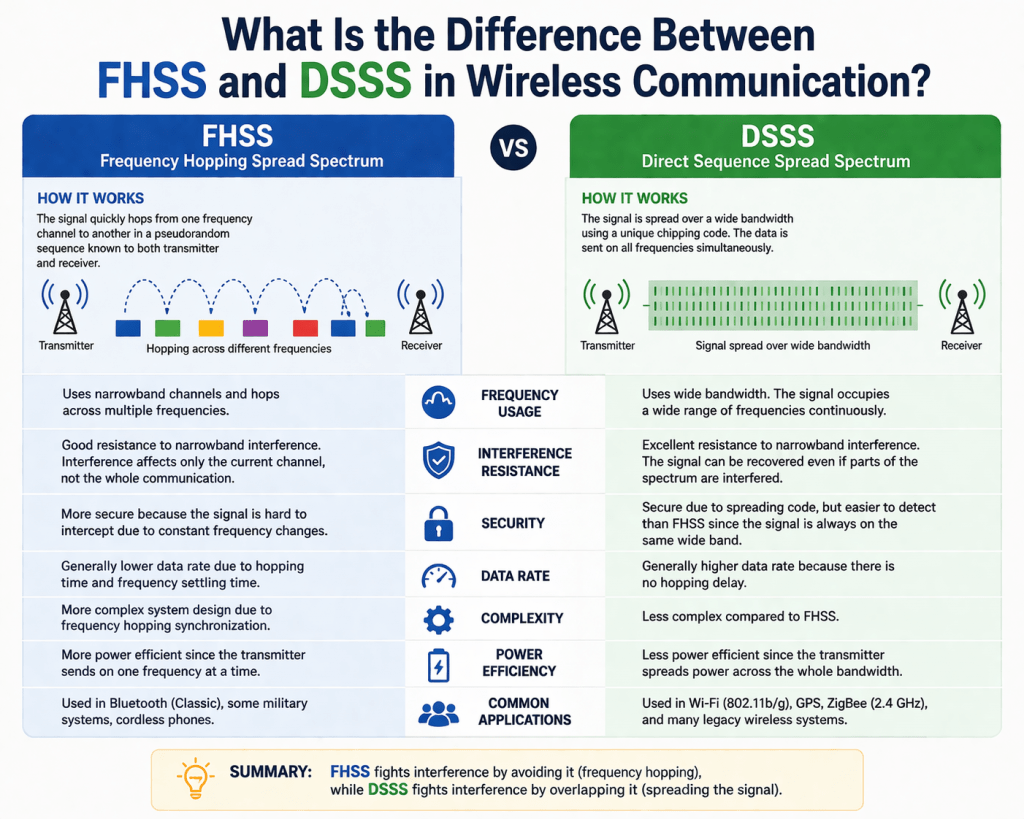
Wireless communication systems rely on controlled manipulation of radio frequency behavior to achieve reliable data transfer in environments filled with interference, attenuation, and signal degradation. Spread spectrum techniques are designed to distribute signal energy across a wider bandwidth than traditionally required, reducing susceptibility to narrowband interference and improving resilience in complex transmission environments. Among the most widely referenced spread spectrum approaches are Frequency Hopping Spread Spectrum (FHSS) and Direct Sequence Spread Spectrum (DSSS), both of which address reliability challenges but through fundamentally different mechanisms. Understanding these methods requires a clear grasp of how signals interact with frequency, noise, and physical obstructions in real-world environments.
In practical deployment scenarios, wireless systems rarely operate in clean spectral conditions. Industrial equipment, overlapping networks, atmospheric conditions, and multipath reflections all contribute to signal distortion. Spread spectrum techniques therefore act as a foundational engineering strategy to ensure that communication does not collapse under localized interference conditions. Instead of concentrating energy into a narrow channel that can be easily disrupted, the signal is deliberately distributed, making it statistically less likely that any single interference source will degrade the entire transmission.
Core Concept of Frequency and Signal Propagation
Radio communication depends on electromagnetic wave propagation, where signals travel through space and interact with objects such as walls, air particles, and electronic devices. Higher frequency signals can carry more information but tend to experience greater attenuation and reflection when encountering obstacles, while lower frequencies propagate more efficiently but may offer lower data throughput. Wireless engineers must balance these trade-offs when designing communication systems. FHSS and DSSS were developed to improve robustness by mitigating the impact of interference, multipath distortion, and signal fading without relying on a single static frequency channel.
Another important factor in propagation behavior is environmental variability. Urban environments introduce dense signal reflections that create constructive and destructive interference patterns, while rural or open environments may experience long-distance fading due to free-space path loss. In both cases, a fixed-frequency transmission is inherently vulnerable because its performance depends heavily on a single spectral slice. Spread spectrum techniques mitigate this dependency by distributing energy either across time, frequency, or code sequences, thereby reducing the probability of complete signal loss in dynamic conditions.
Fundamental Principle Behind FHSS Operation
Frequency Hopping Spread Spectrum operates by dividing available frequency bandwidth into multiple discrete channels. Instead of transmitting data continuously on a single frequency, the transmitter rapidly switches, or “hops,” between predefined frequency channels according to a shared sequence known by both transmitter and receiver. Each segment of data is transmitted on a different frequency, making the signal less vulnerable to persistent interference on any single channel. If one frequency experiences noise or congestion, only a small portion of the data is affected, while the remaining information continues to be transmitted across other frequencies in the hopping pattern.
The effectiveness of FHSS is strongly tied to hop rate and channel spacing. A higher hop rate reduces the time spent on any single frequency, which limits the impact of narrowband interference sources. Channel spacing ensures that adjacent frequencies are sufficiently separated to avoid correlation of interference effects. This structure makes FHSS particularly suitable in environments where interference is intermittent or localized rather than uniformly distributed across the spectrum.
Structural Behavior of FHSS Transmission
In FHSS systems, synchronization between transmitter and receiver is critical. Both must follow the same hopping sequence with precise timing to ensure accurate reconstruction of the transmitted data. The system divides data into packets, and each packet is transmitted at a specific frequency before switching to the next. This rapid switching reduces the probability that interference will disrupt the entire transmission session. It also introduces a level of unpredictability in signal location, which historically contributed to improved communication privacy and reduced interception risk in certain use cases.
Beyond synchronization, FHSS systems also depend on timing accuracy and frequency stability. Even minor drift between transmitter and receiver clocks can cause misalignment in the hopping pattern, leading to data loss or corruption. To address this, modern implementations often include calibration mechanisms and periodic re-synchronization signals. These ensure that both ends remain aligned even in environments where temperature changes or hardware imperfections could otherwise introduce timing errors.
Fundamental Principle Behind DSSS Operation
Direct Sequence Spread Spectrum uses a different strategy by spreading the signal over a wide frequency band simultaneously rather than hopping between channels. In DSSS, each data bit is transformed into a series of smaller code elements using a pseudorandom sequence known as a chip sequence. These chips collectively represent the original bit but are transmitted across a broad frequency range at the same time. At the receiver end, the same code sequence is used to reconstruct the original signal by correlating the received chips and filtering out noise.
This process effectively increases the signal’s processing gain, meaning that the receiver can extract the intended data even when the signal is buried beneath noise levels that would normally render it unusable. The correlation process acts as a mathematical filter that strengthens desired patterns while suppressing random interference. As a result, DSSS is highly effective in environments with continuous or wideband noise sources.
Structural Behavior of DSSS Transmission
DSSS relies heavily on signal redundancy and correlation techniques. Because each bit is represented by multiple chips, even if parts of the signal are lost or corrupted due to interference, the receiver can still reconstruct the original data using majority correlation logic. This redundancy improves resistance to noise and multipath distortion, particularly in environments where signals reflect off surfaces and arrive at slightly different times. DSSS effectively increases signal robustness by embedding the original information within a larger coded structure distributed across the frequency spectrum.
An additional characteristic of DSSS is its ability to support multiple simultaneous transmissions within the same frequency band using different coding sequences. This allows multiple users or devices to operate concurrently without complete spectral separation. The system distinguishes between signals based on their unique code patterns rather than strict frequency isolation, which enhances spectral efficiency in dense communication environments.
Shared Objective of Both Techniques
Although FHSS and DSSS differ in implementation, both are designed to improve wireless reliability in noisy environments. Each technique spreads signal energy across a wider spectrum than conventional narrowband transmission, reducing the likelihood that interference will completely disrupt communication. This shared objective forms the foundation of modern wireless engineering approaches, where resilience is often prioritized alongside speed and spectral efficiency.
In broader system design, these techniques also influence network planning, device compatibility, and regulatory spectrum usage. Engineers often select between FHSS and DSSS based on environmental conditions, bandwidth availability, and desired throughput characteristics. While FHSS emphasizes frequency agility and interference avoidance, DSSS focuses on coding gain and signal reconstruction capability, making both approaches valuable in different operational contexts.
Deeper Operational Mechanisms of FHSS in Real Wireless Environments
Frequency Hopping Spread Spectrum operates as a time-sequenced frequency agility mechanism that distributes transmission activity across multiple carrier channels in a pseudo-random or algorithmically determined order. In practical systems, this hopping behavior is not arbitrary; it is engineered to minimize collision probability with other coexisting wireless systems while also reducing the impact of persistent narrowband interference. The transmitter and receiver maintain a shared hopping map, which defines the exact sequence of frequency transitions over time. This shared coordination is what allows data reconstruction even when individual hops experience degradation or loss.
One of the defining characteristics of FHSS is temporal dispersion of data rather than spectral concentration. Instead of reinforcing signal strength in a single frequency domain, the system distributes transmission events across both time and frequency dimensions. This dual dispersion reduces the probability that any single interferer can consistently disrupt communication. In congested environments, this makes FHSS particularly effective because interference typically affects only specific frequency slices at specific moments, leaving other hops unaffected and recoverable through retransmission logic or redundancy.
Engineering Characteristics of FHSS Channelization and Hopping Patterns
FHSS systems depend on structured channelization, where the available frequency band is segmented into discrete channels of fixed bandwidth. The design of these channels directly influences system performance, as narrower channels increase hop count while wider channels reduce hop diversity. The hopping pattern itself may be deterministic or pseudo-random, but it must satisfy strict statistical properties to ensure uniform spectral utilization and minimize predictable collision behavior.
In advanced implementations, adaptive hopping may be introduced, where the system dynamically avoids channels experiencing persistent interference. This introduces a feedback loop into the FHSS architecture, allowing it to behave more intelligently in congested spectrum environments. However, such adaptation must be carefully balanced against synchronization constraints, as both transmitter and receiver must maintain identical channel state awareness at all times to prevent desynchronization and data loss.
Signal Integrity Challenges in FHSS Systems
Despite its resilience, FHSS is not immune to performance degradation. One of the primary challenges is partial packet loss due to hop-specific interference. Since data is segmented across multiple frequencies, corruption in a subset of hops can lead to incomplete reconstruction if redundancy mechanisms are insufficient. Additionally, rapid hopping introduces timing overhead, as both ends must continuously track frequency transitions with high precision.
Another limitation arises in environments with broadband interference, where multiple frequency channels are simultaneously affected. In such cases, FHSS loses some of its advantage because hopping does not provide isolation from wide-spectrum noise. This reveals an important design constraint: FHSS is optimized for fragmented interference landscapes rather than uniform spectral degradation.
Expanded Functional Model of DSSS Signal Encoding
Direct Sequence Spread Spectrum relies on signal expansion through deterministic coding sequences that convert each information bit into a higher-rate chip sequence. These chip sequences are generated using pseudorandom noise codes that exhibit strong autocorrelation properties. The purpose of this transformation is not only to spread the signal across a wider bandwidth but also to embed redundancy at the symbol level.
The spreading process increases the signal’s processing gain, which is the ratio between spread bandwidth and original data bandwidth. This gain allows the receiver to recover signals even when their power level falls below the ambient noise floor. The receiver performs correlation between the incoming signal and the known code sequence, effectively extracting the original data by reinforcing matching patterns and suppressing uncorrelated noise components.
Mathematical and Structural Behavior of DSSS Correlation
The correlation process in DSSS is a fundamental signal processing operation that measures similarity between received chip sequences and the locally generated reference code. When alignment is correct, the correlation output produces a strong peak corresponding to the transmitted bit value. When noise or interference is present, it tends to distribute randomly across the correlation window, reducing its impact on the peak detection mechanism.
This property gives DSSS a strong advantage in environments with continuous interference, as random noise does not align with the structured code sequence and therefore does not accumulate coherently. However, this also means that DSSS systems rely heavily on precise code synchronization. Any misalignment between transmitter and receiver codes can significantly degrade performance or lead to incorrect bit interpretation.
Spectral Efficiency and Bandwidth Utilization Differences
FHSS and DSSS exhibit fundamentally different spectral efficiency profiles. FHSS uses narrowband transmission at any given moment but spreads usage over time, resulting in intermittent spectral occupancy across multiple channels. DSSS, by contrast, occupies a wider bandwidth continuously but encodes information within that bandwidth using structured redundancy.
From a spectral efficiency perspective, FHSS is more opportunistic, as it avoids congested frequencies dynamically, while DSSS is more deterministic, as it occupies a fixed spectral footprint. This distinction influences system design decisions, particularly in regulated spectrum environments where channel availability and coexistence with other systems must be carefully managed.
Interference Response Behavior in FHSS vs DSSS
Interference resilience manifests differently in FHSS and DSSS due to their underlying operational models. FHSS responds to interference by temporal avoidance, effectively bypassing affected frequencies in subsequent hops. This means that interference impact is localized in time and frequency, limiting its overall effect on long-term data integrity.
DSSS responds through statistical suppression, where interference is treated as noise that is averaged out during correlation. This makes DSSS particularly effective against low-power, wideband noise sources that would otherwise corrupt narrowband systems. However, if interference is structured and aligned with the spreading code, DSSS performance can degrade significantly, revealing a vulnerability to certain forms of coordinated interference.
Multipath Propagation Effects on Both Techniques
Multipath propagation occurs when transmitted signals reflect off surfaces and arrive at the receiver at different times and phases. FHSS handles multipath effects by isolating transmissions into discrete frequency hops, reducing the probability of consistent phase overlap across the entire signal stream. However, individual hops may still experience fading or destructive interference depending on environmental conditions.
In practical deployments, multipath behavior is not uniform and varies significantly based on physical surroundings such as building density, material composition, and object mobility. FHSS benefits from the fact that each hop occupies a different frequency, which means that a destructive multipath condition affecting one channel does not necessarily affect others in the same way. This introduces a form of statistical resilience, where overall performance is maintained even if individual transmissions are degraded. However, in environments where multipath fading is frequency-selective and persistent across multiple channels, FHSS can still experience performance instability due to repeated exposure to similar propagation conditions across hops.
DSSS is inherently more robust against multipath distortion because correlation processing can combine delayed signal components constructively. The wideband nature of DSSS allows reflected signals to contribute positively to the overall correlation output, provided that delay spread remains within the system’s chip timing tolerance. This makes DSSS particularly suitable for indoor environments with high reflection density.
Additionally, DSSS systems can exploit multipath propagation rather than merely tolerate it. Because multiple delayed versions of the same signal arrive at the receiver, the correlation process can reinforce correct signal interpretation when those delayed components align within the chip duration window. This property effectively turns multipath interference into a form of diversity gain, improving signal reliability rather than degrading it. However, if delay spread exceeds system tolerance, inter-symbol interference can occur, reducing decoding accuracy and increasing error rates.
Latency and Throughput Characteristics in Practical Deployment
Latency behavior differs significantly between FHSS and DSSS due to their transmission structures. FHSS introduces latency variability due to hop switching and potential retransmission delays when certain frequencies are degraded. This variability can make FHSS less predictable in high-throughput applications requiring consistent timing.
In more dynamic environments, FHSS latency is also influenced by channel availability and interference density. If multiple hops coincide with congested or noisy channels, retransmission mechanisms or error correction overhead can increase end-to-end delay. This makes FHSS less suitable for deterministic communication systems where timing predictability is critical, such as real-time control or synchronized data streaming applications.
DSSS typically offers more stable latency characteristics because transmission occurs continuously across the spread spectrum. However, DSSS throughput is constrained by chip rate and coding overhead, which reduces raw data efficiency compared to narrowband systems. The trade-off between reliability and throughput is a defining factor in system selection, especially in environments where consistent data flow is more important than peak transmission speed.
Beyond raw throughput limitations, DSSS performance is also influenced by processing complexity at the receiver side. Correlation and despreading operations require computational cycles that can introduce processing latency, especially in low-power or resource-constrained devices. Despite this, DSSS maintains more consistent timing behavior because it avoids the discontinuities associated with frequency hopping transitions.
System Complexity and Implementation Overhead
From an engineering perspective, FHSS and DSSS differ significantly in implementation complexity. FHSS requires precise frequency synthesis and agile radio components capable of rapid channel switching. It also requires robust synchronization mechanisms to maintain hopping alignment between communicating devices.
This places strong demands on RF front-end design, including fast-tuning oscillators and stable frequency references. Any instability in frequency generation can lead to misalignment between transmitter and receiver hopping sequences, resulting in communication breakdown. Additionally, managing hopping tables and ensuring regulatory compliance across different frequency bands adds further design complexity.
DSSS requires more intensive digital signal processing capability, particularly in correlation and code generation. Receiver complexity is generally higher in DSSS systems due to the need for real-time signal reconstruction across wide bandwidths. This shifts complexity from RF hardware in FHSS systems to computational processing in DSSS architectures.
The reliance on digital processing also means DSSS systems are more dependent on algorithmic efficiency and processor performance. As data rates increase, correlation operations must scale accordingly, which can increase power consumption and system cost. However, this computational complexity also enables greater flexibility in adapting to varying channel conditions through software-defined adjustments.
Coexistence Behavior in Shared Spectrum Environments
In environments where multiple wireless systems operate concurrently, coexistence behavior becomes a critical performance factor. FHSS systems inherently reduce collision probability by distributing transmissions across time and frequency, making them less likely to remain on congested channels for extended periods.
This temporal dispersion allows FHSS systems to share spectrum with other technologies more effectively in environments where spectral resources are fragmented. However, as the number of coexisting FHSS systems increases, the probability of hop collisions also rises, which can reduce overall efficiency and increase retransmission overhead.
DSSS systems, while more stable in continuous transmission, occupy broader spectral regions, which can increase the likelihood of overlap with other systems. However, because DSSS spreads energy at lower power density across the spectrum, it can coexist more gracefully in certain scenarios where narrowband systems would experience severe interference.
This low spectral density characteristic allows DSSS signals to behave almost like background noise to unintended receivers, reducing the likelihood of severe disruption. Nevertheless, in highly congested environments, cumulative spectral occupancy can still become a limiting factor, especially when multiple DSSS systems operate simultaneously within overlapping frequency ranges.
Adaptive Behavior and Modern Evolution of Spread Spectrum Techniques
Modern wireless systems increasingly incorporate hybridized or adaptive forms of spread spectrum behavior, combining elements of FHSS and DSSS principles to optimize performance across diverse environments. These adaptations may include dynamic code selection, adaptive hopping patterns, and real-time spectral sensing to avoid interference.
In advanced implementations, systems are no longer strictly bound to fixed hopping sequences or static spreading codes. Instead, they can adjust transmission parameters based on observed channel conditions, interference levels, and spectral availability. This adaptive behavior represents a significant evolution from traditional spread spectrum models, enabling more efficient use of limited spectral resources.
The evolution of these techniques reflects a broader shift in wireless engineering toward cognitive and adaptive communication systems, where static configurations are replaced by responsive architectures capable of adjusting transmission strategies based on environmental feedback.
Future-oriented designs increasingly integrate machine learning-based spectrum analysis, allowing systems to predict interference patterns and proactively adjust transmission strategies. This introduces a level of intelligence into communication systems that was not present in earlier FHSS and DSSS implementations, effectively extending their foundational principles into more autonomous and self-optimizing frameworks.
Advanced Performance Comparison Between FHSS and DSSS in Real-World Wireless Systems
The comparative evaluation of Frequency Hopping Spread Spectrum (FHSS) and Direct Sequence Spread Spectrum (DSSS) becomes significantly more meaningful when examined under real-world deployment conditions rather than ideal theoretical models. Both techniques are designed to improve resilience, but their performance diverges based on environmental density, interference patterns, and system constraints. FHSS tends to perform more effectively in environments characterized by intermittent or localized interference, where specific frequency bands become temporarily unusable. In contrast, DSSS demonstrates stronger stability in environments with continuous background noise or multipath-rich conditions where signal reflections are persistent rather than sporadic.
A key distinction lies in how each system distributes error tolerance. FHSS distributes resilience temporally by ensuring that data is not dependent on a single frequency channel, whereas DSSS distributes resilience structurally by embedding redundancy within each transmitted symbol. This difference shapes their operational strengths: FHSS is more adaptive in spectrum-sharing environments, while DSSS is more robust in maintaining signal integrity under consistent degradation conditions.
Noise Behavior and Signal Recovery Dynamics
Noise interaction plays a defining role in determining the effectiveness of spread spectrum systems. In FHSS, noise affects only the specific hop currently occupying the interfered frequency channel. Since the system transitions rapidly between channels, the overall impact of noise is fragmented. However, if noise persists across multiple adjacent channels or spans wide portions of the spectrum, FHSS performance may degrade due to repeated collision across successive hops.
DSSS, on the other hand, treats noise as a statistical variable that is averaged out during correlation processing. Because the signal is encoded across a wide bandwidth using structured chip sequences, random noise tends to lose coherence and is effectively filtered out during decoding. This makes DSSS highly effective in environments where noise is random, low-power, and uncorrelated. However, if noise becomes structured or synchronized with the spreading code, the correlation advantage can diminish, leading to potential decoding errors.
Temporal Stability and Synchronization Requirements
Synchronization stability is a critical engineering consideration in both FHSS and DSSS systems, but the nature of synchronization differs significantly between them. FHSS requires precise temporal alignment between transmitter and receiver to ensure that both follow identical hopping sequences. Even minor timing drift can cause receivers to tune into incorrect frequencies, resulting in complete packet loss during affected hops.
DSSS requires code synchronization rather than frequency synchronization. The receiver must align its internal pseudorandom code generator with the incoming signal’s chip sequence. Once synchronization is achieved, DSSS systems are generally more tolerant to minor timing variations, as correlation processing can still recover data even with slight misalignment. However, initial acquisition of synchronization in DSSS can be computationally intensive, particularly in noisy environments where signal detection is difficult.
Bandwidth Utilization Efficiency and Spectral Footprint
The efficiency of spectrum utilization is a major factor in modern wireless system design, especially as frequency bands become increasingly congested. FHSS systems utilize narrow instantaneous bandwidth but occupy multiple channels over time. This results in a low duty cycle per channel but broad spectral coverage over time. The advantage of this approach is reduced channel contention, as the system rarely remains on a single frequency long enough to cause sustained interference.
DSSS systems, conversely, maintain continuous wideband occupancy. This means that at any given moment, the system uses more spectrum than FHSS, but the power density per frequency segment is significantly lower. This low spectral density allows DSSS signals to coexist with other systems without overwhelming narrowband transmissions. However, this also limits scalability in highly congested frequency bands, where wide spectral occupation may increase the probability of overlap with other users.
Security and Signal Obfuscation Characteristics
Spread spectrum techniques were historically influenced by the need for secure and resistant communication channels. FHSS provides a degree of inherent obfuscation due to its rapid frequency changes, making it difficult for unintended receivers to predict signal location without knowledge of the hopping sequence. This does not constitute encryption, but it does introduce a layer of structural unpredictability that complicates interception.
DSSS achieves a different form of signal concealment through spectral spreading and low power density. Because the signal energy is distributed across a wide frequency range, it can appear as background noise to unintended receivers. Only receivers with knowledge of the correct chip sequence can reconstruct the original data. This makes DSSS signals difficult to distinguish from ambient noise in certain scenarios, particularly when signal strength is low relative to environmental noise.
Error Performance and Data Integrity Models
Error performance in FHSS systems is primarily influenced by hop-level interference. If a hop is corrupted, the corresponding data segment may be lost or require retransmission. Error correction mechanisms are often used to mitigate this issue, but performance still depends on the proportion of usable hops across the transmission session.
DSSS error performance is governed by correlation threshold behavior. Since each bit is represented by multiple chips, partial corruption does not necessarily result in data loss. Instead, the receiver evaluates overall correlation strength to determine the most likely transmitted value. This allows DSSS systems to tolerate a higher degree of partial signal degradation without requiring retransmission, improving efficiency in noisy environments.
Environmental Suitability and Deployment Scenarios
FHSS is particularly well suited for environments with variable interference sources, such as industrial settings, crowded wireless spaces, or regions with unpredictable spectrum usage. Its ability to avoid interference through hopping makes it flexible in dynamic conditions where spectrum availability changes rapidly.
DSSS is better suited for environments with stable but noisy conditions, such as indoor office spaces or urban areas with consistent multipath reflection. Its ability to maintain signal integrity through redundancy and correlation makes it reliable in scenarios where interference is persistent but not highly structured or synchronized with communication signals.
Hardware and Processing Requirements
The hardware requirements for FHSS systems are heavily centered on frequency agility. Radios must be capable of rapid channel switching with minimal delay, requiring precise frequency synthesizers and fast tuning mechanisms. This places significant emphasis on RF hardware design and timing accuracy.
DSSS systems shift complexity toward digital signal processing. The receiver must perform continuous correlation operations at high speed, requiring computational resources capable of handling wideband signal analysis. As a result, DSSS implementations are often more software-intensive, relying on digital architectures rather than purely RF-based mechanisms.
Scalability and Network Density Considerations
In dense network environments, scalability becomes a critical factor. FHSS scales effectively in environments where multiple systems coexist, as its hopping nature reduces sustained channel occupancy. However, as network density increases, the probability of hop collision also increases, potentially reducing efficiency.
DSSS systems scale differently, as multiple users can share the same frequency band using different spreading codes. This allows for code division multiplexing, where users are separated logically rather than spectrally. However, as the number of simultaneous users increases, cross-correlation interference can degrade performance, limiting scalability under extremely high load conditions.
Energy Efficiency and Power Distribution Models
Energy efficiency in FHSS systems depends on transmission bursts across multiple frequencies. Since transmission is not continuous on a single channel, power consumption may vary depending on hopping activity and retransmission requirements.
DSSS distributes power continuously across a wide bandwidth, resulting in lower power density per frequency segment. While this can improve resilience, it may also increase overall energy consumption due to constant wideband transmission and continuous signal processing at the receiver end. Power efficiency therefore depends on system optimization and hardware design choices.
Long-Term Evolution of Spread Spectrum Technologies
Modern wireless systems have evolved beyond traditional FHSS and DSSS implementations, integrating adaptive modulation, dynamic spectrum access, and cognitive radio principles. These advancements build upon the foundational concepts of spread spectrum communication while introducing intelligent decision-making capabilities that allow systems to adjust transmission strategies in real time.
Hybrid systems may combine frequency hopping with code-based spreading or integrate adaptive channel selection based on real-time spectral analysis. This evolution reflects the increasing complexity of wireless environments and the need for communication systems that can dynamically respond to interference, congestion, and regulatory constraints without sacrificing reliability or efficiency.
Conclusion
The comparison between Frequency Hopping Spread Spectrum (FHSS) and Direct Sequence Spread Spectrum (DSSS) ultimately reflects two different engineering philosophies for solving the same core problem: reliable wireless communication in environments where noise, interference, and signal degradation are unavoidable. Both techniques emerged from the need to move beyond simple single-frequency transmission models, which are inherently fragile when exposed to real-world radio conditions. Instead of relying on a fixed carrier, both FHSS and DSSS distribute signal energy across a broader spectral or temporal structure, but they do so using fundamentally different mechanisms that lead to distinct performance behaviors, implementation requirements, and suitability profiles.
FHSS is built around controlled frequency agility. Its strength lies in its ability to avoid interference rather than fight through it. By rapidly switching across multiple frequency channels, it reduces the probability that a single source of noise will continuously affect communication. This makes it highly effective in environments where interference is unpredictable or localized. Industrial environments, congested wireless spaces, or scenarios with multiple overlapping systems often benefit from this approach because interference tends to be fragmented rather than uniform. However, FHSS depends heavily on precise synchronization and timing alignment between transmitter and receiver. Even minor desynchronization can lead to missed hops and data loss, which introduces a dependency on system stability and clock accuracy.
DSSS, in contrast, takes a more mathematical and signal-processing-driven approach. Instead of avoiding interference through movement across frequencies, it embeds information into a redundant coded structure that is spread across a wide bandwidth simultaneously. This means that even if parts of the signal are lost or corrupted, the receiver can reconstruct the original data through correlation techniques. The effectiveness of DSSS is rooted in its processing gain, where the structured code allows the receiver to distinguish meaningful signal patterns from random noise. This makes DSSS particularly strong in environments with consistent background interference or multipath propagation, where reflections and overlapping signals are common.
One of the most important distinctions between these two methods is how they handle failure. FHSS handles failure temporally; if a hop is corrupted, only that segment of data is affected, and subsequent hops may still deliver usable information. DSSS handles failure statistically; if parts of the signal are corrupted, redundancy within the chip sequence allows the system to recover the original bit through correlation. This difference in error tolerance models explains why FHSS is often seen as more adaptive in dynamic interference conditions, while DSSS is considered more stable in consistently noisy environments.
Another critical dimension is spectral usage. FHSS uses narrow bandwidth at any given instant but spreads usage across multiple channels over time. This leads to efficient coexistence in crowded spectrum environments because the system does not continuously occupy a single frequency. DSSS, on the other hand, occupies a wide bandwidth continuously but with low power density. This allows it to coexist with other systems without overwhelming them, but it also means that DSSS systems require more contiguous spectrum availability. In heavily regulated or tightly packed frequency environments, this distinction becomes highly significant in system design decisions.
From a performance standpoint, throughput and latency behavior also differ. FHSS can introduce variability in latency due to hopping sequences and potential retransmission delays when interference affects certain channels. This makes it less predictable for time-sensitive applications. DSSS typically provides more stable latency because transmission is continuous, but its throughput is constrained by the spreading process, which introduces overhead in the form of chips per data bit. As a result, DSSS trades raw efficiency for signal robustness, while FHSS trades consistency for interference avoidance flexibility.
The complexity of implementation further differentiates the two approaches. FHSS requires highly precise RF components capable of rapid frequency switching and tight synchronization mechanisms. Its complexity is primarily in the radio frequency domain. DSSS shifts complexity into the digital signal processing domain, requiring correlation engines and code generation systems that can operate at high speed and accuracy. This creates a fundamental architectural difference: FHSS is hardware-timing intensive, while DSSS is computation-intensive.
In terms of security characteristics, both techniques offer a degree of inherent signal obfuscation, but neither is a substitute for cryptographic security. FHSS makes signal interception more difficult due to its hopping behavior, while DSSS makes signal detection more challenging due to low power spectral density and noise-like appearance. However, both can be analyzed or reconstructed if the underlying system parameters are known or intercepted, meaning their security benefits are primarily structural rather than cryptographic.
Environmental suitability is another decisive factor. FHSS tends to perform better in environments where interference is sporadic, rapidly changing, or localized to specific frequency bands. DSSS performs better in environments where interference is persistent, broadband, or caused by multipath reflections. This makes DSSS especially relevant in indoor environments and urban deployments, while FHSS is often more effective in industrial, military, or shared-spectrum applications where channel conditions fluctuate frequently.
Over time, both FHSS and DSSS have influenced modern wireless standards and continue to serve as conceptual foundations for newer technologies. Many modern systems incorporate hybrid approaches that borrow elements from both techniques, combining frequency agility with coding-based redundancy to achieve higher resilience and efficiency. Advances in cognitive radio, adaptive spectrum sensing, and dynamic channel allocation have further extended these principles into intelligent systems capable of real-time decision-making based on environmental conditions.
Ultimately, the comparison between FHSS and DSSS is not about determining which is universally superior, but about understanding how each addresses different aspects of the same engineering challenge. FHSS prioritizes adaptability through frequency diversity, while DSSS prioritizes robustness through signal redundancy and correlation. Their continued relevance in wireless communication theory highlights the importance of diversity-based design strategies in managing uncertainty, interference, and complexity in radio frequency environments.