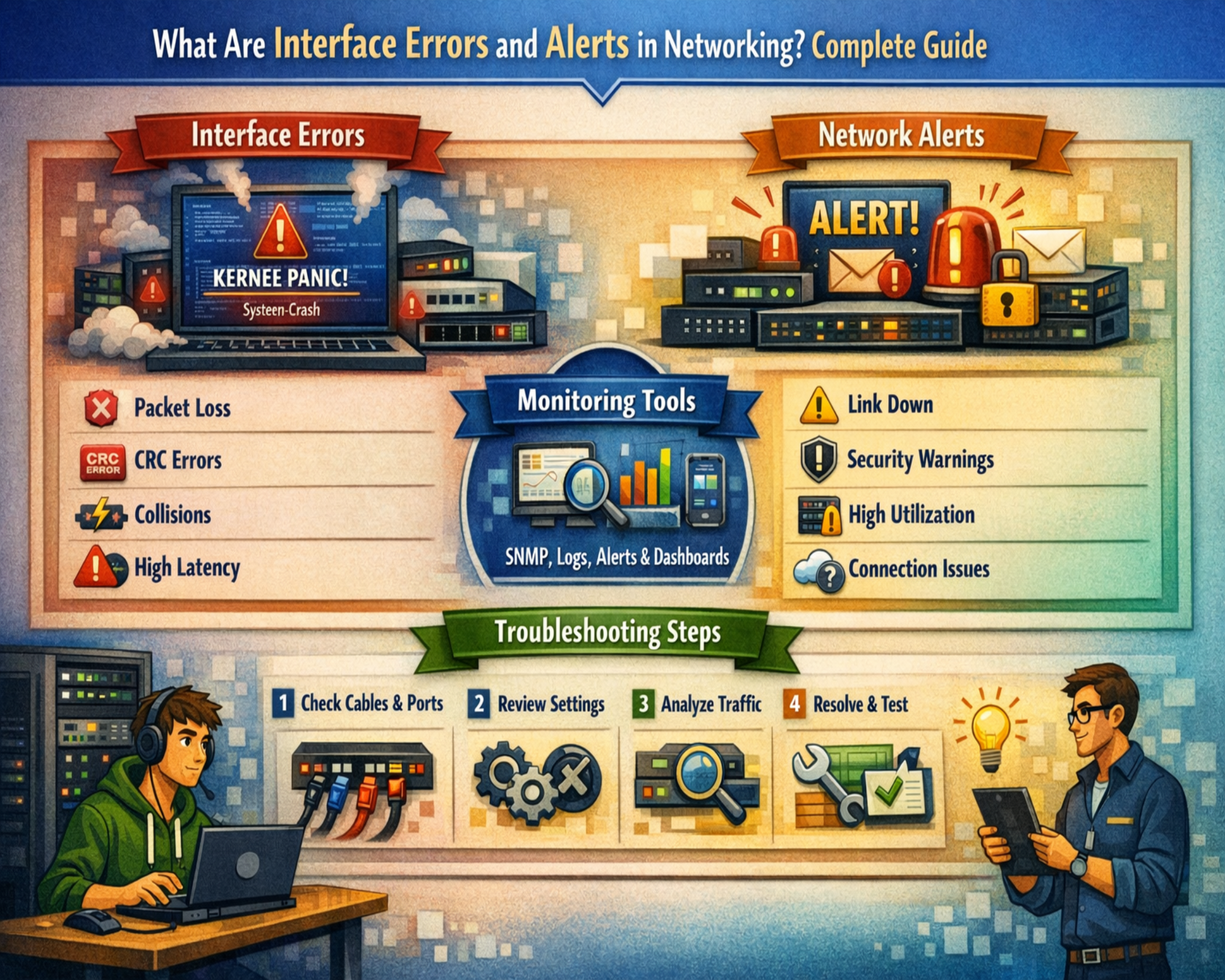
In enterprise and large-scale communication environments, maintaining continuous network availability is one of the most critical operational objectives. Network uptime is not simply a performance metric; it represents the reliability of the entire digital infrastructure that supports business applications, communication systems, cloud services, and internal operations. When a network is functioning properly, data flows seamlessly between devices, users, and services without noticeable delay or interruption. However, when disruptions occur at the infrastructure level, even briefly, the impact can cascade across dependent systems, leading to degraded application performance, user dissatisfaction, and in some cases, complete service unavailability. For this reason, network engineering prioritizes proactive monitoring and early detection of anomalies that may indicate deeper underlying issues. Among the most important categories of these anomalies are interface-level errors, which often serve as early warning indicators of physical or logical faults within network paths.
Understanding Interface Errors in Network Communication Systems
Interface errors refer to discrepancies, faults, or abnormal conditions detected at the point where a network device sends or receives data through a physical or logical interface. These interfaces exist on devices such as routers, switches, firewalls, and servers, forming the communication boundaries between network segments. Each interface is responsible for transmitting and receiving structured data units known as frames or packets, depending on the network layer being considered. When these transmissions are disrupted, altered, or incorrectly interpreted, the device records an interface error. These errors are not always immediately visible in application behavior, which makes them particularly important to monitor at the infrastructure level.
Interface errors can originate from a wide range of conditions, including physical layer impairments, configuration mismatches, signal degradation, or hardware inefficiencies. They are typically recorded in interface statistics maintained by network operating systems. These statistics provide cumulative counts of different error types, enabling engineers to assess the health of a connection over time. Because these counters accumulate continuously, even small but persistent error rates can indicate a developing issue that may eventually impact performance. Understanding interface errors requires interpreting not only their presence but also their frequency, growth patterns, and correlation with network traffic conditions.
Layered Communication Model and the Origin of Interface-Level Issues
To fully understand interface errors, it is essential to consider the layered structure of network communication. In layered networking models, data transmission is divided into multiple abstraction levels, with each layer responsible for specific functions. Interface errors primarily occur at the physical and data link layers, where raw signals are transmitted and converted into structured frames. At the physical layer, electrical or optical signals travel through transmission media such as copper cables or optical fibers. At the data link layer, these signals are organized into frames that include addressing information, error-checking mechanisms, and payload data.
When data is transmitted between devices, it must pass through multiple transformation stages. Any disruption during these stages can introduce inconsistencies that result in interface errors. For example, if electrical interference alters the signal during transmission, the receiving device may interpret corrupted data. Similarly, if synchronization between devices is misaligned, frame boundaries may be incorrectly interpreted. These types of issues are not related to application logic but rather to the integrity of the transmission medium itself. As a result, interface errors serve as indicators of lower-level network health rather than higher-level software issues.
Cyclic Redundancy Check and Data Integrity Validation
One of the most significant mechanisms involved in interface error detection is the Cyclic Redundancy Check, commonly referred to as CRC. CRC is a mathematical algorithm used to verify the integrity of transmitted data. When a network device sends a frame, it performs a calculation on the contents of that frame and generates a fixed-size value known as a checksum. This checksum is attached to the frame before transmission. Upon receipt, the receiving device performs the same calculation on the received data and compares its result with the original checksum. If both values match, the data is considered intact. If they differ, it indicates that the data was altered during transmission, resulting in a CRC error.
This process functions as a safeguard against corruption in transit. However, it is important to understand that CRC does not correct errors; it only detects them. Once a mismatch is identified, the corrupted frame is discarded, and higher-layer protocols are responsible for requesting retransmission if necessary. The reliability of this mechanism makes CRC a fundamental component of Ethernet-based communication systems. It ensures that corrupted data does not propagate further into the network stack, preserving data integrity at the cost of additional retransmission overhead.
Causes of CRC Errors in Network Infrastructure
CRC errors are typically caused by issues that affect the quality of data transmission between network devices. One of the most common causes is physical medium degradation. Network cables, especially copper-based ones, are susceptible to wear, bending, stretching, and environmental damage. Over time, these physical stresses can alter the electrical properties of the cable, leading to signal distortion. Fiber optic cables, while less vulnerable to electrical interference, can still experience problems such as connector misalignment, dust contamination, or excessive bending radius violations, all of which impact signal clarity.
Another major contributor to CRC errors is electromagnetic interference. In environments where network cables run close to power lines, industrial equipment, or other sources of electromagnetic activity, external signals can disrupt data transmission. This interference can introduce noise into the signal, causing bits to flip or become unreadable by the receiving device. Additionally, improper termination of cables or use of substandard connectors can introduce impedance mismatches that degrade signal quality.
Hardware-related issues also play a significant role. Faulty network interface cards, aging transceivers, or malfunctioning switch ports can introduce inconsistencies in signal encoding and decoding processes. These hardware faults may not always be immediately apparent, but can gradually increase CRC error rates over time. Configuration issues such as speed and duplex mismatches between connected devices can further exacerbate the problem by creating collisions and retransmission cycles that corrupt data frames.
Role of Network Configuration in Error Generation
Network configuration plays a critical role in maintaining data integrity across communication links. When devices on either end of a connection are not properly aligned in terms of speed or duplex settings, communication inefficiencies arise. For example, if one device operates in full-duplex mode while the other is set to half-duplex, data collisions may occur, resulting in corrupted frames. These collisions contribute to increased CRC error counts and overall network instability.
Similarly, incorrect auto-negotiation settings can lead to mismatched link parameters, which affect how data is transmitted and received. Modern network devices are typically capable of automatically negotiating optimal settings, but in heterogeneous environments or when legacy equipment is involved, manual configuration may be required to ensure consistency. Failure to align these settings can result in persistent transmission errors that are difficult to diagnose without detailed interface analysis.
Detection of Interface Errors Through Network Monitoring
Detecting interface errors requires continuous observation of network device statistics. Most network operating systems maintain detailed counters for each interface, tracking metrics such as transmitted packets, received packets, error counts, and discarded frames. These counters provide real-time insight into interface behavior and are essential for identifying abnormal conditions. A steadily increasing error counter, particularly for CRC-related issues, indicates a persistent problem that requires investigation.
In addition to local device monitoring, centralized network monitoring systems are often used to aggregate data from multiple devices across an infrastructure. These systems collect interface statistics at regular intervals and provide historical trend analysis. By examining patterns over time, engineers can identify whether errors are isolated incidents or part of a broader systemic issue. Correlating interface error data with traffic load, environmental conditions, and hardware performance helps narrow down potential root causes.
Log analysis is another important method for detecting interface errors. Network devices generate system logs that record significant events, including interface state changes, error occurrences, and link disruptions. These logs can be filtered to identify specific error types and frequency patterns. When combined with statistical monitoring, log analysis provides a more complete view of network health.
Impact of CRC and Interface Errors on Network Performance
The presence of CRC errors has a direct impact on network performance due to the retransmission mechanisms triggered by corrupted frames. When a frame is discarded due to a checksum mismatch, higher-layer protocols must resend the data. This retransmission process increases bandwidth consumption and introduces additional latency into the network. In high-traffic environments, repeated retransmissions can lead to congestion, reducing the overall efficiency of data transfer.
Beyond bandwidth utilization, CRC errors also affect processing resources on network devices. Each error event requires computational effort to detect, log, and manage retransmission processes. On heavily loaded devices, this additional processing can reduce overall throughput capacity. In latency-sensitive applications such as real-time communication, even small increases in delay can significantly degrade user experience.
Persistent interface errors may also lead to instability in network connections. When error rates exceed acceptable thresholds, devices may temporarily disable interfaces or reset connections to recover stability. These disruptions can result in intermittent connectivity, making troubleshooting more complex and impacting service continuity across dependent systems.
Preventive Considerations for Maintaining Interface Integrity
Maintaining interface integrity requires a combination of physical infrastructure management, configuration consistency, and ongoing monitoring. Ensuring that all network cabling meets required standards is essential for minimizing signal degradation. Proper installation practices, including correct cable routing, secure termination, and adherence to maximum length specifications, reduce the likelihood of physical-layer errors.
Configuration alignment between connected devices is equally important. Matching speed and duplex settings ensures that data transmission occurs without negotiation conflicts or collisions. Regular review of device configurations helps maintain consistency across network segments, especially in environments where multiple hardware vendors are used.
Environmental factors should also be considered when designing and maintaining network infrastructure. Minimizing exposure to electromagnetic interference, avoiding physical stress on cables, and ensuring adequate ventilation for network equipment contribute to overall stability. Combined, these measures help reduce the occurrence of interface errors and support sustained network performance.
Expanding the Scope of Interface-Level Anomalies in Modern Networks
While CRC errors are among the most recognized indicators of network degradation, they represent only one segment of a broader spectrum of interface-level anomalies. In real-world network environments, engineers encounter additional error types such as giants, runts, and encapsulation errors, each reflecting distinct failure conditions within data transmission processes. These anomalies provide deeper insight into how data is being handled at the interface level and often reveal configuration inconsistencies, physical limitations, or protocol mismatches that are not immediately visible through application behavior. Unlike higher-level network issues that manifest as service outages, interface anomalies often appear gradually, embedded within device statistics. Their early detection is essential for maintaining performance stability, especially in environments with high traffic throughput or strict latency requirements.
Frame Structure and Size Constraints in Ethernet Communication
To understand giants and runts, it is necessary to examine how Ethernet frames are structured and why size constraints exist. In Ethernet-based communication, data is encapsulated into frames that include a header, payload, and trailer. The header contains addressing information such as source and destination MAC addresses, while the trailer typically includes error-checking data such as CRC values. The payload carries the actual user data being transmitted.
Ethernet standards define minimum and maximum frame sizes to ensure compatibility and efficient transmission across network devices. The minimum frame size is established to prevent collision detection issues in shared media environments, while the maximum frame size ensures that network devices can process data efficiently without excessive buffering requirements. When frames exceed or fall below these defined limits, they are flagged as anomalies. These anomalies manifest as giants or runts, depending on whether the frame size exceeds or falls below acceptable thresholds.
Giants and the Impact of Oversized Frame Transmission
Giants refer to Ethernet frames that exceed the maximum allowable size defined by network standards or configured interface limits. In typical Ethernet environments, the standard maximum transmission unit is designed to accommodate frames up to a specific byte size. When a frame exceeds this limit, it cannot be processed normally and is therefore flagged as a giant.
The occurrence of giants often indicates a mismatch between expected and actual frame sizes within a network segment. This mismatch may result from the incorrect configuration of maximum transmission unit values across connected devices. In environments where jumbo frames are used to optimize performance for large data transfers, inconsistent configuration between devices can lead to unintended frame rejection.
Giants can also arise from encapsulation overhead inconsistencies. When additional headers are added during tunneling, VLAN tagging, or other encapsulation processes, frame sizes can grow beyond expected limits. If intermediate devices are not configured to support these extended frame sizes, they will classify the frames as giants and discard them. This leads to retransmission overhead and potential throughput inefficiencies.
Operational Consequences of Giant Frame Detection
The presence of giant frames introduces inefficiencies in network communication. When oversized frames are discarded, retransmission mechanisms at higher protocol layers must compensate for lost data. This increases bandwidth utilization and introduces additional latency into the system. In high-performance environments, such as data centers or cloud infrastructure, even small inefficiencies can compound into noticeable performance degradation.
Another consequence of giant frames is increased processing overhead on network devices. Interfaces must continuously evaluate incoming frame sizes against configured thresholds. When excessive giant frame occurrences are detected, it often indicates a systemic configuration issue rather than an isolated transmission problem. This can lead to prolonged troubleshooting cycles if not properly correlated with interface configuration settings.
Runts and the Implications of Undersized Frames
Runts represent the opposite end of the frame size spectrum. A runt is an Ethernet frame that is smaller than the minimum allowed size defined by network standards. These frames are typically incomplete or prematurely terminated during transmission. In many cases, runts are associated with collisions or physical layer disruptions that prevent full frame delivery.
The existence of a minimum frame size in Ethernet networks is designed to ensure proper collision detection in shared transmission environments. When frames are smaller than this threshold, they are considered invalid because they do not meet structural requirements for reliable processing. As a result, they are discarded by receiving devices.
Runts often indicate physical layer issues such as faulty cabling, signal attenuation, or hardware malfunctions. They can also be caused by high levels of network congestion where collisions are more frequent, especially in legacy half-duplex environments. In modern full-duplex switched networks, runts are less common but still appear in cases of hardware failure or signal corruption.
Relationship Between Runts, Collisions, and Physical Layer Instability
Runts are closely associated with collision events in Ethernet communication. In environments where multiple devices compete for access to a shared medium, simultaneous transmissions can result in collisions. When collisions occur, frames may be truncated or corrupted before full transmission is completed. These incomplete frames are then recorded as runts.
Even in switched networks where collision domains are segmented, runts can still occur due to physical impairments. Damaged cables, loose connectors, or electromagnetic interference can interrupt signal transmission mid-frame, resulting in incomplete data reception. These conditions highlight the importance of maintaining physical infrastructure integrity to prevent lower-layer transmission errors.
Encapsulation Errors and Protocol Translation Failures
Encapsulation errors occur when there is a mismatch in how data is packaged and interpreted between network devices. Encapsulation refers to the process of wrapping data with protocol-specific headers and trailers as it moves through different layers of the networking stack. Each layer adds its own structural information, which is necessary for proper routing and delivery.
When two devices interpret encapsulation rules differently, communication failures occur. These failures are recorded as encapsulation errors. Unlike CRC errors or frame size violations, encapsulation errors are often related to protocol mismatches rather than physical transmission issues.
Encapsulation errors commonly arise in environments where multiple networking technologies interact. For example, when VLAN tagging standards are inconsistently applied or when tunneling protocols are misconfigured, devices may be unable to correctly interpret incoming frames. This leads to rejection of the data due to structural incompatibility.
Protocol Mismatch Scenarios and Encapsulation Breakdown
One of the most frequent causes of encapsulation errors is a protocol mismatch between connected interfaces. Network devices must agree on encapsulation standards to ensure seamless communication. If one device uses a specific tagging or framing method while the other expects a different format, data cannot be properly decoded.
This issue is particularly common in environments where legacy and modern systems coexist. Older devices may not support newer encapsulation standards, leading to compatibility issues. Similarly, misconfigured trunk links or improperly defined VLAN configurations can result in inconsistent frame interpretation.
Encapsulation breakdown can also occur in tunneled environments where data is wrapped in additional protocol layers for secure or segmented transmission. If tunnel endpoints are not synchronized in terms of configuration, encapsulated data may be rejected upon arrival.
Role of Maximum Transmission Unit in Frame Handling Efficiency
The Maximum Transmission Unit plays a critical role in determining how data is segmented and transmitted across network interfaces. MTU defines the largest allowable size of a packet that can be transmitted without fragmentation. When data exceeds the MTU limit, it must be divided into smaller segments for transmission.
Incorrect MTU configuration can lead to both giants and encapsulation errors. If MTU values are inconsistent across a network path, some devices may reject packets that others accept. This inconsistency leads to fragmentation issues and potential data loss.
MTU mismatches are particularly problematic in complex network environments that include multiple routing paths, VPN tunnels, or virtualized network overlays. Each additional layer of encapsulation reduces effective payload capacity, increasing the likelihood of fragmentation and error generation.
Buffer Management and Interface Queue Behavior
Network interfaces rely on buffers to temporarily store incoming and outgoing data packets. These buffers allow devices to manage variations in traffic flow and prevent immediate packet loss during short bursts of high traffic. However, buffer limitations can contribute to interface errors when traffic exceeds processing capacity.
When buffers become saturated, packets may be dropped or partially processed, leading to anomalies such as runts or CRC-related corruption. Buffer overflow conditions often occur during microburst traffic events, where large volumes of data arrive in a very short time window. These bursts can overwhelm interface processing capabilities, resulting in temporary congestion and error generation.
Effective buffer management is essential for maintaining interface stability. Proper sizing of buffers, along with traffic shaping and queuing mechanisms, helps mitigate the impact of sudden traffic spikes. Without adequate buffering, even well-configured networks may experience intermittent performance degradation under high load conditions.
Interface Counters and Deep Visibility into Network Health
Interface counters provide essential visibility into network behavior by tracking various metrics related to data transmission and error conditions. These counters are maintained at the hardware or operating system level and are continuously updated as traffic flows through the device.
Counters typically include statistics such as frame counts, error counts, discarded packets, and alignment issues. By analyzing these values over time, engineers can identify trends that indicate underlying infrastructure problems. For example, a gradual increase in runt or giant frame counts may suggest a developing hardware issue or configuration drift.
These counters are especially valuable in long-term network health assessments. Instead of relying on isolated incidents, engineers can observe patterns that reveal systemic weaknesses. When combined with traffic analysis, interface counters provide a comprehensive view of network performance and stability.
Importance of Threshold-Based Monitoring in Error Detection
Threshold-based monitoring is a key technique used to detect abnormal interface behavior before it escalates into service disruption. By defining acceptable limits for error counters, network systems can generate alerts when those limits are exceeded.
Thresholds can be configured based on time intervals, traffic volume, or absolute error counts. When interface errors exceed predefined thresholds, monitoring systems trigger alerts that prompt further investigation. This proactive approach enables engineers to address issues before they significantly impact network performance.
Threshold-based systems are particularly effective in large-scale environments where manual monitoring of each interface is impractical. By automating detection processes, organizations can maintain higher levels of operational awareness and reduce response times to emerging network issues.
Correlation of Interface Errors with Network Performance Degradation
Interface errors do not exist in isolation; they often correlate directly with observable performance degradation in network services. Increased error rates can lead to packet loss, retransmissions, and latency spikes, all of which negatively affect application performance.
By correlating interface error data with performance metrics such as throughput, response time, and packet loss rates, engineers can establish causal relationships between physical network conditions and user experience. This correlation is essential for accurate troubleshooting and long-term infrastructure optimization.
In complex environments, multiple error types may occur simultaneously, making correlation analysis even more important. Understanding how different interface anomalies interact helps engineers prioritize remediation efforts and stabilize network performance more effectively.
Transitioning from Physical Errors to Logical Interface Failures
Network interface issues are not limited to physical transmission defects such as CRC errors, runts, or giants. As network architectures become more complex, especially with virtualization, tunneling, and multi-protocol environments, logical-level interface problems have become increasingly significant. These issues often manifest as encapsulation errors, configuration mismatches, and protocol misalignment between communicating devices. Unlike physical errors, which are typically caused by cable degradation or signal interference, logical interface failures originate from inconsistencies in how data is structured, packaged, and interpreted across network layers. These problems are particularly challenging to diagnose because they do not always correlate with obvious hardware faults, yet they can completely disrupt communication between systems.
Understanding Encapsulation in Network Communication Architecture
Encapsulation is a fundamental process in networking where data is wrapped with protocol-specific headers and trailers as it moves through the layered communication model. Each layer of the network stack adds its own metadata to ensure that data can be properly routed, delivered, and interpreted by the receiving device. At the application layer, raw data is generated by user applications. As it moves down the stack, it is segmented, assigned transport information, packaged into network packets, and finally framed for transmission at the data link layer.
This layered encapsulation process is essential for modular communication, but it also introduces potential points of failure. If any layer applies incompatible formatting rules or if two devices interpret encapsulation standards differently, a communication breakdown occurs. These breakdowns are recorded as encapsulation errors at the interface level. Unlike CRC or physical errors, encapsulation issues do not indicate data corruption during transit but instead reflect structural incompatibility in how data is packaged.
Causes of Encapsulation Errors in Modern Networks
Encapsulation errors typically arise from configuration inconsistencies between network devices. One of the most common causes is mismatched protocol encapsulation standards. For example, if one device expects frames to be tagged using a specific VLAN encapsulation method while the connected device uses a different tagging approach, the receiving interface may reject the frames entirely. This mismatch results in communication failure even though the physical link remains operational.
Another frequent cause is improper trunk configuration between switches. Trunk links are designed to carry multiple VLANs across a single physical connection, but they require consistent encapsulation agreements between both endpoints. If one side is configured for a different encapsulation protocol or VLAN tagging scheme, frames may be dropped due to incompatibility.
Encapsulation errors can also occur in environments that use tunneling protocols. In such cases, data is wrapped within additional headers to traverse secure or segmented network paths. If tunnel endpoints are not properly synchronized in terms of encapsulation settings, the receiving device may be unable to decapsulate the data correctly, leading to interface-level rejection of packets.
Impact of Encapsulation Errors on Network Communication Flow
When encapsulation errors occur, the affected data is typically discarded at the interface level before it can reach higher layers of the network stack. This results in silent communication failures where packets are transmitted but never successfully processed by the destination system. Unlike physical errors that may trigger retransmissions due to CRC validation failures, encapsulation errors often lead to persistent delivery failures that require manual intervention to resolve.
The operational impact of these errors is significant in environments that rely on consistent protocol interoperability. Applications that depend on continuous data streams, such as real-time analytics systems or distributed databases, may experience synchronization issues or partial data loss. In severe cases, encapsulation mismatches can lead to complete isolation of network segments, effectively partitioning communication paths within the infrastructure.
Role of Interface Alerts in Network Stability Management
Modern network environments rely heavily on automated alerting systems to maintain stability and uptime. Interface alerts serve as proactive indicators that notify administrators when error conditions exceed acceptable thresholds. These alerts are typically generated by network monitoring systems that continuously evaluate interface statistics in real time.
Alerting systems can be configured to detect specific conditions such as rising CRC error counts, increasing runt or giant frame occurrences, or sudden spikes in encapsulation failures. When these thresholds are exceeded, alerts are triggered through multiple channels, including system logs, dashboards, email notifications, or audible alarms in network operation centers.
The primary purpose of these alerts is to reduce response time between issue detection and resolution. By identifying abnormal behavior early, network engineers can investigate and remediate issues before they escalate into full-service disruptions. This proactive approach is essential in high-availability environments where downtime has significant operational and financial consequences.
Threshold-Based Monitoring and Predictive Network Maintenance
Threshold-based monitoring is a critical component of modern network management strategies. Instead of reacting to failures after they occur, threshold systems define acceptable operational boundaries for interface behavior. When metrics such as error counts, traffic levels, or latency exceed predefined limits, the system generates alerts to indicate potential issues.
This approach enables predictive maintenance, where network administrators can identify early warning signs of degradation before they result in outages. For example, a gradual increase in CRC errors over time may indicate deteriorating cabling or environmental interference. Similarly, rising encapsulation error counts may suggest configuration drift between network devices.
Threshold values are typically customized based on network design, traffic patterns, and performance expectations. In high-performance environments, thresholds may be set at very low tolerance levels to ensure maximum stability. In less critical environments, higher thresholds may be used to reduce unnecessary alerts while still maintaining visibility into major issues.
Role of Centralized Monitoring Systems in Interface Analysis
Centralized monitoring systems play a vital role in aggregating and analyzing interface-level data across large network infrastructures. These systems collect metrics from multiple devices and consolidate them into a unified view of network health. By centralizing data collection, engineers can identify patterns and correlations that would be difficult to detect when analyzing individual devices in isolation.
These systems track a wide range of interface statistics, including packet transmission rates, error counts, buffer utilization, and protocol-specific anomalies. Advanced monitoring platforms also provide historical trend analysis, allowing engineers to observe how interface behavior changes over time. This historical perspective is essential for identifying slow-developing issues that may not trigger immediate alerts but still impact long-term performance.
In addition to statistical analysis, centralized systems often integrate log aggregation capabilities. This allows engineers to correlate interface errors with system events, configuration changes, or external environmental factors. By combining multiple data sources, a more complete understanding of network behavior can be achieved.
Buffer Utilization and Traffic Handling Efficiency in Interfaces
Network interfaces rely on buffering mechanisms to temporarily store packets during transmission and reception. Buffers help manage variations in traffic flow by absorbing short bursts of high data volume. However, buffer limitations can contribute to interface errors when traffic exceeds processing capacity.
When buffers become saturated, incoming packets may be dropped or partially processed, resulting in anomalies such as runts or corrupted frames. This is especially common during microburst traffic events, where large volumes of data arrive in extremely short time intervals. These bursts can overwhelm interface processing capabilities, leading to temporary congestion and increased error rates.
Efficient buffer management is critical for maintaining interface stability. Properly sized buffers ensure that traffic fluctuations can be handled without data loss, while excessive buffering can introduce latency due to queuing delays. Balancing these factors is a key aspect of network design and performance optimization.
Interface Counters as Diagnostic Tools for Network Engineers
Interface counters provide detailed visibility into the operational state of network interfaces. These counters are continuously updated and reflect real-time activity across various performance metrics. Common counters include transmitted packets, received packets, error counts, discarded frames, and alignment issues.
By analyzing these counters, engineers can identify abnormal patterns that indicate underlying network issues. For example, a sudden increase in error counters may suggest a physical layer problem, while consistent growth in encapsulation errors may indicate a configuration mismatch. These counters serve as the primary diagnostic tool for identifying and resolving interface-level anomalies.
Long-term analysis of interface counters is particularly valuable for identifying gradual degradation trends. Instead of reacting to isolated incidents, engineers can observe how interface performance evolves. This enables proactive maintenance and reduces the likelihood of unexpected failures.
Correlation Between Interface Errors and Application Performance Degradation
Interface errors directly influence application-level performance by affecting the reliability and consistency of data transmission. When packets are lost or corrupted at the interface level, higher-layer protocols must initiate retransmission processes. These retransmissions increase latency and reduce effective throughput across the network.
In latency-sensitive applications such as voice communication, video streaming, or real-time data processing, even minor increases in packet loss can result in noticeable performance degradation. Jitter, delay, and packet reordering are common symptoms of underlying interface instability.
By correlating interface error data with application performance metrics, engineers can establish direct relationships between infrastructure health and user experience. This correlation is essential for prioritizing troubleshooting efforts and optimizing network performance.
Advanced Alerting Mechanisms and Automated Response Systems
Modern network environments increasingly rely on automated alerting and response systems to manage interface errors. These systems not only detect anomalies but can also initiate predefined remediation actions. For example, if error thresholds are exceeded, the system may automatically reset an interface, reroute traffic, or adjust configuration parameters.
Automated response systems are particularly useful in large-scale environments where manual intervention is impractical. By reducing response times, these systems help minimize the impact of network issues on end users. However, automation must be carefully configured to avoid unintended disruptions caused by false positives or transient anomalies.
Alerting mechanisms can also be integrated with machine learning models that analyze historical data to predict potential failures. This predictive capability allows networks to transition from reactive maintenance to proactive optimization, improving overall reliability and efficiency.
Strategic Importance of Continuous Interface Health Management
Continuous interface health management is essential for maintaining stable and efficient network operations. As network infrastructures grow in complexity, the likelihood of encountering interface-level anomalies increases. Without consistent monitoring and analysis, these issues can accumulate and lead to significant performance degradation.
Effective interface management requires a combination of real-time monitoring, historical analysis, threshold-based alerting, and automated response mechanisms. Together, these components create a comprehensive framework for ensuring network stability and minimizing downtime. By maintaining visibility into interface behavior and responding quickly to anomalies, organizations can achieve higher levels of operational resilience and performance consistency.
Conclusion
A stable and high-performing network environment depends on far more than simply maintaining device connectivity. It requires continuous validation of how data is transmitted, transformed, and received across every interface in the infrastructure. Interface-level anomalies such as CRC errors, runts, giants, and encapsulation mismatches represent critical signals that reveal the internal health of a network long before end users experience visible disruption. These indicators function as diagnostic layers that expose issues occurring at the physical, data link, and logical boundaries of communication systems. When interpreted correctly, they provide engineers with a structured view of where breakdowns are occurring and why they are happening.
At the core of all interface-related issues is the concept of data integrity during transmission. Every packet that traverses a network is subject to multiple environmental and technical variables that can influence its accuracy. Electrical interference, optical degradation, buffer limitations, configuration inconsistencies, and protocol mismatches all contribute to the likelihood of transmission errors. CRC mechanisms exist to safeguard against silent corruption, ensuring that altered data does not propagate further into the network stack. However, while CRC detection prevents corrupted information from being processed, it also introduces retransmission overhead, which can accumulate into measurable performance degradation when error rates rise.
Similarly, frame size violations such as giants and runts highlight structural inconsistencies in how data is packaged and interpreted. Giants indicate that frames exceed acceptable transmission boundaries, often due to mismatched MTU settings or encapsulation overhead. Runts, on the other hand, represent incomplete or prematurely terminated frames, usually caused by physical layer disruptions or collision-related anomalies. Both conditions reflect instability in the transmission process, even though they originate from different operational causes. Their presence signals that either the physical infrastructure or configuration consistency requires immediate attention.
Encapsulation errors extend the scope of interface analysis into the logical domain of networking. Unlike physical transmission errors, encapsulation failures arise when devices disagree on how data should be structured and interpreted across protocol layers. These mismatches are often subtle and can exist even when physical connectivity appears stable. VLAN tagging inconsistencies, tunneling misconfigurations, and protocol incompatibilities are common sources of encapsulation-related failures. These issues emphasize the importance of standardized configuration practices across all network devices to ensure that data can move seamlessly between heterogeneous systems.
A key observation in modern network environments is that interface errors rarely occur in isolation. Instead, they tend to cluster around specific infrastructure weaknesses or configuration inconsistencies. For example, a single faulty cable can generate CRC errors, runts, and retransmission spikes simultaneously, while a misconfigured trunk link can produce encapsulation failures alongside frame drops. This interdependence highlights the importance of holistic analysis rather than isolated troubleshooting. Engineers must evaluate multiple interface metrics together to accurately identify root causes.
Monitoring systems play a central role in maintaining visibility into these complex interactions. Interface counters, logs, and real-time analytics provide continuous feedback on network behavior. Without this visibility, errors may go unnoticed until they significantly impact performance. Threshold-based monitoring further enhances this capability by introducing proactive alerting mechanisms that notify administrators when error conditions exceed acceptable boundaries. These systems shift network management from reactive troubleshooting to proactive maintenance, reducing downtime and improving operational efficiency.
Another critical aspect of interface management is the role of buffer behavior in traffic handling. Buffers act as temporary storage mechanisms that absorb fluctuations in network traffic. When properly sized and managed, they help maintain smooth data flow even under variable load conditions. However, when buffers become overwhelmed, they contribute to packet loss and frame corruption, indirectly increasing error rates. This relationship between traffic volume and buffer utilization demonstrates how performance bottlenecks can originate from both hardware limitations and traffic patterns.
In high-density or high-throughput environments, small inefficiencies at the interface level can scale into significant operational challenges. Even minor increases in error rates can trigger cascading effects such as retransmission storms, latency spikes, and congestion buildup. These effects are particularly impactful in real-time systems where timing consistency is critical. Voice communication, video conferencing, financial transactions, and distributed computing systems are especially sensitive to these disruptions, making interface health a priority in their design and maintenance.
From a strategic perspective, understanding interface behavior requires integrating multiple layers of analysis. Physical diagnostics identify cable quality and signal integrity issues. Data link analysis focuses on frame structure and error detection. Network-layer evaluation examines routing consistency and encapsulation behavior. Together, these layers form a complete diagnostic framework that allows engineers to pinpoint issues with greater precision. Without this layered approach, troubleshooting becomes fragmented and inefficient.
The increasing complexity of modern networks further amplifies the importance of interface monitoring. As infrastructures evolve to include virtualized environments, cloud integrations, and hybrid architectures, the number of potential failure points increases significantly. Each additional layer of abstraction introduces new opportunities for misconfiguration and incompatibility. This makes continuous monitoring and standardized configuration practices essential for maintaining operational stability across distributed systems.
Ultimately, interface errors serve as an early warning system for deeper infrastructure problems. They provide measurable indicators that reflect the health of both physical and logical network components. By analyzing these indicators systematically, engineers can prevent small issues from escalating into major outages. The ability to interpret interface statistics accurately is therefore a fundamental skill in network engineering, directly tied to maintaining reliability, performance, and scalability in modern communication systems.