
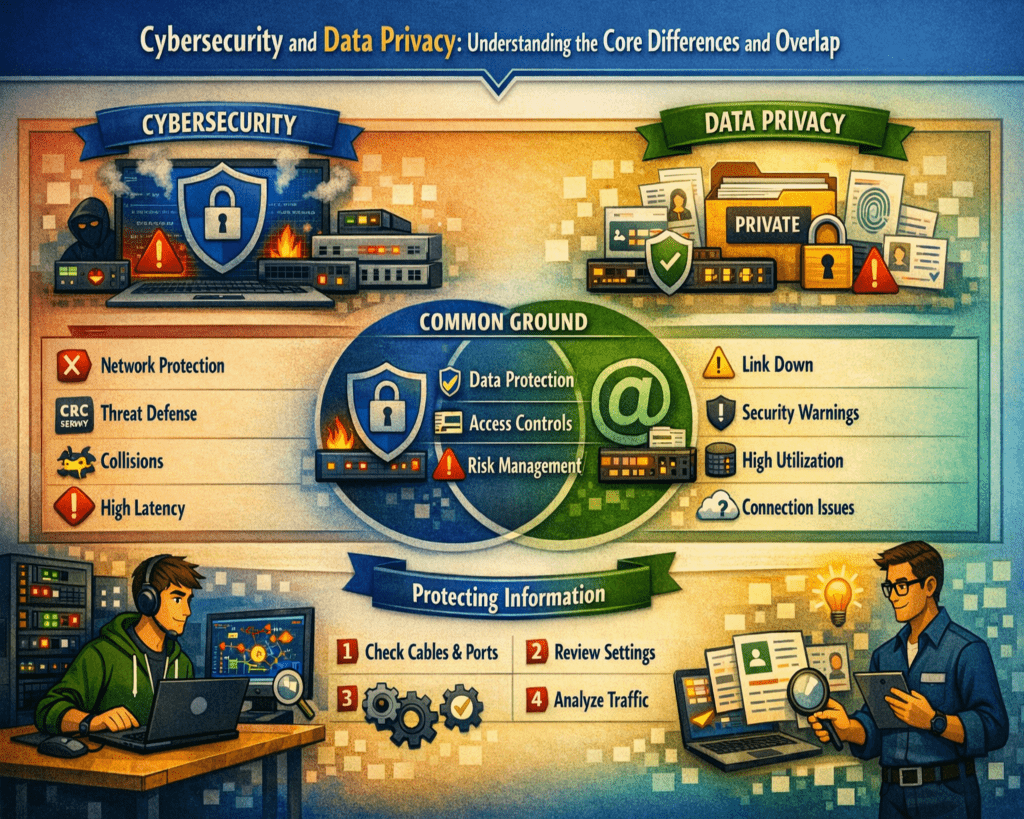
In an increasingly connected digital world, organizations operate within ecosystems where data continuously moves across networks, applications, cloud infrastructures, and third-party platforms. This constant flow of information enables innovation, scalability, and operational efficiency, but it also introduces significant exposure to cyber threats and regulatory risks. As a result, cybersecurity and data privacy have become essential pillars of modern information management. Although they are often discussed together, they represent two distinct disciplines with different goals, methods, and areas of responsibility.
Cybersecurity focuses on protecting systems, networks, and digital assets from unauthorized access, disruption, and malicious attacks. Data privacy, on the other hand, governs how personal and sensitive information is collected, processed, stored, and shared in compliance with ethical standards and legal requirements. While cybersecurity is primarily concerned with defending infrastructure, data privacy is concerned with protecting individual rights and ensuring responsible data usage.
The distinction between these two areas is critical for organizations that depend heavily on digital systems. A strong cybersecurity framework may prevent breaches, but without proper data privacy controls, organizations can still misuse or mishandle data in ways that violate trust or regulatory obligations. Conversely, strong privacy policies without adequate cybersecurity protections leave data vulnerable to theft or corruption. This interdependency highlights why both disciplines must operate together while maintaining their unique focus areas.
Expanding Digital Risk and the Importance of Data Protection
The expansion of digital transformation has significantly increased organizational exposure to cyber risks. Businesses now rely on interconnected systems that span internal infrastructure, cloud services, mobile devices, and external vendors. Each connection point introduces potential vulnerabilities that can be exploited by attackers. The financial and operational consequences of cyber incidents have become increasingly severe, often affecting not only revenue but also reputation, customer trust, and long-term market position.
Data breaches are among the most damaging outcomes of cyberattacks. When sensitive information is exposed, organizations may face financial penalties, legal action, and reputational damage that can take years to recover from. In many cases, the true cost of a breach extends far beyond immediate financial loss, affecting customer loyalty and stakeholder confidence. This makes proactive cybersecurity and data governance strategies essential components of enterprise risk management.
At the same time, regulatory frameworks across different regions have placed stricter requirements on how organizations handle personal data. These regulations define how data should be collected, stored, processed, and shared, creating a structured environment for data privacy enforcement. Organizations that fail to comply risk not only financial penalties but also operational restrictions and loss of business credibility.
Foundations of Cybersecurity in Organizational Systems
Cybersecurity can be understood as a multi-layered discipline that integrates technology, processes, and human behavior to protect digital systems. It is built on three core principles: confidentiality, integrity, and availability. Confidentiality ensures that information is accessible only to authorized users. Integrity ensures that data remains accurate and unaltered unless authorized changes are made. Availability ensures that systems and data are accessible when needed.
To achieve these objectives, cybersecurity employs a combination of preventive, detective, and corrective controls. Preventive controls are designed to stop attacks before they occur, such as firewalls, encryption systems, and authentication mechanisms. Detective controls focus on identifying suspicious activity through monitoring tools, intrusion detection systems, and log analysis. Corrective controls aim to restore systems after an incident, including backup systems, disaster recovery plans, and incident response procedures.
Modern cybersecurity also relies heavily on automation and artificial intelligence to detect anomalies in real time. As attack methods become more sophisticated, manual monitoring alone is no longer sufficient. Automated systems analyze large volumes of data to identify patterns that may indicate malicious activity, enabling faster response times and reducing potential damage.
Security by Design and Development Integration
One of the most important developments in cybersecurity practice is the integration of security into the software development lifecycle. This approach ensures that security considerations are embedded from the earliest stages of system design rather than being added after deployment. This methodology is often referred to as security by design.
In practical terms, security by design involves identifying potential risks before coding begins. Developers and security teams collaborate to assess how systems might be exploited and implement safeguards accordingly. This includes designing secure authentication systems, validating input data, encrypting sensitive information, and establishing secure communication channels between system components.
For example, when building a digital application that processes user data, developers must consider how that data will be transmitted, stored, and accessed. Without proper design, vulnerabilities such as injection attacks, unauthorized access, or data leaks may occur. By embedding security controls early in the development process, organizations reduce the likelihood of costly remediation efforts later.
Another important aspect of secure system design is secure error handling. Systems must be designed to handle failures without exposing sensitive technical information. Detailed error messages can unintentionally reveal system architecture or internal logic, which attackers may exploit. Therefore, systems are designed to provide limited external error feedback while maintaining detailed internal logs for debugging purposes.
Role of Monitoring and Incident Awareness
Continuous monitoring is a fundamental component of cybersecurity operations. Organizations must constantly observe network traffic, system behavior, and user activity to identify potential threats. Monitoring tools collect and analyze data from multiple sources, enabling security teams to detect anomalies that may indicate malicious activity.
Incident awareness also extends to understanding normal system behavior. By establishing a baseline of expected activity, organizations can more easily identify deviations that may signal security incidents. These deviations could include unusual login attempts, unexpected data transfers, or abnormal system performance.
Security teams rely heavily on centralized logging systems to support monitoring efforts. Logs provide a detailed record of system activity, enabling forensic analysis after an incident occurs. However, logging must be carefully managed to avoid exposing sensitive information. This creates a balance between visibility for security purposes and protection of confidential data.
Human Factors and Organizational Security Culture
Despite advances in technology, human behavior remains one of the most significant factors in cybersecurity risk. Many successful attacks exploit human psychology rather than technical vulnerabilities. Social engineering techniques, such as phishing emails or fraudulent communications, rely on convincing individuals to take actions that compromise security.
To address this risk, organizations invest in security awareness training programs. These programs educate employees about common threats and teach them how to recognize suspicious activity. Training often includes simulated attack scenarios to test user responses and reinforce best practices.
A strong security culture emphasizes shared responsibility across the organization. Cybersecurity is not limited to IT departments or specialized teams; it is a collective responsibility that involves every employee. From executives making strategic decisions to operational staff handling daily communications, each individual plays a role in maintaining security posture.
Leadership commitment is particularly important in establishing this culture. When leadership prioritizes security, it influences organizational behavior and resource allocation. Without executive support, cybersecurity initiatives may lack the necessary funding or enforcement to be effective.
Access Control and Identity Management Principles
Access control is a critical component of cybersecurity that governs how users interact with systems and data. It ensures that only authorized individuals can access specific resources based on their roles and responsibilities. This is achieved through authentication and authorization mechanisms.
Authentication verifies identity through credentials such as passwords, biometric data, or security tokens. Authorization determines the level of access granted to an authenticated user. These processes work together to ensure that system access is both secure and controlled.
The principle of least privilege is a key concept in access management. It ensures that users are granted only the minimum level of access necessary to perform their tasks. This reduces the potential impact of compromised accounts and limits the spread of internal threats.
Identity management systems help organizations enforce these principles at scale. They centralize user access control, making it easier to manage permissions, monitor activity, and enforce security policies consistently across systems.
Infrastructure Complexity and Expanding Attack Surfaces
As organizations adopt cloud computing, remote work models, and distributed architectures, the complexity of digital infrastructure continues to grow. This complexity introduces new security challenges because each additional system or integration point represents a potential vulnerability.
Modern applications often rely on multiple interconnected services, including APIs, third-party platforms, and cloud-based storage systems. While these integrations improve functionality and scalability, they also increase the number of entry points available to attackers.
Misconfigurations in these environments are a common source of security incidents. Incorrect access settings, exposed databases, or improperly secured APIs can lead to unauthorized data exposure. As a result, configuration management has become a critical aspect of cybersecurity strategy.
Organizations must continuously evaluate and update their security configurations to ensure they align with current threat landscapes. Static security models are no longer sufficient in dynamic environments where systems evolve rapidly.
Transition Toward Data Privacy Governance
While cybersecurity focuses on protecting systems from external and internal threats, data privacy shifts attention toward the responsible handling of information itself. This includes how data is collected, processed, shared, and retained within organizational systems.
Understanding cybersecurity provides the technical foundation necessary to explore how data privacy frameworks operate. The next section will examine how organizations manage personal data, ensure compliance with legal standards, and implement controls that protect individual privacy rights across digital environments.
Data Privacy in Digital Ecosystems and Its Expanding Role
Data privacy has become a central pillar of modern digital governance as organizations increasingly rely on large-scale data collection and analysis to drive decision-making, personalization, and operational efficiency. Unlike cybersecurity, which focuses on protecting systems and infrastructure from unauthorized access, data privacy focuses on how information about individuals is collected, processed, stored, shared, and ultimately disposed of. The emphasis is not only on protection from external threats but also on ensuring that data is used in a lawful, transparent, and ethical manner throughout its lifecycle.
In contemporary digital ecosystems, data is considered both an asset and a liability. It enables organizations to improve customer experiences, optimize services, and develop predictive insights, but it also introduces significant responsibility. Any misuse, over-collection, or unauthorized sharing of personal data can result in legal consequences, reputational damage, and erosion of user trust. As a result, data privacy is no longer a secondary consideration but a core component of organizational strategy and governance frameworks.
Data privacy operates at the intersection of technology, policy, and ethics. It defines boundaries for how personal information should be handled and establishes expectations for consent, transparency, and accountability. While cybersecurity ensures that data is protected from unauthorized access, data privacy ensures that even authorized access adheres to predefined rules and user expectations.
Core Principles Governing Data Privacy Practices
Data privacy is built upon several foundational principles that guide how organizations interact with personal information. These principles shape policies, technical implementations, and operational procedures across industries.
One of the most important principles is data minimization. This principle requires organizations to collect only the data that is necessary for a specific purpose. Excessive data collection increases risk exposure and creates unnecessary storage and compliance burdens. By limiting data collection to essential information, organizations reduce the potential impact of breaches and misuse.
Another critical principle is purpose limitation. This ensures that data collected for one purpose is not repurposed for unrelated activities without proper authorization or consent. For example, data collected for service delivery should not be used for unrelated marketing activities unless explicitly agreed upon by the user.
Transparency is also a key component of data privacy. Individuals must be informed about what data is being collected, how it will be used, and who it may be shared with. This principle reinforces trust between users and organizations by ensuring that data practices are open and understandable.
Storage limitation is another important principle, requiring organizations to retain personal data only for as long as it is necessary. Once the purpose for which data was collected has been fulfilled, it should be securely deleted or anonymized to reduce risk exposure.
Finally, accountability ensures that organizations take responsibility for complying with data privacy regulations and implementing appropriate safeguards. This includes maintaining documentation, conducting audits, and demonstrating compliance with applicable laws and standards.
Regulatory Frameworks and Compliance Requirements
Data privacy is heavily influenced by legal and regulatory frameworks that define how organizations must handle personal information. These frameworks vary by region but generally share common objectives related to protecting individual rights and ensuring responsible data management.
Regulations typically define categories of personal data, establish consent requirements, and impose obligations on organizations regarding data security and transparency. They also grant individuals certain rights, such as the ability to access their data, request corrections, or demand deletion under specific conditions.
Compliance with these frameworks requires organizations to implement structured governance models that integrate legal, technical, and operational controls. This includes maintaining data inventories, implementing consent management systems, and establishing processes for responding to user requests.
Failure to comply with data privacy regulations can result in significant penalties, including financial fines and operational restrictions. In addition, non-compliance can damage an organization’s reputation and reduce customer trust, which may have long-term business implications.
Consent Management and User Control Mechanisms
Consent is a fundamental aspect of data privacy that defines how individuals agree to the collection and use of their personal information. Effective consent management ensures that users are fully informed and have genuine control over their data.
Consent must be freely given, specific, informed, and unambiguous. This means that users should clearly understand what they are agreeing to and must actively opt in rather than being automatically included without awareness. Organizations must also provide mechanisms for users to withdraw consent at any time.
In practical terms, consent management systems track user preferences and ensure that data processing activities align with those preferences. These systems are often integrated into digital platforms to manage permissions dynamically, especially in environments where data is used across multiple services or departments.
User control mechanisms extend beyond consent and include rights such as data access, correction, and deletion. These rights empower individuals to manage their personal information and ensure that organizations remain accountable for how data is handled.
Data Lifecycle Management and Privacy Enforcement
Data privacy is closely tied to the concept of data lifecycle management, which refers to the stages that data goes through from creation to deletion. These stages typically include collection, storage, usage, sharing, archival, and destruction.
During the collection phase, organizations must ensure that only necessary data is gathered and that users are informed about the purpose of collection. In the storage phase, data must be protected using encryption and access controls to prevent unauthorized access. During usage, strict policies must govern how data is processed and who can access it.
Data sharing introduces additional complexity because information may be transferred to third parties such as service providers or partners. In these cases, organizations must ensure that recipients adhere to the same privacy standards and contractual obligations.
Archival involves storing data for long-term retention when necessary, often for compliance or historical purposes. However, even archived data must remain protected and accessible only to authorized personnel. Finally, destruction ensures that data is permanently removed when it is no longer needed, reducing the risk of unauthorized recovery.
Technical Controls Supporting Data Privacy
Data privacy is enforced through a combination of technical controls that ensure information is protected throughout its lifecycle. One of the most widely used techniques is encryption, which converts data into unreadable formats that can only be accessed with proper decryption keys. Encryption is applied both during data transmission and while data is stored, ensuring protection against interception and unauthorized access.
Another important control is data masking, which replaces sensitive information with obfuscated values while preserving its structure. This allows developers, analysts, and system administrators to work with realistic datasets without exposing actual personal information. Data masking is especially useful in development and testing environments where real data is not required.
Tokenization is another method used to enhance data privacy. It replaces sensitive data elements with unique identifiers or tokens that have no exploitable meaning outside the system. This reduces the risk of exposure in case of unauthorized access to databases or applications.
Access control mechanisms also play a key role in data privacy by ensuring that only authorized users can view or manipulate sensitive data. These controls are often enforced through role-based access systems that align permissions with job responsibilities.
Data Privacy in Cloud and Distributed Environments
The rise of cloud computing and distributed architectures has significantly changed how data privacy is implemented. In traditional environments, data was stored within centralized systems under direct organizational control. However, cloud environments distribute data across multiple regions, platforms, and service providers.
This distribution introduces additional privacy challenges because data may cross jurisdictional boundaries, each with its own regulatory requirements. Organizations must ensure that data remains protected regardless of where it is stored or processed.
Cloud service providers typically offer built-in privacy controls, but organizations remain responsible for configuring and managing these controls correctly. Misconfigurations can lead to unintended data exposure, making configuration management a critical aspect of cloud privacy.
Encryption, identity management, and access control are particularly important in cloud environments. These controls ensure that even if infrastructure is shared, data remains isolated and protected from unauthorized access.
Relationship Between Data Privacy and Trust in Digital Systems
Data privacy plays a direct role in establishing and maintaining trust between organizations and users. When individuals share their personal information, they expect it to be handled responsibly and securely. Any failure in this expectation can result in loss of trust, reduced engagement, and potential legal consequences.
Trust is built through transparency, accountability, and consistent adherence to privacy principles. Organizations that clearly communicate their data practices and demonstrate strong privacy controls are more likely to retain user confidence.
In contrast, poor data privacy practices can lead to reputational damage that extends beyond immediate financial losses. Users are increasingly aware of how their data is used, and they are more likely to disengage from organizations that fail to protect their privacy.
Operational Challenges in Implementing Data Privacy
Implementing data privacy at scale presents several operational challenges. One of the primary challenges is managing data across multiple systems and platforms. As organizations grow, data becomes fragmented across different applications, making it difficult to maintain consistent privacy controls.
Another challenge is ensuring compliance across different regulatory environments. Global organizations must navigate varying legal requirements, each with its own definitions, obligations, and enforcement mechanisms.
Data visibility is also a significant challenge. Organizations must maintain accurate records of where data is stored, how it is used, and who has access to it. Without proper visibility, enforcing privacy policies becomes difficult.
In addition, balancing data utility and privacy can be complex. Organizations often rely on data analysis for decision-making, but privacy requirements may limit how data can be used. Finding the right balance between utility and protection requires careful planning and governance.
Intersection of Privacy Governance and Security Infrastructure
Data privacy and cybersecurity are deeply interconnected in practice. While they have different objectives, they rely on shared infrastructure and controls to achieve their goals. Security mechanisms such as encryption, access control, and monitoring support both disciplines.
However, data privacy introduces additional layers of governance that go beyond technical security. It defines rules about how data should be used, who can access it, and under what conditions it can be shared. This means that even if data is technically secure, it may still violate privacy requirements if used improperly.
Organizations must therefore align their cybersecurity strategies with privacy governance frameworks to ensure comprehensive protection of both systems and information.
Cybersecurity and Data Privacy Integration in Modern Enterprise Systems
Modern enterprises operate in environments where cybersecurity and data privacy are no longer independent disciplines but tightly interwoven components of a unified information governance strategy. While cybersecurity focuses on defending infrastructure, systems, and networks from unauthorized access and malicious activity, data privacy governs how personal and sensitive information is collected, processed, shared, and retained. In practice, both functions must operate in coordination because weaknesses in one directly affect the effectiveness of the other.
As organizations expand across cloud ecosystems, mobile platforms, and distributed architectures, the boundary between security enforcement and privacy compliance becomes increasingly blurred. A secure system that fails to respect data privacy principles can still expose organizations to regulatory penalties and reputational damage. Likewise, a privacy-compliant system that lacks strong cybersecurity defenses remains vulnerable to breaches that compromise sensitive information. This dual dependency has led to the development of integrated governance models where security controls are designed to support privacy requirements from the outset.
Enterprise architecture now commonly includes shared frameworks that unify identity management, encryption strategies, monitoring systems, and compliance reporting. These frameworks ensure that data protection is enforced consistently across all systems, regardless of where data resides or how it is processed. This integration reduces fragmentation and improves the organization’s ability to respond to both security incidents and privacy-related obligations.
Governance Models and Organizational Responsibility Structures
Effective management of cybersecurity and data privacy requires structured governance models that define roles, responsibilities, and accountability across the organization. Governance ensures that technical controls are aligned with business objectives and regulatory requirements while maintaining operational efficiency.
At the organizational level, cybersecurity governance typically focuses on risk management, threat mitigation, and infrastructure protection. This includes establishing policies for access control, network security, incident response, and vulnerability management. Data privacy governance, on the other hand, focuses on ensuring lawful processing of personal data, managing consent, enforcing retention policies, and maintaining compliance with applicable regulations.
Although these functions are distinct, they often report into shared risk management frameworks. This alignment allows organizations to evaluate both security and privacy risks within a unified structure, enabling better decision-making and resource allocation. Governance committees or risk councils are commonly used to oversee these efforts and ensure consistency across departments.
Accountability is a critical element of governance. Organizations must clearly define who is responsible for implementing security controls, managing data privacy obligations, and responding to incidents. Without clear accountability, gaps can emerge between policy design and operational execution, increasing exposure to both security and privacy risks.
Advanced Threats and Evolving Attack Techniques
The modern threat landscape continues to evolve in complexity, driven by advancements in automation, artificial intelligence, and distributed computing. Attackers now leverage sophisticated techniques that target both technical vulnerabilities and human behavior. This dual approach increases the likelihood of successful breaches, particularly in environments with weak governance or inconsistent controls.
One of the most significant developments in recent years is the rise of multi-stage attacks. These attacks often begin with reconnaissance, where attackers gather information about systems, users, and infrastructure. This is followed by initial access, lateral movement, privilege escalation, and finally data exfiltration or system disruption. Each stage is designed to remain undetected for as long as possible, increasing the impact of the attack.
Phishing and social engineering remain among the most common attack vectors. These techniques exploit human psychology rather than technical weaknesses, making them particularly effective. Attackers often impersonate trusted entities to manipulate users into revealing credentials or performing unauthorized actions.
In parallel, automated attack tools have made it easier for attackers to scan large networks for vulnerabilities. These tools can identify misconfigured systems, outdated software, and exposed services within minutes. As a result, organizations must maintain continuous monitoring and rapid patching processes to reduce exposure windows.
Incident Response and Recovery Frameworks
Incident response is a critical component of cybersecurity that focuses on detecting, containing, and recovering from security breaches. A well-defined incident response framework ensures that organizations can react quickly and effectively to minimize damage.
The incident response lifecycle typically includes preparation, identification, containment, eradication, recovery, and post-incident analysis. Preparation involves establishing policies, tools, and training programs that enable rapid response. Identification focuses on detecting anomalies and confirming whether a security incident has occurred.
Containment aims to limit the spread of the incident, preventing further damage to systems or data. Eradication involves removing malicious elements from the environment, such as malware or unauthorized access points. Recovery focuses on restoring systems to normal operation, often using backups or redundancy mechanisms.
Post-incident analysis is a crucial step that examines the root cause of the incident and identifies lessons learned. This process helps organizations strengthen their defenses and prevent similar incidents in the future.
Incident response is closely linked to data privacy because breaches often involve personal or sensitive information. Organizations must not only restore system functionality but also assess whether data exposure has occurred and whether regulatory notification requirements apply.
Privacy Engineering and System Design Integration
Privacy engineering is an emerging discipline that integrates data privacy principles directly into system design and architecture. It ensures that privacy requirements are considered throughout the development lifecycle rather than being addressed after deployment.
This approach includes designing systems that support data minimization, ensuring that only necessary information is collected and processed. It also involves implementing mechanisms for anonymization and pseudonymization to reduce the risk of identifying individuals from stored data.
Privacy engineering also focuses on embedding consent management into system workflows. Users must have clear and accessible mechanisms to control how their data is used. These controls must be integrated into application logic rather than treated as external policies.
Another important aspect is privacy-preserving analytics. Organizations often need to analyze large datasets to gain insights, but this must be done without compromising individual privacy. Techniques such as aggregation and differential privacy help achieve this balance by allowing analysis without exposing raw personal data.
Data Flow Management and Cross-System Communication
In complex digital environments, data rarely remains within a single system. Instead, it flows across multiple applications, services, and infrastructure layers. Managing these data flows is essential for both cybersecurity and data privacy.
Data flow management involves tracking how information moves between systems and ensuring that appropriate controls are applied at each stage. This includes encrypting data during transmission, enforcing access controls at integration points, and validating data integrity throughout its journey.
Cross-system communication introduces additional risk because each integration point represents a potential vulnerability. APIs, for example, are commonly used to facilitate communication between systems but can be exploited if not properly secured. Authentication, authorization, and rate limiting are critical controls in these environments.
Visibility into data flows is also essential for compliance purposes. Organizations must be able to demonstrate where data originates, how it is processed, and where it is stored. This level of visibility supports both security monitoring and privacy auditing.
Data Classification and Sensitivity Handling
Data classification is a foundational practice that supports both cybersecurity and data privacy by categorizing information based on its sensitivity and importance. This allows organizations to apply appropriate protection measures depending on the type of data being handled.
Common classification levels include public, internal, confidential, and highly sensitive. Public data may be freely shared without restriction, while internal data is limited to organizational use. Confidential and highly sensitive data require strict access controls, encryption, and monitoring.
Classification enables organizations to prioritize security resources effectively. Highly sensitive data receives stronger protection mechanisms, while less critical data may be subject to lighter controls. This ensures efficient use of resources while maintaining appropriate levels of protection.
In data privacy contexts, classification also determines how data should be handled under regulatory frameworks. For example, personally identifiable information requires stricter controls and greater transparency compared to non-sensitive operational data.
Emerging Technologies and Their Impact on Security and Privacy
Technological advancements such as artificial intelligence, machine learning, and edge computing are reshaping both cybersecurity and data privacy landscapes. These technologies introduce new capabilities but also new risks.
Artificial intelligence can enhance cybersecurity by improving threat detection and automating response mechanisms. However, it can also be used by attackers to create more sophisticated and adaptive threats. Machine learning models can identify anomalies in network traffic, but they also require large datasets that may include sensitive information.
Edge computing distributes processing closer to data sources, reducing latency and improving performance. However, it also decentralizes data storage, making it more difficult to enforce consistent security and privacy controls across all nodes.
As these technologies evolve, organizations must continuously adapt their governance frameworks to ensure that security and privacy principles remain embedded within new architectures.
Organizational Alignment Between Security and Privacy Functions
For effective risk management, organizations must ensure strong alignment between cybersecurity teams and data privacy functions. Although these teams may operate independently, their objectives are closely related and often overlapping.
Collaboration between these functions ensures that technical controls support privacy requirements and that privacy policies are technically enforceable. For example, encryption strategies implemented by cybersecurity teams directly support data privacy objectives by protecting sensitive information from unauthorized access.
Similarly, privacy requirements such as data minimization influence cybersecurity architecture by reducing the amount of sensitive data that must be protected. This alignment improves overall efficiency and reduces exposure to risk.
Cross-functional coordination also enhances incident response capabilities. When a security breach occurs, privacy teams can quickly assess whether personal data has been affected and determine regulatory obligations for reporting.
Continuous Adaptation in a Changing Digital Landscape
The digital landscape continues to evolve rapidly, requiring organizations to adopt adaptive strategies for both cybersecurity and data privacy. Static policies and outdated systems are no longer sufficient in environments characterized by constant change.
Continuous monitoring, regular audits, and dynamic policy updates are essential for maintaining effective protection. Organizations must also invest in ongoing training and awareness programs to ensure that employees remain informed about emerging threats and evolving privacy expectations.
Adaptability is now a core requirement of modern digital governance. Organizations that fail to evolve their cybersecurity and data privacy practices risk falling behind both regulatory expectations and threat landscapes.
Conclusion
Cybersecurity and data privacy are often introduced as separate disciplines, but in practice they function as two tightly connected layers of the same protective ecosystem. Cybersecurity focuses on protecting systems, networks, and infrastructure from unauthorized access, disruption, and malicious activity, while data privacy governs how personal and sensitive information is collected, processed, stored, and shared in a responsible and lawful manner. The distinction is important, yet real-world implementation shows constant overlap, where one cannot function effectively without the other. In modern digital environments, data has become one of the most valuable organizational assets. It drives analytics, decision-making, automation, and customer engagement strategies. However, the value of data also increases its attractiveness to attackers and heightens the responsibility of organizations to manage it correctly. This dual nature creates a situation where cybersecurity and data privacy must operate together as complementary forces rather than isolated functions.
Cybersecurity ensures that data remains protected from external and internal threats through technical controls such as encryption, authentication systems, intrusion detection mechanisms, and continuous monitoring. Data privacy ensures that even when data is securely stored, it is still handled according to ethical principles, user expectations, and legal obligations. This means that an organization can be technically secure but still fail in terms of privacy compliance if it misuses or over-collects data. Conversely, an organization may have strong privacy policies, but without cybersecurity safeguards, those policies become ineffective because data remains vulnerable to breaches. The modern risk environment is shaped by rapid technological advancement, increased connectivity, and growing dependency on digital infrastructure.
Organizations now operate across hybrid environments that combine on-premises systems, cloud platforms, remote endpoints, and third-party integrations. Each component introduces new risks and expands the potential attack surface. Cyber threats have evolved from simple opportunistic attacks into highly coordinated, persistent, and targeted operations. Attackers often exploit both technical vulnerabilities and human behavior to achieve their objectives. Phishing, credential theft, ransomware, and supply chain attacks are common examples that affect organizations across industries. These attacks are not limited to financial impact alone; they often result in operational disruption, reputational damage, and loss of customer trust. At the same time, data privacy risks have become more prominent due to increased regulatory oversight and heightened public awareness. Individuals are more conscious of how their personal information is collected and used, and governments have introduced strict regulations that define how organizations must handle data.
This has placed additional responsibility on organizations to ensure transparency, accountability, and proper consent management in all data-related activities. As a result, organizations must now manage both security risks and privacy obligations simultaneously, requiring coordinated strategies that integrate technical controls with governance frameworks. A key aspect of modern digital protection is the integration of cybersecurity controls with data privacy governance structures. Technical controls such as encryption, access management, and network segmentation provide the foundational layer of protection, but they must align with privacy principles such as data minimization, purpose limitation, and consent enforcement. Encryption ensures that sensitive data remains unreadable without proper authorization, supporting both security and privacy objectives. Access control systems enforce the principle of least privilege, ensuring that only authorized individuals can access specific datasets. Monitoring systems detect suspicious activity and provide visibility into how data is used across systems.
Governance frameworks define how these technical controls should be applied by determining what data can be collected, how long it should be retained, who can access it, and under what conditions it can be shared. Without governance, technical controls lack direction, and without technical controls, governance lacks enforcement. This interdependency highlights the importance of unified information governance strategies that bring together cybersecurity teams, data privacy officers, compliance units, and business stakeholders. Such alignment ensures that both protection and compliance objectives are met in a consistent and scalable manner. Human behavior remains one of the most influential factors in security and privacy outcomes. Employees across all levels interact with systems, data, and communication channels daily, making them an essential part of the overall protection strategy. Social engineering attacks exploit trust and psychological manipulation rather than technical weaknesses. These attacks often involve impersonation or deception to gain access to sensitive information. Organizations must therefore invest in continuous awareness programs that educate employees about potential threats and appropriate response mechanisms.
Organizational culture also plays a significant role in shaping outcomes. When security and privacy are treated as shared responsibilities rather than isolated technical functions, employees are more likely to adopt safe practices and report suspicious activity. Leadership commitment is essential in building this culture, as it sets expectations for how seriously these issues are taken across the organization. A strong culture of accountability ensures that security and privacy considerations are embedded into everyday decision-making, reducing accidental exposure and strengthening resilience against threats. Effective protection of information requires a clear understanding of the data lifecycle, from creation to deletion. Data is not static; it moves through multiple stages, each presenting different risks and requiring different controls. During collection, organizations must ensure that only necessary data is gathered and that users are informed about its intended use. During storage, data must be protected through encryption and secure access mechanisms. During usage, strict controls ensure that data is accessed only for authorized purposes.
When data is shared with third parties, safeguards must ensure equivalent security and privacy standards. Retention policies define how long data should be stored, preventing unnecessary accumulation of information. Finally, secure deletion ensures that data is permanently removed when no longer required, reducing exposure risks. Proper lifecycle management improves compliance and reduces vulnerability.
As organizations continue digital transformation, cybersecurity and data privacy become central to long-term success. Digital transformation relies heavily on data-driven decision-making, automation, and interconnected systems. Without strong protection mechanisms, these advancements introduce significant risks. Organizations that prioritize both cybersecurity and data privacy are better positioned to build trust, meet regulatory requirements, and maintain resilience. Trust is especially important in digital ecosystems where users depend on organizations to handle data responsibly. Strong security and privacy practices also serve as competitive advantages, as customers increasingly prefer organizations that demonstrate responsible data handling. Conversely, breaches or privacy violations can cause long-term reputational damage that affects growth and sustainability.
The future of cybersecurity and data privacy will be shaped by increasing automation, artificial intelligence, and evolving regulatory frameworks. Intelligent systems will enhance threat detection and response capabilities, but they will also introduce new risks related to data usage and model security. As systems become more interconnected, managing complexity will require continuous adaptation and advanced governance models. Regulatory expectations will continue to evolve, placing greater emphasis on transparency, accountability, and user control. Organizations will need to continuously adapt their strategies to remain compliant while maintaining operational efficiency. Ultimately, cybersecurity and data privacy will remain foundational elements of digital ecosystems, shaping how securely and responsibly organizations operate in a data-driven world.