
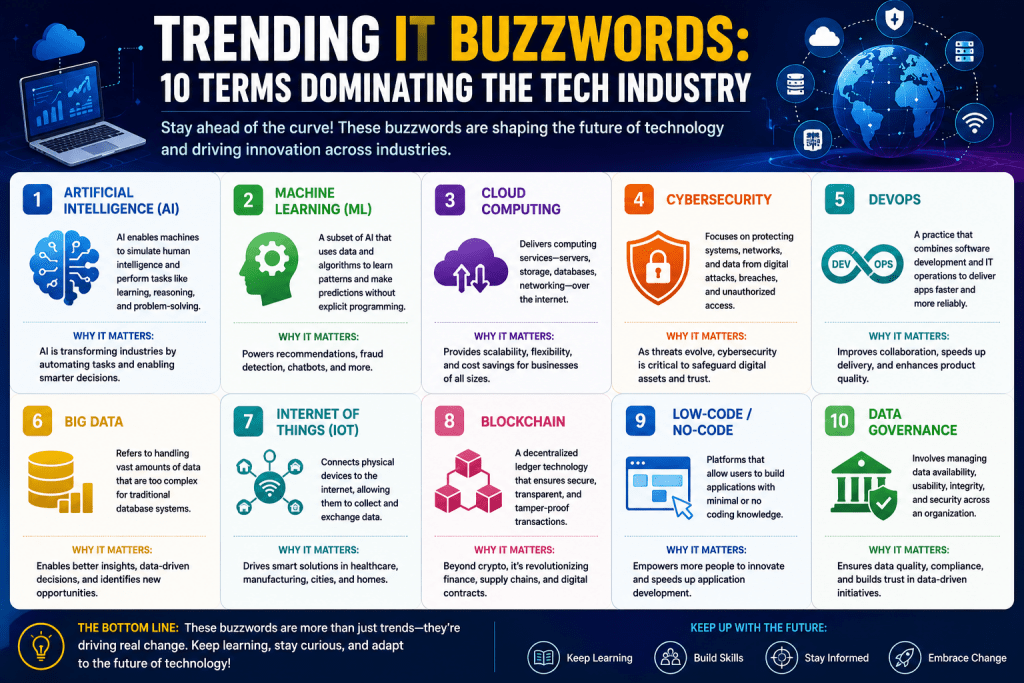
IT buzzwords often sit in a strange position within the technology landscape. They help professionals and organizations talk about emerging trends, evolving architectures, and new capabilities, yet they are also frequently stretched beyond their original meaning. In many cases, a buzzword becomes more of a marketing label than a precise technical term. For IT professionals, this creates a challenge: separating meaningful innovation from exaggerated claims. Understanding these concepts in practical terms is essential to making informed decisions about technology adoption and career development. The following sections explore several influential IT buzzwords and what they actually represent in real-world environments.
5G
5G refers to the fifth generation of cellular network technology, designed to significantly improve speed, latency, and connectivity compared to previous generations. Its primary promise is not just faster mobile internet but the ability to support entirely new categories of applications. These include autonomous systems, augmented reality environments, real-time remote control systems, and large-scale Internet-connected devices. Unlike earlier mobile standards, 5G is built to handle a massive increase in connected endpoints while maintaining performance stability. However, real-world deployment varies widely depending on infrastructure readiness and geographic coverage. While marketing often emphasizes theoretical peak speeds, practical performance depends heavily on network density and spectrum allocation. Over time, as infrastructure expands, 5G is expected to play a foundational role in enabling more responsive and interconnected digital ecosystems.
DevOps
DevOps represents a cultural and operational approach that integrates software development and IT operations into a unified workflow. Rather than treating development and deployment as separate stages handled by different teams, DevOps emphasizes collaboration, automation, and continuous delivery. This approach is designed to shorten development cycles while improving system reliability. Key practices include infrastructure automation, continuous integration, and continuous deployment pipelines. DevOps also encourages shared responsibility for system performance, reducing traditional silos between developers and operations teams. While sometimes used as a job title, DevOps is more accurately described as a methodology rather than a specific role. Its value lies in improving speed and efficiency in software delivery while maintaining stability in production environments.
Cloud Native
Cloud native refers to designing and building applications specifically to operate within cloud environments rather than adapting legacy systems to the cloud. This approach focuses on modular architecture, scalability, and resilience. Applications built in a cloud-native way often rely on microservices, containerization, and dynamic orchestration systems. Instead of running as a single monolithic application, functionality is broken into smaller services that can be independently deployed and scaled. This allows systems to respond more efficiently to changes in demand and reduces the impact of individual component failures. Cloud native design also encourages automation in deployment and management processes, enabling more flexible and responsive infrastructure.
Cloud Computing
Cloud computing describes the delivery of computing resources such as storage, processing power, and software services over a network rather than relying on local infrastructure. It has fundamentally changed how organizations manage IT systems by shifting from capital-intensive hardware ownership to on-demand resource consumption. This model enables scalability, allowing systems to expand or contract based on workload requirements. It also reduces the need for physical infrastructure maintenance. Cloud services are commonly categorized into different service models, including infrastructure, platforms, and software delivered as services. Despite its advantages, cloud adoption requires careful consideration of cost management, data governance, and security responsibilities. In many environments, hybrid approaches combining cloud and on-premises systems are used to balance flexibility and control.
SDN (Software-Defined Networking)
Software-Defined Networking is an approach to network management that separates the control plane from the data plane. In traditional networking, control functions are embedded within individual hardware devices, making configuration and troubleshooting more complex. SDN centralizes control through software-based systems, allowing administrators to manage network behavior programmatically. This improves flexibility and reduces manual configuration effort. Networks can be adjusted dynamically based on traffic conditions or policy changes without physically modifying hardware components. SDN also enhances visibility across the network, making it easier to monitor performance and identify issues. It is commonly used in large-scale data centers and cloud environments where adaptability and automation are critical.
IoT (Internet of Things)
The Internet of Things refers to the growing network of physical devices that are connected to the internet and capable of collecting and exchanging data. These devices range from consumer products like smart home appliances to industrial sensors used in manufacturing and infrastructure management. IoT systems enable real-time monitoring and data-driven decision-making across a wide range of industries. One of the key benefits of IoT is its ability to improve efficiency through automation and predictive analytics. However, it also introduces significant challenges related to security, privacy, and data management. As the number of connected devices increases, ensuring secure communication and proper data handling becomes increasingly important. IoT continues to expand as more devices gain embedded computing and networking capabilities.
Artificial Intelligence
Artificial Intelligence involves systems designed to perform tasks that typically require human intelligence, such as pattern recognition, decision-making, and language processing. Modern AI systems often rely on machine learning techniques, where models are trained on large datasets to identify patterns and make predictions. AI is widely used in areas such as fraud detection, recommendation systems, medical diagnostics, and autonomous systems. Unlike popular portrayals of general intelligence, most practical AI systems today are specialized and focused on narrow tasks. The strength of AI lies in its ability to analyze large volumes of data more quickly and consistently than human operators. As data availability increases, AI systems continue to improve in accuracy and usefulness across various domains.
VDI (Virtual Desktop Infrastructure)
Virtual Desktop Infrastructure is a model where desktop environments are hosted on centralized servers rather than individual physical machines. Users access these environments remotely through endpoint devices, which can have minimal processing power. This approach simplifies device management and improves consistency across user environments. IT teams can update, secure, and manage desktops from a central location rather than configuring each device individually. VDI also supports remote work scenarios by allowing users to access their full desktop environment from different locations. In addition, it can enhance security by keeping sensitive data stored centrally rather than on local devices. However, performance depends heavily on network reliability and server capacity.
Wi-Fi 6
Wi-Fi 6 is a wireless networking standard designed to improve efficiency, capacity, and performance in environments with many connected devices. It introduces enhancements that allow better handling of simultaneous connections, reduced latency, and improved throughput compared to previous Wi-Fi standards. This makes it particularly useful in high-density environments such as offices, public venues, and smart homes. Wi-Fi 6 also improves power efficiency for connected devices, extending battery life in mobile and IoT devices. While theoretical speeds are significantly higher than earlier standards, real-world performance depends on factors such as internet service capacity and network congestion. The primary benefit of Wi-Fi 6 is not just speed but improved stability and consistency in crowded network conditions.
Conclusion
IT buzzwords reflect the rapid evolution of technology, but they also highlight the importance of critical understanding in a fast-changing industry. While terms like 5G, DevOps, cloud native, and artificial intelligence represent genuine technological progress, they are often simplified or overstated in broader discussions. For professionals working in technology, the key is to look beyond the terminology and focus on the underlying principles, architectures, and real-world applications. Each of these concepts represents a shift in how systems are built, deployed, and managed, but their true value emerges only when applied thoughtfully within appropriate contexts.