
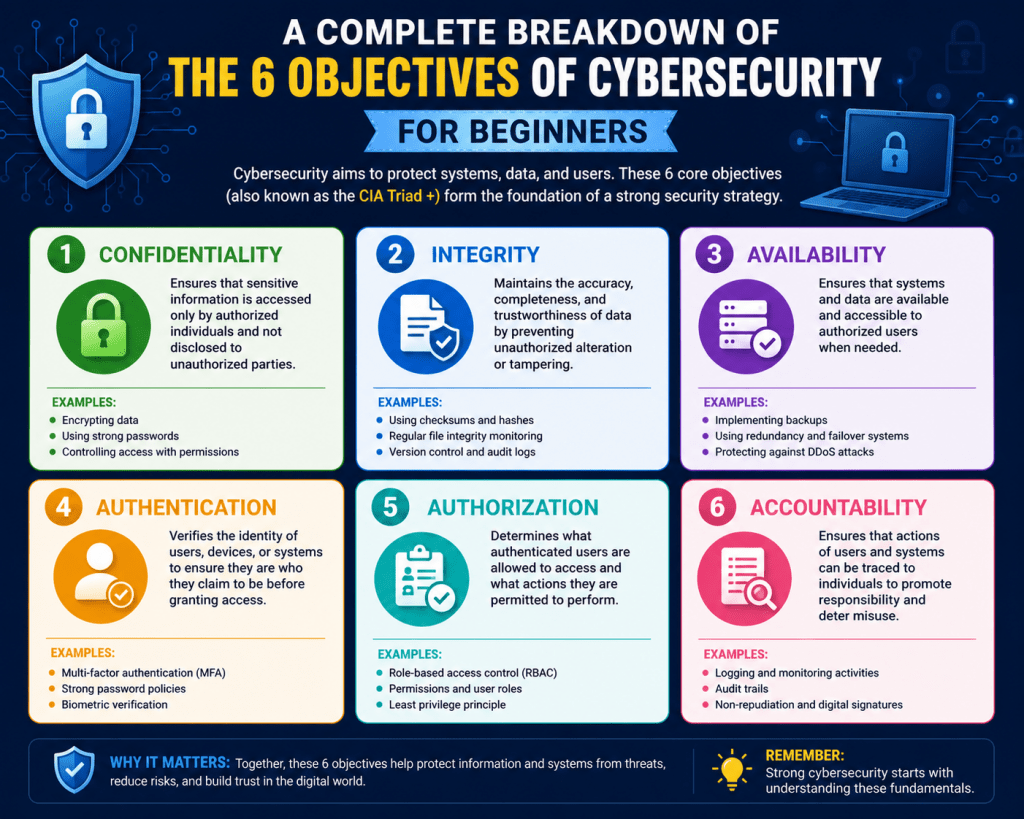
Modern society depends heavily on digital infrastructure that supports communication systems, financial networks, healthcare platforms, industrial operations, and personal services. As this dependency grows, so does the exposure to cyber threats that target weaknesses in software, hardware, and human behavior. Cybersecurity has therefore evolved into a foundational discipline that ensures the protection, stability, and trustworthiness of digital environments. At its core, cybersecurity is not defined by a single tool or technology but by a structured set of objectives that guide how protection mechanisms are designed and implemented. These objectives establish the principles that define what needs to be protected, why it must be protected, and how protection should be achieved.
Understanding cybersecurity objectives is essential because they act as the blueprint for all security decisions. Whether an organization is deploying firewalls, implementing encryption, or training employees, every action aligns with one or more of these fundamental goals. Without a clear understanding of these objectives, security strategies become fragmented and reactive rather than proactive and resilient. The six primary objectives of cybersecurity work together to ensure confidentiality, integrity, availability, trust, compliance, and operational stability across digital ecosystems. Each objective addresses a specific dimension of protection, yet all are interconnected within a unified security framework.
Protecting Critical Assets as the Core Security Priority
Critical assets represent the most valuable components within any digital or organizational environment. These include data repositories, IT infrastructure, communication systems, intellectual property, business applications, and operational technologies that support essential services. The loss or compromise of these assets can severely disrupt business continuity, damage reputation, and result in significant financial and legal consequences.
The protection of critical assets begins with asset identification and classification. Organizations must first determine which systems, applications, and data sets are most valuable and most vulnerable. Not all assets carry the same level of importance, so prioritization is necessary to allocate security resources effectively. High-value assets typically include customer databases, authentication systems, financial processing platforms, and proprietary research data.
Once identified, these assets must be protected through a combination of technical, administrative, and physical controls. Technical controls include mechanisms such as firewalls, intrusion detection systems, endpoint protection software, and network segmentation. These tools help create barriers that prevent unauthorized access and detect suspicious activity in real time. Administrative controls involve policies and procedures that define how systems should be used and managed, while physical controls restrict access to hardware and data centers.
Access control plays a central role in protecting critical assets. It ensures that only authorized individuals can access specific systems or data based on their roles and responsibilities. Authentication methods such as passwords, biometrics, and multi-factor authentication strengthen identity verification processes. Authorization mechanisms further restrict what authenticated users are allowed to do within a system, reducing the risk of insider threats and accidental misuse.
Encryption is another essential layer of protection. By converting readable data into encrypted formats, organizations ensure that even if data is intercepted or stolen, it remains unusable without the appropriate decryption keys. Encryption is applied both to data at rest, such as stored files and databases, and data in transit, such as network communications. This dual-layer protection significantly reduces the risk of data exposure during breaches or interceptions.
Regular system updates and patch management are also crucial for safeguarding critical assets. Cyber attackers often exploit known vulnerabilities in outdated systems. By consistently updating software and applying security patches, organizations close these vulnerabilities before they can be exploited. This proactive approach helps maintain a strong defensive posture against evolving attack techniques.
Monitoring systems and continuous auditing further enhance asset protection. Security teams must constantly observe system behavior to detect anomalies that may indicate malicious activity. Logging mechanisms record system events, enabling forensic analysis in case of incidents. These practices ensure that threats are identified early and addressed before causing significant damage.
Disaster recovery planning is another vital component of asset protection. Despite strong preventive measures, no system is entirely immune to attacks or failures. A well-designed recovery plan ensures that critical systems can be restored quickly after disruptions. This includes maintaining secure backups, defining recovery time objectives, and regularly testing recovery procedures to ensure effectiveness.
Ensuring Privacy and Protection of Sensitive Customer Data
Customer data is one of the most sensitive and valuable types of information handled by modern organizations. It includes personal identifiers, financial records, behavioral data, and communication histories. The misuse or exposure of this data can lead to identity theft, financial fraud, reputational damage, and legal penalties. As a result, protecting customer privacy is a central objective of cybersecurity.
Data privacy focuses on ensuring that personal information is collected, stored, processed, and shared securely and ethically. Organizations must establish clear policies that define how data is handled throughout its lifecycle. These policies should address data minimization, retention periods, access restrictions, and secure disposal methods.
Encryption is a fundamental mechanism used to protect customer data. By encrypting sensitive information, organizations ensure that unauthorized parties cannot interpret or exploit it even if they gain access. Encryption is particularly important for protecting financial transactions, identity documents, and confidential communications. Strong encryption standards significantly reduce the risk of data breaches resulting in usable information leaks.
Secure storage practices are equally important. Customer data must be stored in environments that are protected against unauthorized access, both externally and internally. This includes secure servers, cloud security configurations, and access-controlled databases. Regular security audits help identify vulnerabilities in storage systems and ensure compliance with security policies.
The principle of least privilege is essential in maintaining data privacy. It ensures that users only have access to the data necessary for their job functions. By limiting access rights, organizations reduce the risk of accidental exposure and malicious misuse. This principle also enhances accountability, as user activities can be tracked more effectively.
Transparency is another critical element of data privacy. Organizations must clearly communicate how customer data is collected and used. This includes explaining data usage purposes, sharing policies, and retention practices. Transparency builds trust and ensures that customers are aware of how their information is being handled.
Monitoring systems play a key role in protecting customer data. Continuous surveillance of data access patterns helps detect unusual behavior that may indicate unauthorized access attempts. Early detection allows security teams to respond quickly and minimize potential damage. Incident response procedures ensure that breaches are contained and resolved efficiently.
Regulatory compliance is closely tied to data privacy. Many industries are governed by strict regulations that define how personal data must be handled. Organizations must align their practices with these requirements to avoid penalties and maintain credibility. However, compliance alone is not sufficient; it must be complemented by strong internal security practices that go beyond minimum requirements.
The importance of protecting customer data extends beyond technical safeguards. It reflects an organization’s commitment to ethical responsibility and trustworthiness. In an increasingly data-driven world, maintaining privacy is essential for sustaining long-term relationships with customers and stakeholders.
The Relationship Between Asset Protection and Data Privacy
Although protecting critical assets and safeguarding customer data are distinct objectives, they are deeply interconnected. Critical assets often include the systems that store and process customer data, meaning that any compromise of these systems directly affects data privacy.
For example, if a database server is breached, both infrastructure integrity and customer information are exposed. Similarly, vulnerabilities in application systems can allow attackers to access sensitive data during processing. This interdependence highlights the importance of adopting a holistic cybersecurity strategy rather than treating objectives in isolation.
Integrated security frameworks ensure that asset protection and data privacy are addressed simultaneously. This involves aligning security policies, implementing unified monitoring systems, and ensuring consistent application of controls across all infrastructure components. By doing so, organizations reduce security gaps and improve overall resilience.
Establishing the Foundation for Broader Cybersecurity Objectives
The objectives discussed here form the foundational layer of cybersecurity strategy. Protecting critical assets and ensuring data privacy are essential prerequisites for achieving higher-level goals such as operational continuity, regulatory compliance, and organizational trust.
A strong foundation enables organizations to respond effectively to emerging threats and adapt to evolving technological landscapes. As cyber risks continue to increase in sophistication and frequency, these foundational objectives become even more critical. They provide the structure needed to build resilient systems capable of withstanding modern attack vectors.
Organizations that prioritize these core objectives develop stronger security postures, reduce risk exposure, and enhance their ability to maintain trust in digital environments. This foundation supports the next stages of cybersecurity objectives, which further expand on operational stability, trust assurance, compliance adherence, and workforce productivity.
Minimizing Operational Disruption in Cybersecurity Environments
Modern organizations rely heavily on uninterrupted digital operations to maintain productivity, deliver services, and support communication. Any disruption to these systems—whether caused by cyberattacks, system failures, or misconfigurations—can have widespread consequences. These consequences often include financial losses, reputational damage, regulatory penalties, and reduced customer trust. One of the central objectives of cybersecurity is therefore to minimize disruption to ongoing operations and ensure that systems remain available and functional even under adverse conditions.
Operational continuity depends on the ability of systems to resist, withstand, and recover from cyber incidents. Cyber threats such as ransomware, distributed denial-of-service (DDoS) attacks, malware infections, and insider threats can all interrupt business processes. These threats are becoming increasingly sophisticated, often targeting critical infrastructure and exploiting weaknesses in system design or human behavior. Minimizing disruption requires a combination of preventive, detective, and corrective security controls that work together to maintain system stability.
Preventive controls focus on stopping incidents before they occur. These include firewalls, intrusion prevention systems, endpoint protection mechanisms, and secure configuration standards. By blocking unauthorized access and filtering malicious traffic, these controls reduce the likelihood of operational interruptions. However, prevention alone is not sufficient, as no system is entirely immune to attacks.
Detective controls are equally important in minimizing disruption. These systems monitor network and system activity to identify anomalies that may indicate an ongoing attack. Intrusion detection systems, security information and event management tools, and log analysis systems all contribute to early threat detection. Early identification allows security teams to respond quickly, limiting the impact of potential disruptions.
Corrective controls focus on restoring systems after an incident occurs. These include backup systems, recovery protocols, and system restoration procedures. Regular backups ensure that data can be recovered in the event of corruption or loss, while structured recovery plans define the steps needed to bring systems back online efficiently. The speed and effectiveness of recovery directly influence the level of disruption experienced by an organization.
Incident response planning is a critical component of operational resilience. A well-defined incident response strategy outlines roles, responsibilities, communication channels, and procedural steps to be followed during a cybersecurity event. This structured approach ensures that responses are coordinated and efficient, reducing confusion and minimizing downtime. Incident response teams are trained to identify, contain, eradicate, and systematically recover from security incidents.
Redundancy and system resilience also play a major role in minimizing disruption. Redundant systems ensure that if one component fails, another can immediately take over its functions. This includes redundant servers, backup power supplies, and alternative network paths. High-availability architectures are designed specifically to ensure continuous operation even when individual components fail.
Disaster recovery planning is another essential element of operational continuity. Disaster recovery strategies define how systems and data will be restored after major disruptions such as cyberattacks, hardware failures, or natural disasters. These plans include backup strategies, data replication methods, and recovery time objectives that define acceptable downtime limits. Regular testing of disaster recovery plans ensures that they remain effective and up to date.
Business continuity planning extends beyond technical recovery and includes organizational processes. It ensures that essential functions can continue even when primary systems are unavailable. This may involve alternative workflows, manual processes, or temporary system replacements. The goal is to maintain essential operations under all conditions.
Minimizing operational disruption is not solely a technical challenge but also an organizational one. It requires coordination between IT teams, management, and operational staff. Clear communication, predefined procedures, and regular training are essential to ensure that all stakeholders can respond effectively during incidents.
Ultimately, reducing disruption ensures that organizations can maintain productivity, meet customer expectations, and uphold service reliability even in the face of evolving cyber threats.
Establishing External Trust Through Cybersecurity Assurance
Trust is a fundamental component of digital interactions. Customers, partners, regulators, and stakeholders all rely on the assurance that organizations will protect sensitive information and maintain secure systems. One of the key objectives of cybersecurity is to demonstrate trust externally by proving that adequate security measures are in place and consistently enforced.
Trust is not established through claims alone but through verifiable actions, certifications, transparency, and consistent behavior. Organizations must demonstrate that they follow recognized security standards and implement best practices to protect data and systems. External trust is especially important in industries that handle sensitive information such as finance, healthcare, and government services.
Security certifications play an important role in establishing trust. These certifications are awarded based on adherence to established security frameworks and standards. They indicate that an organization has undergone rigorous evaluation and meets specific security requirements. While certifications do not guarantee complete security, they provide external validation of an organization’s commitment to protecting information.
Transparency is another critical factor in building external trust. Organizations must clearly communicate their security policies, data handling practices, and incident response procedures. Transparency ensures that customers and stakeholders understand how their information is managed and protected. It also demonstrates accountability and openness in security practices.
Regular security audits contribute significantly to trust-building. Independent assessments of security systems help verify that controls are functioning as intended. These audits identify vulnerabilities, assess risk levels, and provide recommendations for improvement. By conducting regular audits, organizations show that they are committed to continuous improvement in security practices.
Incident disclosure is also an important aspect of trust. In the event of a security breach, organizations must communicate transparently about the nature of the incident, the data affected, and the steps taken to mitigate damage. Prompt and honest communication helps maintain trust even in difficult situations.
Vendor and third-party management is another important consideration. Many organizations rely on external service providers for various functions. Ensuring that these partners follow strong security practices is essential for maintaining overall trust. Third-party risk assessments help evaluate the security posture of external entities and ensure alignment with organizational standards.
Trust is also reinforced through consistent security behavior over time. Organizations that consistently demonstrate strong security practices build long-term credibility. This includes maintaining secure systems, responding effectively to incidents, and continuously improving security measures.
External trust is not static; it evolves based on organizational behavior, industry trends, and emerging threats. Maintaining trust requires ongoing effort, adaptability, and commitment to security excellence.
Maintaining Compliance with Regulatory and Legal Frameworks
Compliance is a critical objective of cybersecurity that ensures organizations adhere to laws, regulations, and industry standards governing data protection and information security. Regulatory frameworks are designed to protect individuals, organizations, and systems from misuse, fraud, and security breaches. Compliance is not optional; it is a legal requirement in many jurisdictions and industries.
Regulations vary depending on geography, industry, and the type of data handled. These regulations define how organizations must collect, store, process, and share information. They also establish requirements for security controls, reporting procedures, and data protection measures. Failure to comply with these regulations can result in financial penalties, legal action, and reputational damage.
Maintaining compliance requires a structured approach to security governance. Organizations must implement policies that align with regulatory requirements and ensure that all systems and processes adhere to these policies. This includes defining roles and responsibilities, establishing access controls, and implementing data protection mechanisms.
Regular audits are essential for maintaining compliance. These audits evaluate whether organizational practices align with regulatory standards. They help identify gaps in compliance and provide recommendations for corrective actions. Continuous monitoring ensures that compliance is maintained over time rather than achieved as a one-time effort.
Documentation plays a crucial role in compliance management. Organizations must maintain detailed records of security policies, procedures, incidents, and control implementations. Proper documentation provides evidence of compliance and supports audit processes. It also helps ensure consistency in security practices across the organization.
Training and awareness programs are also important for compliance. Employees must understand regulatory requirements and how they apply to their roles. Regular training ensures that staff members are aware of their responsibilities in maintaining compliance and following security policies.
Compliance is closely linked to risk management. Organizations must identify risks associated with non-compliance and implement controls to mitigate these risks. This includes technical controls, administrative controls, and operational procedures designed to ensure adherence to regulations.
As regulations evolve, organizations must continuously update their security practices. Staying informed about regulatory changes is essential to ensure ongoing compliance. This requires proactive monitoring of legal developments and timely adjustments to security frameworks.
Ensuring Workforce Productivity Through Secure Systems
Cybersecurity also plays a direct role in maintaining workforce productivity. Secure systems enable employees to perform their tasks efficiently without interruption, while insecure systems can lead to downtime, data loss, and operational inefficiencies. One of the objectives of cybersecurity is, therefore, to ensure that security measures support rather than hinder productivity.
Cyber threats such as malware, phishing attacks, and system breaches can significantly disrupt employee workflows. These disruptions reduce efficiency, delay projects, and increase operational costs. By implementing strong security controls, organizations reduce the likelihood of such disruptions and create a stable working environment.
Endpoint protection is a key factor in maintaining productivity. Devices such as laptops, desktops, and mobile devices must be protected against malware and unauthorized access. Security software, device encryption, and secure configuration settings help ensure that endpoints remain safe and functional.
Network security also contributes to productivity by ensuring reliable access to resources. Secure network architectures prevent unauthorized access and reduce the risk of network congestion caused by malicious activity. This ensures that employees can access applications and data without delays.
Authentication systems must be designed to balance security with usability. While strong authentication is essential for protecting systems, overly complex authentication processes can hinder productivity. Multi-factor authentication and single sign-on solutions help achieve this balance by enhancing security while maintaining ease of access.
Security awareness training contributes to productivity by reducing the likelihood of human error. Employees who understand cybersecurity risks are less likely to fall victim to phishing attacks or other social engineering techniques. This reduces disruptions caused by security incidents.
Automation also plays a role in maintaining productivity. Automated security processes such as patch management, threat detection, and system monitoring reduce the workload on employees and security teams. This allows staff to focus on core tasks rather than manual security operations.
Ultimately, cybersecurity ensures that employees can work in a secure, stable, and efficient environment. By reducing disruptions and protecting systems, cybersecurity directly supports organizational productivity and performance.
Strengthening the Workforce Through Secure Operational Environments
A productive workforce is one of the most valuable assets in any organization, and cybersecurity plays a direct role in enabling that productivity. As digital systems become more deeply embedded in daily operations, employees rely heavily on secure and stable access to applications, data, and communication tools. One of the key cybersecurity objectives is to ensure that security controls do not hinder but rather support workforce efficiency while protecting organizational resources from threats.
Insecure systems create disruptions that significantly reduce employee productivity. Cyber incidents such as malware infections, ransomware attacks, phishing attempts, and unauthorized access can interrupt workflows, lock users out of systems, and corrupt essential data. These disruptions not only affect individual performance but also cascade across teams and departments, delaying projects and impacting organizational outcomes.
A secure operational environment begins with endpoint protection. Every device connected to an organizational network represents a potential entry point for attackers. Laptops, desktops, mobile devices, and servers must all be protected through layered security controls. These include antivirus software, endpoint detection and response systems, device encryption, and secure configuration standards. By securing endpoints, organizations reduce the risk of compromise that could disrupt employee activities.
Network security is another critical factor in maintaining workforce productivity. Secure networks ensure that employees can access systems reliably without interference from malicious traffic or unauthorized users. Network segmentation, firewalls, intrusion prevention systems, and secure routing protocols help maintain stable and efficient communication channels. These controls prevent congestion, reduce attack surfaces, and ensure uninterrupted access to critical resources.
Authentication systems must balance security with usability. While strong authentication is necessary to protect systems, overly complex processes can slow down employees and reduce efficiency. Modern cybersecurity approaches use mechanisms such as single sign-on and adaptive authentication to streamline access while maintaining high security standards. This ensures that employees can quickly access the tools they need without compromising protection.
Security awareness training also contributes to workforce efficiency. Employees who understand cyber risks are less likely to fall victim to attacks such as phishing or social engineering. This reduces the likelihood of incidents that could disrupt workflows or compromise systems. Training programs help build a security-conscious culture where employees actively contribute to organizational protection.
Automation further enhances productivity in secure environments. Automated security tools handle repetitive tasks such as patch management, threat detection, and log analysis. This reduces the workload on IT teams and allows employees to focus on their core responsibilities. Automation also improves response times to threats, minimizing potential disruptions.
Ultimately, cybersecurity ensures that employees operate in an environment that is both secure and efficient. By minimizing disruptions and providing reliable access to systems, cybersecurity directly supports organizational performance and long-term success.
Maintaining Operational Integrity Through Controlled System Environments
Operational integrity refers to the ability of systems, processes, and data to remain accurate, consistent, and reliable over time. One of the fundamental objectives of cybersecurity is to ensure that digital environments maintain their integrity even in the presence of internal errors, external attacks, or system failures. Without operational integrity, organizations cannot trust their systems, and decision-making becomes unreliable.
Integrity in cybersecurity focuses on preventing unauthorized modification of data and systems. This includes ensuring that information remains accurate and consistent from creation to storage, processing, and transmission. Any unauthorized change—whether intentional or accidental—can have serious consequences for business operations, compliance, and decision-making processes.
Access control mechanisms play a central role in maintaining integrity. By restricting who can modify data and system configurations, organizations reduce the risk of unauthorized changes. Role-based access control ensures that users are only granted permissions necessary for their responsibilities, minimizing the potential for misuse or accidental corruption of data.
Hashing and data validation techniques are commonly used to verify integrity. Hash functions generate unique identifiers for data sets, allowing systems to detect whether any unauthorized changes have occurred. If even a small change is made to the data, the hash value changes significantly, signaling a potential integrity violation.
Audit logs are another essential component of maintaining operational integrity. These logs record all system activities, including user actions, system changes, and security events. By reviewing logs, organizations can trace modifications and identify unauthorized or suspicious activities. This level of transparency ensures accountability and supports forensic investigations when necessary.
Configuration management also contributes to maintaining system integrity. Proper configuration ensures that systems operate according to predefined standards and security policies. Misconfigurations are a common cause of vulnerabilities, making consistent configuration management essential for maintaining stable and secure environments.
Version control systems help maintain integrity in software environments. By tracking changes to code and system configurations, organizations can ensure that only approved modifications are implemented. This prevents unauthorized or unintended changes from affecting system behavior.
Integrity monitoring tools continuously analyze systems for unexpected changes. These tools alert administrators when critical files, configurations, or data sets are modified. Early detection of integrity violations allows for quick response and mitigation.
Operational integrity also depends on secure update mechanisms. Software updates must be verified and authenticated before installation to ensure they have not been tampered with. Secure update channels prevent attackers from injecting malicious code into systems through compromised updates.
Maintaining operational integrity ensures that organizations can trust their systems and data. Without integrity, decision-making becomes unreliable, and system outputs lose their value.
Building Resilience Against Evolving Cyber Threat Landscapes
Cyber threats are constantly evolving in complexity, scale, and sophistication. Attackers continuously develop new techniques to bypass security controls, exploit vulnerabilities, and disrupt systems. One of the core objectives of cybersecurity is to build resilience—the ability of systems to withstand, adapt to, and recover from cyberattacks.
Resilience is not limited to preventing attacks; it also involves ensuring that systems can continue functioning during and after an incident. This requires a combination of preventive, detective, and corrective controls that work together to maintain stability under adverse conditions.
Preventive measures reduce the likelihood of successful attacks. These include firewalls, secure system configurations, patch management, and access control mechanisms. By reducing vulnerabilities, organizations lower the probability of successful exploitation.
Detective measures focus on identifying threats as early as possible. Intrusion detection systems, security monitoring tools, and behavioral analytics help identify unusual patterns that may indicate an attack. Early detection is crucial for minimizing damage and enabling rapid response.
Corrective measures ensure that systems can recover after an incident. Backup systems, disaster recovery plans, and system restoration procedures allow organizations to restore normal operations quickly. The speed and effectiveness of recovery determine the level of disruption experienced.
Cyber resilience also involves adaptability. As new threats emerge, organizations must continuously update their security strategies. Static defenses quickly become obsolete in dynamic threat environments. Adaptive security models use real-time data and analytics to adjust defenses based on current risk levels.
Redundancy is another important aspect of resilience. Redundant systems ensure that if one component fails, another can immediately take over its function. This reduces downtime and ensures continuity of operations.
Incident response planning strengthens resilience by providing structured procedures for handling security events. Clear roles, communication channels, and response workflows ensure that incidents are managed efficiently and effectively.
Resilience is not just a technical concept but also an organizational mindset. It requires continuous improvement, proactive planning, and a commitment to learning from past incidents.
Ensuring Long-Term Sustainability of Secure Digital Ecosystems
Cybersecurity is not a one-time implementation but a continuous process aimed at ensuring the long-term sustainability of digital systems. As organizations grow and technology evolves, security frameworks must adapt to changing environments, emerging threats, and new operational requirements. One of the key objectives of cybersecurity is therefore to ensure the sustainability of secure systems over time.
Sustainability in cybersecurity involves maintaining security effectiveness while supporting organizational growth and technological advancement. Systems must be designed to scale without compromising security. This requires flexible architectures that can adapt to increased workloads, new applications, and evolving user demands.
Continuous monitoring is essential for sustainability. Security environments must be constantly observed to detect vulnerabilities, performance issues, and emerging threats. Monitoring tools provide real-time insights that allow organizations to make informed security decisions.
Regular updates and maintenance ensure that systems remain secure over time. As vulnerabilities are discovered, they must be addressed promptly through patches and configuration changes. Failure to maintain systems increases the risk of exploitation.
Security governance plays a crucial role in sustainability. Clear policies, standards, and procedures ensure consistency in security practices across the organization. Governance frameworks help align security objectives with business goals.
Training and awareness programs contribute to long-term sustainability by ensuring that employees remain informed about evolving threats and best practices. As technology changes, continuous education helps maintain a strong security culture.
Sustainability also depends on resource management. Organizations must allocate sufficient resources to maintain security infrastructure, update systems, and respond to incidents. Without proper investment, security measures can degrade over time.
Finally, sustainability requires continuous improvement. Security strategies must evolve based on lessons learned, technological advancements, and changes in the threat landscape. This ensures that cybersecurity remains effective in the long term.
Integrating All Cybersecurity Objectives into a Unified Framework
The six objectives of cybersecurity are not independent elements but interconnected components of a unified security framework. Protecting critical assets, safeguarding data privacy, minimizing disruption, ensuring trust, maintaining compliance, and supporting productivity all work together to create a comprehensive defense strategy.
When these objectives are implemented cohesively, organizations achieve a balanced security posture that addresses technical, operational, and organizational needs. This integrated approach ensures that no single area is neglected and that all aspects of security reinforce each other.
For example, protecting critical assets supports data privacy, while maintaining compliance reinforces trust. Minimizing disruption enhances productivity, and resilience ensures long-term stability. Each objective contributes to the overall strength of the cybersecurity framework.
A fragmented approach to cybersecurity leads to gaps in protection and increased vulnerability. In contrast, a unified approach ensures consistency, efficiency, and adaptability. Organizations that align all cybersecurity objectives into a cohesive strategy are better equipped to handle evolving threats and maintain secure operations.
Final Integration of Cybersecurity Objectives in Modern Digital Systems
As digital transformation continues to accelerate, cybersecurity becomes increasingly central to organizational success. The six objectives provide a structured framework for understanding and implementing effective security practices. They ensure that systems remain protected, reliable, and trustworthy in an increasingly complex threat environment.
These objectives are not static concepts but dynamic principles that evolve with technology and threats. Organizations must continuously reassess and refine their security strategies to ensure alignment with these objectives. This ongoing process is essential for maintaining resilience, trust, and operational effectiveness.
Cybersecurity is ultimately about balance—balancing protection with usability, security with productivity, and control with flexibility. The six objectives provide the foundation for achieving this balance in a structured and sustainable way.
Conclusion
Cybersecurity is fundamentally about ensuring that digital systems remain trustworthy, stable, and resilient in an environment where threats are constantly evolving. Across all six objectives—protecting critical assets, safeguarding data privacy, minimizing operational disruption, demonstrating external trust, maintaining regulatory compliance, and supporting workforce productivity—the underlying principle is the same: reducing risk while preserving functionality. These objectives are not isolated goals but interconnected layers of a broader defensive strategy that shapes how modern organizations operate in digital ecosystems.
At the center of cybersecurity lies the protection of critical assets. These assets are the foundation of any organization’s operations, whether they are databases, applications, intellectual property, or infrastructure systems. If these components are compromised, the entire structure of an organization becomes vulnerable. This is why asset protection is not simply a technical task but a strategic priority. It requires continuous identification, classification, and reinforcement of systems that are essential for operational continuity. The importance of this objective becomes even more apparent when considering that attackers rarely target systems randomly; they focus on high-value assets where the impact of disruption is greatest.
Closely connected to asset protection is the safeguarding of customer data. In today’s digital economy, data is often considered more valuable than physical resources. Personal information, financial records, and behavioral data are frequently targeted by attackers due to their potential for exploitation. Protecting this data is not only a technical responsibility but also an ethical obligation. Organizations are expected to handle information transparently and responsibly, ensuring that individuals retain control over how their data is used. Failure to protect privacy can lead to long-term consequences, including loss of trust, legal action, and irreversible reputational damage.
Operational disruption is another critical concern in cybersecurity. Even the most secure systems can be rendered ineffective if they are unable to function reliably under attack or during system failures. Cyber incidents such as ransomware attacks or distributed denial-of-service attempts highlight how quickly operations can be disrupted when defenses are insufficient. The objective of minimizing disruption emphasizes the importance of resilience, redundancy, and recovery planning. It is not enough to prevent attacks; organizations must also ensure that they can continue operating during and after incidents. This shift in perspective—from prevention alone to continuity under stress—represents a core evolution in modern cybersecurity thinking.
External trust plays a significant role in how organizations are perceived in a connected world. Stakeholders, customers, and partners expect assurance that their interactions with digital systems are secure. Trust is built through consistent behavior, transparent communication, and adherence to recognized security standards. When organizations demonstrate that they take security seriously, they establish credibility that extends beyond technical systems into business relationships. Conversely, even a single breach can significantly damage trust, sometimes more than the direct financial impact of the incident itself. This makes trust not just a reputational concern but a strategic asset that must be actively maintained.
Compliance with regulations adds another layer of structure to cybersecurity practices. Legal and regulatory frameworks exist to enforce minimum standards for data protection and system security. While compliance alone does not guarantee complete security, it ensures that organizations meet baseline expectations for protecting sensitive information. These frameworks also create accountability, requiring organizations to document, monitor, and improve their security practices continuously. However, effective cybersecurity goes beyond compliance. Organizations that treat regulations as the endpoint of their security strategy often remain vulnerable, while those that view compliance as a foundation tend to develop stronger, more adaptive defenses.
Workforce productivity is often overlooked as a cybersecurity objective, yet it is deeply affected by security practices. A secure environment enables employees to perform their tasks without interruption, while insecure systems create constant disruptions that reduce efficiency. The challenge lies in balancing strong security controls with usability. If systems are overly restrictive, they can slow down workflows and create frustration. If they are too relaxed, they expose the organization to unnecessary risk. Achieving this balance requires thoughtful design of authentication systems, access controls, and security policies that support rather than hinder daily operations. In this way, cybersecurity becomes an enabler of productivity rather than a barrier to it.
When viewed together, these objectives form a comprehensive framework that supports the overall health of digital systems. Each objective reinforces the others. Protecting assets supports data privacy. Maintaining compliance strengthens trust. Minimizing disruption enhances productivity. This interconnected structure ensures that cybersecurity is not fragmented but unified in purpose. It also reflects the reality that modern threats do not target isolated components—they exploit weaknesses across systems, processes, and human behavior simultaneously.
Another important aspect of cybersecurity is its dynamic nature. Threat landscapes are not static; they evolve continuously as attackers develop new methods and technologies advance. This means that cybersecurity objectives must also be adaptable. Strategies that are effective today may become insufficient tomorrow. Organizations must therefore adopt a mindset of continuous improvement, regularly updating their defenses, policies, and response mechanisms. This adaptability is what separates resilient organizations from those that struggle to recover after incidents.
Ultimately, cybersecurity is not just about technology but about trust, responsibility, and continuity. It ensures that digital systems can be used safely and reliably in an increasingly interconnected world. The six objectives provide a structured way to understand and implement this protection, but their real value lies in how they are applied in practice. Organizations that integrate these objectives into their culture and operations are better equipped to handle uncertainty, respond to threats, and maintain stability in the face of disruption.
As digital transformation continues to expand across industries and societies, the importance of these cybersecurity objectives will only increase. They form the foundation of secure digital interaction and enable the continued growth of technology-driven systems. Without them, the reliability of digital infrastructure would be compromised, and trust in technology would erode. With them, organizations can operate confidently, innovate securely, and maintain resilience in an ever-changing cyber landscape.