
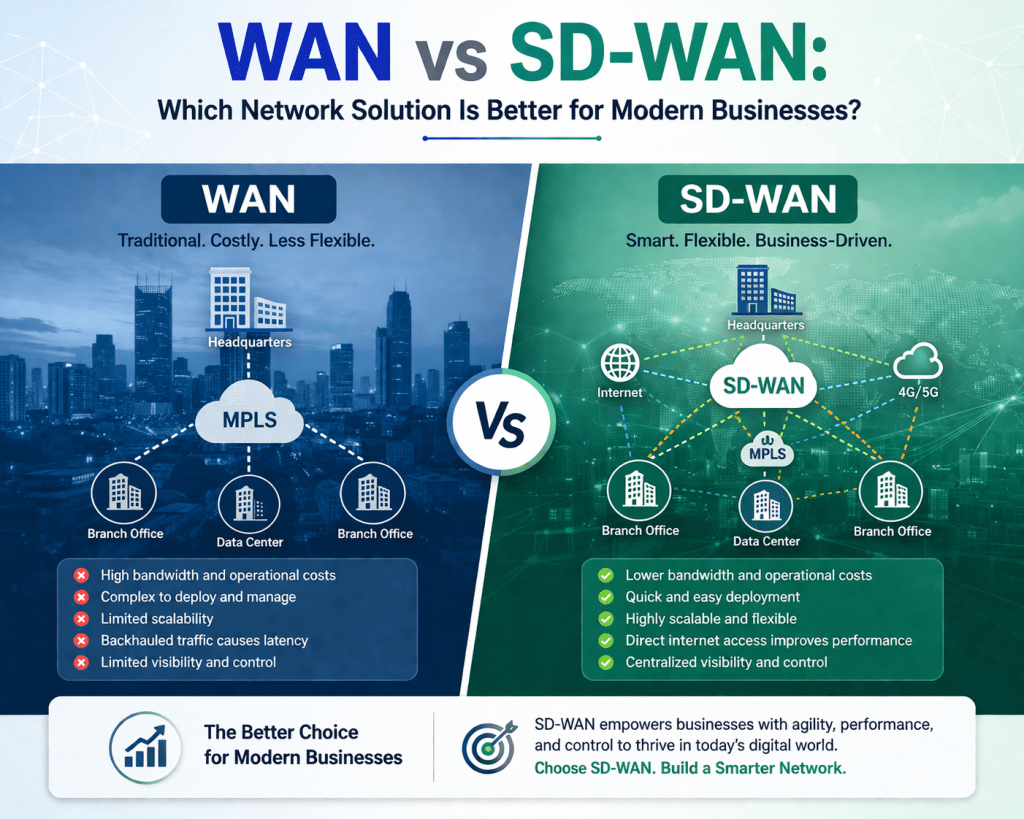
Wide Area Network technology has long served as the foundation for enterprise connectivity across geographically distributed environments. It enabled organizations to link branch offices, data centers, and remote infrastructure over large distances using carrier-provided transport. For many years, this model remained the default architecture for corporate networking because it provided predictable routing paths and centralized control over traffic flow. However, as application delivery models shifted toward cloud computing, remote workforces expanded, and digital services became more latency sensitive, the traditional WAN model began to reveal structural limitations. Software-defined wide-area network technology emerged as a response to these evolving demands, introducing policy-driven routing and cloud-aware traffic optimization that fundamentally changes how enterprise connectivity is managed. The transition from hardware-centric WAN architectures to software-controlled SD-WAN frameworks reflects a broader shift toward abstraction, automation, and centralized orchestration in modern networking.
Understanding Wide Area Network Architecture
A Wide Area Network represents a communication framework that connects multiple local networks across large geographical distances. Unlike a Local Area Network, which operates within a confined environment such as a single office or campus, WANs extend connectivity beyond local boundaries using service provider infrastructure. In practical terms, WANs allow branch locations to communicate with headquarters, data centers, or external systems by transmitting data across carrier-managed links. The internet itself can be viewed as the largest and most complex example of a public WAN, where millions of interconnected networks exchange data through standardized routing mechanisms. Within enterprise environments, WAN connectivity is often established using leased circuits or managed transport services that ensure consistent performance characteristics. These connections form the backbone of distributed business operations by enabling centralized applications, shared resources, and inter-site communication across regions and countries.
Private WAN Technologies and Operational Characteristics
Enterprise WAN implementations commonly rely on private connectivity solutions designed to deliver predictable performance and controlled routing behavior. These include technologies such as Multiprotocol Label Switching, dedicated point-to-point circuits, and virtual private transport services that simulate local network behavior across wide distances. The primary advantage of private WAN infrastructure lies in its ability to offer service-level guarantees for latency, jitter, and packet delivery, which are critical for applications requiring stable performance. Organizations often use these private links to centralize core infrastructure within data centers while ensuring that branch offices can securely access essential systems. In such architectures, all traffic is typically backhauled through centralized hubs where security inspection, routing decisions, and application access control are enforced. This centralized model simplifies governance by concentrating infrastructure management in a limited number of locations while maintaining consistent operational policies across the enterprise network.
Advantages Associated with Traditional WAN Deployments
Traditional WAN architectures provide several operational benefits that have made them widely adopted in enterprise environments. One of the most significant advantages is centralized resource management, where servers, storage systems, and application services are hosted in centralized data centers. This reduces the need for maintaining complex infrastructure at each branch location and allows organizations to streamline IT operations. Another advantage is the predictable performance offered by carrier-managed private circuits, which often include contractual performance guarantees. These guarantees help ensure that critical business applications maintain stable connectivity even under high traffic conditions. Security is also enhanced in traditional WAN setups because traffic can be routed through centralized inspection points where consistent security policies are enforced. Additionally, private WAN links offer a higher degree of isolation from public internet traffic, reducing exposure to external threats and improving data privacy for sensitive enterprise communications.
Limitations and Operational Challenges of WAN
Despite its reliability, traditional WAN architecture introduces several challenges that become more pronounced as enterprise environments scale and diversify. One of the primary limitations is cost, as private leased circuits and managed connectivity services often require significant financial investment. These costs increase further when organizations need to support high-bandwidth demands across multiple branch locations. Another challenge is the lack of flexibility in routing behavior, as traditional WANs typically rely on static configurations or manually maintained routing protocols. This makes it difficult to quickly adapt to changing network conditions or dynamically shift traffic based on application requirements. Additionally, WAN architectures often rely heavily on centralized data center infrastructure, which can lead to inefficient traffic patterns when users access cloud-based applications. In such cases, traffic may be forced to traverse long paths through central hubs before reaching cloud destinations, introducing latency and reducing application performance. Managing security across distributed WAN environments can also be complex, especially when all enforcement is concentrated at central points, requiring high-capacity hardware to inspect aggregated traffic from multiple locations.
Introduction to Software-Defined WAN Concepts
Software-defined wide-area network technology introduces a fundamentally different approach to enterprise connectivity by separating network control from underlying transport infrastructure. Instead of relying solely on fixed hardware configurations, SD-WAN uses centralized software-based controllers to dynamically manage traffic routing across multiple connection types. These may include private WAN links, broadband internet connections, and cellular networks, all operating as part of a unified transport layer. The key innovation in SD-WAN lies in its ability to apply business-driven policies to network traffic, allowing organizations to prioritize applications, optimize performance, and improve resilience without manually configuring each network device. By abstracting routing decisions away from individual hardware components, SD-WAN enables more adaptive and responsive network behavior that aligns with modern cloud-centric application architectures and distributed workforce requirements.
Software-Defined WAN Architecture and Operational Model
Software-defined wide-area network technology is built on a structural separation between control logic and data forwarding functions. This separation is fundamental to how modern enterprise connectivity is managed. In traditional WAN environments, routing intelligence is embedded within individual hardware devices deployed at branch offices or data centers. Each device independently handles configuration, routing decisions, and policy enforcement, which leads to complex management overhead as the network grows. SD-WAN changes this model by introducing a centralized control layer that defines routing behavior across all connected sites. This control layer communicates with distributed edge devices responsible for executing forwarding decisions based on centrally defined instructions.
The architecture typically consists of three functional components: centralized controllers, orchestration systems, and edge devices. Controllers manage routing logic and policy definitions. Orchestration systems handle deployment, monitoring, and configuration consistency. Edge devices at branch locations enforce policies and forward traffic across available transport links. This separation allows SD-WAN systems to scale efficiently across large environments without requiring manual configuration changes at every site.
Overlay Networking and Transport Abstraction
A defining feature of SD-WAN is its use of overlay networking. Instead of relying on a single physical path between locations, SD-WAN creates a logical network layer that operates independently of the underlying transport infrastructure. This overlay is built using encapsulation techniques, where application traffic is wrapped inside secure tunnels before being transmitted across different types of connectivity.
These underlying connections may include broadband internet, private MPLS circuits, LTE or 5G links, and other available transport mechanisms. The SD-WAN system treats all of these links as part of a unified resource pool. This abstraction allows traffic to move dynamically across multiple paths depending on real-time conditions and policy requirements. The key benefit of this model is flexibility, as organizations are no longer locked into a single type of connectivity or dependent on a single provider for all network traffic.
The overlay approach also simplifies network expansion. New branch locations can be connected using whatever transport is available, without redesigning the core network architecture. This makes SD-WAN particularly effective in environments where rapid deployment and scalability are critical operational requirements.
Dynamic Path Selection and Application Awareness
SD-WAN introduces intelligent traffic routing based on application-level awareness and real-time network telemetry. Instead of relying on static routing tables or manually configured paths, SD-WAN continuously evaluates the performance of available links. Metrics such as latency, jitter, packet loss, and available bandwidth are constantly monitored.
Based on this data, the system determines the optimal path for each type of application traffic. For example, real-time communication services such as voice or video conferencing require low latency and minimal jitter, so traffic is directed through the most stable and responsive link. On the other hand, non-critical services such as file transfers or software updates can be routed through lower-cost or higher-latency links without impacting user experience.
This level of application awareness is a major shift from traditional WAN routing, where all traffic is treated uniformly regardless of its importance or sensitivity. By differentiating traffic based on business priority, SD-WAN ensures that critical applications maintain consistent performance even during periods of network congestion.
Policy-Based Traffic Control Framework
A key operational advantage of SD-WAN is its policy-driven management model. Instead of configuring individual network devices, administrators define high-level policies that describe how traffic should be handled across the entire infrastructure. These policies are then distributed automatically to all edge devices.
Policies can define application priority, security requirements, routing preferences, and performance thresholds. Once implemented, they ensure consistent behavior across all locations without requiring manual intervention at each site. This significantly reduces operational complexity and minimizes configuration errors that are common in large-scale WAN deployments.
The policy-based model also improves agility. When business requirements change, administrators can modify a single policy rather than updating configurations across multiple devices. This allows network behavior to adapt quickly to evolving application demands, organizational growth, or changes in traffic patterns.
Integration with Cloud-Centric Infrastructure
Modern enterprise environments increasingly rely on cloud-based applications and services. Traditional WAN architectures were not designed to efficiently support direct cloud connectivity. In many cases, branch traffic is routed through centralized data centers before reaching cloud services. This indirect routing introduces additional latency and increases bandwidth consumption.
SD-WAN addresses this limitation by enabling direct cloud access from branch locations. Traffic destined for cloud applications can be routed directly through internet links or optimized paths without passing through central hubs. This significantly improves application performance and reduces unnecessary network load.
SD-WAN systems are also designed to support multiple cloud environments simultaneously. Organizations using hybrid or multi-cloud strategies benefit from consistent connectivity across different providers without requiring separate network configurations for each environment. This flexibility aligns closely with modern digital transformation strategies that prioritize distributed application architectures.
Security Integration and Network Protection Model
Security in SD-WAN environments is deeply integrated into the network architecture rather than being treated as a separate function. Edge devices typically include encryption capabilities that secure data in transit across all transport types. This ensures that sensitive information remains protected whether it is traveling over private circuits or public internet connections.
In addition to encryption, SD-WAN systems support segmentation, which allows organizations to isolate different types of traffic within the same network infrastructure. This reduces the risk of unauthorized lateral movement in case of a security breach and ensures that sensitive workloads remain protected from less critical traffic.
Many SD-WAN implementations also integrate with advanced security functions such as intrusion detection, application-level filtering, and threat intelligence systems. This convergence of networking and security simplifies infrastructure design by reducing the need for separate security appliances at every branch location. However, it also requires careful policy design to ensure consistent enforcement across all network paths.
Performance Visibility and Network Analytics
SD-WAN environments rely heavily on continuous monitoring and analytics to maintain optimal performance. Edge devices collect detailed information about network conditions, including link quality, application behavior, and traffic volume. This data is transmitted to centralized systems where it is analyzed in real time.
This visibility allows administrators to understand how applications are performing across the entire network. If performance degradation is detected, traffic can be automatically rerouted to alternative paths before users experience disruption. This proactive approach improves reliability and reduces downtime.
Advanced SD-WAN systems also use historical data analysis to identify long-term trends in network usage. This helps organizations plan capacity upgrades, optimize bandwidth allocation, and improve overall network efficiency. The combination of real-time monitoring and historical analysis creates a comprehensive view of network performance that was not possible in traditional WAN environments.
Deployment Approaches and Migration Strategies
Organizations adopt SD-WAN using different deployment models depending on their existing infrastructure and operational requirements. One approach involves a full replacement of traditional WAN routers with SD-WAN edge devices. This allows organizations to redesign their network architecture entirely around software-defined principles.
Another approach is incremental deployment, where SD-WAN is introduced alongside existing WAN infrastructure. In this model, both systems operate simultaneously during a transition period, allowing organizations to gradually migrate traffic to SD-WAN without disrupting existing operations. This reduces risk and provides flexibility during implementation.
Managed deployment models are also common, where external service providers deliver SD-WAN functionality as a fully managed service. This reduces internal operational burden and allows organizations to focus on application performance rather than network infrastructure management.
Hybrid deployments combine private WAN circuits with internet-based connectivity, providing a balance between performance, reliability,y and cost efficiency. This approach allows organizations to reserve high-performance private links for critical applications while using internet connections for general traffic.
Operational Efficiency and Resource Optimization
One of the most significant benefits of SD-WAN is improved operational efficiency. Centralized control and automation reduce the need for manual configuration at individual sites. This allows network teams to manage large-scale environments with fewer resources and less complexity.
Automation also reduces repetitive administrative tasks such as routing updates, configuration changes, and performance tuning. These tasks are handled dynamically by the SD-WAN system based on predefined policies and real-time conditions.
Cost optimization is another major advantage. By intelligently selecting between multiple transport types, SD-WAN reduces dependency on expensive private circuits. Less critical traffic can be routed over lower-cost internet connections, while high-priority traffic continues to use premium links. This balanced approach improves overall cost efficiency without compromising performance.
SD-WAN also improves scalability. As organizations expand, new sites can be added quickly using standardized configurations. This reduces deployment time and simplifies network growth, making it easier for businesses to scale operations across multiple regions.
Comparative Operational Behavior of WAN and SD-WAN Environments
The functional differences between traditional Wide Area Network architectures and Software Defined Wide Area Network systems become most visible when examining how each handles real-world traffic behavior under variable conditions. Traditional WAN systems operate on a relatively static framework where routing paths are predefined, and changes require manual intervention or complex configuration updates. This creates a predictable but rigid structure that prioritizes stability over adaptability. SD-WAN systems, in contrast, operate on a dynamic decision-making model that continuously evaluates network conditions and adjusts traffic flows in real time. This fundamental difference affects everything from application performance to cost efficiency and operational scalability.
In a traditional WAN model, traffic from branch offices is often directed through centralized data centers regardless of destination. This design simplifies security enforcement and control but introduces inefficiencies when users access cloud-based applications. SD-WAN eliminates this constraint by allowing traffic to take direct paths to cloud services or alternate destinations based on policy and performance metrics. This shift reduces unnecessary latency and improves application responsiveness, especially in distributed environments where cloud adoption is high.
Cost Structure Differences and Financial Implications
One of the most significant distinctions between WAN and SD-WAN lies in their cost structures. Traditional WAN deployments rely heavily on dedicated leased lines and private circuits, which are typically priced based on bandwidth and service-level guarantees. These connections are expensive due to the infrastructure requirements needed to maintain reliability, uptime, and consistent performance across long distances. As organizations scale and add more branch locations, the cumulative cost of maintaining multiple private circuits increases significantly.
SD-WAN introduces a more flexible cost model by enabling the use of multiple transport types simultaneously. Instead of relying exclusively on expensive private links, SD-WAN allows organizations to incorporate lower-cost internet connections as part of the primary transport layer. Traffic can be intelligently distributed across these links based on application priority and performance requirements. This hybrid utilization reduces dependency on high-cost circuits while still maintaining acceptable performance for critical applications. The ability to optimize bandwidth usage dynamically translates into measurable cost efficiency over time, particularly for organizations with large distributed networks.
Performance Optimization and Application Behavior
Application performance is one of the most critical factors in evaluating WAN and SD-WAN environments. Traditional WAN systems treat all traffic uniformly, meaning that performance optimization is largely dependent on manual configuration and static routing decisions. This approach can result in inefficiencies when network conditions change or when applications have different performance requirements.
SD-WAN introduces application-aware routing, which allows the network to differentiate between types of traffic and adjust routing behavior accordingly. Real-time applications such as voice communication, video conferencing, and virtual desktops require low latency and consistent packet delivery. SD-WAN systems identify these requirements and prioritize traffic over the most stable and responsive links available. Non-critical applications such as backups or software updates can be routed through less optimal paths without affecting user experience.
This dynamic optimization improves overall network efficiency by ensuring that high-priority traffic receives the necessary resources while lower-priority traffic utilizes available capacity without contention. The result is a more balanced and responsive network environment that adapts continuously to changing conditions.
Scalability and Network Expansion Considerations
Scalability is a key factor in modern network design, particularly for organizations experiencing rapid growth or geographic expansion. Traditional WAN architectures often require significant planning and configuration effort when adding new branch locations. Each new site typically involves provisioning dedicated circuits, configuring routing protocols, and integrating security policies into centralized infrastructure. This process can be time-consuming and resource-intensive.
SD-WAN simplifies scalability by abstracting underlying transport dependencies. New branch locations can be brought online using any available connectivity, including broadband or cellular links. Once connected, the SD-WAN system automatically applies predefined policies and integrates the new site into the existing network topology. This reduces deployment time and minimizes operational complexity.
The ability to scale quickly is particularly valuable in environments with dynamic business requirements, such as retail expansions, remote workforce deployments, or temporary project-based locations. SD-WAN provides a consistent framework that supports rapid expansion without requiring major architectural redesigns.
Security Architecture Differences and Enforcement Models
Security implementation differs significantly between traditional WAN and SD-WAN environments. In conventional WAN architectures, security is typically centralized at data centers or core network locations. All traffic is routed through these centralized points for inspection, filtering, and policy enforcement. While this model provides strong centralized control, it can create bottlenecks and increase latency due to the volume of traffic passing through security gateways.
SD-WAN distributes security enforcement closer to the edge of the network. Many SD-WAN implementations integrate encryption, segmentation, and threat detection directly into branch devices. This allows traffic to be secured at the source before being transmitted across the network. By distributing security functions, SD-WAN reduces reliance on centralized inspection points and improves performance by minimizing unnecessary traffic backhaul.
Segmentation also plays a key role in SD-WAN security architecture. Different types of traffic can be isolated within logical segments, preventing unauthorized communication between unrelated systems. This reduces the risk of lateral movement in the event of a security incident and enhances overall network resilience.
Operational Complexity and Management Efficiency
Managing traditional WAN environments often requires specialized knowledge of routing protocols, hardware configuration, and manual network tuning. Protocols such as dynamic routing mechanisms are commonly used to maintain connectivity across distributed sites, but they require careful configuration, continuous validation, and ongoing maintenance to ensure stable network behavior. As enterprise networks grow in scale and geographical distribution, this complexity increases exponentially rather than linearly. Each new branch, circuit, or routing policy introduces additional configuration dependencies that must be synchronized across multiple devices. This often results in longer troubleshooting cycles, higher operational overhead, and increased reliance on highly skilled network engineers.
SD-WAN reduces operational complexity by introducing centralized management and automation into the network lifecycle. Instead of configuring individual devices at each site, administrators define high-level policies that are automatically distributed and enforced across all network locations. This policy-based approach significantly reduces the need for repetitive configuration tasks and minimizes the likelihood of human error, which is a common cause of outages in traditional WAN environments. It also allows network teams to maintain consistency across large deployments, ensuring that performance, security, and routing rules remain uniform regardless of location.
Automation extends beyond configuration into continuous monitoring and optimization. SD-WAN systems constantly analyze network performance metrics such as latency, jitter, packet loss, and bandwidth utilization. Based on these real-time insights, routing decisions are adjusted automatically without requiring manual intervention. This dynamic behavior allows the network to respond instantly to congestion, link degradation, or outages. As a result, IT teams are freed from routine operational tasks and can focus more on strategic initiatives such as infrastructure planning, cloud integration, and security architecture enhancement.
Reliability and Failover Mechanisms
Network reliability is a critical requirement for enterprise environments, especially in organizations that depend on continuous application availability. Traditional WAN systems typically rely on redundant circuits and manually configured failover mechanisms to maintain connectivity during outages. While these methods provide a basic level of resilience, they depend heavily on predefined failover paths and static routing decisions. If network conditions change unexpectedly or multiple failures occur simultaneously, traditional WAN failover mechanisms may not respond quickly enough to prevent service disruption.
SD-WAN significantly enhances reliability through intelligent path redundancy and automated failover capabilities. Instead of relying on static backup routes, SD-WAN continuously monitors the health of all available links in real time. If a primary connection experiences degradation or complete failure, traffic is automatically rerouted to the best available alternative path within milliseconds. This ensures uninterrupted connectivity for end users and minimizes the impact of network instability on business operations.
In addition to reactive failover mechanisms, SD-WAN also incorporates proactive performance monitoring. The system evaluates link quality continuously and can detect early signs of degradation before they escalate into full outages. This predictive capability allows SD-WAN to shift traffic preemptively, avoiding performance issues before users experience them. Such proactive resilience represents a major advancement over traditional WAN architectures, where responses are typically reactive rather than anticipatory.
Furthermore, SD-WAN environments often support multiple concurrent active links rather than relying on a single primary path with standby backups. This active-active design increases overall network resilience and improves bandwidth utilization by distributing traffic across multiple available connections simultaneously.
Deployment Flexibility and Hybrid Network Models
Modern enterprise environments require highly flexible deployment models that can adapt to varying performance requirements, cost constraints, and geographic distribution. Traditional WAN architectures are often constrained by their reliance on dedicated private circuits, which limit flexibility in how connectivity is established and maintained. Provisioning new circuits can take significant time and involves contractual dependencies with service providers, making rapid deployment difficult.
SD-WAN introduces a highly flexible hybrid networking model that supports multiple types of transport simultaneously. These include private WAN circuits, broadband internet connections, mobile networks, and other available connectivity options. By abstracting the underlying transport layer, SD-WAN enables organizations to design networks based on application requirements rather than infrastructure limitations.
This hybrid approach allows enterprises to strategically allocate resources based on traffic priority. High-performance private links can be reserved for latency-sensitive or mission-critical applications, while less critical traffic can be routed through cost-effective internet connections. This intelligent distribution of traffic ensures optimal utilization of available bandwidth while maintaining consistent application performance.
Hybrid models also improve deployment agility. New branch locations can be connected using whichever transport is available at the time of deployment, allowing organizations to establish connectivity quickly without waiting for dedicated circuit provisioning. This flexibility is particularly beneficial for rapidly expanding businesses, temporary project sites, or geographically dispersed operations where traditional WAN deployment timelines would be restrictive.
Long-Term Strategic Impact on Enterprise Networking
The transition from traditional WAN to SD-WAN represents a broader transformation in enterprise networking strategy, driven by the increasing complexity of digital ecosystems. Rather than relying on rigid infrastructure designed for predictable traffic flows, organizations are shifting toward adaptive, software-driven architectures that respond dynamically to real-time conditions. This evolution is closely aligned with broader trends in cloud computing adoption, edge computing expansion, and workforce decentralization.
SD-WAN plays a foundational role in supporting these modern operational models by enabling consistent connectivity across distributed environments. As applications increasingly move to cloud platforms and users access services from multiple locations, the need for intelligent, policy-driven networking becomes more critical. SD-WAN provides the flexibility required to maintain performance consistency across diverse environments while reducing dependency on centralized infrastructure.
Over time, SD-WAN is expected to evolve further through deeper integration with cloud-native platforms, advanced analytics systems, and automated decision-making frameworks. Machine-driven optimization will likely play an increasingly important role in how networks adapt to changing conditions, further reducing manual intervention and enhancing operational efficiency. Additionally, integration with security frameworks will continue to strengthen, leading to more unified network and security architectures.
This long-term evolution positions SD-WAN as more than just a replacement for traditional WAN systems. It represents a shift toward intelligent networking, where infrastructure is no longer static but continuously adaptive, responsive, and aligned with business objectives.
Conclusion
The comparison between traditional Wide Area Network architectures and Software Defined Wide Area Network systems highlights a fundamental transition in how enterprise connectivity is designed, managed, and optimized. This shift is not simply a technological upgrade but a structural rethinking of how data moves across distributed environments. Traditional WAN systems were built during a period when enterprise applications were largely centralized, predictable, and confined to controlled data center environments. In that context, static routing, dedicated circuits, and centralized security models provided stability and reliability. However, as enterprise ecosystems expanded into cloud computing, remote work, and globally distributed applications, the limitations of this rigid architecture became increasingly evident.
Traditional WAN environments are inherently dependent on fixed paths and manually configured routing policies. While this provides consistency, it also introduces inefficiencies in dynamic conditions. Traffic often must traverse centralized hubs regardless of its final destination, leading to unnecessary latency and bandwidth consumption. This model also places a significant operational burden on network administrators, who must manage routing protocols, maintain configurations across multiple devices, and ensure that performance remains stable across geographically dispersed sites. As organizations scale, these challenges grow in complexity, making traditional WAN systems increasingly difficult to optimize without substantial cost and engineering effort.
SD-WAN addresses these limitations by introducing a software-driven abstraction layer that decouples control logic from physical infrastructure. Instead of relying on static routing decisions, SD-WAN continuously evaluates network conditions and application requirements to dynamically select optimal traffic paths. This real-time adaptability allows organizations to respond to changing performance conditions without manual intervention. The result is a network that behaves more like an intelligent system rather than a fixed infrastructure, adjusting itself based on demand, link quality, and application priority.
One of the most significant differences lies in how each model handles application traffic. Traditional WAN treats all data equally, regardless of whether it is mission-critical or low-priority. This lack of differentiation often leads to inefficient resource utilization, especially when high-bandwidth but non-critical traffic competes with latency-sensitive applications. SD-WAN resolves this issue by introducing application awareness, allowing the network to classify traffic based on business importance. This ensures that critical applications such as communication systems, financial transactions, or real-time services receive prioritized routing and stable performance, while less sensitive traffic is directed through cost-effective paths.
Cost efficiency is another major differentiator between the two architectures. Traditional WAN systems rely heavily on private leased circuits that guarantee performance but come at a high operational cost. These costs scale significantly as organizations expand into new regions or increase bandwidth requirements. SD-WAN reduces this dependency by enabling hybrid connectivity models that combine private links with broadband internet and wireless connections. By intelligently distributing traffic across multiple transport types, SD-WAN optimizes bandwidth utilization and reduces reliance on expensive dedicated circuits. Over time, this leads to a more balanced cost structure that aligns network spending with actual application requirements rather than fixed infrastructure commitments.
Security considerations also evolve between WAN and SD-WAN environments. Traditional WAN models centralize security enforcement at core data centers, requiring all traffic to be inspected at centralized points. While this simplifies governance, it can introduce bottlenecks and increase latency. SD-WAN distributes security functions closer to the edge, integrating encryption, segmentation, and policy enforcement directly into branch devices. This approach reduces unnecessary traffic backhaul while maintaining consistent security policies across all locations. The shift toward distributed security aligns more effectively with modern cloud-based architectures, where users and applications are no longer confined to a single physical perimeter.
Scalability further distinguishes SD-WAN as a more adaptive solution for modern enterprises. Traditional WAN expansion often requires significant planning, provisioning of new circuits, and manual configuration across multiple network components. This process can slow down business expansion and limit agility. SD-WAN simplifies scalability by allowing new locations to be integrated using existing internet connections or temporary links. Once connected, centralized policies are automatically applied, enabling rapid deployment without extensive manual configuration. This capability is particularly valuable in environments where business expansion is frequent or geographically diverse.
Operational efficiency is another area where SD-WAN demonstrates clear advantages. The automation of routing decisions, policy enforcement, and performance optimization reduces the need for constant manual intervention. Network administrators can focus on strategic planning rather than routine configuration tasks. This shift reduces operational overhead and allows IT teams to manage larger and more complex networks with fewer resources. Traditional WAN environments, by contrast, require continuous monitoring and manual adjustments to maintain performance consistency.
Reliability and resilience are also enhanced in SD-WAN systems through intelligent failover mechanisms. Instead of relying on predefined backup routes, SD-WAN continuously monitors link health and dynamically reroutes traffic when degradation is detected. This proactive approach ensures minimal disruption during outages or performance issues. Traditional WAN systems often require manual failover activation or rely on slower convergence mechanisms, which can result in temporary service interruptions.
Ultimately, the distinction between WAN and SD-WAN reflects a broader evolution in enterprise networking philosophy. Traditional WAN represents a hardware-centric, static model designed for predictable environments. SD-WAN represents a software-defined, adaptive model designed for dynamic, cloud-driven ecosystems. As organizations continue to adopt distributed applications, remote work models, and multi-cloud strategies, the demand for flexible, intelligent, and cost-efficient networking solutions continues to grow.
The progression toward SD-WAN is not merely a replacement of one technology with another but a redefinition of how networks are structured and managed. It reflects an industry-wide movement toward abstraction, automation, and policy-driven control. This transformation enables enterprises to build networks that are not only more efficient and scalable but also more aligned with the demands of modern digital infrastructure.