Modern enterprise IT environments operate as interconnected ecosystems rather than isolated systems. Organizations depend on a combination of infrastructure, applications, cloud platforms, cybersecurity layers, and data pipelines that must function in alignment with business objectives. In such environments, the primary challenge is not simply technical performance but structured coordination across multiple domains of decision-making. Enterprise IT governance exists to address this challenge by defining how technology is directed, controlled, and evaluated at scale.
Governance in IT is not limited to documentation or policy creation. It represents a structured approach to ensuring that every technology-related decision contributes to organizational priorities. This includes defining how investments are approved, how risks are assessed, how performance is measured, and how accountability is maintained across different teams. Without governance, enterprise IT environments tend to evolve in fragmented ways, leading to duplicated systems, inconsistent standards, and inefficient resource usage.
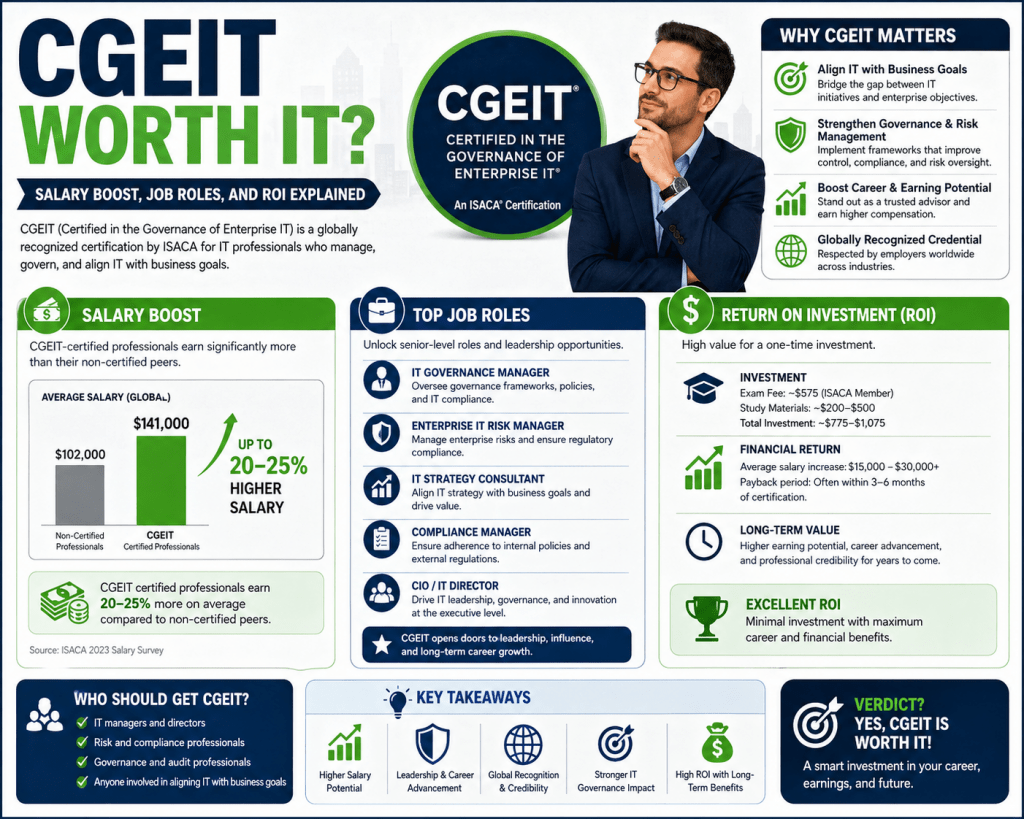
Within this context, CGEIT is positioned as a governance-oriented professional framework designed for individuals involved in strategic IT oversight. It focuses on the principles and practices required to design and manage governance systems rather than operating individual technologies. The emphasis is placed on structured decision-making, enterprise alignment, and the ability to translate business objectives into IT execution models.
Understanding Enterprise IT Governance as a Structural Discipline
Enterprise IT governance can be understood as a structural discipline that defines how decisions flow through an organization. It establishes the hierarchy of authority, the mechanisms for evaluation, and the methods used to ensure accountability. This structure is essential in environments where IT is deeply embedded in business operations and directly influences financial outcomes, customer experience, and operational continuity.
At its core, governance introduces order into complexity. Large organizations operate multiple IT systems that often serve different departments, geographies, and functions. Without a unifying governance model, these systems can evolve independently, leading to inconsistencies in security practices, data handling, and operational standards. Governance frameworks address this by enforcing alignment across all technology initiatives.
Another critical aspect of governance is standardization. Standardization ensures that IT decisions follow consistent criteria, whether they relate to infrastructure deployment, software adoption, or cybersecurity controls. This reduces ambiguity in decision-making and ensures that similar challenges are addressed using consistent methodologies.
CGEIT aligns with this discipline by focusing on the principles that underpin enterprise governance structures. It emphasizes the ability to evaluate organizational needs, define governance models, and ensure that IT systems support long-term strategic direction. Rather than focusing on specific technologies, it operates at the level of organizational design and control mechanisms.
Strategic Alignment Between IT Systems and Business Objectives
One of the primary goals of IT governance is ensuring strategic alignment between technology systems and business objectives. In many organizations, IT capabilities evolve faster than governance structures, leading to gaps between what technology can do and what the business actually needs.
Strategic alignment involves translating business goals into measurable IT outcomes. For example, if an organization aims to improve operational efficiency, IT governance ensures that systems are selected, configured, and managed in ways that support automation, integration, and performance optimization. Similarly, if the objective is expansion into new markets, governance ensures that infrastructure and applications can scale appropriately.
This alignment is not a one-time activity but a continuous process. Business priorities change over time, and IT systems must adapt accordingly. Governance frameworks provide the mechanisms to evaluate ongoing alignment and adjust strategies when necessary.
CGEIT emphasizes this dynamic relationship by focusing on how IT investments are evaluated in terms of business contribution. It encourages structured approaches to assessing whether technology initiatives deliver measurable value and remain aligned with organizational direction. This requires a deep understanding of both business operations and IT capabilities.
In practice, achieving alignment requires collaboration between multiple stakeholders. Executive leadership defines strategic direction, IT governance professionals interpret these objectives, and technical teams implement the required systems. The governance layer ensures that communication between these groups remains structured and consistent.
Decision-Making Models in Enterprise IT Environments
Decision-making in enterprise IT environments is inherently complex due to the scale and interdependence of systems involved. A single decision regarding infrastructure, software, or security can have widespread implications across multiple departments and operational processes.
To manage this complexity, organizations implement structured decision-making models. These models define how decisions are initiated, evaluated, approved, and reviewed. They also specify the roles and responsibilities of individuals involved in the decision-making process.
In most enterprise environments, decision-making is distributed across different levels. Strategic decisions are typically handled by senior leadership, while tactical decisions are managed by IT management teams. Operational decisions are executed by technical teams within predefined governance boundaries.
CGEIT places significant emphasis on the ability to design and operate within these decision-making structures. It focuses on ensuring that decisions are not made in isolation but are evaluated against organizational criteria such as risk exposure, financial impact, and operational feasibility.
An effective decision-making model also incorporates feedback mechanisms. These mechanisms allow organizations to assess the outcomes of previous decisions and refine future approaches. Without feedback loops, governance structures become static and lose their ability to adapt to changing conditions.
In large-scale IT environments, decision-making must also account for interdependencies between systems. A change in one system may affect multiple others, requiring coordinated evaluation. Governance frameworks help manage these dependencies by introducing structured review processes and approval hierarchies.
Risk Management and Control in IT Governance Systems
Risk management is a central component of enterprise IT governance. As organizations increasingly rely on digital systems, exposure to operational, financial, and cybersecurity risks grows significantly. Governance frameworks provide structured methods for identifying, assessing, and mitigating these risks.
Risk in IT environments can take many forms. It may involve data breaches, system downtime, regulatory non-compliance, or operational failures. Each type of risk requires different mitigation strategies and levels of oversight. Governance ensures that risks are evaluated consistently across the organization.
A key principle in governance-based risk management is proportionality. This means that controls should be appropriate to the level of risk involved. Overly restrictive controls can slow down innovation and reduce efficiency, while insufficient controls can expose the organization to significant vulnerabilities.
CGEIT incorporates this principle by emphasizing risk optimization. This involves balancing risk reduction with operational efficiency and business agility. The goal is not to eliminate all risk but to manage it within acceptable thresholds defined by the organization.
Effective risk management also requires continuous monitoring. IT environments are dynamic, and new risks can emerge as systems evolve. Governance frameworks establish processes for ongoing risk assessment and adjustment of controls as needed.
Another important aspect of risk governance is accountability. Clear ownership of risk domains ensures that responsibilities are defined and enforceable. Without accountability, risk management becomes fragmented and less effective.
Resource Optimization in Large-Scale IT Ecosystems
Enterprise IT environments operate under constant pressure to optimize resources. This includes financial resources, human expertise, infrastructure capacity, and system performance. Governance plays a critical role in ensuring that these resources are allocated efficiently and effectively.
Resource optimization involves evaluating competing demands and prioritizing initiatives based on strategic value. In large organizations, multiple projects may compete for the same resources, making structured prioritization essential.
Governance frameworks provide mechanisms for evaluating resource allocation decisions. These mechanisms consider factors such as return on investment, operational urgency, risk impact, and alignment with strategic objectives.
CGEIT emphasizes the importance of resource governance by focusing on how IT resources are managed across the enterprise. This includes not only physical infrastructure but also software assets, human capital, and financial investments.
Efficient resource utilization requires visibility across the entire IT environment. Organizations must have accurate information about system usage, capacity constraints, and performance metrics. Governance structures ensure that this information is collected, analyzed, and used in decision-making processes.
Another dimension of resource optimization is scalability. As organizations grow, IT systems must be able to expand without disproportionate increases in cost or complexity. Governance frameworks help ensure that scalability is considered during planning and implementation phases.
Resource governance also extends to lifecycle management. This involves managing assets from acquisition through deployment, maintenance, and eventual retirement. Structured lifecycle management reduces waste and improves overall efficiency.
Organizational Roles and Governance Responsibility Structures
Enterprise IT governance relies on clearly defined roles and responsibility structures. These structures ensure that decision-making authority is distributed appropriately and that accountability is maintained across all levels of the organization.
In governance environments, roles are typically divided between strategic leadership, operational management, and technical execution. Strategic leadership defines organizational direction, operational management translates strategy into actionable plans, and technical teams implement and maintain systems.
CGEIT is particularly relevant for professionals operating within strategic and governance-focused roles. It emphasizes the ability to operate within leadership structures that require coordination across multiple business and technical domains.
Responsibility structures also define escalation paths. When issues arise, there must be clear mechanisms for determining how decisions are reviewed and resolved. This prevents delays and ensures that critical issues are addressed at the appropriate level.
Another important aspect of governance roles is cross-functional collaboration. IT governance cannot operate in isolation from other business functions. Finance, operations, compliance, and security teams all contribute to governance processes.
Effective governance structures also require communication frameworks. These frameworks ensure that information flows efficiently between stakeholders and that decisions are based on accurate and timely data.
In complex organizations, governance roles may evolve as IT environments mature. As systems become more integrated and business reliance on technology increases, governance responsibilities often expand to include broader strategic oversight functions.
CGEIT Domain Structure and Its Role in Enterprise Governance Mastery
Enterprise IT governance frameworks are built on structured domains that define how organizations manage control, alignment, risk, and value realization across technology ecosystems. These domains are not theoretical partitions but practical lenses through which enterprise IT decisions are evaluated, executed, and monitored. The CGEIT framework is built around this structured domain model, ensuring that professionals understand governance as an interconnected system rather than isolated responsibilities.
Each domain represents a critical dimension of enterprise IT governance. Together, they form a holistic model that governs how IT resources are directed, how investments are justified, how risks are managed, and how organizational outcomes are measured. This structure reflects the reality of modern enterprise environments where IT decisions must satisfy multiple competing requirements simultaneously.
The domain-based approach is particularly important in large-scale organizations where governance cannot be centralized in a single function. Instead, governance responsibilities are distributed across leadership layers, requiring standardized principles to maintain consistency. CGEIT reinforces this distributed model by focusing on the ability to design, implement, and sustain governance structures that operate across organizational boundaries.
Governance of Enterprise IT as a Strategic Control Mechanism
The governance of enterprise IT represents the foundational domain that defines how authority, decision rights, and accountability are structured within an organization. It establishes the control mechanisms that ensure IT activities are aligned with business strategy and organizational objectives.
In practical terms, governance defines who has the authority to make decisions, how those decisions are evaluated, and what criteria are used to approve or reject IT initiatives. Without this structure, enterprise IT environments tend to become fragmented, with inconsistent decision-making leading to inefficiencies and misalignment.
A strong governance model ensures that IT investments are not made in isolation but are part of a broader strategic framework. This includes defining policies for technology adoption, infrastructure expansion, and system modernization. It also ensures that decisions are traceable and accountable at every level of the organization.
CGEIT emphasizes governance as a control mechanism rather than a technical function. It focuses on ensuring that IT supports organizational direction through structured oversight. This includes defining governance committees, establishing decision frameworks, and implementing reporting structures that provide visibility into IT performance.
Another key aspect of this domain is policy enforcement. Governance frameworks establish the rules under which IT systems operate, ensuring compliance with internal standards and external regulatory requirements. These policies serve as the foundation for consistent decision-making across the enterprise.
Governance also introduces performance measurement into IT management. Organizations must be able to evaluate whether governance structures are effective in achieving desired outcomes. This requires the use of metrics, benchmarks, and review processes that assess both operational efficiency and strategic alignment.
IT Resource Management in Complex Enterprise Environments
IT resource management is a critical domain that focuses on how organizations allocate and optimize their technology assets. These resources include infrastructure, applications, personnel, and financial investments. Effective governance ensures that these resources are used efficiently and aligned with organizational priorities.
In large enterprises, resource constraints are a constant challenge. Competing projects often require shared infrastructure, limited budgets, and specialized expertise. Without structured governance, resource allocation becomes reactive rather than strategic, leading to inefficiencies and bottlenecks.
Resource management frameworks ensure that allocation decisions are based on objective criteria such as business value, operational urgency, and risk exposure. This structured approach allows organizations to prioritize initiatives that deliver the greatest impact while maintaining operational stability.
CGEIT emphasizes the importance of aligning IT resources with enterprise objectives. This involves evaluating whether current resource utilization supports strategic goals and identifying areas where optimization is required. It also includes ensuring that resources are scalable to meet future demands.
Human resource management is another critical aspect of this domain. IT governance requires ensuring that teams have the appropriate skills, capacity, and structure to support enterprise systems. This includes workforce planning, role definition, and capability development.
Infrastructure management is equally important. Organizations must ensure that hardware, software, and cloud environments are designed for efficiency, resilience, and scalability. Governance frameworks provide the structure needed to evaluate infrastructure investments and lifecycle management strategies.
Financial resource governance ensures that IT spending is controlled, justified, and aligned with business value. This includes budgeting processes, cost allocation models, and investment evaluation frameworks that support financial accountability across IT operations.
Benefits Realization and Measuring IT Value Contribution
Benefits realization is a central domain in enterprise IT governance that focuses on ensuring technology investments deliver measurable value. In many organizations, IT initiatives are implemented without clear mechanisms for evaluating their actual contribution to business outcomes. This creates a gap between investment and impact.
Benefits realization frameworks address this issue by establishing structured methods for defining, tracking, and evaluating IT value. This includes identifying expected outcomes before project implementation and measuring performance after deployment.
Value in IT governance is not limited to financial returns. It also includes operational efficiency, customer satisfaction, process improvement, and strategic enablement. Governance structures ensure that all forms of value are considered when evaluating IT investments.
CGEIT emphasizes benefits realization as a continuous process rather than a one-time evaluation. This means that organizations must continuously monitor whether IT systems are delivering expected outcomes and make adjustments when necessary.
A key component of benefits realization is defining clear success criteria. Without measurable objectives, it becomes difficult to determine whether an initiative has achieved its intended purpose. Governance frameworks ensure that success criteria are established during the planning phase of IT projects.
Another important aspect is stakeholder alignment. Different stakeholders may have different expectations regarding IT outcomes. Governance ensures that these expectations are reconciled and translated into unified performance indicators.
Benefits realization also requires feedback mechanisms that inform future decision-making. Lessons learned from past initiatives are used to improve planning, execution, and evaluation processes. This creates a continuous improvement cycle within enterprise IT governance.
Risk Optimization in Enterprise IT Governance Structures
Risk optimization is a domain that focuses on balancing risk exposure with operational efficiency and business agility. In modern IT environments, risk cannot be eliminated but must be managed within acceptable boundaries.
Enterprise IT systems face multiple categories of risk, including cybersecurity threats, system failures, regulatory non-compliance, and operational disruptions. Each category requires different mitigation strategies and governance approaches.
Risk optimization involves identifying potential risks, assessing their likelihood and impact, and implementing controls to reduce exposure. However, governance frameworks also ensure that risk controls do not unnecessarily restrict innovation or operational efficiency.
CGEIT emphasizes the concept of balanced risk management. This means that organizations must accept a certain level of risk in order to achieve business objectives. The goal is to find an optimal balance between protection and performance.
Risk governance also involves continuous monitoring. IT environments are dynamic, and new risks can emerge as systems evolve. Governance frameworks ensure that risk assessments are regularly updated and that controls are adjusted accordingly.
Another important element is risk ownership. Clear accountability ensures that specific individuals or teams are responsible for managing defined risk areas. This prevents gaps in responsibility and ensures that risk management activities are consistently executed.
Risk reporting is also a critical component of governance. Leadership teams require visibility into risk exposure to make informed strategic decisions. Governance structures provide standardized reporting mechanisms that communicate risk status across the organization.
Enterprise Decision Architecture and Governance Flow Systems
Enterprise decision architecture refers to the structured flow of decision-making within IT governance systems. It defines how decisions move from identification to evaluation, approval, execution, and review.
In complex organizations, decision-making cannot be centralized at a single point. Instead, it is distributed across multiple layers, each with defined responsibilities and authority levels. This distributed model ensures that decisions are made at the appropriate level while maintaining alignment with enterprise objectives.
CGEIT emphasizes the importance of designing decision architectures that support scalability and consistency. As organizations grow, decision-making processes must remain efficient while accommodating increased complexity.
A well-structured decision architecture includes clear decision rights. These rights define who is authorized to make specific types of decisions, reducing ambiguity and improving accountability. It also includes escalation paths for resolving conflicts or uncertainties.
Another important component is decision documentation. Governance frameworks require that decisions be recorded, justified, and traceable. This ensures transparency and enables future analysis of decision outcomes.
Decision architecture also includes review cycles. These cycles ensure that decisions are periodically evaluated to determine whether they remain valid under changing conditions. This is particularly important in fast-evolving IT environments.
In addition, governance structures must support cross-functional decision-making. IT decisions often impact multiple business units, requiring coordination between technical, financial, and operational stakeholders.
Lifecycle Governance and Continuous IT Oversight Models
Lifecycle governance refers to the management of IT systems throughout their entire existence, from planning and acquisition to operation and retirement. This ensures that systems remain efficient, secure, and aligned with business needs throughout their lifecycle.
In enterprise environments, IT systems are not static. They evolve, requiring continuous oversight and adjustment. Governance frameworks provide the structure needed to manage this evolution effectively.
Lifecycle governance begins with planning and evaluation. During this phase, organizations assess whether new systems or upgrades are necessary and how they align with strategic objectives.
The implementation phase focuses on deployment and integration. Governance ensures that systems are implemented according to defined standards and that risks are managed during transition periods.
Operational governance involves ongoing monitoring of system performance, security, and efficiency. This includes regular assessments to ensure systems continue to meet business requirements.
Eventually, systems reach end-of-life stages where they must be replaced or decommissioned. Governance frameworks ensure that this process is managed in a controlled and risk-aware manner.
CGEIT emphasizes lifecycle governance as a continuous process rather than a linear sequence. This means that oversight is maintained throughout all phases of system existence, ensuring long-term alignment with enterprise goals.
Lifecycle governance also supports cost optimization by ensuring that systems are retired when they are no longer efficient or necessary. This prevents resource waste and reduces operational complexity.
Enterprise Implementation Models for IT Governance Frameworks
Enterprise IT governance does not exist as a theoretical construct alone; it becomes meaningful only when it is implemented through structured operational models inside real organizations. Implementation models define how governance principles are translated into actionable processes, workflows, and organizational behaviors. Without implementation, governance remains conceptual and fails to influence actual decision-making or resource allocation.
Large-scale organizations typically adopt layered governance models that distribute responsibility across multiple tiers of leadership and technical execution. These models ensure that strategic direction is maintained at the executive level while allowing operational flexibility at lower levels. The goal is to maintain alignment without introducing excessive bureaucracy that slows down decision-making.
One of the most important aspects of implementation is governance integration into existing IT and business structures. Organizations rarely build governance systems from scratch. Instead, they embed governance principles into existing workflows such as project approval processes, budgeting cycles, risk management systems, and performance evaluation frameworks.
CGEIT-aligned implementation focuses on ensuring that governance is not an isolated function but a continuous operational discipline. This requires embedding governance checkpoints into every stage of IT decision-making, from planning to execution and evaluation. These checkpoints ensure that decisions are consistently evaluated against strategic objectives, risk thresholds, and resource constraints.
Another critical element of implementation models is scalability. Governance frameworks must be able to operate effectively in small, medium, and large enterprise environments without losing structure or becoming overly rigid. Scalability is achieved by defining adaptable processes that can expand as organizational complexity increases.
Standardization is also essential during implementation. Without standardized governance processes, different departments may interpret policies differently, leading to inconsistencies in execution. Standardization ensures that governance principles are applied uniformly across all organizational units.
Leadership Alignment and Executive Decision Ecosystems
Enterprise IT governance is deeply dependent on leadership alignment. Without alignment at the executive level, governance frameworks cannot function effectively. Leadership alignment refers to the shared understanding among senior stakeholders regarding IT priorities, risk tolerance, investment strategies, and operational expectations.
In large organizations, executive decision-making forms a complex ecosystem involving multiple roles such as CIOs, CTOs, CFOs, and business unit leaders. Each of these roles brings a different perspective to IT governance decisions. The CIO may focus on technology strategy, while the CFO emphasizes financial efficiency, and business leaders prioritize operational outcomes.
Governance frameworks serve as the coordination mechanism that aligns these perspectives into unified decisions. They ensure that conflicting priorities are resolved through structured evaluation rather than informal negotiation or reactive decision-making.
CGEIT emphasizes the importance of leadership alignment because governance effectiveness depends on consistent executive support. Without leadership alignment, governance policies may exist on paper but fail to influence actual organizational behavior.
Executive decision ecosystems also rely heavily on information transparency. Leaders must have access to accurate, timely, and relevant data to make informed governance decisions. This includes performance metrics, risk assessments, financial reports, and operational dashboards.
Another important aspect is decision authority distribution. Governance frameworks define which decisions must be escalated to executive leadership and which can be handled at operational levels. This prevents bottlenecks at the top while maintaining oversight over critical decisions.
Leadership alignment also involves strategic prioritization. In environments with limited resources, executives must determine which initiatives receive funding and which are deferred. Governance frameworks provide structured methods for evaluating and ranking these initiatives based on organizational value.
Organizational Maturity Models in IT Governance Evolution
Organizational maturity in IT governance refers to the degree to which governance processes are defined, standardized, measured, and continuously improved. Mature governance systems are characterized by predictability, consistency, and data-driven decision-making.
At lower maturity levels, governance tends to be informal and reactive. Decisions are often made on a case-by-case basis without standardized criteria. This leads to inconsistencies and inefficiencies across the organization.
As maturity increases, governance becomes more structured. Organizations begin to define formal policies, establish decision-making frameworks, and implement standardized evaluation processes. This reduces variability and improves accountability.
At advanced maturity levels, governance becomes fully integrated into organizational strategy. Decision-making is guided by real-time data, predictive analytics, and continuous feedback loops. Governance is no longer a separate function but an embedded organizational capability.
CGEIT aligns closely with mature governance models because it emphasizes structured decision-making, accountability, and continuous improvement. Professionals operating at this level are expected to understand not only governance principles but also how to evolve governance systems over time.
Maturity models also help organizations identify gaps in their governance structures. By evaluating current capabilities against defined maturity stages, organizations can determine where improvements are needed.
Another important aspect of maturity is cultural alignment. Governance cannot succeed if organizational culture does not support accountability, transparency, and structured decision-making. Mature governance environments foster a culture where data-driven decisions are prioritized over intuition-based choices.
Enterprise Risk Governance and Strategic Exposure Management
Enterprise risk governance focuses on managing exposure to uncertainty across IT systems and organizational processes. In modern digital environments, risk is not a secondary concern but a central element of strategic planning.
Risk governance involves identifying potential threats, evaluating their impact, and implementing structured controls to mitigate exposure. However, it also requires balancing risk reduction with operational efficiency and innovation.
In highly mature organizations, risk is treated as a strategic variable rather than a purely defensive concern. This means that organizations intentionally accept certain risks to achieve competitive advantage or operational efficiency.
CGEIT emphasizes risk governance as a structured discipline that must be integrated into all levels of IT decision-making. This includes strategic planning, project management, infrastructure design, and operational monitoring.
A key element of risk governance is risk quantification. Organizations must be able to assign measurable values to risk exposure to compare different scenarios and make informed decisions. This often involves combining qualitative assessments with quantitative metrics.
Another important component is risk aggregation. In large organizations, risks are distributed across multiple systems and departments. Governance frameworks must consolidate these risks into a unified view to support executive decision-making.
Risk governance also requires continuous reassessment. As systems evolve and external conditions change, risk profiles must be updated to reflect current realities. Static risk models are insufficient in dynamic IT environments.
Financial Governance and IT Investment Accountability
Financial governance in enterprise IT environments ensures that technology investments are justified, controlled, and aligned with business value. IT spending often represents a significant portion of organizational budgets, making financial governance a critical component of overall governance structures.
Financial governance begins with budgeting processes that define how IT resources are allocated across projects, departments, and initiatives. These budgets are based on strategic priorities and expected business outcomes.
Investment evaluation is another key component. Organizations must assess whether proposed IT initiatives provide sufficient return on investment. This evaluation includes cost-benefit analysis, risk assessment, and alignment with strategic objectives.
CGEIT emphasizes financial governance as a mechanism for ensuring accountability in IT spending. It requires that organizations track how funds are used and evaluate whether expenditures produce measurable value.
Cost transparency is also essential. Organizations must understand not only direct costs but also indirect costs associated with IT systems, such as maintenance, training, and operational overhead.
Another important aspect is financial forecasting. Governance frameworks support predictive modeling to estimate future IT costs and resource requirements. This enables organizations to plan more effectively and avoid budget overruns.
Financial governance also includes post-investment review processes. These reviews assess whether IT initiatives delivered expected outcomes and identify lessons learned for future investments.
Performance Measurement and Governance Effectiveness Metrics
Performance measurement is a core element of enterprise IT governance. Without measurable indicators, it is impossible to determine whether governance frameworks are effective or whether IT systems are delivering expected outcomes.
Performance metrics in IT governance cover multiple dimensions, including operational efficiency, system availability, security effectiveness, and business value contribution. These metrics provide a comprehensive view of IT performance.
CGEIT emphasizes the importance of defining clear performance indicators that align with organizational objectives. These indicators must be measurable, relevant, and consistently tracked over time.
Operational metrics focus on system performance, such as uptime, response time, and throughput. These metrics ensure that IT systems function reliably and efficiently.
Strategic metrics focus on business outcomes, such as revenue impact, customer satisfaction, and process efficiency. These metrics evaluate how effectively IT supports organizational goals.
Governance effectiveness metrics assess how well governance structures themselves are functioning. This includes evaluating decision-making speed, policy compliance rates, and risk management effectiveness.
Another important aspect is benchmarking. Organizations often compare their performance against internal targets or industry standards to assess relative effectiveness.
Performance measurement also enables continuous improvement. By analyzing metric trends, organizations can identify areas for optimization and refine governance processes accordingly.
Continuous Evolution of Enterprise IT Governance Systems
Enterprise IT governance is not a static framework. It evolves continuously in response to technological advancements, organizational changes, and external regulatory pressures. This evolution is necessary to maintain relevance in dynamic IT environments.
As technologies such as cloud computing, automation, artificial intelligence, and distributed systems become more prevalent, governance frameworks must adapt to manage new types of complexity. Traditional governance models may not be sufficient to address these emerging challenges.
CGEIT aligns with this evolutionary perspective by emphasizing adaptability and continuous improvement. Governance professionals are expected to understand how to evolve frameworks in response to changing conditions.
One aspect of evolution is process refinement. Governance processes must be regularly reviewed and updated to ensure efficiency and effectiveness. Outdated processes can create bottlenecks and reduce organizational agility.
Another aspect is structural adaptation. As organizations grow or restructure, governance models must be adjusted to reflect new reporting lines, decision authorities, and operational boundaries.
Technological evolution also influences governance. New tools and platforms introduce both opportunities and risks, requiring updated governance approaches to manage them effectively.
Finally, regulatory evolution plays a significant role. Changes in compliance requirements often require adjustments to governance frameworks to ensure continued adherence to legal and industry standards.
Integrated View of Enterprise Governance and Strategic IT Leadership
Enterprise IT governance ultimately represents an integrated system that combines leadership alignment, structured decision-making, risk management, financial accountability, and performance measurement. It operates as the control layer that ensures IT systems serve organizational objectives in a consistent and predictable manner.
CGEIT reflects this integrated perspective by focusing on the ability to design and manage governance systems at an enterprise level. It emphasizes strategic thinking, organizational awareness, and structured control mechanisms rather than technical specialization.
In advanced governance environments, IT leadership is not limited to managing technology but extends to shaping organizational direction. Governance professionals operate at the intersection of business strategy and technological capability, ensuring that both are aligned in pursuit of shared objectives.
This integrated approach is what enables large enterprises to maintain stability while continuing to innovate. Governance provides the structure within which innovation can occur safely, efficiently, and in alignment with business goals.
Final Synthesis on CGEIT and Enterprise IT Governance Value
Enterprise IT governance sits at the intersection of technology execution and business strategy, and its importance increases as organizations scale in complexity. Modern enterprises no longer operate within simple, isolated IT environments; instead, they depend on distributed systems that span cloud infrastructure, hybrid networks, application ecosystems, and data-driven decision platforms. In such environments, the challenge is not only to build systems that function but to ensure those systems consistently align with organizational intent, financial discipline, and acceptable risk boundaries. This is the operational space where CGEIT becomes relevant as a governance-focused professional benchmark.
Across all enterprise environments, one recurring reality is that technology alone does not create business value. Value is created when technology decisions are structured, justified, and continuously aligned with organizational priorities. Without governance, IT environments tend to evolve organically, often driven by short-term needs rather than long-term strategy. This leads to duplication of systems, uncontrolled spending, inconsistent security postures, and misalignment between departments. Over time, these inefficiencies compound and reduce overall organizational agility.
Governance frameworks exist to counteract this fragmentation by introducing structured decision-making processes. These processes define how investments are evaluated, how risks are managed, how resources are allocated, and how outcomes are measured. Rather than allowing IT decisions to occur in isolation, governance ensures that every major action is connected to a broader strategic objective. CGEIT represents a structured approach to understanding and implementing these principles at an enterprise scale.
A key takeaway from enterprise governance thinking is that IT leadership is fundamentally a balancing function. Leaders must continuously evaluate trade-offs between cost, risk, performance, and business value. Increasing system performance may raise costs. Reducing risk may slow down innovation. Accelerating delivery may introduce security vulnerabilities. Governance does not eliminate these tensions; it provides the structure needed to manage them in a controlled and predictable manner.
Within this balancing function, decision accountability becomes essential. In mature organizations, it is not enough to make technically sound decisions. Those decisions must also be traceable, justified, and aligned with organizational goals. Accountability ensures that responsibility for outcomes is clearly defined, which reduces ambiguity and improves organizational learning over time. When decisions succeed or fail, governance frameworks ensure that the organization understands why.
Another important dimension of enterprise governance is its role in aligning diverse stakeholder groups. Large organizations include executives, financial controllers, operational managers, security teams, and technical engineers. Each group has different priorities and success metrics. Governance acts as a coordination mechanism that integrates these perspectives into a unified decision-making structure. Without this integration, organizations risk internal conflict, miscommunication, and inconsistent execution of IT strategy.
Risk management remains one of the most critical outputs of governance systems. As digital dependency increases, organizations become more exposed to cybersecurity threats, regulatory pressures, and operational disruptions. However, risk cannot be treated as something to be eliminated. Instead, it must be optimized. This means understanding which risks are acceptable in pursuit of innovation and which risks must be tightly controlled. Governance frameworks provide structured methods for evaluating these trade-offs and maintaining organizational resilience.
Financial discipline is another foundational pillar of enterprise IT governance. Technology investments often represent a significant portion of enterprise budgets, and without structured oversight, spending can quickly become inefficient. Governance ensures that IT investments are evaluated not only for technical feasibility but also for business return, operational necessity, and long-term sustainability. It introduces transparency into financial decision-making and helps organizations understand the true cost of maintaining and evolving their IT environments.
Equally important is the concept of benefits realization. Many organizations struggle not because they fail to implement technology but because they fail to measure whether that technology delivers meaningful outcomes. Governance introduces structured mechanisms for defining expected benefits in advance and evaluating actual performance after implementation. This creates a feedback loop that improves future decision-making and strengthens organizational maturity over time.
From an operational perspective, governance also supports resource optimization. Enterprise IT environments are resource-intensive, requiring careful allocation of infrastructure capacity, human expertise, and financial investment. Without governance, resource allocation often becomes reactive, driven by immediate demands rather than strategic planning. Structured governance ensures that resources are distributed based on priority, value contribution, and long-term sustainability.
As organizations evolve, governance itself must also evolve. Static governance models quickly become outdated in environments shaped by rapid technological change. Cloud adoption, automation, artificial intelligence, and distributed architectures all introduce new governance challenges. This requires governance systems that are adaptable, continuously reviewed, and capable of scaling with organizational growth. Maturity in governance is not defined by rigidity but by the ability to adapt while maintaining control and consistency.
Leadership alignment remains one of the most decisive factors in governance success. Even the most well-designed governance frameworks will fail if executive leadership is not aligned on priorities and decision structures. Governance depends on shared understanding at the top of the organization regarding risk tolerance, investment strategy, and operational expectations. When leadership is aligned, governance becomes enforceable and effective. When it is not, governance becomes fragmented and inconsistent.
In this broader context, CGEIT reflects a professional understanding of how enterprise IT governance functions as a complete system. It is not centered on technical execution but on structural design, decision architecture, and strategic oversight. It represents the ability to interpret organizational needs and translate them into controlled, measurable, and sustainable IT governance models.
Ultimately, enterprise IT governance is about creating stability within complexity. Modern organizations rely on technology as a core driver of business success, but that reliance introduces risk and operational challenges that must be managed systematically. Governance provides the framework that allows organizations to innovate without losing control, scale without inefficiency, and invest without waste. In this sense, CGEIT aligns with a broader organizational need: the need to ensure that technology remains a strategic enabler rather than a source of fragmentation or instability.