
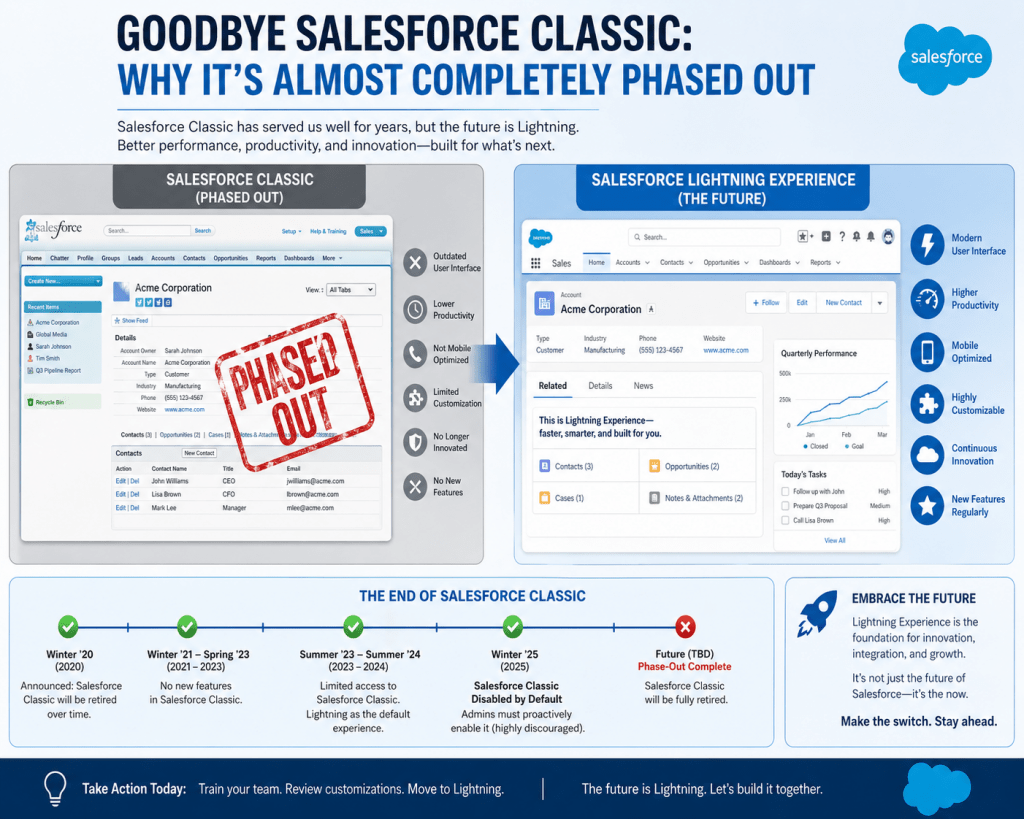
Salesforce Classic represents one of the earliest widely adopted cloud-based CRM interfaces, designed to support core sales automation, customer data management, and pipeline tracking within a browser-based environment. Its architecture was built around a page-centric model where records, objects, and workflows were presented through relatively static layouts. This structure aligned with early cloud computing limitations, where responsiveness and real-time interactivity were not as advanced as modern standards demand.
In its original form, Salesforce Classic provided a functional and reliable system for managing accounts, leads, opportunities, and service cases. The interface prioritized stability and consistency over customization, flexibility, or visual interactivity. Navigation was primarily menu-driven, and user workflows were designed around sequential task execution rather than dynamic component interaction.
This design philosophy worked effectively during a period when CRM systems were primarily used for structured data entry and basic reporting. However, as organizations expanded their digital operations and data complexity increased, the limitations of static interface design began to surface. Users required faster access to insights, more intuitive navigation paths, and improved integration between different functional areas of the platform.
Over time, the growing demand for agility in customer data management exposed structural constraints within legacy CRM environments. While Salesforce Classic remained operationally dependable, its architecture was increasingly viewed as insufficient for supporting modern enterprise-scale digital transformation initiatives.
Structural Limitations of Legacy CRM Architecture in Enterprise Environments
The underlying architecture of Salesforce Classic was built on a multi-page application model, where each interaction typically required a full page reload or server-side processing cycle. This created latency in user interactions, especially when handling large datasets or complex relational queries across multiple objects.
One of the key limitations of this architecture was its inability to support component-level rendering. Unlike modern systems that update specific sections of a page dynamically, Classic required broader page refresh cycles, which reduced efficiency in high-frequency workflows such as sales updates or service ticket processing.
Another architectural constraint was the limited separation between data logic and presentation layers. This meant that customization often required deeper configuration within system settings rather than modular interface adjustments. As organizations scaled, maintaining these configurations became increasingly complex and resource-intensive.
Integration capabilities also reflected the constraints of earlier cloud design models. While external system connections were possible, they often required additional middleware or custom development to maintain synchronization between platforms. This added operational overhead and reduced agility in adapting to evolving business requirements.
As enterprise systems matured, these structural limitations became more apparent, particularly in organizations managing large customer datasets, multi-region operations, and real-time analytics requirements.
Emergence of Modern CRM Frameworks and Component-Based Interfaces
The transition toward modern CRM frameworks introduced a fundamentally different approach to interface design and system interaction. Instead of static page structures, newer architectures adopted component-based models where individual UI elements could operate independently while remaining connected to a unified data layer.
This approach significantly improved system responsiveness and allowed users to interact with specific components without requiring full page reloads. It also enabled real-time updates, where changes in one part of the system could be reflected instantly across related components.
The shift to component-based architecture also introduced greater flexibility in customization. Organizations could now tailor user experiences at a granular level, adjusting dashboards, data views, and workflow elements without modifying core system logic. This represented a major advancement in CRM usability and scalability.
In addition to interface improvements, modern frameworks introduced enhanced metadata-driven design principles. This allowed systems to dynamically generate user interfaces based on underlying data structures and business rules, reducing the need for manual configuration and improving consistency across environments.
These architectural innovations formed the foundation for next-generation CRM experiences, gradually redefining user expectations and industry standards for enterprise software design.
Gradual Transition Strategy and Coexistence of Dual CRM Environments
The shift from legacy CRM systems to modern platforms was not executed as an immediate replacement but rather as a gradual transition strategy. Organizations were encouraged to operate both environments in parallel, allowing users to adapt to new interfaces while maintaining continuity in critical business processes.
This dual-environment approach provided flexibility for enterprises with deeply embedded legacy configurations. Users could continue working within familiar systems while exploring new capabilities introduced in modern interfaces. This reduced operational risk and allowed for incremental adoption based on readiness levels across departments.
During this transition phase, system administrators played a crucial role in managing configuration consistency between environments. Data synchronization, permission alignment, and workflow replication became essential tasks to ensure seamless user experiences across both systems.
Training and user adaptation strategies also became increasingly important. Organizations had to invest in structured onboarding processes to help users understand new navigation models, updated functionality, and enhanced reporting tools. Without proper alignment, productivity gaps could emerge during early adoption phases.
Despite the availability of transition mechanisms, many enterprises delayed full migration due to complexity concerns, resource constraints, and reliance on customized legacy workflows that were not immediately compatible with newer environments.
Enterprise Dependency on Customization and Legacy Workflow Ecosystems
One of the most significant factors influencing the continued use of Salesforce Classic was the extensive level of customization present in enterprise environments. Over time, organizations built highly tailored CRM ecosystems designed to match specific business processes, industry requirements, and operational workflows.
These customizations often included automated approval processes, advanced validation rules, third-party integrations, and role-based access configurations. In many cases, these systems evolved over several years, resulting in deeply interconnected dependencies across departments.
Migrating such complex ecosystems to a modern interface required careful mapping of existing functionalities to new system capabilities. Not all legacy processes had direct equivalents in newer architectures, which necessitated redesigning workflows rather than simply replicating them.
This dependency on customized structures created a significant barrier to rapid migration. Enterprises had to evaluate not only technical feasibility but also operational impact, ensuring that business continuity would not be disrupted during the transition process.
Additionally, legacy workflows often became embedded in organizational culture, making change management a critical component of migration strategy. Users familiar with established processes needed time to adjust to new interaction models and system behaviors.
Performance Evolution and Real-Time Data Processing Enhancements
Modern CRM systems introduced substantial improvements in performance optimization and real-time data processing capabilities. Unlike legacy systems that relied heavily on server-side rendering, newer architectures leverage asynchronous data handling and client-side rendering techniques.
This shift enables faster interaction cycles, reduced latency, and improved scalability across distributed environments. Users can access updated information instantly without waiting for full page reloads, which significantly enhances productivity in time-sensitive workflows.
Real-time processing also supports more advanced analytics capabilities. Data can be aggregated, analyzed, and visualized dynamically, allowing decision-makers to respond quickly to emerging trends or operational changes.
In addition to performance improvements, modern systems incorporate caching mechanisms, optimized query handling, and distributed computing principles to handle large-scale enterprise workloads efficiently. These enhancements are particularly important for organizations operating in global markets with high transaction volumes.
The improved responsiveness of modern systems has contributed significantly to user satisfaction and adoption rates, reinforcing the shift away from older interface models.
Security and Compliance Advancements in Modern CRM Platforms
As CRM systems evolved, security and compliance requirements became increasingly integrated into platform architecture. Modern environments introduced more granular access controls, enhanced encryption standards, and improved auditing capabilities.
Role-based access control systems allow organizations to define precise permission structures, ensuring that users only have access to relevant data based on their responsibilities. This reduces the risk of unauthorized access and improves overall data governance.
Audit trails and activity monitoring features also provide greater transparency into system usage. Organizations can track changes to records, monitor user activity, and generate compliance reports more efficiently than in legacy environments.
Data protection mechanisms have also advanced significantly, with encryption applied both at rest and in transit. This ensures that sensitive customer information remains secure across all system interactions.
Compliance frameworks have been integrated into platform design, enabling organizations to meet regulatory requirements more effectively. This includes support for data residency controls, privacy regulations, and industry-specific compliance standards.
These security enhancements represent a major advancement over legacy systems, which often required additional external tools or custom configurations to achieve similar levels of protection.
Operational Efficiency Gains Through Modern Workflow Automation
Workflow automation has become a central feature of modern CRM systems, enabling organizations to streamline repetitive tasks and improve operational efficiency. Unlike legacy systems, where automation was often rigid and limited, modern platforms support dynamic and context-aware automation rules.
These automation capabilities allow businesses to trigger actions based on specific conditions, such as updating records, sending notifications, or initiating approval processes. This reduces manual intervention and minimizes the risk of human error.
Advanced automation also supports multi-step workflows that can span across different departments and systems. This enables more cohesive business processes and improves coordination between sales, service, and marketing functions.
The flexibility of modern automation tools allows organizations to adapt quickly to changing business requirements without extensive system reconfiguration. This agility is a key advantage over legacy environments, where workflow modifications often require complex administrative changes.
As automation continues to evolve, it plays an increasingly important role in shaping enterprise productivity and digital transformation strategies.
Deepening Gap Between Legacy CRM Interfaces and Modern Cloud Architecture
The evolution of enterprise CRM platforms has created a widening architectural and functional gap between legacy systems like Salesforce Classic and modern cloud-based interfaces. This gap is not simply visual or cosmetic; it is structural, affecting how data is processed, how users interact with records, and how workflows are executed across distributed environments.
Salesforce Classic was designed during a period when CRM systems primarily functioned as structured databases with user-friendly forms layered on top. Its architecture was optimized for predictable workflows, sequential data entry, and relatively low-frequency interaction patterns. However, modern enterprise environments operate under fundamentally different conditions, including real-time analytics, multi-device access, integrated APIs, and AI-driven decision systems.
The newer CRM architecture emphasizes modularity and abstraction. Instead of tightly coupled page layouts, modern systems use loosely connected components that communicate through event-driven frameworks. This enables faster updates, better scalability, and more efficient resource utilization across cloud infrastructure.
As this architectural divergence grows, maintaining parity between legacy and modern systems becomes increasingly difficult. Features introduced in modern environments often cannot be backported to legacy systems due to structural incompatibilities. This naturally accelerates the migration pressure toward newer platforms.
Transformation of User Interaction Models in CRM Ecosystems
One of the most significant shifts in CRM evolution is the transformation of user interaction models. In Salesforce Classic, user interaction follows a linear navigation model where users move through predefined pages and tabs to complete tasks. Each action typically involves navigating through multiple screens, with limited contextual awareness between components.
Modern CRM systems replace this linear structure with contextual interaction models. Users can interact with multiple data points simultaneously within a single interface view. This reduces cognitive load and eliminates repetitive navigation steps, enabling faster decision-making and more efficient task completion.
Context-aware interfaces also introduce adaptive layouts that respond to user roles, behavior patterns, and data relevance. For example, sales representatives may see pipeline-focused dashboards, while service agents are presented with case prioritization tools and knowledge base integration.
This personalization of user experience represents a major departure from the static design philosophy of legacy systems. Instead of one-size-fits-all layouts, modern CRM environments prioritize role-based adaptability and dynamic content rendering.
As organizations adopt these interaction models, user expectations shift accordingly. Systems that do not support contextual workflows increasingly feel outdated, reinforcing the perception that legacy interfaces are no longer aligned with modern operational demands.
Enterprise Integration Complexity and System Interoperability Challenges
Enterprise CRM systems rarely operate in isolation. They are part of a broader ecosystem that includes marketing platforms, ERP systems, customer support tools, analytics engines, and external APIs. The ability of a CRM platform to integrate seamlessly with this ecosystem is a critical factor in its long-term viability.
Salesforce Classic, due to its older architectural design, relies heavily on traditional integration methods that often require additional configuration layers or middleware solutions. While functional, these integration methods can introduce latency, maintenance overhead, and complexity in system synchronization.
Modern CRM platforms, by contrast, are built with integration as a core architectural principle. They support real-time APIs, event-driven data exchanges, and standardized integration frameworks that simplify connectivity across systems. This enables more fluid data movement and reduces dependency on manual synchronization processes.
As enterprises expand their digital ecosystems, integration complexity becomes a decisive factor in platform selection. Systems that require extensive customization for interoperability face increasing pressure from platforms that offer native, scalable integration capabilities.
This shift directly impacts the viability of legacy CRM systems, which struggle to match the speed and flexibility required in modern multi-system environments.
Data Model Evolution and the Shift Toward Real-Time Information Architecture
The underlying data model in CRM systems has undergone significant evolution. Salesforce Classic operates primarily on a relational data model optimized for structured records and predefined object relationships. While effective for traditional CRM functions, this model has limitations when dealing with high-velocity or unstructured data.
Modern CRM architectures extend beyond relational models by incorporating real-time data streaming, event-based updates, and hybrid data structures. This allows systems to process and respond to data changes as they occur, rather than relying on scheduled updates or manual refresh cycles.
Real-time data architecture enables more accurate forecasting, faster response times, and improved customer engagement strategies. For example, sales pipelines can be updated instantly based on customer interactions, while service teams can respond to issues as they emerge in real time.
This evolution in data handling also supports advanced analytics and machine learning applications. By continuously processing live data streams, modern systems can generate predictive insights and automate decision-making processes.
Legacy systems, constrained by older data models, are unable to fully support these capabilities without significant architectural modifications. This limitation further reinforces the transition toward modern CRM platforms.
Operational Scalability and Cloud-Native Infrastructure Advantages
Scalability has become a defining requirement for enterprise CRM systems. Organizations now operate across multiple regions, handle millions of customer interactions, and process large volumes of transactional data daily. Supporting this level of scale requires cloud-native infrastructure designed for elasticity and distributed computing.
Salesforce Classic was developed in an earlier cloud computing era, where scalability was achieved through vertical expansion and controlled resource allocation. While effective at the time, this model is less efficient compared to modern horizontal scaling approaches.
Modern CRM platforms leverage the distributed cloud infrastructure that automatically adjusts resources based on demand. This ensures consistent performance even during peak usage periods and reduces the risk of system bottlenecks.
Cloud-native design also improves system resilience. Data redundancy, failover mechanisms, and distributed processing ensure that systems remain operational even in the event of localized failures.
These advantages are particularly important for global enterprises that require consistent performance across multiple time zones and geographic regions. Legacy systems, with their more rigid infrastructure models, struggle to provide the same level of operational elasticity.
Shift in Administrative Control and System Configuration Paradigms
System administration has also undergone a major transformation in modern CRM environments. In Salesforce Classic, administrative tasks often require navigating multiple configuration screens and managing settings through hierarchical menus.
Modern systems simplify administrative control through centralized dashboards and unified configuration interfaces. This allows administrators to manage users, permissions, workflows, and integrations from a single control layer.
Additionally, metadata-driven configuration models reduce the need for manual coding or deep system customization. Administrators can define behavior rules, layout structures, and automation logic through declarative tools rather than procedural development.
This shift significantly reduces the technical barrier for system management and enables faster deployment of changes across enterprise environments. It also reduces dependency on specialized development resources for routine administrative tasks.
In contrast, legacy systems often require more technical expertise to manage complex configurations, which increases operational overhead and slows down system evolution.
Impact of Mobile Computing on CRM System Design Priorities
The rise of mobile computing has fundamentally reshaped CRM design priorities. Modern business operations are no longer confined to desktop environments; users expect full functionality across mobile devices, tablets, and remote access points.
Legacy CRM interfaces were not originally designed for mobile-first interaction models. As a result, mobile access in older systems is often limited or requires simplified interfaces that do not fully replicate desktop functionality.
Modern CRM platforms are designed with mobile responsiveness as a core principle. Interfaces automatically adapt to screen size, input methods, and device capabilities, ensuring consistent functionality across platforms.
Mobile optimization also includes offline capabilities, push notifications, and real-time synchronization, enabling users to remain productive even in low-connectivity environments.
This mobile-first approach aligns with broader workforce trends, including remote work, field operations, and distributed teams. Systems that cannot fully support mobile workflows are increasingly viewed as operational limitations in modern enterprises.
Artificial Intelligence Integration and Predictive CRM Capabilities
Artificial intelligence has become a core component of modern CRM systems, enabling predictive analytics, automated recommendations, and intelligent workflow optimization. These capabilities rely on large-scale data processing and real-time model execution.
Modern CRM platforms integrate AI engines directly into their architecture, allowing systems to analyze customer behavior, predict sales outcomes, and recommend next-best actions. This transforms CRM systems from passive data repositories into active decision-support tools.
Salesforce Classic, due to its older architectural structure, does not natively support the same level of AI integration. While certain features may be accessible through external services, the lack of deep system integration limits their effectiveness.
AI-driven CRM functionality enhances productivity by reducing manual analysis and enabling data-driven decision-making at scale. This includes predictive lead scoring, automated customer segmentation, and intelligent case routing.
As AI adoption accelerates across industries, the gap between legacy and modern CRM capabilities continues to widen, reinforcing the need for platform modernization.
Security Architecture Advancements in Multi-Tenant Cloud Systems
Security remains a critical factor in CRM system evolution. Modern platforms implement multi-layered security architectures designed to protect data across distributed environments.
These architectures include identity-based access controls, encrypted communication channels, and continuous monitoring systems that detect anomalies in real time. Multi-factor authentication and role-based access policies further strengthen system security.
In addition, modern systems incorporate automated compliance monitoring tools that help organizations adhere to regulatory requirements without manual intervention. This includes data privacy regulations, industry compliance standards, and regional governance policies.
Legacy systems often rely on more static security configurations, which require manual updates and periodic audits. While still functional, these approaches lack the dynamic responsiveness of modern security frameworks.
As cyber threats become more sophisticated, the need for adaptive and continuously evolving security systems becomes increasingly important. This further accelerates the shift toward modern CRM platforms.
Enterprise Decision-Making and Strategic Platform Transition Planning
The decision to transition away from legacy CRM systems is not purely technical; it is strategic. Organizations must evaluate long-term business goals, operational efficiency requirements, and digital transformation objectives.
Platform transition planning involves assessing current system dependencies, identifying migration risks, and developing phased implementation strategies. This ensures that business operations remain stable throughout the transition process.
Stakeholder alignment is also critical. Leadership teams, IT departments, and end users must be coordinated to ensure the successful adoption of new systems. Without alignment, migration efforts can face resistance or operational disruption.
Organizations increasingly view CRM modernization as part of broader digital infrastructure upgrades rather than isolated system changes. This holistic approach ensures that CRM platforms align with enterprise-wide technology strategies.
As this strategic perspective becomes more widespread, legacy systems continue to lose relevance in long-term planning frameworks.
Acceleration of CRM Platform Modernization Across Global Enterprises
The final phase of CRM evolution is characterized by accelerated modernization across enterprise environments, where legacy systems like Salesforce Classic are increasingly being replaced by fully integrated cloud-native platforms. This acceleration is not driven by a single technological advancement but by a convergence of multiple factors, including scalability demands, AI integration, real-time analytics requirements, and global operational complexity.
Enterprises are no longer treating CRM systems as isolated tools for sales tracking. Instead, CRM platforms now function as central data orchestration hubs that connect marketing automation, customer support, finance operations, and predictive analytics. This expanded role requires architectural flexibility that older systems were never designed to support.
As organizations expand digitally, they encounter limitations in legacy CRM structures that restrict innovation velocity. The inability to rapidly deploy new features, integrate advanced analytics, or support high-volume data streams creates operational friction. This friction becomes more pronounced as competitors adopt more agile and intelligent systems.
Modern CRM platforms address these challenges through distributed architecture, microservice-based design principles, and API-first development models. These foundational differences allow enterprises to scale operations without restructuring core systems, enabling continuous innovation rather than periodic upgrades.
Enterprise Workflow Reengineering and Process Decomposition Strategies
One of the most significant aspects of transitioning away from legacy CRM systems involves workflow reengineering. Rather than directly replicating existing processes, organizations must deconstruct and rebuild workflows to align with modern system capabilities.
Salesforce Classic environments often contain deeply embedded process logic that evolved over many years. These workflows may include multi-step approval chains, conditional automation rules, and tightly coupled data dependencies. When migrating to modern systems, these processes cannot always be transferred directly due to structural differences in how automation is handled.
Instead, enterprises adopt process decomposition strategies. This involves breaking down complex workflows into modular components that can be independently managed and recombined within modern automation frameworks. This approach improves flexibility and reduces long-term maintenance complexity.
Process reengineering also provides an opportunity to eliminate inefficiencies that have accumulated over time. Redundant approval steps, outdated validation rules, and manual interventions can be replaced with streamlined automated processes that improve operational speed.
As a result, CRM migration is not merely a technical upgrade but a full-scale operational redesign that aligns business processes with modern digital capabilities.
Data Consolidation and Unified Customer Intelligence Models
Modern CRM systems emphasize unified data models that consolidate customer information across multiple touchpoints. Unlike legacy systems that often store fragmented data across different modules, newer platforms aim to create a single source of truth for customer intelligence.
This unified model integrates data from sales interactions, support tickets, marketing engagement, and external data sources. By consolidating this information, organizations gain a comprehensive view of customer behavior and lifecycle patterns.
Salesforce Classic environments typically rely on object-based data structures that can lead to data silos when extended across multiple departments. These silos make it difficult to generate holistic insights without extensive data extraction and transformation processes.
Modern systems resolve this issue through real-time data synchronization and centralized data lakes. These architectures enable continuous data flow between systems, ensuring that all departments operate on consistent and up-to-date information.
Unified customer intelligence models also enable advanced segmentation and personalization strategies. Organizations can tailor communication, offers, and support based on real-time behavioral insights rather than static historical data.
Advanced Analytics Transformation and Decision Intelligence Systems
The evolution of CRM platforms has significantly expanded the role of analytics from descriptive reporting to predictive and prescriptive intelligence. Legacy systems primarily focus on historical data reporting, where users analyze past performance metrics to inform decisions.
Modern CRM environments extend this capability through advanced analytics engines that process large datasets in real time. These systems generate predictive models that forecast customer behavior, sales outcomes, and operational risks.
Decision intelligence systems go further by recommending specific actions based on data analysis. Instead of simply presenting insights, these systems guide users toward optimal decisions using algorithmic recommendations.
This transformation fundamentally changes how organizations operate. Decision-making becomes faster, more accurate, and more data-driven, reducing reliance on intuition or manual analysis.
Salesforce Classic lacks the deep integration required for these advanced analytics capabilities. While basic reporting features exist, they do not support real-time model execution or AI-driven recommendations at scale.
As analytics becomes central to enterprise strategy, organizations naturally migrate toward platforms that support full-spectrum intelligence systems.
User Adoption Dynamics and Organizational Change Management Challenges
Despite technological advantages, CRM migration success depends heavily on user adoption. Transitioning from Salesforce Classic to modern environments requires significant behavioral and cognitive adjustments for end users.
Users accustomed to legacy interfaces often develop muscle memory around specific navigation patterns, shortcuts, and workflows. When these patterns change, initial productivity disruption is common.
To address this, organizations implement structured change management programs. These programs typically include phased rollouts, targeted training sessions, and role-based learning modules designed to reduce friction during transition.
Change management also involves identifying early adopters within the organization who can serve as internal advocates for the new system. These users help bridge the gap between legacy familiarity and modern functionality.
Communication strategies play a key role in adoption success. Clear articulation of benefits such as improved speed, better visibility, and enhanced automation helps reduce resistance to change.
Over time, as users become familiar with modern systems, productivity typically surpasses legacy performance levels due to improved interface design and workflow efficiency.
Legacy System Sunset Planning and Controlled Decommissioning Strategies
As organizations fully transition to modern CRM platforms, legacy system decommissioning becomes a critical phase. This process is often referred to as sunset planning, where older systems are gradually retired in a controlled and structured manner.
Sunset planning involves multiple stages, including data migration validation, system dependency mapping, and archival strategy development. Organizations must ensure that no critical business function remains dependent on the legacy system before it is fully decommissioned.
Data archival plays a particularly important role in this phase. Historical records must be preserved in compliant storage systems to meet regulatory and auditing requirements. This ensures long-term accessibility without maintaining active legacy infrastructure.
Dependency mapping identifies any external systems, integrations, or workflows that still rely on legacy infrastructure. These dependencies must be reconfigured or replaced before the final system shutdown.
Controlled decommissioning reduces operational risk and ensures a smooth transition to fully modern environments without data loss or workflow disruption.
Performance Benchmarking Between Legacy and Modern CRM Systems
Performance comparison between Salesforce Classic and modern CRM platforms highlights significant differences in speed, responsiveness, and scalability. Legacy systems often rely on server-side rendering processes that introduce latency during high-volume operations.
Modern systems utilize asynchronous processing and distributed computing models that significantly reduce response times. This results in faster page loads, smoother interactions, and improved system reliability under heavy workloads.
Benchmarking studies in enterprise environments consistently show that modern CRM systems outperform legacy systems in key performance indicators such as data retrieval speed, transaction processing time, and concurrent user handling.
Scalability is another major differentiator. Legacy systems often require manual scaling interventions, while modern platforms automatically adjust resources based on demand.
These performance improvements directly impact business outcomes by enabling faster decision-making, improved customer response times, and higher operational efficiency.
Industry Standardization and CRM Ecosystem Consolidation Trends
The CRM industry is undergoing a consolidation phase where multiple legacy systems are being replaced by standardized modern platforms. This trend is driven by the need for interoperability, reduced maintenance costs, and improved data consistency.
Standardized CRM ecosystems allow organizations to adopt uniform processes across departments and regions. This reduces complexity and improves coordination between global teams.
Ecosystem consolidation also simplifies integration with external tools such as marketing automation platforms, analytics engines, and customer engagement systems. Standardized APIs and data models make connectivity more predictable and scalable.
As more organizations adopt standardized CRM frameworks, legacy systems become increasingly isolated and difficult to maintain. This isolation further accelerates the transition toward unified platforms.
Long-Term Sustainability of Modern CRM Architectures
Modern CRM platforms are designed with long-term sustainability in mind. This includes continuous deployment models, modular architecture, and cloud-native infrastructure that supports ongoing evolution without major system overhauls.
Unlike legacy systems that require periodic upgrades or large-scale migrations, modern platforms evolve incrementally through continuous updates. This reduces disruption and ensures that organizations always operate on the latest feature set.
Sustainability also extends to environmental and operational efficiency. Cloud-based architectures optimize resource usage and reduce infrastructure overhead compared to traditional on-premise systems.
These factors contribute to a more resilient and adaptable enterprise technology ecosystem capable of supporting future business demands.
Enterprise Strategic Realignment Toward Fully Digital CRM Ecosystems
The final stage of CRM transformation reflects a broader strategic realignment within enterprises toward fully digital ecosystems. CRM platforms are no longer standalone tools but integral components of end-to-end digital infrastructure.
This realignment involves aligning CRM capabilities with artificial intelligence, automation, customer experience management, and enterprise data strategy. The goal is to create a unified digital backbone that supports all customer-facing and internal operations.
Salesforce Classic, as a legacy interface, represents an earlier stage of this evolution. Its gradual phase-out reflects the natural progression toward more integrated, intelligent, and scalable systems.
As enterprises complete this transition, CRM systems become central engines of digital transformation, driving innovation, efficiency, and customer engagement across all business functions.
Conclusion
The transition away from Salesforce Classic represents more than a simple interface retirement; it reflects a broader shift in how enterprise software is designed, deployed, and continuously evolved. Over time, CRM platforms have moved from static, form-driven systems into dynamic, intelligence-driven ecosystems that prioritize real-time data flow, automation, and user-centric design. This evolution has gradually reduced the relevance of older architectures that were built around fixed page structures and limited interactivity. As a result, Salesforce Classic has become increasingly misaligned with the operational needs of modern organizations, even though it continues to exist in partial use across many enterprise environments.
One of the most important outcomes of this transition is the redefinition of productivity within CRM systems. In legacy environments, productivity was largely measured by the ability to complete structured tasks efficiently within predefined workflows. However, modern CRM platforms redefine productivity as the ability to access actionable insights instantly, automate repetitive processes, and adapt interfaces to contextual needs. This shift fundamentally changes how users interact with customer data and how organizations measure system effectiveness. Instead of focusing on navigation familiarity, the emphasis now lies on speed of decision-making and depth of insight generation.
The coexistence period between legacy and modern CRM environments has played a crucial role in ensuring stability during this transformation. Organizations that relied heavily on Salesforce Classic were able to maintain continuity while gradually adopting newer capabilities. This dual-environment approach reduced operational risk and allowed enterprises to phase migration according to internal readiness rather than external pressure. However, this coexistence also introduced complexity, as teams had to manage parallel systems with differing capabilities, user experiences, and data handling behaviors. Over time, maintaining this dual structure became less efficient compared to fully transitioning to modern architectures.
From a technical perspective, the decline of Salesforce Classic is closely tied to the limitations of its underlying design principles. The system was built during an era when cloud applications prioritized reliability and structured data processing over flexibility and real-time responsiveness. While this design was highly effective in earlier stages of CRM adoption, it does not align with current demands for modularity, scalability, and continuous deployment. Modern CRM systems rely on component-based architecture and event-driven processing, enabling far greater adaptability and performance efficiency. These differences make long-term support for legacy systems increasingly difficult as innovation continues to accelerate.
The shift also highlights the growing importance of artificial intelligence and automation in enterprise workflows. Modern CRM platforms integrate predictive analytics, machine learning models, and automated decision systems directly into user workflows. These capabilities allow organizations to anticipate customer behavior, optimize sales strategies, and streamline service operations with minimal manual intervention. Salesforce Classic, by contrast, was not designed with native intelligence layers, making it dependent on external tools or manual processes to achieve similar outcomes. This limitation further reinforces the necessity of transitioning toward more advanced systems.
User experience evolution is another central factor driving this transformation. Legacy interfaces were built around structured navigation paths and static layouts, which required users to adapt their behavior to the system. Modern CRM design reverses this relationship by adapting the system to user behavior. Context-aware interfaces, responsive components, and personalized dashboards create a more intuitive experience that reduces friction and improves engagement. As users become accustomed to these modern interaction models, older systems increasingly feel inefficient and restrictive by comparison.
At the organizational level, CRM modernization is closely linked to broader digital transformation initiatives. Enterprises are increasingly focused on building integrated digital ecosystems where CRM systems act as central hubs for customer intelligence and operational coordination. This requires seamless integration with analytics platforms, marketing systems, financial tools, and external data sources. Modern CRM architectures are designed to support this level of connectivity through standardized APIs and flexible integration frameworks. Legacy systems, with their more rigid structures, struggle to maintain the same level of interoperability without significant customization effort.
Security and compliance considerations also play a major role in accelerating this transition. As data protection regulations become more complex and security threats more sophisticated, organizations require systems that support continuous monitoring, adaptive access controls, and automated compliance reporting. Modern CRM platforms incorporate these capabilities directly into their architecture, reducing reliance on external security layers. Legacy systems, while still functional, often require additional configuration and oversight to meet evolving compliance standards, increasing operational overhead and risk exposure.
Another important dimension of this shift is the change in how enterprises approach system maintenance and long-term scalability. Traditional CRM environments often required periodic upgrades, manual patches, and significant downtime during updates. In contrast, modern cloud-native platforms operate on continuous deployment models, where updates are delivered incrementally without disrupting user activity. This approach ensures that systems remain current without requiring large-scale migration events in the future. It also allows organizations to adopt new features more rapidly, keeping pace with technological innovation.
Ultimately, the movement away from Salesforce Classic represents a broader transformation in enterprise technology philosophy. The focus has shifted from maintaining stable, static systems to building adaptive, intelligent, and continuously evolving platforms. This change reflects the growing complexity of business environments and the need for systems that can respond dynamically to shifting demands. While legacy systems played a foundational role in establishing cloud-based CRM adoption, their limitations have become more apparent as expectations for speed, intelligence, and integration have increased.
The long-term direction of CRM development points toward fully unified digital ecosystems where data, intelligence, and user experience converge into a single adaptive framework. In this environment, the concept of a fixed legacy interface becomes less relevant, replaced by systems that evolve continuously alongside business needs. Salesforce Classic, while historically significant, represents an earlier stage in this evolution. Its gradual decline is not an abrupt ending but a natural outcome of technological progression, shaped by changing enterprise requirements and advances in system design.