
Wireless communication has transformed the way digital devices exchange information. From smartphones and laptops to smart home systems and industrial equipment, modern communication relies heavily on wireless networking standards that make data transfer faster, more stable, and more efficient. Behind every wireless signal are advanced technologies designed to improve signal quality, reduce interference, and maximize transmission speed.
Among the most important wireless transmission methods are Direct Sequence Spread Spectrum, commonly known as DSSS, and Orthogonal Frequency Division Multiplexing, known as OFDM. These two technologies play a major role in how wireless networks operate. Although both are designed to improve communication performance, they achieve this goal in completely different ways.
Understanding the differences between DSSS and OFDM helps explain why modern wireless systems can handle massive amounts of data while maintaining reliability in crowded environments. Each technology has its own strengths, limitations, and applications. While DSSS focuses heavily on reliability and resistance to interference, OFDM is designed to improve efficiency and increase data transfer speeds.
Wireless communication may appear simple from the user’s perspective, but the underlying technology is extremely sophisticated. Signals must travel through environments filled with walls, furniture, electronic devices, weather conditions, and other wireless signals. Every one of these factors can weaken or disrupt communication. DSSS and OFDM were developed to overcome these challenges in different ways.
Understanding DSSS Technology
Direct Sequence Spread Spectrum is a wireless communication technique that spreads transmitted data across a wide range of frequencies. Instead of sending information through a single narrow frequency channel, DSSS distributes the signal over a broader spectrum. This approach increases reliability and helps protect the signal from interference and noise.
The main idea behind DSSS is redundancy. When data is transmitted, each individual bit is converted into multiple smaller units called chips. These chips are generated using a mathematical pattern called pseudonoise code. Although the name suggests random noise, the sequence is actually carefully controlled and predictable to both the transmitter and receiver.
The transmitter applies the pseudonoise pattern to the original data before transmission. On the receiving side, the receiver uses the same pattern to reconstruct the original information. Even if some chips are lost or corrupted during transmission, the receiver can still recover the original data because enough redundant information remains available.
This redundancy is one of the biggest strengths of DSSS. Wireless signals often experience interference from other devices, physical obstacles, and environmental conditions. Since DSSS spreads information across multiple frequencies, temporary disruptions affecting one frequency usually do not destroy the entire signal.
DSSS is especially effective in noisy environments where interference is common. Because the signal is spread across a wide bandwidth, it becomes more resistant to narrowband interference sources. This characteristic makes DSSS highly reliable for maintaining stable communication in difficult wireless conditions.
Another important feature of DSSS is security. Since the data is encoded using a pseudonoise sequence, unauthorized devices without the correct decoding pattern cannot easily interpret the transmitted information. While DSSS is not a replacement for encryption, it does add a layer of complexity that makes interception more difficult.
The process of spreading the signal also improves resistance against signal fading. Wireless signals often weaken as they travel through physical environments. Walls, metal surfaces, and moving objects can reflect or absorb radio waves, causing fluctuations in signal strength. DSSS minimizes the impact of these problems by distributing the information across multiple frequencies.
How DSSS Handles Signal Interference
One of the biggest challenges in wireless networking is interference. Wireless signals share limited spectrum space with many other devices. Routers, Bluetooth devices, cordless phones, microwaves, and industrial equipment can all generate interference that affects communication quality.
DSSS addresses this problem by spreading the signal over a broad frequency range. If interference disrupts a small portion of the spectrum, the remaining frequencies still carry enough information for successful communication. This makes DSSS highly dependable in environments with unpredictable interference sources.
Signal reflections are another major issue in wireless communication. Radio waves often bounce off walls, floors, ceilings, and objects before reaching the receiver. These reflected signals can arrive at slightly different times, creating distortion known as multipath interference.
DSSS helps reduce the effects of multipath interference because the receiver can reconstruct the signal even when portions of the transmission are distorted. The redundancy built into the spread spectrum approach improves the ability to recover lost data.
Another advantage of DSSS is reduced sensitivity to jamming. Because the signal is distributed across many frequencies, intentional or accidental interference targeting a narrow frequency range becomes less effective. This characteristic made DSSS valuable in military communication systems long before it became common in commercial networking.
Wireless reliability becomes increasingly important as more devices connect to the same environment. In crowded areas such as offices, apartment buildings, airports, and shopping centers, wireless networks compete for limited spectrum space. DSSS improves communication stability under these challenging conditions.
The technology also supports longer transmission distances compared to some other wireless techniques. Since the signal is spread across a wider bandwidth and contains redundant information, receivers can often detect and reconstruct signals even when they become weak over long distances.
The Role of Chips in DSSS Transmission
The concept of chips is central to understanding how DSSS works. A chip is not the same as a data bit. Instead, it represents a smaller component generated from the original bit using the pseudonoise code.
For example, a single data bit may be converted into several chips before transmission. Each chip carries part of the information needed to reconstruct the original bit. Because the chips are transmitted across multiple frequencies, the communication becomes more resistant to errors.
The receiver compares incoming chips with the expected pseudonoise pattern. If enough matching chips are detected, the receiver successfully reconstructs the original data bit. Even when some chips are lost or corrupted, the system still functions correctly.
This process significantly improves transmission reliability. In environments where wireless signals are unstable or noisy, the ability to recover data from incomplete transmissions becomes extremely valuable.
Chip sequences also help distinguish desired signals from background noise. Since the receiver knows the expected pseudonoise pattern, it can filter out unrelated interference more effectively. This improves signal clarity and reduces communication errors.
The use of chips increases bandwidth requirements because more information must be transmitted compared to the original data size. However, this tradeoff is acceptable in situations where reliability matters more than maximum speed.
DSSS systems prioritize communication stability and interference resistance over raw throughput performance. This design philosophy influenced many early wireless networking standards.
Introduction to OFDM Technology
Orthogonal Frequency Division Multiplexing represents a very different approach to wireless communication. Instead of relying mainly on redundancy, OFDM focuses on maximizing spectrum efficiency and increasing transmission speed.
OFDM divides the available frequency spectrum into many smaller subchannels called subcarriers. Each subcarrier carries a portion of the overall data stream simultaneously. By transmitting multiple streams in parallel, OFDM achieves significantly higher data rates than traditional single-carrier systems.
The word orthogonal refers to the mathematical relationship between subcarriers. Although the subcarriers overlap in frequency space, they are carefully timed so they do not interfere with one another. This allows OFDM to pack signals very closely together without causing collisions.
Traditional wireless systems often leave unused gaps between frequency channels to prevent interference. These gaps waste valuable spectrum space. OFDM eliminates much of this wasted space by arranging subcarriers in a highly organized structure.
The result is dramatically improved spectrum efficiency. More data can be transmitted within the same bandwidth compared to older communication methods.
OFDM became extremely important as wireless networks evolved to support higher internet speeds, streaming media, online gaming, cloud computing, and large-scale data transfer. Modern wireless standards rely heavily on OFDM because it supports high-capacity communication in crowded environments.
One reason OFDM performs so well is its ability to handle multipath interference. Reflected signals arriving at different times can severely disrupt traditional wireless systems. OFDM minimizes this problem by using long symbol durations and advanced signal processing techniques.
Each subcarrier in an OFDM system operates at a relatively low data rate. Since the overall data stream is divided among many subcarriers, individual signals become less vulnerable to distortion caused by delayed reflections.
This design makes OFDM highly effective in urban environments filled with buildings, vehicles, and obstacles that reflect radio waves.
How OFDM Uses Frequency Spectrum Efficiently
Wireless spectrum is limited and highly valuable. As more devices connect to wireless networks, efficient spectrum usage becomes increasingly important. OFDM addresses this challenge through intelligent frequency management.
Instead of using one large channel for transmission, OFDM divides the spectrum into many narrow subcarriers. These subcarriers overlap in a mathematically controlled way that prevents interference.
The overlapping structure allows OFDM systems to use available bandwidth much more efficiently than older communication methods. More data fits into the same amount of spectrum space, increasing overall network capacity.
Timing plays a critical role in OFDM operation. Subcarriers are synchronized with extreme precision so their peaks and zero points align in ways that avoid collisions. This synchronization creates the orthogonal relationship that gives OFDM its name.
Because the subcarriers do not interfere with one another, the system can support high-speed parallel transmission. Multiple streams of data travel simultaneously across different subcarriers, dramatically improving throughput performance.
Another important benefit of OFDM is adaptability. Modern OFDM systems can dynamically adjust modulation levels and transmission parameters based on signal conditions. Strong connections may use aggressive high-speed modulation schemes, while weaker connections switch to more robust settings for improved reliability.
This flexibility helps wireless networks maintain stable performance under changing conditions.
OFDM and Multipath Signal Management
Multipath propagation is one of the biggest obstacles in wireless communication. Signals rarely travel directly from transmitter to receiver without encountering reflections. Buildings, walls, vehicles, and other objects cause radio waves to bounce and scatter in multiple directions.
When reflected signals arrive at different times, they can interfere with each other and distort the original transmission. Traditional single-carrier systems struggle with this issue because delayed signals overlap with incoming data.
OFDM handles multipath propagation much more effectively. By dividing the signal into many slower subcarriers, the system reduces sensitivity to timing distortions.
Longer symbol durations make it easier for receivers to separate delayed reflections from the main signal. In addition, OFDM systems often include guard intervals that create small timing buffers between symbols. These buffers prevent reflected signals from interfering with adjacent transmissions.
As a result, OFDM performs exceptionally well in complex environments where reflections are unavoidable. Urban wireless networks, indoor Wi-Fi systems, and mobile communication platforms benefit greatly from OFDM’s multipath resistance.
This capability became increasingly important as wireless communication expanded into densely populated areas filled with physical obstacles and competing devices.
Comparing DSSS and OFDM Approaches
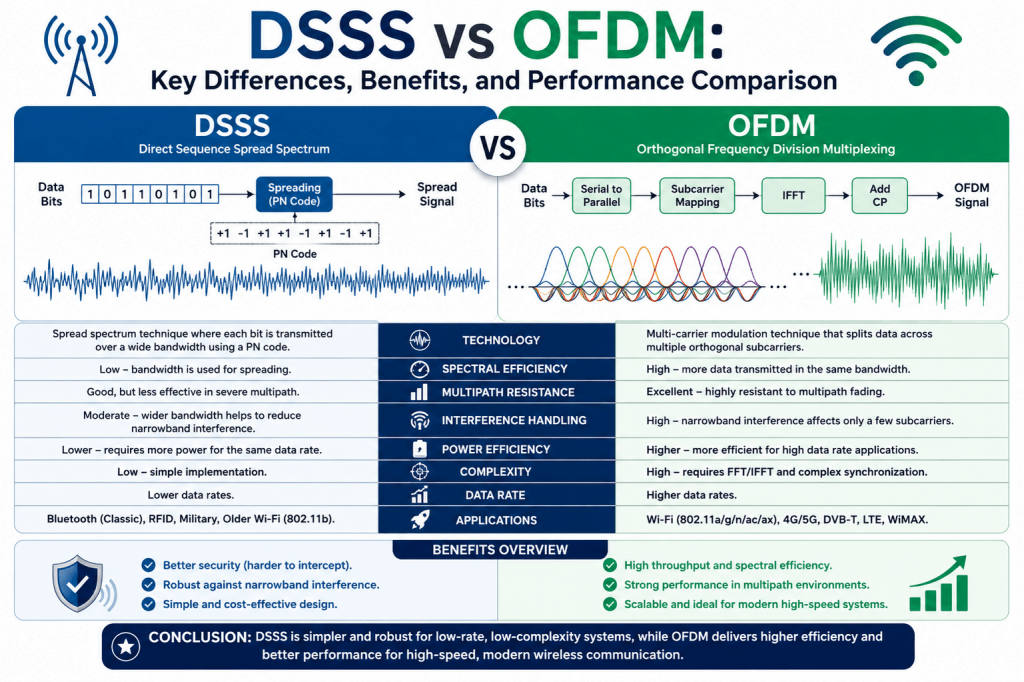
Although DSSS and OFDM both improve wireless communication, their design philosophies are very different. DSSS focuses on spreading information widely to improve reliability and resistance to interference. OFDM focuses on organizing frequencies efficiently to maximize speed and capacity.
DSSS achieves stability through redundancy. Each data bit becomes multiple chips spread across a broad frequency range. Even if portions of the transmission are lost, the receiver can recover the original information.
OFDM, on the other hand, achieves efficiency through parallel transmission. Instead of repeating data, it divides the spectrum into tightly packed subcarriers that carry separate streams simultaneously.
This difference affects overall performance characteristics. DSSS systems are generally simpler and highly reliable in noisy environments. OFDM systems provide much higher data rates and better spectrum efficiency but require more advanced processing and synchronization.
DSSS is particularly effective in situations where communication stability matters more than speed. OFDM excels in modern high-bandwidth applications where large amounts of data must be transmitted quickly.
Both technologies also address interference differently. DSSS minimizes interference impact through signal spreading and redundancy. OFDM prevents interference through mathematical synchronization and orthogonal frequency organization.
In practice, modern wireless networks often combine multiple technologies to achieve the best balance between reliability, efficiency, and speed.
DSSS vs OFDM Performance in Real Wireless Networks
Wireless communication systems operate in environments filled with challenges that constantly affect signal quality. Buildings, weather conditions, moving objects, electronic devices, and network congestion all influence how data travels through the air. DSSS and OFDM were developed to solve these challenges in different ways, and understanding their real-world performance helps explain why both technologies remain important in wireless networking.
DSSS was designed during a time when wireless communication reliability was the highest priority. Early wireless systems needed strong protection against interference because hardware limitations made signals more vulnerable to disruption. DSSS solved this problem by spreading information across multiple frequencies and using redundant chips to reconstruct lost data.
OFDM emerged later as wireless demand increased dramatically. As internet usage expanded and multimedia applications became common, networks required much faster data transmission rates. OFDM addressed this need by improving spectrum efficiency and supporting parallel communication across multiple subcarriers.
The evolution from DSSS-focused systems to OFDM-based networks reflects the changing priorities of wireless communication. Early networks emphasized reliability and coverage, while modern networks emphasize speed, scalability, and high-capacity data transfer.
Despite these differences, both technologies continue to influence modern communication systems. Their principles remain fundamental to wireless engineering and network design.
Data Transmission Efficiency in DSSS
Efficiency in wireless communication refers to how effectively a system uses available spectrum to transfer data. DSSS prioritizes reliability over maximum efficiency because it spreads information across a wider bandwidth than necessary for the original data size.
When a DSSS transmitter sends information, each bit becomes multiple chips. This process increases redundancy but also consumes additional spectrum space. More bandwidth is required to carry the same amount of information compared to systems optimized purely for speed.
Although this may appear inefficient from a throughput perspective, the tradeoff provides important benefits. DSSS transmissions remain stable even in environments with heavy interference. This reliability makes DSSS valuable for applications where consistent communication matters more than raw speed.
The spreading process also reduces the likelihood that narrowband interference will completely destroy a signal. Since information exists across many frequencies, interference affecting one section of the spectrum usually cannot disrupt the entire transmission.
DSSS systems are particularly effective in environments where wireless signals encounter unpredictable noise sources. Industrial facilities, older office buildings, and crowded wireless spaces often create conditions where stable communication becomes difficult. DSSS handles these situations remarkably well because of its redundancy-based design.
Another factor affecting DSSS efficiency is signal recovery capability. Receivers do not need every transmitted chip to reconstruct the original data. Even partial reception often contains enough information for successful decoding. This improves communication reliability under weak signal conditions.
The tradeoff between efficiency and reliability defines DSSS performance. While it may not achieve extremely high speeds, it delivers dependable communication in environments where signal integrity is critical.
OFDM and High-Speed Communication
OFDM was specifically developed to improve data transmission speed and spectrum utilization. Instead of spreading a single signal across a broad frequency range, OFDM divides the available spectrum into multiple subcarriers that operate simultaneously.
This parallel communication structure dramatically increases throughput. Multiple streams of information travel at the same time, allowing OFDM systems to transmit large amounts of data efficiently.
One of the biggest advantages of OFDM is its ability to maximize spectrum usage. Traditional wireless systems often leave empty buffer spaces between channels to prevent interference. These unused gaps reduce overall efficiency.
OFDM eliminates much of this wasted space through orthogonal subcarrier alignment. The subcarriers overlap without interfering because their timing relationships are mathematically controlled. This allows more information to fit into the same bandwidth.
Modern wireless technologies rely heavily on OFDM because of its high-capacity performance. Streaming video, cloud applications, online gaming, and real-time communication all require rapid data transfer that older spread spectrum methods cannot efficiently support.
Another major advantage of OFDM is scalability. Network designers can adjust the number of subcarriers, modulation techniques, and bandwidth allocation based on application requirements. This flexibility allows OFDM to support everything from local Wi-Fi networks to advanced mobile communication systems.
The processing complexity of OFDM is higher than DSSS because the system requires precise synchronization and advanced digital signal processing. However, improvements in computing power and semiconductor technology made large-scale OFDM implementation practical.
As wireless demand continues increasing, OFDM remains one of the most important technologies for achieving high-speed communication.
Signal Reliability and Stability Differences
Reliability is one of the most important characteristics in wireless communication. A network may offer high theoretical speeds, but poor stability can make the connection frustrating and unusable.
DSSS excels in signal stability because of its redundancy-based transmission structure. By spreading data across multiple frequencies and generating multiple chips for each bit, DSSS creates strong protection against signal corruption.
If interference damages part of the transmission, the receiver can still reconstruct the original data using the remaining chips. This makes DSSS highly resistant to temporary disruptions caused by environmental conditions or competing wireless devices.
OFDM approaches reliability differently. Instead of using heavy redundancy, OFDM relies on advanced frequency organization and error correction mechanisms. Its subcarriers are carefully synchronized to prevent interference while maximizing transmission efficiency.
Although OFDM provides excellent performance in most environments, it can be more sensitive to synchronization problems and frequency errors compared to DSSS. Small timing inaccuracies may affect multiple subcarriers simultaneously.
However, modern OFDM systems include sophisticated correction techniques that greatly improve reliability. Adaptive modulation, forward error correction, and dynamic channel management help maintain stable communication even under challenging conditions.
In environments with significant signal reflections, OFDM often performs better than older single-carrier systems because its long symbol durations reduce the impact of delayed signals.
The choice between DSSS and OFDM depends heavily on communication priorities. DSSS emphasizes dependable signal recovery, while OFDM emphasizes efficient high-speed transmission with intelligent correction systems.
Interference Resistance in Wireless Communication
Interference remains one of the biggest problems in wireless networking. Multiple devices compete for limited spectrum space, creating congestion and signal degradation.
DSSS was specifically designed to resist interference. Since the signal spreads across a broad frequency range, narrowband interference sources affect only a small portion of the transmission. The receiver can usually recover the original information even when some frequencies become corrupted.
This characteristic gives DSSS excellent resilience in noisy environments. Electronic equipment, neighboring wireless networks, and industrial machinery generate interference that DSSS can often tolerate effectively.
The pseudonoise coding process also helps DSSS receivers distinguish intended signals from background noise. Since both transmitter and receiver share the same spreading sequence, unrelated signals become easier to filter out.
OFDM handles interference differently. Instead of relying mainly on spreading, it uses precise frequency organization and advanced error correction. Subcarriers operate independently, allowing the system to isolate and manage interference affecting specific portions of the spectrum.
Adaptive techniques enable OFDM systems to respond dynamically to changing interference conditions. Subcarriers experiencing poor signal quality may switch to more robust modulation schemes while stronger channels maintain higher speeds.
This flexibility improves overall network performance in crowded wireless environments.
However, OFDM systems may experience performance degradation if synchronization becomes unstable or if interference affects multiple subcarriers simultaneously. Advanced signal processing helps reduce these risks, but OFDM generally requires more computational complexity than DSSS.
Both technologies provide strong interference resistance, but they achieve it through very different engineering approaches.
Wireless Spectrum Usage and Capacity
Wireless spectrum is a limited resource shared by countless communication systems. Efficient spectrum management is essential for supporting growing demand from smartphones, laptops, smart devices, and industrial equipment.
DSSS consumes relatively large amounts of bandwidth because it spreads signals across wide frequency ranges. This improves reliability but reduces spectrum efficiency compared to more advanced techniques.
During the early years of wireless networking, this tradeoff was acceptable because network traffic volumes were lower. Stability and interference resistance were considered more important than maximum capacity.
As internet usage expanded, the need for higher efficiency became increasingly urgent. OFDM solved this problem by organizing frequency usage much more effectively.
Instead of spreading one signal broadly, OFDM divides the spectrum into many tightly packed subcarriers. These subcarriers overlap mathematically without causing interference, allowing far more data to fit into the same bandwidth.
This efficient spectrum utilization became one of OFDM’s greatest strengths. Modern wireless networks support massive numbers of users and devices because OFDM enables extremely high-capacity communication.
The ability to transmit parallel data streams also improves network scalability. As bandwidth requirements increase, OFDM systems can expand capacity more effectively than traditional spread spectrum approaches.
Spectrum efficiency continues to grow in importance as wireless technologies evolve. Streaming services, virtual reality applications, connected vehicles, and smart cities all require enormous communication capacity.
OFDM remains a foundational technology for addressing these demands.
Multipath Propagation Challenges
Multipath propagation occurs when wireless signals reflect off surfaces before reaching the receiver. Instead of arriving through one direct path, signals travel along multiple routes with slightly different delays.
These delayed reflections can interfere with each other and distort communication quality. Urban environments are especially vulnerable because buildings, vehicles, windows, and metal structures create countless reflective surfaces.
DSSS provides moderate resistance to multipath interference because its redundancy allows partial signal recovery. Even when some chips become distorted, the receiver may still reconstruct the original data successfully.
However, OFDM was specifically optimized to handle multipath conditions more efficiently. By dividing the signal into many slower subcarriers, OFDM reduces sensitivity to timing distortions caused by delayed reflections.
Long symbol durations help receivers separate overlapping signals more effectively. In addition, OFDM systems often use guard intervals that create timing buffers between transmissions.
These guard intervals prevent delayed reflections from interfering with neighboring symbols, dramatically improving performance in reflective environments.
This capability became especially important as wireless communication expanded into dense urban areas and indoor spaces filled with obstacles.
Modern OFDM systems are highly effective at maintaining stable performance under severe multipath conditions. This is one reason why OFDM became dominant in advanced wireless networking technologies.
Hardware Complexity and Processing Requirements
The hardware requirements for DSSS and OFDM differ significantly because of their underlying transmission methods.
DSSS systems are relatively straightforward compared to OFDM. The primary processing tasks involve pseudonoise generation, chip spreading, and signal correlation at the receiver.
Although DSSS requires additional bandwidth, its signal processing demands are generally lower than those of OFDM systems.
OFDM requires much more advanced digital signal processing. The transmitter must divide data among numerous subcarriers, maintain precise synchronization, and manage modulation across multiple parallel channels.
Receivers must accurately separate overlapping subcarriers while correcting timing errors and interference distortions.
Fast Fourier Transform algorithms play a major role in OFDM processing. These mathematical operations convert signals between time and frequency domains, enabling efficient subcarrier management.
The computational complexity of OFDM was once considered a major challenge. Earlier hardware struggled to perform the required calculations efficiently.
Advances in microprocessors, integrated circuits, and digital signal processors eventually made OFDM practical for large-scale commercial deployment.
Modern wireless devices now handle OFDM processing easily because hardware capabilities improved dramatically over time.
The higher complexity of OFDM is justified by its enormous performance advantages in speed and spectrum efficiency.
Energy Consumption and Power Efficiency
Power efficiency is another important consideration in wireless communication systems. Mobile devices, battery-powered equipment, and portable electronics all depend on efficient energy usage.
DSSS systems often provide stable low-power communication because their simpler processing requirements consume less computational energy. The spreading process itself increases transmission redundancy, but the overall signal processing workload remains relatively manageable.
This made DSSS attractive for earlier wireless devices with limited processing capabilities and battery resources.
OFDM systems require more computational power due to their advanced signal management and synchronization processes. Managing numerous subcarriers simultaneously increases processing demands.
However, OFDM can also improve overall transmission efficiency by delivering data much faster. Higher throughput allows devices to complete communication tasks more quickly, potentially reducing total transmission time.
Modern hardware optimization techniques significantly improve OFDM energy efficiency. Specialized processors and integrated wireless chipsets handle complex calculations with minimal power consumption.
The balance between processing energy and transmission efficiency continues to influence wireless system design.
As wireless technologies advance, engineers constantly seek ways to maximize performance while minimizing power usage across both DSSS and OFDM-based systems.
DSSS and OFDM in Modern Wireless Standards
Wireless communication standards have evolved significantly as demand for faster internet, better connectivity, and stronger network reliability continues to grow. DSSS and OFDM both played major roles in this evolution, influencing how modern wireless systems are designed and implemented.
During the early stages of wireless networking, DSSS became one of the foundational technologies used in wireless communication standards. At the time, network speeds were relatively low compared to modern systems, but reliability and stable communication were considered far more important than raw throughput.
DSSS offered exactly what early wireless networks needed. By spreading data across a wide range of frequencies and introducing redundancy through chip encoding, DSSS provided dependable communication even in environments with interference and signal reflections.
As wireless networking became more common, the number of connected devices increased rapidly. Homes, offices, schools, airports, and public spaces began relying heavily on wireless internet access. This growing demand exposed the limitations of older communication methods.
Higher bandwidth applications such as video streaming, online gaming, cloud computing, and large file transfers required much faster wireless speeds. DSSS alone could no longer provide the performance levels expected from modern networks.
This growing need for speed and efficiency accelerated the adoption of OFDM technology. Unlike DSSS, OFDM was specifically optimized for high-capacity communication and efficient spectrum usage. Its ability to divide bandwidth into multiple orthogonal subcarriers allowed wireless networks to support dramatically higher data rates.
Modern wireless standards increasingly adopted OFDM because it delivered the scalability required for advanced networking applications.
DSSS in Early Wireless Networking Systems
Early wireless local area networks relied heavily on DSSS because of its strong resistance to interference and signal degradation. At the time, wireless environments were relatively simple, but reliability remained a major concern.
Wireless signals frequently encountered obstacles such as walls, furniture, machinery, and competing electronic devices. DSSS addressed these problems effectively by spreading transmissions across broader frequency ranges.
The redundancy built into DSSS communication made early wireless systems more dependable than narrowband alternatives. Even when portions of the signal became corrupted, receivers could still reconstruct the original information using the remaining chips.
This reliability was extremely valuable in business environments where stable communication mattered more than high speeds. Offices and industrial settings needed dependable wireless connectivity for basic networking tasks, inventory management, and communication systems.
DSSS also performed well over longer distances compared to some early high-speed technologies. Since receivers could recover signals even when transmission strength weakened, DSSS provided solid coverage in larger environments.
Another reason DSSS became popular was its relative simplicity. Hardware capable of supporting DSSS communication was easier to develop using the processing technology available during earlier stages of wireless networking.
As wireless adoption expanded, DSSS laid the foundation for future innovations in wireless communication.
The Rise of OFDM in High-Speed Networks
As internet usage evolved, wireless networks needed to support much larger volumes of traffic. Simple web browsing was no longer the primary use case. Users demanded real-time video streaming, online collaboration, multiplayer gaming, and rapid cloud access.
These applications required communication systems capable of delivering high throughput with low latency.
OFDM emerged as the ideal solution because of its exceptional spectrum efficiency and support for parallel data transmission. By dividing communication into multiple synchronized subcarriers, OFDM dramatically increased wireless capacity.
One of OFDM’s greatest advantages was its ability to maximize limited spectrum resources. Instead of wasting bandwidth with large frequency gaps, OFDM packed subcarriers closely together while preventing interference through orthogonal timing relationships.
This efficiency allowed networks to transmit far more data within the same spectrum space.
The ability to support adaptive modulation also made OFDM highly flexible. Wireless systems could automatically adjust transmission settings based on signal quality and environmental conditions.
Strong connections could use aggressive modulation schemes for higher speeds, while weaker connections switched to more robust configurations for improved reliability.
This dynamic adaptability improved overall network performance and user experience.
OFDM quickly became the dominant technology for advanced wireless standards because it could handle the growing complexity and scale of modern communication demands.
Wi-Fi and the Influence of DSSS and OFDM
Wireless networking technologies used in homes and businesses evolved through multiple generations, and both DSSS and OFDM contributed to this development.
Early Wi-Fi standards relied heavily on DSSS communication techniques. These systems prioritized stable connectivity and interference resistance rather than extreme speed.
At the time, internet connections themselves were relatively slow, so wireless network limitations were less noticeable. Basic tasks such as email, file sharing, and simple web browsing did not require massive bandwidth.
As broadband internet speeds increased, wireless networking standards had to improve as well. OFDM became increasingly important because it enabled much higher throughput and better spectrum utilization.
Modern Wi-Fi systems rely extensively on OFDM technology to deliver fast and efficient wireless communication. Streaming high-definition video, supporting multiple simultaneous devices, and maintaining stable performance in crowded environments all depend heavily on OFDM-based transmission methods.
Despite the transition toward OFDM, DSSS concepts still influenced modern wireless design. Techniques involving redundancy, signal spreading, and interference management remain important in advanced communication systems.
Many wireless technologies combine ideas from both DSSS and OFDM to achieve balanced performance.
This blending of technologies demonstrates how wireless engineering evolves by building upon previous innovations rather than completely replacing them.
DSSS and OFDM in Mobile Communication
Mobile communication systems face unique challenges compared to fixed wireless networks. Smartphones and mobile devices constantly move between environments with varying signal conditions, interference levels, and network congestion.
DSSS provided important benefits during earlier stages of mobile communication because its redundancy improved signal reliability in unstable environments.
As users moved through cities, buildings, and transportation systems, wireless signals frequently encountered reflections, fading, and interference. DSSS helped maintain communication stability under these changing conditions.
However, the rapid growth of mobile internet usage created enormous demand for faster data transmission. Video streaming, mobile applications, cloud services, and social media platforms required communication systems capable of handling massive data volumes.
OFDM became essential for supporting these requirements. Its efficient spectrum usage and high-capacity transmission capabilities allowed mobile networks to serve millions of users simultaneously.
Modern mobile communication systems rely heavily on OFDM and related technologies because they support scalable, high-speed wireless networking.
The ability to divide communication into multiple subcarriers also improves performance in complex urban environments where signal reflections are common.
Advanced mobile systems use sophisticated OFDM variations combined with multiple antenna technologies to maximize coverage, speed, and reliability.
These innovations continue pushing wireless communication toward even greater performance levels.
Spectrum Congestion and Network Scalability
One of the biggest challenges facing wireless communication today is spectrum congestion. The number of connected devices continues growing rapidly, increasing competition for limited wireless frequencies.
Smartphones, laptops, tablets, smart TVs, gaming consoles, industrial sensors, security systems, and Internet of Things devices all share the same wireless environments.
DSSS performs well in noisy conditions because its spread spectrum design resists interference effectively. However, DSSS is not highly spectrum-efficient compared to modern high-capacity communication systems.
As wireless traffic volumes increased, more efficient spectrum management became necessary.
OFDM addressed this challenge by organizing frequency usage much more effectively. Its tightly packed orthogonal subcarriers allow far more information to travel within the same bandwidth.
This efficiency dramatically improves network scalability.
Modern wireless networks must support dense populations of connected devices operating simultaneously. Stadiums, airports, shopping centers, universities, and smart cities all require communication systems capable of handling enormous wireless demand.
OFDM enables this scalability through efficient frequency allocation and advanced signal management.
Adaptive communication techniques further improve performance by dynamically adjusting transmission parameters based on real-time network conditions.
As connected device ecosystems continue expanding, spectrum efficiency will remain one of the most important priorities in wireless engineering.
Security Considerations in DSSS and OFDM
Security is another important aspect of wireless communication. Since wireless signals travel openly through the air, communication systems must protect data from unauthorized access and interference.
DSSS naturally provides a degree of signal obscurity because transmitted information is spread across multiple frequencies using pseudonoise sequences. Without the correct decoding pattern, intercepting and reconstructing the signal becomes more difficult.
Although DSSS alone does not provide strong encryption, it does add complexity that helps reduce accidental interception.
OFDM focuses primarily on transmission efficiency rather than inherent signal obscurity. Its subcarriers are carefully organized for maximum spectrum utilization, but additional security protocols are typically required to protect transmitted data.
Modern wireless networks rely on encryption, authentication, and advanced security frameworks layered on top of OFDM communication systems.
Both DSSS and OFDM can operate securely when combined with proper encryption technologies.
As wireless communication becomes increasingly important for banking, healthcare, government systems, and industrial operations, strong security mechanisms remain essential.
Future wireless systems will continue integrating advanced security features alongside high-speed communication technologies.
Future Evolution of Wireless Technologies
Wireless communication continues evolving at an extraordinary pace. New applications such as artificial intelligence, autonomous vehicles, augmented reality, smart infrastructure, and industrial automation require increasingly advanced networking capabilities.
The principles introduced by DSSS and OFDM continue influencing modern wireless research and development.
DSSS demonstrated the value of redundancy, interference resistance, and reliable signal recovery. These concepts remain important in communication systems designed for unstable or noisy environments.
OFDM revolutionized spectrum efficiency and high-capacity wireless communication. Its influence extends across modern networking technologies, mobile communication systems, and broadband wireless infrastructure.
Future wireless technologies will likely build upon OFDM foundations while introducing even more advanced techniques for managing interference, improving efficiency, and increasing capacity.
Artificial intelligence may eventually help wireless systems dynamically optimize spectrum allocation and communication parameters in real time.
Massive antenna systems, advanced beamforming, and ultra-dense wireless architectures are already pushing communication performance far beyond earlier limitations.
Despite these advancements, the core challenges remain the same. Wireless systems must balance speed, reliability, coverage, interference resistance, energy efficiency, and security.
The ongoing evolution of wireless communication reflects the constant effort to improve how information travels through increasingly crowded and complex environments.
Conclusion
DSSS and OFDM represent two of the most influential wireless communication technologies ever developed. Although they approach communication challenges differently, both played essential roles in shaping modern networking systems.
DSSS focuses on reliability by spreading signals across wide frequency ranges and using redundant chip encoding to protect against interference and signal loss. Its design emphasizes stable communication, resistance to noise, and dependable performance in difficult environments.
OFDM focuses on efficiency by dividing spectrum into multiple synchronized subcarriers that support parallel data transmission. Its advanced frequency organization dramatically improves speed, capacity, and spectrum utilization.
The transition from DSSS-dominated systems to OFDM-based networks reflects the changing demands of wireless communication. Early networks prioritized reliability and coverage, while modern systems require massive throughput and support for countless connected devices.
Today, wireless communication technologies continue building upon the principles introduced by both DSSS and OFDM. Modern networks combine reliability mechanisms, advanced signal processing, adaptive communication techniques, and efficient spectrum management to deliver fast and stable connectivity across the world.
Understanding DSSS and OFDM provides valuable insight into how wireless systems evolved and why modern communication networks are capable of supporting the enormous digital demands of today’s connected society.