
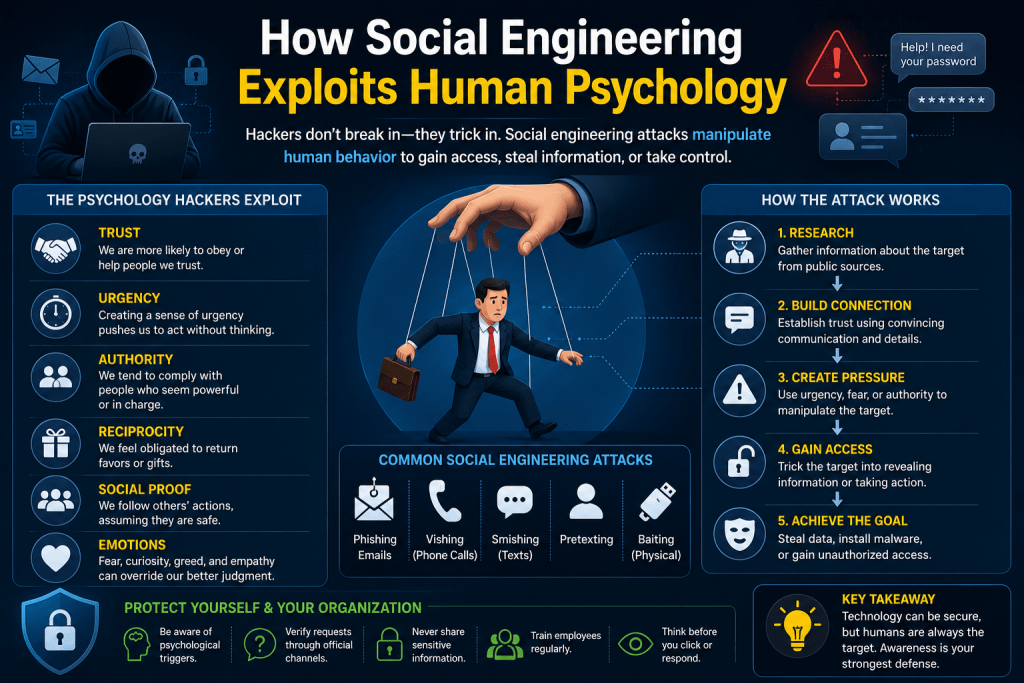
Social engineering remains one of the most dangerous forms of cyberattack because it targets human behavior instead of computer systems. Firewalls, antivirus software, and advanced security tools can protect networks from many technical threats, but human emotions are much harder to defend. Attackers understand this reality very well. Instead of spending months trying to break through encrypted systems, they often focus on manipulating people into willingly giving away information, access, or control.
The effectiveness of social engineering comes from the fact that humans naturally trust, react emotionally, and make decisions under pressure. Every person wants to feel safe, respected, included, and informed. Social engineers exploit these natural psychological responses to achieve their goals. In many cases, victims do not even realize they are being manipulated until the damage has already occurred.
Modern communication technologies have amplified the power of social engineering attacks. Email, messaging apps, social media platforms, and online collaboration tools provide attackers with unlimited opportunities to reach potential victims. A criminal sitting in one country can manipulate someone thousands of miles away within seconds. This global connectivity has transformed social engineering into a large-scale threat affecting businesses, governments, and ordinary individuals alike.
Understanding the Core Meaning of Social Engineering
At its core, social engineering is the act of influencing or manipulating someone into performing actions they would not normally perform. These actions may include revealing confidential information, transferring money, opening malicious files, or granting unauthorized access to systems.
Unlike traditional hacking, social engineering does not rely heavily on technical expertise alone. Instead, it relies on understanding human psychology. Attackers carefully study how people think, behave, and respond to different situations. They use this knowledge to design convincing scenarios that trigger emotional reactions.
A social engineer may pretend to be a trusted coworker, a bank employee, a government official, or even a friend. The goal is always the same: gain trust quickly enough to influence the victim’s decisions. Once trust is established, victims often lower their guard and cooperate willingly.
This manipulation can happen through many channels. Some attacks occur through emails designed to look legitimate. Others happen through phone calls, text messages, fake websites, or social media conversations. In many situations, attackers combine multiple methods together to make their schemes appear more believable.
Why Humans Are Easier to Exploit Than Computers
Computers follow rules and instructions exactly as programmed. Humans do not. Human behavior is influenced by emotions, stress, habits, assumptions, and social expectations. This unpredictability creates opportunities for attackers.
Cybersecurity systems can block suspicious software, detect unusual traffic, and monitor unauthorized access attempts. However, if an employee willingly shares their password with someone pretending to be a company executive, technical defenses become useless.
Attackers recognize that manipulating people is often faster and cheaper than attacking systems directly. Instead of writing sophisticated malware, a criminal can simply convince a victim to click a dangerous link. This method saves time while still producing highly effective results.
Human beings also tend to trust familiar routines. People receive emails daily, answer phone calls regularly, and interact online constantly. Attackers disguise themselves within these normal activities. Because the communication appears routine, victims rarely suspect malicious intent immediately.
Another important factor is distraction. Many people multitask throughout the day while dealing with deadlines, meetings, notifications, and personal responsibilities. Social engineers exploit busy environments because distracted individuals are more likely to make mistakes or overlook warning signs.
The Emotional Foundation of Social Engineering
Emotions are one of the strongest weapons used in social engineering attacks. Fear, excitement, curiosity, urgency, and trust all influence decision-making processes. Attackers deliberately trigger emotional reactions because emotional thinking often overrides logical analysis.
Fear is particularly powerful. If someone receives a message claiming their bank account has been compromised, panic may cause them to react immediately without verifying the message. Similarly, threats involving legal consequences, account suspension, or financial loss push victims toward impulsive decisions.
Excitement and opportunity also play major roles. Messages promising prizes, promotions, discounts, or exclusive offers attract attention quickly. People naturally respond positively to rewards, making them more vulnerable to manipulation.
Curiosity is another effective trigger. Humans instinctively want answers to unknown situations. An email with a mysterious attachment or an unexpected message can tempt someone to investigate further, even when caution would be safer.
Social engineers understand that emotional responses reduce critical thinking. When emotions become stronger, logical reasoning weakens. Attackers create scenarios specifically designed to exploit this psychological weakness.
How Trust Becomes a Weapon
Trust is essential for human society. People trust family members, coworkers, institutions, and businesses every day. Without trust, communication and cooperation would become extremely difficult. Unfortunately, attackers exploit this necessity.
One common technique involves impersonation. Attackers pretend to represent trusted organizations such as banks, delivery companies, technology providers, or employers. Victims often cooperate because the request appears to come from a familiar source.
Modern attackers spend significant time researching their targets before launching attacks. Social media profiles, public records, company websites, and online discussions provide valuable information. Using this data, attackers create highly personalized messages that appear authentic.
For example, an attacker may learn that an employee recently attended a conference. The attacker could then send a fake follow-up email related to that event. Because the message references real information, the victim becomes more likely to trust it.
Relationships built over time can also be exploited. Some attackers spend weeks or months communicating with victims before making requests. Gradually building familiarity increases the likelihood of compliance later.
Trust-based attacks are especially dangerous because victims rarely suspect manipulation from people they believe they know or recognize. Once trust exists, skepticism decreases dramatically.
The Role of Technology in Modern Social Engineering
Technology has dramatically increased the reach and sophistication of social engineering attacks. Years ago, attackers were limited by physical distance and communication barriers. Today, the internet allows manipulation on a global scale.
Email remains one of the most common attack methods because it is inexpensive and easy to distribute. Attackers can send millions of phishing emails within minutes. Even if only a small percentage of recipients respond, the campaign can still generate significant profits.
Social media platforms have expanded opportunities even further. Attackers gather personal information, monitor behavior patterns, and identify relationships through online profiles. This information helps create believable attacks tailored to specific individuals.
Messaging applications also create new vulnerabilities. People tend to trust messages received through communication platforms they use daily. Attackers exploit this familiarity by impersonating coworkers, friends, or support teams.
Artificial intelligence has further increased the danger. Attackers can now generate convincing messages with proper grammar, realistic tone, and personalized details. Voice imitation technology and deepfake videos are making impersonation attacks increasingly believable.
The combination of psychology and advanced technology creates highly effective manipulation campaigns capable of targeting individuals, organizations, and even entire populations.
Why Social Engineering Works on Intelligent People
Many people assume only inexperienced or careless individuals fall victim to social engineering attacks. In reality, highly educated and experienced professionals are targeted successfully every day.
Intelligence alone does not eliminate emotional reactions. Even cybersecurity experts can become vulnerable when tired, stressed, distracted, or emotionally triggered. Attackers understand that anyone can make mistakes under the right conditions.
Professional environments often increase vulnerability rather than reduce it. Employees are expected to respond quickly, collaborate efficiently, and trust internal communications. Attackers exploit workplace culture by sending urgent requests that appear to come from managers or executives.
Confidence can also create weaknesses. People who believe they would never fall for scams sometimes pay less attention to warning signs. Overconfidence reduces caution and increases risk.
Social engineering attacks are carefully designed to appear realistic. Many fraudulent emails and messages closely resemble legitimate communications. Logos, branding, writing style, and formatting are often copied convincingly.
Additionally, attackers continuously improve their methods. Failed attacks provide valuable lessons, allowing criminals to refine future campaigns. Over time, social engineering techniques become increasingly sophisticated and difficult to detect.
The Connection Between Social Engineering and Cybercrime
Social engineering plays a major role in modern cybercrime. Many major security breaches begin with some form of human manipulation rather than technical hacking.
Attackers frequently use phishing emails to distribute malware. A victim opens an infected attachment or clicks a malicious link, unknowingly installing harmful software on their device. Once inside the system, attackers can steal data, monitor activity, or spread further داخل the network.
Ransomware attacks commonly start through social engineering techniques. Employees may receive fake invoices, shipping documents, or urgent notifications containing malicious files. Once opened, ransomware encrypts company data and demands payment for recovery.
Credential theft is another major objective. Attackers create fake login pages that imitate trusted services. Victims unknowingly enter usernames and passwords, which attackers immediately capture and use.
Financial fraud schemes also rely heavily on manipulation. Criminals impersonate executives or vendors to trick employees into transferring funds. These attacks can result in enormous financial losses within minutes.
Because human behavior remains difficult to control completely, social engineering continues to serve as one of the most effective entry points for cybercriminals worldwide.
The Evolution of Social Engineering Over Time
Social engineering is not a new phenomenon. Manipulation and deception have existed throughout human history. Con artists, spies, and criminals have always relied on psychological tactics to influence others.
What has changed is the scale and speed of attacks. Digital communication enables criminals to target massive audiences instantly. A scam that once required physical presence can now operate entirely online.
Early internet scams were often easy to identify because of poor grammar, unrealistic claims, and obvious inconsistencies. Modern attacks are far more polished. Attackers research victims carefully and create professional-looking communications.
Social engineering has also expanded beyond financial theft. Today, manipulation campaigns may target political opinions, public perception, social division, and misinformation distribution. Large groups of people can be influenced simultaneously through coordinated online campaigns.
The rise of remote work has introduced additional risks. Employees working from home rely heavily on digital communication, making impersonation attacks easier. Without face-to-face verification, fraudulent requests become harder to identify.
As communication technology continues evolving, social engineering methods will likely become even more sophisticated and personalized.
Why Awareness Alone Is Not Enough
Security awareness training helps reduce risk, but it cannot eliminate social engineering entirely. Knowing about attacks does not guarantee perfect decision-making during real situations.
People often recognize scams only after reflecting calmly. During stressful or urgent moments, emotional reactions may still override caution. Attackers intentionally create pressure to reduce rational analysis.
Repeated exposure to warnings can also create fatigue. Employees constantly reminded about phishing attacks may eventually stop paying close attention. Over time, security messages lose emotional impact.
Another challenge involves balancing security with productivity. Organizations want employees to work efficiently and respond quickly. Excessive caution can slow operations, creating tension between convenience and security.
Attackers continuously adapt their techniques to bypass awareness efforts. When people learn to recognize one method, criminals develop new variations. This constant evolution makes social engineering an ongoing challenge rather than a problem with a permanent solution.
The human element remains unpredictable. Even well-trained individuals can experience moments of distraction, exhaustion, or emotional vulnerability. Attackers depend on these moments to succeed.
The Human Condition as the Ultimate Vulnerability
The true reason social engineering is so effective lies within basic human nature. People want to trust others, help coworkers, avoid conflict, respond quickly, and stay informed. These behaviors are not weaknesses in themselves. They are normal social traits necessary for society to function.
Attackers weaponize these positive human qualities for malicious purposes. Kindness becomes vulnerability. Trust becomes access. Curiosity becomes opportunity. Urgency becomes pressure.
Social engineering succeeds because it manipulates instincts developed over thousands of years of human interaction. Technology may evolve rapidly, but human psychology changes much more slowly.
Understanding this reality is essential for both individuals and organizations. Technical defenses remain important, but awareness of psychological manipulation is equally critical. Recognizing emotional triggers, verifying suspicious requests, and slowing down during high-pressure situations can reduce risk significantly.
Despite advances in cybersecurity technology, social engineering continues thriving because humans remain emotional, social, and trusting beings. As long as those traits exist, attackers will continue attempting to exploit them.
Authority as a Powerful Social Engineering Weapon
One of the strongest psychological tools used in social engineering attacks is authority. Human beings are naturally conditioned to respect authority figures from a very young age. Parents, teachers, police officers, managers, and government officials all represent positions of power and control within society. Over time, people develop habits of listening to and obeying those they perceive as authoritative.
Social engineers exploit this deeply rooted behavior. Instead of appearing suspicious or threatening, attackers often pretend to be individuals with power, expertise, or official status. Victims are far more likely to comply with requests when they believe those requests come from someone important.
This tactic works because questioning authority can feel uncomfortable. Many people worry about appearing disrespectful, disobedient, or uncooperative. Attackers understand these emotional reactions and use them strategically.
A fake email appearing to come from a company executive demanding urgent action may convince employees to bypass normal security procedures. Similarly, someone posing as technical support may persuade users to share passwords or install software. The illusion of authority lowers skepticism and increases compliance.
Authority-based attacks are particularly effective in workplaces because organizations operate through hierarchy. Employees are trained to follow instructions from supervisors quickly and efficiently. Social engineers imitate that structure to manipulate victims into making mistakes.
How Impersonation Creates Credibility
Impersonation is one of the most common forms of social engineering. Attackers carefully imitate trusted individuals or organizations to appear legitimate. The more believable the disguise, the greater the chances of success.
Modern attackers use publicly available information to strengthen their impersonation attempts. Company websites reveal employee names, job titles, email formats, and organizational structures. Social media accounts provide personal details, interests, travel plans, and communication styles.
Using this information, attackers can craft highly convincing messages. An email may include a manager’s real name, company branding, and realistic wording. To a busy employee, the communication may appear completely genuine.
Phone-based impersonation attacks are also extremely dangerous. Attackers may call victims pretending to represent banks, government agencies, internet providers, or security departments. A confident tone of voice combined with believable details often convinces victims to cooperate.
Some attackers even create fake identities over extended periods. They build online profiles, establish social connections, and interact regularly with targets before launching attacks. By the time the manipulation begins, victims may already trust the fake identity completely.
The success of impersonation demonstrates how strongly humans rely on familiarity and appearance when determining trustworthiness.
The Psychological Impact of Fear
Fear is among the most effective emotional triggers in social engineering. When people feel threatened, they often react quickly instead of thinking carefully. Attackers deliberately create fear to pressure victims into immediate action.
Messages warning about compromised bank accounts, legal trouble, security breaches, or account suspension are designed specifically to provoke anxiety. Fear narrows attention and encourages impulsive decisions.
A person receiving a message claiming their online account will be permanently locked may panic and click malicious links without verifying authenticity. Similarly, threats involving taxes, fines, or law enforcement can intimidate victims into revealing sensitive information.
Fear-based attacks are successful because humans instinctively seek to eliminate danger quickly. Attackers exploit this survival response by presenting themselves as the solution to the problem they created.
Scammers frequently use aggressive language and urgent deadlines to intensify emotional pressure. Victims may feel they have only minutes to respond before facing serious consequences. Under this stress, logical thinking weakens significantly.
Fear also discourages people from asking questions. Victims may worry about making situations worse or appearing guilty. This silence benefits attackers by reducing opportunities for verification.
Why Urgency Weakens Rational Thinking
Urgency is another critical ingredient in successful social engineering attacks. Attackers intentionally create situations where victims feel rushed and unable to think carefully.
Under normal circumstances, people may verify requests, consult coworkers, or examine suspicious details. Urgency disrupts these protective behaviors by creating pressure for immediate action.
An attacker might claim that a payment must be processed within minutes to avoid penalties. Another may insist that confidential documents are urgently needed before an important meeting. The goal is always to reduce the victim’s available thinking time.
Human brains respond differently under pressure. Stress increases emotional reactions while decreasing analytical reasoning. Attackers exploit this psychological shift by creating artificial emergencies.
Urgency is especially effective in professional environments because employees are often expected to act quickly. Delayed responses may be viewed negatively within many workplaces. Social engineers use this cultural expectation to their advantage.
Cybercriminals frequently combine urgency with authority for maximum effect. A message appearing to come from a senior executive demanding immediate action can be extremely persuasive. Employees may fear disciplinary consequences if they hesitate or question the request.
This combination creates a dangerous environment where victims prioritize speed over caution.
The Role of Curiosity in Human Vulnerability
Curiosity is a natural human trait that social engineers manipulate regularly. People instinctively want answers, explanations, and new information. Attackers use curiosity to lure victims into dangerous actions.
Unexpected emails, mysterious attachments, shocking headlines, or secretive messages all trigger curiosity. Victims often feel compelled to investigate, even when warning signs exist.
A subject line claiming “Confidential Salary Information” or “Important Internal Report” may tempt employees to open malicious files. Similarly, social media posts with sensational claims encourage users to click suspicious links.
Curiosity-based attacks succeed because humans dislike uncertainty. People naturally seek closure and understanding when presented with incomplete information. Attackers exploit this psychological discomfort to guide victims toward risky behavior.
Online environments intensify this vulnerability. Notifications, headlines, and trending topics constantly compete for attention. Attackers design malicious content to blend seamlessly into this information flow.
Curiosity can also override caution because investigating something feels harmless initially. Victims may assume simply opening a message or clicking a link poses little risk. By the time they recognize danger, attackers may already have gained access to systems or information.
Social Proof and the Need for Belonging
Humans are deeply social creatures. People often look to others for guidance when making decisions, especially during uncertain situations. Social engineers exploit this tendency through social proof and consensus tactics.
If individuals believe others are performing certain actions, they become more likely to follow along. This behavior helps explain trends, peer pressure, and viral online activity.
Attackers may create fake reviews, false testimonials, or fabricated popularity to influence victims. Messages claiming that “thousands of users have already updated their accounts” or “everyone in your department has completed this process” encourage compliance.
Social media platforms amplify the power of social proof dramatically. Fake accounts, coordinated campaigns, and manipulated engagement metrics can create the illusion of widespread agreement or popularity.
People generally prefer fitting in rather than standing apart from groups. Social engineers use this psychological desire to encourage participation in scams, misinformation campaigns, or fraudulent activities.
Consensus-based attacks are particularly dangerous because they reduce suspicion. If others appear to trust something, individuals often assume it must be safe or legitimate.
Attackers understand that humans are influenced heavily by perceived group behavior. By manufacturing artificial consensus, they manipulate victims into lowering their defenses.
Scarcity and the Fear of Missing Out
Scarcity is another psychological trigger frequently used in social engineering. People place higher value on opportunities they believe are limited or temporary.
Attackers create artificial scarcity to pressure victims into acting quickly without careful evaluation. Limited-time offers, exclusive access, urgent deadlines, and disappearing opportunities all exploit fear of missing out.
This tactic appears frequently in scams involving fake investments, online shopping fraud, and promotional offers. Victims may rush into decisions because they fear losing valuable opportunities.
Scarcity works because humans associate rarity with importance. If something appears difficult to obtain, people assume it must have significant value.
Digital communication makes scarcity-based manipulation extremely effective. Flash sales, countdown timers, and exclusive invitations create strong emotional pressure online. Victims often react impulsively before verifying legitimacy.
Cybercriminals use scarcity alongside urgency to maximize effectiveness. Combining “limited availability” with “act immediately” creates intense pressure that reduces rational thinking.
The emotional fear of exclusion can be surprisingly powerful. People do not want to miss rewards, opportunities, or experiences others might receive. Social engineers exploit this emotional vulnerability repeatedly.
How Familiarity Builds False Security
Familiarity creates comfort, and comfort reduces caution. Social engineers frequently use familiar language, branding, routines, and relationships to lower suspicion.
An email resembling routine workplace communication may not attract much scrutiny. Similarly, messages referencing familiar events, colleagues, or services appear safer than unfamiliar communications.
Attackers study their targets carefully to mimic normal interactions convincingly. They may copy writing styles, company logos, or communication patterns. This attention to detail makes fraudulent messages appear authentic.
Repeated exposure also increases trust. If victims interact with attackers multiple times without negative experiences, they become more comfortable gradually. Over time, suspicion fades and trust grows.
This strategy is especially effective in long-term scams. Some attackers invest months building relationships before requesting money or sensitive information. Victims may feel emotionally connected to individuals who never actually existed.
Familiarity-based attacks demonstrate how trust develops through repeated interaction. Humans naturally become less defensive around people and situations that feel known or predictable.
Unfortunately, attackers exploit this psychological comfort to gain deeper access and control.
The Rise of Large-Scale Psychological Manipulation
Social engineering has expanded far beyond individual scams. Today, large-scale psychological manipulation campaigns target entire communities and populations.
Social media platforms allow information to spread instantly across millions of users. Coordinated groups can amplify messages, influence opinions, and manipulate public perception on massive scales.
False information campaigns often rely on social engineering principles. Emotional content spreads quickly because fear, anger, and outrage encourage sharing. Attackers exploit emotional reactions to influence public discussions and behavior.
These campaigns may target political beliefs, social tensions, or public trust in institutions. By manipulating emotions repeatedly, attackers attempt to shape how groups think and react.
Automated accounts and artificial engagement make false narratives appear more popular than they actually are. This manufactured consensus influences how people interpret information online.
The psychological principles behind these campaigns remain similar to traditional social engineering. Trust, fear, urgency, familiarity, and social proof continue driving human behavior. Technology simply increases speed, reach, and scale.
Large-scale manipulation demonstrates that social engineering is no longer limited to stealing passwords or financial information. It can influence societies, relationships, and public opinion itself.
Why Social Engineering Continues to Evolve
Social engineering remains effective because attackers constantly adapt their techniques. Human psychology changes slowly, but technology evolves rapidly. Criminals combine timeless psychological principles with modern communication tools to create increasingly sophisticated attacks.
Artificial intelligence now allows attackers to generate personalized messages automatically. Deepfake technology can imitate voices and faces convincingly. Fraudulent websites and communications appear more realistic than ever before.
Remote work environments have also created new vulnerabilities. Employees rely heavily on digital communication and may lack direct verification methods. Attackers exploit this distance by impersonating coworkers and executives more easily.
The growing amount of personal information available online further strengthens social engineering attacks. Public posts, professional profiles, and digital footprints provide attackers with valuable research material.
As organizations improve technical security, attackers focus even more heavily on human vulnerabilities. Manipulating people often remains easier than defeating advanced cybersecurity systems directly.
Because human emotions and social behaviors remain consistent across cultures and generations, social engineering will likely continue evolving rather than disappearing.
The Importance of Psychological Awareness
Defending against social engineering requires more than technical knowledge. Individuals must understand how psychological manipulation works and recognize emotional triggers before reacting impulsively.
Awareness begins with slowing down during stressful or urgent situations. Attackers depend on emotional reactions and rushed decisions. Taking time to verify requests can prevent many successful attacks.
Questioning unusual requests, even from familiar sources, is essential. Verification through separate communication channels reduces the risk of impersonation scams.
Understanding emotional manipulation also improves resistance. Recognizing when fear, urgency, curiosity, or excitement is influencing decisions helps restore logical thinking.
Organizations increasingly recognize that cybersecurity is not only a technical challenge but also a psychological one. Employee education programs now focus heavily on behavioral awareness and social engineering recognition.
Despite these efforts, perfect protection remains impossible because human behavior is naturally emotional and social. Attackers exploit qualities that are fundamentally part of being human.
Social engineering succeeds not because people are unintelligent, but because human psychology contains predictable patterns that can be manipulated skillfully. Understanding those patterns is one of the most important defenses against modern cyber threats.
How Social Media Supercharged Social Engineering
Social media platforms completely transformed the scale and effectiveness of social engineering attacks. Before the rise of digital networks, attackers had limited access to personal information and communication channels. Today, billions of people voluntarily share details about their lives online every day. Photos, locations, relationships, career information, interests, habits, and opinions are publicly available across multiple platforms. For social engineers, this information is extremely valuable.
Attackers no longer need to guess details about their targets. They can study victims carefully before launching attacks. A criminal can learn where someone works, who their coworkers are, what events they attended recently, and even how they communicate online. This information helps attackers craft personalized scams that appear highly believable.
For example, if someone posts about attending a business conference, attackers may send fake follow-up emails related to that event. If a user shares vacation photos online, criminals may target their workplace while they are away. Even simple details like birthdays, hobbies, or favorite brands can be used to build trust and manipulate victims.
Social media also encourages emotional reactions. Platforms are designed to maximize engagement, meaning content that triggers strong emotions spreads quickly. Social engineers exploit this environment by creating messages designed to provoke fear, outrage, excitement, or sympathy.
False information campaigns thrive in these emotionally charged spaces. Attackers understand that emotional content is more likely to be shared without verification. As a result, manipulation spreads rapidly across online communities, influencing large numbers of people simultaneously.
The Danger of Oversharing Online
Many people underestimate how dangerous personal information can become in the hands of social engineers. Information that appears harmless individually can become powerful when combined together.
Attackers often build detailed profiles of victims using public posts and online activity. This process is known as reconnaissance. The more information attackers gather, the easier it becomes to impersonate trusted contacts and design convincing scams.
A social engineer may discover where someone works, identify their coworkers, and learn about ongoing projects simply by examining social media profiles. Armed with this information, the attacker can send realistic-looking emails requesting sensitive data or urgent actions.
Even personal habits create vulnerabilities. Posting travel plans publicly may inform criminals that someone is away from home or unavailable to verify suspicious requests. Sharing pet names, schools attended, or family details can help attackers answer security questions or reset passwords.
Many users also trust social media interactions too easily. Fake accounts pretending to represent attractive individuals, recruiters, customer support representatives, or influencers frequently manipulate victims successfully.
The culture of online sharing creates an environment where privacy boundaries become weaker. Social engineers exploit this openness to gather intelligence and establish trust more effectively than ever before.
Phishing Attacks and Why They Still Work
Phishing remains one of the most successful social engineering techniques despite years of public awareness campaigns. Attackers continue using phishing because it consistently produces results.
Phishing attacks typically involve fake emails, messages, or websites designed to trick victims into revealing sensitive information. These scams often imitate trusted organizations such as banks, online services, delivery companies, or employers.
Many people wonder why phishing continues succeeding when so many warnings exist. The answer lies in human psychology. Phishing attacks target emotions and behavior patterns rather than technical weaknesses.
Modern phishing messages are often highly sophisticated. Attackers use professional designs, realistic branding, and convincing language. Some phishing emails appear nearly identical to legitimate communications.
Timing also increases effectiveness. Attackers frequently exploit real-world events, trending news, shopping seasons, or emergencies to make scams appear more believable. During periods of uncertainty or stress, people are more likely to react emotionally and less likely to analyze carefully.
Phishing attacks also rely on volume. Sending millions of emails costs very little. Even if only a tiny percentage of recipients respond, attackers can still achieve significant financial gains.
Another reason phishing remains successful is distraction. Many people check messages quickly while multitasking, working under pressure, or using mobile devices. Small warning signs are easy to miss in fast-paced environments.
Ultimately, phishing works because it manipulates natural human behavior rather than trying to defeat technology directly.
Business Email Compromise and Corporate Manipulation
One of the most financially damaging forms of social engineering is business email compromise. These attacks specifically target organizations by impersonating executives, vendors, or trusted business partners.
In many cases, attackers research company structures carefully before launching attacks. They identify employees responsible for handling payments, invoices, or sensitive data. Then they create fraudulent requests that appear legitimate.
A common tactic involves impersonating a company executive requesting an urgent money transfer. Because the request appears to come from leadership, employees may comply without verification.
Attackers often study internal communication styles to make messages more convincing. They may mimic writing patterns, signatures, or email formatting used within the organization.
Some business email compromise attacks involve fake vendor invoices. Employees receive payment requests that appear authentic and unknowingly send money directly to criminals.
These scams can cause enormous financial losses within minutes. Unlike traditional hacking attacks, social engineering bypasses many technical security controls because victims willingly authorize transactions themselves.
Corporate culture sometimes increases vulnerability as well. Employees may hesitate to question senior executives or delay urgent requests. Attackers exploit these workplace dynamics strategically.
Business email compromise demonstrates how social engineering can target organizational trust structures rather than technical systems alone.
The Relationship Between Stress and Manipulation
Stress significantly increases vulnerability to social engineering attacks. When people feel overwhelmed, exhausted, or emotionally pressured, their ability to evaluate risks decreases.
Modern life creates constant mental strain for many individuals. Work deadlines, financial concerns, personal responsibilities, and continuous digital notifications all contribute to cognitive overload.
Social engineers exploit these stressful conditions deliberately. Attackers know that distracted or anxious individuals are more likely to make impulsive decisions.
For example, an employee rushing to complete tasks before a deadline may open suspicious attachments without careful inspection. A person worried about financial problems may respond quickly to fake banking alerts or investment opportunities.
Stress also reduces attention to detail. Warning signs that might normally appear obvious can easily be overlooked when someone feels mentally overwhelmed.
Attackers frequently intensify existing stress intentionally. Urgent messages, threats, warnings, and emotional pressure create additional anxiety that weakens rational thinking further.
This psychological manipulation is highly effective because stress changes how the brain processes information. Emotional responses become stronger while analytical reasoning becomes weaker.
Understanding this connection between stress and vulnerability is essential for improving resistance to social engineering attacks.
How Cybercriminals Exploit Human Kindness
Not all social engineering attacks rely on fear or intimidation. Many exploit positive human qualities such as kindness, empathy, and helpfulness.
People naturally want to assist others, especially when someone appears confused, distressed, or in need of urgent support. Attackers take advantage of this instinct regularly.
A criminal pretending to be a new employee struggling with account access may persuade coworkers to share credentials or bypass procedures. Someone posing as a customer support representative may request sensitive information under the guise of solving a problem.
Charity scams are another common example. Attackers exploit sympathy during natural disasters, humanitarian crises, or public tragedies by creating fake donation campaigns.
Romance scams also rely heavily on emotional connection and empathy. Attackers build relationships with victims over time before requesting money or sensitive information. Victims often comply because emotional attachment overrides suspicion.
These attacks succeed because helping others is considered socially positive behavior. Victims may feel guilty refusing assistance or questioning someone who appears vulnerable.
Social engineers understand that kindness can become a powerful weakness when manipulated strategically.
The Future of Social Engineering Attacks
Social engineering attacks are becoming increasingly advanced as technology evolves. Artificial intelligence, voice cloning, deepfake videos, and automated communication tools are changing how attackers operate.
Voice imitation technology allows criminals to mimic real individuals convincingly. A fake phone call appearing to come from a manager or family member can manipulate victims into taking immediate action.
Deepfake videos create additional risks by making fake visual content appear authentic. Attackers may eventually use realistic video impersonations during scams or misinformation campaigns.
Artificial intelligence also enables large-scale personalization. Attackers can generate customized phishing emails automatically using publicly available information gathered online.
Automation allows criminals to target thousands of individuals simultaneously while still maintaining personalized communication styles. This combination of scale and realism increases effectiveness significantly.
The growth of remote work environments introduces further challenges. Digital communication has replaced many face-to-face interactions, reducing opportunities for identity verification.
As technology becomes more integrated into daily life, social engineering opportunities will likely continue expanding. Attackers adapt quickly to new platforms, communication tools, and behavioral trends.
The future of cybersecurity will depend not only on technical defenses but also on understanding psychological manipulation and human behavior more deeply.
Why Technical Security Alone Cannot Stop Social Engineering
Organizations often invest heavily in technical cybersecurity solutions such as firewalls, encryption systems, antivirus software, and intrusion detection tools. While these technologies are essential, they cannot fully protect against social engineering.
The primary reason is simple: social engineering targets people directly. If a victim willingly provides access or information, technical defenses may become irrelevant.
For example, a perfectly secure network can still be compromised if an employee shares login credentials with an attacker pretending to be technical support.
Human decision-making introduces unpredictability that technology alone cannot eliminate. Employees may ignore warnings, bypass security procedures, or make emotional decisions under pressure.
Attackers focus on exploiting these behavioral weaknesses because they are often easier to manipulate than software vulnerabilities.
This reality highlights the importance of combining technical security with behavioral awareness. Training employees to recognize manipulation tactics is just as important as maintaining updated security systems.
Organizations must create cultures where verification is encouraged and employees feel comfortable questioning unusual requests. Without this balance, technical security measures remain incomplete.
The Importance of Critical Thinking in Cybersecurity
Critical thinking is one of the strongest defenses against social engineering attacks. Attackers depend heavily on emotional reactions and impulsive decisions. Slowing down and analyzing situations carefully can prevent many scams from succeeding.
People should develop habits of verifying unexpected requests independently. Instead of clicking links directly, users can contact organizations through official channels. Suspicious messages should always be questioned, especially when urgency or fear is involved.
Critical thinking also involves recognizing emotional manipulation. If a message creates panic, excitement, or pressure, that emotional response itself may be a warning sign.
Cybersecurity awareness is not only about understanding technology. It is about understanding how manipulation influences human behavior.
The ability to pause, think logically, and verify information becomes increasingly valuable in digital environments filled with misinformation and deception.
Strong critical thinking skills reduce vulnerability because they interrupt the emotional decision-making process attackers rely upon.
Conclusion
Social engineering remains one of the most effective forms of cyberattack because it exploits the most unpredictable element in any system: human behavior. Unlike technical attacks that target software or hardware, social engineering manipulates emotions, trust, habits, and psychological instincts.
Attackers understand that people naturally seek connection, respond to authority, avoid conflict, and act emotionally during stressful situations. These normal human traits create opportunities for manipulation when exploited skillfully.
Modern technology has dramatically increased the scale and sophistication of social engineering attacks. Social media platforms, digital communication tools, artificial intelligence, and remote work environments provide attackers with powerful new methods for influencing victims.
Despite advances in cybersecurity technology, social engineering continues succeeding because human psychology cannot simply be patched or updated like software. Awareness, critical thinking, emotional control, and verification habits remain essential defenses.
As society becomes increasingly connected through digital systems, understanding social engineering will become even more important. The battle against cyber threats is no longer only about protecting computers and networks. It is also about protecting human judgment from manipulation and deception.