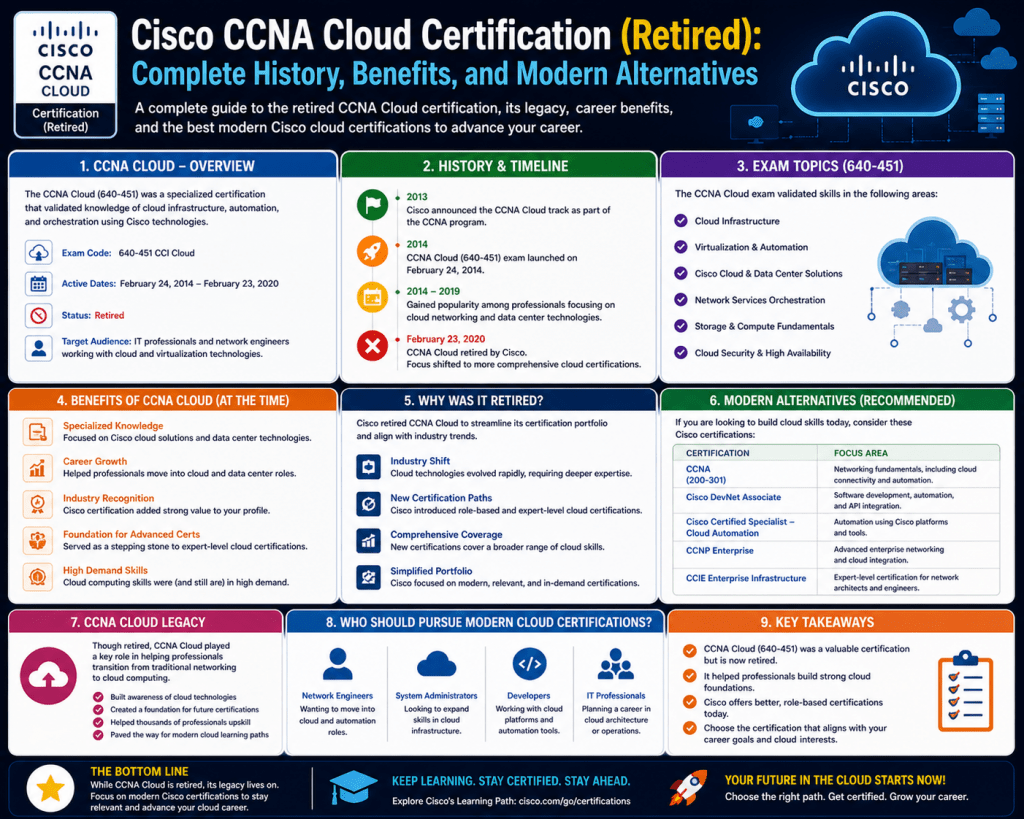
The Cisco Certified Networking Associate Cloud certification was introduced during a major transition period in information technology when organizations were rapidly shifting from traditional on-premises infrastructure toward virtualized and cloud-based environments. At that time, enterprises were beginning to adopt hybrid architectures that combined physical data centers with cloud platforms, creating a demand for professionals who could bridge both worlds. The CCNA Cloud certification was designed to validate the foundational knowledge required to operate within this evolving ecosystem.
Unlike traditional networking certifications that focused primarily on routers, switches, and local infrastructure, CCNA Cloud extended its scope into cloud computing principles. It acknowledged that modern networking was no longer confined to physical hardware but had expanded into software-defined environments where resources could be provisioned, scaled, and managed dynamically. This shift required professionals to understand both networking fundamentals and cloud service delivery models.
The certification was positioned at the associate level within Cisco’s certification hierarchy, meaning it targeted individuals who already had basic IT or networking knowledge and were looking to specialize in cloud technologies. It served as a structured entry point into cloud computing concepts while maintaining a strong connection to networking principles, which remained essential for cloud operations.
Purpose and Strategic Role of CCNA Cloud in Enterprise IT
The primary purpose of the CCNA Cloud certification was to equip IT professionals with the ability to understand, deploy, and manage cloud infrastructure in enterprise environments. At the time of its introduction, many organizations were struggling with the complexity of integrating cloud services into existing systems. There was a clear need for professionals who could translate traditional IT skills into cloud-ready capabilities.
One of the key strategic objectives of the certification was workforce transformation. Many network engineers and system administrators had extensive experience with physical infrastructure but limited exposure to cloud technologies. CCNA Cloud aimed to bridge this gap by introducing cloud concepts in a structured and accessible manner, without requiring advanced software development knowledge.
Another important purpose was to standardize cloud-related skill sets. As cloud adoption grew, there was inconsistency in how professionals understood and implemented cloud solutions. The certification provided a unified framework for understanding cloud architecture, deployment models, and operational practices, ensuring that certified individuals shared a common baseline of knowledge.
The certification also aligned with the broader industry shift toward virtualization and automation. Cloud computing was not just about remote servers; it represented a fundamental change in how computing resources were provisioned and managed. CCNA Cloud introduced professionals to these concepts, preparing them for more advanced roles in cloud architecture and operations.
Evolution of Cloud Computing and Its Impact on Certification Design
The emergence of cloud computing fundamentally changed how IT infrastructure was designed and managed. Instead of relying on static physical servers, organizations began using virtualized environments that could scale dynamically based on demand. This shift required a new set of skills that combined networking, storage, and compute management in a unified framework.
CCNA Cloud was developed in response to this transformation. It reflected the early stages of cloud adoption, when organizations were still learning how to integrate cloud services into their operations. At this stage, cloud environments were often hybrid, combining on-premises infrastructure with external cloud platforms.
As cloud technology matured, the industry began moving toward more advanced concepts such as automation, orchestration, and infrastructure as code. These developments eventually outpaced the original scope of CCNA Cloud, leading to its retirement. However, during its active period, the certification played an important role in preparing professionals for this transition.
Detailed Structure of the CCNA Cloud Certification Exams
The CCNA Cloud certification was divided into two separate exams, each focusing on a different aspect of cloud computing. This structure was designed to ensure that candidates developed both theoretical understanding and practical operational skills.
The first exam focused on foundational cloud knowledge. It introduced candidates to the core principles of cloud computing, including service models, deployment models, and virtualization technologies. Candidates were expected to understand how cloud environments are structured and how resources are allocated within them. This included knowledge of compute, storage, and network virtualization.
The second exam focused on cloud administration and operational tasks. This included managing cloud resources, configuring services, monitoring system performance, and troubleshooting issues within cloud environments. Candidates were also expected to understand basic automation concepts and how they apply to cloud operations.
Both exams followed a similar format in terms of duration and question structure. Each exam lasted approximately 90 minutes and included between 55 and 65 questions. The questions were designed to test a combination of conceptual understanding and practical application.
The question types varied widely to assess different skill levels. Multiple-choice questions tested theoretical knowledge, while drag-and-drop and simulation-based questions evaluated practical understanding. Scenario-based questions were particularly important, as they required candidates to apply their knowledge to realistic enterprise situations.
Cloud Fundamentals Covered in the Certification
The foundational portion of the certification focused heavily on understanding cloud computing concepts. Candidates were introduced to different cloud deployment models, including public, private, and hybrid clouds. Each model represented a different approach to resource management and infrastructure control.
Public cloud environments involve shared infrastructure managed by third-party providers, while private clouds are dedicated to a single organization. Hybrid clouds combine both models, allowing organizations to maintain sensitive workloads on-premises while leveraging external cloud services for scalability.
Another key area of focus was virtualization. Candidates learned how physical hardware is abstracted into virtual machines and containers, enabling more efficient use of resources. This concept is central to cloud computing and forms the foundation for modern infrastructure design.
The certification also covered basic storage concepts, including block, file, and object storage. Understanding these storage types was essential for managing cloud resources effectively and ensuring optimal performance.
Networking fundamentals were also included, particularly in relation to cloud environments. Candidates needed to understand how data flows between virtual machines, how networks are segmented, and how connectivity is maintained in distributed systems.
Operational Skills and Cloud Administration Concepts
The administrative portion of the certification focused on real-world operational tasks. Candidates were expected to understand how to manage cloud resources efficiently and ensure system reliability.
One of the key operational areas was resource provisioning. This involved deploying virtual machines, configuring storage, and allocating network resources based on organizational requirements. Candidates also needed to understand how to scale resources dynamically based on demand.
Monitoring and troubleshooting were also important components. Cloud environments require continuous monitoring to ensure performance and availability. Candidates learned how to identify issues, analyze system behavior, and resolve common problems in virtualized environments.
Basic automation concepts were introduced to help professionals streamline repetitive tasks. Although not as advanced as modern DevOps practices, this provided a foundation for understanding how automation improves efficiency in cloud operations.
Security was another critical aspect of cloud administration. Candidates were expected to understand access control mechanisms, data protection strategies, and basic compliance requirements. This ensured that cloud environments remained secure and aligned with organizational policies.
Question Formats and Assessment Methodology
The exam design reflected a strong emphasis on practical knowledge. Instead of relying solely on memorization, candidates were evaluated through scenario-based and simulation-style questions.
Multiple-choice questions tested conceptual understanding of cloud principles and networking fundamentals. These questions required candidates to select the most appropriate answers based on theoretical knowledge.
Drag-and-drop questions assessed the ability to organize and classify information. For example, candidates might be asked to match cloud services with their corresponding functions or deployment models.
Simulation-based questions were particularly important, as they replicated real-world cloud environments. Candidates had to perform tasks such as configuring virtual machines or troubleshooting network issues within a simulated interface.
Fill-in-the-blank questions tested precision and attention to detail, ensuring that candidates had a strong grasp of terminology and technical concepts.
Target Audience and Professional Relevance
The CCNA Cloud certification was primarily aimed at IT professionals transitioning from traditional networking roles into cloud computing. This included network engineers, system administrators, and data center technicians.
For network engineers, the certification provided an opportunity to expand their skill set into cloud environments. Since cloud infrastructure relies heavily on networking principles, this transition was natural and highly relevant.
System administrators benefited from the certification by gaining a deeper understanding of virtualization and resource management. This allowed them to manage more complex environments that combined physical and virtual infrastructure.
Entry-level IT professionals also found value in the certification, as it provided a structured introduction to cloud computing. It served as a stepping stone toward more advanced certifications and roles in cloud architecture and engineering.
Industry Context and Long-Term Influence
Although the CCNA Cloud certification is no longer active, its influence can still be seen in modern cloud certification frameworks. It represented an early attempt to formalize cloud knowledge within a structured certification path.
The certification helped shape how cloud skills were defined and assessed in professional environments. Many of its core concepts, such as virtualization, hybrid infrastructure, and cloud networking, remain fundamental to modern IT operations.
Over time, the industry moved toward more integrated and automation-focused certification models. However, CCNA Cloud played an important role in preparing professionals for this transition by introducing them to foundational cloud concepts at an early stage in the evolution of cloud computing.
Evolution of Cisco CCNA Cloud Certification in a Changing IT Landscape
The Cisco Certified Networking Associate Cloud certification existed during a transitional phase in enterprise IT, when organizations were shifting from traditional infrastructure models to cloud-centric architectures. Over time, this shift became more accelerated, and the expectations placed on IT professionals changed significantly. The evolution of CCNA Cloud reflects this broader transformation in how networking, computing, and infrastructure management are defined.
Initially, the certification filled a critical gap. Many professionals had strong experience in on-premises networking but lacked exposure to cloud environments. CCNA Cloud provided a structured introduction to cloud concepts while maintaining continuity with traditional networking knowledge. However, as cloud technologies matured, the boundaries between networking, virtualization, automation, and software development began to blur.
This convergence meant that certifications needed to cover broader and more integrated skill sets. The original structure of CCNA Cloud, which separated cloud fundamentals and administration into two exams, became less aligned with real-world expectations. Modern environments require professionals who can work across domains rather than within isolated technical silos.
Shifting Industry Demand Toward Cloud-Native Skills
One of the major reasons behind the evolution of certifications like CCNA Cloud was the increasing demand for cloud-native skills. Organizations were no longer simply migrating workloads to the cloud; they were redesigning applications and infrastructure to be cloud-first.
Cloud-native environments introduced new paradigms such as microservices architecture, containerization, and distributed systems. These concepts required professionals to understand not only infrastructure but also application behavior and orchestration mechanisms. Traditional associate-level certifications were not designed to cover this depth of complexity.
As a result, the industry began to prioritize skills such as automation, API integration, and infrastructure as code. These skills allowed systems to be managed programmatically rather than manually, increasing efficiency and scalability. CCNA Cloud, which was primarily focused on foundational cloud operations, gradually became less aligned with these emerging requirements.
Transition from Static Infrastructure to Software-Defined Environments
Another major factor influencing the retirement of CCNA Cloud was the widespread adoption of software-defined infrastructure. In traditional IT environments, network and compute resources were configured manually using physical devices. In contrast, software-defined environments abstracted these resources into programmable layers.
This shift fundamentally changed the role of IT professionals. Instead of configuring individual devices, professionals were now expected to manage entire systems through centralized control planes and automation frameworks. Networking itself became more dynamic, with virtual networks replacing many physical configurations.
CCNA Cloud introduced some of these concepts at a basic level, particularly virtualization and cloud networking. However, it did not fully incorporate the depth of programmability and automation that became standard in modern infrastructure. As a result, newer certifications began to replace it with more comprehensive coverage of software-defined technologies.
Limitations of the CCNA Cloud Certification Framework
Although CCNA Cloud was valuable during its time, it had structural limitations that eventually led to its retirement. One of the primary limitations was its narrow scope in relation to rapidly evolving cloud technologies.
The certification focused heavily on foundational cloud concepts and basic administrative tasks. While this was appropriate for early-stage cloud adoption, it did not extend into advanced areas such as orchestration, continuous deployment, or multi-cloud management.
Another limitation was its reliance on a dual-exam structure that separated theoretical knowledge from operational tasks. In modern IT environments, these domains are deeply integrated, and professionals are expected to apply both simultaneously.
Additionally, the certification did not fully address the growing importance of development-oriented skills in infrastructure management. As cloud platforms evolved, the distinction between developers and system administrators began to blur, requiring a more unified skill set that CCNA Cloud did not fully encompass.
Rise of Integrated Certification Models
As the IT industry evolved, certification programs began to adopt more integrated models that combined networking, cloud computing, automation, and security into unified learning paths. This approach better reflected the realities of modern infrastructure management.
Instead of offering narrowly focused certifications, organizations began designing programs that covered broader skill domains. These included cloud architecture, infrastructure automation, and application deployment. This shift allowed professionals to develop more holistic skill sets.
Integrated certification models also emphasized practical application over theoretical knowledge. Candidates were expected to demonstrate their ability to solve real-world problems rather than simply understand concepts in isolation.
This approach made older certifications like CCNA Cloud less relevant, as they were designed around a more segmented view of IT systems.
Impact of Automation and DevOps Practices
One of the most significant forces driving change in certification design was the rise of automation and DevOps practices. These methodologies transformed how IT systems were developed, deployed, and maintained.
Automation reduced the need for manual configuration by enabling systems to be managed through scripts and code. DevOps introduced a collaborative approach between development and operations teams, emphasizing continuous integration and continuous delivery.
These changes required professionals to develop new competencies beyond traditional networking and system administration. Skills such as scripting, version control, and pipeline management became essential.
CCNA Cloud included only introductory-level coverage of automation concepts. As DevOps practices became central to IT operations, this limited scope was no longer sufficient, leading to the development of more advanced certifications focused specifically on automation and infrastructure as code.
Emergence of Multi-Cloud and Hybrid Architectures
Another major development that influenced the retirement of CCNA Cloud was the rise of multi-cloud and hybrid architectures. Organizations began using multiple cloud providers simultaneously to improve flexibility, resilience, and cost efficiency.
Hybrid environments, which combine on-premises infrastructure with cloud services, have become increasingly common. This introduced additional complexity in terms of networking, security, and resource management.
Professionals working in these environments needed to understand interoperability between different platforms. They also needed to manage workloads across distributed systems while maintaining consistent performance and security.
CCNA Cloud was primarily designed around single-cloud or simplified cloud models. It did not fully address the complexity of multi-cloud environments, which became a standard requirement in enterprise IT.
Redefinition of Networking in Cloud Environments
The concept of networking itself evolved significantly during the period when CCNA Cloud was active. Traditional networking focused on physical devices and static configurations. In cloud environments, networking became virtualized and highly dynamic.
Virtual networks, software-defined routing, and overlay architectures replaced many traditional networking components. This required professionals to rethink how connectivity and data flow were managed.
CCNA Cloud introduced foundational networking concepts within cloud contexts, but it did not fully explore advanced virtual networking architectures. As cloud platforms evolved, networking became more integrated with automation and orchestration systems, requiring deeper technical expertise.
Workforce Transformation and Skill Realignment
The retirement of CCNA Cloud also reflected broader changes in workforce requirements. IT roles were becoming more specialized and interdisciplinary, requiring professionals to combine knowledge from multiple domains.
Instead of focusing solely on networking or cloud administration, professionals were expected to understand systems holistically. This included infrastructure, applications, security, and automation.
Organizations began prioritizing adaptable skill sets over narrowly defined certifications. This shift encouraged continuous learning and cross-domain expertise.
CCNA Cloud, while valuable in its time, represented a more segmented approach to IT education that no longer matched these evolving expectations.
Standardization of Cloud Competencies
As cloud computing matured, the industry began to standardize cloud competencies across platforms and providers. This meant that professionals were expected to understand universal cloud principles rather than platform-specific implementations.
Concepts such as scalability, elasticity, distributed computing, and fault tolerance became core knowledge areas. These principles apply across all cloud environments, regardless of vendor.
CCNA Cloud contributed to this standardization by introducing foundational cloud concepts. However, newer certification models expanded this approach to include more advanced and universal cloud skills.
Influence on Modern Certification Design
Although CCNA Cloud was retired, its influence can still be seen in modern certification frameworks. It helped establish early definitions of cloud-related skills within the networking domain.
Many of the concepts introduced in CCNA Cloud, such as virtualization and hybrid infrastructure, remain foundational in current IT education. The certification also helped shape the structure of associate-level cloud learning paths.
Modern certifications have built upon this foundation by incorporating automation, orchestration, and multi-cloud strategies. These additions reflect the continued evolution of IT infrastructure and the increasing complexity of cloud environments.
Long-Term Industry Transformation Driven by Cloud Adoption
The broader transformation driven by cloud adoption continues to reshape the IT industry. Infrastructure is increasingly abstracted, automated, and distributed across global environments.
This transformation has reduced the importance of manually configured systems while increasing the value of strategic design and automation skills. IT professionals are now expected to focus on system optimization rather than individual component management.
CCNA Cloud existed during the early stages of this transformation. It played a role in preparing professionals for the initial shift but was eventually superseded by more advanced and integrated certification models that better reflect current industry needs.
Recommended Certification Paths After CCNA Cloud Retirement
After the retirement of the Cisco Certified Networking Associate Cloud certification, the IT industry did not move away from cloud education; instead, it restructured how cloud skills are validated and developed. The emphasis shifted from single-purpose certifications toward broader, more adaptable learning paths that reflect the complexity of modern infrastructure. This change created multiple alternative certification routes that align more closely with current cloud computing, networking, and automation requirements.
Instead of focusing on a single replacement for CCNA Cloud, professionals are now encouraged to follow a combination of certifications that collectively cover networking fundamentals, cloud platforms, automation, and infrastructure management. These paths are designed to build layered expertise, allowing learners to progress from foundational knowledge to advanced cloud architecture concepts.
Foundational Networking Certifications as a Starting Point
A strong networking foundation remains essential even in cloud-centric environments. Despite the abstraction introduced by cloud platforms, underlying network principles such as IP addressing, routing, switching, and subnetting continue to play a critical role in system design and troubleshooting.
Modern entry-level networking certifications focus on these core principles while also introducing automation and virtualization concepts. Unlike older certification models, they integrate cloud-relevant topics such as network programmability and basic infrastructure automation.
This foundational stage is important because cloud environments are heavily dependent on network performance and configuration. Without understanding how data flows across systems, it becomes difficult to manage cloud infrastructure effectively. Therefore, networking certifications serve as the first step toward building a cloud-ready skill set.
Cloud Fundamentals Certifications and Their Role
After establishing networking knowledge, the next logical step involves cloud fundamentals certifications. These certifications are designed to introduce learners to cloud computing concepts, including service models, deployment strategies, and basic architecture design.
At this level, professionals learn how cloud environments operate from a conceptual perspective. This includes understanding how resources are provisioned, how scalability works, and how cloud services are structured. These concepts form the backbone of modern IT infrastructure.
Cloud fundamentals certifications also introduce learners to shared responsibility models, which define how security and operational responsibilities are divided between providers and users. This concept is essential for understanding how cloud environments are managed securely and efficiently.
Unlike CCNA Cloud, which combined networking and cloud into a single framework, modern certifications separate these domains into more flexible learning paths. This allows professionals to specialize or broaden their expertise depending on career goals.
Intermediate Cloud Certifications for Operational Expertise
Once foundational knowledge is established, intermediate-level cloud certifications focus on operational skills. These certifications emphasize hands-on experience in managing cloud environments, deploying applications, and maintaining infrastructure performance.
At this stage, professionals are expected to understand how to work within cloud platforms in practical scenarios. This includes managing virtual machines, configuring storage systems, and monitoring application performance.
Automation becomes more prominent at this level. Professionals begin to interact with scripting tools, APIs, and orchestration systems that allow them to manage infrastructure more efficiently. These skills are essential in modern IT environments where manual configuration is no longer scalable.
Security also becomes more advanced at this stage. Learners gain deeper insight into identity management, access control, and data protection strategies. This reflects the increasing importance of cybersecurity in cloud operations.
Advanced Certifications and Cloud Architecture Roles
At the advanced level, certifications focus on designing and managing complex cloud architectures. Professionals at this stage are responsible for creating scalable, secure, and highly available systems that support enterprise-level applications.
Cloud architecture involves making decisions about system design, workload distribution, and performance optimization. It requires a deep understanding of both technical and business requirements.
Unlike entry-level certifications, advanced credentials emphasize strategic thinking and system-level design. Professionals must understand how different cloud services interact and how to build resilient architectures that can adapt to changing demands.
This level of certification is often aligned with roles such as cloud architect, senior infrastructure engineer, or enterprise systems designer. These roles require a combination of technical expertise and strategic planning abilities.
Integration of Automation and Infrastructure as Code
One of the most significant developments in modern certification paths is the integration of automation and infrastructure as code. These concepts have become central to how cloud environments are managed and deployed.
Infrastructure as code allows systems to be defined and managed using configuration files rather than manual processes. This enables consistent deployments, faster scaling, and improved reliability.
Automation tools allow repetitive tasks to be executed programmatically, reducing the need for manual intervention. This is particularly important in large-scale environments where manual management would be inefficient and error-prone.
Modern certification paths incorporate these concepts at multiple levels, ensuring that professionals understand both the theory and practical application of automation in cloud environments.
Multi-Cloud and Hybrid Infrastructure Skills
As organizations increasingly adopt multi-cloud strategies, professionals are required to understand how different cloud platforms interact. This includes managing workloads across multiple providers and ensuring consistent performance and security.
Hybrid infrastructure, which combines on-premises systems with cloud services, adds another layer of complexity. Professionals must be able to manage connectivity, data flow, and system integration across different environments.
Certification paths now include training on these concepts to prepare professionals for real-world scenarios where no single cloud platform dominates. This reflects the industry’s move toward flexibility and interoperability.
Cloud Security and Governance Knowledge Areas
Security has become one of the most critical aspects of cloud computing. Modern certification paths place significant emphasis on understanding security frameworks, governance models, and compliance requirements.
Professionals must learn how to protect data, manage identities, and ensure regulatory compliance across cloud environments. This includes understanding encryption methods, access control policies, and monitoring systems.
Governance is also an important aspect, as organizations need to ensure that cloud resources are used efficiently and securely. This involves defining policies, managing costs, and maintaining operational standards.
These skills are essential for maintaining trust and reliability in cloud systems, especially in enterprise environments.
Career Roles Enabled by Modern Certification Paths
The evolution of certification paths after CCNA Cloud has expanded the range of available career opportunities. Professionals can now pursue roles that span networking, cloud computing, security, and automation.
Entry-level roles include network support specialists, cloud support technicians, and system administrators. These positions focus on maintaining and supporting the IT infrastructure.
Mid-level roles include cloud engineers, infrastructure specialists, and automation engineers. These professionals are responsible for implementing and managing cloud systems.
Advanced roles include cloud architects, solution designers, and enterprise infrastructure leads. These positions involve strategic decision-making and system design at a large scale.
This progression reflects the layered structure of modern certification paths, where each stage builds on the previous one.
Importance of Continuous Learning in Cloud Careers
The rapid evolution of cloud technology means that static knowledge quickly becomes outdated. As a result, continuous learning is essential for maintaining relevance in the IT industry.
Certification paths are designed to support ongoing skill development. Professionals are encouraged to update their knowledge regularly and adapt to new technologies and methodologies.
This approach ensures that IT professionals remain capable of working with evolving systems and emerging technologies.
Long-Term Direction of Cloud Certification Ecosystems
The long-term direction of cloud certification ecosystems is toward greater integration, flexibility, and real-world applicability. Instead of focusing on isolated technologies, modern certifications emphasize interconnected systems and cross-domain expertise.
This reflects the reality of modern IT environments, where networking, computing, security, and automation are deeply interconnected. Professionals must be able to operate across all these domains to manage complex infrastructure effectively.
The retirement of CCNA Cloud marked a transition point in this evolution, shifting the focus from specialized entry-level cloud networking toward broader, more dynamic certification frameworks that better reflect industry needs.
Transformation of IT Skill Expectations Over Time
Over time, IT skill expectations have evolved from hardware-focused expertise to software-driven infrastructure management. This transformation has redefined what it means to be a network or cloud professional.
Today’s professionals are expected to understand not only how systems operate but also how they can be optimized, automated, and scaled. This requires a combination of technical depth and adaptability.
Certification paths now reflect this reality by emphasizing practical skills, system design, and automation rather than isolated theoretical knowledge.
Conclusion
The retirement of the Cisco Certified Networking Associate Cloud certification marks a broader transition in how the IT industry defines, structures, and validates cloud computing skills. Rather than being viewed as the disappearance of a relevant credential, it is more accurately understood as part of a necessary evolution in response to rapidly changing infrastructure models, operational practices, and workforce expectations. The original CCNA Cloud program was built for a specific moment in technological history, when enterprises were beginning to adopt cloud computing and needed professionals who could bridge traditional networking with early-stage cloud concepts. At that stage, the industry was still defining what “cloud-ready” meant in practical operational terms, and certifications like CCNA Cloud played a foundational role in that definition.
However, as cloud technologies matured, the limitations of early certification structures became more apparent. The industry moved from basic virtualization and cloud awareness toward deeply integrated ecosystems involving automation, distributed systems, orchestration platforms, and multi-cloud strategies. This shift fundamentally changed the nature of IT work. Infrastructure was no longer something manually configured and maintained in isolated environments; instead, it became programmable, dynamic, and deeply interconnected with application development processes. In this new environment, the narrow scope of CCNA Cloud no longer aligns with real-world job roles, which increasingly demand broader and more adaptable skill sets.
One of the most significant lessons from the lifecycle of CCNA Cloud is how quickly foundational technologies can evolve into complex ecosystems that require entirely new approaches to education and certification. When CCNA Cloud was active, cloud computing itself was still emerging as a mainstream enterprise strategy. Many organizations were experimenting with hybrid models, combining on-premises infrastructure with external cloud services. The certification helped professionals understand these early architectures and provided a structured way to learn cloud fundamentals within a networking context. In that sense, it served as an important bridge between legacy IT systems and modern cloud environments.
Yet, as cloud adoption accelerated, the expectations placed on IT professionals expanded far beyond what early associate-level certifications were designed to cover. Organizations began adopting DevOps methodologies, infrastructure automation, container orchestration, and continuous deployment pipelines. These changes required professionals to think not only in terms of infrastructure but also in terms of software lifecycle management and system programmability. The role of a network or cloud engineer has evolved into something far more interdisciplinary, blending elements of software engineering, systems architecture, security, and operations.
This transformation made it necessary to rethink how certifications were structured. Instead of focusing on narrow specializations like CCNA Cloud, the industry gradually shifted toward more integrated learning paths that emphasize adaptability and cross-domain expertise. Modern certification approaches now prioritize real-world problem-solving, automation skills, and multi-platform knowledge rather than isolated theoretical frameworks. This ensures that professionals are better prepared for environments where cloud services, networking systems, and security frameworks are tightly interconnected.
Another important factor in the transition away from CCNA Cloud is the rise of multi-cloud and hybrid cloud strategies. Enterprises no longer rely on a single cloud provider or a single deployment model. Instead, they distribute workloads across multiple platforms to improve resilience, optimize costs, and avoid vendor lock-in. This creates a much more complex operational environment where professionals must understand interoperability, data consistency, and cross-platform management. The original CCNA Cloud framework, which was largely built around simpler cloud models, could not fully capture this level of complexity.
At the same time, automation has become a defining characteristic of modern IT infrastructure. Manual configuration and repetitive administrative tasks have been largely replaced by automated workflows, infrastructure as code, and policy-driven management systems. This shift has significantly changed the skill set required for cloud and network professionals. Rather than focusing primarily on configuration tasks, professionals are now expected to design systems that are self-managing, scalable, and resilient. This requires a deeper understanding of scripting, APIs, orchestration tools, and system design principles.
The retirement of CCNA Cloud also highlights the importance of continuous learning in the IT industry. Unlike more static professions, IT is defined by constant change, where tools, platforms, and methodologies evolve rapidly. Certifications that remain fixed in scope for too long risk becoming outdated as industry practices shift. As a result, modern certification ecosystems are designed to encourage ongoing skill development, periodic recertification, and continuous engagement with new technologies. This ensures that professionals remain relevant in a fast-moving technological landscape.
From a career perspective, the transition away from CCNA Cloud has not reduced opportunities; instead, it has expanded them. Professionals are no longer confined to narrowly defined roles but can pursue diverse career paths that combine networking, cloud engineering, automation, and security. Roles such as cloud architect, infrastructure engineer, DevOps specialist, and systems designer reflect this expanded scope. Each of these roles requires a combination of foundational knowledge and advanced technical skills, along with the ability to adapt to evolving technologies.
The broader industry implication of this shift is that cloud computing is no longer treated as a separate domain within IT. Instead, it has become the central framework around which modern infrastructure is built. Networking, storage, security, and application development are all integrated within cloud ecosystems. This convergence means that future certification models must continue to evolve toward holistic approaches that reflect the interconnected nature of modern systems.
In retrospect, CCNA Cloud can be seen as an important stepping stone in this evolution. It provided early structure to a field that was still emerging and helped prepare professionals for the initial wave of cloud adoption. Its retirement does not diminish its value; rather, it reflects the natural progression of technology from early adoption to mature, integrated systems. The knowledge areas it introduced, such as virtualization, cloud deployment models, and basic cloud administration, remain relevant today, even if they are now embedded within more advanced frameworks.
Ultimately, the shift away from CCNA Cloud underscores a fundamental truth about the IT industry: skills and certifications must evolve alongside technology. What begins as foundational knowledge eventually becomes part of a larger, more complex system that demands broader understanding and deeper expertise. Professionals who adapt to this evolution by continuously expanding their skills are better positioned to succeed in modern cloud-driven environments.