Data engineering has become one of the most important pillars of modern digital systems as organizations increasingly rely on data-driven decision-making. In earlier computing environments, data was often stored in isolated systems with limited interaction between applications. As digital transformation accelerated, the volume, velocity, and variety of data increased significantly, making traditional approaches insufficient for modern demands. Cloud computing introduced a scalable and flexible foundation that allowed organizations to rethink how data is collected, processed, stored, and analyzed.
In this environment, data engineers play a central role in ensuring that data flows efficiently between systems. They design and build pipelines that move data from multiple sources into centralized platforms where it can be used for analytics, reporting, and machine learning. These pipelines must operate reliably under heavy workloads while maintaining accuracy and security. As businesses expand globally, data systems must also support distributed environments where users and applications operate across multiple regions.
The importance of this role has grown because data is no longer just a byproduct of business operations; it has become a core asset. Organizations depend on real-time insights to improve performance, optimize operations, and understand customer behavior. This shift has elevated data engineering from a support function to a strategic discipline within cloud ecosystems.
Evolution from Traditional Databases to Cloud Data Systems
Traditional database systems were designed primarily for structured data and transactional workloads. These systems worked well for applications that required consistent and predictable access patterns, such as inventory systems or financial records. However, they were limited in scalability and flexibility, especially when dealing with large volumes of unstructured or rapidly changing data.
As data began to grow exponentially, organizations faced challenges in managing storage capacity and processing speed. Scaling traditional systems often required expensive hardware upgrades and complex maintenance procedures. This limitation led to the adoption of distributed computing models, where data could be spread across multiple nodes and processed in parallel.
Cloud platforms transformed this landscape by introducing on-demand scalability and managed services. Instead of maintaining physical infrastructure, organizations could now provision resources dynamically based on workload requirements. This shift enabled the development of advanced data services, including distributed storage systems, real-time analytics engines, and automated data pipelines.
Cloud-based systems also introduced new data formats and processing models. Semi-structured and unstructured data, such as logs, sensor data, and streaming events, became more common. These formats required flexible storage solutions and processing frameworks capable of handling diverse data types without strict schema constraints.
Core Responsibilities of Modern Data Engineers
Modern data engineers are responsible for designing and maintaining the infrastructure that supports data flow within an organization. Their work involves multiple layers of data management, starting from ingestion and ending with consumption by analytics or machine learning systems. One of their primary responsibilities is building data pipelines that extract data from various sources and transform it into usable formats.
These pipelines must be designed to handle both batch and real-time data. Batch processing involves collecting large volumes of data over a period and processing it in chunks, while real-time processing focuses on continuous data streams that require immediate handling. Each approach serves different business needs, and data engineers must understand when to apply each method effectively.
Another key responsibility involves ensuring data quality and consistency. Data coming from multiple sources may contain inconsistencies, missing values, or errors. Engineers must implement validation and cleansing mechanisms to ensure that only accurate and reliable data enters downstream systems. This process is critical for maintaining trust in analytical outputs.
Security and compliance also play a major role in the responsibilities of a data engineer. With increasing regulatory requirements, organizations must ensure that sensitive data is protected at all times. This includes implementing encryption, managing access controls, and maintaining audit trails for data usage.
Performance optimization is another essential aspect of the role. Data systems must be tuned to handle large-scale workloads without degradation in performance. Engineers often analyze system metrics to identify bottlenecks and improve efficiency through better design and resource allocation.
Understanding Cloud Data Architecture Concepts
Cloud data architecture refers to the structured design of systems that store, process, and manage data in cloud environments. These architectures are typically composed of multiple layers, each serving a specific function within the data lifecycle. The ingestion layer is responsible for collecting data from external and internal sources. The storage layer organizes and retains data in structured or unstructured formats. The processing layer transforms raw data into meaningful insights, while the consumption layer delivers data to end users or applications.
One of the key advantages of cloud architecture is its scalability. Resources can be dynamically adjusted based on demand, allowing systems to handle fluctuating workloads efficiently. This elasticity is particularly important for organizations that experience seasonal or unpredictable data spikes.
Another important concept is data distribution. In cloud environments, data is often distributed across multiple regions or availability zones to improve performance and reliability. This distribution ensures that users can access data with minimal latency regardless of their location.
Data redundancy and replication are also critical components of cloud architecture. By maintaining multiple copies of data, systems can recover quickly from failures and ensure continuous availability. This approach enhances resilience and minimizes the risk of data loss.
Introduction to Cloud Data Implementation Focus Areas
In cloud-based data environments, implementation involves translating architectural designs into functional systems. This includes configuring storage solutions, building data pipelines, and integrating various services to ensure seamless data flow. Implementation also involves selecting appropriate tools and technologies based on workload requirements.
Storage configuration is one of the foundational aspects of implementation. Engineers must decide how data will be stored, whether in relational databases, object storage systems, or distributed file systems. Each option has its own advantages depending on the type of data and usage patterns.
Data pipeline implementation focuses on creating workflows that automate the movement and transformation of data. These workflows must be designed to handle errors gracefully and ensure data consistency throughout the process. Automation plays a key role in reducing manual intervention and improving reliability.
Integration of services is another critical aspect. Modern cloud ecosystems consist of multiple interconnected services that work together to process data. Engineers must ensure that these services communicate effectively and operate as a unified system.
Introduction to DP-200 and Its Role in Cloud Data Expertise
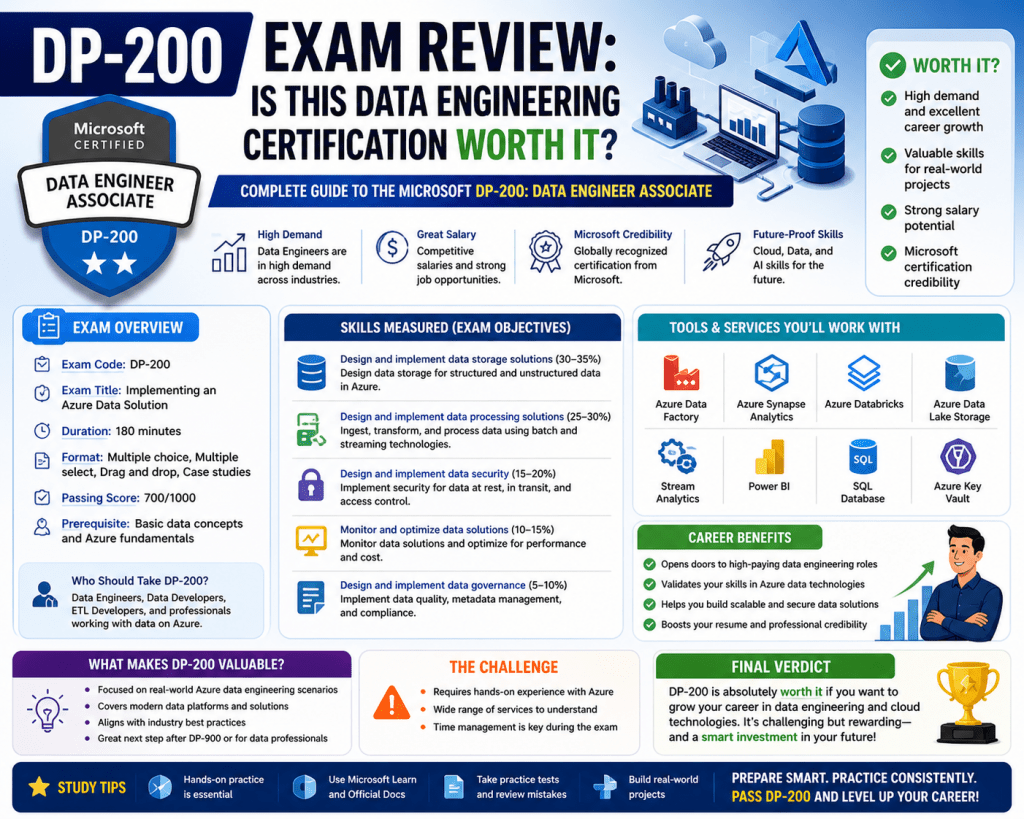
The DP-200 certification represents a structured validation of skills related to implementing data solutions in cloud environments. It focuses on practical knowledge required to design and build data systems that operate efficiently at scale. Rather than emphasizing theoretical concepts alone, it evaluates the ability to apply knowledge in real-world scenarios.
This certification is positioned within a broader data engineering pathway and is designed for individuals who work with data storage, processing, and optimization tasks. It emphasizes hands-on skills such as configuring data services, building pipelines, and managing data workflows.
A key aspect of this certification is its focus on implementation challenges. Candidates are expected to understand how to translate architectural designs into working systems that meet performance, security, and scalability requirements. This includes working with both structured and unstructured data, as well as integrating multiple data sources.
The certification also reflects the increasing complexity of modern data environments. As organizations adopt more advanced cloud solutions, the need for professionals who can manage these systems effectively has grown significantly. This has made implementation-focused skills highly valuable in the job market.
Key Skill Areas Associated with Cloud Data Implementation
Cloud data implementation requires a diverse set of skills that span multiple domains. One of the most important areas is data storage management. Engineers must understand how to configure and optimize storage systems for different types of workloads. This includes selecting appropriate storage models and ensuring efficient data retrieval.
Data processing is another critical skill area. Engineers must be able to design systems that handle both batch and streaming data efficiently. This requires knowledge of distributed processing frameworks and workflow orchestration techniques.
Monitoring and optimization skills are also essential. Data systems must be continuously monitored to ensure they are performing as expected. Engineers use performance metrics to identify issues and apply optimizations that improve system efficiency.
Security management is another key area of expertise. With increasing concerns around data privacy and compliance, engineers must implement robust security measures to protect sensitive information. This includes encryption, access control, and auditing mechanisms.
Why Data Engineering Skills Are Becoming Increasingly Important
The demand for data engineering skills continues to grow as organizations become more dependent on data-driven strategies. Businesses across industries are investing heavily in data infrastructure to gain competitive advantages. This has created a strong need for professionals who can design, build, and maintain complex data systems.
The rise of artificial intelligence and machine learning has further increased the importance of data engineering. These technologies rely heavily on high-quality data pipelines to function effectively. Without properly engineered data systems, advanced analytics models cannot produce reliable results.
Cloud adoption has also contributed to the growing demand for data engineers. As more organizations migrate to cloud platforms, they require professionals who understand how to manage data in distributed environments. This includes knowledge of scalability, reliability, and performance optimization.
The increasing complexity of data ecosystems means that organizations can no longer rely on general IT skills alone. Specialized knowledge in data engineering is required to handle modern data challenges effectively.
Designing Scalable Data Storage Solutions in Cloud Environments
Modern data storage systems are the foundation of any cloud-based data architecture. As organizations generate increasing volumes of structured, semi-structured, and unstructured data, traditional storage models are no longer sufficient to handle the scale and complexity of modern workloads. Cloud environments have introduced highly scalable storage systems that allow data engineers to design flexible architectures capable of adapting to changing business demands.
A key principle in cloud storage design is the separation of storage and compute. This allows data to be stored independently of processing resources, enabling each layer to scale according to its own requirements. This separation improves efficiency, reduces costs, and allows systems to handle variable workloads without performance degradation.
Object storage has become one of the most widely used storage models in cloud environments due to its scalability and durability. It is particularly well-suited for storing large volumes of unstructured data such as logs, media files, and backups. Data engineers must understand how to structure object storage systems in a way that supports efficient retrieval and processing.
In addition to object storage, distributed file systems play a crucial role in big data environments. These systems are designed to store large datasets across multiple nodes, allowing parallel processing and high availability. Proper configuration of these systems ensures that data can be accessed quickly and reliably, even under heavy workloads.
Data partitioning is another important concept in storage design. By dividing large datasets into smaller, more manageable segments, systems can improve query performance and reduce processing time. Effective partitioning strategies depend on understanding data access patterns and workload characteristics.
Data redundancy and replication are also essential for ensuring high availability. By maintaining multiple copies of data across different locations, systems can recover quickly from hardware failures or network disruptions. This approach enhances resilience and ensures continuous access to critical data.
Implementing Efficient Data Ingestion Pipelines
Data ingestion is the process of collecting data from multiple sources and transferring it into a centralized system for processing and analysis. In modern cloud environments, ingestion pipelines must be capable of handling diverse data formats, high throughput, and real-time streaming requirements.
One of the main challenges in data ingestion is dealing with heterogeneous data sources. These sources may include databases, APIs, applications, IoT devices, and external data feeds. Each source may produce data in different formats and at different rates, requiring flexible ingestion mechanisms.
Batch ingestion is commonly used when data does not need to be processed immediately. In this approach, data is collected over a period of time and then processed in bulk. This method is efficient for large datasets but introduces latency between data generation and availability.
Streaming ingestion, on the other hand, processes data in real time as it is generated. This approach is essential for use cases that require immediate insights, such as fraud detection, monitoring systems, and real-time analytics. Streaming systems must be designed to handle continuous data flow without interruption.
Data validation is a critical step in ingestion pipelines. Incoming data must be checked for accuracy, completeness, and consistency before it is processed further. Invalid or corrupted data can lead to inaccurate analysis and should be filtered or corrected early in the pipeline.
Error handling mechanisms are also essential. Data pipelines must be able to handle failures gracefully without losing data or disrupting the entire system. This often involves implementing retry logic, dead-letter queues, and logging mechanisms to track issues.
Building Robust Data Transformation Workflows
Data transformation is the process of converting raw data into a structured and usable format. This step is essential for ensuring that data can be effectively analyzed and used for decision-making. Transformation workflows often involve multiple stages, including cleaning, enrichment, aggregation, and formatting.
Data cleaning is the first step in transformation. This involves removing duplicates, correcting errors, and handling missing values. Clean data is essential for ensuring accuracy in downstream analytics processes.
Data enrichment involves adding additional context or information to existing datasets. This can include combining data from multiple sources or generating new derived fields. Enrichment improves the value of data by making it more meaningful and useful for analysis.
Aggregation is used to summarize large datasets into more manageable forms. This can include calculating averages, totals, or other statistical measures. Aggregated data is often used for reporting and visualization purposes.
Data formatting ensures that transformed data is consistent and compatible with downstream systems. This may involve converting data types, standardizing structures, or aligning schemas across different datasets.
Automation plays a crucial role in transformation workflows. Automated pipelines reduce manual effort, improve consistency, and ensure that data is processed promptly. Workflow orchestration tools help coordinate the execution of transformation tasks in the correct order.
Understanding Batch and Streaming Data Processing Models
Batch processing and streaming processing are two fundamental paradigms in data engineering. Each model serves different purposes and is suited to different types of workloads.
Batch processing is designed for handling large volumes of data that can be processed at scheduled intervals. This approach is efficient for workloads where real-time processing is not required. Batch systems collect data over time and process it in bulk, allowing for optimized resource usage.
Streaming processing focuses on continuous data flow and real-time analysis. In this model, data is processed as soon as it is generated, enabling immediate insights and responses. Streaming systems are essential for applications that require low latency and real-time decision-making.
The choice between batch and streaming depends on business requirements. Some systems may use a hybrid approach, combining both models to achieve a balance between efficiency and responsiveness.
Latency is a key consideration in streaming systems. Low-latency processing ensures that data is analyzed quickly, enabling timely actions. However, achieving low latency requires careful system design and optimization.
Scalability is also important in both models. Batch systems must be able to handle large data volumes efficiently, while streaming systems must support continuous high-throughput data flows.
Managing Data Processing with Distributed Systems
Distributed data processing systems are essential for handling large-scale data workloads in cloud environments. These systems divide processing tasks across multiple nodes, allowing for parallel execution and improved performance.
One of the main advantages of distributed processing is scalability. As data volumes increase, additional nodes can be added to the system to distribute the workload. This ensures that performance remains consistent even as demand grows.
Fault tolerance is another important feature of distributed systems. If one node fails, other nodes can continue processing without interruption. This improves system reliability and reduces the risk of data loss.
Data partitioning plays a key role in distributed processing. By dividing data into smaller partitions, systems can process multiple segments simultaneously. Effective partitioning strategies help optimize performance and reduce processing time.
Task scheduling is also critical in distributed systems. Workloads must be distributed efficiently across available resources to ensure balanced processing. Poor scheduling can lead to resource bottlenecks and reduced performance.
Monitoring Data Pipelines for Performance and Reliability
Monitoring is a critical aspect of data engineering that ensures systems operate efficiently and reliably. Without proper monitoring, it is difficult to identify issues or optimize performance.
Performance monitoring involves tracking key metrics such as processing time, throughput, and resource utilization. These metrics provide insights into system behavior and help identify bottlenecks.
Pipeline monitoring focuses on tracking the execution of data workflows. This includes monitoring data ingestion, transformation, and storage processes. Any failures or delays must be detected and addressed quickly to prevent data inconsistencies.
Logging is an essential component of monitoring systems. Logs provide detailed information about system operations and can be used for debugging and analysis. Effective logging practices help engineers understand system behavior over time.
Alerting systems are used to notify engineers when issues occur. These alerts can be triggered based on predefined thresholds or anomalies in system behavior. Timely alerts help prevent minor issues from escalating into major failures.
Optimizing Data Systems for Performance and Cost Efficiency
Optimization is an ongoing process in data engineering that focuses on improving system performance while reducing operational costs. Cloud environments provide flexible resources, but inefficient usage can lead to unnecessary expenses.
One common optimization technique is query tuning. Poorly optimized queries can significantly impact performance, especially when working with large datasets. By analyzing query execution plans, engineers can identify inefficiencies and improve performance.
Data partitioning strategies also play a role in optimization. Proper partitioning reduces the amount of data scanned during queries, resulting in faster response times.
Resource scaling is another important optimization technique. Cloud systems allow dynamic scaling of compute and storage resources based on demand. This ensures that resources are used efficiently without over-provisioning.
Caching is often used to improve performance by storing frequently accessed data in memory. This reduces the need for repeated data retrieval operations and improves response times.
Implementing Security and Compliance in Data Systems
Security is a fundamental requirement in modern data systems. With increasing concerns about data privacy and regulatory compliance, organizations must implement robust security measures to protect sensitive information.
Data encryption is one of the most important security mechanisms. Encrypting data at rest and in transit ensures that unauthorized users cannot access sensitive information.
Access control mechanisms are used to restrict data access based on user roles and permissions. This ensures that only authorized users can view or modify data.
Auditing is another critical component of data security. Audit logs track user activity and system changes, providing a record of how data is accessed and used.
Compliance requirements vary depending on industry and region. Data systems must be designed to meet relevant regulatory standards, ensuring that data is handled responsibly and securely.
Integrating Multiple Data Sources in Cloud Architectures
Modern data systems often require integration of multiple data sources to create a unified view of information. These sources may include internal systems, external APIs, third-party services, and real-time data streams.
Data integration involves combining data from different sources into a consistent format. This process requires careful mapping of data fields and structures to ensure compatibility.
Data synchronization ensures that information remains consistent across systems. Changes in one system must be reflected in others to maintain data integrity.
Data federation is another approach where data remains in its original location but is accessed through a unified interface. This allows systems to query multiple sources without physically moving data.
Effective integration requires careful planning and coordination to ensure that data flows smoothly across all systems without duplication or inconsistency.
Monitoring and Observability in Modern Cloud Data Systems
Monitoring and observability have become essential pillars in cloud data engineering because modern systems are no longer static or centralized. Instead, they are distributed across multiple services, regions, and processing layers. This complexity makes it difficult to understand system behavior without structured visibility into how data flows and how each component performs under different workloads.
In cloud-based data environments, monitoring is not limited to checking whether a system is running or not. It involves continuous tracking of performance metrics, pipeline execution states, resource consumption, and data quality indicators. Observability goes a step further by providing insights into why a system behaves a certain way, allowing engineers to diagnose issues rather than just detect them.
A well-designed observability strategy includes logs, metrics, and traces. Logs provide detailed records of system events, metrics offer numerical performance indicators, and traces show the flow of data through different components. When combined, these elements give a complete picture of system behavior.
Data pipelines especially require strong monitoring because they often involve multiple dependent stages. A failure in one stage can affect the entire workflow. Monitoring systems help identify such failures quickly so that corrective actions can be taken before they impact downstream processes.
Another important aspect of monitoring is anomaly detection. Instead of relying solely on predefined thresholds, modern systems use intelligent techniques to identify unusual patterns in data behavior. This helps detect issues such as sudden spikes in data volume, unexpected latency increases, or irregular processing patterns.
Performance Optimization Strategies for Cloud Data Workloads
Performance optimization in cloud data systems is a continuous process that focuses on improving efficiency while maintaining reliability and scalability. As data volumes grow, inefficient designs can lead to increased latency, higher costs, and degraded user experiences. Data engineers must therefore design systems that are both scalable and efficient from the beginning.
One of the most effective optimization strategies is improving data access patterns. When data is structured and stored in a way that aligns with how it is queried, performance improves significantly. Poorly structured data often leads to unnecessary scanning of large datasets, which increases processing time.
Partitioning strategies play a major role in optimization. By dividing datasets into logical segments, systems can reduce the amount of data processed during queries. Effective partitioning depends on understanding how data is accessed and which fields are frequently used in filtering operations.
Indexing is another important technique used to accelerate data retrieval. Indexes allow systems to locate data quickly without scanning entire datasets. However, indexes must be designed carefully because excessive indexing can increase storage overhead and slow down write operations.
Caching mechanisms are also widely used to improve performance. Frequently accessed data is stored in memory so that it can be retrieved quickly without repeated computation or database access. This significantly reduces response times for repeated queries.
Resource scaling is a key advantage of cloud environments. Systems can automatically scale up or down based on demand, ensuring that resources are used efficiently. However, improper scaling configurations can lead to over-provisioning or underutilization, both of which affect performance and cost.
Query optimization is another critical area. Inefficient queries can consume large amounts of computational resources. By analyzing query execution plans, engineers can identify bottlenecks and restructure queries to improve performance.
Data Lifecycle Management in Cloud Architectures
Data lifecycle management refers to the process of managing data from creation to deletion. In cloud environments, data is constantly generated, processed, stored, and eventually archived or removed. Proper lifecycle management ensures that storage resources are used efficiently and that outdated data does not consume unnecessary space.
The first stage of the lifecycle is data creation and ingestion. At this stage, data is collected from multiple sources and introduced into the system. This data may be structured or unstructured and must be validated before further processing.
Once data is ingested, it enters the active processing stage. During this phase, data is transformed, cleaned, and prepared for analysis. This is often the most resource-intensive stage of the lifecycle, requiring efficient processing pipelines.
After processing, data moves into storage systems where it is used for reporting, analytics, or machine learning. At this stage, access patterns determine how frequently data is queried and how it should be optimized for retrieval.
Over time, data becomes less frequently accessed. This is known as cold data. Cold data is typically moved to lower-cost storage tiers to reduce expenses while still maintaining availability if needed.
Eventually, data reaches the end of its lifecycle and may be deleted or archived permanently. Proper deletion policies ensure compliance with regulatory requirements and prevent unnecessary storage accumulation.
Automated lifecycle policies are commonly used in cloud environments to manage these transitions. These policies define rules for moving data between different storage tiers based on age, usage, or business requirements.
Streaming Data Systems and Real-Time Processing Architecture
Streaming data systems are designed to process continuous flows of data in real time. Unlike batch systems that process data in intervals, streaming systems handle data as soon as it is generated. This enables immediate insights and faster decision-making.
Real-time processing architectures are commonly used in scenarios such as fraud detection, monitoring systems, IoT applications, and live analytics dashboards. These systems must be capable of handling high throughput while maintaining low latency.
A streaming architecture typically consists of data sources, ingestion layers, processing engines, and output sinks. Data sources continuously generate events that are captured by ingestion systems and passed to processing engines for analysis.
Processing engines apply transformations, aggregations, and filtering operations to incoming data streams. These engines must be optimized for continuous execution rather than batch processing.
Output sinks store or deliver processed data to downstream systems. This may include databases, dashboards, or alerting systems.
Windowing techniques are often used in streaming systems to group data into time-based segments. This allows meaningful analysis of continuous data streams by dividing them into manageable intervals.
Fault tolerance is critical in streaming systems because data is continuously flowing. Systems must ensure that no data is lost during failures and that processing can resume seamlessly.
Distributed Data Processing and Scalability Principles
Distributed data processing systems are designed to handle large-scale workloads by dividing tasks across multiple computing nodes. This approach allows systems to scale horizontally, making it possible to process massive datasets efficiently.
One of the key advantages of distributed systems is parallel processing. By dividing data into smaller partitions, multiple nodes can process data simultaneously. This significantly reduces processing time compared to single-node systems.
Data partitioning strategies are critical for achieving efficient distribution. Poor partitioning can lead to uneven workload distribution, causing some nodes to become overloaded while others remain underutilized.
Task scheduling mechanisms ensure that workloads are distributed evenly across available resources. Efficient scheduling improves performance and prevents bottlenecks.
Fault tolerance is another essential feature of distributed systems. If a node fails, the system must redistribute tasks to other nodes without disrupting processing.
Consistency models also play an important role in distributed architectures. Depending on the use case, systems may prioritize strong consistency, eventual consistency, or a balance between both.
Scalability in distributed systems is achieved by adding more nodes to handle increased workloads. However, scalability must be carefully managed to avoid communication overhead and synchronization issues between nodes.
Security Architecture for Cloud Data Systems
Security is a foundational requirement in cloud data engineering. As data becomes more distributed and accessible across multiple systems, the risk of unauthorized access and data breaches increases significantly.
Encryption is one of the primary mechanisms used to protect data. Data is encrypted both at rest and in transit to ensure that it cannot be accessed by unauthorized parties. Encryption keys must be managed securely to maintain system integrity.
Access control mechanisms define who can access specific data and what actions they can perform. Role-based access control is commonly used to enforce security policies within organizations.
Authentication systems verify the identity of users and applications before granting access to data systems. Strong authentication mechanisms reduce the risk of unauthorized access.
Audit logging tracks all interactions with data systems, providing a detailed record of user activity. These logs are essential for detecting suspicious behavior and ensuring compliance with regulations.
Data masking techniques are used to protect sensitive information by obscuring it from unauthorized users while still allowing meaningful use of the data.
Compliance requirements vary across industries, but all cloud data systems must adhere to relevant standards to ensure responsible data handling.
Data Engineering Automation and Workflow Orchestration
Automation is a key component of modern data engineering because it reduces manual effort and improves system reliability. Automated workflows ensure that data processes are executed consistently and efficiently.
Workflow orchestration tools manage the execution of complex data pipelines. These tools coordinate multiple tasks, ensuring that each step is completed in the correct order.
Dependency management is an important aspect of orchestration. Data pipelines often consist of interdependent tasks, and failures in one task can affect downstream processes.
Scheduling mechanisms allow pipelines to run at predefined intervals or in response to specific events. This ensures timely data processing and reduces delays.
Error handling in automated workflows ensures that failures do not disrupt entire systems. Retry mechanisms, fallback processes, and alerting systems help maintain pipeline stability.
Automation also extends to infrastructure management. Cloud resources can be provisioned, scaled, and decommissioned automatically based on workload demands.
Integration of Analytics and Data Consumption Layers
The final stage of data systems involves making processed data available for consumption. This includes analytics platforms, reporting tools, and machine learning systems.
Data visualization tools help transform raw data into meaningful insights through charts, dashboards, and reports. These tools rely on well-structured data pipelines to function effectively.
Machine learning systems consume processed data to build predictive models. The quality of these models depends heavily on the quality of the underlying data pipelines.
Business intelligence systems use aggregated data to support decision-making processes. These systems require fast and reliable access to processed data.
Data APIs are often used to expose data to external applications. These APIs must be designed for performance, security, and scalability.
Conclusion
The evolution of cloud data engineering has fundamentally reshaped how organizations think about data, systems design, and digital decision-making. What was once a relatively narrow technical function focused on database maintenance and structured query optimization has expanded into a broad, highly strategic discipline that influences nearly every aspect of modern digital infrastructure. As businesses continue to generate massive volumes of data from applications, devices, transactions, and user interactions, the need for professionals who can design, build, and maintain scalable data systems has become more critical than ever.
One of the most important shifts in this field is the move from static, on-premises systems to dynamic, cloud-based architectures. This transition has introduced new levels of flexibility and scalability, allowing organizations to process and analyze data in ways that were previously impossible. However, it has also introduced significant complexity. Data is no longer stored in a single location or processed through a single system. Instead, it flows through distributed environments, passes through multiple services, and is often transformed in real time. This complexity requires a deeper level of technical understanding and architectural thinking from data engineers.
In this context, structured learning paths and certifications have gained importance as a way to validate skills and ensure consistency in knowledge. A certification like DP-200 represents more than just an exam; it reflects a structured approach to understanding how modern data systems are implemented in cloud environments. It focuses on real-world skills such as data ingestion, transformation, storage design, pipeline orchestration, monitoring, and optimization. These are not theoretical concepts but practical requirements that directly impact system performance and business outcomes.
The role of a data engineer today is no longer limited to writing queries or managing databases. It involves designing end-to-end data ecosystems that support a wide range of use cases, from real-time analytics to machine learning and business intelligence. This requires a combination of technical expertise, problem-solving ability, and architectural awareness. Engineers must understand how different components of a system interact, how data moves through pipelines, and how performance can be optimized without compromising reliability or security.
Another important aspect of modern data engineering is the emphasis on scalability. Systems must be designed to handle unpredictable workloads and growing data volumes without degradation in performance. This requires careful planning around storage architecture, compute resources, and data partitioning strategies. Cloud platforms provide the tools to achieve this scalability, but it is up to engineers to design systems that use these tools effectively. Poor design decisions can lead to inefficiencies, increased costs, and system bottlenecks that are difficult to resolve later.
Security and compliance have also become central concerns in data engineering. As data becomes more valuable, it also becomes more sensitive. Organizations must ensure that data is protected at every stage of its lifecycle, from ingestion to storage to processing and consumption. This involves implementing encryption, access controls, auditing mechanisms, and data governance policies. Engineers must balance the need for accessibility with the requirement for strict security, ensuring that only authorized users can access sensitive information while maintaining system usability.
Real-time data processing has further transformed the landscape of data engineering. In many industries, waiting for batch-processed data is no longer sufficient. Businesses now require immediate insights to respond to changing conditions, detect anomalies, and make timely decisions. This has led to the adoption of streaming architectures that process data continuously as it is generated. Designing such systems requires a different mindset compared to traditional batch processing, as engineers must account for latency, fault tolerance, and continuous data flow.
At the same time, batch processing remains relevant for large-scale analytical workloads. Many organizations use a combination of batch and streaming systems to meet different business needs. This hybrid approach requires engineers to understand the strengths and limitations of each model and design systems that integrate them effectively. The ability to work across both paradigms is becoming a key skill in modern data engineering roles.
Another defining characteristic of the field is automation. As data systems grow in complexity, manual management becomes impractical. Automation allows engineers to build repeatable, reliable workflows that reduce human error and increase efficiency. This includes automating data ingestion, transformation, validation, deployment, and monitoring processes. Workflow orchestration tools play a central role in managing these automated pipelines, ensuring that tasks are executed in the correct order and that failures are handled gracefully.
Performance optimization is also a continuous responsibility in data engineering. Even well-designed systems can degrade over time as data volumes increase or usage patterns change. Engineers must constantly monitor system performance and make adjustments to improve efficiency. This may involve optimizing queries, adjusting partitioning strategies, scaling resources, or redesigning pipelines. Optimization is not a one-time task but an ongoing process that evolves with the system.
Data integration is another critical challenge in modern environments. Organizations often rely on multiple data sources, each with its own format, structure, and update frequency. Combining these sources into a unified system requires careful mapping, transformation, and synchronization. Without proper integration, data becomes fragmented and loses its value. Effective integration ensures that data remains consistent and usable across different systems and applications.
The growing importance of data engineering has also had a significant impact on career opportunities. Organizations across industries are actively seeking professionals who can manage complex data systems and support data-driven decision-making. This demand has led to strong job prospects and competitive salaries for skilled data engineers. However, the field is also highly competitive, requiring continuous learning and adaptation to new technologies and methodologies.
Certifications and structured learning paths help professionals establish credibility and demonstrate their expertise in a standardized way. While experience remains essential, formal validation of skills can provide an advantage in a competitive job market. It also helps individuals structure their learning journey and focus on the most relevant skills required in the industry.
Ultimately, cloud data engineering represents a convergence of multiple disciplines, including software engineering, database management, systems architecture, and data analytics. It requires both technical depth and broad conceptual understanding. Professionals in this field must be able to think across layers of abstraction, from low-level data storage mechanisms to high-level business requirements.
As technology continues to evolve, the role of data engineering will likely become even more important. Emerging trends such as artificial intelligence, machine learning, and real-time analytics will further increase the demand for high-quality data systems. Organizations will continue to rely on data engineers to build the infrastructure that powers these innovations.
In this evolving landscape, the ability to design scalable, secure, and efficient data systems will remain a core skill. Those who develop expertise in this area will be well-positioned to contribute to the next generation of data-driven technologies and play a key role in shaping the future of digital transformation.