
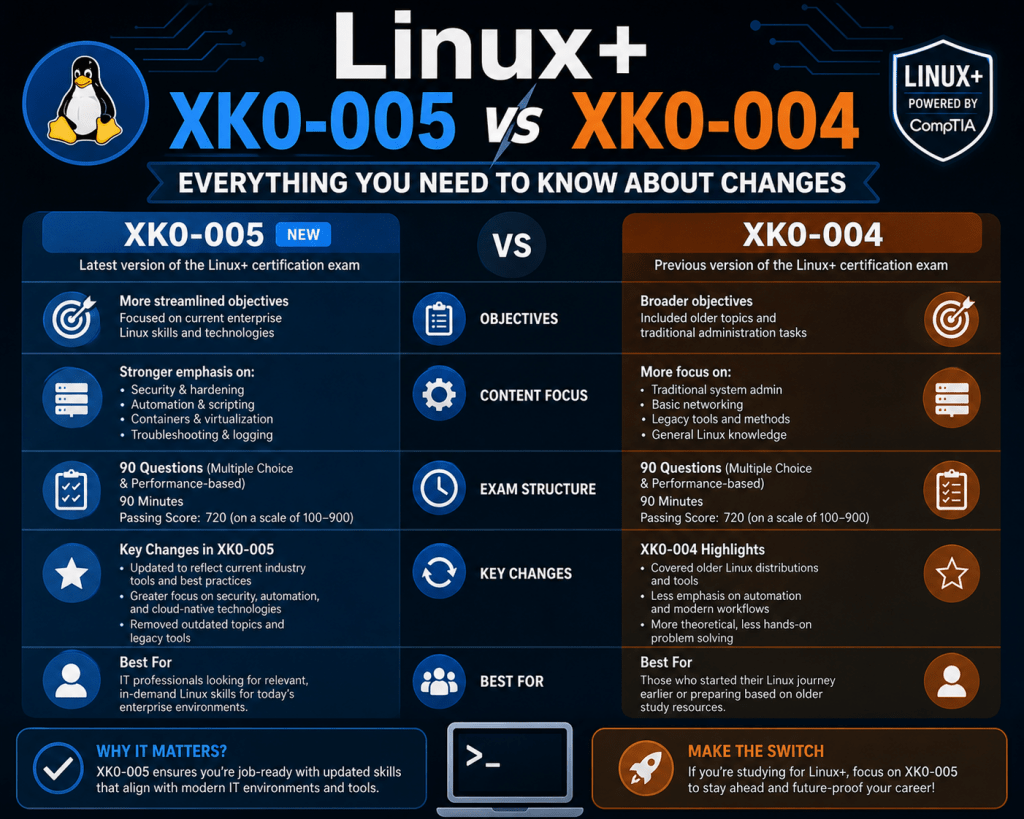
Linux has steadily evolved from a niche operating system used by enthusiasts into a core foundation of global IT infrastructure. Today, it powers enterprise servers, cloud platforms, virtualization systems, and containerized applications across nearly every industry. As this evolution accelerated, certification programs designed to validate Linux skills also had to transform to stay relevant. The shift from older exam versions such as XK0-004 to newer versions like XK0-005 reflects this ongoing adaptation to real-world technological change. Instead of focusing solely on traditional system administration tasks, modern certification structures increasingly emphasize cloud integration, automation workflows, and security-centric administration. This evolution ensures that certified professionals are aligned with the operational demands of contemporary IT environments, where systems are distributed, virtualized, and continuously deployed rather than manually managed on physical hardware.
Role of Linux+ Certification in IT Career Development
Linux+ certification serves as a foundational validation of the technical skills required to manage Linux-based systems. It demonstrates an individual’s ability to configure, maintain, and troubleshoot operating systems that form the backbone of enterprise infrastructure. Beyond basic administration, the certification now represents a broader understanding of system operations in modern environments, including cloud platforms and automated infrastructure pipelines. Employers value this certification because it reflects practical competency in handling real-world system challenges, from user management and file permissions to system security and performance monitoring. As organizations continue migrating workloads to cloud environments, Linux expertise has become a critical requirement for roles in system administration, DevOps engineering, cybersecurity operations, and infrastructure management. This makes Linux+ not just a technical milestone but a career-enabling credential that aligns with evolving industry needs.
Purpose and Scope of Linux+ Exam Framework
The Linux+ exam is designed to evaluate a candidate’s proficiency across multiple domains of Linux system administration. It combines theoretical understanding with performance-based scenarios that simulate real-world system tasks. The exam typically covers areas such as system configuration, security management, troubleshooting, and automation. Each domain is weighted to reflect its importance in professional environments. Over time, the scope of the exam has expanded to include emerging technologies that are now integral to Linux environments, such as containerization and cloud-based system management. The primary goal of the certification framework is to ensure that candidates are not only familiar with Linux commands and tools but also capable of applying them in dynamic and scalable infrastructures where automation and remote management are essential.
General Structure of Linux+ Exam Versions
Linux+ certification exams are structured into clearly defined domains that represent essential skill areas. Each domain evaluates specific competencies required for managing Linux systems effectively. Traditionally, these domains have included system management, security, troubleshooting, and maintenance. In earlier versions, such as XK0-004, the structure included a broader focus on hardware-related configuration and manual system operations. However, newer versions like XK0-005 have refined this structure to better align with cloud-based environments and automation-driven workflows. The reduction in the number of domains and the redistribution of weightings reflect a shift toward efficiency, scalability, and modern IT practices. This structured approach ensures a comprehensive evaluation of both foundational and advanced Linux skills.
Transition from XK0-004 to XK0-005 in Certification Design
The transition from XK0-004 to XK0-005 represents more than a simple update; it reflects a fundamental change in how Linux skills are defined in the modern IT landscape. XK0-004 focused heavily on traditional system administration tasks, including hardware interaction, manual configuration, and on-premises system maintenance. In contrast, XK0-005 introduces a more streamlined and modernized structure that prioritizes automation, security, and cloud integration. This shift acknowledges that most enterprise systems are no longer confined to physical infrastructure but are distributed across virtualized environments. As a result, candidates are now expected to understand how Linux operates within cloud ecosystems, container platforms, and automated deployment pipelines rather than solely focusing on standalone system management.
Evolution of Domain Structure and Skill Distribution
One of the most noticeable differences between XK0-004 and XK0-005 lies in the restructuring of exam domains. Earlier versions included more fragmented domains that separately addressed hardware configuration, system maintenance, and troubleshooting. The newer version consolidates these areas into broader categories that better reflect real-world job roles. This restructuring reduces redundancy while emphasizing critical skill areas such as automation and security. The redistribution of domain weightings also highlights the increasing importance of scripting and system orchestration. Instead of spending significant focus on hardware-level configuration, the updated structure prioritizes tasks that involve managing scalable systems through automated processes and remote administration tools.
System Administration in Modern Linux Certification Context
System administration remains a core pillar of Linux+ certification, but its scope has expanded significantly over time. In earlier exam versions, system administration primarily involved local configuration, manual updates, and direct hardware interaction. In modern versions, system administration extends to managing virtual machines, cloud instances, and containerized workloads. This includes configuring system services, managing users and permissions, and ensuring system stability across distributed environments. The emphasis is now on remote administration and scalable system design rather than isolated machine management. This reflects the reality of enterprise IT environments where physical access to servers is rare, and administrators rely on network-based tools to manage infrastructure at scale.
Security Emphasis in Modern Linux+ Certification
Security has become a central focus in Linux+ certification due to the increasing complexity and connectivity of modern systems. As infrastructure moves to cloud-based environments, securing access and protecting data has become more challenging and more critical. Modern exam versions emphasize identity and access management, encryption techniques, and authentication protocols. Candidates are expected to understand concepts such as public key infrastructure, multi-factor authentication, and centralized identity services. These security measures are essential for protecting systems from unauthorized access and ensuring compliance with organizational policies. The increased focus on security reflects the broader industry trend toward zero-trust architectures and secure-by-design system configurations.
Rise of Automation and Scripting in Linux Environments
Automation has become a defining characteristic of modern IT infrastructure, and Linux+ certification reflects this shift by incorporating scripting and automation into its core objectives. Instead of relying on manual execution of repetitive tasks, system administrators are now expected to automate processes using shell scripting and configuration tools. This includes automating system updates, managing scheduled tasks, and deploying applications across multiple systems. Automation not only improves efficiency but also reduces the risk of human error, making it essential for large-scale environments. The inclusion of automation in certification exams ensures that candidates are prepared for infrastructure environments where manual system management is no longer practical.
Cloud Computing Influence on Linux+ Exam Evolution
The rise of cloud computing has significantly influenced the structure and content of Linux+ certification exams. In traditional environments, administrators managed physical servers located within data centers. However, modern infrastructure is heavily cloud-based, with virtual machines and containerized applications hosted across distributed platforms. This shift has led to a reduced emphasis on hardware-specific knowledge and an increased focus on cloud-based system administration. Candidates are expected to understand how Linux operates within virtual environments, including resource allocation, remote configuration, and scalable deployment strategies. This cloud-centric approach ensures that certification remains relevant in an industry dominated by virtual infrastructure.
Introduction of Container Concepts in Certification Objectives
Containerization has become a critical component of modern software deployment strategies, and its inclusion in Linux+ certification reflects its importance in real-world environments. Containers allow applications to run in isolated environments, ensuring consistency across development, testing, and production systems. Understanding container lifecycle management, basic deployment operations, and runtime behavior is now an expected skill for certified professionals. This includes knowledge of how containers interact with host systems, how they are monitored, and how they are scaled across environments. The integration of container concepts into certification objectives highlights the shift toward modular and portable application deployment models.
Alignment of Certification with Industry Skill Requirements
The overall evolution of Linux+ certification demonstrates a clear alignment with industry skill requirements. As organizations adopt cloud computing, automation, and containerization, the demand for professionals who understand these technologies has increased significantly. Certification frameworks have adapted by incorporating these concepts into exam objectives, ensuring that candidates are prepared for modern IT roles. This alignment ensures that Linux+ certification remains relevant and valuable in a competitive job market where technical adaptability and infrastructure knowledge are essential. By bridging traditional Linux administration skills with modern infrastructure practices, the certification creates a comprehensive skill profile that reflects real-world expectations.
Understanding the Structural Shift in Exam Domains
The transition from XK0-004 to XK0-005 represents a deliberate restructuring of how Linux skills are categorized and evaluated. Earlier versions of the exam were divided into more fragmented domains that reflected traditional system administration tasks such as hardware configuration, system maintenance, troubleshooting, and security. While these areas are still relevant, they have been reorganized in the newer version to better align with modern IT workflows. XK0-005 consolidates and refines these domains into fewer but broader categories that reflect real-world job responsibilities more accurately. This restructuring reduces overlap between topics and emphasizes skills that are directly applicable to cloud-based, automated, and containerized environments. The result is a more streamlined certification model that prioritizes practical system operations over isolated technical tasks.
From Hardware-Centric to Cloud-Centric Thinking
One of the most significant differences between XK0-004 and XK0-005 is the reduced emphasis on hardware-level system management. In XK0-004, candidates were expected to understand physical system configuration, hardware interaction, and on-premises infrastructure management. This included tasks such as managing storage devices, configuring hardware components, and maintaining physical servers. However, with the rise of virtualization and cloud computing, physical hardware interaction has become less relevant for most system administrators. XK0-005 reflects this shift by minimizing hardware-focused content and instead emphasizing virtualized environments where infrastructure is abstracted from physical machines. In modern IT environments, administrators interact with virtual machines and cloud instances rather than physical servers, making hardware-specific knowledge less critical than system orchestration and remote management skills.
System Management Domain Evolution
System management remains a core domain in both XK0-004 and XK0-005, but its scope and focus have evolved significantly. In XK0-004, system management primarily involved direct configuration of Linux systems, including file system management, user account creation, and service configuration. XK0-005 expands this domain to include cloud-based system management and virtual infrastructure control. This includes managing system resources in distributed environments, configuring services across multiple instances, and ensuring consistent system behavior in virtualized platforms. The focus has shifted from individual machine management to scalable system administration, where administrators are responsible for maintaining consistency across large numbers of systems. This change reflects the realities of modern enterprise environments, where infrastructure is often distributed across multiple data centers and cloud providers.
Security Domain Transformation and Modern Threat Landscape
Security has undergone one of the most significant transformations between XK0-004 and XK0-005. While earlier versions focused on basic system security principles such as file permissions, firewall configuration, and local authentication, the newer versions place a much stronger emphasis on identity management, encryption, and access control in distributed environments. Modern systems operate in highly connected environments where threats are not limited to local access but include network-based attacks and unauthorized cloud access. XK0-005 introduces a deeper focus on public key infrastructure, secure authentication mechanisms, and centralized identity systems. Multi-factor authentication and single sign-on technologies are now essential components of the security domain. This shift reflects the growing importance of protecting cloud-based infrastructure and ensuring secure access across distributed systems.
Expansion of Identity and Access Management Concepts
Identity and access management has become a central component of modern Linux security practices. In XK0-004, access control was primarily focused on local user permissions and group management. XK0-005 expands this concept significantly by introducing centralized authentication systems and federated identity management. This includes understanding how users authenticate across multiple systems using unified credentials and how access policies are enforced across distributed environments. The emphasis on identity management reflects the reality of modern enterprise systems, where users frequently access resources across multiple platforms and services. Secure authentication mechanisms are essential for maintaining system integrity and preventing unauthorized access in complex IT environments.
Automation and Scripting Domain Expansion
Automation has become one of the most important additions to XK0-005 compared to XK0-004. In earlier versions, scripting was present but not a dominant focus area. XK0-005 significantly increases the importance of automation by dedicating a larger portion of the exam to scripting, task automation, and system orchestration. Candidates are expected to understand how to use shell scripts to automate repetitive tasks such as system updates, backups, and configuration management. Automation tools and scripting languages are now essential for managing large-scale environments where manual administration is impractical. This shift reflects the industry-wide adoption of DevOps practices, where infrastructure is managed through code rather than manual intervention. Automation improves efficiency, reduces errors, and ensures consistency across systems.
Role of Shell Scripting in Modern System Administration
Shell scripting plays a critical role in Linux automation and is a key focus area in XK0-005. Unlike manual command execution, shell scripts allow administrators to automate sequences of tasks that would otherwise require repetitive input. This includes system configuration, log management, and resource monitoring. In modern IT environments, scripting is not just a supplementary skill but a core requirement for system administrators. XK0-005 emphasizes practical scripting scenarios where candidates must demonstrate the ability to write and interpret scripts that perform real-world system tasks. This reflects the increasing reliance on automation in enterprise environments where efficiency and scalability are essential.
Troubleshooting Domain Reorganization
Troubleshooting remains an essential component of Linux+ certification, but its structure has been refined in XK0-005. In XK0-004, troubleshooting was often treated as a standalone domain focused on diagnosing and resolving system issues. XK0-005 integrates troubleshooting more closely with system management and operational tasks. This reflects the reality that troubleshooting is not a separate activity but an ongoing part of system administration. Candidates are expected to identify and resolve issues related to system performance, network connectivity, service failures, and configuration errors. The emphasis is on analytical problem-solving and systematic diagnosis rather than isolated repair tasks. This approach better reflects real-world scenarios where system issues often span multiple layers of infrastructure.
Integration of Monitoring and Diagnostic Practices
Modern Linux environments require continuous monitoring and diagnostics to ensure system stability and performance. XK0-005 reflects this requirement by emphasizing monitoring tools and diagnostic techniques. Candidates are expected to understand how to interpret system logs, monitor resource usage, and identify performance bottlenecks. Monitoring is not only used for troubleshooting but also for proactive system management. By identifying potential issues before they escalate, administrators can maintain system reliability and prevent downtime. This proactive approach is increasingly important in cloud environments where systems must operate continuously with minimal disruption.
Containerization as a Core Competency Area
Container technology has become a fundamental component of modern application deployment, and XK0-005 incorporates this concept as a key competency area. Containers allow applications to run in isolated environments, ensuring consistency across different stages of development and deployment. Candidates are expected to understand basic container operations such as creating, running, and managing containers. This includes knowledge of container lifecycle management and resource allocation. The inclusion of containerization in the exam reflects its widespread adoption in cloud computing environments where applications are deployed in modular and scalable units. Understanding container concepts is now essential for modern system administrators.
Introduction of Kubernetes Awareness
While XK0-005 is not a Kubernetes certification, it introduces foundational awareness of container orchestration concepts. Kubernetes is widely used for managing containerized applications at scale, and Linux professionals are expected to have a basic understanding of its purpose and structure. This includes knowledge of how applications are deployed in clusters, how workloads are distributed, and how resources are managed across multiple nodes. The focus is not on deep Kubernetes administration but on conceptual understanding of how container orchestration fits into modern infrastructure. This reflects the growing importance of scalable application deployment systems in enterprise environments.
Domain Weight Redistribution and Its Implications
The redistribution of domain weightings between XK0-004 and XK0-005 highlights shifting industry priorities. In XK0-004, greater emphasis was placed on hardware and traditional system administration tasks. In XK0-005, more weight is allocated to automation, security, and system management in virtual environments. This redistribution reflects the reduced importance of physical infrastructure and the increased importance of scalable, automated systems. The changes in weighting also indicate that certification is now more aligned with job roles that involve cloud infrastructure management and DevOps practices. Candidates are expected to demonstrate a balanced skill set that includes both foundational Linux knowledge and modern infrastructure capabilities.
Alignment with Modern IT Job Roles
The updated exam structure aligns closely with current IT job roles such as system administrator, cloud engineer, DevOps technician, and infrastructure specialist. These roles require a combination of Linux expertise, automation skills, and cloud platform knowledge. XK0-005 reflects these requirements by integrating relevant topics into its domains. Instead of focusing solely on traditional system administration tasks, the exam evaluates a broader range of competencies that are directly applicable to modern IT environments. This alignment ensures that certified professionals are well-prepared for roles that require both technical depth and operational flexibility in dynamic infrastructure environments.
Real-World Application of Linux+ Skills in Modern IT Environments
Linux+ certification is ultimately designed to reflect real-world system administration and infrastructure management tasks. In modern IT environments, Linux is not used in isolation but as part of complex ecosystems that include cloud platforms, virtualization layers, container systems, and automated deployment pipelines. The skills validated through XK0-004 and XK0-005 are directly applicable to these environments, but the newer version places greater emphasis on scenarios that mirror current industry practices. Instead of focusing heavily on manual configuration of standalone systems, XK0-005 emphasizes distributed system management, cloud-based operations, and automated workflows. This reflects the reality that most organizations no longer maintain isolated servers but instead operate large-scale, interconnected infrastructures where systems must be managed remotely and efficiently.
System Administration in Cloud-Based Infrastructure
Modern system administration has shifted significantly from traditional on-premises environments to cloud-based infrastructures. In older models, administrators physically accessed servers to configure and maintain them. Today, most systems are hosted in cloud environments where access is remote and management is centralized through web interfaces or command-line tools. XK0-005 reflects this shift by emphasizing skills related to managing virtual machines, configuring remote systems, and maintaining services in distributed environments. System administrators are now expected to manage infrastructure that spans multiple geographic regions and cloud providers. This requires a strong understanding of networking, security, and automation to ensure consistent performance and reliability across all systems.
Automation as a Core Operational Requirement
Automation has become one of the most critical aspects of modern IT operations. In large-scale environments, manually performing repetitive tasks is inefficient and error-prone. As a result, system administrators are expected to automate processes such as software deployment, system updates, configuration management, and monitoring. XK0-005 places significant emphasis on automation skills, reflecting their importance in real-world environments. Automation is typically achieved through scripting and configuration tools that allow administrators to define system behavior programmatically. This shift toward automation aligns with the broader industry movement toward infrastructure as code, where systems are managed through scripts and templates rather than manual intervention.
Scripting Skills and Operational Efficiency
Scripting is a foundational skill for modern Linux professionals. It enables the automation of complex workflows and reduces the need for manual system management. In XK0-005, scripting is not treated as an optional skill but as a core competency. Candidates are expected to understand how to write scripts that perform tasks such as file manipulation, system monitoring, and process automation. Shell scripting remains the most common form of automation in Linux environments due to its simplicity and direct integration with system commands. By mastering scripting, professionals can significantly improve operational efficiency and reduce the likelihood of human error in system administration tasks.
Security in Distributed and Cloud Environments
Security considerations have become increasingly complex as systems move into distributed and cloud-based environments. Unlike traditional setups where systems were confined to internal networks, modern infrastructures are exposed to external networks and multiple access points. XK0-005 reflects this reality by placing greater emphasis on advanced security concepts such as identity management, encryption, and secure authentication protocols. Administrators must ensure that only authorized users can access systems and that data remains protected during transmission and storage. This requires knowledge of encryption techniques, certificate management, and secure communication protocols. Security is no longer a standalone task but an integrated part of every system administration activity.
Identity and Access Management in Modern Systems
Identity and access management has become a central component of system security in modern IT environments. Instead of managing user accounts locally on individual systems, organizations now rely on centralized authentication services that control access across multiple platforms. XK0-005 emphasizes these concepts by requiring an understanding of authentication frameworks and access control systems. This includes managing user identities across distributed environments and ensuring consistent access policies across cloud services. Identity management systems help organizations maintain security while allowing users to access multiple resources with a single set of credentials. This approach improves both security and usability in complex IT environments.
Troubleshooting in Complex Infrastructure Systems
Troubleshooting remains a critical skill for Linux professionals, but its complexity has increased significantly in modern environments. In traditional systems, troubleshooting often involved diagnosing issues on a single machine. In modern infrastructures, problems can span multiple systems, networks, and cloud services. XK0-005 reflects this complexity by focusing on systematic diagnostic approaches rather than isolated issue resolution. Candidates are expected to analyze system logs, monitor performance metrics, and identify root causes of failures in distributed environments. Effective troubleshooting requires a deep understanding of system interactions and dependencies, as issues in one component can affect multiple layers of infrastructure.
Monitoring and Proactive System Management
Modern system administration emphasizes proactive monitoring rather than reactive problem-solving. Instead of waiting for systems to fail, administrators continuously monitor system performance to detect potential issues early. XK0-005 incorporates monitoring concepts that allow professionals to understand system behavior in real time. This includes tracking resource usage, analyzing logs, and identifying performance bottlenecks before they impact users. Proactive monitoring is essential in cloud environments where systems must remain highly available and scalable. By continuously observing system metrics, administrators can ensure optimal performance and prevent downtime.
Containerization in Production Environments
Containerization has become a standard method for deploying applications in modern IT environments. Containers allow applications to run in isolated environments with consistent configurations, making them highly portable and scalable. XK0-005 introduces container concepts that reflect their widespread use in production systems. Administrators are expected to understand how containers are created, managed, and deployed within Linux environments. This includes knowledge of container lifecycle operations and resource management. Containers are particularly important in cloud environments where applications must be deployed quickly and scaled efficiently across multiple systems.
Understanding Orchestration Concepts in Modern Infrastructure
While XK0-005 does not require deep expertise in orchestration platforms, it introduces foundational concepts related to container orchestration. In modern IT environments, applications are often deployed across multiple containers that must be managed collectively. Orchestration systems handle tasks such as load balancing, scaling, and resource allocation. Understanding these concepts helps Linux professionals appreciate how modern applications are structured and deployed. This knowledge is essential for working in environments where applications must remain highly available and responsive under varying workloads.
Cloud Integration and Virtualized System Management
Cloud computing has fundamentally changed how Linux systems are deployed and managed. Instead of physical servers, administrators now work with virtual machines hosted on cloud platforms. XK0-005 reflects this shift by emphasizing cloud-based system management skills. This includes provisioning virtual machines, configuring network settings, and managing system resources in virtual environments. Cloud integration requires a strong understanding of how Linux operates within distributed systems and how resources are allocated dynamically based on demand. This shift has made traditional hardware knowledge less relevant while increasing the importance of virtualization and cloud operations.
Performance Optimization in Virtual Environments
Performance optimization in modern Linux environments involves managing resources efficiently across virtual systems. Unlike physical servers, where resources are fixed, virtual environments allow dynamic allocation of CPU, memory, and storage. XK0-005 emphasizes the importance of monitoring and optimizing system performance to ensure efficient resource utilization. This includes identifying performance bottlenecks, adjusting system configurations, and ensuring that applications run efficiently under varying loads. Performance optimization is essential in cloud environments where multiple virtual machines share underlying physical resources.
Career Relevance of Linux+ Certification in Modern IT Roles
Linux+ certification remains highly relevant for a wide range of IT roles. System administrators use Linux+ knowledge to manage enterprise infrastructure, while cloud engineers rely on Linux skills to deploy and maintain virtual environments. DevOps professionals use Linux automation and scripting to streamline deployment pipelines and manage infrastructure as code. Cybersecurity specialists rely on Linux knowledge to secure systems and analyze potential threats. XK0-005 aligns closely with these roles by incorporating modern technologies and practices that are widely used in the industry. This ensures that certified professionals are equipped with skills that are directly applicable to current job requirements.
Entry-Level and Intermediate Career Path Opportunities
Linux+ certification is particularly valuable for individuals entering the IT field or transitioning into infrastructure-related roles. It provides a structured foundation in Linux system administration while introducing modern concepts such as automation and cloud integration. Entry-level roles such as junior system administrator or support technician benefit from Linux+ knowledge, as it provides the technical foundation needed to manage Linux systems effectively. Intermediate roles such as cloud technician or DevOps assistant build on these skills to manage more complex infrastructures. The certification serves as a stepping stone for more advanced certifications and specialized career paths in IT infrastructure and security.
Strategic Decision-Making Between XK0-004 and XK0-005
Choosing between XK0-004 and XK0-005 depends largely on timing and career goals. XK0-004 represents a more traditional approach to Linux system administration, focusing on foundational skills and legacy system management. XK0-005 represents a modernized version that aligns with current industry trends such as cloud computing, automation, and containerization. Candidates who are already preparing for XK0-004 may choose to complete it if they are close to readiness, while new candidates are generally better served by focusing on XK0-005 due to its updated content. The strategic choice depends on whether the goal is to quickly obtain certification or to align with long-term industry relevance.
Long-Term Industry Relevance of Updated Certification Content
The evolution from XK0-004 to XK0-005 reflects broader trends in the IT industry toward automation, virtualization, and cloud-native architectures. These trends are not temporary but represent long-term shifts in how systems are designed and managed. As a result, the content covered in XK0-005 is likely to remain relevant for years to come. Professionals who focus on modern certification content are better positioned to adapt to future changes in technology and infrastructure design. This long-term relevance makes updated certification paths more valuable for sustained career growth in the IT industry.
Conclusion
The evolution of Linux+ certification from XK0-004 to XK0-005 reflects a broader transformation in the IT industry, where traditional system administration is steadily merging with cloud computing, automation, and security-driven infrastructure design. What was once primarily focused on managing standalone Linux systems has now expanded into a much wider discipline that includes distributed systems, container platforms, and automated workflows. This shift is not just about updating exam content but about redefining what it means to be a Linux professional in modern environments where infrastructure is dynamic, scalable, and heavily abstracted from physical hardware.
One of the most important takeaways from this transition is how significantly the role of a Linux administrator has changed. In earlier IT environments, administrators were often responsible for physically interacting with servers, configuring hardware, and maintaining localized systems. The XK0-004 structure still reflected much of this mindset, where hardware awareness and traditional system maintenance were key components. However, as organizations moved toward virtualization and cloud-first strategies, the necessity for direct hardware management diminished. The XK0-005 framework acknowledges this shift by reducing emphasis on physical infrastructure and instead focusing on virtualized environments where systems are deployed, managed, and scaled remotely.
This change in focus also highlights the growing importance of automation in modern IT operations. Manual configuration and repetitive administrative tasks are no longer sustainable in environments where hundreds or thousands of systems may need to be managed simultaneously. Automation allows administrators to define system behavior once and apply it consistently across large infrastructures. This reduces human error, improves efficiency, and ensures consistency across environments. The inclusion of scripting and automation in the updated certification structure reflects the reality that modern Linux professionals must think in terms of systems that manage themselves through predefined logic rather than constant manual intervention.
Security has also become a far more prominent concern in modern Linux environments. In traditional systems, security often focused on local access control and basic firewall configurations. Today, systems are distributed across multiple networks and cloud platforms, exposing them to a much broader range of threats. As a result, security practices have evolved to include identity management, encryption, and centralized authentication systems. The emphasis on these areas in XK0-005 reflects the need for professionals who can secure not just individual machines but entire ecosystems of interconnected services. The rise of multi-factor authentication, public key infrastructure, and centralized identity systems demonstrates how security has become deeply integrated into every layer of system administration.
Another major shift reflected in the updated certification structure is the growing importance of containerization. Modern applications are rarely deployed directly onto physical or even virtual machines in isolation. Instead, they are packaged into containers that can be deployed consistently across different environments. This approach ensures that applications behave the same way in development, testing, and production environments. The inclusion of container-related concepts in XK0-005 highlights how essential this technology has become in modern infrastructure. While the certification does not require deep specialization in orchestration platforms, it introduces foundational knowledge that helps professionals understand how modern applications are structured and deployed at scale.
The broader adoption of cloud computing has also fundamentally reshaped the expectations placed on Linux professionals. In cloud-based environments, infrastructure is no longer static. Systems can be created, modified, or destroyed dynamically based on demand. This requires administrators to think in terms of scalability and flexibility rather than fixed configurations. The updated certification framework reflects this reality by emphasizing skills related to virtual machine management, remote system administration, and resource optimization in distributed environments. Understanding how Linux operates within cloud platforms has become essential for nearly every IT role that interacts with modern infrastructure.
Troubleshooting, which has always been a core skill for Linux professionals, has also evolved in complexity. In traditional environments, troubleshooting often involved identifying and resolving issues on a single system. In modern infrastructures, problems can span multiple layers, including network configurations, virtual machines, container environments, and cloud services. This requires a more analytical and systematic approach to problem-solving. Professionals must be able to interpret system logs, monitor performance metrics, and identify root causes that may not be immediately visible. The updated certification structure reflects this complexity by integrating troubleshooting into broader system management and operational domains rather than treating it as an isolated skill.
Performance monitoring and system optimization have also become increasingly important in modern Linux environments. Systems are expected to operate continuously with minimal downtime, especially in cloud-based infrastructures where availability is critical. Administrators must be able to monitor system behavior in real time, identify performance bottlenecks, and make adjustments to ensure optimal resource utilization. This proactive approach to system management represents a significant shift from traditional reactive models, where issues were addressed only after they occurred. The ability to anticipate and prevent problems has become just as important as the ability to resolve them.
From a career perspective, Linux+ certification continues to serve as a strong foundation for individuals entering the IT industry or transitioning into infrastructure-focused roles. The updated XK0-005 structure aligns more closely with current job requirements, making it particularly relevant for roles in cloud engineering, system administration, DevOps, and cybersecurity. These roles require a combination of traditional Linux knowledge and modern infrastructure skills, including automation, cloud integration, and security management. The certification helps bridge this gap by providing a structured learning path that reflects both foundational and advanced concepts.
The decision between older and newer certification versions ultimately depends on timing and long-term career objectives. While older versions still provide valuable foundational knowledge, newer versions are better aligned with current and future industry trends. As IT infrastructure continues to evolve toward cloud-native architectures and automated systems, professionals who are trained in modern certification frameworks are better positioned to adapt to changing technologies. The updated content ensures that learners are not only prepared for current job roles but also equipped with skills that will remain relevant as technology continues to advance.
Overall, the transition from XK0-004 to XK0-005 represents more than just an exam update. It reflects a fundamental shift in how Linux systems are used, managed, and integrated into modern IT environments. The focus has moved away from isolated system administration tasks toward a more holistic understanding of infrastructure that includes automation, security, cloud computing, and containerization. This evolution ensures that Linux professionals remain adaptable in a rapidly changing technological landscape where efficiency, scalability, and security are essential for success.