
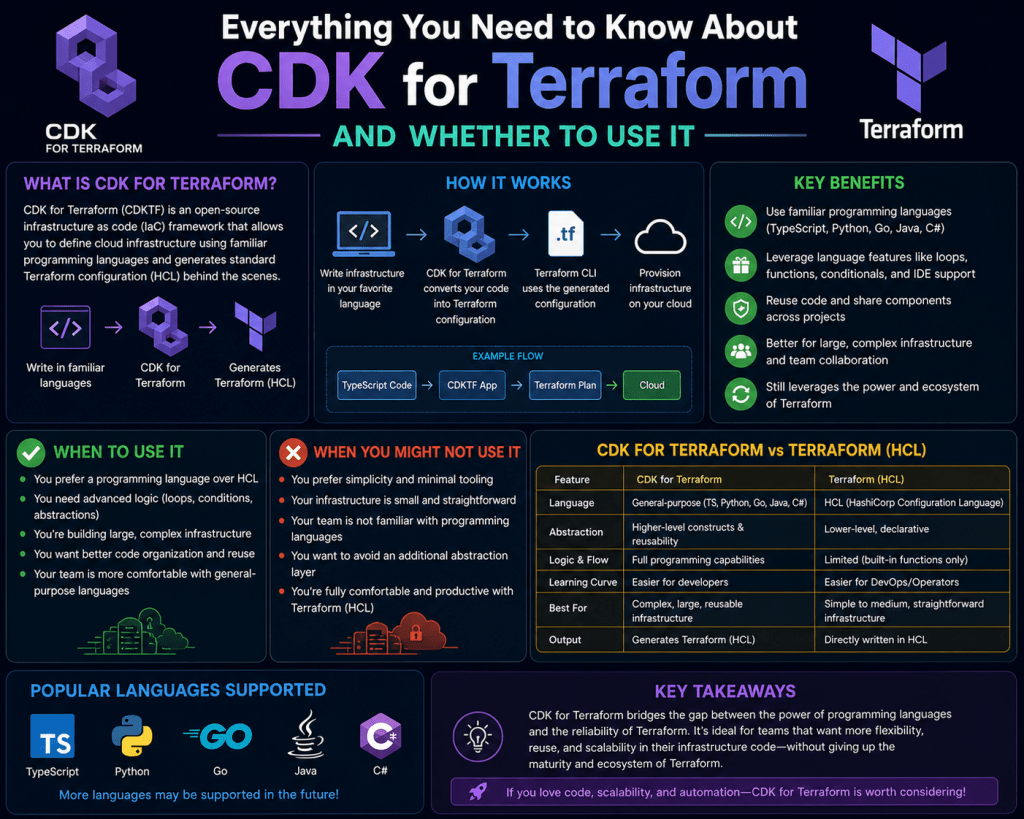
Infrastructure as code has changed how modern cloud environments are built and managed. Instead of manually configuring servers, networks, and storage through dashboards or command-line steps, infrastructure is defined in structured files that can be versioned, reused, and deployed automatically. This approach reduces human error, improves consistency, and allows large-scale automation across cloud environments.
Terraform is one of the most widely used tools in this space because it supports multiple cloud providers and offers a unified workflow for infrastructure management. It works by reading configuration files and converting them into execution plans that describe exactly what changes will happen before anything is applied. This makes infrastructure changes predictable and safe to review before deployment.
In distributed cloud systems where workloads span multiple regions and services, this predictability becomes extremely important. Terraform ensures that infrastructure remains aligned with a defined desired state rather than relying on manual updates or ad-hoc changes.
How Terraform Structures Infrastructure Management
Terraform follows a state-driven approach. It continuously compares the current state of infrastructure with the desired state defined in configuration files. When differences are detected, it generates a plan to update the system accordingly.
This approach removes the need for manual tracking of infrastructure changes. Instead, the system itself becomes the source of truth. Every resource, such as virtual machines, databases, and networking components, is managed as part of a larger dependency graph.
This graph ensures that resources are created, updated, or destroyed in the correct order. For example, a network must exist before a virtual machine can be attached to it. Terraform automatically handles these relationships, reducing complexity for engineers.
Understanding HCL as the Core Configuration Language
At the core of Terraform is HashiCorp Configuration Language, commonly known as HCL. It is a declarative language designed specifically for infrastructure definition. Instead of describing step-by-step instructions, HCL focuses on defining the final desired state of infrastructure.
HCL uses block structures that represent resources, variables, providers, and outputs. Each block contains key-value pairs that define configuration details such as region, instance type, or access rules. The syntax is designed to be readable and similar in structure to JSON, making it easier to understand for engineers from different backgrounds.
Although HCL is simple in design, it provides a powerful abstraction over cloud provider APIs. It allows engineers to define complex infrastructure without directly interacting with low-level service interfaces.
Structure And Behavior of HCl Configurations
HCL configurations are built using structured blocks that define infrastructure components. Resource blocks define cloud resources, provider blocks define cloud platforms, and variable blocks introduce flexibility into configurations.
Terraform reads these files and builds a dependency graph that determines execution order. This ensures that resources are created in the correct sequence based on their relationships. For example, a database that depends on a network will only be created after the network is available.
This automated dependency management is one of the key strengths of Terraform. It reduces the need for manual orchestration and ensures consistent infrastructure deployment across environments.
LLimitations ofHCL inn Complex Infrastructure Environments
While HCL is effective for many infrastructure use cases, it becomes less flexible as systems grow in complexity. One limitation is the lack of advanced programming features. It does not support full object-oriented design, complex abstractions, or rich control structures found in general-purpose programming languages.
This makes it difficult to build highly reusable infrastructure patterns without duplicating configuration or relying heavily on modules. Although modules help reduce repetition, they do not provide the same level of flexibility as software programming constructs.
Another limitation is handling dynamic logic. While conditional expressions exist, they are limited compared to full programming languages. This can make it harder to build infrastructure that adapts dynamically to different environments or input conditions.
Increasing Complexity In Modern Cloud Architectures
Modern cloud systems are far more complex than traditional infrastructure environments. They include microservices, distributed systems, event-driven architectures, and multi-region deployments. Managing these systems requires more than static configuration files.
Infrastructure must now respond to changing workloads, security requirements, and deployment environments. This requires dynamic logic, reuse patterns, and abstraction capabilities that go beyond what HCL was originally designed to handle.
As a result, engineers began exploring ways to combine infrastructure as code with full programming capabilities, leading to new approaches such as CDK for Terraform.
Introduction to CDK for Terraform As A Modern Alternative
CDK for Terraform introduces a different way of defining infrastructure. Instead of writing static configuration files in HCL, engineers use general-purpose programming languages to define infrastructure.
This allows infrastructure to be written using familiar programming concepts such as classes, functions, loops, and objects. These definitions are then converted into Terraform-compatible configurations behind the scenes.
The final output is still managed by Terraform, but the process of generating infrastructure becomes programmable rather than static.
How Cdk For Terraform Works Behind The Scenes
CDK for Terraform works through a synthesis process. Engineers write infrastructure definitions in supported programming languages, and these definitions are then compiled into Terraform configuration files.
Once generated, Terraform treats these files like any other configuration. It builds dependency graphs, generates execution plans, and applies changes accordingly.
This separation allows developers to focus on logic and structure while Terraform handles provisioning and state management. It combines software engineering practices with infrastructure automation.
Programming Languages Supported by CDK for Terraform
CDK for Terraform supports multiple programming languages, including TypeScript, Python, Java, C#, and Go. Each language brings different strengths depending on the development environment.
TypeScript is widely used for its strong typing and modern ecosystem. Python is popular for simplicity and automation tasks. Java and C# are common in enterprise environments with structured development practices. Go is often used in cloud-native systems due to its performance and concurrency features.
This flexibility allows teams to adopt CDK for Terraform without changing their existing programming ecosystems.
Shifting From Declarative To Programmatic Infrastructure Design
The biggest change introduced by CDK for Terraform is the shift from declarative to programmatic infrastructure design. In declarative systems, engineers describe what the final infrastructure should look like. In programmatic systems, engineers describe how infrastructure should be constructed using code.
This allows infrastructure to be generated dynamically based on inputs, conditions, or business logic. It also enables reusable patterns using programming constructs like functions and classes.
This shift aligns infrastructure development more closely with application development practices.
Impact On Reusability And Modular Design
CDK for Terraform improves reusability by allowing infrastructure to be built using programming abstractions. Instead of relying only on static modules, engineers can create reusable classes and functions that generate infrastructure dynamically.
This makes it easier to scale infrastructure design across large systems. A single reusable component can generate multiple variations of infrastructure based on input parameters, reducing duplication and improving maintainability.
Early Adoption Considerations And Practical Implications
While CDK for Terraform provides flexibility, it also introduces additional complexity. Engineers must understand programming concepts such as dependency management, code structure, and build processes.
Debugging can also be more complex because errors may originate from generated configurations rather than directly written infrastructure code. This requires understanding both the programming layer and the resulting Terraform output.
Because it is still evolving, best practices and workflows may change over time as the ecosystem matures.
Evolution Of Infrastructure Engineering Practices
The rise of CDK for Terraform reflects a broader shift in infrastructure engineering. Infrastructure is increasingly treated as programmable systems rather than static configuration files.
This evolution enables greater automation, reuse, and scalability in cloud environments. It also reduces the gap between application development and infrastructure management, allowing both to operate under similar principles.
As cloud systems continue to grow in complexity, this convergence between software engineering and infrastructure design is likely to become even more important.
Understanding The Fundamental Philosophy Differences
The difference between HCL-based Terraform and CDK for Terraform begins at the level of design philosophy. HCL is built around a declarative model where the focus is on describing the final desired state of infrastructure. Engineers specify what should exist, and Terraform determines how to make it happen. This approach reduces complexity by removing procedural logic from infrastructure definitions and letting the system handle orchestration.
CDK for Terraform introduces a different philosophy. Instead of describing only the desired state, engineers use general-purpose programming languages to construct infrastructure dynamically. This means infrastructure can be generated using logic, loops, functions, and reusable classes. The focus shifts from static declaration to programmable construction.
This difference fundamentally changes how engineers think about infrastructure. In HCL, infrastructure is defined as a configuration. In CDK for Terraform, infrastructure is treated as software.
Declarative Model in HCL and Its Strengths
The declarative nature of HCL provides clarity and simplicity. Engineers define resources in a straightforward format without worrying about execution order or procedural steps. Terraform automatically determines dependencies and ensures resources are created in the correct sequence.
This model is particularly useful in environments where infrastructure requirements are stable and predictable. It reduces cognitive load because engineers do not need to think about logic flow or programmatic behavior. Instead, they focus entirely on the desired outcome.
Another strength of the declarative model is consistency. Because the configuration describes only the final state, repeated executions produce the same results as long as the configuration does not change. This makes infrastructure highly predictable and easier to audit.
Programmatic Model in CDK for Terraform
CDK for Terraform introduces a programmatic model where infrastructure is built using code execution. Instead of static files, engineers write code that generates infrastructure definitions. This allows for dynamic behavior that is not possible in traditional HCL configurations.
For example, infrastructure can be generated based on input parameters, environment variables, or external data sources. This makes it possible to create flexible systems that adapt automatically to different deployment scenarios.
Programmatic infrastructure also enables reuse at a deeper level. Instead of repeating configuration blocks or relying solely on modules, engineers can define reusable classes and functions that encapsulate infrastructure logic.
Flexibility In Infrastructure Design
One of the biggest advantages of CDK for Terraform is flexibility. Traditional HCL configurations are limited by their declarative nature, which restricts how much logic can be embedded in infrastructure definitions. CDK removes this limitation by allowing full programming capabilities.
This means engineers can create conditional infrastructure, generate resources dynamically, and implement complex logic that adapts to different environments. For example, the same codebase can generate different infrastructure layouts for development, staging, and production environments without duplicating configuration files.
This flexibility is especially valuable in large-scale systems where infrastructure requirements vary significantly across teams, applications, and regions.
Reusability And Abstraction Differences
Reusability is handled differently in HCL and CDK for Terraform. In HCL, reuse is primarily achieved through modules. Modules allow engineers to encapsulate a set of resources and reuse them across configurations. However, modules are still relatively static and limited in terms of logic.
CDK for Terraform introduces a more advanced form of reuse through programming constructs. Engineers can create classes, inheritance structures, and functions that generate infrastructure dynamically. This allows for higher levels of abstraction and reduces duplication significantly.
For example, a single infrastructure class can define a pattern for deploying a complete application stack, and that class can be reused with different parameters to generate multiple environments.
Maintainability in Large-Scale Systems
Maintainability becomes a critical factor as infrastructure grows in size and complexity. In HCL, maintainability is achieved through modularization and consistent structure. However, as the number of modules increases, managing relationships between them can become challenging.
CDK for Terraform improves maintainability by introducing structured programming patterns. Instead of managing many loosely connected modules, engineers can organize infrastructure into logical code structures that follow software engineering principles.
This allows teams to apply familiar practices such as code reuse, abstraction layers, and object-oriented design. As a result, infrastructure becomes easier to evolve without introducing inconsistencies.
Learning Curve And Skill Requirements
HCL has a relatively gentle learning curve because it is designed specifically for infrastructure definition. Its syntax is simple and does not require deep programming knowledge. This makes it accessible to system administrators, DevOps engineers, and cloud engineers.
CDK for Terraform, on the other hand, requires knowledge of general-purpose programming languages. Engineers must understand concepts such as object-oriented programming, dependency management, and software design patterns.
This increases the learning curve but also aligns infrastructure development more closely with software engineering practices. Teams with strong development backgrounds often find CDK easier to adopt because it uses familiar tools and patterns.
Debugging And Troubleshooting Differences
Debugging in HCL-based Terraform is relatively straightforward because configurations are static and directly interpreted by Terraform. Errors typically point to specific configuration lines, making issues easier to trace.
In CDK for Terraform, debugging can be more complex because infrastructure is generated from code. Errors may originate from the programming layer rather than the final Terraform configuration. This requires engineers to understand both the source code and the generated output.
While this adds complexity, it also enables more powerful debugging capabilities at the programming level. Engineers can use standard development tools such as debuggers, logging frameworks, and testing systems.
Performance Considerations In Infrastructure Generation
Performance in HCL-based Terraform is generally predictable because configurations are static. Terraform processes the configuration, builds a dependency graph, and executes changes.
In CDK for Terraform, there is an additional synthesis step where code is converted into Terraform configuration files. This adds a small overhead but enables dynamic infrastructure generation.
In most cases, this overhead is minimal compared to the overall provisioning time of infrastructure resources. However, in very large systems with complex logic, synthesis performance can become a consideration.
Scalability In Enterprise Environments
Scalability is one of the key factors in choosing between HCL and CDK for Terraform. HCL scales well in environments where infrastructure patterns are relatively consistent and modular. It is widely used in enterprise systems due to its stability and predictability.
CDK for Terraform scales effectively in environments where infrastructure needs to be highly dynamic. It allows teams to build infrastructure factories that generate resources automatically based on input data.
This makes it suitable for organizations with multi-tenant systems, platform engineering teams, or environments where infrastructure is frequently generated and destroyed.
Security And Governance Implications
Security and governance are important considerations in infrastructure management. HCL provides clear visibility into infrastructure definitions because everything is explicitly written in configuration files. This makes auditing relatively straightforward.
CDK for Terraform introduces an additional layer of abstraction, which can make visibility more complex. Since infrastructure is generated from code, understanding the final output requires analyzing both the source code and the synthesized configuration.
However, CDK also enables stronger governance patterns by allowing centralized control over infrastructure generation logic. This can enforce consistent security policies across multiple environments automatically.
Team Collaboration And Workflow Integration
Team collaboration differs significantly between the two approaches. HCL is often easier for cross-functional teams because it does not require advanced programming knowledge. It allows infrastructure and operations teams to work directly with configuration files.
CDK for Terraform aligns more closely with software development workflows. It integrates well with version control systems, code reviews, testing pipelines, and continuous integration processes.
This makes it particularly effective in organizations where infrastructure and application development teams are closely aligned.
Use Cases Where HCL Is More Effective
HCL remains highly effective in environments where infrastructure is stable, predictable, and relatively simple. It is ideal for standard cloud deployments, basic networking setups, and systems where configuration does not change frequently.
It is also well-suited for teams that prefer simplicity and direct control over infrastructure definitions without introducing programming complexity.
Use Cases Where Cdk For Terraform Excels
CDK for Terraform is particularly effective in environments that require dynamic infrastructure generation. This includes multi-environment deployments, large-scale microservice architectures, and systems that require automated infrastructure provisioning.
It is also beneficial for teams with strong software engineering backgrounds who want to apply programming principles to infrastructure management.
Hybrid Approaches In Real World Systems
In many real-world environments, organizations use a hybrid approach combining both HCL and CDK for Terraform. HCL is used for stable infrastructure components, while CDK is used for dynamic or complex systems.
This allows teams to balance simplicity and flexibility without fully committing to one approach. Hybrid usage is often seen in large enterprises where different teams have different infrastructure needs. Long-Term Evolution Of Infrastructure Practices
The evolution of infrastructure as code is moving toward greater programmability and abstraction. While HCL provides a strong foundation for declarative infrastructure, CDK for Terraform represents a shift toward treating infrastructure as software.
This evolution reflects the increasing complexity of cloud environments and the need for more flexible infrastructure management systems. As cloud adoption continues to grow, both approaches are likely to coexist, each serving different roles within modern infrastructure ecosystems.
Introduction To Real World Infrastructure Decision Making
In real-world cloud engineering environments, the decision between HCL-based Terraform and CDK for Terraform is rarely theoretical. It is driven by system complexity, team structure, automation needs, and long-term scalability goals. Organizations do not simply choose one approach based on preference alone; they evaluate how infrastructure is created, maintained, and evolved.
Infrastructure decisions directly affect deployment speed, system reliability, and operational efficiency. Because of this, teams carefully analyze how each approach fits into their workflows before adopting it at scale.
Enterprise Adoption Patterns In Infrastructure Automation
In enterprise environments, HCL remains the dominant approach for most Terraform usage. Its stability, simplicity, and widespread adoption make it a reliable choice for production systems. Many organizations prefer HCL for foundational infrastructure components such as networking, identity management, and baseline compute resources.
However, CDK for Terraform is increasingly being adopted in areas where infrastructure needs to be dynamic or highly reusable. Platform engineering teams, automation teams, and developer productivity groups often use CDK to build internal infrastructure frameworks.
This creates a layered adoption model where HCL handles stable infrastructure layers, while CDK handles dynamic provisioning systems on top.
Platform Engineering And The Rise Of Infrastructure Abstraction
Platform engineering has become a major driver of CDK for Terraform adoption. In this model, infrastructure teams build internal platforms that abstract away underlying cloud complexity for application developers.
CDK for Terraform fits naturally into this model because it allows infrastructure to be packaged as reusable code components. Instead of requiring every team to write infrastructure definitions manually, platform teams can expose predefined infrastructure modules as programmable interfaces.
This reduces duplication, improves consistency, and accelerates development cycles across large organizations.
Infrastructure As Product Thinking
Modern infrastructure design is increasingly treated as a product rather than a static system. In this model, infrastructure teams are responsible for delivering reusable, scalable, and well-documented infrastructure capabilities to internal users.
CDK for Terraform supports this approach by enabling infrastructure to be packaged as code-based products. These products can be versioned, updated, and distributed across teams just like software libraries.
HCL can also support this model through modules, but CDK provides a more flexible foundation for building infrastructure products with complex logic and customization options.
Multi-Environment Deployment Strategies
One of the most common challenges in cloud engineering is managing multiple environments,s such as development, testing, staging, and production. Each environment often requires slight variations in configuration while maintaining overall consistency.
In HCL, this is typically managed through variables and separate configuration files. While effective, it can become repetitive when differences between environments grow.
CDK for Terraform simplifies this process by allowing environments to be generated programmatically. Engineers can define a single infrastructure model and dynamically adjust it based on environmental parameters. This reduces duplication and ensures consistency across environments.
Dynamic Infrastructure Generation At Scale
Large-scale systems often require infrastructure to be created dynamically based on demand. This includes auto-scaling systems, ephemeral environments, and per-customer infrastructure provisioning in multi-tenant platforms.
CDK for Terraform excels in these scenarios because it allows infrastructure to be generated using loops, conditions, and external data sources. This enables systems to automatically adapt to changing requirements without manual intervention.
HCL can handle some dynamic behavior, but it becomes less efficient when complexity increases. CDK provides a more natural way to express dynamic infrastructure logic using programming constructs.
Reusable Infrastructure Design Patterns
Reusable design patterns are essential in large infrastructure systems. These patterns ensure consistency, reduce duplication, and improve maintainability across teams.
In HCL, reuse is primarily achieved through modules. Modules are effective but relatively static in nature. They define a fixed structure that is reused with different inputs.
CDK for Terraform allows more advanced reuse patterns through object-oriented and functional programming. Engineers can define base infrastructure classes and extend them to create specialized versions. This enables deeper customization without duplicating logic.
These patterns make it easier to scale infrastructure across multiple teams and projects.
Testing And Validation In Infrastructure Code
Testing infrastructure is an important aspect of modern cloud engineering. In HCL, testing is often performed through validation tools, plan outputs, and manual review of generated execution plans.
CDK for Terraform introduces the ability to apply software testing methodologies directly to infrastructure code. Since infrastructure is written in programming languages, engineers can use unit testing frameworks, integration tests, and automated validation pipelines.
This improves reliability and reduces the risk of misconfigurations reaching production environments.
Continuous Integration And Delivery Integration
Continuous integration and delivery pipelines play a critical role in modern infrastructure workflows. Both HCL and CDK for Terraform integrate into CI/CD systems, but they do so differently.
HCL-based workflows typically involve validating configuration files, generating execution plans, and applying changes through automated pipelines.
CDK for Terraform introduces an additional synthesis step where infrastructure code is compiled into Terraform configurations before execution. This step integrates naturally into CI/CD pipelines, allowing infrastructure generation to be treated as part of the build process.
This approach aligns infrastructure management more closely with application deployment workflows.
Observability And Debugging At Scale
As infrastructure systems grow, observability becomes increasingly important. Engineers need visibility into how infrastructure is generated, deployed, and modified over time.
In HCL, observability is relatively straightforward because configuration files directly represent infrastructure definitions. Execution plans provide clear insights into changes.
In CDK for Terraform, observability extends to both the code layer and the generated infrastructure layer. Engineers must understand how code translates into configuration and how that configuration is executed by Terraform.
This dual-layer visibility provides more flexibility but requires stronger tooling and debugging practices.
Security Considerations In Programmable Infrastructure
Security is a critical concern in infrastructure design. In HCL, security policies are directly embedded in configuration files, making them easy to audit and review.
CDK for Terraform introduces abstraction, which can make direct inspection more complex. However, it also enables centralized enforcement of security policies through reusable code components.
For example, security rules can be embedded into infrastructure classes, ensuring consistent application across all generated resources. This reduces the risk of misconfiguration caused by human error.
Governance And Standardization Across Teams
Governance becomes increasingly important in large organizations where multiple teams manage infrastructure independently. Without standardization, infrastructure can become inconsistent and difficult to manage.
HCL relies on conventions, modules, and review processes to enforce governance. CDK for Terraform enables stronger governance by embedding rules directly into infrastructure generation logic.
This allows organizations to enforce architectural standards programmatically rather than relying solely on documentation or manual enforcement.
Cloud Native Architecture Compatibility
Modern cloud-native architectures rely heavily on microservices, containers, and distributed systems. These environments require infrastructure that is highly modular and scalable.
CDK for Terraform aligns well with cloud-native principles because it allows infrastructure to be composed programmatically. This makes it easier to define infrastructure that matches microservice architectures.
HCL also supports cloud-native systems but often requires more manual structuring to achieve similar levels of flexibility.
Evolution Of Developer And Infrastructure Roles
The introduction of CDK for Terraform is also changing the roles of developers and infrastructure engineers. Traditionally, infrastructure management and application development were separate disciplines.
With CDK, these boundaries are becoming less distinct. Developers can now define infrastructure using the same languages they use for application development, while infrastructure engineers can apply software engineering principles to system design.
This convergence is leading to more collaborative workflows and shared responsibilities across teams.
Cost Optimization Through Infrastructure Automation
Cost optimization is a major concern in cloud environments. Infrastructure must be designed not only for performance but also for efficiency.
CDK for Terraform enables more advanced cost optimization strategies by allowing infrastructure to be generated dynamically based on usage patterns. For example, resources can be scaled or decommissioned automatically based on demand logic embedded in code.
HCL can support cost optimization through configuration adjustments, but CDK provides more flexibility for implementing dynamic cost control systems.
Migration Strategies From Hcl To Cdk For Terraform
Organizations that want to adopt CDK for Terraform often follow gradual migration strategies. Instead of replacing existing HCL systems, they introduce CDK in specific areas where complexity is high.
Over time, infrastructure teams may shift more workloads to CDK-based systems while maintaining HCL for stable and foundational infrastructure components.
This hybrid approach reduces risk and allows teams to adopt new practices incrementally. Long-Term Future Of Infrastructure As Code
The future of infrastructure as code is moving toward greater programmability, abstraction, and automation. While HCL will continue to play an important role due to its simplicity and stability, CDK for Terraform represents a shift toward infrastructure as software.
As cloud systems become more complex, the need for dynamic infrastructure generation will continue to grow. This will likely increase adoption of programmable infrastructure models across industries.
In the long term, infrastructure management is expected to become more closely aligned with software engineering practices, with CDK-style approaches playing a central role in this transformation.
Conclusion
The evolution of infrastructure management reflects a broader transformation in how modern computing systems are designed and operated. What began as manual server configuration has gradually shifted toward fully automated, code-driven infrastructure provisioning. Terraform has played a central role in this transformation by introducing a consistent and predictable way to manage cloud resources across multiple environments and providers. At the core of its traditional approach is HCL, a declarative language designed to simplify infrastructure definition while maintaining clarity and control. However, as cloud systems continue to grow in complexity, new demands have emerged that extend beyond the capabilities of static configuration languages.
CDK for Terraform represents one of the most significant responses to these changing demands. It introduces a programmable approach to infrastructure definition, allowing engineers to use general-purpose programming languages instead of a domain-specific configuration language. This shift is not just a technical enhancement but a conceptual change in how infrastructure is perceived and managed. Infrastructure is no longer treated as a fixed set of declarations but as a dynamic system that can be generated, manipulated, and reused through code.
The comparison between HCL and CDK for Terraform highlights a broader tension between simplicity and flexibility. HCL offers a clean, declarative structure that is easy to read, easy to audit, and widely understood across technical teams. Its strength lies in its stability and predictability. For many organizations, especially those managing standard cloud deployments, HCL remains more than sufficient. It provides a reliable foundation for infrastructure automation without introducing unnecessary complexity.
On the other hand, CDK for Terraform introduces a level of flexibility that aligns more closely with modern software engineering practices. By allowing infrastructure to be defined using programming languages such as Python, TypeScript, Java, C#, and Go, it enables engineers to apply familiar concepts like abstraction, inheritance, loops, and functions directly to infrastructure design. This makes it possible to build highly reusable, modular, and dynamic infrastructure systems that adapt to changing requirements in ways that static configurations struggle to achieve.
One of the most important implications of this shift is the increased alignment between application development and infrastructure engineering. Traditionally, these two domains have been separated, with different tools, workflows, and mental models. Developers focused on writing application code, while infrastructure teams managed configuration and deployment. CDK for Terraform helps bridge this gap by allowing both groups to work within a shared programming environment. This convergence improves collaboration, reduces friction, and enables faster delivery cycles.
However, this increased flexibility comes with trade-offs. CDK for Terraform introduces additional layers of abstraction, which can make debugging and system understanding more complex. Instead of directly reading infrastructure definitions, engineers must interpret generated configurations and understand how code translates into Terraform outputs. This requires a deeper understanding of both programming logic and infrastructure behavior. As a result, teams adopting CDK must invest in stronger engineering practices, including testing, code reviews, and structured design patterns.
Another important consideration is maintainability. While CDK for Terraform enables powerful reuse mechanisms, it also introduces the risk of over-engineering infrastructure systems. Without clear design principles, code-based infrastructure can become just as complex as poorly structured application code. This makes architectural discipline essential when adopting programmable infrastructure approaches. Teams must carefully balance abstraction with simplicity to ensure systems remain understandable over time.
Despite these challenges, the long-term direction of infrastructure management is clearly moving toward greater programmability. As cloud environments become more distributed and dynamic, static configuration models will struggle to keep up with evolving demands. CDK for Terraform represents a natural progression toward infrastructure systems that behave more like software applications—flexible, modular, and capable of adapting to changing conditions through logic rather than manual updates.
In large-scale enterprise environments, this evolution is already visible. Many organizations are adopting hybrid models where HCL is used for the foundational infrastructure layer,s while CDK for Terraform is used for higher-level orchestration and dynamic provisioning. This layered approach allows teams to benefit from the stability of declarative configurations while leveraging the flexibility of programmable infrastructure where needed. Over time, these hybrid models may evolve further as teams become more comfortable with code-driven infrastructure practices.
Security and governance also play a critical role in this transition. While HCL provides straightforward visibility into infrastructure definitions, CDK for Terraform requires additional attention to ensure that generated configurations adhere to organizational policies. However, when implemented correctly, CDK can actually strengthen governance by embedding policies directly into reusable code components. This ensures that infrastructure is consistently deployed according to defined standards, reducing the risk of misconfiguration and human error.
Cost management is another area where programmable infrastructure offers advantages. Dynamic infrastructure generation makes it easier to scale resources based on demand, automate resource cleanup, and optimize cloud usage patterns. These capabilities become increasingly important as organizations seek to control cloud spending while maintaining performance and availability.
Looking forward, the role of infrastructure engineers is likely to continue evolving. Rather than focusing solely on writing configuration files, engineers will increasingly act as software designers who build infrastructure systems using programming principles. This shift requires new skills, including software architecture, testing methodologies, and advanced automation techniques. At the same time, it opens up new opportunities for innovation in how infrastructure is designed and operated.
The continued development of CDK for Terraform also suggests that infrastructure as code will become more deeply integrated with software development ecosystems. As tools improve and best practices mature, the distinction between application code and infrastructure code will continue to blur. Infrastructure may increasingly be treated as an extension of application logic, rather than a separate domain.
Ultimately, the choice between HCL and CDK for Terraform is not about replacing one with the other, but about understanding where each approach fits best. HCL provides simplicity, clarity, and reliability for stable infrastructure needs. CDK for Terraform provides flexibility, power, and expressiveness for complex and dynamic systems. Together, they represent two complementary approaches to solving the challenges of modern infrastructure management.
As cloud systems continue to expand in scale and complexity, the need for both approaches will remain. What will change is how they are combined, integrated, and applied within modern engineering practices. The future of infrastructure management will likely be defined not by a single tool or language, but by the ability to seamlessly move between declarative and programmatic models depending on the needs of the system.