
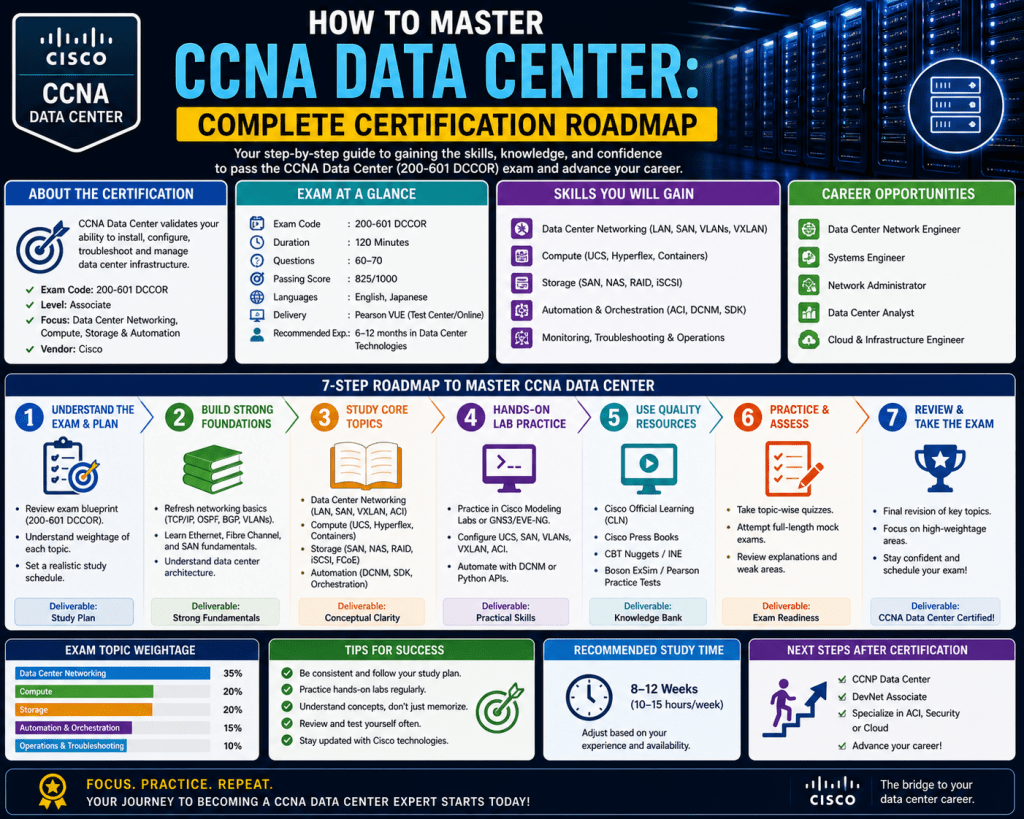
The modern information technology landscape is heavily dependent on large-scale infrastructure systems that support digital communication, application hosting, and enterprise data management. Among these systems, data centers play a central role in ensuring uninterrupted service delivery across organizations of all sizes. As businesses increasingly rely on cloud computing, virtualization, and high-speed networking, the demand for skilled professionals who understand data center operations continues to grow. A structured certification pathway provides learners with a guided approach to developing technical expertise in this field. The CCNA Data Center certification is designed to introduce foundational knowledge related to data center environments, focusing on how infrastructure components work together to support enterprise operations. It serves as an entry point for individuals seeking to build careers in networking, system administration, and infrastructure engineering.
Understanding the Role of Data Centers in Digital Infrastructure
Data centers are specialized facilities that house computing systems, storage devices, and networking equipment required to support digital services. These environments are designed to ensure high levels of availability, scalability, and security, which are essential for modern business operations. Within a data center, thousands of interconnected systems work together to process, store, and transmit data efficiently. The architecture of these facilities is built around redundancy and fault tolerance, ensuring that services remain operational even in the event of hardware or software failures. Professionals working in this domain must understand how different components interact, including servers, switches, routers, and storage arrays. The efficiency of a data center directly impacts application performance, user experience, and overall organizational productivity. This makes data center knowledge a critical skill set for IT professionals working in enterprise environments.
Foundational Structure of Entry-Level Data Center Certification
Entry-level certification in data center technologies is designed to provide learners with a structured introduction to essential concepts and operational principles. It focuses on building a strong foundation in networking, infrastructure design, and system maintenance. Unlike advanced certifications that emphasize specialized expertise, this level concentrates on core competencies that are required for entry into technical roles. Learners are introduced to basic data center architecture, including how physical and virtual components interact within an enterprise environment. The certification framework typically includes topics such as network fundamentals, equipment installation, and basic troubleshooting techniques. These elements are essential for understanding how data centers function as integrated systems. The structured nature of the certification ensures that learners gradually develop the knowledge required to progress into more advanced technical roles.
Core Objectives and Learning Outcomes of Data Center Training
The primary objective of data center certification training is to equip learners with the knowledge and skills required to manage and support enterprise infrastructure. One of the key learning outcomes is an understanding of network architecture and how data flows within a controlled environment. Learners also develop the ability to configure and manage networking devices, ensuring proper communication between systems. Another important outcome is the ability to identify and resolve common infrastructure issues that may impact system performance. The training also emphasizes understanding hardware components, including servers and storage systems, and how they are deployed within a data center environment. In addition to technical knowledge, learners develop problem-solving abilities and analytical thinking skills, which are essential for maintaining efficient and reliable infrastructure systems.
Importance of Networking Fundamentals in Data Center Environments
Networking forms the backbone of all data center operations, as it enables communication between different systems and devices. Without a strong networking foundation, it becomes difficult to understand how data moves within an infrastructure environment. Key concepts such as IP addressing, routing, and switching are essential for managing connectivity between servers and storage systems. Network segmentation and traffic management also play a significant role in ensuring optimal performance and security within data centers. Professionals working in this field must understand how to configure and maintain network devices to ensure seamless communication across systems. The ability to troubleshoot network-related issues is also critical, as even minor disruptions can impact overall system performance. This makes networking knowledge one of the most important aspects of data center certification training.
Data Center Infrastructure Components and Their Functions
A data center consists of multiple interconnected components that work together to deliver computing services. Servers are responsible for processing and executing applications, while storage systems manage the retention and retrieval of data. Networking equipment, such as switches and routers, facilitates communication between different systems within the infrastructure. Power systems ensure continuous operation by providing a reliable energy supply, while cooling systems maintain optimal environmental conditions to prevent overheating. Each of these components plays a critical role in ensuring the stability and efficiency of the data center. Understanding how these elements interact is essential for professionals working in infrastructure management. The ability to configure, monitor, and maintain these systems is a key requirement for ensuring uninterrupted service delivery.
Role-Based Applications of Data Center Certification Knowledge
The knowledge gained through data center certification applies to a variety of technical roles within the IT industry. Network administrators use this knowledge to manage and maintain communication systems within enterprise environments. Network engineers apply these concepts to design and optimize infrastructure solutions that support organizational needs. Data center administrators focus on ensuring operational stability and managing day-to-day infrastructure activities. Data center engineers are responsible for implementing and configuring complex systems that support business operations. Each of these roles requires a combination of technical expertise, analytical thinking, and problem-solving ability. The certification provides a foundation that aligns with these career paths, enabling learners to transition into specialized technical positions within the industry.
Technical Skills Developed Through Certification Preparation
Preparation for data center certification involves the development of several important technical skills. One of the primary skills is the ability to configure and manage network devices, which is essential for maintaining communication within a data center environment. Learners also develop skills in system troubleshooting, enabling them to identify and resolve issues that may affect performance. Understanding hardware installation and configuration is another key area, as professionals must be able to deploy and maintain physical infrastructure components. In addition, learners gain exposure to system monitoring techniques, which help ensure that infrastructure operates efficiently. These technical skills are complemented by analytical abilities that allow professionals to evaluate system performance and make informed decisions about infrastructure optimization.
Prerequisite Knowledge and Recommended Preparation for Learners
Although entry-level certification does not require formal prerequisites, having prior exposure to networking and IT fundamentals is highly beneficial. A basic understanding of networking concepts such as IP addressing, subnetting, and routing protocols provides a strong foundation for learning more advanced topics. Familiarity with computer hardware and operating systems also helps learners better understand how data center environments function. Experience with basic IT support tasks can further enhance comprehension of infrastructure concepts. Many learners choose to study introductory networking principles before beginning certification preparation, as this improves their ability to grasp complex technical topics. Building this foundational knowledge ensures a smoother learning experience and better long-term retention of concepts.
Overview of Assessment Structure and Evaluation Approach
The certification assessment is designed to evaluate both theoretical knowledge and practical application skills. It typically consists of multiple sections that cover different aspects of data center technologies. The question format includes multiple-choice questions, scenario-based problems, and simulation exercises that test real-world application abilities. The duration of each exam is structured to allow sufficient time for analysis and problem-solving. The number of questions varies within a defined range, ensuring comprehensive coverage of all relevant topics. Evaluation is based on overall performance rather than individual question accuracy, allowing candidates to demonstrate their understanding across multiple areas. This approach ensures that certified professionals possess the necessary skills to operate effectively in real-world data center environments.
Evolution of Data Center Technologies and Industry Trends
The field of data center technology continues to evolve as organizations adopt new computing models and infrastructure strategies. Virtualization has transformed traditional physical environments into flexible and scalable systems that can support multiple workloads simultaneously. Cloud integration has further expanded the capabilities of data centers by enabling hybrid and distributed architectures. Automation technologies are also playing an increasing role in optimizing infrastructure management and reducing operational complexity. These advancements have created a growing demand for professionals who understand both traditional and modern data center concepts. As organizations continue to modernize their IT infrastructure, the need for skilled professionals with foundational knowledge in data center operations remains strong.
Advancing From Foundational Knowledge to Intermediate Data Center Concepts
As learners progress beyond the introductory stage of data center certification, they begin to encounter more structured and technically detailed concepts that form the backbone of enterprise infrastructure management. At this stage, the focus shifts from basic awareness to practical understanding of how systems operate in real-world environments. Intermediate knowledge builds on foundational networking principles and expands into areas such as advanced switching techniques, infrastructure integration, and system interoperability. This transition is important because data center environments are not isolated systems; they are interconnected ecosystems that require coordination between hardware, software, and network components. Understanding this layered structure allows professionals to move beyond simple configuration tasks and begin working with more complex operational scenarios. The progression also introduces learners to the importance of scalability and performance optimization within enterprise systems.
Data Center Network Architecture and Structural Design Principles
Data center network architecture is designed to ensure high-speed connectivity, redundancy, and efficient data flow between systems. Unlike traditional networks, data center environments require a more robust and scalable design to handle large volumes of traffic. The architecture typically consists of multiple layers that separate core functions such as access, aggregation, and core switching. Each layer plays a specific role in ensuring that data is transmitted efficiently and securely across the infrastructure. The design also incorporates redundancy to prevent single points of failure, ensuring the continuous availability of services. Understanding how these layers interact is essential for managing large-scale environments where performance and reliability are critical. Professionals working in this field must also consider factors such as latency, bandwidth allocation, and traffic balancing when designing or maintaining network systems.
Advanced Switching and Routing Concepts in Data Center Environments
Switching and routing are fundamental to data center operations, and an advanced understanding of these concepts is essential for managing enterprise-level infrastructure. Switching within a data center involves directing data packets between devices within the same network segment, ensuring efficient communication between servers and storage systems. Routing, on the other hand, involves directing traffic between different networks, both internal and external. In advanced environments, these processes are optimized using techniques such as virtual switching, dynamic routing protocols, and load balancing mechanisms. These technologies ensure that data flows efficiently even under high traffic conditions. Professionals must also understand how to configure and troubleshoot switching and routing devices to maintain optimal network performance. This includes identifying bottlenecks, resolving connectivity issues, and optimizing traffic distribution across the network.
Data Center Equipment Installation and Configuration Practices
The installation and configuration of data center equipment requires careful planning and execution to ensure system reliability and efficiency. This process involves deploying servers, configuring networking devices, and integrating storage systems into the overall infrastructure. Proper equipment installation ensures that systems operate within defined parameters and maintain consistent performance levels. Configuration tasks include setting up network interfaces, assigning IP addresses, and establishing communication protocols between devices. In addition to initial setup, ongoing configuration adjustments may be required to accommodate changes in workload or infrastructure design. Professionals must also follow standardized procedures to ensure compatibility and minimize the risk of configuration errors. The ability to properly install and configure equipment is a critical skill for maintaining stable and efficient data center operations.
Infrastructure Monitoring and Performance Optimization Techniques
Monitoring data center infrastructure is essential for ensuring that systems operate efficiently and without interruption. Performance optimization involves analyzing system behavior and making adjustments to improve speed, reliability, and resource utilization. Monitoring tools are used to track network traffic, server performance, and storage usage in real time. This information helps administrators identify potential issues before they impact system performance. Optimization techniques may include load balancing, resource allocation adjustments, and network traffic prioritization. These strategies ensure that critical applications receive the necessary resources to function effectively. Professionals must also understand how to interpret performance data and make informed decisions based on system behavior. This proactive approach helps maintain high levels of efficiency and reduces the risk of downtime in enterprise environments.
Data Center Storage Systems and Data Management Principles
Storage systems play a crucial role in data center environments by managing the storage, retrieval, and protection of digital information. These systems are designed to handle large volumes of data while ensuring fast access and high reliability. Different types of storage technologies are used, including direct-attached storage, network-attached storage, and storage area networks. Each type serves a specific purpose depending on the requirements of the organization. Data management principles focus on ensuring that information is stored securely, backed up regularly, and accessible when needed. Redundancy and replication techniques are often used to prevent data loss in case of system failures. Understanding how storage systems integrate with networking and computing resources is essential for maintaining efficient data center operations.
Virtualization Technologies and Their Impact on Data Centers
Virtualization has transformed modern data center environments by enabling multiple virtual machines to run on a single physical server. This technology improves resource utilization, reduces hardware costs, and increases operational flexibility. Virtualization allows organizations to create isolated environments for different applications, improving security and efficiency. It also simplifies system management by enabling centralized control of virtual resources. In data center environments, virtualization plays a key role in supporting cloud computing and hybrid infrastructure models. Professionals working in this field must understand how virtual machines are created, managed, and optimized. They must also be able to troubleshoot virtual environments and ensure that resources are allocated efficiently across multiple workloads.
Data Center Security Principles and Access Control Mechanisms
Security is a critical aspect of data center operations, as these environments store and process sensitive organizational data. Security principles focus on protecting infrastructure from unauthorized access, cyber threats, and physical vulnerabilities. Access control mechanisms are used to ensure that only authorized personnel can interact with specific systems or data. This includes authentication processes, role-based access controls, and encryption technologies. Physical security measures such as restricted access areas and surveillance systems are also implemented to protect hardware components. Network security plays an equally important role, involving firewalls, intrusion detection systems, and secure communication protocols. Understanding these security layers is essential for maintaining the integrity and confidentiality of data center operations.
Troubleshooting Methodologies in Data Center Operations
Troubleshooting is a critical skill in data center management, as it ensures that system issues are identified and resolved quickly. A structured approach to troubleshooting involves identifying the problem, analyzing potential causes, testing solutions, and implementing corrective actions. Common issues in data center environments include network connectivity failures, hardware malfunctions, and performance degradation. Professionals must be able to use diagnostic tools to analyze system behavior and identify root causes of problems. Effective troubleshooting also requires a deep understanding of system architecture and how different components interact. By following a systematic approach, professionals can minimize downtime and ensure continuous service availability.
Role of Automation in Modern Data Center Management
Automation has become an essential component of modern data center operations, enabling organizations to streamline processes and reduce manual intervention. Automated systems are used to manage tasks such as configuration updates, performance monitoring, and resource allocation. This reduces the risk of human error and improves operational efficiency. Automation tools also enable predictive maintenance, allowing administrators to address potential issues before they impact system performance. In large-scale environments, automation is critical for managing complex infrastructure efficiently. Professionals working in this field must understand how automation technologies are implemented and how they interact with existing systems. This knowledge is increasingly important as data centers continue to evolve toward more intelligent and self-managing environments.
Integration of Cloud Technologies with Data Center Infrastructure
Cloud computing has significantly influenced the evolution of data center environments by introducing flexible and scalable infrastructure models. Modern data centers often integrate cloud-based services to enhance their capabilities and support dynamic workloads. This integration allows organizations to combine on-premises infrastructure with cloud resources, creating hybrid environments that offer greater flexibility. Cloud technologies enable on-demand resource allocation, reducing the need for extensive physical infrastructure. Professionals must understand how data centers interact with cloud platforms and how workloads are distributed across different environments. This requires knowledge of virtualization, networking, and storage systems working together in a unified architecture.
Operational Efficiency and Resource Management in Data Centers
Operational efficiency is a key goal in data center management, as it directly impacts performance, cost, and reliability. Resource management involves allocating computing, storage, and network resources in a way that maximizes efficiency while minimizing waste. This requires continuous monitoring and adjustment of system configurations based on workload demands. Techniques such as load balancing and capacity planning are used to ensure that resources are utilized effectively. Energy efficiency is also an important consideration, as data centers consume significant amounts of power. Professionals must understand how to optimize infrastructure to reduce operational costs while maintaining high performance levels.
Career Development Pathways in Data Center Technologies
As professionals gain experience in data center environments, they can pursue more specialized and advanced career roles. These roles often involve deeper technical expertise and greater responsibility in managing complex infrastructure systems. Career progression may include positions focused on network engineering, system architecture, or infrastructure design. Each role requires a combination of technical knowledge, practical experience, and problem-solving skills. Continuous learning is essential in this field due to the rapid evolution of technology. Professionals are expected to stay updated with emerging trends and advancements in data center technologies to remain competitive in the industry.
Transitioning to Advanced Data Center Infrastructure Concepts and Enterprise Scaling
As professionals move beyond intermediate knowledge, data center environments become significantly more complex, requiring a deeper understanding of enterprise-scale infrastructure design and operational strategy. At this level, the focus shifts toward optimizing performance across large distributed systems, ensuring scalability, and maintaining resilience under high-demand workloads. Modern organizations depend on data centers not just as storage and computing facilities, but as dynamic ecosystems that support critical business applications, cloud integration, and global connectivity. Advanced learning introduces the concept of designing infrastructure that can adapt to rapid growth while maintaining stability. This includes understanding how distributed architectures function, how redundancy is engineered across multiple layers, and how system components interact in high-availability environments. Professionals at this stage are expected to think beyond individual devices and focus on entire infrastructure ecosystems.
High Availability Design and Fault-Tolerant Data Center Architecture
High availability is a core principle in advanced data center design, ensuring that systems remain operational even in the presence of hardware or software failures. Fault-tolerant architecture is built using redundant components, multiple network paths, and backup systems that automatically take over when primary systems fail. This design philosophy minimizes downtime and ensures continuous service delivery for critical applications. Redundancy is implemented at every layer, including power supply systems, cooling mechanisms, network connectivity, and storage infrastructure. Load balancing techniques distribute traffic across multiple servers to prevent overload and maintain performance consistency. Professionals working in advanced environments must understand how to design systems that can withstand unexpected failures without affecting end users. This requires a strong grasp of system interdependencies and failure recovery mechanisms.
Advanced Data Center Networking Strategies and Optimization Models
Networking in advanced data center environments goes beyond basic switching and routing, focusing instead on optimization, scalability, and intelligent traffic management. Modern networks use high-speed switching fabrics that allow for rapid data movement between systems with minimal latency. Advanced routing techniques ensure that data takes the most efficient path across complex infrastructures. Traffic engineering plays a key role in optimizing bandwidth usage and preventing congestion. Technologies such as software-defined networking introduce flexibility by allowing centralized control over network behavior. This enables administrators to dynamically adjust network configurations based on workload demands. Professionals must also understand how to implement segmentation strategies to isolate traffic and improve security. These advanced networking models are essential for supporting large-scale cloud and enterprise environments.
Enterprise Storage Architecture and Data Lifecycle Management
Storage systems in advanced data centers are designed to handle massive volumes of structured and unstructured data while ensuring high performance and reliability. Enterprise storage architecture includes multiple layers of storage technologies, each serving different operational needs. High-speed storage is used for critical applications that require fast data access, while long-term storage solutions are used for archival purposes. Data lifecycle management ensures that information is stored, accessed, archived, and eventually deleted according to organizational policies. This process helps optimize storage utilization and reduce operational costs. Data replication and backup strategies are implemented to ensure data integrity and prevent loss in case of system failures. Professionals must understand how to balance performance, cost, and reliability when designing storage solutions for enterprise environments.
Virtualization at Scale and Multi-Tenant Infrastructure Design
Virtualization in advanced data center environments extends beyond basic virtual machine deployment and focuses on large-scale resource management across multiple tenants. Multi-tenant infrastructure allows different users or departments to share the same physical resources while maintaining isolation and security. This approach improves efficiency and reduces hardware costs. Virtualization platforms enable dynamic resource allocation, allowing computing power and memory to be distributed based on workload requirements. Advanced virtualization also supports live migration, enabling virtual machines to move between physical servers without downtime. This capability is essential for maintaining system availability during maintenance or upgrades. Professionals working at this level must understand how virtualization integrates with networking, storage, and security systems to create a unified infrastructure environment.
Cloud Integration and Hybrid Infrastructure Management
Modern data centers are no longer isolated systems but are often integrated with cloud environments to create hybrid infrastructure models. This integration allows organizations to combine on-premises resources with cloud-based services, providing greater flexibility and scalability. Hybrid infrastructure enables workloads to be distributed across different environments based on performance, cost, and security requirements. Cloud integration also supports rapid deployment of applications and services without the need for extensive physical infrastructure. Professionals must understand how data centers communicate with cloud platforms and how data is synchronized across environments. This requires knowledge of networking protocols, virtualization technologies, and storage synchronization techniques. Hybrid models represent a significant shift in how data center operations are managed and optimized.
Automation, Orchestration, and Intelligent Infrastructure Management
Automation plays a critical role in advanced data center environments by reducing manual intervention and improving operational efficiency. Automated systems are used to manage configuration changes, monitor system performance, and allocate resources dynamically. Orchestration takes automation a step further by coordinating multiple automated processes across different systems. This ensures that complex workflows are executed consistently and efficiently. Intelligent infrastructure management uses data analytics and machine learning to predict system behavior and optimize performance. These technologies enable proactive maintenance, reducing the likelihood of system failures. Professionals must understand how automation tools interact with physical and virtual infrastructure components. This knowledge is essential for managing large-scale environments where manual operations are no longer feasible.
Advanced Security Frameworks and Zero Trust Architecture Principles
Security in advanced data center environments is based on multi-layered frameworks designed to protect against increasingly sophisticated threats. Traditional perimeter-based security models have evolved into zero-trust architectures, where no user or device is automatically trusted. Every access request must be verified, regardless of its origin. This approach significantly reduces the risk of unauthorized access and data breaches. Security frameworks include identity management systems, encryption protocols, intrusion detection systems, and continuous monitoring tools. Network segmentation is used to isolate sensitive systems and limit potential attack surfaces. Professionals must understand how to implement security policies that cover both physical and virtual infrastructure. Security is no longer a static function but an ongoing process that adapts to changing threat landscapes.
Performance Tuning and Capacity Planning in Large-Scale Systems
Performance tuning is essential for ensuring that data center systems operate efficiently under varying workloads. This involves analyzing system performance metrics and making adjustments to improve responsiveness and throughput. Capacity planning focuses on predicting future resource requirements based on current usage trends. This helps organizations scale their infrastructure proactively rather than reactively. Techniques such as workload balancing, resource optimization, and system profiling are used to enhance performance. Professionals must also understand how different components interact under load conditions. Effective performance management ensures that applications remain responsive even during peak usage periods. This is particularly important in enterprise environments where downtime or delays can have significant operational impacts.
Disaster Recovery Planning and Business Continuity Strategies
Disaster recovery is a critical aspect of advanced data center management, focusing on restoring operations after unexpected disruptions. Business continuity planning ensures that essential services remain available even during major system failures or disasters. These strategies involve creating backup systems, replication sites, and recovery procedures that can be activated when needed. Data replication across multiple geographic locations helps ensure that information is not lost in case of a regional failure. Recovery time objectives and recovery point objectives are used to define acceptable levels of downtime and data loss. Professionals must design systems that can quickly recover from disruptions while minimizing impact on business operations. This requires careful planning and regular testing of recovery procedures.
Emerging Technologies Shaping the Future of Data Centers
The future of data center technology is being shaped by several emerging trends that are transforming how infrastructure is designed and managed. Artificial intelligence is being used to optimize system performance and automate decision-making processes. Edge computing is bringing processing capabilities closer to end users, reducing latency and improving response times. Containerization technologies are enabling more efficient application deployment and management. Sustainability is also becoming a major focus, with organizations seeking to reduce energy consumption and environmental impact. These emerging technologies are reshaping traditional data center models and creating new opportunities for innovation. Professionals must stay informed about these developments to remain relevant in a rapidly evolving industry.
Strategic Career Growth and Specialization in Data Center Domains
At advanced levels, career progression becomes more specialized, with professionals focusing on specific areas such as infrastructure architecture, cloud integration, or network engineering. These roles require deep technical expertise and the ability to design and manage complex systems. Strategic thinking becomes increasingly important, as professionals are often responsible for making decisions that impact entire infrastructure ecosystems. Continuous learning is essential due to the rapid pace of technological change. Professionals are expected to adapt to new tools, frameworks, and methodologies as they emerge. Specialization allows individuals to develop expertise in niche areas, increasing their value within the industry. Career growth in this field is closely tied to the ability to understand and manage increasingly complex data center environments.
Evolving Role of Data Centers in Digital Transformation
Data centers are central to the digital transformation strategies of modern organizations. They support the infrastructure required for cloud computing, big data analytics, artificial intelligence, and global communication systems. As businesses continue to digitize their operations, the role of data centers becomes even more critical. They are no longer just physical facilities but integrated platforms that enable innovation and growth. Professionals working in this field must understand how data centers support broader business objectives. This includes aligning infrastructure capabilities with organizational goals and ensuring that systems can adapt to changing demands. The evolution of data center technology reflects the increasing importance of digital infrastructure in every aspect of modern life.
Conclusion
The progression through a data center certification pathway represents far more than a sequence of exams or technical milestones. It reflects a structured development journey that gradually transforms a learner from someone with foundational networking awareness into a professional capable of understanding, managing, and optimizing complex enterprise infrastructure. Throughout this journey, each stage builds on the previous one, reinforcing essential concepts while introducing increasingly advanced ideas related to networking, storage systems, virtualization, security, and large-scale infrastructure design. This layered approach ensures that knowledge is not only acquired but also deeply integrated into a practical understanding that can be applied in real operational environments.
At the foundational level, learners are introduced to the essential building blocks of data center environments. These include basic networking principles, hardware components, and the fundamental structure of enterprise systems. This stage is critical because it establishes the mental framework required to understand how different technologies interact. Without this base, advanced concepts such as virtualization, automation, or hybrid cloud integration would be difficult to fully comprehend. The early focus on networking fundamentals ensures that learners understand how data flows within systems, how devices communicate, and how infrastructure supports application delivery. This understanding becomes the foundation for every advanced topic encountered later in the learning process.
As learners progress into intermediate stages, the focus shifts toward integration, configuration, and operational awareness. At this level, the complexity of data center environments becomes more apparent. Systems are no longer viewed as isolated components but as interconnected ecosystems that must work together seamlessly. Learners begin to understand how switching, routing, storage, and compute resources interact within a unified infrastructure. They also develop the ability to troubleshoot issues, monitor performance, and optimize system behavior. This stage is particularly important because it bridges the gap between theoretical knowledge and real-world application. It teaches learners how to think critically about system behavior and how to respond to operational challenges effectively.
The intermediate phase also introduces the importance of scalability and efficiency. Data centers are not static environments; they are dynamic systems that must adapt to changing workloads and business demands. Professionals must understand how to allocate resources efficiently, balance workloads, and ensure that systems remain stable under varying conditions. This requires not only technical knowledge but also analytical thinking and problem-solving skills. The ability to interpret system performance data and make informed decisions becomes a key competency at this stage. It is also during this phase that learners begin to appreciate the importance of structured design principles and standardized operational procedures.
As the learning journey advances into more complex and specialized areas, the focus expands to include enterprise-scale infrastructure design, automation, virtualization at scale, and hybrid cloud integration. These concepts represent the modern evolution of data center technology. Virtualization allows multiple systems to operate on shared physical resources, significantly improving efficiency and flexibility. Automation reduces manual workload and increases consistency in system management, while orchestration enables coordinated control of multiple processes across distributed environments. Hybrid infrastructure models combine on-premises systems with cloud-based services, creating highly flexible and scalable environments that support modern digital transformation initiatives.
At this stage, security becomes a central concern. Data centers handle vast amounts of sensitive information, making them critical targets for cyber threats. Advanced security frameworks are designed to protect infrastructure at multiple levels, including network, application, and physical layers. Concepts such as zero trust architecture emphasize continuous verification and strict access control, ensuring that no user or system is automatically trusted. Encryption, segmentation, and continuous monitoring further enhance protection. Professionals must understand how to implement and maintain these security measures while ensuring that they do not negatively impact system performance or usability.
Another key aspect of advanced data center knowledge is performance optimization and capacity planning. These processes ensure that systems operate efficiently under both normal and peak conditions. Performance tuning involves analyzing system behavior and making adjustments to improve responsiveness and resource utilization. Capacity planning focuses on predicting future infrastructure needs based on current trends and usage patterns. Together, these practices ensure that organizations can scale their infrastructure effectively without experiencing performance degradation or resource shortages. This requires a deep understanding of system interdependencies and workload behavior.
Disaster recovery and business continuity planning also play a crucial role in advanced data center management. These strategies are designed to ensure that critical services remain operational even in the event of major disruptions. This includes creating redundant systems, maintaining backup environments, and implementing recovery procedures that can be activated quickly when needed. The goal is to minimize downtime and data loss while maintaining operational stability. Professionals must understand how to design systems that are resilient and capable of recovering from unexpected failures. This aspect of data center management highlights the importance of reliability and preparedness in enterprise environments.
As technology continues to evolve, data centers are becoming increasingly intelligent and automated. Artificial intelligence and machine learning are being integrated into infrastructure management systems to predict failures, optimize performance, and automate decision-making processes. Edge computing is also transforming traditional architectures by bringing processing capabilities closer to end users, reducing latency, and improving efficiency. These advancements are reshaping the way data centers operate and creating new opportunities for innovation. Professionals working in this field must continuously update their knowledge to keep pace with these changes.
Career progression in the data center domain is closely tied to continuous learning and specialization. As professionals gain experience, they often move into more focused roles that require deeper technical expertise and strategic thinking. These roles may involve infrastructure design, cloud integration, network optimization, or security architecture. Each specialization requires a strong understanding of core principles combined with advanced technical skills. The ability to adapt to new technologies and methodologies is essential for long-term success in this field. The industry is highly dynamic, and professionals who remain adaptable and committed to learning are best positioned for growth.
Ultimately, the data center certification pathway represents a comprehensive framework for developing technical expertise in one of the most critical areas of modern information technology. It provides a structured progression from foundational concepts to advanced enterprise-level skills, ensuring that learners are well-prepared for real-world challenges. The knowledge gained through this journey is applicable across a wide range of industries and roles, making it highly valuable for long-term career development. As digital transformation continues to accelerate, the importance of skilled data center professionals will only increase, reinforcing the relevance and value of this certification pathway in the evolving technology landscape.