
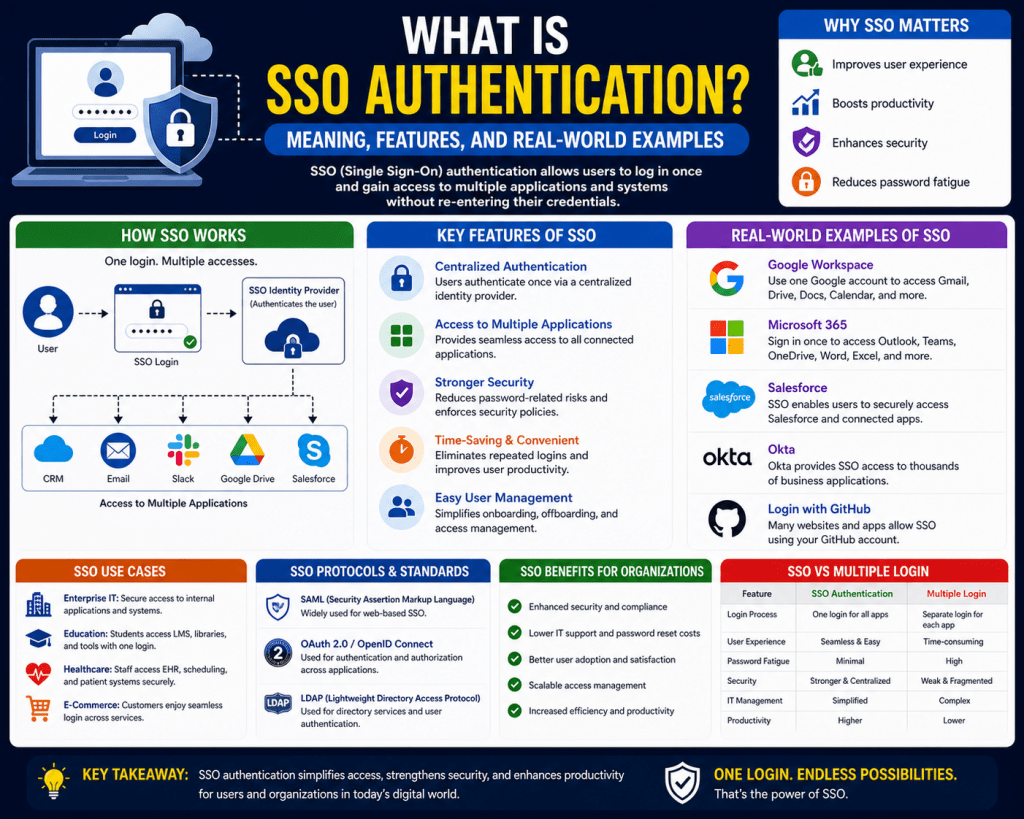
Single Sign-On, commonly referred to as SSO, is a widely adopted authentication method that allows users to access multiple systems or applications using a single set of login credentials. In today’s interconnected digital landscape, individuals and organizations rely on numerous services to perform daily tasks. Managing separate credentials for each of these services can quickly become overwhelming, leading to inefficiencies and security risks. SSO addresses this challenge by streamlining the login process and centralizing authentication.
The rapid growth of digital platforms has increased the demand for secure and user-friendly access mechanisms. Traditional authentication methods often require users to log in multiple times, which can disrupt workflows and reduce productivity. SSO eliminates this redundancy by enabling users to authenticate once and gain access to all authorized services. This approach not only improves convenience but also enhances the overall user experience.
As organizations continue to expand their digital ecosystems, the importance of efficient identity management becomes more apparent. SSO plays a critical role in this process by providing a unified framework for authentication. It simplifies access control, reduces administrative overhead, and ensures that users can interact with systems seamlessly. Understanding the fundamentals of SSO is essential for anyone involved in modern technology environments.
Defining Single Sign-On and Its Core Concept
Single Sign-On is an authentication mechanism that allows a user to log in once and gain access to multiple independent systems without needing to re-enter credentials. The core concept revolves around trust and centralized identity verification. Instead of each application handling authentication separately, a central authority verifies the user’s identity and shares that verification with other connected systems.
This centralized approach reduces the need for multiple login prompts and minimizes the risk of password-related issues. Users no longer need to remember numerous credentials, which often leads to weaker password practices. By consolidating authentication, SSO encourages stronger security measures and better credential management.
A practical example of SSO can be seen in ecosystems developed by companies like Google. When a user logs into one service within the ecosystem, they automatically gain access to other integrated services without additional authentication steps. This seamless experience demonstrates the efficiency and practicality of SSO in real-world scenarios.
The concept of SSO extends beyond convenience. It also supports scalability and interoperability between systems. As organizations adopt new technologies, SSO can be integrated to maintain a consistent authentication experience. This flexibility makes it a valuable component of modern identity management strategies.
The Evolution of Authentication Methods
Authentication methods have evolved significantly over time. In the early days of computing, systems relied on simple username and password combinations. While this approach was sufficient for smaller environments, it became less effective as the number of applications increased. Users were forced to manage multiple credentials, leading to confusion and security vulnerabilities.
As digital systems grew more complex, new authentication methods were introduced to address these challenges. Multi-factor authentication added an extra layer of security by requiring additional verification steps. While this improved security, it did not fully resolve the issue of managing multiple logins.
SSO emerged as a solution to these limitations. By centralizing authentication, it reduced the need for repeated logins and simplified access management. This innovation marked a significant shift in how users interact with digital systems. Instead of focusing solely on security, SSO balanced security with usability.
The evolution of authentication continues as new technologies and threats emerge. SSO remains a key component of this progression, adapting to meet the needs of modern environments. Its ability to integrate with other security measures ensures that it remains relevant in an ever-changing landscape.
How SSO Simplifies User Experience
One of the primary advantages of SSO is its ability to enhance user experience. By eliminating the need for multiple logins, it allows users to access services quickly and efficiently. This is particularly beneficial in environments where individuals rely on numerous applications throughout the day.
The reduction of login prompts minimizes interruptions and helps users maintain focus on their tasks. Instead of repeatedly entering credentials, users can navigate between systems seamlessly. This streamlined experience contributes to higher productivity and satisfaction.
SSO also reduces the cognitive burden associated with managing multiple passwords. Users no longer need to remember complex combinations for each application. This not only improves convenience but also encourages better security practices. When users are not overwhelmed by password management, they are more likely to create strong and unique credentials.
In addition to improving usability, SSO provides a consistent interface for authentication. Users interact with a single login system, which simplifies the overall experience. This consistency is especially important in large organizations where multiple systems are used across different departments.
Core Components of an SSO System
An SSO system is built on several key components that work together to enable seamless authentication. The identity provider is the central element responsible for verifying user credentials. It acts as the trusted authority that confirms a user’s identity and generates authentication tokens.
Service providers are the applications or systems that users want to access. Instead of handling authentication independently, these systems rely on the identity provider for verification. This trust relationship allows users to access multiple services without repeated logins.
Directory services play an important role in storing user information. These systems maintain data such as usernames, passwords, roles, and permissions. When a user attempts to log in, the identity provider queries the directory service to validate the credentials.
Authentication tokens are another critical component. These tokens are generated after successful authentication and are used to verify the user’s identity across different systems. They eliminate the need to share sensitive credentials with each application, enhancing security.
Protocols facilitate communication between components. They define how authentication data is exchanged and ensure that the process is secure and efficient. Without these protocols, it would be difficult for different systems to work together seamlessly.
Understanding the Role of Identity Providers
The identity provider is the backbone of any SSO system. It is responsible for authenticating users and managing identity information. When a user enters their credentials, the identity provider verifies them against stored data and determines whether access should be granted.
Once authentication is successful, the identity provider generates a token that represents the user’s identity. This token is then shared with service providers, allowing them to grant access without requiring additional login steps. This process ensures that authentication is centralized and consistent across all connected systems.
Identity providers also handle session management. They track active sessions and determine when a user should be logged out. This centralized control enhances security by ensuring that access is revoked when necessary.
In addition to authentication, identity providers often support advanced security features. These may include multi-factor authentication, risk-based authentication, and monitoring tools. By integrating these features, identity providers help organizations maintain a strong security posture.
The Importance of Authentication Tokens
Authentication tokens are a fundamental aspect of SSO functionality. They serve as proof that a user has been authenticated and can be trusted by other systems. These tokens are generated by the identity provider and contain information about the user’s identity and session.
Tokens are designed to be secure and tamper-resistant. They are often encrypted to prevent unauthorized access. This ensures that sensitive information is protected during transmission and storage.
One common type of token is the JSON Web Token, which is widely used in modern authentication systems. These tokens are compact and efficient, making them suitable for use in web and mobile applications. They allow systems to verify identity without directly handling credentials.
The use of tokens reduces the risk associated with credential sharing. Instead of transmitting usernames and passwords to multiple systems, only the token is shared. This minimizes exposure and enhances overall security.
Session Management in SSO Environments
Session management is a critical component of SSO systems. Once a user is authenticated, a session is established to maintain access across multiple applications. This session persists until the user logs out or the session expires.
Sessions are typically managed through browser cookies or similar mechanisms. These cookies store information about the user’s authentication status and allow systems to recognize the user without requiring repeated logins.
Centralized session management ensures that changes in authentication status are reflected across all connected systems. For example, when a user logs out, the session is terminated, and access to all services is revoked. This provides a consistent and secure experience.
Session management also involves setting expiration times and handling inactive sessions. These measures help prevent unauthorized access and ensure that sessions do not remain active indefinitely. Proper session management is essential for maintaining both security and usability.
Security Considerations in SSO Implementation
While SSO offers numerous benefits, it also introduces certain security considerations. One of the primary concerns is the reliance on a single set of credentials. If these credentials are compromised, an attacker may gain access to multiple systems. This makes it essential to implement strong security measures.
Multi-factor authentication is a key component of secure SSO implementations. By requiring additional verification, it reduces the risk of unauthorized access. Even if credentials are compromised, the attacker would still need to pass the additional authentication step.
Another important consideration is the availability of the identity provider. Since it serves as the central authentication authority, any disruption can impact access to all connected systems. Ensuring high availability and redundancy is critical to maintaining reliable access.
Monitoring and logging are also essential for detecting suspicious activity. By tracking authentication attempts and user behavior, organizations can identify potential threats and respond accordingly. This proactive approach helps mitigate risks and maintain system integrity.
Proper configuration and regular updates are necessary to address vulnerabilities. As threats evolve, SSO systems must be updated to ensure continued security. Organizations should also conduct regular audits to verify that their authentication processes remain effective.
The Growing Importance of SSO in Digital Environments
As digital transformation continues to accelerate, the role of SSO becomes increasingly important. Organizations are adopting a wide range of applications and services, making efficient access management essential. SSO provides a scalable solution that can adapt to changing needs.
The shift toward remote work and cloud-based services has further highlighted the value of SSO. Users need secure access to systems from various locations and devices. SSO enables this flexibility while maintaining a consistent authentication experience.
In addition to improving user experience, SSO supports compliance with security standards and regulations. By centralizing authentication, organizations can enforce policies more effectively and ensure that access controls are consistently applied.
The integration of SSO with emerging technologies continues to expand its capabilities. As new authentication methods and security tools are developed, SSO remains a central component of identity management strategies. Its ability to balance convenience and security makes it an essential tool in modern digital environments.
Exploring Different Types of Single Sign-On Systems
Single Sign-On systems can be categorized based on how they are implemented and the environments in which they operate. Although the core concept remains the same, different types of SSO are designed to address specific use cases and technical requirements. Understanding these variations is essential for building a strong foundation in authentication systems.
One of the most common types is web-based SSO. This form is widely used in online platforms where users access multiple services through a browser. Web-based SSO relies on secure communication between systems to authenticate users and share identity information. It is commonly used in cloud-based environments where multiple applications are interconnected.
Enterprise SSO is another major category. This type is designed for organizational environments where employees need access to internal systems and applications. Enterprise SSO often integrates with directory services and supports advanced access control mechanisms. It is tailored to meet the security and compliance needs of large organizations.
Federated SSO extends the concept further by allowing authentication across different domains or organizations. This approach enables users to access external services using their existing credentials. It is particularly useful in partnerships and collaborative environments where multiple entities need to share resources securely.
Each type of SSO has its own advantages and challenges. The choice of implementation depends on factors such as system architecture, security requirements, and user needs. By understanding these types, organizations can select the most appropriate solution for their environment.
Understanding Web-Based SSO and Its Mechanisms
Web-based SSO is the most familiar form of Single Sign-On for many users. It allows individuals to log in once and gain access to multiple web applications without repeated authentication. This approach is commonly used in platforms where users interact with various services through a single interface.
The process begins when a user attempts to access a web application. If the user is not already authenticated, they are redirected to an identity provider. After entering their credentials, the identity provider verifies the information and generates an authentication token. This token is then sent back to the application, granting access.
The key to web-based SSO lies in secure communication between systems. Applications must trust the identity provider and accept the tokens it generates. This trust is established through predefined configurations and security protocols. Once the relationship is in place, authentication becomes seamless.
Web-based SSO improves both usability and security. Users benefit from reduced login prompts, while organizations can enforce consistent authentication policies. This combination makes it a popular choice for modern applications.
SAML Protocol and Its Role in SSO
Security Assertion Markup Language, commonly known as SAML, is one of the most widely used protocols in SSO implementations. It is an XML-based standard that facilitates the exchange of authentication and authorization data between systems.
SAML works by transferring assertions from the identity provider to the service provider. These assertions contain information about the user’s identity and authentication status. When a user logs in, the identity provider generates a SAML assertion and sends it to the application. The application then uses this assertion to grant access.
One of the strengths of SAML is its ability to support cross-domain authentication. This makes it suitable for enterprise environments where multiple systems need to work together. It also provides a high level of security through encryption and digital signatures.
Despite its advantages, SAML can be complex to implement. It requires careful configuration and a thorough understanding of the protocol. However, its reliability and widespread adoption make it a cornerstone of many SSO systems.
OAuth 2.0 and Authorization Frameworks
OAuth 2.0 is another important component in modern SSO systems. Unlike traditional authentication protocols, OAuth 2.0 focuses on authorization rather than identity verification. It allows users to grant applications access to their resources without sharing credentials.
In an OAuth 2.0 flow, the user authorizes an application to access specific data. The application receives an access token, which it uses to interact with the resource server. This process ensures that sensitive information, such as passwords, is not exposed.
Although OAuth 2.0 is not an authentication protocol by itself, it is often used in combination with other technologies to enable SSO. Its flexibility and scalability make it suitable for a wide range of applications, including mobile and web environments.
The use of OAuth 2.0 enhances security by limiting the scope of access. Applications can only access the data they are authorized to use, reducing the risk of misuse. This makes it a valuable tool in modern authentication systems.
OpenID Connect and Modern Authentication Layers
OpenID Connect is an authentication layer built on top of OAuth 2.0. It adds identity verification capabilities, making it suitable for SSO implementations. By combining the strengths of OAuth 2.0 with additional features, OpenID Connect provides a comprehensive solution for authentication and authorization.
In an OpenID Connect flow, the identity provider issues an ID token after successful authentication. This token contains information about the user and can be used by applications to verify identity. The use of standardized tokens simplifies integration and improves interoperability.
OpenID Connect is widely used in consumer applications due to its simplicity and efficiency. It supports modern development practices and integrates well with various platforms. This makes it a preferred choice for developers building scalable authentication systems.
The protocol also supports advanced features such as user profile access and session management. These capabilities enhance the overall functionality of SSO systems and provide a richer user experience.
Enterprise SSO and Organizational Use Cases
Enterprise SSO is designed to meet the needs of organizations with complex IT environments. It enables employees to access multiple internal systems using a single set of credentials. This approach simplifies access management and improves productivity.
In enterprise environments, SSO is often integrated with directory services such as Active Directory. These services store user information and provide a centralized source for authentication. By connecting SSO with directory services, organizations can maintain consistent access control across all systems.
Role-based access control is another important aspect of enterprise SSO. It ensures that users can only access resources relevant to their roles. This enhances security and helps organizations comply with regulatory requirements.
Enterprise SSO also supports auditing and monitoring. By tracking user activity, organizations can detect potential security threats and ensure compliance with policies. This level of visibility is essential for maintaining a secure environment.
The implementation of enterprise SSO requires careful planning and coordination. Organizations must ensure that all systems are compatible and properly configured. Despite the complexity, the benefits of streamlined access and improved security make it a worthwhile investment.
Federated Identity and Cross-Domain Authentication
Federated identity is a key concept in advanced SSO systems. It allows users to access services across different domains using a single identity. This approach is particularly useful in scenarios where multiple organizations collaborate and share resources.
In a federated identity system, trust relationships are established between identity providers and service providers. These relationships enable the secure exchange of authentication data. When a user logs in, their identity is verified by their home organization and accepted by external systems.
Federation reduces the need for multiple accounts and simplifies user management. It also enhances security by centralizing authentication. Users benefit from a seamless experience, while organizations maintain control over access.
The implementation of federated identity requires standardized protocols and careful configuration. Trust relationships must be established and maintained to ensure secure communication. Despite these challenges, federation is a powerful tool for enabling collaboration and expanding access.
LDAP and Directory Services in SSO
Lightweight Directory Access Protocol, or LDAP, plays a crucial role in many SSO implementations. It is used to store and manage user information in a centralized directory. This information includes credentials, roles, and group memberships.
When a user attempts to log in, the identity provider queries the LDAP directory to verify the credentials. This centralized approach ensures consistency and simplifies user management. Administrators can update user information in one place, and the changes are reflected across all connected systems.
LDAP also supports role-based access control by storing information about user roles and permissions. This allows organizations to enforce access policies and ensure that users can only access authorized resources.
The use of directory services enhances the scalability of SSO systems. As organizations grow, new users and systems can be added بسهولة without disrupting existing processes. This flexibility makes LDAP a valuable component of enterprise authentication systems.
Kerberos and Ticket-Based Authentication
Kerberos is another technology commonly used in SSO environments, particularly within enterprise networks. It is a ticket-based authentication protocol that allows users to access multiple services without repeatedly entering credentials.
In a Kerberos system, the user authenticates with a central server and receives a ticket. This ticket is then used to access other services within the network. Each service trusts the ticket and grants access without requiring additional authentication.
The use of tickets enhances security by minimizing the exposure of credentials. Instead of transmitting passwords, the system relies on encrypted tickets to verify identity. This reduces the risk of interception and unauthorized access.
Kerberos is widely used in internal networks where security and efficiency are critical. Its ability to provide seamless authentication makes it a key component of many enterprise SSO solutions.
Steps to Implement Single Sign-On Successfully
Implementing SSO requires a structured approach to ensure success. The first step is to understand the requirements and identify the systems that need to be integrated. This involves evaluating existing infrastructure and determining compatibility.
The next step is to choose the appropriate protocols and technologies. Depending on the environment, this may include SAML, OAuth 2.0, OpenID Connect, or Kerberos. Each protocol has its own strengths and should be selected based on specific needs.
Setting up the identity provider is a critical part of the process. This involves configuring authentication methods, connecting to directory services, and establishing trust relationships with service providers. Proper configuration ensures that the system operates smoothly.
Testing is an essential phase of implementation. It helps identify potential issues and ensures that authentication flows work as expected. Thorough testing reduces the risk of disruptions and improves reliability.
User training and support are also important. Users need to understand how the system works and how to use it effectively. Providing clear guidance helps ensure a smooth transition and encourages adoption.
Common Challenges in SSO Deployment
Despite its benefits, implementing SSO can present several challenges. One of the main issues is system compatibility. Not all applications support SSO, which can complicate integration efforts. Organizations may need to modify or replace incompatible systems.
Another challenge is the complexity of configuration. Setting up SSO involves multiple components and protocols, which can be difficult to manage. Proper planning and expertise are required to ensure a successful implementation.
Security risks must also be considered. Since SSO relies on a single set of credentials, a compromised account can have widespread consequences. Implementing strong security measures is essential to mitigate this risk.
User resistance can also be a factor. Some users may be hesitant to adopt new systems or change their привычки. Providing training and support can help address these concerns and encourage acceptance.
Maintaining high availability is another challenge. The identity provider must be reliable, as any downtime can disrupt access to all connected systems. Organizations must invest in infrastructure and redundancy to ensure continuous operation.
Best Practices for Managing SSO Systems
Effective management of SSO systems requires adherence to best practices. One of the most important practices is enforcing strong authentication policies. This includes using multi-factor authentication and setting strict password requirements.
Regular monitoring and auditing are essential for maintaining security. By tracking user activity and authentication attempts, organizations can detect anomalies and respond to potential threats. This proactive approach helps prevent security breaches.
Updating and patching systems is another critical practice. As vulnerabilities are discovered, systems must be updated to address them. Regular maintenance ensures that the SSO environment remains secure and reliable.
Access control should be carefully managed. Users should only have access to the resources they need. Implementing role-based access control helps enforce this principle and reduces the risk of unauthorized access.
Finally, organizations should plan for contingencies. This includes preparing for potential failures and ensuring that backup systems are in place. A well-designed contingency plan helps maintain access and minimizes disruptions.
Planning a Strong Foundation for Single Sign-On Deployment
Building a reliable Single Sign-On environment begins with careful planning and a clear understanding of organizational needs. Before any technical implementation starts, it is important to evaluate the existing infrastructure, applications, and user requirements. This initial phase determines how effectively SSO will integrate into the environment and how well it will perform over time.
A strong foundation requires identifying all systems that will be included in the SSO framework. These systems may include internal tools, cloud applications, and external services. Each system must be assessed for compatibility with SSO protocols and identity providers. If certain applications do not support SSO, organizations must decide whether to upgrade, replace, or integrate them using additional tools.
Another important aspect of planning is defining authentication policies. These policies determine how users will log in, what security measures will be enforced, and how access will be controlled. For example, organizations may require multi-factor authentication for sensitive systems while allowing simpler login methods for less critical applications. Establishing these rules early ensures consistency and security across the entire environment.
Scalability should also be considered during the planning stage. As organizations grow, new users and applications will need to be added to the SSO system. Designing a scalable architecture from the beginning helps avoid future complications and ensures that the system can handle increased demand without performance issues.
Choosing the Right Identity Provider for SSO
Selecting an identity provider is one of the most critical decisions in an SSO implementation. The identity provider acts as the central authority for authentication and plays a key role in the overall performance and security of the system. Choosing the right provider requires evaluating several factors, including compatibility, scalability, and security features.
Well-known identity providers such as Okta, Microsoft, and Auth0 offer a wide range of capabilities designed to support modern authentication needs. These platforms provide tools for managing users, integrating applications, and enforcing security policies. Each provider has its own strengths, so the choice depends on the specific requirements of the organization.
Compatibility with existing systems is a key consideration. The identity provider must support the protocols and technologies used by the organization’s applications. This ensures seamless integration and reduces the need for complex configurations. In addition, the provider should offer support for future technologies to maintain long-term relevance.
Security features are equally important. The identity provider should support advanced authentication methods, including multi-factor authentication, adaptive authentication, and risk-based analysis. These features help protect user accounts and prevent unauthorized access.
Performance and reliability are also critical factors. Since the identity provider handles all authentication requests, it must be able to process them quickly and consistently. High availability and redundancy are essential to prevent downtime and ensure continuous access to systems.
Integrating Applications and Systems into SSO
Once the identity provider is selected, the next step is integrating applications into the SSO environment. This process involves configuring each application to trust the identity provider and accept authentication tokens. While the concept is straightforward, the implementation can vary depending on the application and protocol used.
The integration process typically begins with establishing trust relationships. This involves exchanging configuration details between the identity provider and the application. These details may include certificates, endpoints, and metadata required for secure communication. Proper configuration ensures that authentication requests and responses are handled correctly.
Applications must also be configured to redirect users to the identity provider for authentication. When a user attempts to access an application, they are redirected to the login page of the identity provider. After successful authentication, the user is redirected back to the application with a valid token.
Testing is a critical part of integration. Each application must be tested to ensure that authentication flows work as expected. This includes verifying login, logout, and session management processes. Thorough testing helps identify issues early and ensures a smooth user experience.
In complex environments, integration may require the use of middleware or connectors. These tools help bridge the gap between applications that do not natively support SSO and the identity provider. By using these solutions, organizations can extend SSO capabilities to a wider range of systems.
Enhancing Security in SSO Environments
Security is a central concern in any authentication system, and SSO is no exception. While SSO simplifies access, it also creates a single point of entry that must be protected. Implementing strong security measures is essential to ensure the safety of user data and system resources.
Multi-factor authentication is one of the most effective ways to enhance security. By requiring additional verification steps, it reduces the risk of unauthorized access. Even if a password is compromised, the attacker would still need to pass the additional authentication factor.
Another important measure is the use of strong password policies. Users should be required to create complex passwords that are difficult to guess. Regular password updates and restrictions on reuse can further strengthen security.
Monitoring and logging play a vital role in maintaining security. By tracking authentication attempts and user activity, organizations can detect suspicious behavior and respond quickly. This includes identifying unusual login patterns, failed attempts, and access from unfamiliar locations.
Encryption is also essential for protecting data. All communication between the identity provider and applications should be encrypted to prevent interception. This ensures that sensitive information, such as authentication tokens, remains secure during transmission.
Managing User Access and Roles Effectively
Effective access management is a key component of a successful SSO system. It ensures that users have the appropriate level of access to resources based on their roles and responsibilities. This not only improves security but also enhances efficiency by preventing unnecessary access.
Role-based access control is widely used in SSO environments. It involves assigning roles to users and defining permissions for each role. For example, an employee in a finance department may have access to financial systems, while an employee in a different department does not. This approach simplifies access management and reduces the risk of unauthorized access.
User provisioning is another important aspect. When a new user joins an organization, their account must be created and configured with the appropriate roles and permissions. Similarly, when a user leaves, their access must be revoked promptly. Automating these processes helps ensure consistency and reduces administrative workload.
Regular audits are necessary to maintain accurate access control. Over time, users may change roles or responsibilities, and their access must be updated accordingly. Conducting periodic reviews helps identify and correct any discrepancies.
Centralized management provided by SSO makes it easier to enforce access policies. Administrators can manage user access from a single interface, ensuring that changes are applied consistently across all systems.
Ensuring High Availability and Reliability
Since SSO relies on a central identity provider, ensuring high availability is critical. Any disruption in the identity provider can affect access to all connected systems. To prevent this, organizations must design their SSO infrastructure with reliability in mind.
One approach is to implement redundancy. This involves deploying multiple instances of the identity provider in different locations. If one instance fails, another can take over, ensuring continuous operation. Load balancing can also be used to distribute traffic and improve performance.
Disaster recovery planning is another important consideration. Organizations should have a plan in place to restore services in case of a failure. This may include data backups, failover systems, and recovery procedures.
Regular testing of these systems is essential to ensure they work as expected. By simulating failure scenarios, organizations can identify weaknesses and improve their response strategies. This proactive approach helps minimize downtime and maintain user access.
Monitoring system performance is also important. By tracking metrics such as response time and error rates, administrators can detect issues early and take corrective action. Continuous monitoring ensures that the SSO system remains reliable and efficient.
Addressing Common Risks and Mitigation Strategies
While SSO offers many benefits, it also introduces certain risks that must be managed carefully. One of the most significant risks is the potential for a single point of failure. Since all authentication depends on the identity provider, any compromise or outage can have widespread consequences.
To mitigate this risk, organizations should implement strong security measures and redundancy. Multi-factor authentication, encryption, and monitoring help protect against unauthorized access. Redundant systems ensure that authentication services remain available even during failures.
Another risk is credential compromise. If a user’s credentials are stolen, an attacker may gain access to multiple systems. Educating users about security best practices, such as avoiding phishing attacks and using strong passwords, is essential.
Session management risks must also be considered. Sessions should have appropriate expiration times to prevent unauthorized use. Inactive sessions should be terminated automatically to reduce exposure.
Integration risks can arise when connecting multiple systems. Misconfigurations or compatibility issues can create vulnerabilities. Thorough testing and validation are necessary to ensure secure integration.
Future Trends in Single Sign-On Technology
The field of authentication continues to evolve, and SSO is adapting to meet new challenges and opportunities. One of the most significant trends is the move toward passwordless authentication. This approach eliminates the need for traditional passwords and relies on alternative methods such as biometrics or hardware tokens.
Another trend is the integration of artificial intelligence and machine learning. These technologies can analyze user behavior and detect anomalies, providing an additional layer of security. For example, if a login attempt deviates from normal patterns, the system can trigger additional verification steps.
Cloud-based SSO solutions are also becoming more popular. They offer flexibility, scalability, and ease of deployment. Organizations can quickly integrate new applications and manage authentication from a centralized platform.
Zero-trust security models are influencing the design of SSO systems. This approach assumes that no user or system should be trusted by default. Continuous verification and strict access controls are used to ensure security. SSO plays a key role in implementing this model by providing centralized authentication and monitoring.
As technology continues to advance, SSO will remain an essential component of identity management. Its ability to adapt to new requirements and integrate with emerging technologies ensures its relevance in the future digital landscape.
Conclusion
Single Sign-On has become a defining element of modern authentication, shaping how users interact with digital systems across personal and professional environments. Its core value lies in simplifying access while maintaining a strong security framework. By allowing users to authenticate once and gain access to multiple systems, it removes unnecessary friction and transforms the overall user experience into something far more seamless and efficient. This balance between convenience and protection is what makes SSO a critical part of today’s identity management strategies.
The widespread adoption of SSO reflects the growing complexity of digital ecosystems. Users no longer rely on a single application or platform; instead, they navigate through interconnected services that require constant authentication. Without a unified approach, this would result in repeated login prompts, increased frustration, and higher chances of poor password practices. SSO addresses these challenges by centralizing authentication, which not only reduces repetition but also encourages stronger credential management habits.
Security remains one of the most important aspects of SSO, and its centralized nature offers both advantages and responsibilities. On one hand, it allows organizations to enforce consistent policies, implement advanced authentication methods, and monitor user activity from a single point. On the other hand, it requires careful planning to ensure that this central point does not become a vulnerability. Strong safeguards such as multi-factor authentication, encryption, and continuous monitoring are essential to maintain the integrity of the system and protect against potential threats.
The role of identity providers is fundamental in ensuring that SSO operates effectively. These systems act as the gatekeepers of authentication, verifying user identities and issuing tokens that grant access to connected services. Their reliability, performance, and security directly influence the success of an SSO implementation. A well-configured identity provider can deliver fast and secure authentication, while a poorly managed one can lead to disruptions and risks. This highlights the importance of selecting the right technology and maintaining it properly over time.
Another significant aspect of SSO is its ability to enhance productivity. By removing the need for repeated logins, users can focus more on their tasks and less on administrative hurdles. This is particularly valuable in professional environments where efficiency is critical. Employees can move between applications without interruption, leading to smoother workflows and better overall performance. The time saved through streamlined access may seem small in individual instances, but it accumulates into meaningful gains across an entire organization.
From an administrative perspective, SSO simplifies access management in a way that traditional methods cannot match. Managing multiple systems individually can be complex and time-consuming, especially as organizations grow. SSO introduces a centralized approach where user access can be controlled, updated, and monitored from a single interface. This reduces the likelihood of errors, ensures consistency, and makes it easier to enforce security policies across all systems. It also supports scalability, allowing organizations to expand their digital environments without losing control over access management.
The integration of SSO with various protocols and technologies demonstrates its flexibility and adaptability. Whether it is used in web-based environments, enterprise systems, or federated networks, SSO can be tailored to meet different requirements. This versatility ensures that it remains relevant in a wide range of use cases. As new technologies emerge, SSO continues to evolve, incorporating new methods of authentication and improving its ability to handle complex scenarios.
Despite its many advantages, SSO requires thoughtful implementation to achieve its full potential. Challenges such as system compatibility, user adoption, and infrastructure reliability must be addressed carefully. Organizations must invest time in planning, testing, and training to ensure a smooth transition. When implemented correctly, these challenges can be managed effectively, allowing the benefits of SSO to outweigh the complexities involved.
The growing emphasis on secure and user-friendly authentication highlights the importance of solutions like SSO in the future. As digital transformation continues to accelerate, the need for efficient access management will only increase. Users expect quick and seamless access to services, while organizations demand strong security measures to protect their data. SSO meets both of these expectations by providing a unified approach that supports convenience without compromising protection.
Emerging trends such as passwordless authentication and advanced threat detection are further shaping the evolution of SSO. These developments aim to reduce reliance on traditional credentials and enhance security through innovative methods. By integrating these advancements, SSO systems can continue to improve and adapt to new challenges. This ongoing evolution ensures that SSO remains a vital component of modern identity management.
In the broader context of digital security, SSO represents a shift toward more intelligent and user-centric authentication models. It moves away from fragmented systems and embraces a unified approach that aligns with the needs of modern users and organizations. This shift is not just about technology but also about improving the way people interact with digital systems. By reducing complexity and enhancing security, SSO contributes to a more efficient and secure digital environment.
Ultimately, the significance of SSO lies in its ability to bridge the gap between usability and security. It provides a practical solution to the challenges of managing multiple credentials while maintaining a strong defense against potential threats. As organizations continue to expand their digital presence, the role of SSO will remain central to ensuring that access is both secure and efficient. Its continued development and integration with emerging technologies will further strengthen its position as an essential tool in the evolving landscape of authentication and identity management.