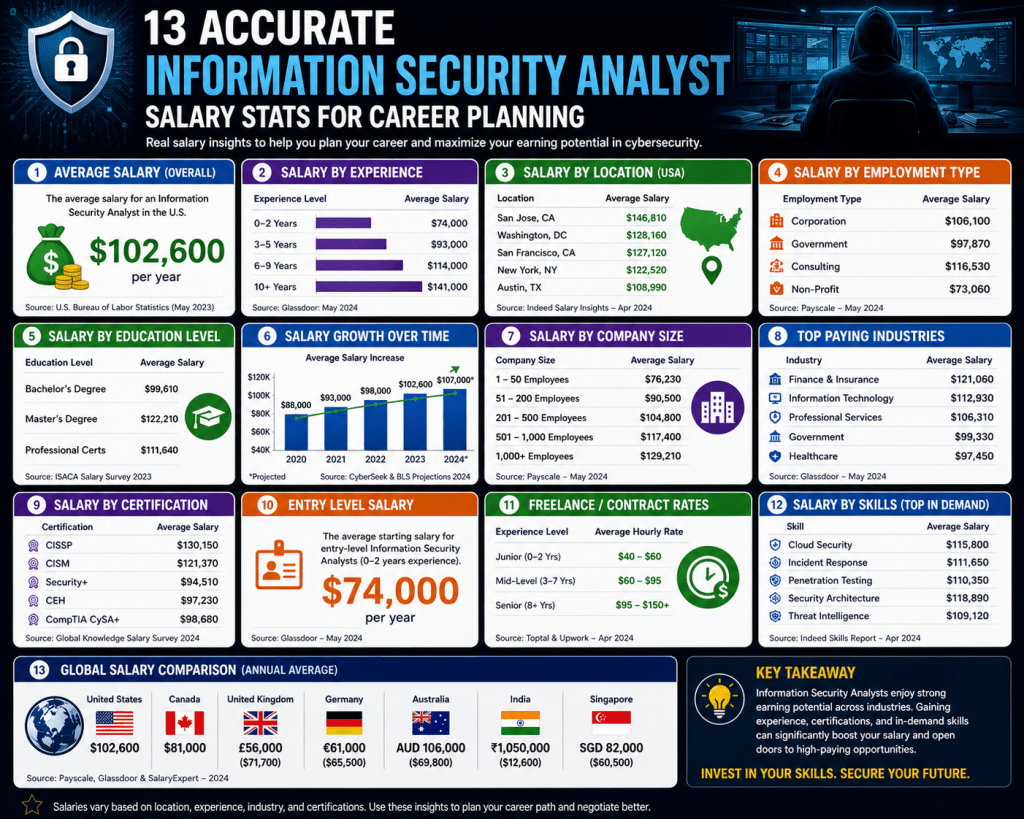
Average salary figures for information security analysts often create a misleading impression of what professionals actually earn. Many widely shared numbers are influenced by high-paying regions where compensation is significantly above the norm. In large metropolitan areas with dense technology industries, salaries are elevated due to intense competition for skilled talent and higher living costs. While these figures may appear attractive, they do not represent the experience of most professionals working in smaller or mid-sized cities.
A more accurate understanding of compensation comes from examining markets that are not dominated by major technology companies. Mid-sized metropolitan areas provide a more balanced perspective because salaries are aligned with local demand and economic conditions. In these regions, organizations still require strong cybersecurity defenses, but compensation structures are more stable and less affected by extreme outliers.
National averages remain useful as a general benchmark, but they should not be treated as a guaranteed expectation. Entry-level professionals often start at a lower salary range while gaining practical experience. As individuals build their technical skills and become more comfortable handling security tasks, their earning potential increases. Mid-level analysts typically fall within a consistent salary band, while senior professionals and specialists can command higher compensation due to their expertise and responsibilities.
Cost of living is one of the most important factors to consider when evaluating salary figures. A higher salary in an expensive city may not provide the same financial comfort as a slightly lower salary in a more affordable area. Housing, transportation, and daily expenses all influence how far a salary can stretch. This is why many professionals choose to work in regions where they can maintain a better balance between income and living costs.
Industry presence also plays a significant role in shaping salary trends. Cities with strong healthcare systems, financial institutions, or government operations tend to offer steady demand for cybersecurity professionals. These industries handle sensitive information and must comply with strict regulations, which increases the need for skilled analysts. As a result, compensation in these regions can remain competitive even without the influence of large technology companies.
Experience level directly impacts earning potential in this field. Individuals at the beginning of their careers typically focus on foundational tasks such as monitoring systems, reviewing alerts, and assisting with basic security operations. As they gain experience, they take on more complex responsibilities, including threat analysis, vulnerability management, and incident response. This progression allows them to move into higher salary brackets over time.
Specialization can further enhance earning potential. Analysts who develop expertise in specific areas such as cloud security, digital forensics, or threat intelligence often stand out in the job market. Organizations value professionals who can address particular challenges and are willing to offer higher compensation for those skills. As cybersecurity threats continue to evolve, specialized knowledge becomes increasingly valuable.
The growth of remote work has also influenced salary expectations. Professionals now have access to opportunities beyond their immediate location, allowing them to explore roles that may offer better compensation. However, many employers still adjust salaries based on geographic location, even for remote positions. Understanding how these adjustments work can help individuals make more informed career decisions.
Salary data should always be interpreted carefully. Different sources may use varying methods to calculate averages, and figures can include a wide range of job roles and experience levels. Instead of focusing on a single number, it is more useful to look for patterns and trends across multiple sources. This approach provides a clearer picture of what professionals can realistically expect to earn.
In addition to base salary, total compensation often includes bonuses, benefits, and other incentives. These elements can significantly impact overall earnings and should not be overlooked. Benefits such as health coverage, retirement plans, and performance bonuses contribute to the overall value of a position and can vary widely between organizations.
The demand for information security analysts continues to grow as organizations face increasing cybersecurity threats. This demand creates a stable job market with opportunities for professionals at all levels. While salaries may vary depending on location, experience, and specialization, the overall outlook remains strong, making this a reliable and rewarding career path.
Core Responsibilities of an Information Security Analyst
An information security analyst is responsible for protecting an organization’s digital infrastructure from cyber threats. This role has become essential as businesses rely more heavily on technology and data. Analysts work to prevent unauthorized access, detect potential risks, and respond to security incidents promptly.
One of the primary duties of an information security analyst is to monitor systems for unusual activity. This involves reviewing logs, analyzing alerts, and using specialized tools to identify potential threats. By continuously observing network behavior, analysts can detect suspicious patterns and take action before a situation escalates into a serious security breach.
Vulnerability management is another key responsibility. Analysts regularly examine systems, applications, and networks to identify weaknesses that could be exploited by attackers. This process includes running scans, evaluating risks, and prioritizing issues based on their severity. Once vulnerabilities are identified, analysts work with other teams to implement solutions that reduce risk.
Incident response is a critical aspect of the role. When a security event occurs, analysts must quickly investigate the issue, determine its cause, and take steps to contain it. This process requires a combination of technical knowledge and problem-solving skills, as each incident can present unique challenges. An effective response helps minimize damage and ensures that systems are restored as quickly as possible.
Risk assessment plays an important role in maintaining a strong security posture. Analysts evaluate potential threats and analyze how they could impact the organization. By understanding these risks, they can recommend strategies to reduce exposure and improve overall security. This proactive approach allows organizations to stay ahead of potential threats rather than reacting after an incident occurs.
Information security analysts are also involved in developing and enforcing security policies. These policies establish guidelines for protecting systems and data, ensuring consistency across the organization. Analysts work closely with different departments to implement these policies and ensure that they are followed. This collaboration helps create a unified approach to security.
Compliance is especially important in industries that handle sensitive information. Analysts must ensure that their organization meets regulatory requirements and follows established standards. This often involves documenting security practices, preparing for audits, and demonstrating that controls are effective. Maintaining compliance helps build trust and prevents legal or financial consequences.
Communication is a key skill for information security analysts. They must be able to explain complex technical concepts to individuals who may not have a technical background. This includes writing reports, presenting findings, and providing clear recommendations. Effective communication ensures that security measures are understood and supported throughout the organization.
Collaboration with other teams is essential for addressing security challenges. Analysts often work with network administrators, system engineers, and developers to implement solutions and improve overall security. This teamwork ensures that security is integrated into all aspects of the organization’s operations.
Continuous learning is necessary due to the constantly evolving nature of cybersecurity. New threats, tools, and technologies emerge regularly, requiring analysts to stay updated on the latest developments. This ongoing learning process helps them remain effective and adapt to changing environments.
Technical expertise is fundamental to success in this role. Analysts must understand networking, operating systems, and security tools to identify vulnerabilities and respond to threats. As technology continues to advance, the range of required skills expands, making adaptability an important trait.
Problem-solving ability is equally important. Security incidents often involve complex situations that require careful analysis and quick decision-making. Analysts must be able to evaluate different scenarios and develop effective solutions under pressure.
The role of an information security analyst goes beyond responding to immediate threats. These professionals contribute to the long-term security strategy of an organization by identifying risks, implementing controls, and promoting best practices. Their work helps create a secure environment that supports business operations and protects valuable data.
As cybersecurity becomes increasingly important, the role of the information security analyst continues to grow in significance. Organizations depend on these professionals to safeguard their systems and maintain trust with customers and stakeholders. This growing demand not only creates career opportunities but also supports steady growth in salaries and professional development.
Essential Skills That Define a Successful Information Security Analyst
The role of an information security analyst requires a combination of technical expertise, analytical thinking, and adaptability. As cyber threats become more advanced, the expectations placed on professionals in this field continue to grow. Employers are no longer looking for individuals who only understand basic security concepts. Instead, they seek well-rounded professionals who can navigate complex systems, interpret data, and respond effectively to evolving risks.
One of the most critical skill areas is a strong understanding of security frameworks and compliance standards. Organizations rely on structured approaches to manage risk and protect data, and analysts must be familiar with widely accepted frameworks. These frameworks provide guidelines for implementing security controls, assessing risk, and maintaining compliance with regulations. A solid grasp of these standards allows analysts to align their work with organizational goals and regulatory requirements.
Networking knowledge is another foundational skill. Understanding how data moves across systems is essential for identifying vulnerabilities and detecting suspicious activity. Analysts must be comfortable working with protocols, firewalls, and intrusion detection systems. This knowledge enables them to analyze traffic patterns, recognize anomalies, and implement effective security measures.
Proficiency with security tools is also essential. Analysts use a variety of platforms to monitor systems, detect threats, and respond to incidents. These tools generate large amounts of data, and the ability to interpret this information is crucial. Analysts must be able to distinguish between normal activity and potential threats, which requires both technical knowledge and practical experience.
Cloud security has become increasingly important as organizations move their operations to cloud-based environments. Analysts must understand how to secure cloud infrastructure, manage access controls, and protect sensitive data. This includes knowledge of identity management, encryption, and secure configuration practices. As cloud adoption continues to grow, this skill set becomes even more valuable.
Scripting and automation are becoming essential components of modern cybersecurity roles. Analysts often use scripting languages to automate repetitive tasks, analyze logs, and enhance detection capabilities. Automation helps improve efficiency and allows analysts to focus on more complex issues. Even a basic understanding of scripting can significantly enhance productivity and effectiveness.
Soft skills are just as important as technical abilities. Communication plays a key role in ensuring that security measures are understood and implemented across the organization. Analysts must be able to explain technical concepts in a clear and concise manner, especially when working with non-technical stakeholders. This skill is essential for gaining support and ensuring that security initiatives are successful.
Problem-solving is another critical skill. Cybersecurity challenges often involve complex scenarios that require careful analysis and creative thinking. Analysts must be able to evaluate situations, identify potential solutions, and make decisions under pressure. This ability to think critically is what allows them to respond effectively to threats and minimize damage.
Time management and prioritization are also important. Analysts often deal with multiple alerts and incidents simultaneously, and not all of them require immediate attention. The ability to assess the severity of each situation and prioritize tasks accordingly is essential for maintaining an effective security posture.
Continuous learning is a defining characteristic of successful information security analysts. The cybersecurity landscape is constantly changing, with new threats and technologies emerging regularly. Analysts must stay updated on the latest trends, tools, and best practices. This commitment to ongoing education ensures that they remain effective in their roles and can adapt to new challenges.
How Experience Influences Salary Growth in Cybersecurity
Experience is one of the most significant factors affecting salary progression in the field of information security. As professionals gain hands-on experience, their responsibilities expand, and their value within the organization increases. This growth is reflected in higher compensation and more advanced career opportunities.
At the entry level, analysts typically focus on foundational tasks such as monitoring alerts, reviewing logs, and assisting with basic security operations. These roles are designed to build practical skills and provide exposure to real-world scenarios. While salaries at this stage may be modest, they serve as a stepping stone for future growth.
As analysts gain experience, they begin to take on more complex responsibilities. This may include investigating security incidents, managing vulnerabilities, and implementing security controls. With this increased responsibility comes higher compensation, as organizations recognize the value of experienced professionals who can handle critical tasks.
Mid-level analysts often develop specialized skills that set them apart from their peers. This specialization can lead to higher salaries and more advanced roles. For example, an analyst who focuses on threat intelligence or cloud security may be able to command a higher salary due to the demand for these skills.
Senior-level professionals typically have several years of experience and a deep understanding of cybersecurity principles. They may lead teams, develop security strategies, and oversee major projects. These roles come with significant responsibility and are compensated accordingly. Senior analysts often earn salaries at the أعلى end of the spectrum, reflecting their expertise and leadership capabilities.
Experience also impacts earning potential through increased confidence and negotiation ability. Professionals who have a proven track record are better positioned to negotiate higher salaries and better benefits. They can demonstrate their value to employers and justify their compensation expectations.
Another important aspect of experience is exposure to different environments and challenges. Analysts who have worked in various industries or handled diverse security incidents often have a broader perspective. This versatility makes them more valuable to employers and can lead to higher compensation.
Certifications and continuous learning also contribute to salary growth, but their impact is often amplified by experience. A certification combined with practical experience is more valuable than either one alone. Employers look for individuals who can apply their knowledge in real-world situations, and experience provides that proof.
Career progression in cybersecurity is not always linear. Some professionals may move into specialized roles, while others may transition into management positions. Each path offers different opportunities for salary growth, and the choice depends on individual interests and career goals.
Certifications and Their Role in Career Advancement
Certifications play an important role in the development of an information security analyst’s career. They serve as a validation of knowledge and demonstrate a commitment to professional growth. While certifications alone do not guarantee success, they can significantly enhance an individual’s credibility and marketability.
Entry-level certifications are often the starting point for individuals entering the field. These certifications cover fundamental concepts such as risk management, network security, and threat analysis. They provide a solid foundation and help candidates stand out when applying for their first cybersecurity role.
As professionals gain experience, they may pursue more advanced certifications that focus on specific areas of cybersecurity. These certifications demonstrate a deeper level of expertise and can open doors to higher-paying positions. For example, certifications in areas such as ethical hacking, incident response, or security management are highly valued by employers.
Certifications also help professionals stay updated on industry standards and best practices. Many certification programs require ongoing education or periodic renewal, which encourages continuous learning. This ensures that certified professionals remain knowledgeable about the latest developments in cybersecurity.
In addition to technical certifications, there are also certifications focused on management and governance. These are particularly valuable for individuals who aspire to leadership roles. They cover topics such as risk management, policy development, and strategic planning, which are essential for managing security programs.
The value of certifications varies depending on the employer and the role. Some organizations place a strong emphasis on certifications, while others prioritize experience and practical skills. However, in many cases, having relevant certifications can give candidates a competitive edge in the job market.
Certifications can also impact salary negotiations. Employers may be willing to offer higher compensation to candidates who hold recognized certifications, especially if those certifications align with the organization’s needs. This makes certifications a valuable investment for long-term career growth.
Strategies to Increase Your Salary as an Information Security Analyst
Increasing salary in the field of information security requires a combination of skill development, strategic career planning, and effective communication. Professionals who actively manage their careers are more likely to achieve higher levels of compensation.
One of the most effective strategies is gaining relevant experience. Taking on additional responsibilities, participating in security projects, and seeking opportunities to work on complex tasks can help build valuable skills. This experience not only enhances technical abilities but also demonstrates initiative and commitment.
Specialization is another important factor. Focusing on a specific area of cybersecurity can make a professional more valuable to employers. Whether it is cloud security, threat intelligence, or incident response, developing expertise in a niche area can lead to higher salaries and more advanced roles.
Networking and professional relationships also play a significant role in career growth. Building connections with other professionals in the field can lead to new opportunities and valuable insights. Engaging with the cybersecurity community helps individuals stay informed and connected.
Negotiation skills are essential for maximizing salary potential. Many professionals accept initial offers without negotiation, which can result in lower compensation over time. Being prepared to discuss salary expectations and demonstrate value can lead to better outcomes.
Staying updated on industry trends is another key strategy. Understanding emerging threats, new technologies, and evolving best practices allows professionals to remain relevant and competitive. This knowledge can also be used to identify new opportunities for growth and advancement.
Pursuing continuous education and training is important for long-term success. Whether through certifications, workshops, or self-study, ongoing learning helps professionals expand their skill set and adapt to changes in the field. This commitment to growth is often rewarded with higher compensation.
Finally, being proactive in career planning is essential. Setting clear goals, tracking progress, and seeking feedback can help individuals stay on track and make informed decisions. By taking control of their career path, information security analysts can position themselves for success and achieve their desired level of compensation.
Career Paths and Long-Term Growth in Information Security
The field of information security offers a wide range of career paths, making it one of the most flexible and dynamic areas in technology. As professionals gain experience, they are not limited to a single role or direction. Instead, they can choose to specialize in technical domains, move into leadership positions, or transition into strategic roles that influence the overall security posture of an organization. This flexibility is one of the key reasons why many individuals are drawn to cybersecurity as a long-term career.
At the early stage, most professionals begin as junior analysts or security operations center analysts. These roles focus on monitoring systems, reviewing alerts, and assisting with incident response. The primary goal at this stage is to build a strong foundation in security principles and gain hands-on experience with tools and processes. Over time, this experience becomes the basis for moving into more advanced roles.
As analysts gain confidence and technical expertise, they often transition into mid-level positions. These roles involve greater responsibility, including threat analysis, vulnerability management, and coordination with other teams. Professionals at this level are expected to work more independently and contribute to improving security processes. This stage is critical for developing problem-solving skills and understanding how different parts of an organization interact from a security perspective.
Beyond mid-level roles, professionals can choose to specialize in specific areas of cybersecurity. Specialization allows individuals to focus on topics such as incident response, cloud security, application security, or digital forensics. Each of these areas requires a unique set of skills and offers different growth opportunities. Specialists are often highly valued because they bring deep expertise that can address complex security challenges.
Another common path is moving into engineering roles. Security engineers focus on designing and implementing security solutions rather than only monitoring and responding to threats. This may include configuring security tools, developing automation processes, and building secure systems. Engineering roles often require a deeper understanding of technology and can offer higher earning potential due to the complexity of the work.
For those interested in leadership, management roles provide another avenue for career advancement. Security managers are responsible for overseeing teams, coordinating projects, and ensuring that security initiatives align with organizational goals. These roles require strong communication and organizational skills, as well as the ability to make strategic decisions. Management positions often come with increased responsibility and higher compensation.
At the highest level, professionals may move into executive roles such as chief information security officer. These positions involve setting the overall security strategy, managing budgets, and communicating with senior leadership. Executives are responsible for ensuring that the organization’s security efforts support business objectives and comply with regulations. This level of responsibility requires extensive experience and a deep understanding of both technology and business.
Career growth in information security is not limited to vertical progression. Many professionals choose to explore lateral moves that broaden their skill set. For example, an analyst may transition into a role focused on risk management or compliance. These roles provide a different perspective on security and can open up new opportunities for advancement.
Continuous learning is essential for long-term success in this field. Technology evolves rapidly, and new threats emerge regularly. Professionals must stay updated on the latest trends, tools, and techniques to remain effective. This commitment to learning not only enhances skills but also increases earning potential and career opportunities.
Advanced Roles and High-Level Responsibilities in Cybersecurity
As professionals progress in their careers, they take on more advanced roles that involve greater responsibility and complexity. These positions require a combination of technical expertise, strategic thinking, and leadership skills. Advanced roles are often focused on designing security solutions, managing teams, and shaping organizational policies.
Security engineers play a critical role in building and maintaining secure systems. They are responsible for implementing security controls, configuring tools, and ensuring that systems are protected against threats. This role requires a deep understanding of technology and the ability to design solutions that address specific security challenges. Engineers often work closely with developers and system administrators to integrate security into all aspects of the organization.
Another advanced role is that of a security architect. Architects focus on designing the overall security framework for an organization. They analyze risks, evaluate technologies, and create strategies to protect systems and data. This role requires a broad understanding of cybersecurity as well as the ability to think strategically. Architects must consider both current threats and future risks when designing security solutions.
Incident response specialists are also highly valued in advanced roles. These professionals are responsible for handling complex security incidents and ensuring that they are resolved effectively. They must be able to analyze situations quickly, identify the root cause of incidents, and implement solutions to prevent future occurrences. This role requires strong analytical skills and the ability to work under pressure.
Leadership roles, such as security managers and directors, involve overseeing teams and coordinating security efforts. These professionals are responsible for setting priorities, managing resources, and ensuring that projects are completed successfully. They must also communicate with other departments and senior leadership to align security initiatives with business goals.
Executive roles require a different set of skills. Chief information security officers are responsible for the overall security strategy of an organization. They must balance security needs with business objectives and ensure that resources are used effectively. This role involves making high-level decisions, managing budgets, and communicating with stakeholders at all levels.
Advanced roles often come with higher salaries due to the level of expertise and responsibility required. However, they also demand a greater commitment to continuous learning and professional development. Professionals in these positions must stay informed about emerging threats and technologies to ensure that their organizations remain secure.
The Impact of Industry Trends on Future Salary Growth
The cybersecurity landscape is constantly evolving, and industry trends play a significant role in shaping salary growth. As new technologies emerge and threats become more sophisticated, the demand for skilled professionals continues to increase. This demand drives competition among employers and contributes to rising salaries.
One of the most significant trends is the increasing reliance on cloud computing. As organizations move their operations to cloud environments, the need for professionals who understand cloud security grows. This demand has led to higher salaries for individuals with expertise in securing cloud infrastructure and managing access controls.
Another important trend is the growth of remote work. This shift has expanded the talent pool and created new opportunities for professionals. However, it has also introduced new security challenges, as organizations must protect distributed systems and remote access points. Analysts who can address these challenges are highly valued and often command higher compensation.
The rise of automation and artificial intelligence is also impacting the field. These technologies are being used to improve threat detection and response, allowing organizations to handle large volumes of data more efficiently. Professionals who understand how to work with these technologies and integrate them into security processes are in high demand.
Regulatory requirements continue to evolve, particularly in industries that handle sensitive data. Organizations must comply with these regulations to avoid penalties and maintain trust. This creates a need for professionals who understand compliance and can implement effective security measures. As a result, salaries in this area remain competitive.
Cyber threats are becoming more advanced and targeted, which increases the need for skilled professionals. Organizations are investing more in cybersecurity to protect their assets and maintain operations. This investment contributes to job stability and salary growth within the field.
Global factors also influence salary trends. Economic conditions, technological advancements, and geopolitical events can all impact the demand for cybersecurity professionals. Understanding these factors helps individuals anticipate changes in the job market and plan their careers accordingly.
Building a Sustainable and High-Earning Career in Cybersecurity
Achieving long-term success in information security requires a strategic approach to career development. Professionals must focus on building skills, gaining experience, and adapting to changes in the industry. A sustainable career evolves and continues to provide opportunities for growth and advancement.
One of the most important steps is developing a strong foundation in core security concepts. This includes understanding networking, systems, and basic security principles. A solid foundation allows professionals to build more advanced skills and adapt to new technologies.
Gaining practical experience is equally important. Hands-on work provides valuable insights and helps individuals develop problem-solving skills. Whether through professional roles, projects, or simulations, experience is essential for building confidence and expertise.
Continuous learning is a key factor in maintaining a successful career. Professionals must stay updated on the latest trends, tools, and best practices. This can be achieved through self-study, training programs, and participation in the cybersecurity community. Staying informed ensures that skills remain relevant and valuable.
Networking and professional relationships also play a significant role. Building connections with other professionals can lead to new opportunities and provide valuable support. Engaging with the community helps individuals stay informed and connected to industry developments.
Setting clear career goals is important for long-term success. Professionals should identify their interests and determine the path they want to follow. Whether focusing on technical expertise or leadership roles, having a clear direction helps guide decision-making and career progression.
Adaptability is another essential quality. The cybersecurity field is constantly changing, and professionals must be willing to learn new skills and adjust to new challenges. Those who embrace change are more likely to succeed and achieve higher levels of compensation.
Time management and organization are also important for maintaining productivity and achieving goals. Balancing multiple responsibilities and staying focused on priorities helps professionals perform effectively and advance in their careers.
Finally, maintaining a strong work ethic and commitment to excellence is essential. Cybersecurity professionals are responsible for protecting critical systems and data, and their work has a significant impact on organizations. By consistently delivering high-quality work, individuals can build a strong reputation and achieve long-term success in the field.
Conclusion
Understanding the reality of information security analyst salaries requires moving beyond surface-level averages and focusing on the factors that truly shape earning potential. While national figures can provide a general sense of direction, they often fail to reflect the day-to-day experiences of most professionals. Salaries are influenced by a combination of location, experience, industry demand, and technical expertise, all of which interact in complex ways. Recognizing these variables allows individuals to develop a more accurate and practical understanding of what they can expect throughout their careers.
One of the most important insights is that compensation should always be viewed in context. A salary figure alone does not determine financial well-being. Cost of living, job stability, and career growth opportunities all play a significant role in shaping overall satisfaction. In many cases, professionals working in mid-sized cities may enjoy a higher quality of life than those earning more in expensive urban centers. This perspective highlights the importance of evaluating job opportunities holistically rather than focusing solely on headline salary numbers.
The role of an information security analyst continues to evolve as organizations face increasingly sophisticated threats. This evolution has expanded the scope of responsibilities, requiring professionals to develop a diverse set of skills. From monitoring systems and responding to incidents to managing risks and ensuring compliance, analysts play a critical role in protecting organizational assets. This broad range of responsibilities not only makes the role more challenging but also enhances its value within the job market.
Skill development remains a central factor in achieving long-term success in cybersecurity. Technical knowledge provides the foundation, but it must be complemented by analytical thinking, communication abilities, and adaptability. Professionals who invest in continuous learning are better equipped to handle emerging threats and take advantage of new opportunities. This commitment to growth not only improves job performance but also increases earning potential over time.
Experience acts as a powerful driver of career progression. As individuals gain hands-on exposure to real-world scenarios, they develop the confidence and expertise needed to take on more complex tasks. This progression naturally leads to higher compensation and greater responsibility. The ability to demonstrate practical experience often carries more weight than theoretical knowledge alone, making it essential for professionals to actively seek opportunities that expand their skill set.
Specialization offers another pathway to increased earning potential. By focusing on specific areas such as cloud security, incident response, or threat intelligence, professionals can differentiate themselves in a competitive job market. Organizations are willing to invest in individuals who possess deep expertise in critical areas, especially as cybersecurity challenges become more complex. This demand for specialized skills creates opportunities for higher salaries and advanced roles.
Career flexibility is one of the defining characteristics of the cybersecurity field. Professionals are not limited to a single path but can explore a variety of roles based on their interests and strengths. Whether transitioning into engineering, moving into management, or pursuing strategic positions, there are numerous ways to advance within the industry. This flexibility allows individuals to shape their careers according to their goals and adapt to changes in the job market.
The impact of industry trends cannot be overlooked when considering long-term salary growth. Technological advancements, regulatory changes, and evolving threat landscapes all influence demand for cybersecurity professionals. Those who stay informed about these trends are better positioned to anticipate changes and adjust their career strategies accordingly. This proactive approach helps ensure continued relevance and competitiveness in the field.
Remote work has introduced new dynamics into the cybersecurity job market. While it has expanded access to opportunities, it has also created additional considerations regarding salary structures. Employers may adjust compensation based on location, even for remote roles, which reinforces the importance of understanding regional pay trends. At the same time, remote work offers greater flexibility and the potential to access a wider range of positions.
Building a sustainable career in information security requires more than technical expertise. It involves setting clear goals, maintaining a strong work ethic, and continuously seeking improvement. Professionals who take an active role in managing their careers are more likely to achieve long-term success. This includes staying updated on industry developments, building professional relationships, and developing both technical and non-technical skills.
The importance of communication and collaboration should not be underestimated. Cybersecurity is not an isolated function but a collaborative effort that involves multiple departments within an organization. Analysts must be able to work effectively with others, explain complex concepts, and contribute to a culture of security awareness. Strong interpersonal skills enhance effectiveness and open doors to leadership opportunities.
As the demand for cybersecurity professionals continues to grow, the field offers a stable and rewarding career path. Organizations across all industries recognize the importance of protecting their systems and data, which ensures a steady need for skilled analysts. This demand supports consistent salary growth and provides a wide range of opportunities for advancement.
Ultimately, achieving success in this field requires a balanced approach that combines knowledge, experience, and strategic planning. By understanding the factors that influence salaries and focusing on continuous development, professionals can build a career that is both financially rewarding and professionally fulfilling. The journey may vary for each individual, but those who remain committed to learning and growth are well-positioned to thrive in the ever-changing landscape of cybersecurity.