In radio frequency systems, the phrase “no signal” is often misleading. In most real-world situations, a signal is still present, but it is too weak or too distorted to be properly interpreted by the receiver. RF communication is not binary in nature; it operates on gradients of signal quality influenced by power levels, noise, and interference. What often appears as a complete loss of signal is usually a breakdown in signal clarity rather than total absence of transmission. This makes RF analysis fundamentally about interpreting signal quality rather than simply detecting signal presence.
RF Power Basics and the Role of Electrical Measurement
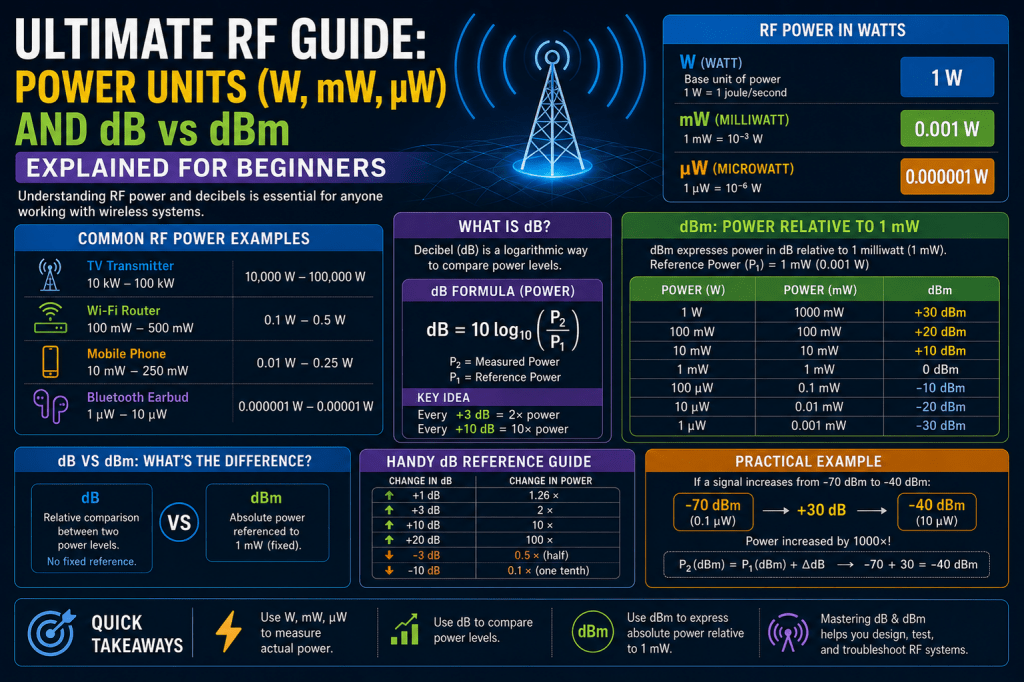
Radio frequency energy is a form of electrical power that follows the same physical principles as other electrical systems. The standard unit of measurement is the watt, which represents energy transfer per second. However, RF systems rarely operate at full watt-scale power in typical communication scenarios. Wireless technologies are designed to function at much lower power levels because high power is inefficient, unnecessary for most communication ranges, and often restricted by regulatory limits.
Because RF communication often involves very small amounts of energy, subunits of the watt are commonly used. The milliwatt is one of the most important units in this context. It represents one thousandth of a watt and provides a practical scale for describing wireless transmissions. Most wireless access points, mobile devices, and IoT systems operate within milliwatt ranges rather than full watts.
Even smaller units such as microwatts are relevant in specialized systems, particularly in ultra-low-power devices. These systems are engineered to operate with minimal energy consumption, sometimes relying on intermittent transmissions or energy harvesting methods. In such environments, power efficiency is more important than transmission strength, and every unit of energy must be carefully managed to extend operational lifespan.
Why RF Systems Use Milliwatts Instead of Watts
Using watts to describe RF power in wireless communication would be impractical due to the small scale of typical transmissions. Writing extremely small fractions of a watt repeatedly would create unnecessary complexity. The milliwatt simplifies this representation and aligns better with the actual operating range of most devices.
Wireless systems are typically optimized to use the lowest possible transmit power that still maintains reliable connectivity. This reduces interference with nearby systems and improves energy efficiency. In IoT environments, this becomes even more important, as many devices rely on batteries and are expected to function for long periods without maintenance. Lower transmit power directly translates into longer operational life and reduced environmental noise.
Decibels as a Logarithmic Approach to RF Measurement
RF systems frequently deal with extremely large differences between signal strengths. To manage this effectively, logarithmic measurements are used instead of linear scales. The decibel is a logarithmic unit that represents ratios between two power levels rather than an absolute quantity.
This approach allows engineers to work with large variations in signal strength using manageable numerical values. A small change in decibels can represent a significant change in actual power. A three-decibel change corresponds to approximately a doubling or halving of power, while a ten-decibel change represents a tenfold increase or decrease.
This logarithmic structure is particularly useful in wireless communication because signal strength can vary dramatically depending on distance, obstacles, and environmental conditions. Instead of dealing with large and complex numbers, decibels provide a simplified and consistent way to evaluate system behavior.
Understanding dBm as an Absolute RF Power Reference
While decibels are used for relative comparisons, RF systems also require a standardized reference point. This is where dBm becomes important. dBm is a measurement of absolute power relative to one milliwatt, expressed on a logarithmic scale.
A value of zero dBm corresponds exactly to one milliwatt of power. Positive values indicate power levels above one milliwatt, while negative values represent power levels below one milliwatt. Most wireless communication systems operate and measure received signals in negative dBm values because signals naturally weaken as they travel through space and obstacles.
This makes dBm a practical and widely used unit in wireless analysis. It allows engineers to evaluate both transmitted and received signal strengths using a consistent reference scale that aligns with real-world operating conditions.
Signal Propagation and Real-World RF Attenuation
As radio waves travel through space, they lose strength due to a phenomenon known as path loss. Distance alone causes signal energy to spread out, reducing its intensity. Additionally, physical objects such as walls, furniture, and terrain further weaken the signal.
This continuous reduction in signal strength means that the power received by a device is often significantly lower than the original transmitted power. Despite this reduction, modern RF systems are designed to operate effectively at very low received power levels. The ability to detect weak signals is a key feature of wireless receivers.
However, successful communication does not depend solely on signal strength. The surrounding RF environment plays an equally important role in determining whether the signal can be properly interpreted.
Noise Floor and Background RF Activity
Every RF environment contains background electromagnetic energy that is unrelated to the intended communication. This collection of unwanted signals forms what is known as the noise floor. The noise floor represents the baseline level of RF energy present in a given frequency range.
Noise can originate from a variety of sources, including natural atmospheric activity, electronic devices, industrial equipment, and other wireless systems operating in the same spectrum. Unlike intentional signals, noise is generally random and uncoordinated, making it difficult for receivers to distinguish useful data from background energy.
The noise floor is not constant. It varies depending on environmental conditions, device density, and spectrum usage. In quieter environments, the noise floor is lower, allowing weaker signals to be detected more easily. In crowded environments, the noise floor rises, reducing the effective range and clarity of communication.
Signal to Noise Ratio as a Measure of Communication Quality
The relationship between signal strength and background noise is expressed through the signal to noise ratio. This metric compares the power of the intended signal to the level of environmental noise. It is expressed in decibels because it represents a relative difference rather than an absolute measurement.
A higher signal to noise ratio indicates a clearer and more reliable communication channel. When the signal is significantly stronger than the noise floor, the receiver can easily extract meaningful information. When the ratio is low, the signal becomes difficult to distinguish, resulting in degraded performance or potential communication failure.
This metric is widely used because it provides a more accurate representation of real-world communication quality than raw signal strength alone.
Interference and Signal to Interference Plus Noise Ratio
In many RF environments, noise is not the only challenge. Interference from other active transmitters also affects signal quality. This leads to the use of a more comprehensive metric known as signal to interference plus noise ratio.
This measurement includes both background noise and competing signals operating on similar frequencies. In dense wireless environments, interference can significantly degrade performance even when signal strength appears sufficient.
By accounting for both noise and interference, this ratio provides a more realistic assessment of communication reliability. It reflects how effectively a receiver can separate the intended signal from all unwanted RF energy in the environment.
Practical Interpretation of RF Performance
RF performance is not determined by a single metric but by the interaction of multiple factors, including power levels, environmental noise, interference, and receiver sensitivity. A strong transmitted signal does not guarantee successful communication if the noise floor is high or interference is present.
Efficient wireless design focuses on maintaining an optimal balance between power consumption and signal clarity. Devices are typically configured to operate at the lowest possible transmit power that still ensures a stable signal to noise ratio. This approach improves energy efficiency, reduces interference, and enhances overall network stability.
Conclusion
Radio frequency communication is fundamentally about relationships rather than isolated values. Understanding RF systems requires interpreting how signal power interacts with environmental noise and interference. Units such as watts, milliwatts, and microwatts describe absolute power levels, while decibels and dBm provide a structured way to analyze relative performance. However, the most important aspect of RF communication is not raw power but signal quality as defined by metrics like signal to noise ratio and signal to interference plus noise ratio. These ratios determine whether a signal can be successfully decoded in real-world conditions where noise and interference are always present.