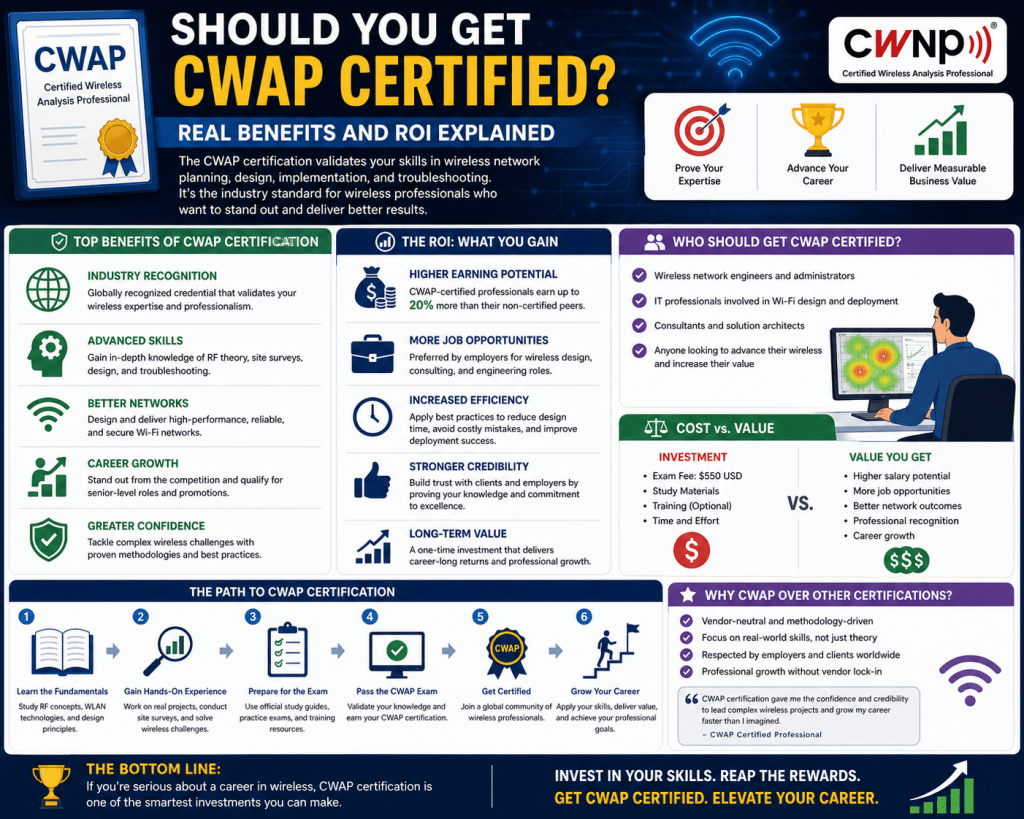
The CWAP-404 certification represents a highly specialized credential in the field of enterprise wireless networking, focusing on advanced analysis, troubleshooting, and performance evaluation of Wi-Fi systems. Unlike entry-level networking certifications that emphasize configuration and basic administration, this certification is designed for professionals who are expected to interpret wireless behavior at a protocol and spectrum level. In modern enterprise environments, wireless networks are no longer secondary to wired infrastructure; they are often the primary medium for communication, application access, and cloud connectivity. This shift has increased the demand for engineers who understand how wireless systems function internally rather than only how to deploy them. CWAP-404 validates the ability to analyze wireless frames, identify performance issues, and understand how physical and data link layer interactions impact overall network stability. It is widely regarded as a technical milestone for engineers transitioning into advanced wireless specialization roles.
The Evolution of Enterprise Wireless Networks and Its Impact on Skill Requirements
Wireless networking has undergone a major transformation over the past two decades, evolving from a convenience-based connectivity option into a mission-critical enterprise infrastructure component. Early wireless deployments were limited in scope, often supporting simple mobility use cases such as laptops in office environments. However, modern networks now support high-density environments, real-time communication systems, cloud-based applications, and large-scale IoT deployments. These advancements have introduced new challenges related to congestion, interference, security, and scalability. As a result, organizations require engineers who can go beyond surface-level troubleshooting and analyze network behavior in depth. CWAP-404 aligns with this evolution by focusing on the technical complexities of wireless communication, including signal behavior, frame structure interpretation, and protocol efficiency. This shift in requirements reflects the broader industry trend toward highly specialized networking roles that demand both theoretical understanding and practical diagnostic capability.
Role of CWAP Certified Professionals in Enterprise IT Environments
Professionals holding CWAP-level expertise typically operate in advanced technical roles where they are responsible for maintaining and optimizing wireless infrastructure performance. These roles often exist within large enterprise environments such as corporate campuses, healthcare systems, educational institutions, and industrial facilities where wireless connectivity must remain stable under heavy usage conditions. CWAP-certified engineers are expected to diagnose complex issues that cannot be resolved through basic configuration changes. Instead, they rely on deep analysis of wireless behavior, including packet-level inspection and RF environment evaluation. Their responsibilities may include identifying causes of intermittent connectivity, optimizing access point placement, and resolving performance degradation caused by interference or congestion. Because wireless networks directly impact productivity and operational efficiency, professionals with CWAP-level knowledge are considered highly valuable within IT teams responsible for infrastructure reliability.
Core Objectives and Skill Validation Focus of CWAP-404
The CWAP-404 certification is structured to validate advanced technical skills in wireless network analysis rather than basic operational knowledge. Its primary objective is to ensure that professionals can interpret wireless communication behavior at a granular level. This includes understanding how wireless frames are constructed, how devices communicate over shared radio frequencies, and how network performance is influenced by environmental and protocol-level factors. The certification also evaluates the ability to troubleshoot complex wireless issues using analytical tools and methodologies. Instead of focusing on configuration tasks such as setting up access points or managing SSIDs, it emphasizes diagnostic reasoning and deep technical interpretation. This makes it particularly relevant for engineers responsible for resolving high-impact network issues in enterprise environments where downtime or performance degradation can significantly affect business operations.
Physical Layer Fundamentals and Wireless Signal Behavior
The physical layer is one of the most critical components of wireless communication, as it governs how data is transmitted over radio frequencies. CWAP-404 certification requires an in-depth understanding of how wireless signals propagate through different environments and how they are affected by physical obstacles, distance, and interference sources. Engineers must understand concepts such as modulation, attenuation, reflection, and absorption, which all influence signal quality and reliability. The physical layer also determines how effectively data can be transmitted between devices in real-world conditions. In enterprise environments, physical layer issues are often responsible for connectivity problems such as weak signals, dropped connections, or inconsistent throughput. CWAP-level knowledge enables engineers to diagnose these issues by analyzing RF behavior and making informed decisions about network design and access point placement.
MAC Layer Architecture and Wireless Frame Control Mechanisms
The MAC layer plays a central role in managing how wireless devices access and share the communication medium. In the CWAP-404 certification, significant emphasis is placed on understanding MAC layer functions, including frame structure, transmission coordination, and collision avoidance mechanisms. Wireless networks operate in a shared medium where multiple devices compete for access, making efficient coordination essential for performance. The MAC layer defines rules that govern how devices communicate, ensuring that data is transmitted efficiently and reliably. Engineers must understand different frame types, including control, management, and data frames, as well as how these frames interact during communication processes. A deep understanding of MAC layer behavior allows professionals to identify issues such as retransmissions, congestion, and inefficient channel utilization, all of which can significantly impact network performance.
Wireless Frame Exchanges and Communication Sequences
Wireless communication is structured around a series of frame exchanges that occur between devices during various network operations. CWAP-404 certification requires professionals to understand these exchanges in detail, including processes such as authentication, association, data transfer, and roaming. Each of these processes involves multiple steps where devices exchange specific types of frames to establish and maintain communication. For example, authentication ensures that devices are authorized to connect to the network, while association establishes the connection parameters. Data transfer involves the continuous exchange of information between devices, and roaming ensures seamless connectivity when a device moves between access points. Understanding these sequences is essential for diagnosing issues that may occur during any stage of wireless communication, particularly in environments with high device mobility or dense user populations.
Spectrum Utilization and RF Environment Analysis
Spectrum analysis is a key aspect of wireless network troubleshooting that focuses on understanding how radio frequencies are used within a given environment. CWAP-404 certification emphasizes the ability to analyze RF spectrum usage to identify interference sources, channel congestion, and signal overlap issues. Wireless networks operate within specific frequency bands, and multiple devices often compete for limited spectrum resources. Interference from neighboring networks, electronic devices, and environmental factors can significantly degrade performance. Engineers must be able to interpret spectrum data to identify patterns that indicate network inefficiencies or external disruptions. This level of analysis is critical in enterprise environments where multiple wireless systems operate simultaneously, requiring careful planning and optimization to maintain performance and reliability.
Protocol-Level Analysis and Packet Inspection Techniques
Protocol analysis involves examining wireless communication at the packet level to understand how data is transmitted and received across the network. CWAP-404 certification requires engineers to interpret captured packet data and identify issues related to retransmissions, delays, and protocol inefficiencies. This type of analysis provides deep insight into network behavior and is essential for diagnosing complex performance issues. By examining packet exchanges, engineers can determine whether problems originate from client devices, access points, or network infrastructure. Protocol-level analysis also helps identify misconfigurations, security issues, and communication failures that may not be visible through standard monitoring tools. This skill is particularly important in enterprise environments where network reliability and performance are critical to business operations.
Integration of Wireless Domains in Real-World Troubleshooting Scenarios
One of the most important aspects of CWAP-404 certification is the integration of multiple wireless domains during real-world troubleshooting. Wireless network issues rarely originate from a single cause; instead, they often result from a combination of physical layer conditions, MAC layer behavior, and protocol-level interactions. Engineers must be able to analyze these factors collectively to identify root causes effectively. For example, a performance issue may be triggered by RF interference at the physical layer, which leads to increased retransmissions at the MAC layer and ultimately results in degraded application performance at the protocol level. Understanding these interdependencies is essential for resolving complex network issues in enterprise environments. CWAP-404 certification trains professionals to approach wireless troubleshooting holistically, ensuring that they can evaluate all contributing factors when diagnosing network problems.
Deep Dive into CWAP-404 Exam Structure and Wireless Knowledge Domains
The CWAP-404 certification exam is designed to evaluate advanced wireless networking expertise through a structured set of knowledge domains that reflect real-world enterprise challenges. Unlike entry-level networking exams that focus on configuration and general troubleshooting, this certification is heavily centered on analysis, interpretation, and diagnostic reasoning. The exam structure is divided into multiple technical domains that collectively measure a candidate’s ability to understand wireless communication at both macro and micro levels. These domains are not isolated topics but interconnected areas that reflect how wireless networks operate in production environments. Engineers preparing for this certification must develop a strong conceptual foundation in radio frequency behavior, protocol design, frame structure interpretation, and network performance analysis. Each domain builds on the others, requiring candidates to think in terms of system-wide interactions rather than individual components.
Understanding 802.11 Physical Layer Technologies in Enterprise Networks
The physical layer of wireless networking defines how data is transmitted over radio frequencies, making it one of the most fundamental aspects of CWAP-404 certification. This domain focuses on how wireless signals are generated, modulated, transmitted, and received across different environments. Engineers must understand how various modulation techniques affect data throughput and reliability, as well as how environmental factors influence signal propagation. In enterprise environments, physical layer challenges are common due to obstacles such as walls, metal structures, and electronic interference. These factors can significantly degrade signal quality and lead to performance issues such as packet loss and reduced throughput. CWAP-level expertise requires professionals to analyze these conditions and determine how they impact overall network behavior. Understanding physical layer characteristics is essential for designing efficient wireless networks and resolving connectivity issues that originate from signal degradation or interference.
802.11 MAC Layer Behavior and Frame Processing Mechanisms
The MAC layer is responsible for controlling how wireless devices access the shared communication medium, making it a critical focus area in CWAP-404 certification. This layer ensures that multiple devices can communicate over the same frequency without causing excessive collisions or data loss. It governs how frames are structured, transmitted, acknowledged, and retransmitted when necessary. Engineers must understand different frame types, including management frames, control frames, and data frames, and how each type functions within the communication process. The MAC layer also defines mechanisms for medium access control, ensuring fair usage of the wireless channel among competing devices. In high-density environments such as corporate offices or public venues, MAC layer inefficiencies can lead to congestion and performance degradation. CWAP-certified professionals are expected to analyze these behaviors and identify the root causes of inefficiencies through detailed frame inspection and protocol understanding.
Wireless Frame Structure and Communication Workflow Analysis
Wireless communication relies on structured frame exchanges that facilitate data transfer between devices. These frame exchanges occur in a defined sequence that includes authentication, association, data transmission, and disconnection processes. CWAP-404 certification emphasizes the importance of understanding how these frames are constructed and how they interact during communication sessions. Each frame contains specific fields that provide information about source and destination addresses, control information, and error-checking mechanisms. Engineers must be able to interpret these fields to diagnose communication issues effectively. In enterprise environments, frame exchange failures can result in connectivity problems, authentication errors, or performance inconsistencies. Understanding the workflow of wireless communication allows professionals to pinpoint where breakdowns occur and implement appropriate corrective measures. This level of analysis is essential for maintaining stable and efficient wireless networks.
Spectrum Analysis and Radio Frequency Environment Evaluation
Spectrum analysis plays a critical role in wireless network troubleshooting by providing visibility into how radio frequencies are utilized within a given environment. CWAP-404 certification requires professionals to understand how to evaluate RF spectrum data to identify interference, congestion, and channel overlap issues. Wireless networks operate within shared frequency bands, meaning multiple devices and systems often compete for limited spectrum resources. External factors such as neighboring networks, electronic devices, and environmental conditions can introduce interference that negatively impacts performance. Engineers must be able to interpret spectrum data to determine the source and severity of these issues. This involves analyzing channel utilization, signal strength, and noise levels to optimize network performance. In enterprise deployments, effective spectrum management is essential for ensuring consistent connectivity and minimizing performance degradation caused by RF interference.
Protocol Analysis and Wireless Packet Interpretation Techniques
Protocol analysis is a core component of CWAP-404 certification that focuses on examining wireless communication at the packet level. This process involves capturing and analyzing data packets transmitted across the wireless network to understand how devices interact. Engineers use protocol analysis to identify issues such as retransmissions, delays, misconfigurations, and communication failures. Each packet contains detailed information about the communication process, including headers, control information, and payload data. By interpreting this information, engineers can reconstruct communication sequences and identify where problems occur. Protocol analysis is particularly useful in complex environments where network issues cannot be resolved through basic monitoring tools. It provides deep visibility into network behavior, enabling professionals to diagnose issues that affect performance, reliability, and security.
Medium Access Control Algorithms and Network Efficiency Mechanisms
Wireless networks rely on medium access control algorithms to manage how devices share the communication channel. These algorithms determine when and how devices can transmit data to avoid collisions and ensure efficient use of the wireless medium. CWAP-404 certification requires an understanding of mechanisms such as the Distributed Coordination Function and Enhanced Distributed Channel Access. These mechanisms define rules for channel access based on factors such as priority, traffic type, and network conditions. In enterprise environments, efficient medium access control is essential for maintaining performance in high-density deployments. Poorly optimized access mechanisms can lead to congestion, increased latency, and reduced throughput. Engineers must understand how these algorithms function and how they can be optimized to improve overall network efficiency. This knowledge is critical for designing and maintaining scalable wireless infrastructures.
EDCA prioritizes traffic classes using contention windows and access categories in 802.11e QoS mechanisms\text{EDCA prioritizes traffic classes using contention windows and access categories in 802.11e QoS mechanisms}EDCA prioritizes traffic classes using contention windows and access categories in 802.11e QoS mechanisms
Enhanced Distributed Channel Access introduces quality of service prioritization by assigning different contention parameters to traffic categories, improving performance for time-sensitive applications.
802.11 Frame Exchange Sequences and Network Behavior Modeling
Frame exchange sequences represent the ordered communication steps that occur between wireless devices during network interactions. CWAP-404 certification requires professionals to understand these sequences in detail, including how devices establish connections, maintain communication, and terminate sessions. Each exchange involves multiple frames that serve specific purposes, such as request, response, acknowledgment, and confirmation. Engineers must be able to analyze these sequences to identify where failures or inefficiencies occur. For example, issues in authentication sequences may indicate security misconfigurations, while delays in association processes may suggest congestion or interference. Understanding frame exchange behavior is essential for modeling network performance and diagnosing complex wireless issues. This knowledge allows engineers to reconstruct communication flows and identify root causes of network problems.
Security Mechanisms and Wireless Authentication Processes
Wireless security is deeply integrated into frame exchange processes and plays a critical role in network communication. CWAP-404 certification includes understanding how authentication and encryption mechanisms operate within wireless networks. These processes ensure that only authorized devices can access the network and that data transmitted over the air remains secure. Engineers must understand different authentication methods, encryption protocols, and key exchange mechanisms used in enterprise wireless environments. Security-related frame exchanges are often complex and involve multiple steps that must be completed successfully for a connection to be established. Failures in these processes can result in connectivity issues or security vulnerabilities. Understanding wireless security mechanisms is essential for ensuring both network accessibility and data protection in enterprise environments.
MIMO Technologies and Advanced Wireless Performance Optimization
Multiple Input Multiple Output (MIMO) technology is an important component of modern wireless networking that enhances performance by using multiple antennas for transmission and reception. CWAP-404 certification requires an understanding of how MIMO systems improve throughput, reliability, and signal quality. In enterprise environments, MIMO technologies are used to support high-density deployments and bandwidth-intensive applications. Engineers must understand how spatial streams are utilized and how environmental factors affect MIMO performance. Proper configuration and optimization of MIMO systems can significantly improve network efficiency and user experience. However, improper implementation can lead to performance inconsistencies. CWAP-level knowledge enables professionals to analyze MIMO behavior and optimize wireless systems for maximum efficiency.
Roaming Behavior and Client Mobility Management in Wireless Networks
Roaming is a critical aspect of wireless networking that allows devices to maintain connectivity while moving between access points. CWAP-404 certification requires an understanding of how roaming decisions are made and how devices transition between different network coverage areas. Roaming behavior is influenced by factors such as signal strength, access point load, and client device algorithms. In enterprise environments, seamless roaming is essential for maintaining uninterrupted connectivity for mobile users. Poor roaming performance can result in dropped connections, latency issues, and degraded user experience. Engineers must analyze roaming behavior to ensure that transitions between access points occur smoothly and efficiently. This involves understanding both client-side and infrastructure-side factors that influence roaming decisions.
Interconnection of Wireless Domains in Complex Enterprise Environments
Wireless networking domains covered in CWAP-404 certification are deeply interconnected, and real-world troubleshooting requires a holistic understanding of these relationships. Physical layer conditions influence MAC layer behavior, which in turn affects protocol performance and application experience. For example, RF interference may cause signal degradation at the physical layer, leading to increased retransmissions at the MAC layer and reduced throughput at the application level. Engineers must be able to analyze these interactions to identify the root causes of network issues. This systems-level thinking is essential for managing complex enterprise wireless environments where multiple variables influence performance simultaneously. CWAP-404 certification develops this analytical mindset by training professionals to evaluate wireless networks as integrated systems rather than isolated components.
Career Impact of CWAP-404 Certification in Enterprise Wireless Networking
The CWAP-404 certification plays a significant role in shaping career trajectories for network engineers who specialize in wireless technologies. In modern enterprise environments, wireless infrastructure has become a core dependency rather than a supporting feature, which has elevated the importance of professionals who can design, analyze, and troubleshoot these systems at an advanced level. Engineers with CWAP-level expertise are often positioned in roles that require deep technical understanding of wireless behavior, including performance optimization, interference mitigation, and protocol-level diagnostics. These responsibilities extend beyond routine network administration and move into specialized engineering functions where decisions directly impact organizational connectivity and productivity. As enterprises scale their wireless deployments to support remote work, IoT devices, and cloud-based applications, the demand for advanced wireless professionals continues to increase steadily.
Industry Demand for Advanced Wireless Analysis Skills
The growing reliance on wireless connectivity across industries has created a strong demand for engineers capable of handling complex wireless environments. Organizations now operate in environments where hundreds or thousands of devices connect simultaneously to shared wireless infrastructure, creating challenges related to congestion, interference, and performance variability. Traditional networking skills are no longer sufficient to address these challenges, as issues often originate at the protocol or physical layer and require advanced diagnostic techniques to resolve. CWAP-404 certified professionals are uniquely positioned to address these problems because they possess the ability to analyze wireless behavior at a granular level. This includes interpreting packet captures, evaluating RF spectrum conditions, and understanding how wireless protocols behave under different network conditions. As a result, organizations increasingly value professionals who can ensure consistent performance in high-density wireless environments.
Financial Growth and Compensation Trends in Wireless Engineering Roles
Wireless engineering roles that require advanced analysis skills are generally associated with higher compensation levels compared to general networking positions. This is largely due to the specialized nature of the work and the critical importance of wireless infrastructure in modern IT environments. Engineers who can diagnose and resolve complex wireless issues contribute directly to organizational efficiency by minimizing downtime and improving network performance. Compensation for professionals with CWAP-level expertise tends to increase with experience, particularly when they move into senior engineering or architectural roles. Entry-level professionals may begin in support or technician roles, but as they gain experience and certification, they can progress into positions focused on wireless design, optimization, and enterprise-scale troubleshooting. The financial growth potential in this field reflects the increasing strategic importance of wireless networking in business operations.
Technical Skill Advancement Through CWAP-404 Preparation
Preparing for the CWAP-404 certification requires significant technical skill development, particularly in the areas of wireless protocol analysis, RF behavior, and network diagnostics. Unlike foundational networking certifications, this certification demands a deep understanding of how wireless systems function internally. Candidates must learn how to interpret packet captures, analyze frame structures, and evaluate spectrum data to identify performance issues. This process enhances critical thinking and analytical reasoning skills, as engineers must connect multiple layers of network behavior to identify root causes of problems. The preparation process also improves familiarity with wireless tools and methodologies used in enterprise environments. These skills are directly transferable to real-world job roles, making the certification preparation process itself a valuable professional development experience.
Complexity and Learning Curve of Advanced Wireless Analysis
The CWAP-404 certification is widely regarded as challenging due to its emphasis on deep technical analysis rather than surface-level networking knowledge. Candidates must be comfortable working with detailed technical information and interpreting complex interactions between wireless components. One of the primary challenges is understanding how different layers of the wireless stack interact under varying conditions. For example, issues at the physical layer may manifest as retransmissions at the MAC layer and ultimately affect application performance. This layered complexity requires engineers to develop a systems-thinking approach to troubleshooting. Additionally, spectrum analysis and packet-level inspection require familiarity with specialized tools and methodologies. The learning curve can be steep, but it ultimately leads to a high level of technical competence that is highly valued in enterprise networking environments.
Wireless Troubleshooting Methodologies and Diagnostic Approaches
Effective wireless troubleshooting requires a structured approach that integrates multiple diagnostic techniques. CWAP-404 certification emphasizes the importance of combining physical layer analysis, MAC layer evaluation, and protocol inspection to identify network issues. Engineers must be able to isolate problems by systematically analyzing different aspects of wireless behavior. This may involve examining signal strength and interference at the RF level, reviewing frame retransmission patterns at the MAC layer, and analyzing packet flows at the protocol level. Each layer provides different insights into network performance, and combining these perspectives allows engineers to develop a comprehensive understanding of the issue. This methodology is essential in enterprise environments where wireless problems often have multiple contributing factors.
Role of Spectrum Management in Wireless Network Optimization
Spectrum management is a critical component of wireless network optimization, particularly in environments with high device density and multiple overlapping networks. CWAP-404 certified professionals are trained to analyze RF spectrum usage to identify inefficiencies and interference sources. Wireless networks operate within limited frequency ranges, meaning that proper channel allocation and utilization are essential for maintaining performance. Interference from neighboring networks, electronic devices, and environmental factors can significantly degrade signal quality. Engineers must evaluate spectrum data to determine the optimal configuration for access points, including channel selection, power settings, and placement strategies. Effective spectrum management reduces congestion and improves overall network reliability, making it a key responsibility in enterprise wireless engineering roles.
Protocol-Level Visibility and Its Importance in Enterprise Networks
Protocol-level visibility provides deep insight into how wireless devices communicate within a network. CWAP-404 certification emphasizes the ability to analyze packet captures to understand communication patterns, identify inefficiencies, and diagnose failures. This level of visibility allows engineers to see exactly how devices interact during authentication, association, and data transfer processes. It also enables the identification of issues such as retransmissions, delays, and misconfigurations that may not be visible through standard monitoring tools. In enterprise environments, protocol-level analysis is essential for maintaining network reliability, as it allows engineers to pinpoint the exact source of performance issues and implement targeted solutions.
Wireless Security Considerations in Enterprise Deployments
Security is an integral part of wireless networking and plays a significant role in CWAP-404 certification topics. Wireless networks must be designed to ensure that only authorized devices can access network resources while maintaining secure communication channels. This involves understanding authentication mechanisms, encryption protocols, and key management processes. Security-related frame exchanges are often complex and involve multiple steps that must be completed for a connection to be established. Engineers must be able to analyze these processes to identify potential vulnerabilities or configuration issues. In enterprise environments, maintaining secure wireless communication is essential for protecting sensitive data and ensuring compliance with organizational security policies.
MIMO and Advanced Wireless Performance Enhancements
Modern wireless networks rely on advanced technologies such as Multiple Input Multiple Output systems to improve performance and reliability. CWAP-404 certification includes understanding how MIMO technology enhances throughput by using multiple antennas for simultaneous data transmission and reception. This improves signal quality, increases data rates, and enhances overall network efficiency. Engineers must understand how spatial streams are utilized and how environmental conditions affect MIMO performance. In enterprise environments, proper implementation of MIMO technology is essential for supporting high-bandwidth applications and dense user populations. However, optimizing MIMO performance requires careful analysis of environmental and configuration factors.
Client Roaming and Mobility Optimization in Wireless Networks
Client roaming is a critical function in wireless networks that enables devices to maintain connectivity while moving between access points. CWAP-404 certification requires an understanding of how roaming decisions are made and how devices transition between coverage areas. Roaming behavior is influenced by factors such as signal strength, access point load, and client-side algorithms. In enterprise environments, seamless roaming is essential for maintaining uninterrupted connectivity for mobile users. Poor roaming performance can result in dropped connections and degraded user experience. Engineers must analyze roaming behavior to ensure that transitions between access points occur efficiently and without disruption.
Integration of Wireless Systems in Large-Scale Enterprise Environments
In large-scale enterprise environments, wireless networks operate as complex systems composed of multiple interacting components. CWAP-404 certified professionals must understand how physical, MAC, and protocol layers work together to deliver seamless connectivity. Wireless performance issues often arise from interactions between these layers rather than isolated problems. For example, RF interference can lead to packet loss at the physical layer, which results in retransmissions at the MAC layer and degraded application performance. Engineers must be able to analyze these interactions holistically to identify root causes and implement effective solutions. This systems-level understanding is essential for managing modern enterprise wireless networks, where performance and reliability are critical to business operations.
Conclusion
The CWAP-404 certification represents a specialized milestone in the field of enterprise wireless networking, and its overall value becomes most apparent when viewed through the lens of long-term technical development rather than short-term credential acquisition. In modern IT environments, wireless infrastructure is no longer a secondary convenience layer; it has become a primary access medium for business applications, collaboration platforms, cloud services, and distributed workforces. This shift has fundamentally changed the expectations placed on network engineers, requiring a deeper level of analytical competence that goes beyond configuration and routine troubleshooting. CWAP-level expertise sits precisely in this space, where understanding how wireless systems behave at a protocol, frame, and spectrum level directly translates into improved network reliability and performance.
One of the most important aspects of CWAP-404 is that it forces professionals to think differently about wireless networking problems. Instead of treating symptoms at the surface level, engineers are trained to investigate underlying causes that exist across multiple layers of the network stack. This includes physical layer conditions such as signal degradation or interference, MAC layer behavior such as retransmissions and contention, and protocol-level interactions that govern communication efficiency. In real-world enterprise environments, wireless issues rarely originate from a single source. More often, they are the result of interconnected problems that require a structured analytical approach. CWAP training develops this mindset, enabling professionals to move from reactive troubleshooting to proactive network optimization.
The long-term career impact of this certification is closely tied to this shift in thinking. Engineers who develop CWAP-level skills are better equipped to handle complex environments where traditional troubleshooting methods are insufficient. As organizations continue to expand their wireless deployments to support high-density user environments, IoT ecosystems, and cloud-first architectures, the demand for professionals who can interpret wireless behavior at a granular level continues to increase. This demand is not limited to specific industries; it spans across sectors such as healthcare, education, finance, manufacturing, and public infrastructure, all of which rely heavily on stable and high-performance wireless connectivity.
From a technical perspective, CWAP-404 also strengthens a professional’s ability to work with diagnostic tools and methodologies that are essential in enterprise networking. Packet capture analysis, spectrum interpretation, and protocol inspection are not just theoretical concepts; they are practical skills that directly influence how network issues are resolved in production environments. Engineers who can interpret wireless frames and understand how devices communicate over shared spectrum gain a significant advantage in identifying inefficiencies and resolving performance bottlenecks. This ability becomes especially important in environments where downtime or degraded performance can have operational or financial consequences.
Another key dimension of the certification’s value lies in its emphasis on wireless system behavior rather than isolated configuration tasks. In many networking roles, engineers may become familiar with setting up access points, configuring security settings, or managing wireless controllers. While these tasks are important, they do not necessarily provide insight into why networks behave the way they do under load or in complex environments. CWAP-level expertise bridges this gap by focusing on the underlying mechanics of wireless communication. This includes how devices compete for channel access, how frames are structured and exchanged, and how environmental factors influence performance. This deeper understanding allows engineers to design more efficient networks and anticipate potential issues before they impact users.
The certification also plays a significant role in professional differentiation. In competitive IT job markets, many candidates may possess similar foundational networking certifications or general experience with wireless technologies. However, CWAP certification signals a higher level of specialization and analytical capability. It demonstrates that a professional is capable of handling advanced troubleshooting scenarios and working in environments where wireless performance is mission-critical. This differentiation often translates into access to more specialized roles, such as wireless engineer, network performance analyst, or enterprise infrastructure specialist.
In addition to career advancement, the knowledge gained through CWAP preparation has a direct impact on day-to-day job performance. Engineers who understand wireless behavior at a deeper level are able to resolve issues more efficiently, reduce troubleshooting time, and implement more effective long-term solutions. Instead of relying on trial-and-error approaches, they can systematically analyze network behavior and identify root causes with greater accuracy. This leads to more stable network environments and improved user experience across the organization.
It is also important to recognize that CWAP-404 is not an isolated learning endpoint but rather part of a broader professional development path in wireless networking. It builds upon foundational knowledge and prepares engineers for more advanced roles in network design, architecture, and optimization. As wireless technologies continue to evolve, particularly with the expansion of high-speed standards and dense deployment environments, the ability to understand and adapt to these changes becomes increasingly valuable. CWAP-certified professionals are better positioned to stay relevant in this evolving landscape because they possess a strong conceptual foundation in how wireless systems operate at a fundamental level.
The certification also encourages a more disciplined approach to problem-solving. Wireless networking issues often require careful observation, data collection, and structured analysis. CWAP training reinforces these habits by exposing engineers to detailed scenarios that require methodical reasoning. Over time, this approach becomes part of a professional’s natural workflow, improving both efficiency and accuracy in troubleshooting tasks. This structured thinking is particularly valuable in large-scale enterprise environments where multiple systems and variables must be considered simultaneously.
From an organizational perspective, having CWAP-certified professionals on a team contributes to overall network stability and performance. These engineers are capable of identifying inefficiencies that may otherwise go unnoticed and implementing improvements that enhance user experience. This includes optimizing access point configurations, reducing interference, improving roaming performance, and ensuring efficient spectrum utilization. As wireless networks become more critical to business operations, this level of expertise becomes increasingly important for maintaining operational continuity.
Ultimately, the CWAP-404 certification represents more than just an exam or credential. It represents a shift toward advanced wireless engineering capability, where professionals are expected to understand not only how networks are configured but how they behave under real-world conditions. This depth of understanding is what separates general network administrators from specialized wireless engineers. While the certification requires significant effort and technical commitment, the resulting skill set provides long-term value in both career development and practical job performance.