
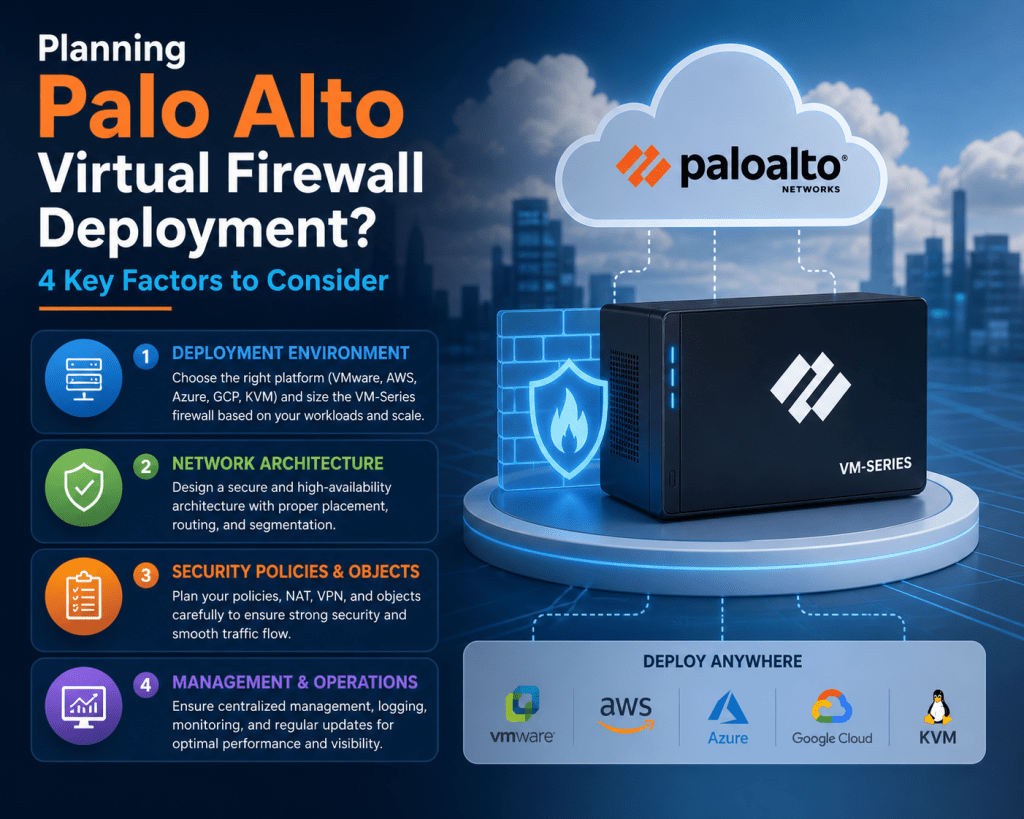
Palo Alto VM-Series virtual firewalls are software-defined security appliances designed to extend advanced network protection into virtualized and cloud-native environments. They are engineered to deliver the same inspection engine, policy enforcement logic, and threat prevention capabilities as physical next-generation firewalls, but in a form factor that can be deployed on hypervisors, cloud platforms, and container ecosystems. This allows organizations to maintain consistent security enforcement across on-premises data centers and distributed cloud workloads without redesigning core security architecture for each environment.
At their core, VM-Series firewalls provide application-level visibility, user-based policy control, intrusion prevention, URL filtering, and malware detection. These capabilities are enforced through PAN-OS, the same operating system used in physical Palo Alto firewalls. This consistency ensures that security teams can apply uniform policies regardless of whether traffic originates in a private data center or a public cloud region. However, despite this software consistency, the underlying infrastructure of each deployment environment introduces variations in networking behavior, scaling methods, and high availability implementation.
Cloud environments differ significantly in how they handle networking constructs such as routing, segmentation, and interface abstraction. Public cloud providers often impose constraints such as reliance on Layer 3 networking only, meaning that traditional Layer 2 designs like bridging or VLAN-based segmentation may not be fully supported. These constraints directly influence how VM-Series firewalls are integrated into cloud architectures and require careful adaptation of traditional firewall deployment models.
Architecture and Operational Model of VM-Series Firewalls
The architecture of VM-Series firewalls is built around a separation of control and data processing functions. The management plane handles configuration, logging, and policy management, while the data plane is responsible for inspecting and processing traffic in real time. This separation allows the firewall to scale efficiently in virtual environments where resources can be dynamically allocated.
The dataplane performs deep packet inspection, application identification, and threat detection using a combination of signature-based and behavioral analysis techniques. Traffic is classified based on application identity rather than port numbers, allowing for more granular security policies. This is particularly important in cloud environments where applications frequently use dynamic ports and encrypted traffic is increasingly common.
PAN-OS ensures that security policies remain consistent across different deployment types. Whether the firewall is running on a physical appliance or a virtual machine, the same rule structure, object definitions, and security profiles apply. This reduces operational complexity and minimizes the risk of misconfiguration when migrating workloads between environments.
Another important architectural aspect is the use of virtual interfaces. VM-Series firewalls rely on virtual network interfaces to connect to cloud or hypervisor-based networks. These interfaces are mapped to virtual switches, cloud subnets, or virtual networks depending on the environment. The configuration of these interfaces determines how traffic flows through the firewall and how security policies are applied to different network segments.
VM-Series Models and Scalability Considerations
VM-Series firewalls are available in multiple models designed to support different performance and capacity requirements. These models range from lightweight instances intended for low-traffic environments to high-performance versions capable of handling large-scale enterprise workloads. Each model defines limits on throughput, concurrent sessions, security policies, and VPN tunnels.
Selecting the appropriate model requires understanding both current and projected network demand. Over-provisioning may result in unnecessary cost, while under-provisioning can lead to performance degradation and security gaps. As cloud environments are inherently elastic, organizations often scale VM-Series deployments horizontally by adding additional firewall instances rather than relying solely on vertical scaling.
In many architectures, multiple VM-Series firewalls are deployed in parallel to distribute traffic load. This approach enhances scalability and resilience, especially in environments where traditional hardware-based high availability configurations may not be fully supported. Some cloud platforms enable load balancing across firewall instances, while others rely on routing-based traffic distribution.
Capacity licensing is directly tied to the selected model. Each VM-Series instance is assigned a license that defines its operational limits. These limits include session capacity, rule counts, and feature availability. Proper licensing ensures that the firewall can operate at full functionality without restrictions, which is essential in production environments where security enforcement cannot be compromised.
Deployment Ecosystems and Infrastructure Integration
VM-Series firewalls can be deployed across a wide range of environments, including private clouds, public clouds, hybrid architectures, and containerized platforms. Each environment introduces unique integration requirements that affect how the firewall operates within the broader network.
In private cloud environments, VM-Series firewalls are typically deployed as virtual appliances within hypervisor-managed infrastructure. Administrators have full control over networking, storage, and compute resources, allowing for highly customized security architectures. This level of control enables advanced segmentation strategies and detailed traffic inspection policies.
Public cloud environments introduce a different operational model. Firewalls are often deployed through pre-configured marketplace images or templates provided by the cloud platform. While this simplifies deployment, it also introduces constraints based on the cloud provider’s networking model. For example, interface configuration may be limited to predefined roles such as management, trusted traffic, and untrusted traffic.
Hybrid cloud architectures combine both private and public cloud resources. In these environments, VM-Series firewalls serve as enforcement points between different infrastructure domains. They ensure that traffic moving between clouds is inspected and governed by consistent security policies. This requires careful design of routing, VPN connectivity, and centralized management.
Containerized environments represent one of the most complex deployment scenarios. Unlike traditional virtual machines, containers are highly ephemeral and operate within distributed orchestration systems. Security in these environments must account for dynamic workload movement, microservices communication, and abstracted networking layers. VM-Series firewalls can be integrated to provide network-level security, but they must be adapted to the unique characteristics of container ecosystems.
Factor 1: Private Cloud Deployment Considerations and Design Principles
Private cloud deployment of VM-Series virtual firewalls provides the highest level of control over infrastructure design, making it suitable for organizations with strict security, compliance, or performance requirements. In this model, the firewall is deployed as a virtual machine image within a controlled virtualization environment, such as an enterprise data center.
One of the most critical considerations in private cloud deployment is resource allocation. VM-Series firewalls depend heavily on compute resources, particularly CPU and memory, to perform deep packet inspection and real-time traffic analysis. Insufficient allocation can result in packet drops, increased latency, and reduced throughput. Proper sizing must be performed based on expected traffic volume, number of security policies, and application complexity.
Network design plays an equally important role. Private cloud environments allow for flexible network segmentation using virtual switches, VLANs, and routing policies. VM-Series firewalls can be strategically placed at key network boundaries to enforce segmentation between different application tiers, such as user access networks, application servers, and database layers. This segmentation reduces the attack surface and limits lateral movement in the event of a security breach.
Another important aspect is interface mapping. Each VM-Series firewall uses virtual network interfaces that must be correctly mapped to underlying virtual networks. These interfaces define how traffic enters and exits the firewall. Misconfiguration at this layer can result in traffic bypassing security inspection or being incorrectly routed.
Licensing is a foundational requirement in private cloud deployments. VM-Series firewalls require capacity-based licensing to unlock full functionality. These licenses define operational limits such as session capacity, number of security rules, and supported features. Selecting the appropriate license ensures that the firewall can scale with organizational needs without performance degradation.
High availability design is another key factor in private cloud environments. Because organizations control the entire infrastructure stack, they can implement active-passive or active-active firewall configurations. These setups ensure continuity of service in the event of hardware or software failure. Proper synchronization between firewall instances is essential to maintain session persistence and policy consistency.
Logging and monitoring integration is also essential. VM-Series firewalls generate detailed traffic logs, threat alerts, and system events that must be integrated into centralized monitoring systems. This visibility is critical for detecting anomalies, investigating incidents, and maintaining compliance with security standards.
Security policy design in private cloud environments tends to be highly granular. Administrators can define rules based on applications, users, services, and zones. This allows for precise control over traffic flows and ensures that only authorized communications are permitted between different segments of the infrastructure.
Factor 2: Public Cloud Deployment Models and Architectural Constraints
Public cloud deployment of Palo Alto VM-Series virtual firewalls introduces a fundamentally different operating model compared to private cloud environments. In this model, infrastructure is owned and managed by a cloud service provider, while the firewall itself is deployed as a virtual instance within a shared and highly abstracted networking environment. This abstraction significantly influences how security controls are implemented, how traffic is routed, and how scalability is achieved.
One of the most important characteristics of public cloud environments is their reliance on predefined networking constructs. Unlike private clouds,s where administrators can freely design Layer 2 and Layer 3 topologies, public clouds typically enforce Layer 3-only networking. This means that VM-Series firewalls must operate within routed network segments, and traditional bridging or VLAN-based segmentation is not supported in the same way. As a result, security architecture must be adapted to align with subnet-based segmentation models.
Public cloud deployments also introduce constraints around interface configuration. VM-Series firewalls are typically provisioned with a fixed number of virtual network interfaces, each assigned specific roles such as management traffic, trusted internal traffic, or untrusted external traffic. These interfaces are mapped to virtual networks or subnets defined by the cloud environment. Any deviation from these predefined mappings requires careful architectural planning to avoid traffic misrouting or inspection bypass.
Another critical consideration is elasticity. Public cloud environments are inherently dynamic, allowing workloads and security appliances to scale up or down based on demand. VM-Series firewalls must therefore be designed to support horizontal scaling models, where multiple firewall instances operate in parallel to distribute traffic load. This approach replaces traditional vertical scaling methods used in physical appliances and introduces new challenges in traffic synchronization and policy consistency.
High availability in public cloud environments is also implemented differently. Some platforms support active-passive configurations where two firewall instances are deployed across different availability zones to ensure redundancy. Others rely on load-balancing mechanisms or distributed firewall architectures where multiple instances independently process traffic without direct synchronization. Each model has implications for session persistence, failover behavior, and overall network resilience.
Another important architectural constraint is dependency on cloud-native routing services. In many cases, VM-Series firewalls must integrate with native routing tables and virtual network gateways provided by the cloud platform. This integration ensures that traffic flows through the firewall for inspection before reaching its destination. Misalignment between routing configurations and firewall placement can result in traffic bypassing security controls entirely.
Cloud provider APIs also play a significant role in deployment automation. VM-Series firewalls can be integrated into infrastructure-as-code workflows, allowing automated provisioning, configuration, and scaling. This automation is essential in large-scale environments where manual configuration would be inefficient and error-prone. However, it also requires careful management of templates and policy definitions to maintain consistency across deployments.
VM-Series Licensing and Subscription Architecture
Licensing in VM-Series firewall deployments is a foundational component that directly impacts functionality, scalability, and feature availability. Unlike traditional hardware-based licensing models, VM-Series licensing is capacity-based and subscription-driven, meaning that firewall capabilities are tied to licensed performance metrics rather than physical device constraints.
Each VM-Series instance requires a capacity license that defines operational limits such as maximum concurrent sessions, number of security rules, supported VPN tunnels, and throughput capacity. These limits ensure that the firewall operates within defined performance boundaries and aligns with the intended workload profile. Selecting an appropriate license requires detailed analysis of traffic volume, application complexity, and expected growth trends.
Licensing models typically include perpetual and term-based options. Perpetual licensing allows continuous use of the firewall at the assigned capacity without expiration, making it suitable for stable environments with predictable workloads. Term-based licensing, on the other hand, provides time-limited access to firewall capabilities and is commonly used in dynamic or rapidly evolving cloud environments where flexibility is required.
Feature licensing is another critical component of VM-Series deployments. Advanced security capabilities such as threat prevention, malware analysis, URL filtering, and secure remote access are often enabled through additional subscriptions. These features extend the firewall’s core functionality and provide deeper inspection and protection capabilities across network traffic.
In public cloud environments, licensing may be bundled with deployment images or offered separately through a bring-your-own-license model. In bundled models, certain security features are pre-enabled, simplifying deployment but reducing flexibility. In BYOL models, organizations maintain full control over feature selection and licensing allocation, allowing for more customized security architectures.
License enforcement is tightly integrated with the firewall’s operating system. Once activated, the license determines the available capacity and feature set. If usage exceeds licensed limits, performance degradation or feature restrictions may occur. This makes accurate capacity planning a critical step in deployment design.
Factor 3: Hybrid Cloud Deployment and Cross-Environment Security Integration
Hybrid cloud architectures combine private infrastructure with public cloud resources, creating a distributed computing environment that requires unified security enforcement across multiple domains. VM-Series firewalls play a central role in maintaining consistent security policies across these environments by acting as enforcement points between different network boundaries.
One of the primary challenges in hybrid cloud deployments is maintaining policy consistency. Because workloads are distributed across multiple environments, security rules must be applied uniformly to ensure that traffic is inspected regardless of its origin or destination. This requires centralized policy management systems capable of synchronizing configurations across all firewall instances.
Connectivity between private and public cloud environments is typically established using secure tunnels such as site-to-site VPNs. VM-Series firewalls often serve as termination points for these tunnels, enabling encrypted communication between environments. Proper configuration of routing, encryption protocols, and tunnel redundancy is essential to ensure reliable and secure connectivity.
Another critical aspect of hybrid deployments is centralized monitoring and logging. Security events generated across multiple environments must be aggregated into a unified visibility layer. This allows security teams to analyze traffic patterns, detect anomalies, and respond to threats in a coordinated manner. Without centralized visibility, hybrid environments can become fragmented and difficult to secure effectively.
Routing design in hybrid environments is significantly more complex than in single-cloud architectures. Traffic must be carefully directed through firewall instances to ensure inspection without introducing latency or bottlenecks. This often involves designing asymmetric routing paths, policy-based routing rules, and failover mechanisms that account for multiple network domains.
High availability in hybrid environments must also consider cross-environment redundancy. While private clouds may support traditional HA configurations, public clouds may rely on distributed scaling or regional redundancy models. Aligning these approaches requires careful architectural planning to ensure consistent failover behavior across environments.
Centralized Management and Policy Orchestration in Distributed Deployments
As VM-Series firewalls are deployed across multiple environments, centralized management becomes essential for maintaining operational efficiency and security consistency. Centralized management platforms enable administrators to define security policies once and apply them across all firewall instances, regardless of deployment location.
Policy orchestration ensures that security rules, address objects, and application controls remain synchronized across private, public, and hybrid environments. This reduces configuration drift and minimizes the risk of inconsistent security enforcement. It also simplifies compliance management by providing a unified view of security posture across the entire infrastructure.
Logging and reporting are integral components of centralized management. VM-Series firewalls generate detailed logs that include traffic flows, threat detections, and system events. Aggregating this data into a centralized system enables deeper analysis and supports incident response workflows. It also provides historical visibility into network behavior, which is critical for forensic investigations.
Automation plays a key role in managing large-scale deployments. Infrastructure-as-code frameworks and orchestration tools can be used to automate firewall provisioning, configuration updates, and scaling operations. This reduces manual intervention and ensures that deployments remain consistent across environments.
Factor 4: Containerized Environments and Microservices Security Challenges
Containerized environments represent one of the most complex deployment scenarios for VM-Series firewalls due to their highly dynamic and distributed nature. Unlike traditional virtual machines, containers are lightweight, ephemeral, and designed to run microservices that communicate frequently across distributed networks.
Security in container environments must address multiple layers, including host operating systems, container runtimes, orchestration platforms, image registries, and application workloads. VM-Series firewalls contribute to this security model by providing network-level visibility and enforcement across container traffic flows.
One of the primary challenges in container environments is the absence of a traditional network perimeter. Microservices often communicate internally within clusters, bypassing conventional firewall boundaries. This requires a shift toward distributed security models where enforcement is embedded closer to workloads rather than centralized at network edges.
VM-Series firewalls can be integrated into container orchestration platforms to monitor and control traffic between services. This integration enables visibility into east-west traffic, which is critical for detecting lateral movement and preventing unauthorized communication between microservices.
Image security is another important consideration. Containers are built from images that may contain vulnerabilities or misconfigurations. Ensuring that only trusted images are deployed is a key part of the security strategy. VM-Series firewalls can complement this by monitoring runtime behavior and detecting anomalous traffic patterns.
Runtime protection focuses on monitoring active container behavior to identify malicious activity. This includes detecting unusual network connections, unauthorized data transfers, and deviations from expected communication patterns. VM-Series firewalls provide the network-level enforcement layer required to support these detection mechanisms.
Orchestration platforms introduce additional complexity by dynamically scheduling containers across nodes. This requires security policies to adapt in real time as workloads move across the infrastructure. VM-Series firewalls must therefore integrate closely with orchestration systems to maintain consistent enforcement.
In container environments, scalability is a fundamental requirement. Security solutions must be able to scale alongside rapidly changing workloads without introducing latency or bottlenecks. VM-Series firewalls address this by supporting distributed deployment models that align with microservices architectures.
Container Security Architecture and VM-Series Integration in Modern Cloud Systems
Containerized environments represent one of the most rapidly evolving areas in enterprise infrastructure, and they introduce a fundamentally different security paradigm compared to traditional virtual machines or monolithic applications. VM-Series virtual firewalls are designed to extend network security principles into these environments, but doing so requires adapting to the unique characteristics of container orchestration, microservices communication, and highly dynamic workload lifecycles.
Unlike traditional server-based architectures, container environments do not rely on fixed hosts or static IP relationships. Instead, workloads are continuously created, destroyed, and rescheduled across clusters. This ephemeral nature makes conventional perimeter-based security models insufficient. VM-Series firewalls, therefore, function as distributed enforcement points, providing visibility into traffic flows between containerized services and ensuring that policy enforcement is consistent even as workloads shift.
In container environments, security must operate across multiple layers simultaneously. These include the underlying host operating system, the container runtime engine, the orchestration layer, image registries, and the application layer itself. Each layer introduces its own set of vulnerabilities and attack surfaces. VM-Series firewalls primarily focus on the network and traffic inspection layer, but their effectiveness depends on integration with these surrounding components.
Microservices architectures further complicate security enforcement because applications are broken into independent services that communicate over internal APIs. This east-west traffic often bypasses traditional network inspection points, making it difficult to detect lateral movement or unauthorized communication. VM-Series firewalls help address this gap by inspecting traffic within cluster networks and enforcing application-aware security policies.
Another important consideration is the shifting concept of trust boundaries. In container environments, the idea of a fixed perimeter is replaced by distributed trust zones that are defined by workload identity, service behavior, and network segmentation policies. VM-Series firewalls contribute to this model by enabling policy enforcement based on application identity rather than static network attributes.
Container orchestration platforms introduce additional complexity through automated scheduling and scaling mechanisms. Containers may be moved between nodes based on resource availability, performance optimization, or failure recovery. VM-Series firewalls must therefore maintain consistent policy enforcement regardless of where workloads are running, requiring tight integration with orchestration APIs and control planes.
Security Challenges in Containerized and Microservices Environments
Containerized environments introduce several unique security challenges that differ significantly from traditional infrastructure models. One of the most significant challenges is workload volatility. Containers can be instantiated or terminated in seconds, making it difficult to maintain persistent security rules based on IP addresses or fixed network segments.
Another challenge is image integrity. Container images serve as the foundation for running workloads, and if these images are compromised or improperly configured, they can introduce vulnerabilities into the environment. Security strategies must therefore include validation of container images before deployment, as well as runtime monitoring to detect suspicious behavior once containers are active.
The shared kernel model used by containers also introduces risk. Unlike virtual machines, which operate with isolated operating systems, containers share the host kernel. This increases the potential impact of kernel-level vulnerabilities and requires careful isolation strategies at the runtime level. VM-Series firewalls help mitigate network-based exploitation attempts but must be complemented by host-level security controls.
Network visibility is another critical challenge. In container environments, a large portion of traffic occurs internally between services. This internal communication is often invisible to traditional perimeter security tools. VM-Series firewalls extend visibility into these internal flows, enabling detection of unauthorized communication patterns and potential lateral movement.
Orchestration systems such as Kubernetes further increase complexity by dynamically managing service discovery, load balancing, and scaling. These systems rely heavily on abstract networking layers, which can obscure traffic paths from traditional monitoring tools. VM-Series integration with orchestration environments allows security policies to adapt dynamically as services scale or relocate.
Factor 4: Container Deployment Considerations for VM-Series Firewalls
Deploying VM-Series firewalls in containerized environments requires a fundamentally different approach compared to traditional infrastructure. The first consideration is integration with the container orchestration layer. Security enforcement must align with how workloads are scheduled and managed across clusters.
One key requirement is visibility into service-to-service communication. In microservices architectures, applications often consist of dozens or hundreds of independent services communicating over internal APIs. VM-Series firewalls must be positioned to inspect this traffic without introducing latency or disrupting service discovery mechanisms.
Another important consideration is dynamic policy enforcement. Because containers are ephemeral, static security rules are insufficient. Instead, policies must be tied to workload identity, labels, or metadata provided by the orchestration system. This allows security controls to follow workloads as they move across nodes or clusters.
Network abstraction layers also play a significant role. Container platforms typically use overlay networks to enable communication between services. These overlays can obscure underlying traffic paths, making it necessary for VM-Series firewalls to integrate directly with network plugins or virtual networking components.
Scalability is a critical requirement in container environments. As workloads scale up and down rapidly, security enforcement must scale proportionally without manual intervention. VM-Series firewalls support distributed deployment models that allow multiple instances to operate in parallel, ensuring that security capacity matches workload demand.
Another consideration is policy segmentation. Container environments often host multiple applications or tenants within the same cluster. VM-Series firewalls can enforce segmentation between these workloads, ensuring that traffic is restricted based on defined security zones or application boundaries.
Logging and monitoring are essential components of container security. VM-Series firewalls generate detailed traffic and threat logs that must be integrated into centralized observability systems. This enables real-time detection of anomalies and supports forensic investigations in the event of a security incident.
Centralized Security Management Across Distributed VM-Series Deployments
As VM-Series firewalls are deployed across private clouds, public clouds, hybrid environments, and container platforms, centralized management becomes essential for maintaining operational consistency. Without centralized control, security policies can quickly become fragmented, leading to misconfigurations and inconsistent enforcement.
Centralized management systems allow administrators to define security policies once and deploy them across multiple environments. This ensures that rules governing traffic inspection, application control, and threat prevention remain consistent regardless of where workloads are hosted.
Policy synchronization is a critical function in distributed environments. When changes are made to security rules, they must be propagated across all firewall instances without delay. This prevents configuration drift and ensures that all environments enforce the same security standards.
Centralized logging provides a unified view of network activity across all deployment types. This includes traffic flows, security alerts, and system events. Aggregating this data enables security teams to identify patterns, detect anomalies, and respond to incidents more effectively.
Reporting and analytics are also enhanced through centralized management. By consolidating data from multiple firewall instances, organizations can gain insights into application behavior, network performance, and threat trends across their entire infrastructure.
Automation plays a key role in managing large-scale deployments. Infrastructure automation tools can be used to deploy, configure, and update VM-Series firewalls across multiple environments. This reduces operational overhead and ensures consistency in configuration management.
Factor 5: Licensing Strategy and Capacity Planning for VM-Series Firewalls
Licensing and capacity planning are fundamental aspects of VM-Series deployment strategy, particularly in environments where workloads are dynamic and distributed. Unlike traditional hardware firewalls, VM-Series instances rely on software-based licensing models that define operational limits and feature availability.
Capacity licensing determines the maximum number of sessions, security rules, and throughput that a firewall instance can handle. Proper capacity planning requires understanding both current traffic loads and future growth projections. Underestimating capacity can lead to performance degradation, while overestimating can result in unnecessary cost.
Licensing models are typically structured around subscription-based or perpetual frameworks. Subscription models provide flexibility for dynamic environments, allowing organizations to adjust capacity as needed. Perpetual models offer long-term stability for environments with predictable workloads.
Feature-based licensing enables advanced security capabilities such as intrusion prevention, malware detection, and URL filtering. These features extend the firewall’s functionality and are often required for enterprise-grade security enforcement.
In cloud environments, licensing may be bundled with deployment images or managed independently. Bundled licensing simplifies deployment but reduces flexibility, while independent licensing allows for more granular control over feature activation.
Capacity planning must also account for horizontal scaling models. In distributed deployments, multiple VM-Series instances may be used to handle traffic load. Licensing strategies must therefore support scaling across multiple instances without introducing inconsistencies in enforcement.
Performance Optimization and Traffic Engineering in VM-Series Deployments
Performance optimization is a critical factor in ensuring that VM-Series firewalls operate efficiently across diverse deployment environments. Because these firewalls are software-based, their performance is directly influenced by underlying compute, memory, and network resources.
CPU allocation plays a significant role in packet processing and deep inspection performance. Insufficient CPU resources can result in increased latency and reduced throughput. Proper sizing ensures that inspection engines operate efficiently without bottlenecks.
Memory allocation is equally important, particularly for maintaining session tables, security policies, and traffic logs. Inadequate memory can lead to session drops or incomplete inspection of network flows.
Network design also impacts performance. Efficient routing paths reduce latency and ensure that traffic flows through firewall instances without unnecessary hops. Poorly designed routing can result in asymmetric paths, which complicate inspection and policy enforcement.
Hardware acceleration features available in virtualization platforms can enhance firewall performance by offloading certain processing tasks. These features improve throughput and reduce CPU utilization, particularly in high-traffic environments.
Traffic engineering strategies such as load balancing and distributed deployment help ensure that no single firewall instance becomes a bottleneck. By distributing traffic across multiple instances, organizations can achieve both scalability and resilience.
Continuous monitoring is essential for maintaining optimal performance. Metrics such as throughput, session utilization, and CPU usage must be tracked to identify potential issues before they impact production systems.
Final Considerations for VM-Series Deployment Across Multi-Environment Architectures
VM-Series virtual firewalls are designed to operate across a wide range of environments, including private clouds, public clouds, hybrid infrastructures, and containerized platforms. Each environment introduces unique constraints, requiring careful planning and adaptation of security architectures.
The consistency of PAN-OS across all deployment types ensures that security policies remain uniform, even as infrastructure changes. This consistency simplifies operations and reduces the risk of configuration errors.
However, environmental differences such as networking limitations, scaling models, and high availability configurations must be carefully considered during deployment design. These differences directly influence how security controls are implemented and enforced.
A successful VM-Series deployment strategy requires balancing flexibility, scalability, and performance while maintaining strict security enforcement across all environments.
Conclusion
In modern enterprise and cloud-driven infrastructures, the role of Palo Alto VM-Series virtual firewalls extends far beyond traditional perimeter security. As organizations continue shifting workloads across private cloud environments, public cloud platforms, hybrid architectures, and containerized ecosystems, the need for a consistent, scalable, and deeply integrated security enforcement layer becomes increasingly critical. VM-Series firewalls address this requirement by providing a unified security platform that maintains feature parity with physical next-generation firewalls while adapting to the operational realities of virtualized infrastructure.
One of the most significant strengths of VM-Series firewalls is their consistency in policy enforcement through PAN-OS. Regardless of whether the deployment is on-premises or within a public cloud provider, the same security logic applies. This consistency reduces operational complexity and eliminates the fragmentation that often occurs when different security tools are used across environments. Security teams benefit from a unified policy model that governs applications, users, and traffic flows in a predictable and standardized manner.
However, this consistency does not eliminate the need for careful architectural planning. Each deployment environment introduces constraints that influence how the firewall operates. Public cloud platforms, for example, impose strict networking limitations such as Layer 3-only connectivity, predefined interface roles, and restricted control over routing behavior. These constraints require organizations to rethink traditional firewall placement strategies and adopt cloud-native design principles. Similarly, private cloud environments provide more flexibility but demand deeper responsibility for resource allocation, redundancy design, and performance tuning.
Hybrid cloud architectures further increase complexity by introducing multiple operational domains that must work together seamlessly. In these environments, VM-Series firewalls often serve as the connective security layer between disparate infrastructure segments. Ensuring secure and efficient communication across environments requires carefully designed routing paths, secure tunneling mechanisms, and centralized management frameworks. Without these elements, hybrid deployments can quickly become fragmented, leading to inconsistent security enforcement and increased exposure to risk.
Containerized environments present an entirely different set of challenges. Unlike traditional infrastructure, containers are highly dynamic, short-lived, and often distributed across large-scale orchestration platforms. This volatility makes it difficult to rely on static security models. Instead, security must be closely integrated with orchestration systems and must adapt in real time as workloads scale, move, or terminate. VM-Series firewalls contribute to this model by providing network-level visibility and enforcement across microservices communication paths. This capability is essential in preventing lateral movement and detecting anomalous behavior within highly distributed application architectures.
Another key consideration in VM-Series deployments is scalability. Unlike hardware appliances, virtual firewalls can be scaled horizontally by deploying additional instances rather than upgrading physical capacity. This approach aligns well with cloud-native architectures, where elasticity is a core principle. However, horizontal scaling introduces challenges in traffic distribution, policy synchronization, and session management. Proper design ensures that multiple firewall instances operate cohesively without creating inconsistencies in security enforcement or visibility gaps.
Licensing and capacity planning also play a critical role in ensuring successful deployments. VM-Series firewalls operate under capacity-based licensing models that define limits for sessions, throughput, and feature availability. Accurate capacity planning is essential to avoid performance degradation and to ensure that firewalls can handle peak traffic conditions. In dynamic environments, licensing strategies must also support flexibility, allowing organizations to scale resources up or down based on demand.
Performance optimization remains a continuous requirement across all deployment types. Because VM-Series firewalls rely on underlying compute resources, their efficiency is directly influenced by CPU allocation, memory availability, and network design. Poor resource allocation can result in bottlenecks that affect packet inspection and increase latency. In contrast, well-optimized environments enable firewalls to perform deep inspection and threat analysis at scale without impacting application performance. Traffic engineering techniques such as load balancing and distributed deployment further enhance performance and resilience.
Centralized management is another essential component in large-scale VM-Series deployments. As organizations expand across multiple cloud environments, maintaining consistent policy enforcement becomes increasingly difficult without a unified management layer. Centralized systems enable administrators to define policies once and apply them across all environments, reducing configuration drift and improving operational efficiency. They also provide aggregated visibility into traffic flows, security events, and system behavior, enabling more effective monitoring and incident response.
Logging and analytics capabilities further strengthen the value of VM-Series deployments. By collecting and correlating data from multiple firewall instances, organizations can gain deep insights into application behavior, user activity, and potential threat patterns. This visibility is critical for both proactive threat detection and post-incident forensic analysis. In complex hybrid or multi-cloud environments, centralized logging becomes indispensable for maintaining situational awareness.
Security in modern infrastructures is no longer defined by a single perimeter but by a distributed set of enforcement points embedded across environments. VM-Series virtual firewalls align with this reality by providing consistent, scalable, and deeply integrated security controls that can be deployed wherever workloads exist. Their ability to operate across private clouds, public clouds, hybrid architectures, and container platforms makes them a foundational component of modern cybersecurity strategies.
At the same time, successful deployment requires more than simply installing virtual appliances. It demands a comprehensive understanding of each environment’s constraints, a well-defined architecture, and continuous optimization. Factors such as networking design, licensing strategy, performance tuning, and centralized management all contribute to the effectiveness of the overall security posture.
As organizations continue to embrace cloud-first and distributed computing models, the importance of adaptable security frameworks will only increase. VM-Series firewalls represent a key element in this evolution, enabling enterprises to maintain strong security controls while embracing the flexibility and scalability of modern infrastructure.