
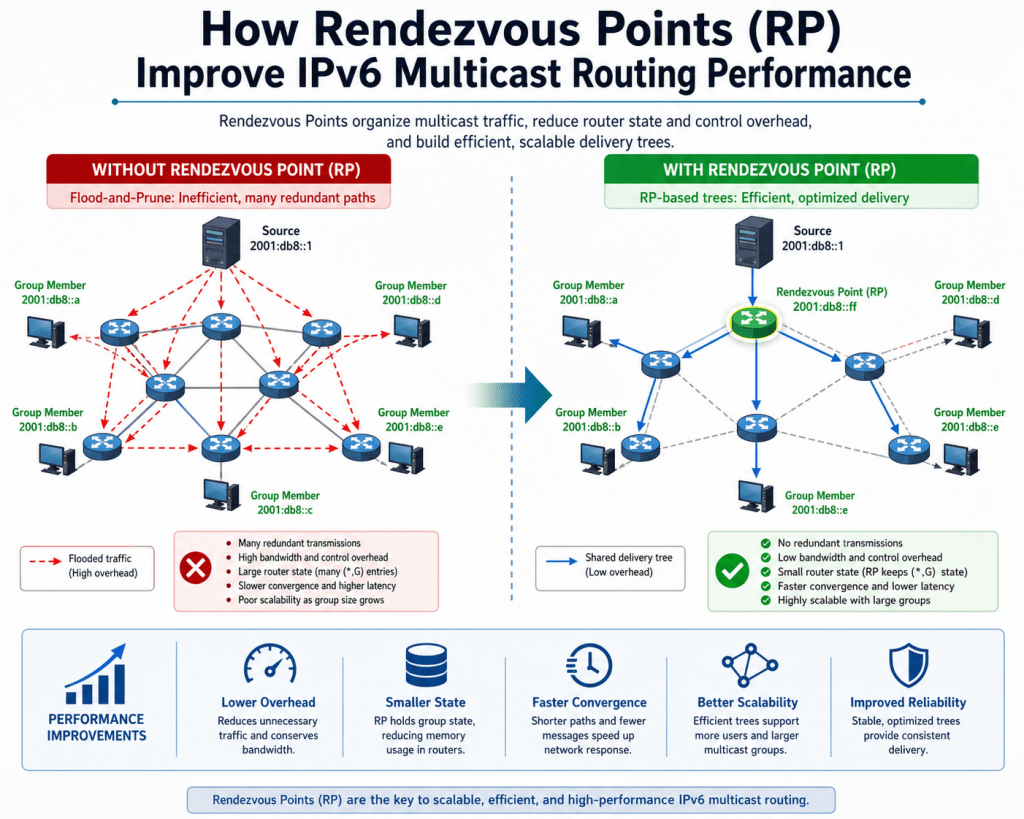
Multicast communication in IPv6 networks represents a structured method of delivering data from a single source to multiple receivers without unnecessarily duplicating traffic. Unlike unicast, where each recipient receives an individual copy of the data, multicast introduces the concept of shared delivery. This model is essential in environments where multiple devices require identical information simultaneously, such as streaming media, real-time analytics, or synchronized updates across distributed systems. IPv6 was designed with multicast as a core capability, replacing older broadcast mechanisms and improving efficiency across large-scale networks.
At its core, multicast is about optimizing resource usage. Every packet transmitted in a network consumes bandwidth, processing power, and memory in routers and endpoints. When the same data is sent repeatedly to different destinations, these resources are consumed unnecessarily. Multicast eliminates this inefficiency by allowing a single transmission to be replicated only where needed within the network infrastructure. This selective replication is what makes multicast scalable and suitable for modern high-demand applications.
Understanding the Shift from Unicast and Broadcast to Multicast
To fully appreciate IPv6 multicast, it is important to understand how it differs from earlier communication models. Unicast communication is straightforward: one sender communicates with one receiver. While this method is reliable and simple, it does not scale efficiently when multiple receivers require the same data. Each additional receiver increases bandwidth consumption on the source and across intermediate network paths.
Broadcast communication, on the other hand, sends data to every device within a network segment. This approach eliminates the need to manage individual recipients but introduces inefficiency by delivering data to devices that may not require it. Broadcast traffic can quickly overwhelm network segments, especially in large environments, leading to unnecessary load and reduced performance.
Multicast introduces a more intelligent alternative. Instead of sending data to all devices or duplicating it for each recipient, multicast sends a single stream to a group address. Only devices that have explicitly joined that group receive the data. This approach ensures that network resources are used only where there is demand. IPv6 eliminates traditional broadcast, reinforcing multicast as the primary method for one-to-many communication.
Multicast Group Addressing and IPv6 Structure
IPv6 multicast relies on a dedicated address space designed specifically for group communication. These addresses are easily distinguishable from unicast addresses and are used to identify specific multicast groups. Devices that wish to receive multicast traffic must join the relevant group address, signaling their interest in receiving the data stream associated with that group.
The structure of IPv6 multicast addresses includes information about scope, which defines how far the multicast traffic is allowed to travel. Scope can be limited to a single network segment, an organization, or a broader domain, depending on configuration. This prevents unnecessary propagation of multicast traffic beyond its intended boundary.
Multicast group membership is dynamic, meaning devices can join or leave at any time. This flexibility is essential in modern networks where demand for data streams may change frequently. Routers maintain awareness of group memberships and use this information to determine where to forward multicast traffic.
How IPv6 Multicast Routing Differs from Traditional Routing
Traditional routing focuses on determining the best path between a single source and a single destination. Multicast routing, however, must support one-to-many communication patterns. This requires a fundamentally different approach, where routers construct distribution trees rather than simple point-to-point paths.
These distribution trees ensure that multicast traffic is delivered efficiently to all interested receivers while minimizing duplication. Instead of sending multiple copies from the source, the network replicates packets only at branching points where paths diverge toward different receivers. This reduces overall bandwidth consumption and improves scalability.
IPv6 multicast routing builds on the existing unicast routing infrastructure. This means that before multicast can function effectively, the underlying unicast network must already be operational. Multicast routing does not replace unicast routing; it depends on it to determine optimal forwarding paths.
The Role of Protocol Independent Multicast in IPv6 Networks
Protocol Independent Multicast serves as the primary mechanism for enabling multicast routing in IPv6 environments. Its design allows it to operate independently of any specific unicast routing protocol. Whether a network uses OSPF, IS-IS, or static routing, PIM can function without modification. This independence makes it highly adaptable to diverse network architectures.
PIM does not maintain its own topology database. Instead, it relies on the existing unicast routing table to determine how to forward multicast traffic. This design simplifies configuration and reduces redundancy in routing information. By leveraging existing routing data, PIM ensures consistency between unicast and multicast forwarding paths.
One of the key advantages of PIM is its scalability. It is designed to support large networks with multiple routers and numerous multicast groups. By building distribution trees only when needed, PIM avoids unnecessary state maintenance in routers, improving overall efficiency.
PIM Sparse Mode and Its Importance in Multicast Design
Among the different operational modes of PIM, Sparse Mode is the most widely used in enterprise and service provider networks. This mode assumes that multicast receivers are sparsely distributed across the network. As a result, multicast traffic is only forwarded to segments where there is explicit interest.
In Sparse Mode, routers do not automatically flood multicast traffic. Instead, they wait for explicit join requests from downstream routers or hosts. This demand-driven approach ensures that multicast traffic is only delivered where it is needed, reducing unnecessary bandwidth usage.
PIM Sparse Mode is particularly effective in large networks where multicast groups may have relatively few subscribers compared to the total number of connected devices. It prevents unnecessary load on routers and links, making it suitable for scalable deployments.
Introduction to Multicast Listener Discovery in IPv6
Multicast Listener Discovery is a critical protocol that enables devices to communicate their interest in receiving multicast traffic. It operates between hosts and their directly connected routers, allowing routers to maintain accurate records of group memberships.
When a device wants to join a multicast group, it sends an MLD report message. This message informs the local router that the device wishes to receive traffic for a specific multicast address. The router then updates its forwarding state to include that interface for the relevant group.
MLD also supports periodic queries from routers to ensure that group membership information remains accurate. If devices no longer respond, routers can assume that there are no active listeners and stop forwarding traffic for that group. This dynamic mechanism ensures efficient use of network resources.
Why Multicast Efficiency Matters in IPv6 Architectures
The efficiency of multicast becomes especially important in environments where data must be delivered to many recipients simultaneously. Examples include live video streaming, financial data distribution, and large-scale system updates. In these scenarios, unicast communication would create significant redundancy and consume excessive bandwidth.
Multicast reduces this overhead by ensuring that only one stream of data is generated by the source. The network itself handles replication where necessary, distributing traffic efficiently across multiple paths. This reduces strain on the source device and improves overall network performance.
IPv6 enhances this efficiency by integrating multicast as a fundamental communication method rather than an optional feature. This design choice reflects the increasing importance of scalable data distribution in modern networks.
Conceptual Overview of Rendezvous Points in Multicast Networks
As multicast networks grow in size and complexity, coordinating communication between sources and receivers becomes more challenging. This is where rendezvous points play a critical role. A rendezvous point acts as a central meeting location within the network where multicast sources and receivers can connect.
Instead of requiring every router to know about every source, routers forward multicast join requests toward the rendezvous point. This simplifies the process of building distribution trees and reduces routing complexity. The rendezvous point serves as an anchor for shared multicast trees, ensuring that data flows efficiently from sources to receivers.
Rendezvous points are particularly important in PIM Sparse Mode, where multicast traffic is only forwarded when explicitly requested. They provide a structured mechanism for initiating multicast communication without requiring full network-wide knowledge of all sources.
Interaction Between Sources, Receivers, and Rendezvous Points
In a multicast environment, sources generate data streams while receivers express interest in those streams. The rendezvous point facilitates communication between these two entities. When a receiver joins a multicast group, its local router sends a join request toward the rendezvous point.
Similarly, when a source begins transmitting multicast traffic, it registers with the rendezvous point. This allows the rendezvous point to establish a connection between the source and all interested receivers. Once this connection is established, multicast traffic can flow efficiently through the network.
This interaction ensures that multicast distribution is both scalable and efficient. Instead of relying on direct source-to-receiver connections, the network uses a structured hierarchy that minimizes redundancy and optimizes delivery paths.
Building Efficient Multicast Distribution Trees in IPv6
Multicast distribution trees are fundamental to how IPv6 multicast routing operates. These trees define the paths that multicast traffic follows from sources to receivers. There are two primary types of trees: shared trees and source-specific trees.
Shared trees rely heavily on rendezvous points to coordinate traffic flow. In this model, all sources send their traffic to the rendezvous point, which then distributes it to receivers. This simplifies routing and reduces state complexity in the network.
Source-specific trees, on the other hand, create direct paths from sources to receivers. While more efficient in some cases, they require more routing state and are typically used after initial communication has been established through a shared tree.
The construction of these trees is dynamic and adapts to changes in network conditions and group memberships. This flexibility ensures that multicast routing remains efficient even in large and evolving networks.
IPv6 Multicast Routing Architecture and the Role of PIM in Scalable Networks
Multicast routing in IPv6 environments is built on a layered architecture where efficiency, scalability, and control converge to deliver data from one source to many receivers without unnecessary duplication. At the heart of this architecture is Protocol Independent Multicast, which provides the mechanism for constructing and maintaining multicast distribution trees across complex networks. Unlike traditional routing methods that focus on point-to-point communication, multicast routing must continuously adapt to dynamic group memberships and changing network topologies. This requires a flexible yet structured approach that can scale across enterprise and service provider environments.
The fundamental design principle behind IPv6 multicast routing is separation of concerns. Unicast routing determines reachability between network nodes, while multicast routing leverages that information to build optimized delivery paths for group-based communication. This separation allows multicast to operate independently while still relying on the stability of the underlying network infrastructure.
Deep Dive into PIM Neighbor Formation and Router Interaction
When Protocol Independent Multicast is enabled on IPv6 routers, the first step in establishing multicast functionality is neighbor discovery. Routers that support PIM begin exchanging control messages with directly connected neighbors to form adjacency relationships. These relationships are essential because they define how multicast routing information is shared across the network.
Once PIM neighbors are established, routers can exchange join and prune messages that determine how multicast traffic should flow. A join message indicates that a downstream router has interested receivers for a particular multicast group, while a prune message signals that no receivers exist on a given path. This dynamic interaction ensures that multicast traffic is only forwarded where necessary.
PIM adjacency is not dependent on a specific routing protocol. Instead, it relies on multicast-enabled interfaces and the presence of IPv6 unicast reachability. This means that routers running different unicast protocols can still participate in the same multicast domain as long as connectivity exists.
Understanding Reverse Path Forwarding in Multicast Routing
Reverse Path Forwarding is a critical mechanism that ensures multicast packets are forwarded correctly and efficiently through the network. RPF prevents routing loops and ensures that multicast traffic flows along optimal paths toward receivers. The principle is straightforward: a router will only forward a multicast packet if it arrives on the interface that the router would use to send unicast traffic back to the source.
This check ensures that multicast traffic follows the shortest and most logical path through the network. If a packet arrives on a non-RPF-compliant interface, it is discarded. This prevents duplicate transmissions and looping behavior, which could otherwise degrade network performance.
RPF plays a foundational role in both shared tree and source tree multicast models. In shared trees, it ensures that traffic flows toward the rendezvous point correctly. In source trees, it ensures that traffic follows the most efficient path directly from the source to the receivers.
Multicast Distribution Trees and Their Structural Behavior
Multicast distribution trees define the logical path that multicast traffic follows through the network. These trees are constructed dynamically based on group membership and routing information. There are two primary types of trees used in IPv6 multicast routing: shared trees and shortest path trees.
Shared trees are centered around a rendezvous point and are used during the initial stages of multicast communication. All multicast sources send their traffic to the rendezvous point, which then distributes it to receivers. This simplifies the initial setup and reduces the amount of routing state required in the network.
Shortest path trees, on the other hand, provide optimized direct paths between sources and receivers. Once a multicast stream is established through a shared tree, routers may switch to a shortest path tree to reduce latency and improve efficiency. This transition is known as tree switching and is a key optimization feature in multicast routing.
The Operational Mechanics of Rendezvous Points in IPv6 Networks
Rendezvous points serve as the central coordination mechanism for shared multicast trees. They act as meeting locations where sources and receivers converge before a more optimized distribution path is established. The rendezvous point maintains awareness of active multicast groups and coordinates the flow of traffic between participants.
When a receiver expresses interest in a multicast group, its local router sends a join message toward the rendezvous point. This message travels hop by hop through the network until it reaches the RP. Each intermediate router along the path updates its forwarding state to ensure that multicast traffic can flow back toward the receiver.
Similarly, when a source begins transmitting multicast data, it registers with the rendezvous point. This registration allows the RP to know where multicast traffic originates and how to distribute it to interested receivers. Once both sides are connected, multicast traffic begins flowing through the shared tree.
Encapsulation of Multicast State Information in IPv6 Routing Tables
Routers participating in IPv6 multicast maintain specialized state information that tracks group memberships, source addresses, and forwarding interfaces. This state information is distinct from unicast routing tables but closely integrated with them. Each multicast entry typically includes information about incoming interfaces (IIF) and outgoing interfaces (OIF).
The incoming interface represents the expected path toward the source, based on unicast routing. The outgoing interface list identifies all downstream interfaces where multicast traffic should be forwarded. This structure allows routers to make precise forwarding decisions without unnecessary flooding.
As group memberships change, multicast state entries are dynamically updated. When new receivers join, outgoing interfaces are added. When receivers leave, interfaces are removed. This continuous adjustment ensures that multicast routing remains efficient and accurate at all times.
Source Registration and the Role of Encapsulation in RP Communication
In many multicast deployments, sources must register with the rendezvous point before their traffic can be distributed. This registration process ensures that the RP is aware of all active sources within a multicast group. In some cases, encapsulation techniques are used to forward initial multicast packets from the source to the RP.
Encapsulation involves wrapping multicast packets inside unicast packets for transmission to the rendezvous point. Once the RP receives these packets, it decapsulates them and forwards them along the shared tree to the receivers. This mechanism allows multicast traffic to traverse parts of the network that may not yet have full multicast routing state.
This process is temporary and primarily used during the initial stages of multicast session establishment. Once the shared tree is fully formed, encapsulation is no longer necessary, and native multicast forwarding takes over.
Transition from Shared Trees to Source-Specific Optimization Paths
One of the key optimizations in multicast routing is the transition from shared trees to source-specific shortest path trees. While shared trees provide a simple and scalable way to establish initial communication, they are not always the most efficient for long-term traffic delivery.
As multicast traffic stabilizes, routers may choose to switch to a direct path between the source and receivers. This reduces latency and minimizes unnecessary routing through the rendezvous point. The decision to switch is typically based on traffic volume, network conditions, and policy configurations.
This optimization improves overall performance while maintaining the scalability benefits of shared tree construction. It represents a balance between simplicity and efficiency in multicast routing design.
Impact of IPv6 Multicast on High-Demand Network Applications
Multicast is particularly valuable in environments where large numbers of devices require simultaneous access to the same data. Examples include live streaming platforms, financial data feeds, software distribution systems, and real-time monitoring applications.
In these scenarios, unicast delivery would create excessive load on both servers and the network infrastructure. Multicast eliminates this inefficiency by ensuring that only one stream is generated and distributed intelligently across the network.
IPv6 enhances these capabilities by providing a large address space and built-in multicast support. This eliminates the need for legacy broadcast-based solutions and enables more scalable and predictable network behavior.
Network Convergence and Multicast Scalability Considerations
As networks grow in size and complexity, multicast routing must remain stable and scalable. One of the key challenges is maintaining consistent state information across all participating routers. This requires careful synchronization of group memberships, routing updates, and forwarding decisions.
Scalability is achieved through hierarchical design principles and efficient state management. Rendezvous points help reduce complexity by centralizing initial communication, while PIM ensures that routing decisions are distributed across the network.
Proper design of multicast domains is essential to avoid unnecessary overhead. This includes careful selection of rendezvous points, optimization of group scoping, and efficient use of routing resources.
Behavior of Multicast Traffic Under Network Failures and Path Changes
Multicast routing is designed to adapt to network failures and topology changes without disrupting active sessions. When a link or router fails, multicast routing protocols quickly recompute distribution trees to restore connectivity.
Because multicast relies on dynamic state rather than static paths, it can recover more quickly than traditional routing methods in many cases. New paths are established based on updated unicast routing information, ensuring continued delivery of multicast streams.
This resilience makes multicast suitable for mission-critical applications where uninterrupted data delivery is essential.
Hierarchical Design Principles in Large-Scale IPv6 Multicast Deployments
In large networks, multicast routing is often implemented using hierarchical design principles. This involves dividing the network into domains, each with its own routing policies and rendezvous point configurations.
Hierarchical design reduces complexity by limiting the scope of multicast state information. It also improves scalability by distributing routing responsibilities across multiple layers of the network.
Each domain can operate independently while still participating in global multicast communication when necessary. This flexibility is essential for large enterprises and service provider environments.
Evolution of Multicast Routing Strategies in IPv6 Ecosystems
Multicast routing continues to evolve as network demands increase. Modern implementations focus on improving efficiency, reducing state complexity, and enhancing convergence speed. Innovations in routing protocols and hardware acceleration are further improving multicast performance.
IPv6 provides a strong foundation for these advancements by integrating multicast as a core feature rather than an add-on. This ensures that future network architectures can continue to scale without requiring fundamental redesigns of communication models.
Optimized IPv6 Multicast Forwarding Behavior in Large-Scale Networks
IPv6 multicast forwarding is designed to handle complex, large-scale communication scenarios where multiple receivers require the same data stream simultaneously. Unlike traditional unicast routing, which creates individual paths for each destination, multicast forwarding constructs efficient distribution paths that minimize redundancy while maximizing delivery efficiency. In advanced network environments, this forwarding behavior becomes increasingly critical as applications demand low latency, high scalability, and consistent data distribution across geographically distributed nodes.
At the forwarding level, multicast routers make decisions based on group membership information, incoming interface validation, and routing state maintained through multicast protocols. These decisions ensure that packets are only forwarded along interfaces where interested receivers exist. This selective forwarding prevents unnecessary duplication of traffic and reduces congestion in backbone links. The design is especially important in IPv6 environments where multicast replaces legacy broadcast mechanisms entirely.
Multicast State Maintenance and Dynamic Routing Adaptation
One of the most important aspects of IPv6 multicast routing is the continuous maintenance of routing state information. Unlike static routing entries, multicast state is dynamic and changes frequently based on receiver activity. Every time a host joins or leaves a multicast group, routers must update their internal forwarding tables to reflect the new membership state.
This dynamic behavior ensures that multicast traffic is always delivered efficiently. When no receivers exist for a particular group on a given network segment, routers automatically prune that branch from the distribution tree. When new receivers join, the branch is reactivated, and traffic begins flowing again. This constant adaptation allows multicast networks to remain efficient even in highly variable environments.
The state maintained by routers includes information about source addresses, group memberships, and interface mappings. This information is critical for ensuring correct forwarding behavior and preventing unnecessary traffic propagation.
Advanced Role of Rendezvous Points in Source Coordination
Rendezvous points serve as central coordination nodes in shared tree multicast architectures. Their primary role is to facilitate communication between multicast sources and receivers in a structured and scalable manner. Instead of requiring direct knowledge of all sources across the network, routers rely on the rendezvous point as a central reference for group communication.
When a multicast source begins transmitting data, it registers with the rendezvous point. This registration process allows the RP to maintain awareness of active sources within a multicast group. Similarly, when receivers join a group, their requests are directed toward the RP, which ensures that traffic is properly distributed.
The rendezvous point effectively acts as an aggregation and distribution hub. It does not necessarily forward all traffic permanently, but it plays a crucial role in establishing initial communication paths. Once these paths are established, routers may optimize traffic flow by switching to more direct routing methods.
Hierarchical Multicast Distribution and Scalability Engineering
Large-scale IPv6 multicast networks rely heavily on hierarchical design principles to maintain scalability. In such environments, the network is divided into multiple layers, each responsible for handling multicast traffic within its domain. This hierarchical structure reduces the complexity of routing state management and improves overall efficiency.
At the top level, rendezvous points coordinate inter-domain multicast communication. At lower levels, local routers manage group membership and forwarding decisions within their specific network segments. This layered approach ensures that multicast traffic does not overwhelm any single point in the network.
Hierarchical multicast design also improves fault isolation. If one segment of the network experiences issues, multicast traffic can continue flowing in other segments without disruption. This resilience is essential in enterprise and service provider environments where uptime and reliability are critical.
Multicast Routing Convergence and Network Stability Mechanisms
Convergence in multicast routing refers to the process by which the network adapts to changes such as link failures, topology updates, or group membership modifications. Fast convergence is essential to ensure uninterrupted delivery of multicast streams, especially in real-time applications.
When a network change occurs, multicast routing protocols quickly recompute distribution trees using updated unicast routing information. This allows traffic to be rerouted along alternative paths without significant delay. In many cases, convergence occurs within seconds, minimizing disruption to active multicast sessions.
Stability is achieved through careful control of routing updates and state synchronization. Routers exchange periodic control messages to ensure that all nodes in the multicast domain maintain consistent views of group memberships and routing paths.
Interaction Between IPv6 Unicast Routing and Multicast Forwarding Logic
IPv6 multicast routing is tightly coupled with unicast routing infrastructure. While multicast handles group-based communication, unicast routing provides the foundation for determining reachability between network nodes. This relationship is essential for constructing accurate multicast distribution trees.
Routers use unicast routing tables to determine the reverse path toward multicast sources. This ensures that multicast packets follow optimal paths and do not enter routing loops. The reverse path forwarding check is a critical component of this process, validating that each incoming packet arrives on the expected interface.
Because multicast depends on unicast routing, any changes in the unicast topology directly impact multicast behavior. This tight integration ensures consistency across the network but also requires careful coordination during network design and optimization.
Efficient Handling of Multicast Group Membership Changes
Group membership in IPv6 multicast networks is highly dynamic. Devices frequently join and leave multicast groups based on application requirements. Efficient handling of these changes is essential for maintaining optimal network performance.
When a device joins a multicast group, it sends a membership report to its local router. This triggers an update in the multicast forwarding state, ensuring that traffic for that group is delivered to the correct interface. Similarly, when a device leaves a group, the router removes the associated forwarding entry if no other receivers are present.
To prevent excessive control traffic, routers periodically verify group membership using query mechanisms. This ensures that stale entries are removed and that forwarding state remains accurate. This dynamic lifecycle management is a key factor in multicast efficiency.
Multicast Traffic Optimization Through Tree Switching Techniques
One of the advanced optimization techniques in IPv6 multicast routing is tree switching. Initially, multicast traffic flows through a shared tree rooted at the rendezvous point. While this approach is efficient for establishing communication, it is not always optimal for long-term data delivery.
As traffic stabilizes, routers may switch from the shared tree to a source-specific shortest path tree. This transition reduces latency by establishing a direct path between the source and receivers. It also reduces load on the rendezvous point, allowing it to focus on coordination rather than data forwarding.
Tree switching is typically triggered based on traffic thresholds or policy configurations. Once the switch occurs, multicast traffic bypasses the rendezvous point and flows directly through the optimized path. This improves performance while maintaining scalability.
Load Distribution and Traffic Engineering in Multicast Networks
Multicast routing inherently supports efficient load distribution by replicating traffic only where necessary. However, advanced network designs often incorporate additional traffic engineering techniques to further optimize performance.
Traffic engineering involves controlling how multicast streams are distributed across available network paths. This can include selecting preferred routes, balancing load across multiple links, and avoiding congested segments. These techniques ensure that multicast traffic does not overwhelm any single part of the network.
Rendezvous points play an important role in traffic engineering by serving as central coordination points. They help determine initial distribution paths and can influence how multicast trees are constructed across the network.
Failure Recovery and Redundancy in IPv6 Multicast Systems
Network resilience is a critical requirement for multicast deployments. IPv6 multicast routing includes built-in mechanisms for detecting failures and recovering quickly without disrupting active sessions.
When a link or router fails, affected multicast trees are automatically recalculated using alternative paths. This ensures that receivers continue to receive traffic even in the presence of network disruptions. Redundancy is achieved through multiple possible distribution paths within the network topology.
In some designs, multiple rendezvous points may be configured to provide additional redundancy. If one RP becomes unavailable, another can take over coordination responsibilities, ensuring continuity of multicast services.
Multicast Security Considerations in IPv6 Environments
Security is an important aspect of multicast routing, particularly in large-scale or public-facing networks. Because multicast traffic is distributed to multiple receivers, controlling access to multicast groups is essential.
Access control mechanisms are often used to restrict which devices can join specific multicast groups. This prevents unauthorized access to sensitive data streams. Additionally, routers may implement filtering policies to control which multicast traffic is allowed to traverse certain network segments.
Authentication and verification mechanisms ensure that only legitimate devices participate in multicast communication. These security measures help protect the integrity of multicast streams and prevent misuse of network resources.
Multicast Performance Tuning and Infrastructure Optimization
Optimizing multicast performance involves fine-tuning various aspects of the network, including routing protocols, interface configurations, and group management policies. Proper configuration ensures that multicast traffic flows efficiently and reliably across the network.
Key optimization techniques include minimizing unnecessary state information, reducing control message overhead, and ensuring efficient path selection. Network administrators must carefully balance scalability with performance to achieve optimal results.
Hardware acceleration in modern routers also plays a significant role in improving multicast performance. Dedicated forwarding engines can handle multicast replication more efficiently than software-based processing, reducing latency and improving throughput.
Integration of IPv6 Multicast with Modern Network Architecture
IPv6 multicast is increasingly integrated into modern network architectures, including cloud environments, distributed systems, and edge computing platforms. These environments rely heavily on efficient data distribution mechanisms to support real-time applications and large-scale data processing.
Multicast provides a foundation for these systems by enabling efficient one-to-many communication. Its integration with IPv6 ensures compatibility with modern addressing schemes and eliminates reliance on outdated broadcast-based methods.
As network architectures continue to evolve, multicast will remain a critical component for scalable data distribution, particularly in environments where performance and efficiency are essential.
Conclusion
IPv6 multicast routing, with its reliance on structured forwarding mechanisms, rendezvous points, and protocol-independent design principles, represents one of the most efficient approaches to modern network communication. Across large-scale infrastructures, the need to distribute identical data streams to multiple receivers is no longer a rare requirement but a standard operational demand. Applications such as live video distribution, real-time analytics, financial data feeds, and large-scale system synchronization all depend on the ability of the network to replicate and deliver traffic intelligently without overwhelming bandwidth resources. Multicast achieves this by shifting replication responsibility away from the source and distributing it strategically across the network topology.
The evolution from unicast-heavy architectures to multicast-optimized designs highlights a fundamental shift in how network engineers approach scalability. In unicast communication, each additional receiver introduces a proportional load on the sender and the network. This linear growth model quickly becomes unsustainable in environments with hundreds or thousands of endpoints. Broadcast communication, while simpler, introduces its own inefficiencies by delivering traffic to all nodes regardless of interest. IPv6 multicast resolves both limitations by introducing group-based delivery, where only subscribed devices receive traffic, and replication occurs only where necessary within the routing infrastructure.
At the center of this system lies the concept of structured coordination through rendezvous points. These nodes serve as logical aggregation points where sources and receivers meet indirectly through routing mechanisms. Instead of requiring every router to maintain awareness of every source, the rendezvous point provides a simplified reference structure that reduces complexity and improves scalability. This abstraction allows multicast networks to grow without overwhelming routing tables or control plane resources. It also enables a clear separation between control signaling and data forwarding, which is essential for maintaining efficiency in large deployments.
Protocol Independent Multicast further strengthens this architecture by decoupling multicast functionality from any specific unicast routing protocol. Whether a network relies on OSPF, IS-IS, or static routing, multicast can operate consistently as long as underlying reachability exists. This independence is a critical design advantage because it ensures multicast can be deployed across heterogeneous environments without requiring major changes to existing infrastructure. By leveraging unicast routing tables for reverse path validation and forwarding decisions, PIM maintains alignment between multicast and unicast topologies, ensuring consistency in packet delivery.
Another important aspect of IPv6 multicast efficiency is its reliance on dynamic state management. Unlike static routing configurations, multicast routing is continuously adjusted based on real-time group membership changes. Devices join and leave multicast groups dynamically, and routers respond by updating forwarding states accordingly. This ensures that traffic is only delivered where it is actively needed. The use of mechanisms such as Multicast Listener Discovery enables routers to maintain accurate awareness of receiver interest without excessive overhead. This dynamic adaptability is what allows multicast to function efficiently in highly variable environments.
The role of distribution trees in multicast routing cannot be understated. These logical structures define how traffic flows from sources to receivers across the network. Shared trees provide a scalable mechanism for initial communication, while shortest path trees offer optimized delivery once traffic patterns stabilize. The ability to transition between these models ensures that multicast can balance simplicity and efficiency depending on operational requirements. This adaptability is particularly valuable in environments where traffic patterns evolve or where latency sensitivity is a concern.
Scalability remains one of the most significant advantages of IPv6 multicast. As networks grow, multicast continues to perform efficiently because it avoids redundant data transmission and minimizes state overhead through intelligent routing decisions. Hierarchical network design further enhances this scalability by distributing responsibility across multiple layers, preventing any single router or domain from becoming a bottleneck. This distributed approach ensures that multicast systems can expand to support large enterprise environments and global service provider infrastructures without degradation in performance.
Reliability and resilience are also integral to multicast design. When network failures occur, multicast routing protocols quickly recompute distribution paths using updated unicast information. This allows traffic to be rerouted with minimal disruption, maintaining continuity of service for receivers. Redundant paths and multiple possible forwarding routes ensure that multicast streams remain available even in the presence of link or node failures. In some advanced designs, redundant rendezvous points further enhance fault tolerance by providing backup coordination mechanisms.
Security considerations are equally important in multicast deployments. Because multicast traffic is inherently distributed, controlling access to group communication is essential. Mechanisms such as group filtering, access control policies, and authentication frameworks help ensure that only authorized devices participate in multicast communication. These safeguards protect sensitive data streams and prevent unauthorized consumption of network resources. As multicast continues to be used in enterprise and service provider environments, security remains a critical design consideration.
Performance optimization in multicast networks often involves fine-tuning routing behavior, reducing unnecessary control traffic, and leveraging hardware acceleration where available. Modern networking equipment is increasingly capable of handling multicast replication at line rate, which significantly improves throughput and reduces latency. Careful configuration of multicast protocols ensures that traffic flows efficiently across the network while avoiding congestion or unnecessary processing overhead.
In modern network architectures, IPv6 multicast plays a foundational role in enabling scalable, efficient communication. Its integration into cloud environments, edge computing systems, and distributed applications demonstrates its continued relevance in evolving technology landscapes. As data consumption patterns continue to shift toward real-time and multi-recipient delivery models, multicast provides a robust and future-ready solution.
Ultimately, IPv6 multicast routing, supported by rendezvous points and protocol-independent mechanisms, represents a mature and highly optimized communication model. It addresses the fundamental challenges of scalability, efficiency, and adaptability in modern networks. By combining intelligent routing, dynamic state management, and hierarchical design principles, multicast ensures that data can be delivered reliably to large numbers of receivers without unnecessary overhead. This makes it an essential component of contemporary network engineering and a critical enabler of next-generation communication systems.